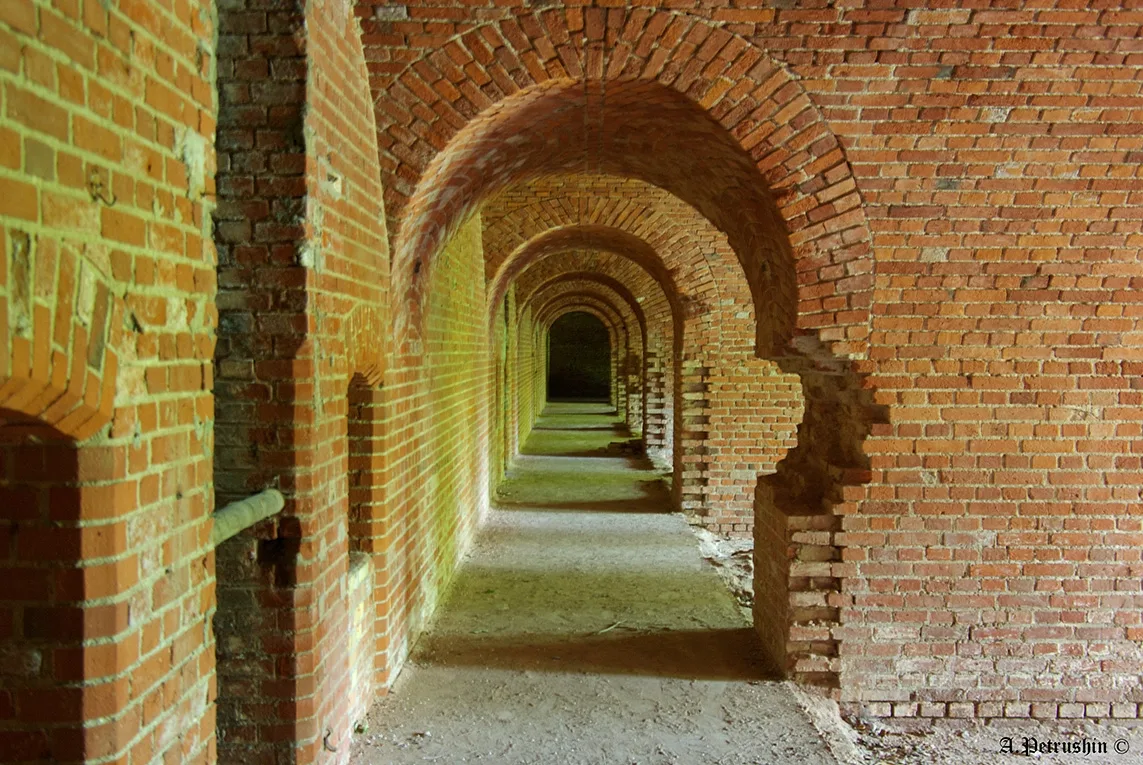
What, then, is a fort?
So that everything written below needs no further explanation, let us run very briefly through the basic concepts of the fort and the fort fortress. A fort, then, is a structure designed for long-term, self-sufficient defence. It follows that a fort must be of considerable size to accommodate a sufficient number of garrison troops. It must be suited to all-round defence and have massive walls and roofs so as not to be destroyed in a short time. It is equally clear that, besides its combat rooms, a fort must have a spacious arsenal, food stores, reserves of fuel and water, and a self-contained life-support system.
The part of the fort facing the front is called the field side. The elements of the fort on the field side are likewise called field elements: the field rampart, the field caponier, the field barracks and so on. The opposite part of the fort is called the gorge (the gorge of the fort), and to the left and right lie the flanks of the fort.
An important element of the fort are the caponiers – casemated rooms at the level of the moat that allow the moat to be swept with enfilading fire (“flanking the moat”). If a caponier is designed to sweep the moat in both directions, it is called a full caponier or simply a caponier; if the moat is covered from it in one direction only, it is a demi-caponier.
An underground gallery of the fort, well protected by earth and stone, is called a postern. Sometimes only the galleries leading from the gorge towards the field side are called posterns, while those running from flank to flank are simply called galleries.
The moat around the fort has two walls: the one farther from the fort itself is called the counterscarp, and the nearer one the escarp. In front of the moat lies an empty, easily swept space – the glacis. It slopes towards the enemy, and the gradient is chosen so that bullets and shells “skim” along the glacis, as it were, making it unnecessary to change the sights as the enemy approaches.
Now, armed with knowledge of the main elements of a fort, let us turn to the history of how they came about.
The Empire demands new fortresses
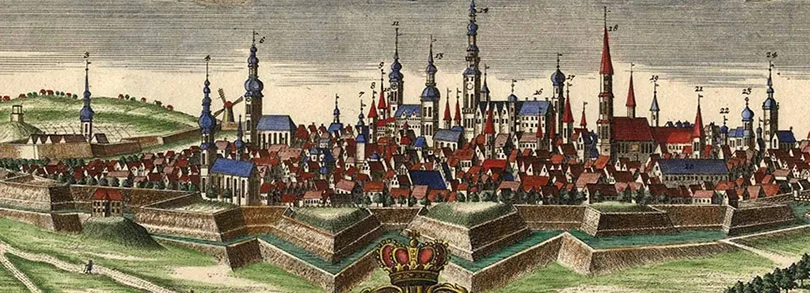
In 1862 the construction of Königsberg’s second rampart ring was completed; parts of it survive to this day in the form of the city gates, the rampart works along Litovsky Val Street and in Yuzhny Park, and the reduit of the Astronom Bastion on Gvardeysky Prospekt. When they began building this colossal structure, the fortification engineers relied on the experience of the wars against Napoleon but failed to take into account how rapidly artillery would develop in those years. While the new bastion belt was being built, Europe’s gunmakers mastered the production of rifled breech-loading guns, which had a far greater range and a heavier projectile than smoothbore artillery. The guns’ rate of fire increased as well. As a result, the fortress, designed as first-class, did not by the end of construction meet the main requirement the military demanded of it: it was incapable of holding the enemy at such a distance that he could not shell the city centre. And it was no longer possible to overcome this shortcoming by any modernisation of the existing fortifications. What the decision would have been is unknown, but then, at Prussia’s borders far from Königsberg, the Franco-Prussian War of 1870–71, so fateful for the country, broke out. And so the question of the Königsberg fortress was simply postponed for the time being.
That very war not only gave birth to a powerful new European state – the German Empire; its course and outcome also forced a rethinking of all existing fortification solutions. So what had happened there?
What happened was that for the first time in many years the attacking side (Prussia) had to conduct full-scale operations to take enemy fortresses. Many fortresses defended themselves for quite a long time and stubbornly, yet they did not fulfil all the tasks assigned to them. The fortress of Strasbourg surrendered on the 52nd day of the siege, although its position was not hopeless. But the city authorities, tired of the constant artillery bombardment of residential districts, forced the commandant to raise the white flag. The fortress of Toul surrendered for the same reason, but only 10 hours after the assault began. The fortresses of Metz and Paris had huge garrisons of 140,000 and 400,000 soldiers, but the enormous armies quickly exhausted their food supplies and were therefore forced to capitulate. Thus two conclusions naturally followed from the French campaign: the need to prevent by any means the enemy artillery from striking the residential districts of a fortress city, and the inadmissibility of using a fortress as a large army barracks. A fortress should retain a garrison sufficient for its defence, while the field units are meant to cover the fortress from outside its perimeter.
These conclusions, and above all the fact that the German Empire had now acquired not only the status of a leading European power with far-reaching plans but also the potential enemies inevitable with such plans, forced the German military authorities to tackle questions of fortress construction in haste. Of 50 fortresses, 14 were abolished. But of the remaining 36, as many as 29 were to undergo thorough modernisation. Königsberg was among them. The task was made somewhat easier by the huge indemnities that defeated France paid to the young German Empire, and by Germany having free labour in the form of half a million French prisoners of war.
The modernisation of the Königsberg fortress was among the priority tasks, since a cooling of Russian-German relations was anticipated. This was expected because Germany, in the person of Bismarck, had no intention of keeping the promises given in exchange for neutrality in the Franco-Prussian War – to help repeal the provisions of the Treaty of Paris that restricted Russia’s presence in the Black Sea region.
A first-rank fortress
The idea of the new fortresses was as follows: at a distance of 5–7 km from the old fortress enceinte, a ring of forts is built – powerful, fortified, permanent artillery positions. The field units are deployed in the intervals between the forts. The task of the resulting fort fortress is thus reduced to holding the enemy at a distance of 2–5 km from the line of forts, and if the defensive line is breached, the forts defend themselves independently, holding back superior enemy forces. In that time the army is to move reserves to the breakthrough sector and restore the situation in the theatre of operations. Successful resistance by the forts to the enemy’s siege artillery was to be achieved through the qualitatively better position held by the fort’s garrison, which will be examined in more detail below.
And so, as early as 1871, the German inspector general of fortresses, Kameke, set the engineering committee the task of designing a fort that would become the basis for all German fort fortresses. The design was to take into account the lessons of the recent war: the fort had to be extensive and accommodate a considerable garrison and artillery armament, as well as everything necessary for long-term defence in complete isolation. The fort’s roofs were to have a masonry thickness of at least 1 metre, and the earth cover was to reach a thickness of 5 m instead of the previously accepted 1.8 m. Remarkably, the German fortification engineers turned for advice on the placement of the artillery to the famous Russian military engineer Eduard Ivanovich Totleben. And together with him the concept was worked out of distributing the fortress’s main artillery among field positions next to the forts and in the intervals between them. Thus, already at the end of the 19th century, while the forts were being built, the importance of artillery positions directly on the forts’ grounds became secondary. This is an important point that allows us to grasp the true role of the Königsberg forts during their storming in April 1945.
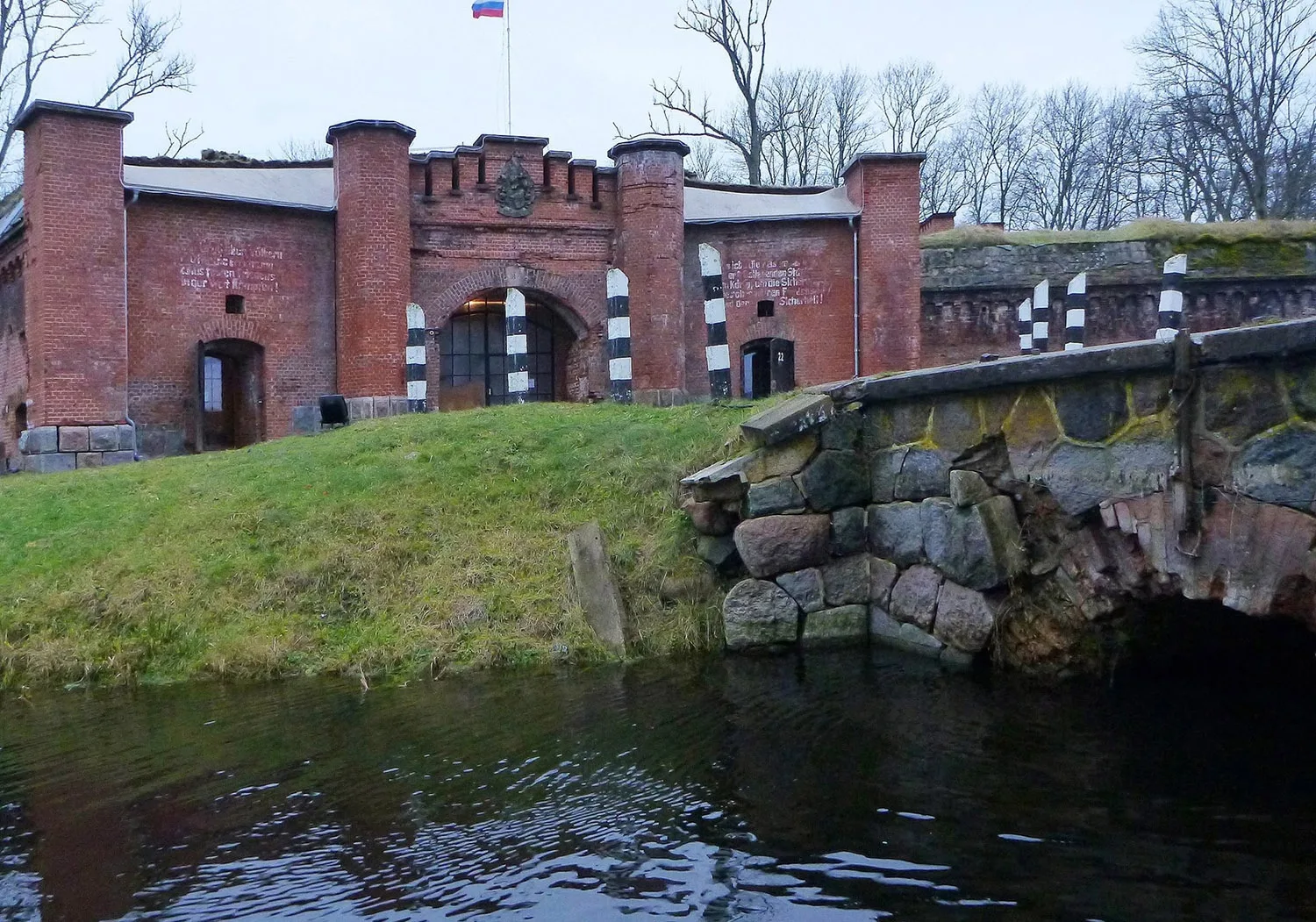
 The main entrance to Fort No. 3 “König Friedrich III”.
Construction of Fort No. 3, named “Quednau” after its location, had already been under way for two years when the design of the German standard fort was finally ready. This was probably the reason why Fort No. 3 turned out larger and more elaborate than all the others. All the other large forts (except Fort No. 7), on the other hand, were exactly those “German standard forts”, no ifs or buts.
Standard – yet no two were exact copies of each other. Differences could still be found in the type of moat (wet or dry), in the design of the gorge barracks (number of storeys and different plans), and in the layout of individual rooms. Fort No. 7 differed greatly in shape from the others: with a shortened gorge and no caponiers, it was close in form to a regular pentagon. At first the forts were named after their locations: I – “Lauth”, II – “Neudamm”, III – “Quednau”, IV – “Beydritten”, V – “Charlottenburg”, VI – “Marienburg” (or “Juditten”), VII – “Holstein”, VIII – “Kalgen”, IX – “Hoch Karschau” or “Ponarth”, X – “Schönfließ” (or “Altenberg”), XI – “Seligenfeld”, XII – “Neuendorf”. Soon, however, they were renamed in honour of members of the Hohenzollern dynasty and of Prussian noble families renowned for their military merits. The new names were: I – “Stein”, II – “Bronsart”, III – “König Friedrich III”, IV – “Gneisenau”, V – “König Friedrich Wilhelm III”, VI – “Königin Luise”, VII – “Herzog von Holstein”, VIII – “König Friedrich I”, IX – “Dohna”, X – “Canitz”, XI – “Dönhoff”, XII – “Eulenburg”. The forts were invariably connected to each other by a road, for it was already clear then that the manoeuvring of troops was acquiring particular importance for any military operation. The finishing touch in building the ring of forts was the construction of three small forts, Ia, IIa and Va, which were given names straight away: “Gröben”, “Barnekow” and “Lehndorff”.
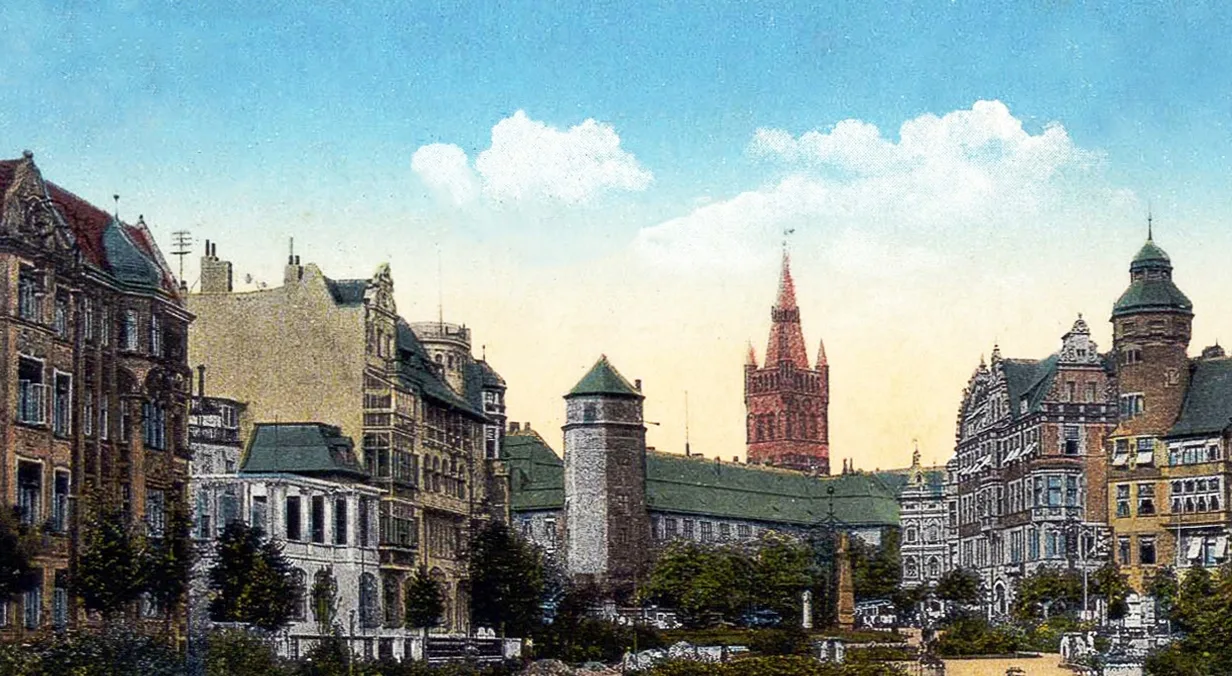
Königsberg now had two defensive rings – an outer and an inner one. In terms of the area it covered and the strength of its fortifications, Königsberg became one of the largest fortresses of its era. And so it received the resounding status of a first-rank fortress.
Building a fort – nothing to it
The idea of a standard fort solved a host of problems. The standard is always cheaper than the original. For standard work it is easier to train engineers and builders, and for a standard garrison, soldiers. Their training can begin even before the fort is built, at another, similar site. The German standard fort had one more clever technical feature: its construction required neither bringing in nor carting away soil. The earth cover was made with the soil excavated when digging the moat and the inner courtyards. The original thickness of the brick walls and roofs was at least 1 m.
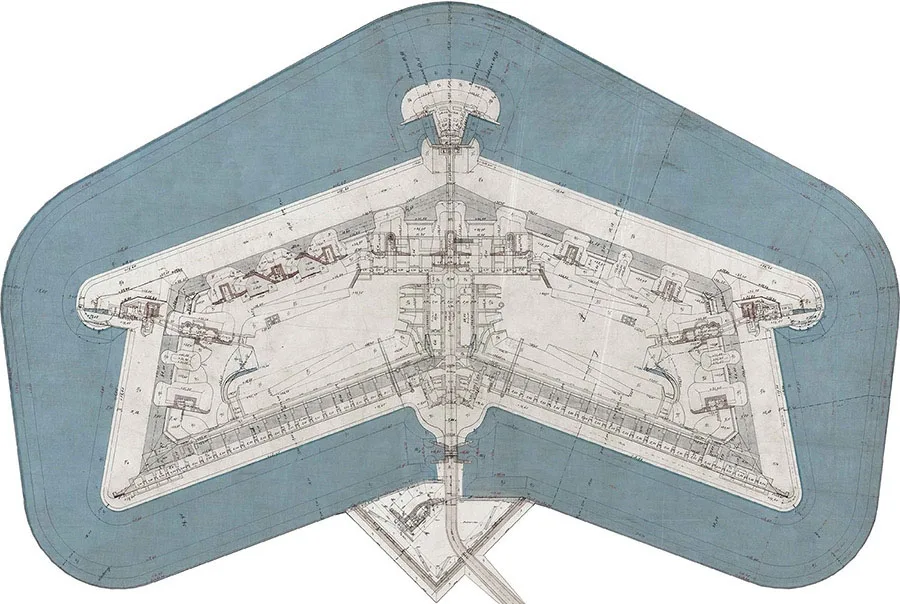 Original plan of Fort No. 11 “Dönhoff”.
The layout of the fort is fairly simple. If you look at the plan of the fort, you will see that it consists of two ramparts – the field rampart and the gorge rampart – inside which lie the barracks of the same names. The field barracks contained the combat rooms, the gorge barracks the living quarters. Of course, in all-round defence every room became a combat room. From the gorge to the field rampart runs the well-earthed main (central) postern (ЦП), which begins at the fort’s only entrance (Вх). The postern separates the left and right courtyards (ЛД and ПД). During an assault, the field caponier (НК) and the two demi-caponiers (ЛПК and ППК) take on a special role. The caponiers housed 3.7 cm rapid-fire revolver cannons, which successfully defended the moat against an enemy who had broken through. Flanking of the moat on the gorge side was done in various ways. On the plans it is provided by the gorge barracks with their bastioned trace and by the entrance building, which acts as a gorge caponier. Sometimes additional gorge demi-caponiers were used on the flanks instead of a bastioned trace, and sometimes flanking from a single gorge caponier sufficed.
So what was the advantage of an artillery position on the fort’s field rampart over the enemy’s position in the field in front of the fort? The fort’s guns stood 4–6 m above the level of the glacis, and up to 20 m above the enemy.
Thus, with the enemy within range of flat-trajectory fire, the fort had an advantage in range of several hundred metres. But it all began earlier, when the enemy approached to within some 5–7 kilometres of the line of forts. A gun position on the fort allowed both flat-trajectory and high-angle fire, the latter giving the maximum range. An artillery duel at such distances also gave the advantage to the fort. Its garrison’s gunners received precise target designation, since from the height of the fort’s rampart the terrain lay spread out before them like the palm of a hand; besides, all the main reference points had been ranged in advance. The attacking enemy, on the other hand, firing heavy guns at high angles, had a very poor idea of where his shells were landing, since a hit in the moat in front of the fort, in the inner courtyard or in the moat behind the fort produced similar pictures of shell bursts for an observer. That made it much harder for the attacking side to correct its fire for range. Now imagine a battery of heavy guns firing one salvo every 2–4 minutes. Ranging could therefore take quite a long time. And when the position was changed – as it was easily covered by fire from the fort – ranging had to be done all over again.
An advantage in position and protection – that is the main idea of the fort.
Meanwhile, the fort as an artillery position also had a host of drawbacks, some of which were present from the outset while others made themselves felt later. Since the fort’s guns were exposed to high-angle fire, once the enemy’s field artillery had ranged in on the fort, its fire caused heavy losses in guns and gun crews. When the means of counter-battery fire developed, an object such as a fort could be blanketed by medium-calibre artillery within a few minutes. This put the guns out of action and made it impossible to bring reserve guns into position.
Thus the fort was put out of the fight without the casemate roofs being penetrated, solely through massed fire from far from the most powerful weapons. This shortcoming was overcome by building so-called armoured-turret forts, whose artillery was mounted in armoured turrets that field artillery could not penetrate and that heavy siege artillery could damage only under a whole series of favourable circumstances. But in Königsberg the forts had no such armoured elements, except for an armoured observation cupola. Through its embrasures the fort’s command could monitor the situation without risk to itself, but only to the fort’s front. Such cupolas were installed on Forts No. 2, 3, 5, 6, 10, 11.
The eternal struggle of shield and sword
The forts began to be modernised literally right after they were built. The reason for the need to modernise was, once again, the growing power of artillery. No sooner had all 12 large forts entered service than the appearance of new high-explosive shells and guncotton powder called the effectiveness of the new fortress structures into question. Firing trials at proving grounds showed that a metre-thick brick vault was no obstacle for the new guns of special power. The shell penetrated up to 5 m into the ground before exploding. And even if the brick vault under the earth rampart was not destroyed, the powerful shock wave knocked off a multitude of brick fragments from the inner side of the brick roof, which struck the men sheltering in the casemates. But even a complete penetration of such a roof became the rule rather than the exception.
The second problem the fortification engineers faced was the increased firing range of artillery. Standing 5–7 km from the fortress enceinte, the fort could no longer guarantee the protection of the city districts from enemy fire.
The third aspect we have already mentioned – the vulnerability of the artillery on the fort’s ramparts. And the fourth trouble was that a fort designed for all-round defence became a “stone trap” for its garrison as soon as the enemy blocked the fort’s only entrance. Getting out of it was no easier than getting in.
In other words, a blockaded fort was left only with passive defence, with no possibility of sorties or of breaking the blockade with the garrison’s own forces. And the fort’s garrison could not even help relief troops hurrying to its aid.
The first shortcoming identified was overcome relatively easily: the fort’s casemates were modernised. The brick structures were covered with a metre-thick layer of sand. On top of that a layer of concrete, also one metre thick, was laid. After that the earth cover was restored. In this way all the important rooms and structures of the fort were reinforced. In secondary rooms, and wherever a sand-and-concrete cushion was impossible, the brickwork was merely protected from the inside with corrugated metal. A thin layer of sand was placed between the brick and the metal. This arrangement was called splinter protection, as it served to prevent brick fragments from forming inside the room.
The increased range of siege artillery was to be neutralised by strengthening the field counter-batteries, which were to quickly detect and suppress the enemy guns shelling the city.
The third solution was fatal for the leading role of the forts in the city’s defence. It was decided to remove all large-calibre artillery from the forts. Now it was placed only on batteries adjoining the fort and in field positions. Of course, this did not make the guns any better protected, but they were now harder to detect, and if detected, the position could be changed quickly. Somewhat later the medium-calibre artillery also left the fort ramparts. Only the revolver cannons in the caponiers remained, to protect the fort itself against assault.
The fourth issue was resolved less radically, by installing an additional blockhouse on some forts to cover the entrance. The effectiveness of this measure, frankly, looks doubtful.
Analysing the changes made, one can see that they were the death throes of the very idea of the fort fortress and of fortress building in general. Its main component – the fort – could be further reinforced and earthed over, but its role as the key node of defence was steadily being lost.
The fort was inevitably turning into a blind bunker capable, at best, of defending itself for a while. And although the forts were still in service at the start of the First World War, their time had passed. Huge armies required equally vast fortified areas. The most dangerous directions from which an attack might be expected were now blocked by echeloned permanent defensive lines (such as the Maginot Line, for example). And if the old fort fortresses found a place in them at all, it was only as one element, and far from the most reliable.
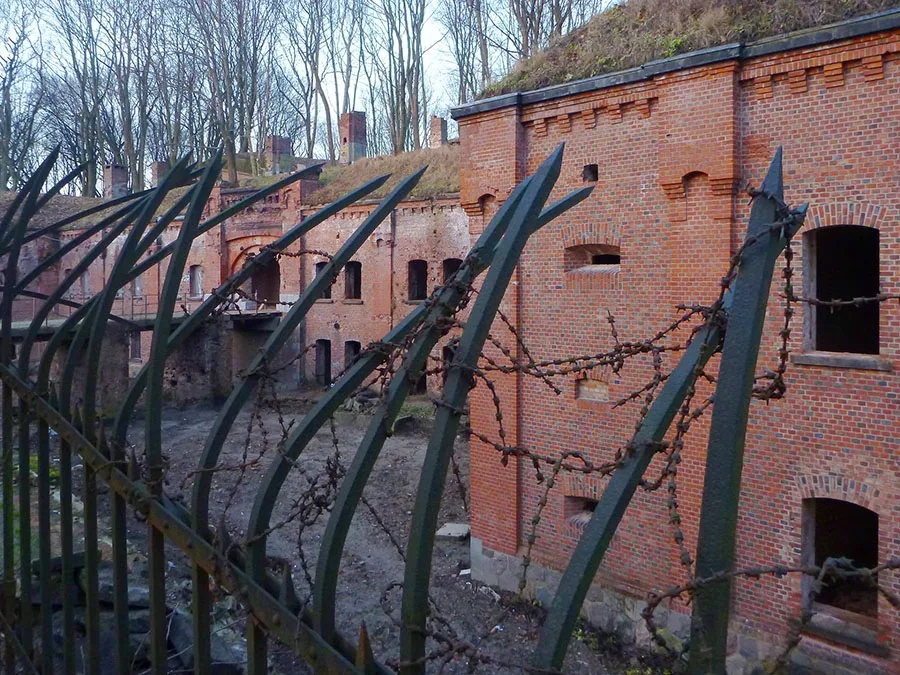
Before the end of the 19th century a few more changes were made to the forts: where the moat allowed it, casemated rooms – counterscarp galleries (coffers) – were built into its counterscarp. They were connected to the central postern by underground passages beneath the moat. The purpose of the coffers was the same as that of the caponiers – to sweep the moat with flanking fire. Only the coffers had the advantage that, until the enemy’s soldiers were in the moat, they could not fire on them in any way and thus make their assault easier. In addition, the moat was fitted with an anti-assault grille with strong, sharp spikes.
And a little later the forts were electrified. There was both an external and an autonomous power supply.
The Old Guard rushes into battle
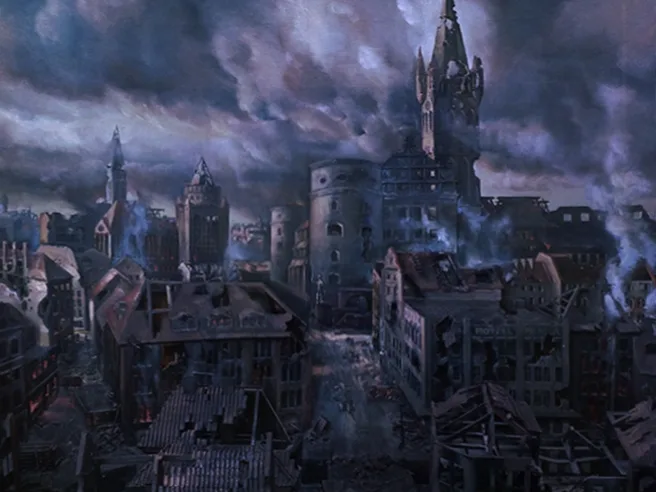
And yet it happened. The forts of Königsberg, seemingly already pensioned off, were called up once again into the active army. In early 1945, when a wave of fire and steel rolled across East Prussia and reached its very capital within two weeks, Königsberg, for the first time since the uprising of the pagan Prussians in 1260, did not strike its flag before an advancing enemy. The commandant of the besieged fortress city, General Otto Lasch, received unequivocal instructions to defend the capital of East Prussia to the last defender. But, unlike the Führers of various calibres who issued such orders, he was a military man and therefore understood that, in the situation as it stood, the interval between the death of the fortress’s first defender and that of its last might not prove all that long. In effect, Red Army units could have joined battle for the city straight off the march. At the very end of January 1945 chaos reigned in the city, and the defence had not been properly prepared. Things were heading towards a confrontation, with unpredictable losses, between an unprepared defence and an unprepared assault...
But the Soviet command, in the person of Marshal Vasilevsky and his staff, chose the most balanced decision: to encircle the city and to begin the assault only after thorough preparation and after making good the losses in the armies of the 3rd Belorussian Front assigned to storm the city.
The resulting pause allowed the commandant of the besieged city to take full control of the situation. Judging by his memoirs, Otto Lasch was no rabid Nazi ready to die without blinking just because the Führer so wished. Yet for a number of reasons Lasch could not act against Hitler’s will either and surrender the city without a fight. His memoirs of the events of those days are full of notes of hopelessness and doom. But it seems he still did not lose hope that the city would remain a besieged citadel right up to the capitulation of the high command in Berlin.
Be that as it may, in organising the defence General Lasch could not ignore the fact that Königsberg had forts. Goebbels promptly declared the belt of forts to be “Königsberg’s nightshirt”, in which the city could sleep soundly without fear of the enemy. How a nightshirt was to save anyone from deadly weapons, he did not, however, explain.
General Lasch (at least in his memoirs) held a different opinion of how strong this “nightshirt” was. He writes that the defensive line was forced to run along the line of the old forts. This is a very apt definition of the forts’ role: they are there, and that is better than if they were not. But had they not been there, the defence would still have been on this line. Firstly, because a very convenient lateral road runs here, known to us today as the ring road. Secondly, because it was precisely in front of these lines that the Red Army came to a halt. Behind, the city outskirts; ahead, the open field. Between them, the ring road. A more convenient position there cannot be. And the forts are a pleasant bonus on top of that.
It should be noted here that by the time Königsberg was encircled, its garrison had only 14 forts out of 15 left. A mishap had befallen Fort No. 9 “Dohna”.
The circumstances in which the German side lost this fort have still not been fully clarified. In former times this gave rise to a host of legends, which even found their way into serious literature on the storming of Königsberg. It is hardly worth listing all the versions in which the events at this fort were presented, but the current version is as follows: on the night of 29 to 30 January 1945, units of General Galitsky’s 11th Guards Army reached Fort No. 9. From there on, the Soviet and German versions of events diverge considerably. German sources, and above all Commandant Lasch, claim that the Russians, straight off the march (almost by chance!), slipped into the fort with tanks (or self-propelled guns) and, having discovered caponiers beneath their tracks, demanded the fort’s capitulation. In response, the fort’s garrison (two companies of convalescents, a Volkssturm platoon and a radio-telephone platoon led by two officers decided to blow up the fort, after which the arsenal was blown up and most of the garrison perished under its rubble.
The Soviet version looks more convincing: a reconnaissance company of the 11th Guards Army approached the fort and discovered that the fort’s garrison was keeping guard exceptionally badly. The 41st Separate Assault Engineer-Sapper Battalion was called in to help, and its men blew up the counterscarp of the moat. Under cover of submachine-gun and machine-gun fire, the sappers laid a 200-kilogram demolition charge to blow up the field caponier, whose fire was hampering the assault on the fort. The powerful explosion set off the ammunition inside the fort, causing its roofs to collapse over considerable stretches, and the surviving defenders lost all will to resist and surrendered.
However it may have happened, the fall of Fort No. 9 “Dohna” clearly demonstrated the full vulnerability of a fort as a strongpoint of defence. Moreover, the ring of forts had now been breached at one point, and the resulting bridgehead threatened the solidity of the city’s entire southern line of defence.
The remaining forts, on the other hand, not only stayed in the hands of the German army but continued to be reinforced in anticipation of the coming assault. Above all, they were strengthened with barbed-wire obstacles and minefields. Additional rifle positions were built on the ramparts.
The armament of the forts’ garrisons consisted mainly of rifles and machine guns. The artillery armament of the forts themselves consisted of light guns of small and medium calibre, as well as mortars. Installing heavy weapons here was impractical, since the fort could not be camouflaged as an artillery position. More powerful artillery (105 mm light field howitzers) was placed in positions adjoining the forts. A major miscalculation by the German command was the absence of effective anti-tank weapons on the forts, above all anti-tank artillery (the 37 mm guns available were effective only against light tanks). This fact considerably hastened the fall of the forts that lay in the path of the Soviet offensive.
The forts of Königsberg became the object of propaganda, both German and Soviet. Both sides emphasised the power and impregnability of these structures, only their aims differed: the Nazis, in a hopeless situation, were raising the morale of Königsberg’s defenders, while Soviet political officers were preparing their men for fierce and bloody fighting, rightly reasoning that it was better to overestimate the enemy’s defensive capability than to underestimate it. It was this propaganda that became the basis of the cliché of Königsberg as a first-class fortress. There were no first-class fortresses left at that time, above all because fortresses themselves were a relic of past eras.
Indeed, when both sides in their appeals and instructions call the medieval castle of the Order “the citadel of the Königsberg fortress”, it becomes clear that all this was purely a battle for the minds and spirit of the soldiers, not elements of military science.
The “nightshirt” versus artillery of special power
The moment of truth for the Königsberg forts came on 2 April 1945, when the artillery preparation for the assault on the city began. For four days the forts in the Red Army’s attack sector were methodically shelled by all available artillery systems of medium and large calibre, as well as of high and special power. Such a long artillery preparation was carried out for the first time in the entire course of the war, and it therefore had to be approved at the very highest level – by the Supreme Commander-in-Chief. Overall, the plan of the artillery offensive was this: on the first day, targets are reconnoitred by artillery of up to 152 mm calibre. Artillery observers were to spot hits on brick and concrete structures and record the destruction of the earth cover. Then the artillery of high and special power comes into play. The former was represented at Königsberg by captured 211 mm K 38 guns and Soviet 203 mm B-4 howitzers. Its task was to destroy pillboxes and dugouts in the attack sector with shells weighing 120–160 kilograms.
Against the forts, however, it was proposed to use the most powerful weapons the Red Army possessed – the 280 mm Br-5 mortars and the still pre-revolutionary 305 mm howitzers of the 1915 model, with concrete-piercing shells weighing 246 and 377 kg respectively.
The long time allotted for shelling the forts before the assault is also explicable: guns of special power, with a well-drilled crew, send one shell onto the target roughly every 6 minutes. That is 10 shells an hour. Over an April day’s daylight, 100. And to destroy the forts, according to calculations by the commander of artillery of the Samland Group of Forces (formerly the 1st Baltic Front), N. M. Khlebnikov, some 250–300 shells would have been needed. Moreover, to spot overs and shorts, only one or at most two guns should work on a fort. Besides, a gun of special power is a one-off item; at Königsberg there were not many more of them than targets they had to destroy. The 280 mm mortars and 305 mm howitzers are not quite ordinary guns. They are extremely immobile. To destroy powerful structures they are placed in position so that the gun’s angle of elevation matches the most favourable angle at which the shell strikes the obstacle. Often the site of the position did nothing for concealing the gun or protecting it from return fire, but the need to fire from precisely that spot left the gunners no choice. By day the guns of special power were covered against enemy fire by counter-battery assets, which were to determine the coordinates of the enemy guns immediately and suppress them with fire from medium- and large-calibre artillery.
At night the covering artillery kept up continuous harassing fire to prevent the fort’s garrison from bringing guns into position and repairing damage to the fort’s infrastructure.
This is how the results of the shelling of Fort No. 5 look in the report of the command of the 245th Separate Gumbinnen Artillery Battalion of Special Power of the Reserve of the Supreme High Command (245 OAD OM):
In one day the battalion fired 131 shells at the fort. Hits – 35, of which:
– 8 shells produced a strong flame and a sharp sound: this indicates that the shell hit a concrete obstacle but did not penetrate it.
– 8 muffled explosions with smoke slowly emerging were observed; these explosions indicate complete penetration.
– 2 hits produced grey dust, which indicates the destruction of the obstacle.
– 14 hits on the mounds of the fort; earth, planks, wood chips, rags and paper could be seen flying.
– Several hits landed in the anti-tank ditch; a spray of water could be seen.
– During ranging, one shell produced a triple explosion; mines evidently detonated.
– Shell bursts to the left of and in front of the fort set off mines in the minefield in three sectors.
By 18.00 on 2 April, 150 shells had been brought up.
The report also notes that during the night the enemy fired 11 shots in response; the 105 mm shells did the battalion no harm.
The final results of the shelling of the forts were summed up by a special commission of the 3rd Belorussian Front, which inspected the forts after the assault. The following results were recorded:
– Fort No. 4: 226th OAD OM RVK. Br-5 mortars (280 mm). 100 hits, 9 penetrations.
– Fort No. 5: 245th OAD OM RVK. Br-5 mortars (280 mm). 73 hits, 2 penetrations.
– Fort No. 8: 329th OAD OM RVK. 1915-model howitzers (305 mm). 78 hits, 5 penetrations. One demi-caponier completely destroyed.
– Fort No. 10: 330th OAD OM RVK. 1915-model howitzers (305 mm). 172 hits, 2 penetrations. The armoured observation cupola smashed.
– Fort No. 5a – 280 shells of 280 mm and 74 shells of 203 mm. 90 hits on the fort. 4 hits directly on the barracks. No penetrations.
– It was found that all enemy artillery not sheltered in casemates had been destroyed by artillery fire.
The commission noted the high combat proficiency of the special-power artillery units, but also pointed out that the power of Soviet artillery systems was insufficient for the complete destruction of fortifications of this type. However, the 280 mm mortars and 305 mm howitzers represented the reasonable limit of power for land-based tube artillery, and more powerful systems were never subsequently adopted by the Soviet Armed Forces.
The Assault
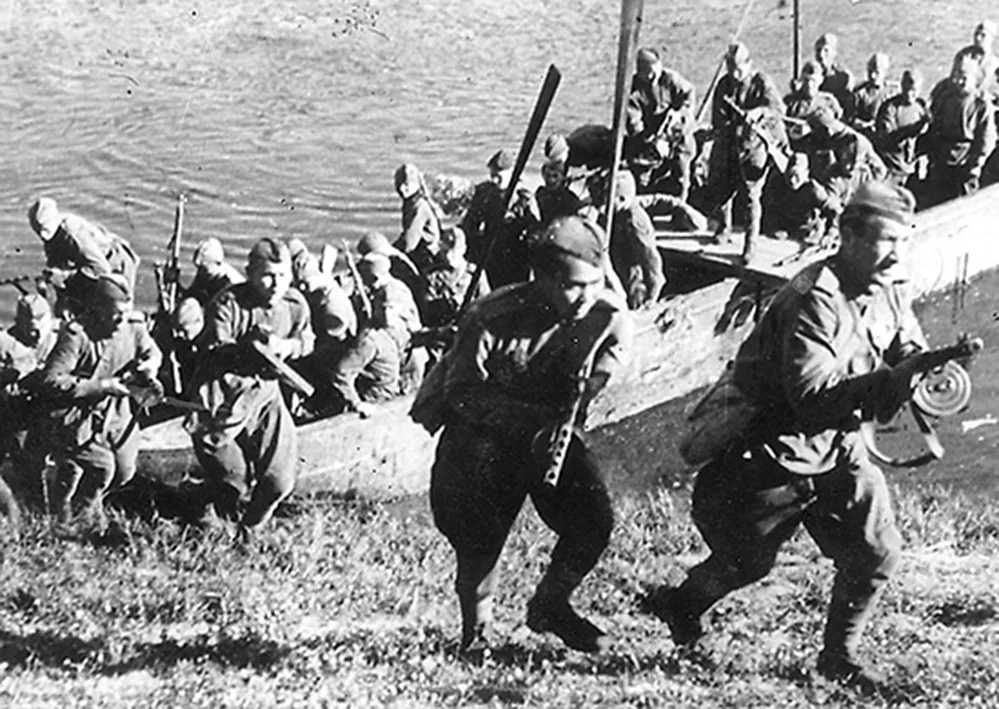
As is well known, the assault on the fortress of Königsberg began on 6 April 1945. The main striking forces were assault groups, specially formed and trained for fighting in heavily fortified city districts, of the 11th Guards Army in the south (commander Guards Colonel General K. N. Galitsky) and of the 43rd and 50th Armies in the north (commanders Lieutenant General A. P. Beloborodov and Lieutenant General F. P. Ozerov). And although preliminary data indicated that Forts No. 8 and No. 10 in the attack sector of the southern forces, and No. 4, No. 5, No. 5a and No. 6 in the attack sector of the northern group of forces, had been seriously damaged, the assault detachments were instructed not to storm the forts head-on but to bypass them and blockade them with battalions detailed for the purpose, while the rest of the troops continued the general offensive.
Subsequent events showed that this decision was absolutely right. The damage to the casemates of the shelled forts turned out to be less significant than the artillery observation data had suggested. A frontal assault on the forts would have led to numerous and unjustified losses.
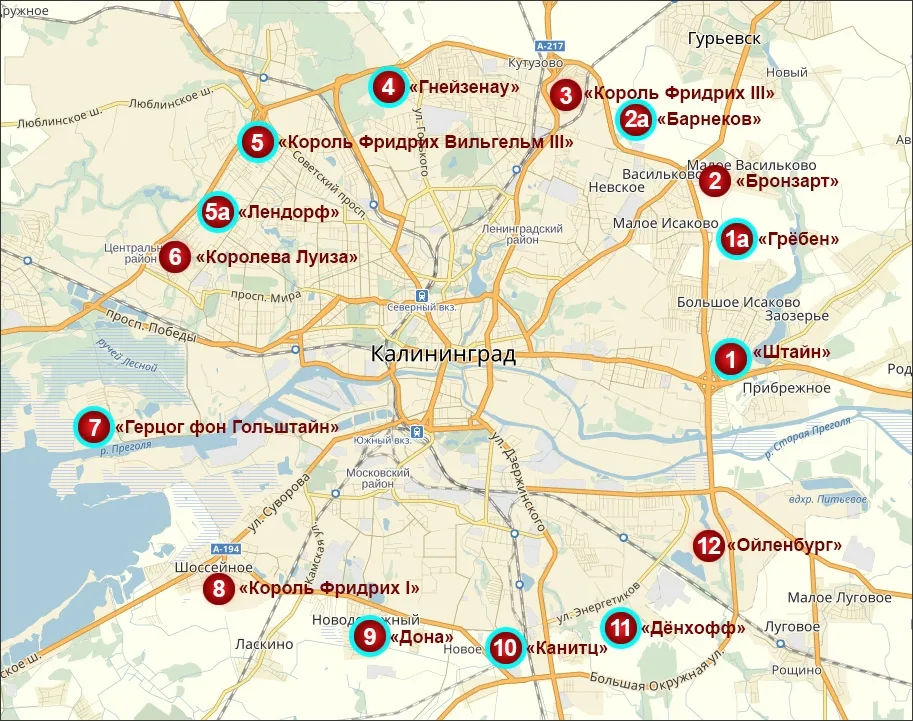 Map of the locations of the Königsberg forts based on Yandex Maps of Kaliningrad. Light blue circles mark the forts whose defensive moats are filled with water. The moat around Fort No. 1 “Stein” is currently filled with water, although according to the design it was meant to be dry.
The Fate of the Forts
Fort No. 1 “Stein” lay on a secondary axis. According to General Lasch, the commandant of Fort No. 1, Vogel, was shot by his own sergeant major, since he had no intention of capitulating and was determined to fight to the last soldier. The infantry units covering the fort were withdrawn from their positions to organise a breakout towards Pillau. Left without cover, surrounded by Soviet troops and under constant fire, the fort capitulated on the morning of 9 April.
Forts No. 1a “Gröben”, No. 2 “Bronsart” and No. 2a “Barnekow” were occupied by units of the 50th Army on the morning of 9 April after minor fire and the withdrawal of their garrisons, which had been ordered to leave the fortifications before they were completely cut off from the main grouping in Königsberg.
Fort No. 3 “König Friedrich III” was bypassed by Soviet troops even before the order to abandon the fort arrived. There were minor skirmishes in the vicinity of the fort, then artillery shelled the fort’s gorge barracks, after which the assault began early on the morning of 9 April; it was over fairly quickly, however – the fort capitulated by 8 a.m.
Fort No. 4 “Gneisenau” lay in the attack sector of the 206th and 216th Rifle Divisions of the 43rd Army. By 6 April the fort had been blockaded and was methodically shelled by the guns of self-propelled artillery (remember the lack of anti-tank guns on the forts?!). The fire of the self-propelled artillery drove the German soldiers into the underground casemates. The garrison had no means whatsoever of resisting the forces blockading the fort, and things were heading towards a final assault and hand-to-hand fighting in the fort’s galleries. However, by 8 a.m. on 7 April the decision was taken not to fight to the last soldier but to surrender to the mercy of the victor.
Fort No. 5 “König Friedrich Wilhelm III” fought the most stubbornly. At 10 a.m. on 6 April the artillery preparation began, during which the fort did not return fire. Assault groups of the 801st and 802nd Regiments bypassed the fort and continued fighting in the city’s suburbs, thereby cutting the fort off from its covering forces. The assault on the fort was entrusted to the second echelon – the 1st Battalion of the 732nd Regiment with attached artillery. The enemy embrasures were blanketed with artillery and machine-gun fire. The sappers first blew up the counterscarp, which made it possible to descend into the moat. Then, under cover of machine-gun fire and smokescreens, they crossed the moat, laying and detonating charges at the wall of the barracks. At the same time, according to a number of sources, a 280 mm mortar fired three aimed shots at the blockhouse protecting the fort’s entrance. The mortar fired over open sights, which the firing manual for this gun prohibited. The blockhouse was completely destroyed, and one of the ranging shells punched a hole right through the wall of the gorge barracks.
After that the infantrymen went in to storm the fort. In two days of fighting it came to bayonet charges in the fort’s casemates. The fort capitulated only on 8 April at around 9 a.m.
Fort No. 5A “Lehndorff” lay in the attack sector of the 33rd Guards and 87th Guards Divisions of the 43rd Army. By 18-00 on 6 April it had been blockaded by the 262nd Regiment of the 87th Guards Division, advancing in the second echelon of the offensive. Within an hour the artillery of the 337th Self-Propelled Artillery Regiment had suppressed all firing points on the fort’s grounds. The sappers prepared demolition charges to blow up its casemates. At 19.45 the fort’s command was presented with an ultimatum demanding the fort’s immediate surrender. Those who surrendered were guaranteed their lives, and the wounded medical care. At 3 a.m. on 7 April the fort raised the white flag. 194 of its defenders were taken prisoner.
Fort No. 6 “Königin Luise” received its share of 280 mm shells and on 6 April already went into battle with the advancing 24th Guards and 319th Divisions of the 43rd Army. The fort was blockaded and attacked with ISU-152 self-propelled guns (and once again we recall that the forts had no anti-tank weapons!) and two infantry battalions under the command of Majors Zenov and Nikolaenko. For two days the garrison fought under complete siege, and when all possibilities of defence were exhausted, it tried to break out of the fort into the city. Some of the soldiers were destroyed by Soviet troops; the rest surrendered.
Fort No. 7 “Herzog von Holstein” was cut off from besieged Königsberg by the end of 8 April by units of the 11th Guards and 43rd Armies that had linked up, and therefore took no direct part in the city’s defence. It was taken in the course of the operation that then began to completely clear the Samland Peninsula of the German fascist troops.
Fort No. 8 “König Friedrich I” lay on the axis of the 11th Guards Army’s main thrust. In this direction the 16th Guards, 18th Guards and 84th Guards Divisions were advancing. The fort was blockaded by the 243rd Regiment of the 84th Guards Division, while the assault groups continued the advance on Königsberg. By 18:00 on 6 June the fort had been completely cut off from the rest of the enemy grouping. Guards Major Romanov, who commanded the battalions with their attached artillery, called in two platoons of demolition flamethrowers as reinforcements. The operation to take the fort began at dawn on 7 April. A smokescreen was used in taking the fort. It allowed the Soviet soldiers to get close to the counterscarp of the moat, from where they opened massed flamethrower fire on the embrasures of the field caponier. The men in the caponier suffered burns, and ammunition began to detonate. The concentration of attention on the field side of the fort weakened the defence of the gorge; this was exploited by the 1st Company, which, under cover of machine-gun fire, crossed the bridge and began throwing grenades into the embrasures of the gorge barracks. Using dead ground, soldiers of the 2nd Company and the flamethrower platoons made their way onto the field rampart.
The flamethrower men began pouring flammable liquid into the ventilation pipes. The very first fires in the casemates forced the fort’s garrison to capitulate. This happened by 11 a.m. on 7 April. About 100 soldiers and officers were taken prisoner. Among those who surrendered were many soldiers with burns, and another 38 seriously wounded were found during the search of the fort’s rooms.
Fort No. 9 “Dohna” had been put out of the fight by the explosion of its arsenal long before the assault.
Fort No. 10 “Canitz” lay in the attack sector of the 26th Guards and 83rd Guards Divisions of the 11th Guards Army. Leaving small forces to blockade the fort, the divisions continued their advance. The blockading units launched an assault on the fort from the gorge side, laid massed artillery fire on the gorge barracks, and under cover of this fire the infantry and sapper units burst into the fort. Machine gunners and artillerymen meanwhile suppressed the firing points. Up to a company of enemy soldiers still remained in the fort’s barracks, so continuing the assault promised heavy losses. It was decided to force the fort to capitulate. The sappers laid several powerful charges, and the fort’s garrison was informed over a loudspeaker that further resistance would mean the fort being blown up and needless losses. At 5 a.m. on 7 April the fort’s garrison of 110 soldiers and officers, led by Major Macht, capitulated.
Forts No. 11 “Dönhoff” and No. 12 “Eulenburg” were subjected to far less intense fire than the other forts of the southern defensive front. They lay away from the axis of the main thrust. Realising that the advancing Red Army units had already moved far ahead, the garrisons abandoned the forts and tried to join up with the main grouping defending the city. The withdrawal was accompanied by skirmishes, which, however, were not fierce in character. According to Commandant Otto Lasch, the commander of Fort No. 12 shot himself, and the garrison left the fort without its commander. On the morning of 7 April the Red Army took full control of Fort No. 12, and by 1 p.m. of Fort No. 11.
From a turbulent past to a sad present
Immediately after the fighting ended, the forts continued their service. Apparently as a tribute to tradition, the military moved into Forts 1, 1a, 2, 3a, 3, 6, 7, 10, 11 and 12. In most cases the forts performed auxiliary functions and were used as depots (including military vegetable stores). At Forts No. 4 and No. 5, ammunition was destroyed. Fort No. 9 was abandoned because of the damage. Forts No. 5a and No. 8 were not used. Sometimes, of course, there were bright moments in their lives. Thus Fort No. 5 was not completely destroyed by the blowing-up of “echoes of war” but was transformed in time into a memorial complex – a monument to the mass heroism of Soviet soldiers. For a long time it was the only one known to civilian Kaliningraders as “the fort”. Excursions and wedding parties came here, flowers were laid here on 9 April and 9 May, and this fort featured in every set of postcards of the city. The other forts were either closed off altogether or unknown to most townspeople. Everything began to change with the demilitarisation of the region: the military left first Forts No. 2 and No. 3, then No. 1, No. 1a and No. 2a. Two significant events then took place at Fort No. 3: the film “Order to Cross the Border” was shot here, in which the fort figured as a Japanese fortress, which is why inscriptions in hieroglyphs can still be found on its walls.
The second story is far more mysterious: after the military left, part of the collection of the Prussia Museum that went missing in 1945 was found at the fort. Who buried it there – the Nazis or looters from among our fellow citizens – remains unknown to this day.
Everyone seemed to understand that the best future for the forts lay in use as museums or for excursions. In practice, however, only three sites currently perform this function: Forts No. 1, No. 5 and No. 11. Forts No. 2 and No. 3 have been leased by private individuals. What will come of this, the future will tell. Forts No. 6, No. 7 and No. 12 are under military guard. There, at least, one can expect that they will not be pulled apart for bricks. Fort No. 5a is guarded by a figure who is legendary among local historians. Serious concern is caused by the state of Forts No. 4, No. 8, No. 9 and No. 10. Here, according to eyewitnesses, there are rubbish dumps, casemates being destroyed by bulldozers, bricks being extracted and roofs collapsing. And there is no hope of any significant improvement in the situation with these forts.
ANO “Fortification Heritage of the Kaliningrad Region”
Fort No. 11 “Dönhoff”
Translated from Russian with the help of AI (Claude, Anthropic), October 2026.