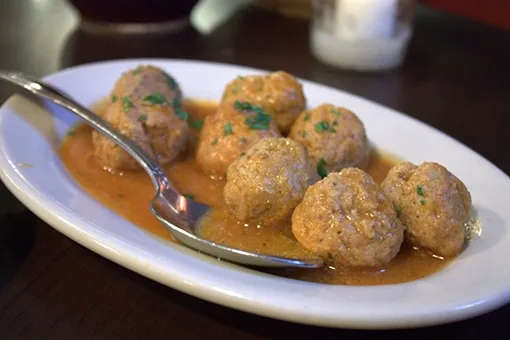
However, there is evidence that a recipe for Königsberg Klopse was printed much earlier. In 1805 the publishing house of Göbbels and Unzer brought out a book entitled "Preussisches Kochbuch fuer Frauenzimmer, die Hauswesen und Kueche mit moeglichst geringer Muehe und Kosten selbst verwalten wollen", which translates literally as "A Prussian Cookbook for Housewives Who Wish to Manage Their Household and Kitchen Themselves with the Least Possible Effort and Expense". Its compiler, Juliane Amalie, dedicated it to her sisters Caroline and Luise. Although it is called a Prussian cookbook, the recipes collected in it are for Königsberg dishes, as noted by Margarete Haslinger and Ruth Maria Wagner (Margarete Haslinger, Ruth Maria Wagner), the authors of the collection "Recipes of Good East Prussian Cooking" ("Rezepte der guten Ostpreussischen Kueche").
In their book they write that in the modern version Klopse are patties of minced meat that can be boiled or fried.
But at the beginning of the century before last, when meat grinders were not even dreamed of and mincing meat with a knife was far too laborious, housewives did things more simply.
The authors cite an old recipe for Klopse, for which the pork is to be sliced thinly and pounded with a wooden mallet or the handle of a kitchen knife.
The dish takes its name from the German word "klopfen", to pound or knock.
Put finely chopped suet on the bottom of a pan, top it with a layer of meat, season with salt and pepper and sprinkle with English spice. Then add more pieces of suet or butter, a layer of meat and spices. Carry on like this until the pan is two-thirds full. Add water and stew over a moderate heat, lifting the meat slightly on all sides with a spoon from time to time so that it does not burn. When it is almost done, lay a couple of lemon slices, capers and chopped anchovies on top, add wine and stew a little longer.
The following method of making Königsberg Klopse belongs to the Lube family of Königsberg and dates from 1840. It was shared by Harald Saul, a collector of recipes from Gera (Germany), in his book "Unforgettable East Prussian Cooking" (Harald Saul. «Unvergessliche Kueche Ostpreussen»).
For ¾ pound of pork and ¼ pound of beef (minced beforehand), take 125 g of stale white bread soaked in water, a grated onion, 4 boiled and mashed potatoes and the whites of two eggs, well beaten. Do not throw away the yolks! Then add salt and pepper and mix everything to a mushy consistency. Shape the Klopse. They are best cooked in bone broth with plenty of spices and onion.
When the Klopse are done, lift them out and keep them warm. For the sauce, blend a little flour with sour cream and stir it into the boiling broth in which the Klopse were cooked. For flavour, add a small knob of butter, chopped capers or a little lemon juice. When the sauce has cooled slightly, stir in the egg yolk.
So there is reason to believe that the meat grinder already existed in 1840. Or else housewives used a special two-handled, half-moon-shaped knife for mincing meat.
Harald Saul's collection already holds more than 100 recipes for Königsberg Klopse.
The latest, the 107th, taken from the family cookbook of Anna Kubert of Gross Weide (now the town of Pastva, Poland), was published in his book "Old Family Recipes from East Prussia" ("Alte Familienrezepte aus Ostpreussen").
Grandma Anna's Königsberg Klopse, with which her grandchildren still amaze their guests and colleagues:
Mix 500 g of minced meat (half pork, half beef), 1 beaten egg, pepper and salt and leave to rest, covered, for 30 minutes. Meanwhile pour half a litre of water into a pan and add an onion, two bay leaves, five black peppercorns, a teaspoon of capers and diced carrot and celeriac. Simmer the broth for 30 minutes, but do not let it boil hard. Then shape the mince into patties and lower them into the broth. Move the pan to the edge of the stove. After 20 minutes the meat patties are done. Put the pan back on the heat and bring the broth to the boil, adding flour mixed with sour cream. Remove from the heat when the sauce has thickened, and pour it over the Klopse.
Königsberg Klopse are still very popular today, and not only in Kaliningrad-Königsberg, where some restaurants and cafés offer the dish as their speciality, but in Europe as well.
Over time many varieties of Klopse appeared. They are both boiled and fried, and made not only from the meat of domestic animals but also from game and fish.
Proof of this is a recipe from the above-mentioned book by Margarete Haslinger and Ruth Maria Wagner, "Recipes of Good East Prussian Cooking".
Fish Klopse
— 1 kg of pike or haddock (or 500 g of fillet)
— 1 onion
— 2 eggs
— 2 small stale bread rolls or 3 tbsp of breadcrumbs
— 1 bunch of soup greens
Spices for cooking fish
— 6 tbsp of butter
— 2 tbsp of flour
— ½ l of cream
— Lemon juice (to taste)
— 2 egg yolks
— Capers or crab, optional
Bone the fish and put it through the mincer together with the bread rolls soaked in water. Lightly fry the finely chopped onion in butter and add it to the fish mince. Lightly beat 2 tbsp of butter with the two eggs and add this to the mince too. Mix well and shape the Klopse.
Make a broth from the head and the remaining parts of the fish, adding the soup greens, salt and spices. After 15 minutes strain the broth, return it to the heat and lower the Klopse into it for 10 minutes.
Make a roux from the flour and butter, thin it with broth and cream, and add lemon juice, salt and a pinch of sugar. Put the Klopse into the sauce, garnish with crab and serve with boiled potatoes.
There is another way of making fish Klopse. They can be fried as well as boiled. To do this, shape the mince into patties, coat them in egg and breadcrumbs and fry in butter until golden brown. Klopse can also be deep-fried by lowering the patties into a pan of boiling vegetable or coconut oil.
Fish Klopse, garnished with lemon slices and parsley, were served on a warmed platter.
There are even mock Königsberg Klopse. They were invented by East Prussian housewives during the last war, writes Marion Lindt in her book "East Prussian Traditional Dishes" (Marion Lindt. «Ostpreussische Spezialitaeten»). Today the dish is very popular with vegetarians, which is why it is sometimes called "vegetarian Klopse".
The recipe is quite simple:
— 200 g of lentils
— 250 g of Savoy cabbage
— 2 eggs
— 2 onions
— 1 tbsp of clarified butter
— 1 tsp of capers
— Salt (to taste)
— Ground pepper (to taste)
— 1 tbsp of semolina
— 1 small bread roll
— 1 bay leaf
— 4 allspice berries (pimento)
— 2 tbsp of flour
— 125 g of sour cream
— Sugar (to taste)
— Lemon juice (to taste)
— 20 g of butter
— 1 egg yolk
Grind the dried lentils in a blender. Clean the Savoy cabbage, cut it in half and remove the core. Separate the leaves and wash them. Put the ground lentils in a pan, cover with water and simmer gently. Then drain off the water.
Put the cabbage leaves in another pan, cover with water and cook until soft. Drain and likewise set aside.
Hard-boil the eggs and chop them together with the onion and cabbage, mix everything with the lentils, and add the clarified butter melted in a frying pan, the capers, salt, ground pepper and semolina. Add just enough of the bread roll for the mixture to bind. Shape into balls and place them in a dish.
Finely chop the second onion. Bring ½–¾ l of water to the boil and add the onion, a pinch of salt, the bay leaf and the allspice. Carefully lower the Klopse into the broth and cook over a medium heat for about 10 minutes. Lift them out just as carefully with a slotted spoon and keep them warm.
Strain the broth, mix the flour with the sour cream and stir it into the broth. Bring to the boil, stirring, and cook for 5 minutes. Add salt, sugar and lemon juice. Take the pan off the heat, melt the butter in a frying pan and mix it with the egg yolk. Pour the thickened sauce over the Klopse before serving.
Incidentally, Klopse are sometimes nicknamed "German folk meatballs". They come as Königsberg, Dresden, Bavarian…
That said, every German region prepares them to its own taste. The only thing that stays the same is the sauce poured over them.
The closest relatives of Klopse are traditional Swedish meatballs (Köttbullar). They are shaped into balls ranging from the size of a walnut to that of a small apple. They differ from Klopse in that they are not boiled but fried, after first being coated in rice or wheat flour. In addition, the mince for the meatballs (which can be made of either meat or fish) may include grains, vegetables and even dried fruit and mashed potato. But these are already "lyrical digressions" from the classic, and they often happen when making Klopse too. The most important thing the two dishes have in common, of course, is the sauce. Neither Swedish meatballs nor Königsberg Klopse are ever served without it.
Translated from Russian with the help of AI (Claude, Anthropic), October 2026.