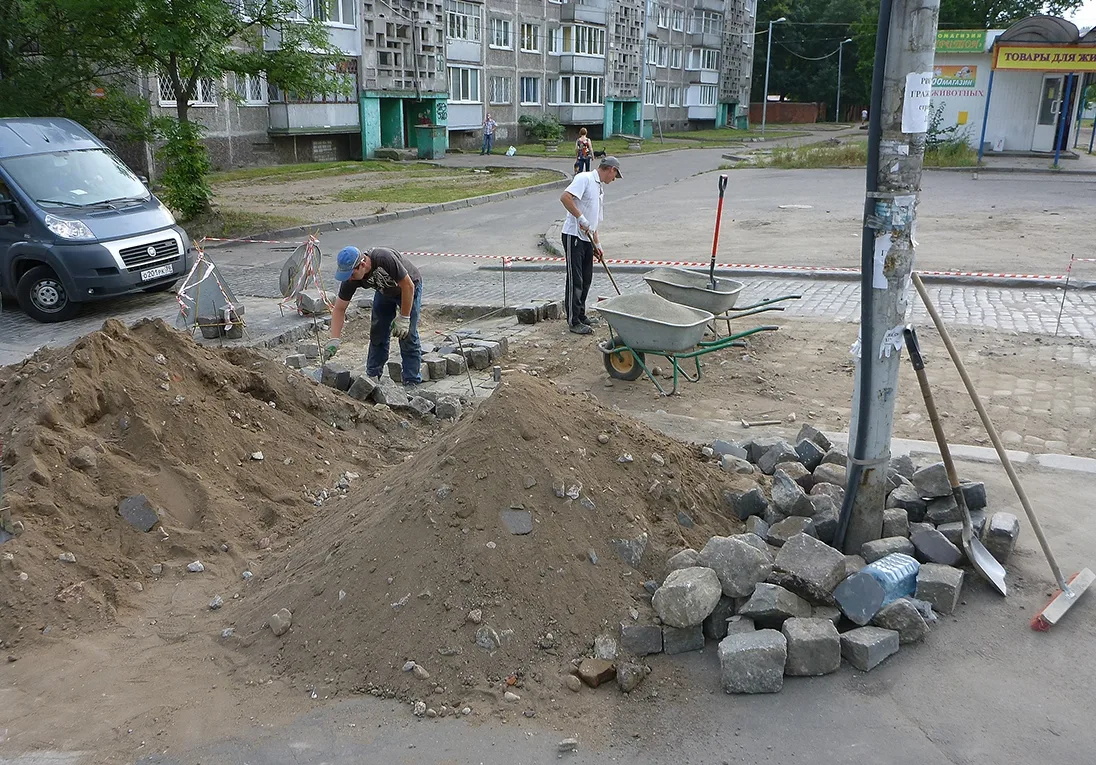
Do Kaliningrad's cobblestones have a future ?
Although Kaliningrad is trying to present itself as a city attractive to tourists, people in Russia and Europe (to say nothing of America and Asia) know offensively little about it. In the West, on hearing of Kaliningrad, people as a rule immediately think of Kant , and in the East — of cobblestones.
"I did my military service in your city in the 60s," an elderly taxi driver in Tula told me a couple of years ago, on learning where I had come from. "You had cobblestones there back then. Are they still there, or what?" Note that he did not ask about the Royal Castle, whose ruins he must surely have seen; he was not interested in the fate of amber (who knows — maybe it's run out by now?); he paid no attention to the state of our beaches; even the exclave's isolation from the rest of the country, a topic so dear to Russians from other cities, left the driver unmoved. His heart ached only for the cobblestones.
"Are they?" he turned to me and slowed down.
"They are," I replied.
"Well, thank God," the taxi driver breathed out and drove on.
An unquestionable value
Among local defenders of the pre-war cultural heritage, cobbled roads also hold a special place. One of the most popular Kaliningrad online communities on the subject is called "Save the Cobblestones!" (https://www.facebook.com/groups/gorodk/). Its coordinator, Anna Karpenko, has stated many times on all sorts of platforms that, in the view of the community's members (the group now has several hundred), cobblestones are an unquestionable cultural value. And if so, they must be preserved wherever they are now. This means not only the cobblestones in plain sight but also those hidden under asphalt that may be uncovered during roadworks. The defenders of the cobblestones believe they should be removed only in exceptional cases. For instance, if they pose a real danger to road users.
But this view is not shared by everyone in Kaliningrad. Whenever cobblestones come up, many local motorists immediately think of their suspension. My car isn't government property, they say, repairs are expensive these days, so to hell with those cobblestones of yours… Besides, many Kaliningraders blame the cobbled roads for keeping them awake, because they make cars rattle like toys. Given that motorists are the majority in Kaliningrad, and practically everyone wants to sleep at night, it is hard to hope that cobblestone shares will show steady growth any time soon.
An insidious trap
In theory the local authorities could change the situation. But so far no particular zeal on their part can be discerned. Yes, say the city bosses, we understand that cobblestones are very important, but most townspeople are against them, and what about us? We go along with the people. And if that's so, then there seems to be no need to worry about preserving the historical heritage. Cover it with asphalt — and job done.
Of course, in two or three years that asphalt, as is our custom, will be covered with holes and potholes. But that's no big deal. You can lay new asphalt very quickly. It's costly for the budget, of course, but everyone is happy. The motorists, and those who sleep too lightly, but above all the construction companies, which regularly get new contracts.
…Still, it is not always possible to brush off the defenders of the historical heritage completely. Some two years ago a sort of experiment was carried out — the cobblestones were relaid on one of the most beautiful streets in the city, Telmana Street. But very soon the new road surface went wavy and fell apart, and driving on it became utterly impossible.
Thus the cobblestones were discredited and their defenders fell into a trap. "Well, look, we met you halfway, we tried to do as you wanted, and look what came of it!" the authorities seemed to be saying to the members of the popular online community. "Now it's obvious to everyone that the cobblestones have to go, because they can't be relaid properly — we don't have specialists like that."
Simple recipes
In fact, of course, cobblestones can be relaid properly. And finding good specialists is no problem. You just have to look for them not in Central Asia, as is often done here, but, say, in Germany or Italy. Or, at the end of the day, in Poland, where people all but worship those very cobblestones.
I remember that a few years ago Kaliningrad journalists meeting the chairman of the Gdańsk city council, Bogdan Oleszek, asked how often the city had to replace cobblestones with asphalt. The question had to be repeated several times. And the problem was not the language barrier at all. Pan Bogdan simply could not get his head round it: how could one replace cobblestones with asphalt? Why?!
"The people of Gdańsk simply wouldn't allow it!" he exclaimed when he finally grasped the point. "A completely unreal situation!" "But surely the cobbles bother drivers?" the Kaliningraders persisted. Oleszek apparently didn't know what to say. He just shrugged.
Apparently in Gdańsk the cobblestones are relaid by true masters of their craft, so they cause no problems for motorists. Of course, the work of such specialists does not come cheap. But I think Kaliningrad spends a great deal more replacing its worn-out asphalt almost every year. Or perhaps it is even simpler. Perhaps the people of Gdańsk love their city more than their cars, which is why the question of replacing cobblestones with asphalt simply never arises there. Most likely, though, both of these simple factors are at work in Gdańsk.
It has all happened before…
So, if you think about it, the recipe for preserving the cobblestones is ridiculously simple. If residents and the authorities care, they will stay; if they don't, they will disappear. For now, as already noted, there is little cause for optimism. Most Kaliningraders (even if they don't own a car and sleep soundly at night) don't stop to think what the value of these stones is; they don't feel it. They don't understand that along with the cobblestones the city is losing part of its soul, that by uprooting the ancient cobbles we are cutting the roots that bind us to this land. And yet, surprisingly, most Kaliningraders are convinced that their city will be interesting to tourists even without cobblestones. And not just "without cobblestones" — without anything old at all. Let alone anything pseudo-old.
A few months ago, during a public discussion of the terms of yet another architectural competition organised by the Heart of the City bureau, a fairly well-known lady gave an inspired speech arguing that Kaliningrad essentially does not need a historic centre. In her view, we should all look forward rather than back. "Let Kaliningrad be a beautiful, bright city with decent, modern architecture and without medieval cramping. Then we ourselves will enjoy living here , and visitors will flock to us," she concluded.
I must say her speech struck a chord with many of those taking part in the discussion. "Yes, yes," people agreed with the speaker. "We must look forward; Königsberg can't be restored anyway…" And as I listened I realised that all this had happened before. From practically 1945 onwards, the new inhabitants of this land, having energetically shaken off the burden of the past, set about building a new, large, modern city in place of the old one, which in their view was not a great success. It was a long, hard task and at times — why deny it — downright heroic.
By the early nineties of the last century, however, they were all terribly tired. They stopped, took a critical look at what they had built and, with a heavy sigh, went off on holiday to Gdańsk, whose centre had been meticulously restored after the war. With all its narrow streets, old houses and, of course, its cobblestones.
I think the taxi driver from Tula would also have liked Gdańsk better than Kaliningrad...
P.S. Then again, perhaps things here are not so bad after all. For example, the cobblestones were recently relaid on Griga Street. That's great. The main thing is that it doesn't end up like Telmana Street.
Photo: Mikhail Ogorodnikov.
Translated from Russian with the help of AI (Claude, Anthropic), October 2026.