– Gennady Viktorovich, what difficulties did the Soviet command face in conducting the East Prussian Operation?
– Having fought their way through Belarus and Lithuania, by the autumn of 1944 the Soviet troops had suffered tangible losses, and months of strain were telling on their physical condition. Stocks of materiel and weapons had been used up. Time was needed to restore the troops' combat effectiveness. Plus, it must be admitted, the command of the 3rd Belorussian Front had failed to obtain an accurate picture of the nature of the enemy defences built in East Prussia. The Germans, for their part, took every measure in the summer and autumn of 1944 to prevent Soviet troops from invading their territory.
Although the Wehrmacht was in a crisis on all fronts, it still managed to concentrate considerable effort on holding the situation in certain sectors. The English historian Basil Liddell Hart wrote in this connection: "… the law of overstretched communications finally began to work in the Germans' favour, reducing the Russian pressure… and thus increasing the resistance of the mixed forces, consisting of regular troops and Volkssturm units, which the Germans sent to hold the... line".
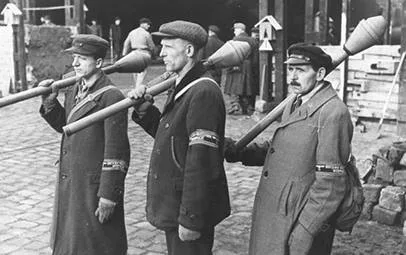
Volkssturm
Units of the people's militia of the Third Reich, created in the last months of the Second World War.
One of these sectors was the East Prussian one. Meanwhile, the troops of the 3rd Belorussian Front had been severely drained in the preceding battles, and reinforcements of men and materiel were insignificant, because the main strategic direction was, not without reason, considered to be Berlin.
– Despite all the difficulties, on 25 April 1945 the storming of Pillau (Baltiysk) concluded the entire East Prussian Operation. What place does the East Prussian Operation occupy in the Second World War?
– Strategically, the Red Army won a major victory here, routing a large grouping of German troops. For Germany, the loss of East Prussia was not only the loss of a province important both economically and in spiritual and patriotic terms, but also led to a significant decline in the military power of the aggressor state.
A grouping of more than half a million men was routed. The Germans finally lost the possibility of using the encircled Courland grouping in the interests of their main forces. Finally, the German command's plans to strike from East Prussia at the grouping of Soviet troops operating in the Berlin direction were thwarted.
And one more thing. The date "25 April 1945" requires comment. The point is that with the capture of Pillau by Soviet troops the main German grouping in East Prussia was finished. The operation itself continued and ended only on 8 May 1945, when the last German troops surrendered after fierce fighting at the "base" of the Frische Nehrung spit (in the area of the present-day Polish village of Sztutowo).
– And what significance did the capture of Königsberg have in the context of the East Prussian Operation?
– Königsberg was not just a large north German city, not just a military fortress on the Baltic coast, but the political and strategic centre of the entire military system in East Prussia. It was through Königsberg that the East Prussian grouping was supplied with food, ammunition, weapons and the necessary equipment. German reserves were formed here. And finally, holding Königsberg was a matter of German prestige. The capture of this city immediately decided the fate of the entire East Prussian enemy grouping.
– What were the main reasons for the Red Army's success?
– German memoirists and researchers often use the considerable superiority of Soviet troops in men and materiel in the East Prussian Operation as an argument in scholarly debates. This argument may look like a kind of objective circumstance justifying defeat. Indeed, the Soviet superiority on the whole was very considerable.
However, one must take into account the fact that the operation under analysis was evidence of the growing strength of the Red Army as a whole and of the improvement of Soviet military art. The fighting was characterised by its great scope and bitter struggle, which demanded extraordinary efforts in commanding the troops.
The operation itself was conducted on a front with a total length of 550 km and a depth of over 200 km! The enemy had to be defeated by overcoming his fortified areas, in difficult terrain and bad weather, and the enemy also had support from the sea.
It should be borne in mind that the Soviet military command managed not just to achieve clear superiority in men and materiel, which in itself is an indicator of generalship. Within the framework of the operation, the command of the 3rd Belorussian Front not only chose the right directions for the front and army attacks, but also created decisive superiority in men and materiel in those directions.
The command of the 3rd Belorussian Front reacted quickly and efficiently enough to changes in the combat situation. Thus, when it became clear that the well-prepared enemy defences could not be broken through and split by a frontal attack, a new form of combat operations was chosen: by combining various forms of operational manoeuvre, the simultaneous cutting off and fragmentation of the German troops, followed by their destruction, was achieved.
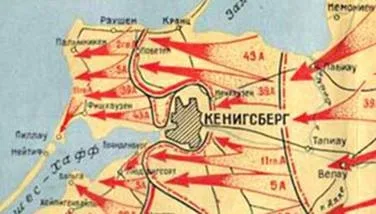
The Samland Peninsula
Also known as Sambia. Today it is called the Kaliningrad Peninsula. It lies on the south-eastern coast of the Baltic Sea.
– What could the German leadership oppose to these tactics?
– In these conditions the German command could rely only on rapid manoeuvre of its forces and means, which in a number of cases it carried out quite successfully. An example of this is the relief of Königsberg carried out on the Samland Peninsula in February 1945. And yet the Soviet military leadership's use, in turn, of various forms of operational manoeuvre, and its switching between them during the operation itself, often confronted the Germans with insoluble problems.
One should also note a feature of the Soviet military command such as the ability to learn quickly. An example here is the Gumbinnen operation of 1944. During the Gumbinnen breakthrough, the troops of the 3rd Belorussian Front for the first time encountered a well-prepared and organised permanent enemy defence. This operation did not achieve the goals set for it. But its results were used in preparing and conducting the new offensive. Both operationally and tactically.
In particular, such a form of combat as the night offensive became widespread. This is clearly seen in the example of the 11th Guards Army, which of the 130 km it covered on East Prussian territory, covered 60 km at night, forcing rivers and capturing Insterburg (Chernyakhovsk) and the major strongpoints of Taplacken (Talpaki) and Wehlau (Znamensk).
– Many German fortifications can still be found in the Kaliningrad Region today: pillboxes, forts. What tactics were used to suppress their firepower?
– At the tactical level, the formation of assault detachments and groups to fight the garrisons of forts, pillboxes and urban fortifications became widespread. Another form of fighting strongpoints was also used: blockading them, followed by the destruction or capture of the garrison.
– And how did they manage to deal with the powerful German grouping encircled near Heiligenbeil (Mamonovo)?
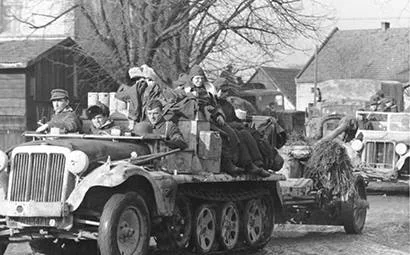
The Heilsberg grouping
Named after the town of Heilsberg (German: Heilsberg), now Lidzbark Warmiński (Poland). It comprised the remnants of 19 divisions. The Heilsberg fortified area included, among others, the towns of Heiligenbeil (Mamonovo) and Preußisch Eylau (Bagrationovsk).
– The Heilsberg grouping was routed by gradually compressing the enemy's defences and destroying him in a limited area through the extensive use of artillery and aviation. Splitting attacks were impossible given the high concentration of enemy troops and the prepared defences.
– What tactics were used in the storming of Königsberg?
– In the storming of Königsberg, the possibility of delivering converging attacks with the forces of two armies, encircling the enemy grouping in the city and then rapidly routing it, was brilliantly exploited. But I would correct you: this is no longer tactics but operational art. Tactics is the use of assault groups and detachments in the course of battle.
So, the combined use of these two components of military science in practice is what led to rapid success with small losses. In storming the mighty fortress of Königsberg, Soviet troops suffered 3,700 irrecoverable losses. Suffice it to say that the "price" of taking Vilnius was 4,300 men. And those were simply cities, not fortresses!
And, of course, achieving victory as a whole in the East Prussian Strategic Operation of 1945 would have been impossible without the truly self-sacrificing combat work of Soviet soldiers and officers. The fighting was fierce and demanded an incredible exertion of strength over four months.
One must also take into account the circumstance that the fighting had to be conducted against German soldiers, many of whom were defending their land, their homeland. We must give the German soldiers their due: they fought sparing neither strength nor life. This was an exceptionally strong enemy. But all the more honourable is the victory won by the Soviet soldier!
Translated from Russian with the help of AI (Claude, Anthropic), October 2026.