LEGENDS OF PRUSSIA on the blog of Tatyana Kolivay.
Like Rome, the Eternal City, Urbs Septicollis1, Königsberg lies on seven hills, from which delightful views of the surroundings open up. The city is situated in a landscape exceptionally comfortable to live in. It is a plain through which the navigable river Pregel flows. And small hills here and there allow us to enjoy magnificent views.
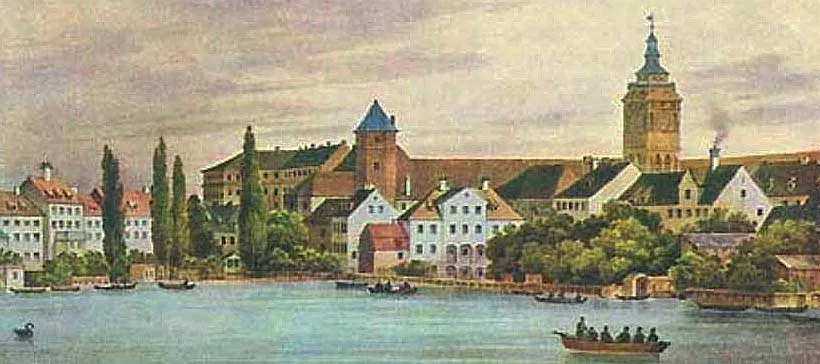
Here, wherever you cast your eye, there is a great deal of water, and this lends the city an inexpressible charm. The navigable Pregel with its branches washes the whole of Königsberg and forms at its centre the unique island of Kneiphof. Beautiful is the panorama that opens up from the Promenade onto the Lindenmarkt, which lies on the main arm of the Pregel flowing unhurriedly below. To the left, the expanses of fields and copses, and to the right, old houses with their quaint little balconies, buried in greenery. They stretch from the Blue Tower, the city prison, to the Exchange building. And in the middle, two bridges, and above the railings of one of them, the Green Bridge, the masts of the ships crowding in the port can be seen.
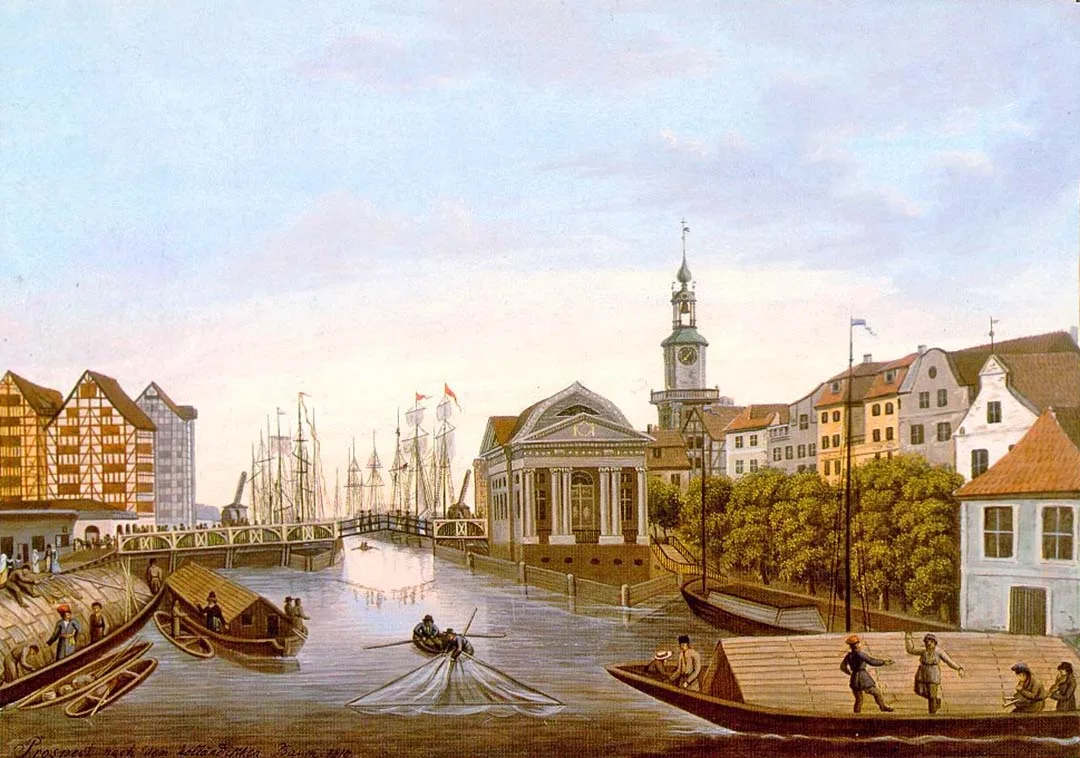
Even more beautiful are the views that open up from the Green Bridge towards the lagoon. At this spot one of the Pregel's arms, which has flowed around the island of Kneiphof, joins the main river, and the river flows broad and free. Along both its banks stretch long rows of warehouses.
On the left side, below, the fortress can be seen, and on the right the river customs house, the Holländer Baum. The half-timbered warehouse buildings, the customs house, the balconied office of the local steamship company and also the Red Crane, which unfortunately burned recently, give the right bank of the Pregel an extraordinarily picturesque appearance.
But it is the ships that give Königsberg its quite special charm. One scene on the river replaces another every minute. Here, on the right, along the arm of the Pregel by the embankment, the "penny ferry" — the Pfennigfähre — crawls along at a snail's pace, and over there a boat rowed by a couple of sailors cuts through the smooth water. Here a ship is looking for a berth in front of the warehouse from which it is to collect its cargo, trying to squeeze into a free space at the quay. At last it is lucky: one of the vessels, fully loaded, casts off from the wharf. And beyond the Holländer Baum customs house newly arrived vessels are dropping anchor to discharge their ballast. At this spot the soil of America, Norway and Holland mingles with the soil of Prussia, and the local boys are forever rummaging there in search of curious shells.
Walking across the Green Bridge, you see truly magical views all around. Broad water wherever you look: the river rolling its waves to the sea, the flags and sails of the ships in the port, the evening sunset sinking into the distant mirror of the sea — all this creates the sense of the presence of Poseidon, the god of the seas. And it is a thrilling feeling.
It is heightened by the unique architecture of the place. The broad street of the Vordere Vorstadt, built in the modern style, the imposing bank building, the slender tower of the Green Gate and the solid Baroque building of the stock exchange form a high foreground from which beautiful views open up.
On the embankment to the right spreads the Fish Market and next to it the flea market (Fisch- und Krammarkt). There are always crowds of people there. And on the opposite side rise the college buildings of the Albertina, from behind which the Cathedral peeps out, creating the impression of an idyllic picture of a medieval monastery buried in the greenery of its gardens.
Here you can always see the ever-present fishing boats, as well as the vessels that bring cheese, butter and, in autumn, fruit. The fishing boats look like a broad oblong box, while the vessels bringing cheeses have a pointed, tent-shaped wooden roof to protect them from the sun. They line up on the river in long rows.
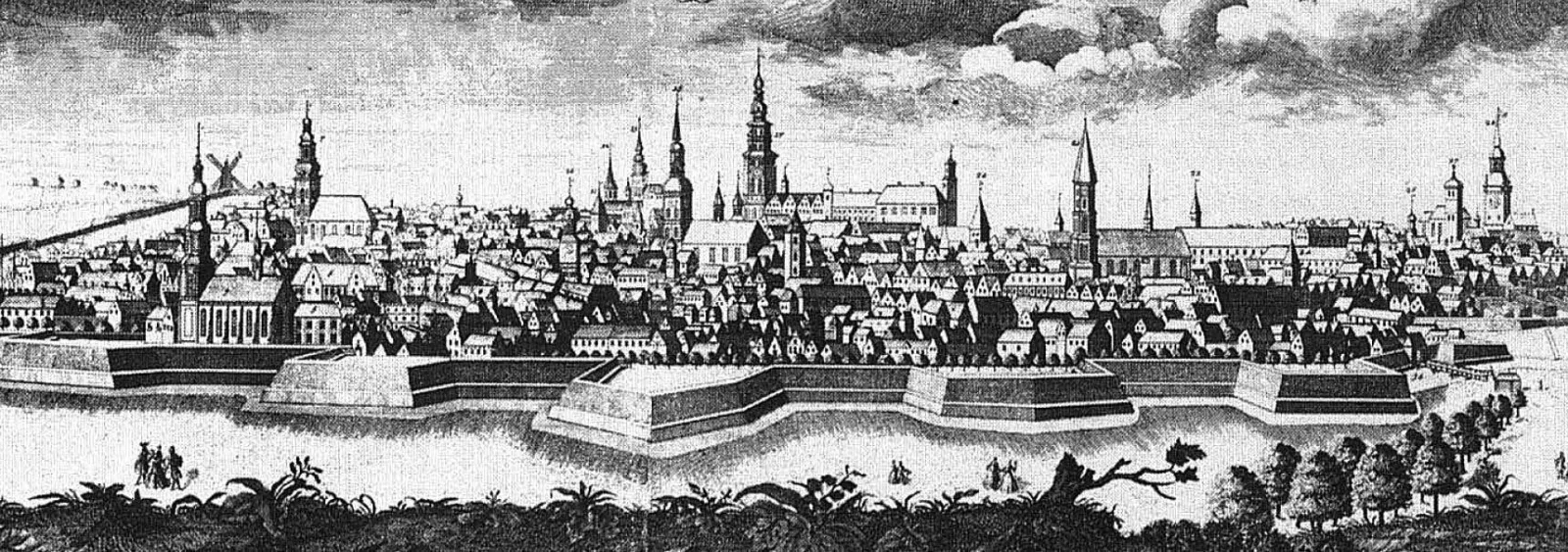
Beyond the city rampart, on three sides, there is nothing but a flat plain with fields and ploughland. Between them and the rampart lie ponds (for example, the Upper Pond) or pits, which were formed when earth was taken from these places to build the fortifications. The pits are gradually disappearing, filling up with city rubbish and rags. Vagrants, beggars and dzimkens2 are constantly rummaging in these rubbish heaps, searching for bright rags, broken knife blades, broken combs, shards of glassware, buttons and similar junk.
TRANSLATOR'S NOTE
1. A city built on seven hills (Urbs Septicollis)
2. Dzimken — a word borrowed from Polish ziomek (masc.) 'fellow countryman'; also dschimke, schimke. A term for Polish raftsmen and boatmen in former East and West Prussia.
LEGENDS OF PRUSSIA on the blog of Tatyana Kolivay.
Translated from Russian with the help of AI (Claude, Anthropic), October 2026.