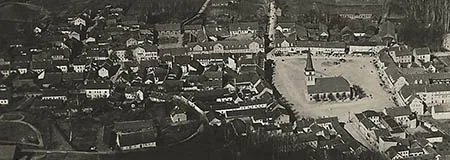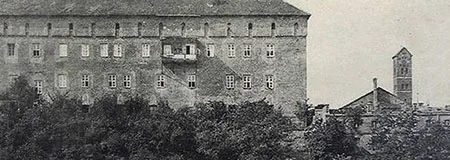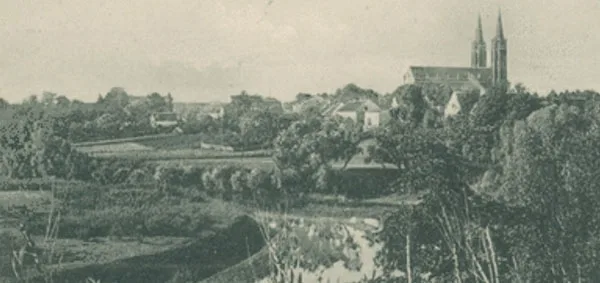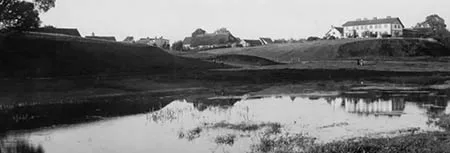
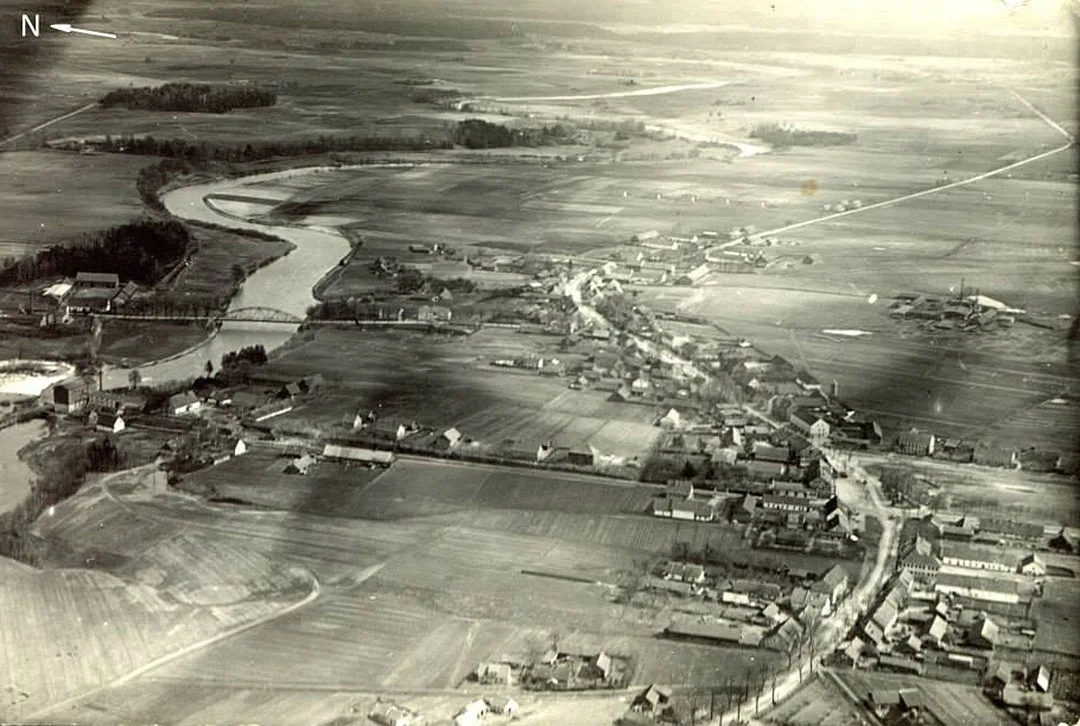
A settlement on the site of the town first appears in records in 1521 as Haselpusch. In 1557 the name Lesdehnen is mentioned. No later than 1578 a church was built in the village. The first church building burned down in 1661, and a new one was built in its place. In 1663 a watermill was built in Lesdehnen. In 1734 the village was renamed Lasdehnen, and this became the official founding date of the town of Krasnoznamensk in Soviet historiography. By 1885 Lasdehnen was a church village (Kirchdorf) with a royal office, a watermill, an oil mill and 48 households.
From 1818 Lasdehnen belonged to Kreis Pillkallen (from 1938 Kreis (Landkreis) Schloßberg, Dobrovolsk).
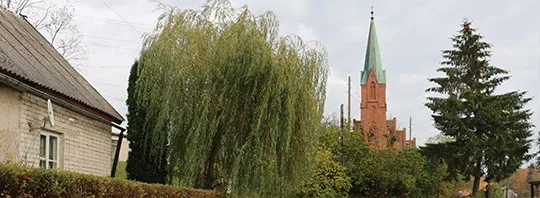
In 1861 Lasdehnen had 214 buildings, and in 1871 there were 83 dwelling houses. In 1869 the building of the second church was demolished as dilapidated, and in 1874–77 the third church building was erected, which survives to this day.
On 08.04.1874 Lasdehnen was included in the newly established Amtsbezirk Lasdehnen. The heads of the Amtsbezirk were always residents of Lasdehnen: in 1874–83 an estate owner named Leiner; in 1883–85 the retired royal forestry cashier Thalau; in 1885-91 the royal forestry cashier Deckner; in 1891–1903 the estate and mill owner Gerlach; from 1903 an estate owner by the name of Sokat; in 1912-33 the community head May; and from 1933 the merchant Otto Skattitat.
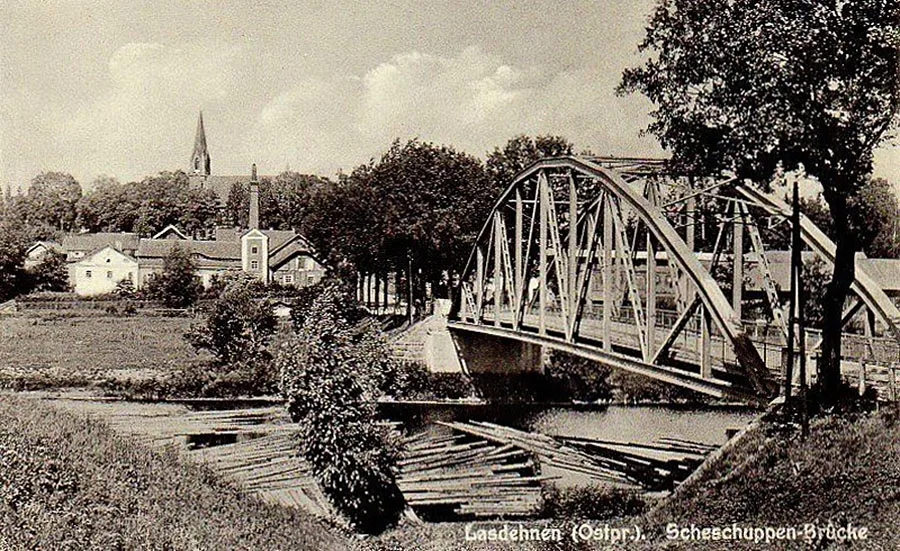 Bridge over the Sheshupe.
On 24.12.1901 traffic opened on the first line of the Pillkallen narrow-gauge railway (Pillkaller Kleinbahn), which connected Lasdehnen with Pillkallen (Dobrovolsk). A station was opened on this line in Lasdehnen. Originally the gauge was the standard one for East Prussian narrow-gauge lines, 750 mm. In 1916–17 it was widened to 1,000 mm.
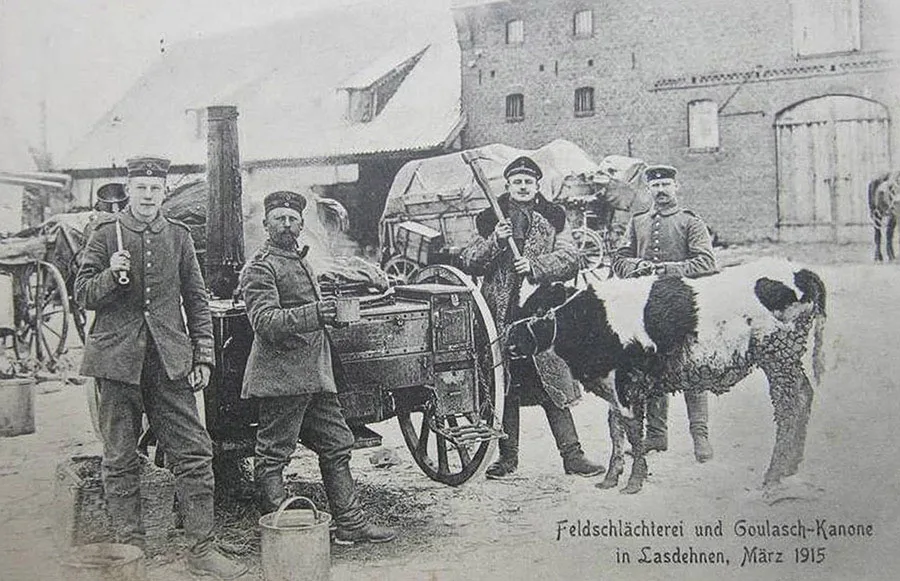 Lunch at a German field kitchen in March 1915.
During the First World War, in the offensive of the Russian 1st Army in August–September 1914, no serious fighting took place near Lasdehnen. From December 1914 to January 1915 there was fighting of local significance around Lasdehnen. On 15.12.1914 Russian troops fought their way into Lasdehnen but were soon driven out. On 25 January 1915 the 3rd Cavalry Division (Gen. Ye. A. Leontovich) of the Russian 10th Army (Gen. N. A. Yepanchin) launched a determined assault on Lasdehnen, but it was halted by German troops (the 1st Brandenburg Cavalry Division and 11 Landwehr battalions). As a reminder of these events, a Russian artillery shell remained lodged in the masonry of the church tower, where it still is today. On 08.02.1915 the German counteroffensive began, as a result of which the Russian army was thrown back to Kovno.
In 1920 a new bridge over the Sheshupe was built in Lasdehnen.
In the 1920s the village had a mill, a brickworks, a sawmill, a dairy, a filling station, a gasworks, a private school and an elementary school, a hotel and a restaurant. In 1932 a ceramic tableware factory began operating. The Lasdehnen rifle club was popular, and its members trained at the local shooting range.
In 1945, during the Insterburg–Königsberg Operation, the plan was to cut off Lasdehnen with five divisions of the 39th Army. Fearing encirclement, the German units left the town on the night of 17–18 January, and on 18 January soldiers of the 315th Separate Machine-Gun and Artillery Battalion (Major N. I. Tashirov) of the 152nd Fortified Region (Col. M. I. Sobolev) of the 39th Army entered it.
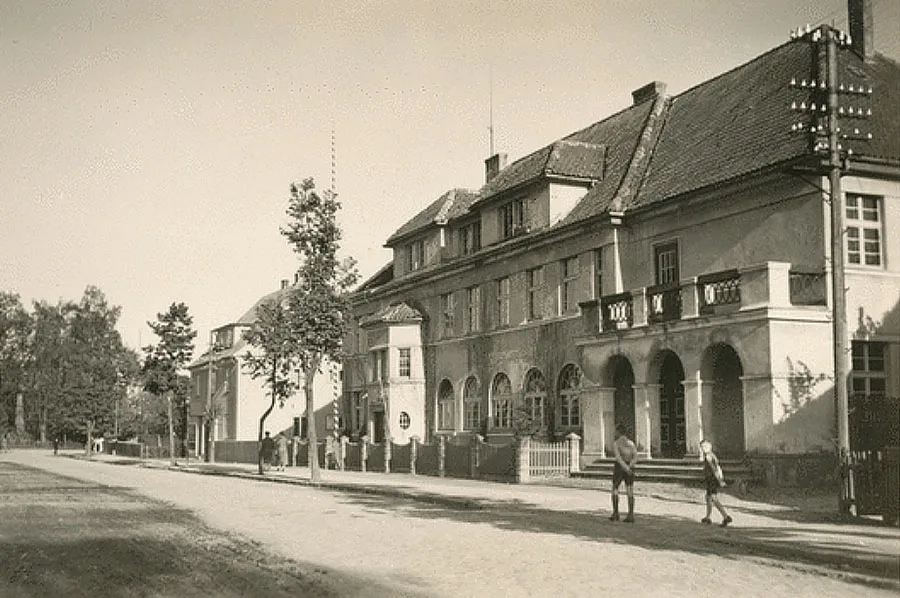 Lasdehnen school for girls.
On 07.09.1946 Lasdehnen was renamed Krasnoznamensk, and the Krasnoznamensk District was created at the same time. Krasnoznamensk received the status of a town of regional subordination, since the nearest pre-war town, Pillkallen (Dobrovolsk), had been badly destroyed. Even before the renaming, a timber enterprise was set up in 1945.
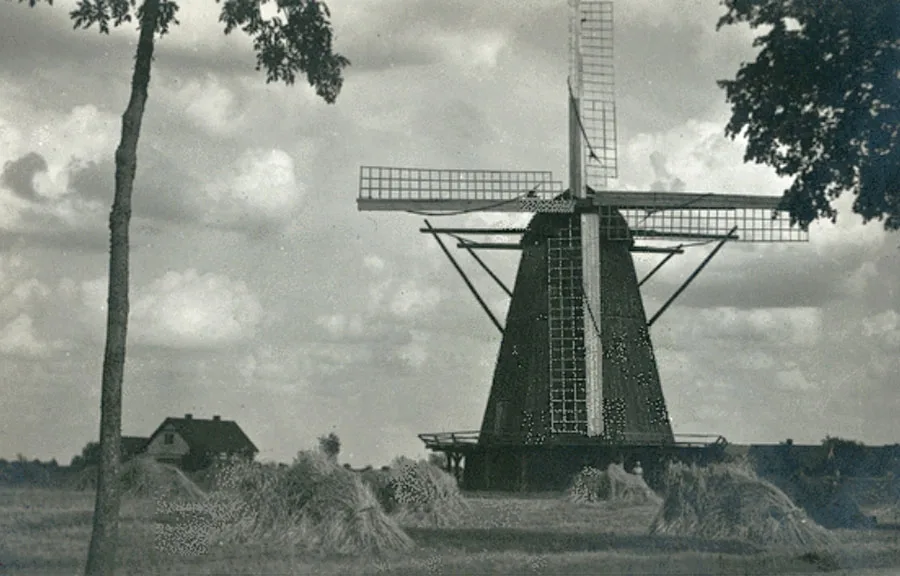 Mill by the road to Schloßberg (Dobrovolsk).
By September 1946 the first 937 families from the Oryol and Voronezh regions had arrived in the Krasnoznamensk District. In 1946 the "Selstroy" office and a tile and brick works were set up. In 1947 a butter factory went into operation, and the forestry enterprise of the "Nemanles" trust began work. Also in 1947 the district newspaper "Krasnoye Znamya" began publication. A bakery and sewing, shoemaking and joinery workshops also opened in the town. In 1947–48, 1,000 sq m of housing was put into use. In 1948 the town administration listed 162 houses. A seven-year school, a kindergarten, a district hospital, an outpatient clinic, a women's health clinic, a library and a hotel were opened. The residents built a bathhouse through voluntary unpaid work days (subbotniks). In 1947–48 a power station was built on the Sheshupe, supplying electricity to the town and the district. A wooden bridge over the Sheshupe was also built.
By 1953 the entire pre-war housing stock in Krasnoznamensk had been restored, and the 200-seat "Oktyabr" cinema opened. In 1954 a 20-bed maternity hospital began operating. In 1956 the butter factory was converted into a cheese factory; its output was 230 tonnes of butter and 28 tonnes of cheese a year. In 1957 a new school opened. By this time the town also had a pharmacy, bank branches, a seed inspection office and a collective-farm market. A town park and monuments to Lenin and to the fallen Soviet soldiers were unveiled. By the end of the 1950s bus services to Neman, Gusev, Dobrovolsk and Nesterov had been introduced. By 1960 a school for working youth had opened, while the power station had ceased operation.
In 1961 regular Kaliningrad–Krasnoznamensk flights began, operated by An-2 aircraft.
In 1967 a new reinforced-concrete bridge over the Sheshupe was built. In 1970 a people's theatre opened, and in 1971 a new 400-seat House of Culture. Also by 1971 a secondary school, a new 320-place kindergarten, a nursery, a second library, a communications centre, a bus station, a polyclinic and a veterinary clinic had opened. The town had all the institutions proper to a district centre: a savings bank, a prosecutor's office, a court, a fire station and a military enlistment office. Later in the 1970s a children's music school, a children's philharmonic (1977), a department store and a consumer services complex were opened. The largest enterprises were the timber enterprise (400 employees), the brickworks (20 million bricks a year) and the cheese factory. In the 1980s a canteen, a fashion atelier, a bookshop and a furniture shop opened in Krasnoznamensk. An asphalt-concrete plant and a peat enterprise began operating. In 1988 a T-10 tank, labelled, however, as an IS-3, was mounted on a pedestal at the exit from Krasnoznamensk towards Dobrovolsk.
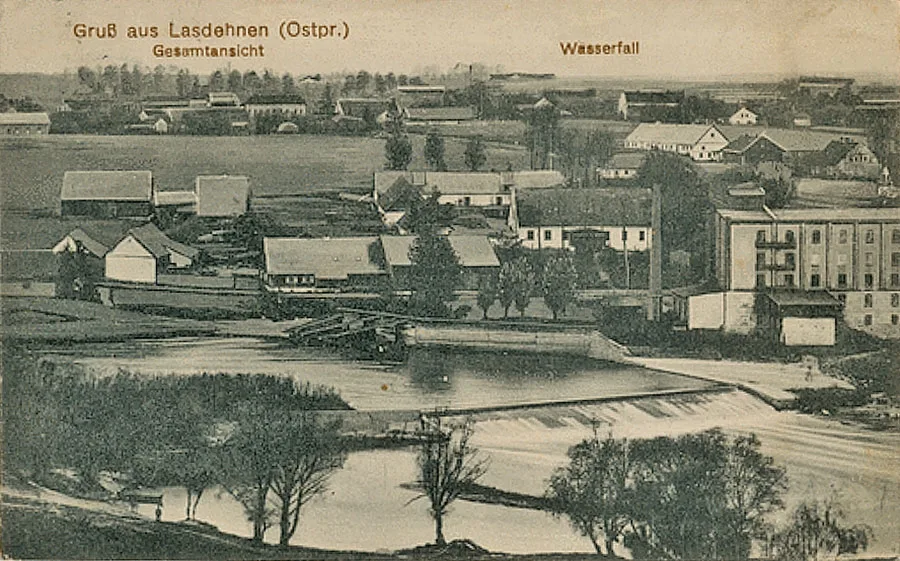 Pre-war postcard showing the weir on the Sheshupe.
The market reforms led to the emergence of a number of small commercial businesses in Krasnoznamensk, but most of them closed within a few years. The state enterprises were turned into joint-stock companies, but most of them likewise failed to survive in the new realities.
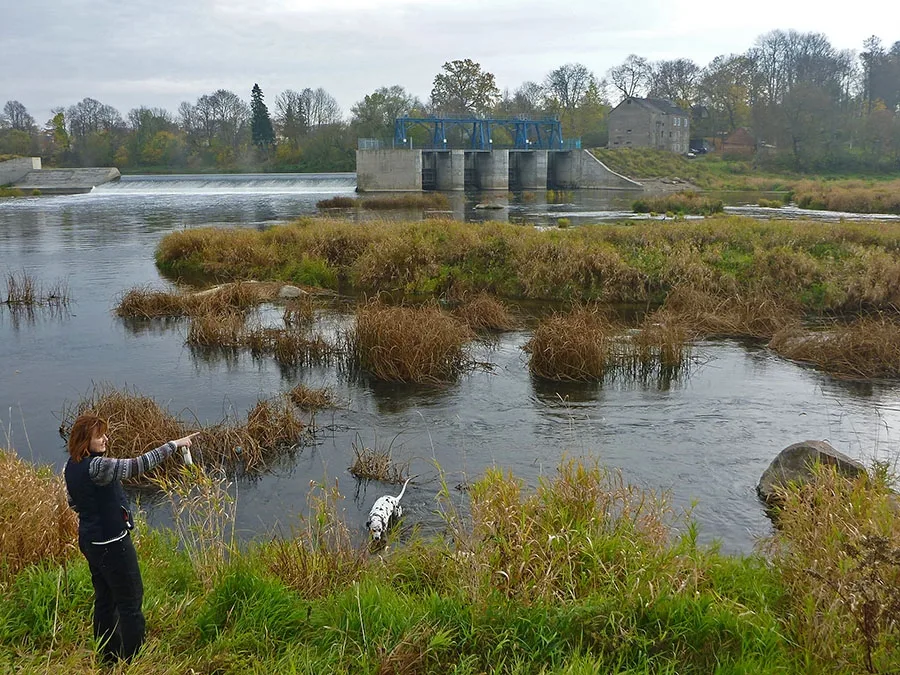 The same weir on the Sheshupe in present-day Krasnoznamensk.
In 2001 the "Agroservis" LLC (formerly "Selkhoztekhnika") closed. In 2003 the brickworks was shut down. By 2010 two industrial enterprises remained: the cheese factory and "Balttorf".
In 2006 the façades in the town centre were restored for the celebration of the town's 275th anniversary. In 2015 a new school building opened in Krasnoznamensk.
In 2021 the T-10 tank was removed from its pedestal, which caused concern about the fate of the monument. However, in June of the same year it was returned to its place. Today the town has a secondary school, a kindergarten, a children's art school, a centre for culture, youth and sport, a central library and a children's library, a district hospital, the "Oktyabr" cinema and a hotel. The district newspaper "Krasnoye Znamya" is published. In 2001–21 the annual international fishing tournament "Krasnoznamensk Vimba" was held.
Sights: the church (1877), a monument to 157 unknown Russian soldiers (1915), a monument to German soldiers (1915), the narrow-gauge railway station building (1901), the T-10 tank on a pedestal at the entrance to the town, a mass grave of Soviet soldiers (over 200 people, monument of 1957), the weir on the Sheshupe, pre-war buildings.
Population: 1816 – 813, 1861 – 978, 1867 – 1033, 1871 – 1031, 1885 – 1294, 1912 – 1578, 1933 – 2065, 1939 – 2070, 1947 (Jan.) – 695, 1947 (Oct.) – 1081, 1959 – 2843, 1970 – 2911, 1979 – 3392, 1989 – 3894, 2002 – 3751, 2010 – 3522 2012 – 3494, 2014 – 3362, 2015 – 3324, 2016 – 3282, 2017 – 3237, 2018 – 3188, 2019 – 3154, 2020 – 3088 inhabitants.
Population composition of Lasdehnen in 1871: Protestant Christians – 1007, Catholics – 21, Jews – 3, children under 10 – 245, literate – 553 (72%)
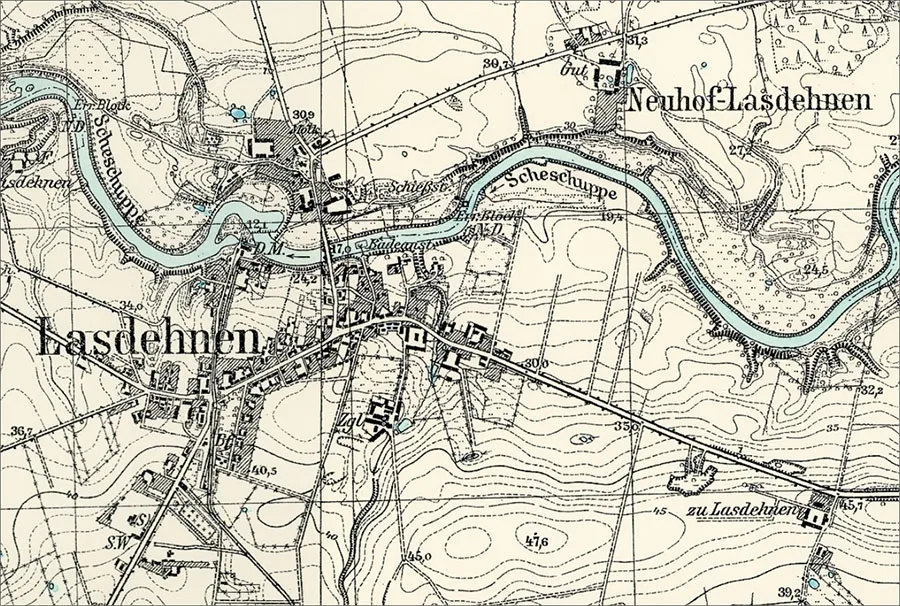
For Reference
Amtsbezirk Lasdehnen. On 08.04.1874 Amtsbezirk No. 15 Lasdehnen was established in Landkreis Pillkallen (Dobrovolsk), comprising three rural communities: Lasdehnen (Krasnoznamensk), Sallehnen (from 1938 Sallen, Vysokoye, part) and Schilleningken (from 1938 Ebertann, Khlebnikovo), as well as the Gutsbezirk (estate district) Neuhof-Lasdehnen (from 1938 Altbaum, Smolenskoye). On 30.09.1928 the Gutsbezirk Neuhof-Lasdehnen was merged with the rural communities of Nickelstanaten (from 1938 zu Altbaum, Smolenskoye, part) and Uszeszuppen (from 1938 zu Altbaum, Smolenskoye, part) into the new rural community of Neuhof-Lasdehnen, which belonged partly to Amtsbezirk Lasdehnen. But as early as 16.09.1929 the community of Neuhof-Lasdehnen moved entirely to Amtsbezirk Jucknaten (Illovayskoye). Three communities remained in Amtsbezirk Lasdehnen: Lasdehnen (Krasnoznamensk), Sallehnen (Vysokoye, part) and Schilleningken (Khlebnikovo); its composition did not change after that.
The parish of Lasdehnen comprised: Alt Skardupönen (from 1938 Königsfeld, 54°57'42'' N 22°31'59'' E), Alxnupönen (from 1938 Altsnappen, Vysokoye), Ambrasgirren (from 1929 Waldlinden, Rossoshanskoye, later Ostrogozhskoye), Antbudupönen (Vormwalde, Berestovoye, part), Bagdohnen (from 1938 Rodungen, Sheykino), Ballupönen (from 1938 Ballen, Polyanskoye), Beiningkehmen (from 1938 Beinicken, Dolgoye), Budupöhnen (from 1938 Sandhöhe, Berestovoye), Forsthaus Dargutschen forestry (from 1938 Forsthaus Siebeneichen, Srednerechye), Endruscheiten (from 1938 Kleinhuben, Udarnoye), Eygarren (Eigern, Zarechnoye, part), Grenzwald (Pugachyovo), Gricklaugken (from 1938 Bönick, Zelenolesye), Groß Darguszen (from 1938 Tanneck, 54°58'22'' N 22°40'00'' E), Groß Wersmeningken (from 1938 Langenfelde, Belkino), Hermoneiten (from 1938 Hermannsdorf, Yolkino), Forsthaus Inster forestry (Sheykino, part), Jucknaten (from 1938 Meißnersrode, Illovayskoye), Kalnischken (from 1938 Hohentann, 54°58'14'' N 22°36'46'' E), Forsthaus Kallwellen forestry (from 1938 Forsthaus Lindnershorst, Polyanskoye, part), Karunischken (from 1928 Königsfeld, 54°58'17'' N 22°32'07'' E), Klein Darguszen (from 1938 Grenzheide, Srednerechye), Klein Wersmeningken (from 1938 Dreßlershausen, 54°54'17'' N 22°23'19'' E), Klohnen (54°54'37'' N 22°21'44'' E), Königshuld (from 1938 Friedrichsweiler, Polyanskoye), Lasdinehlen (from 1938 Sommerswalde, Michurino), Laukehlischken (from 1938 Käsarsruhe, Danilevskoye), Löbegallen (from 1938 Löbenau, Tolstovo), Löblaugken (from 1929 Waldlinden, Rossoshanskoye, later Ostrogozhskoye), Lubinehlen (from 1938 Lubenwalde, Illovayskoye), Maszuiken (from 1938 Blockswalde, Udarnoye), Neu Löbegallen (from 1938 Neulöbenau, Mezhdurechye), Neu Skardupönen (from 1938 Grenzwald, Pugachyovo), Neuhof-Lasdehnen (from 1938 Altbaum, Smolenskoye), Nickelstanaten (from 1938 zu Altbaum, Smolenskoye, part), Payszeln (from 1938 Insterwangen, Lvovskoye), Plonszöwen (from 1936 Waldhufen, Paporotnoye), Rucken (Rossoshanskoye, later Ostrogozhskoye), Sallehnen (from 1938 Sallen, Vysokoye, part), Schillenöhlen (from 1938 Flußfelde, 54°59'13'' N 22°36'27'' E), Schilleningken (from 1938 Ebertann, Khlebnikovo), Schönhof (Zarechnoye, forestry), Sturmen (Paporotnoye), Szogelgalwen (from 1938 Kiefernhorst, 55°01'34'' N 22°35'35'' E), Trakinnen (Danilevskoye, part), Tulpeningken (from 1938 Tulpeningen, Zarechnoye), Tuppen (Podgorodnoye), Uszballen (from 1938 Lindenhorst, Polyanskoye), Uszbördszen (from 1938 Karpfenwinkel, Ostrogozhskoye), Uszeszuppen (from 1938 zu Altbaum, Smolenskoye, part), Uszproduppen (from 1938 Dachsheide, Udarnoye), Forsthaus Wersmeningken forestry (from 1938 Forsthaus Langenfelde, Belkino, part), Weszkallen (from 1938 Forsthusen, Gruzdevo), Weszkallen (from 1920 Waldlinden, Rossoshanskoye), Woitekaten (from 1938 Ostfurt, Zarechnoye).
Present-day photo by Mikhail Ogorodnikov.
Translated from Russian with the help of AI (Claude, Anthropic), October 2026.