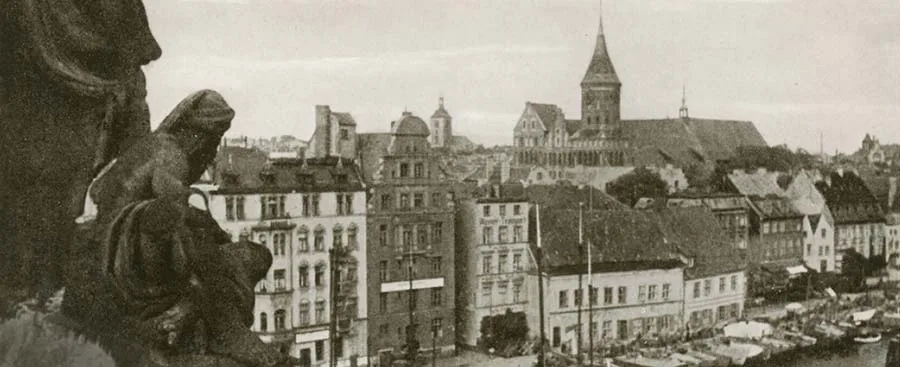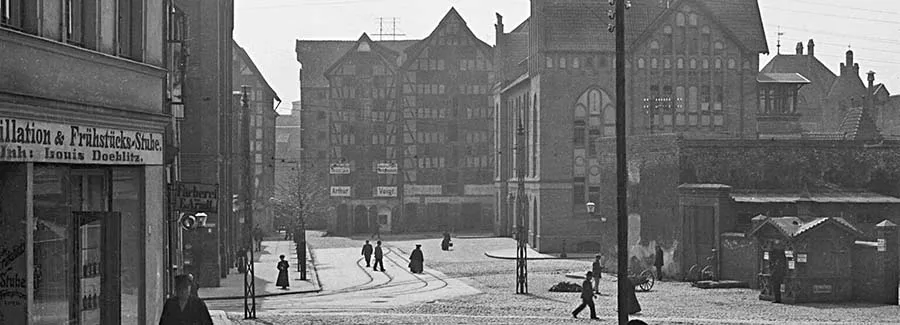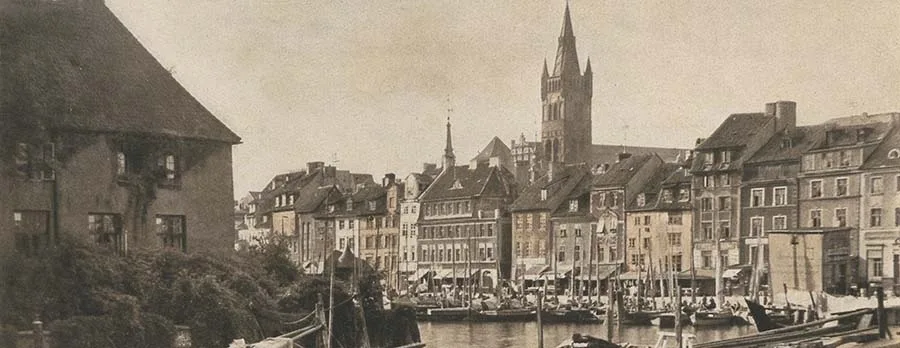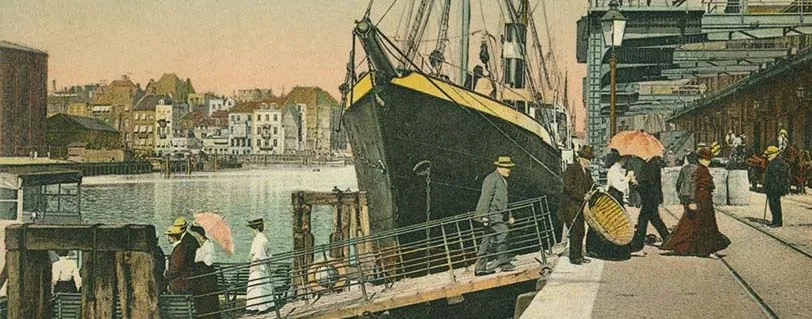
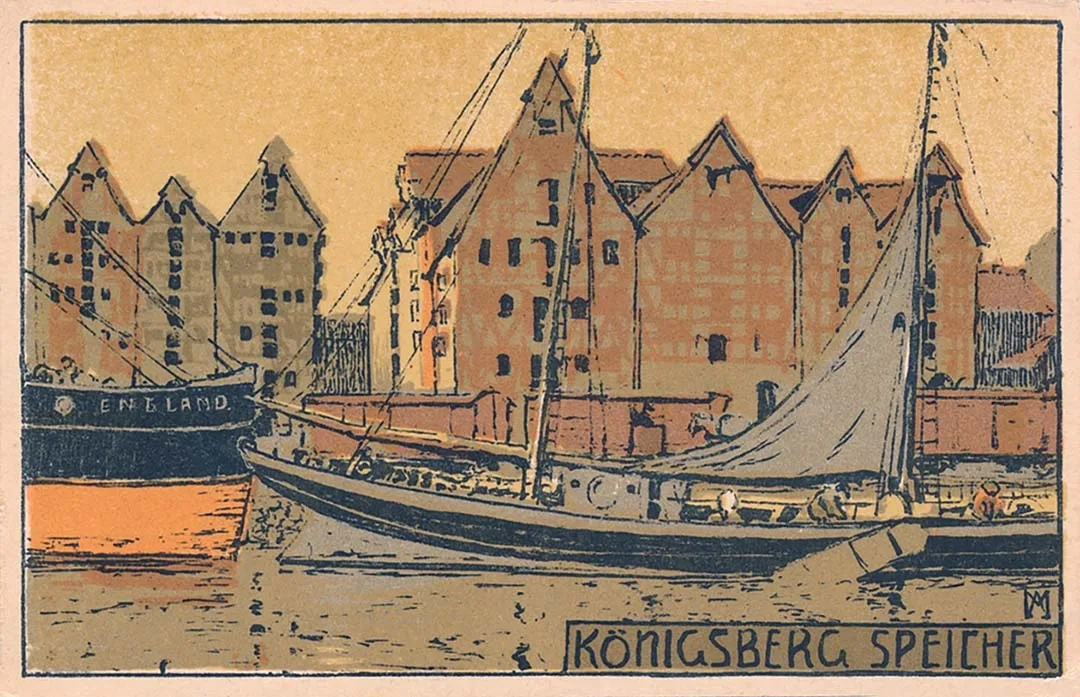
Lastadie (Lastadie), the name of the commercial port of the Altstadt (Altstadt) on the bank of the Pregel (Pregel), comes from the Latin word lastagium, meaning "the loading of ships", which reached the Baltic from southern Europe. At the beginning of the 17th century we find a densely built-up commercial district here. It stretches from the quay on the Pregel (Pregel) embankment along the whole western bank of the Hundegatt (Hundegatt). Besides merchants' offices, half-timbered warehouses (Speicher) and railway goods sheds (Packhaus), there are also a shipyard (Schiffsbauplatz), the Altstadt slaughterhouse (Altstädtische Schlachthaus), a lime store (Kalkhof) and a tar works (Teerhof).
The Altstadt Exchange (Börse der Altstädter) was also here. This district often suffers from floods caused by strong westerly winds.
(Today this is the bank of the Pregolya from the Museum of the World Ocean on Peter the Great Embankment, where the ferry crossing used to be, and on along the Yunost sports complex to the Lastadie hotel, which reminds us of the history of this place. As for the hydronym Hundegatt (in translation, "Dog Strait"), it arose by analogy with the name of the Kattegat strait ("Cat Strait") separating Denmark and Sweden. In addition, one may suppose that the name stresses its narrowness: any dog could swim across it. And the traffic on it is so heavy that you get barked at from all sides while manoeuvring along it. Editor's note.)
The Altstadt Exchange was built of sturdy timber and decorated with Ionic pilasters. In plan it was a regular quadrangle. Its dimensions were 7 metres in length and 5.5 metres in width.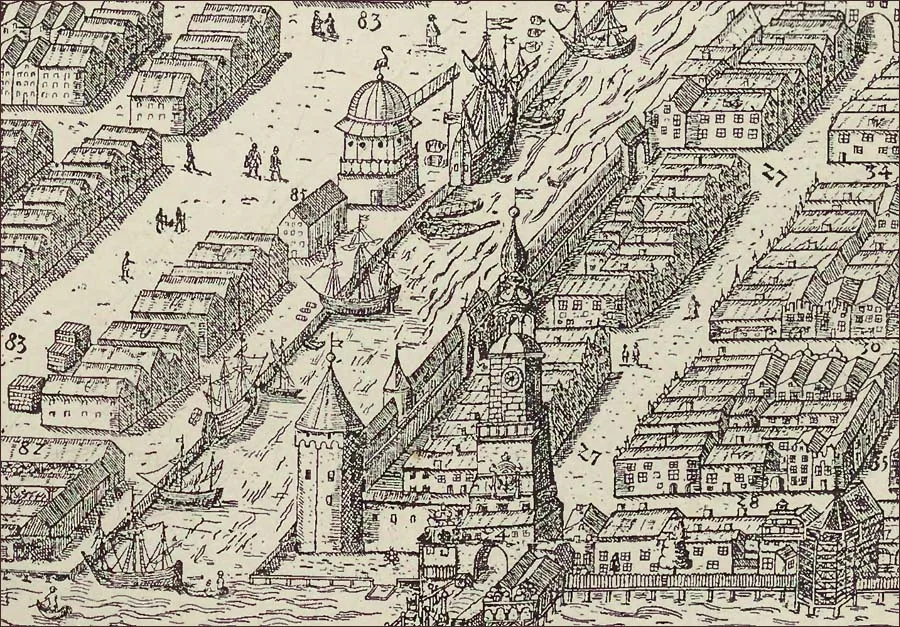 The Altstadt Exchange on the bank of the Hundegatt and the Green Gate in the Kneiphof city wall.
Outwardly it closely resembled the old Amsterdam exchange. Its domed roof was crowned with the figure of a crane. The interior was decorated with paintings whose main subjects were trade and seafaring.
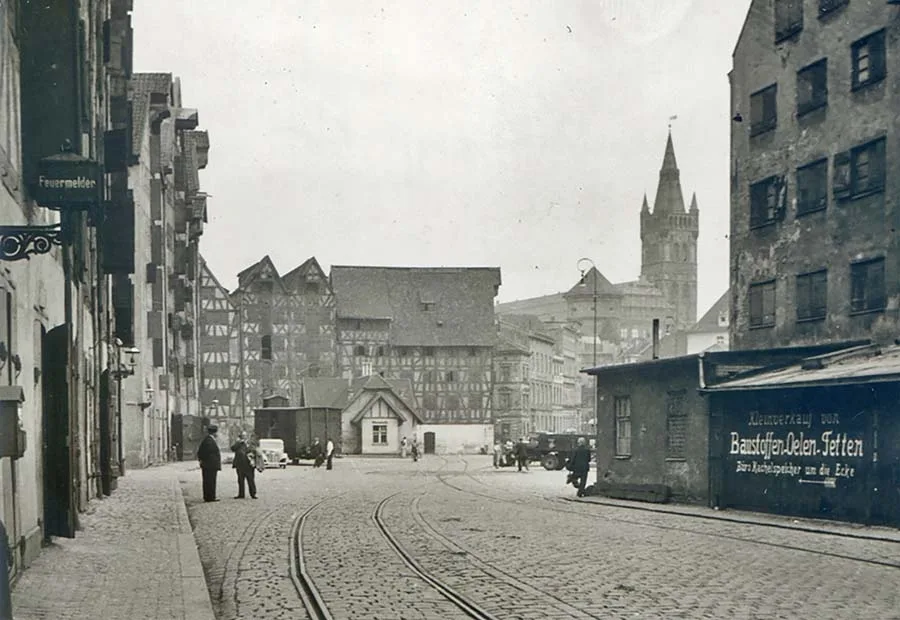 The Lastadie district of port warehouses underlined the Hanseatic character of Königsberg.
Beneath the paintings were oval plaques bearing maxims. A picture of a beehive, for example, is accompanied by this one: "Alone you are nothing" (Nichts vor sich allein); beneath a fountain gushing from the water: "Share it with your neighbour" (Dem Nächsten teil es mit). The names of 36 merchants and officials were placed on the painted window panes. In 1699 the exchange was repaired, but in 1717 the so-called "Red Scales" (Rote Wage) were built onto its outer side, as a result of which the exchange became completely invisible from the water. (In the last years before the unification of the towns the Altstadt exchange was housed on a small barge moored at the Shop Bridge, and later below the Hundegatt, downstream on the Pregel. Ed.) In 1728 the Altstadt Exchange passed into history, giving way to the Kneiphof one (Börse der Kneiphofs), which received the status of the exchange for the whole of Königsberg. The "Red Scales" were also demolished when, in the second half of the 19th century, a railway track was laid to the warehouses and the Bohlwerk (Bohlwerk, a retaining bank reinforcement of thick logs).
The space between the Altstadt Exchange and the Lastadie Gate (Lastadien Thor) was formerly not built up. From the lime store up to and including the Hundegatt the shoreline was reinforced with a Bohlwerk. West of the shipyard there was also the Wood Square (Holzplatz).
The Altstadt timber meadows (Altstädtischen Klappholzwiesen) were here too. Right up to the Dutch Boom (Holländer Baum) there was not a single house. Now neither the old shipyard nor the other medieval structures can be found. In their place are quays and warehouses.
Here steamers are loaded and unloaded, there is a herring warehouse (Heringspeicher), a granary (Körnerspeicher) belonging to the military authorities towers above, and numerous warehouses with Speicher marks stand in rows: Black Eagle (Schwarzenadlerspeicher), Pelican (Pelikanspeicher), Stork (Storchspeicher) and others.
The railway tracks run right along the warehouse streets, which makes the transhipment of goods easier. For the heaviest loads the city acquired a large crane made at the local Steinfurt factory (Steinfurt).
Lastadie Lane (Lastadien Gasse), like the Altstadt Watering Lane (Altstädtische Tränk Gasse) that crosses it, is also built up mainly with warehouses. At No. 3 Watering Lane is the house of the Mennonite Congregation (Mennoniten-Gemeinde). The Mennonites descend from the Anabaptists ("re-baptisers"). They perform baptism not in infancy but in adulthood (at the age of awareness). After their community in Westphalia was destroyed in 1535 and its adherents suffered bloody persecution, one Menno Simons (Menno Simons, 1496–1561) gathered those who remained and founded a new community named after him. The Mennonites took no part in wars and did not enter state service. They lived strictly according to the precepts of their faith.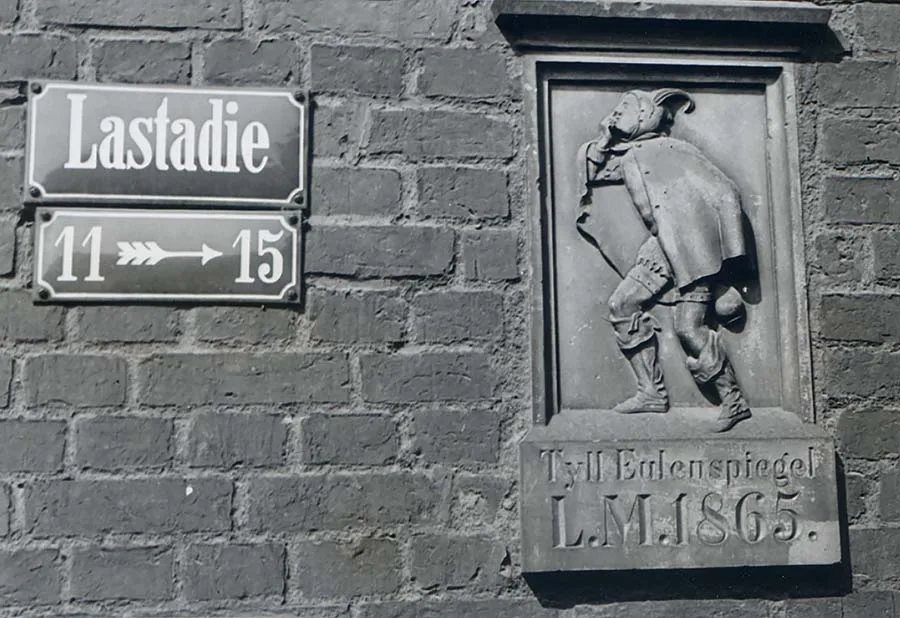 The Speicher mark of Till Eulenspiegel.
In 1711 some of the Mennonites arrived in Prussian Lithuania, which had been depopulated by the plague. In 1722 the community received permission to keep its customs. On 23 August 1763 they began building their church in Königsberg.
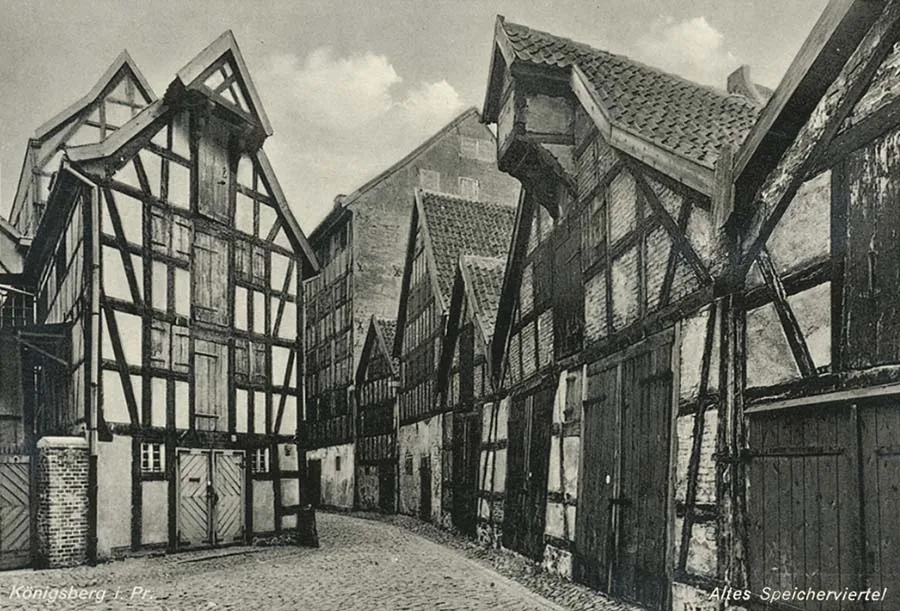
A lane inside the old warehouse quarter.
The Mennonite church in the Lastadie was consecrated on 1 January 1770. (The church has not survived; it stood on the site of the Yunost sports complex. Editor's note.)
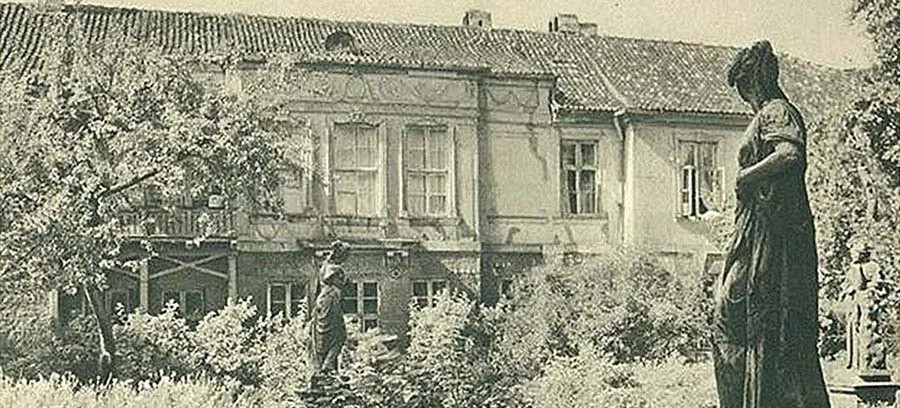
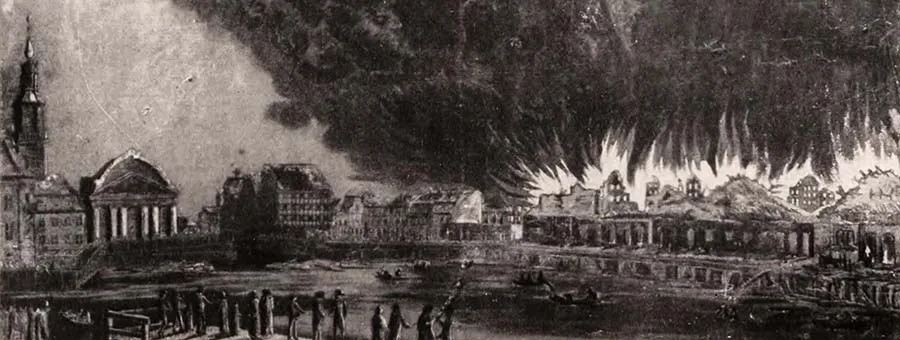
At the corner of Watering Lane and the New Ditch (Neuen Graben) stood the Zschock Foundation (Zschocksche Stift), owned by merchants. The foundation's garden was so magnificent that it became a real sight of Königsberg. It was called the Saturgus Garden (Saturgusche Garten), after Commercial Councillor Saturgus, who was famous for his rich collection of plants. In 1803 the garden suffered badly in a great fire, after which it lost its uniqueness and importance. (Today not even the remains of this garden, which the Russian officer Bolotov admired during the Seven Years' War, can be found. Editor's note.)
Parallel to the New Ditch (now Krasnoyarskaya Street) runs Licent Street (Licentgrabenstraße, now Mariupolskaya Street). In the south they are joined by Customs Street (Licentstraße, now Pravaya Naberezhnaya).
The street names containing the word "Licent" derive from the customs duty levied on goods arriving by water. Large ships are inspected here at the quay wall of the Customs Office (Licenthaus).
Small vessels are inspected by mooring directly at the Dutch Boom in the west and at the Lithuanian Boom in the east. Local names ending in "...baum" (der Baum is German for tree or log) recall the booms across the river Pregel made of logs fastened together. They prevented vessels from entering the city until their cargo had cleared customs. Then one of the logs was unfastened and swung round along the river so that a boat, ship or raft could pass into the port waters. (Let us recall that until 1924 the banks of the Altstadt and the Vorstadt served Königsberg as its port. Editor's note.)
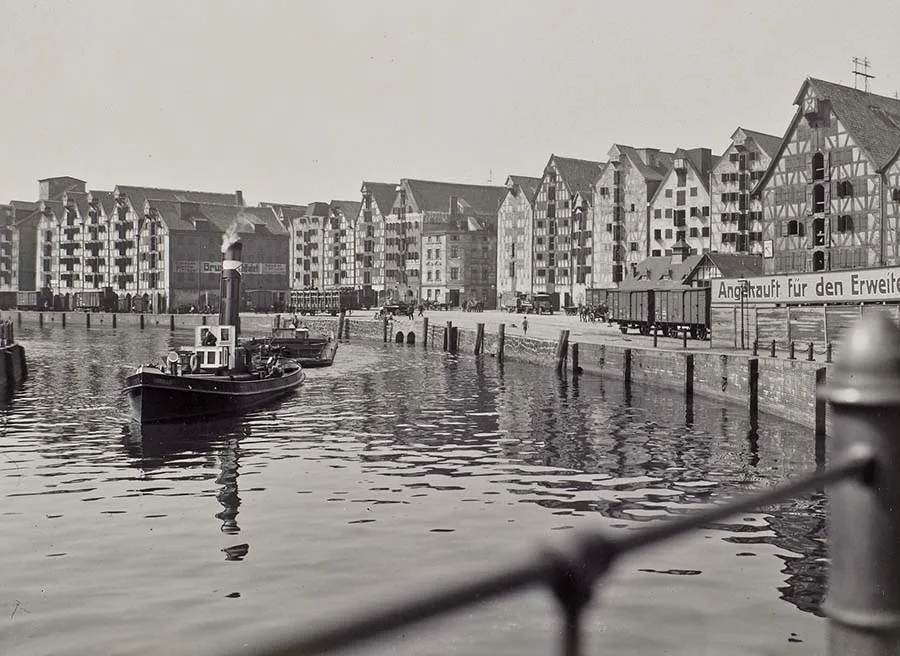 The Hundegatt. A tug pulls a barge along the Lastadie shore.
All goods arriving overland were also taxed. The tax was collected either at the city gates or, for larger and more valuable consignments, at the post office goods shed. Bales, crates and other goods were taken to the freight depot (Packhof), while liquid goods were handed over to the office called the crane administration (Krahnamt).
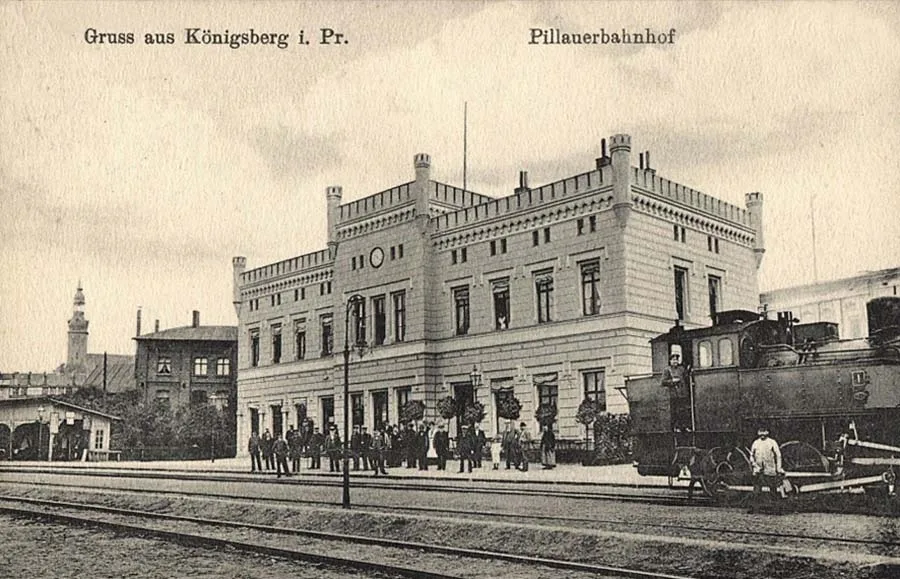 Pillau Station. On the left is the spire of the Neuroßgarten Church.
Goods shipped from Königsberg by water were prepared for transport by the sealing office known as the "Plombage" (Plombage), where consignments were sealed for security. The postal sealing office (Postplombage) received goods arriving by post and dispatched everything carried overland. Today customs duties are levied only on goods imported from abroad.
The old customs house (alte Licenthaus) stood on the left bank of the Pregel, where Fort Friedrichsburg (Fort Friedrichsburg) was later built. In 1665 the customs house was moved to the right bank. On its site there now stands the Main Tax Office (Hauptsteueramt) at 16–17 Dutch Street (Holländerbaumstraße). (This building has been destroyed; it stood at the north-western corner of today's Mariupolskaya Street and Pravaya Naberezhnaya. Editor's note.) Opposite it rises the large customs warehouse building, standing right on the bank of the Pregel.
The Old Customs Canal (alte Licentgraben) used to run close to the building of the Pillau Station (Pillauer Bahnhof), sometimes also called the Customs Station (Licentbahnhof).
Like the East Station (Ostbahnhof) on the left bank of the Pregel, the Pillau Station was built in 1865 practically on a swamp that had first been drained. And now the whole area between Old Canal Street (Alten Graben), named in memory of the old Customs Canal, Dutch Street (Holländerbaumstraße), Licent Street (Licent-Grabenstraße) and Ropewalk Street (Reiferbahn) is occupied by the station complex. The exterior of the Pillau Station building is very austere.
(A considerable part of the buildings here was demolished around 1930 in connection with the construction of the new Holländerbaum station near the Double-Deck Bridge. All that remains of those times today are an old railway bridge and the remnants of an embankment and track. Thus the Altstadt commercial port of the Lastadie occupied the shore strip of the Hundegatt, and in its western part stretched along the bank of the Pregel as far as the Double-Deck Bridge. Editor's note.)
Photos on this page: Bildarchiv Ostpreußen / bildarchiv-ostpreussen.de.
Translated from Russian with the help of AI (Claude, Anthropic), October 2026.