LEGENDS OF PRUSSIA on the blog of Tatyana Kolivay.
It happened in the hot summer of 1839. After lunch I was sitting at the window of my room, engrossed in an interesting book. Suddenly a shadow fell across the page. Thinking it was a cloud that would soon drift past, I went to the window. It had struck six. At that time I lived in a house next to the Burgkirche, a minute's walk from Bergplatz. Above the roofs of the houses opposite I saw thick black smoke spreading. It rose higher and higher, widening and growing ever denser. In the street agitation could already be felt. People looked up at the sky in fright, gathered in groups, looked for a place from which the source of the smoke could be seen, and exchanged anxious glances and questions. I took my hat and cane and hurried towards the Pregel, from the direction of which the smoke was rising.
But when I reached the river, I saw that I had to turn much further to the right. Meanwhile, out of the smoke, which was spreading ever wider in all directions, dazzling sparks kept showering down like meteors.
Passing the street flea market, I saw that the traders were sitting calmly on their chairs. An old woman was absorbed in reading a thick, battered book; a middle-aged man was brushing an old velvet armchair. A young girl in the last stall, where black, yellow and red coffins are sold, was calmly knitting, staring apathetically in front of her. I thought I was finally losing my mind when I saw a horse pulling a cart across the square, on which a rope was stretched between two little poles, and monkeys in red jackets were balancing on it, displaying their innate abilities. A crowd of dzimken1 and children stood goggling at them with such attention that it seemed the whole world could sink into oblivion without disturbing them.
With quick steps I set off across the Honey Bridge2 to the Blue Tower3. Turning round it, I stopped for a moment. The whole bank was packed with people, and boats were darting back and forth on the Pregel. Behind the exchange building4 tongues of flame, like long writhing snakes, were leaping into the sky. Black smoke stretched ominously in all directions, and there was still a dead calm. I heard someone say that a hemp warehouse on the Lastadie5 was burning and that, supposedly, the fire was spreading fast and had already caught the roofs of the neighbouring warehouses. I tried to get through to the Klapperwiese6 district to find out how things stood with my friend, Herr Toussaint, and whether I could be of any use to him, because the warehouse of his trading house was in the danger zone.
As I was pushing my way through the crowd over the nearest bridge, the black smoke suddenly turned greyish-yellow. Like the wings of a bat it spread out over the whole Pregel, so that for some ten minutes almost nothing could be seen.
That moment was very frightening. There was something of the end of the world in it. The sudden disappearance of all objects in a dreadful, suffocating fog was extremely terrifying.
The explanation was that the spruce wood of the rafters of the burning warehouse had burnt through and the hemp had caught fire. But then a breeze came in from the sea, the air began to move, and through large gaps in the smoke one could see now the bridges and the bank crowded with people, now the merrily sparkling flashes of fire.
I walked slowly along the plank pavement to the entrance to the Klapperwiese, where the loading crane stood. The heat was unbearable. Stunned people stood rooted to the spot and, without taking their eyes off the terrible spectacle, involuntarily huddled together. On the Pregel, all the ships anchored near the Lastadie first moved into the arm of the Pregel, closer to the pier, some towards the Holländer Baum7, and the wittinen8 from under the Green Bridge9 towards Lomse10. But when the fire with incredible speed seized the granaries standing behind the Red Crane, when the roof of Toussaint's warehouse burst into flames, when sparks flew far across the river to the suburbs, all the ships, as if on command, began to withdraw to a safe distance.
This flight of the ships took place in solid smoke, which, billowing, seemed to wrap them in many shrouds. To a person with a good imagination it might have seemed that giant ghosts were wandering along the river.
The vessels on our side, by the southern bank, were also forced to leave the spot as quickly as possible. Every minute of delay could cost them dearly, as they risked catching fire from the sparks flying in all directions. Most of them were wittinen. The crews pulled them by ropes, and they crawled slowly along the bank. This general movement of vessels, the haste, the shouting, the smoke, the accidental mishaps: at the loading crane the anchor of a Dutch two-master broke loose and crashed into the water, tearing a piece of plank out of the plank pavement with its fluke.
One might have thought that a naval battle was taking place, or at the very least an earthquake.
So I came to the Klapperwiese, but found no one at the Toussaint trading house. The owner of the firm lived with his family at Rodmannshöfen11, a country estate a mile and a half from the city. One of his sons had galloped off there on horseback to tell the family what had happened, while the other was busy putting out the fire together with the office staff.
I returned to the loading crane. The view of the opposite bank was exactly like the one that had formed in my mind as a child when I read the Revelation of St John the Divine. It was something apocalyptic. The terrifying inferno, the columns of smoke, the people running back and forth like ants, the dreadful fear of what might suddenly happen in the next few minutes, the apprehensive glances — now towards the city, where the streets are so narrow, now towards the suburbs, where houses and warehouses had only just been rebuilt after the last fire. Would the fire leap across there? The caution not out of place amid the turmoil — not to be crushed by carts, horses, soldiers; the growing heat that made the waters of the Pregel steam and the planks of the pavement creak suspiciously — all this was enough to fill a person with a sense of his own insignificance and helplessness before the rampage of the elements.
The heat was becoming ever more unbearable. Water was poured continuously on the hemp warehouses on my side. Fiery prominences cut through the air, sending real fiery arrows towards the Green Bridge and the nearest warehouses. On their roofs crowded people with poles, fire hooks, buckets of water and wet sacks. They were trying to ward off any danger of fire.
The whole group of warehouses up to the herring shed12 was already burning, with the exception, however, of the last one. Toussaint's warehouse, the middle one in the row, had only recently been painted light green when the trading house celebrated its centenary. The half-timbering beams and hatch doors were coated with black oil varnish, and the doors were clad with sheet iron. The warehouse held out for a long time, although inside the fire was already blazing and raging.
But then the roof burst, and the flames shot high into the sky. The façade of the building, however, behaved like a knight with his visor lowered. Its doors were still tightly shut, and only now and then a terrible crack shook the air. Everything around already lay in ruins; this building seemed to want to defy the fire. When the smoke cleared a little and the flames lit it up brightly, the black hatches looked so grim and so contemptuous, and the green of the walls so peaceful, as if it were unthinkable for them to turn into charred debris like everything around.
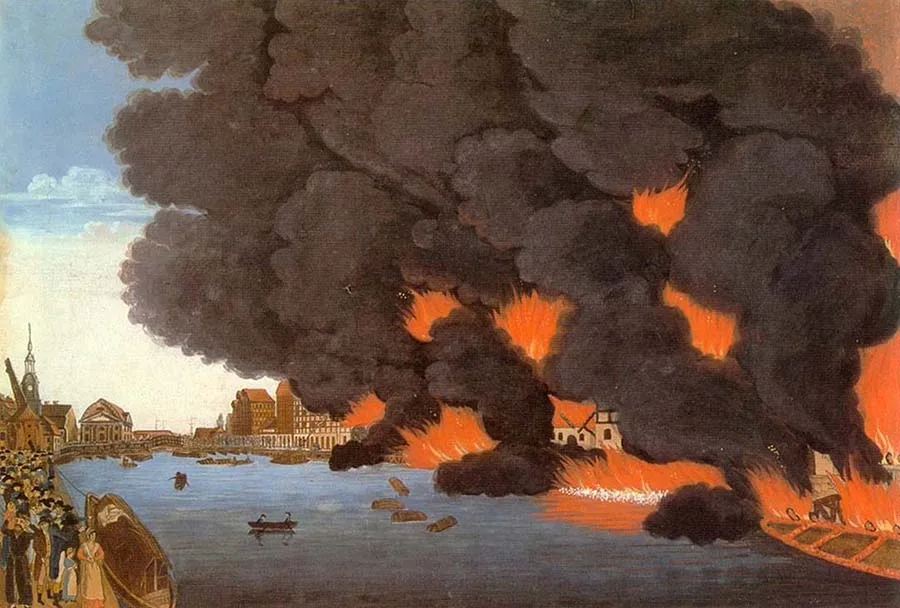 The Königsberg Vorstadt suffered two severe fires at the end of the 18th century.
But then suddenly all the hatches burst open almost at once, fire broke out of them like an enraged dragon, and in an instant engulfed the venerable building from top to bottom. An unforgettable moment.
From here the stream of flame rolled on to the herring shed, a long, single-storey plain building on a bend of one of the arms of the Pregel. At first the structure smoked. Then for several minutes its roof "sweated": liquid gathered on it, giving off a suffocating smell — sharp and bitter. Then the frame of the building flared up at the corners, and the flames danced merrily in the rafters, the way the little lights of festive illuminations flicker in a breath of wind. Here and there leaps, pirouettes, the whirling of scarlet tongues… As if these were playful fire spirits revelling at their feast and flying back and forth with demonic speed. They made a vivid contrast to the grim resistance that the Toussaint warehouse had put up against the fire.
The fire went no further. Through the efforts of the valiant fire brigades, as well as young merchants and soldiers who tirelessly fought the fire with water pumps13, the fire was prevented from spreading towards the city. The direction of the wind also became favourable. Cart after cart of flax and hemp left the neighbouring warehouses. From this moment on the fire belonged to history and to the onlookers, who could now, without any fear, calmly enjoy the spectacle of its dying down.
It struck nine. The cavalry trumpets and the infantry drums sounded the tattoo. These signs of the ordinary peaceful order of life, the measured striking of the tower clocks, the long-drawn notes of the trumpets and the hoarse roll of the drums had a magically soothing effect. They contrasted extraordinarily with the spectacle of catastrophe just witnessed, the general agitation, the horror at the destructive force of the elements.
When the firemen left the quay and the bridge was cleared of the crowd of onlookers and occupied by soldiers, when the fire was finally put out and the mood of the public began to change from the uncertainty, panic and anxiety that had prevailed until then to grumbling, speculation and the search for new spectacles and pleasures, hundreds14 of priestesses of love did not fail to appear on the streets, and extraordinary manifestations of the coarsest sensuality could be observed all around. Here and there one could see girls and men, with coarse jokes and laughter, disappearing in pairs into the streets of the suburbs, the lanes between the warehouses, the nearby avenues and even... the bushes. Once again the ancient bond between cruelty and lust triumphed. The greater people's tension had been until that moment, the more unbridled their release became, turning into licentiousness.
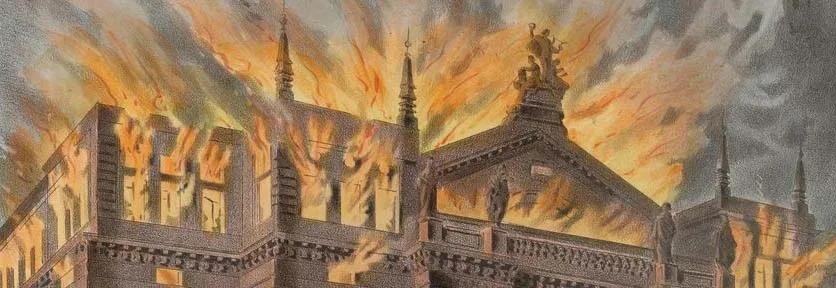
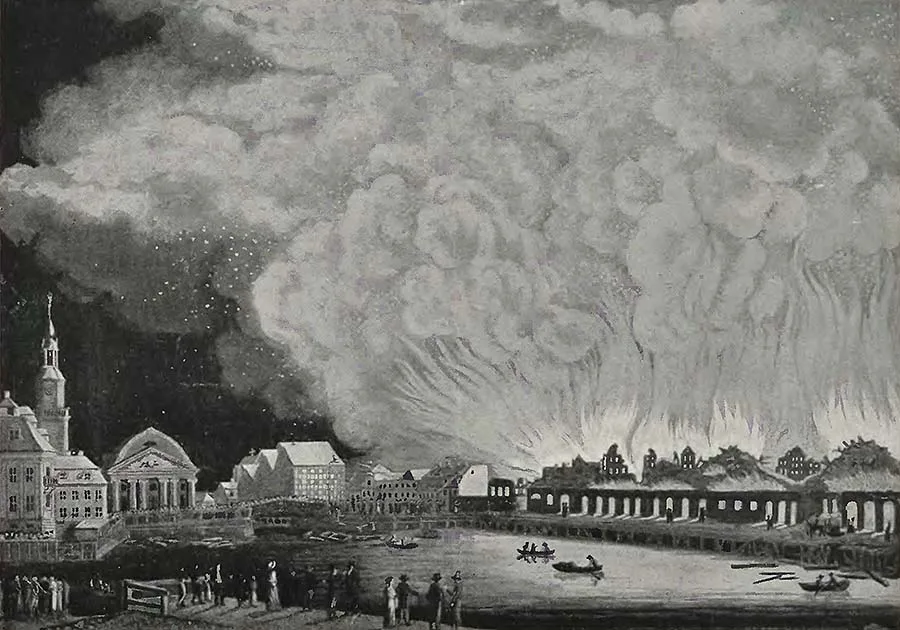 The night fire in the Vorstadt in 1811.
The spectacle the Pregel presented was worth a great deal. On the water, saturated with heat, anthracite-black streaks wandered, and the waves glittered like gilded polished steel.
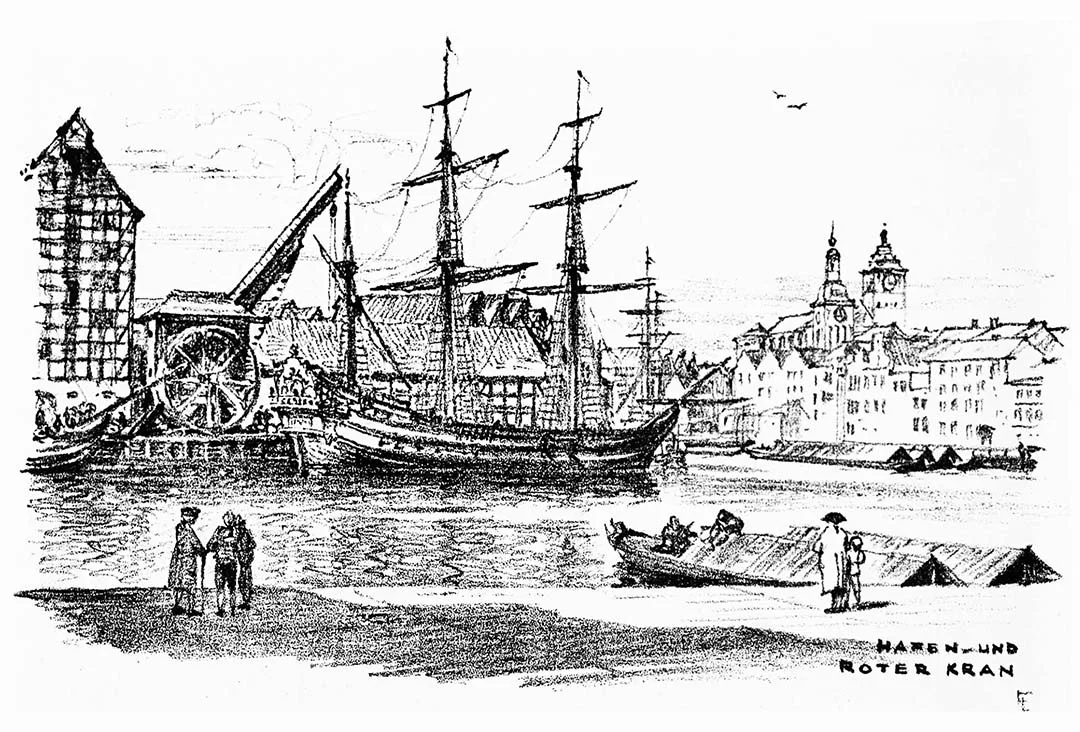
Large barrels of burning oil and spirits floated on the river. Guard ships manoeuvred back and forth along the quays and the Green Bridge, because the fire on the Lastadie had not yet been fully extinguished, the plank pavement was burning, and fiery sparks were still flying through the air. But the centre of everyone's attention was undoubtedly the Red Crane, which stretched up through the fire to the sky, vanishing into it when the flames flared up strongly and reappearing again. It alone remained standing. The flames in the burning warehouses sounded in different ways: now as a rattling crackle, now as an even hum, now as a dull rolling rumble — as if earth were being shovelled onto a coffin lid. Suddenly the Red Crane let out a creaking sigh. Its mighty iron frame shuddered and jerked, but held. All its wooden casing had already burnt away, the fire had devoured the treadwheel — the crowd impatiently awaited the fall of the giant.
Of the crane only the iron skeleton remained, its simple lines glowing in the flames, but it stood until the foundation gave way, until the fire had eaten through the planks of the pavement. And as soon as this happened, the crane collapsed at once.
It was about ten o'clock in the evening; from that moment the spectacle of the fire, beautiful in its horror, remained almost unchanged throughout the night, and the crowd of spectators gradually dispersed.
I did not go to bed until one in the morning. The night passed quietly, and in the morning the drums and trumpets sounded again for the changing of the soldiers' watch. The third of August had come, the birthday of Frederick William III15. At nine in the morning I was to give a ceremonial address in the hall of the German Society, and although I did not believe there would be a single person there willing to listen to me, I had to set off all the same. Fortunately, the subject I wished to speak on was the hegemony of Prussia in Germany — at least thoroughly patriotic and not too far removed from current affairs. Some fifty or sixty listeners gathered, and I delivered my address, after which I immediately hurried back to the Pregel.
The air was warm and damp; now and then rain began and stopped at once, and bright sunshine gleamed through the misty haze. When I came out onto the Green Bridge, the sight that opened before me was extremely picturesque. Numerous ladies in splendid morning toilettes thronged the bridge and the quay.
These snow-white dresses, colourful shawls, coquettish parasols, these lively rosy faces shooting glances, these lazy steps on a leisurely stroll — all this contrasted strikingly with the scene of devastation on the right bank of the Pregel.
The eye missed the familiar perspective. All the images so deeply imprinted in us — the granaries, the warehouses, the crane, the herring shed — had vanished and no longer existed. Black and red skeletons, like the bones of an ancient extinct beast, stuck up lifelessly from the site of the fire. Huge heaps of rubble, charred mountains of maize, bales of flax covered with a thick crust of soot, fragments of barrels and beams lay in disorder everywhere. In the hollows between them were huge puddles of dirty water, on which circles spread from the drizzling rain.
Here and there something was still burning, the ruins were smoking, and the smoke billowed picturesquely in the air, seeming to collide with the black-blue rain clouds hanging low over the ground. Further off, beyond the Holländerbaum, beyond the gleaming mirror-like surface of the river, one could see the fluttering sails of ships crowded together like the flotilla of some unknown land. It was a magnificent sight. The smoke drifted in the same direction and for moments covered both masts and sails with an impenetrable veil, until they reappeared on the horizon.
I made my way to the ruins. The houses adjoining the warehouse district had been abandoned by their inhabitants. The walls and roofs were soaked through, most of the windows were broken, and empty rooms without furniture looked forlornly out of the window openings. All around, life was still in full swing. The pumps were still pumping water copiously. The firemen kept the passages clear to prevent people from crowding where now a piece of wall, now a beam would fall from time to time.
Near the herring shed an unimaginable commotion suddenly arose — the herring had been offered to anyone who wanted to take it. The people threw themselves into this peculiar entertainment with enthusiasm. With incredible greed, young and old — children, men, women, old people — snatched herring from under the debris soaked with stinking smoke. Everyone tried to grab as much as possible. In the general frenzy that arose, no one cared about their clothes. Herring was stuffed into boots, inside shirts, into all pockets, into hats. Cursing, laughing and raging, people often snatched the booty out of one another's hands. The spectacle was truly gripping and horrifying.
Watching this savagery, these primitive, instinctive grabbing movements, the goggling eyes, the coarse shouts, the roaring and wailing, the reckless behaviour (especially of the fair sex), it was easy to understand to what bestiality people can sink fairly quickly.
And in the neighbouring streets herring was already being sold briskly, laid out on the doorsteps of the houses...
In the evening I drove to the site of the fire again. Around the Castle Pond pistol and rifle shots rang out in honour of the one who was celebrating his name day on the third of August. Kettledrums thundered, rockets crackled as they were launched. The streets were brightly lit; the illuminations on Französische Straße were especially festive. Vases of flowers had been set out everywhere. Everything was very merry; people smiled carefree and enjoyed themselves as if nothing had happened. Truly, the digestive system of a metropolis with a population of seventy thousand is very powerful.
Between eight and nine in the evening I found that the site of yesterday's fire was completely deserted. Only those who had to be there were present, while the public sought its pleasures elsewhere. Multicoloured smoke was still rising from the ruins of the herring shed. It took the most intricate forms — now streaming majestically upwards, lit by the sunset in tender pink and ghostly pale green hues, now creeping along the ground. For several weeks the site of the fire went on smoking…
LEGENDS OF PRUSSIA on the blog of Tatyana Kolivay.
NOTES
1. Dzimken — a word borrowed from the Polish ziomek, masc., 'fellow countryman'; also dschimke, schimke. A name for Polish raftsmen and boatmen in former East and West Prussia.
2. Honey Bridge (German Honigbrücke). One of the seven bridges of Königsberg. For more about it, see the LINK. On the bridges of Königsberg, see the LINK.
3. The oldest structure on the island of Kneiphof was a fortress tower, the Blue Tower. It stood in the south-eastern part of the island, not far from the Honey Bridge. It was built in the 14th century, at about the same time as the Cathedral. For centuries it was used as a prison. It was demolished after the Second World War.
4. Exchange — in the third quarter of the 19th century the exchange building stood on the island of Kneiphof, directly opposite the spot where the Exchange (the Museum of Fine Arts) stands today.
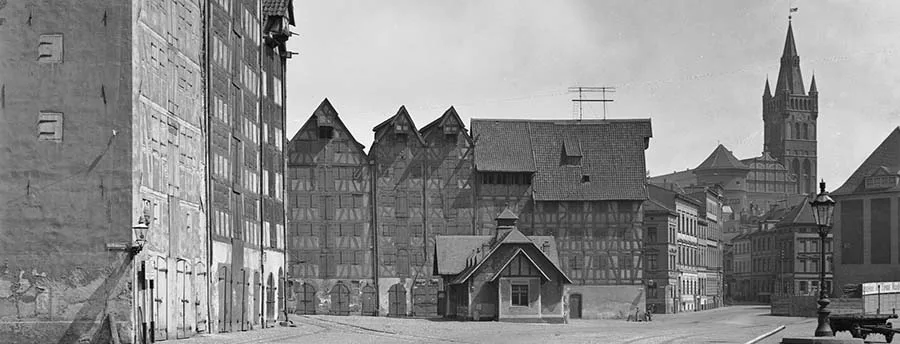
5. One of the main symbols of Königsberg was its Lastadie (German Lastadie) — a district of old half-timbered warehouses, the so-called Laak district. For more about them, see the LINK.
6. Klapperwiese (German Klapperwiese), literally "riveted meadow". Another name was Venice Island (German Insel Venedig). The numerous ditches cutting through the land near the Pregel were jokingly compared to the Venetian canals. The name is first recorded as a colloquial one in 1737 and received official recognition in 1763. LINK .
7. Holländerbaum (German Holländerbaum) — a customs post on the Pregel. During the construction of the bastions (1626–27), two new barriers were laid across the Pregel, the Dutch and the Lithuanian. They not only closed the river for the night but also served as an important part of the customs boundary erected around the city by the Elector's administration. With regard to ships and other craft, the barrier guards had roughly the same duties as the tally clerks at the city gates had with regard to carts and sledges.
8. Wittinen are the rafts of the dzimken /see note 1/. Wittinen were often 500 to 600 feet long or more.
9. Green Bridge (German Grüne Brücke). On the bridges of Königsberg, see the LINK.
10. Lomse — one of the two islands of Königsberg. Today it is called Oktyabrsky.
11. The author gives the place as "Rodmannshöfen".
12. Herring shed /barn/ (German Heringsbracke).
13. These old-time water pumps were called Prahmspritzen (German), or Prahmowa (Polish). Since "Prahm" means "barge" in German, it may be assumed that the pump equipment itself was mounted on a barge and the water was pumped from the river.
14. Thus in the original ("Hunderte von Hetären...").
15. Frederick William III (1770–1840) — King of Prussia from 16 November 1797. Son of Frederick William II and Frederica Louisa of Hesse-Darmstadt, great-nephew of Frederick II the Great, father of the Russian Empress Alexandra Feodorovna, wife of Nicholas I, and grandfather of the Russian Emperor Alexander II.
Translated from Russian with the help of AI (Claude, Anthropic), October 2026.