Introduction
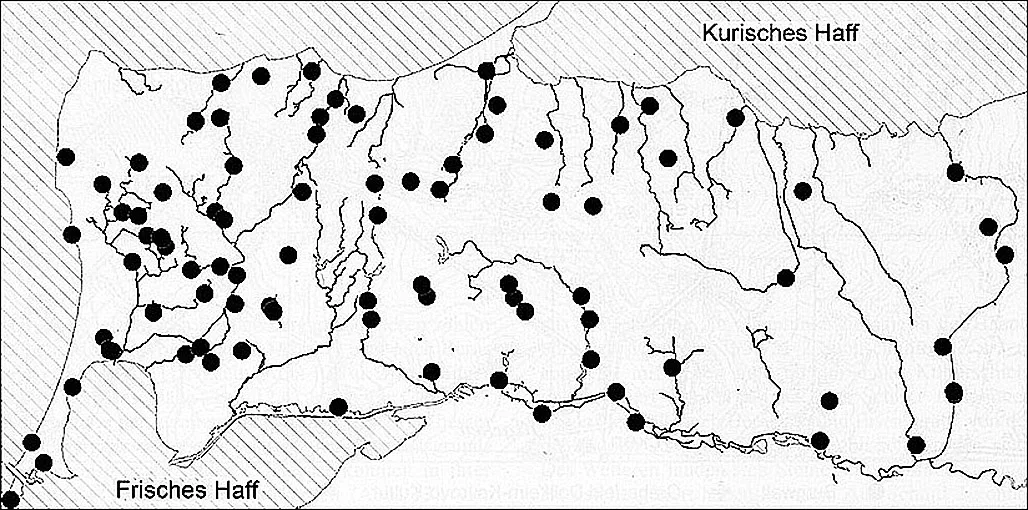
On pre-war topographic maps these sites most often appear under the German names “Schlossberg” (castle hill), “Burgwall” (embanked castle), “Hausenberg” (Haus castle on a hill), “Schanzenberg/Alte-Schanze” (hill for shelter / old refuge), “Schwedenschanze” (“Swedish” shelter, or more precisely a later calque (after 1630?) of the Baltic swent-švent, which earlier indicated the holiness of the place), “Hünenberg” (“giants’ hill”, a name from folk etymology). Other names occur too, including hybrid Prussian-German ones such as Pillen-berg/Pill-berg (Old Prussian Pils — castle, German Berg — hill), and sometimes surviving Prussian names of castle hills: Pilgar(bs) (gārbs — hill in Old Prussian), Worpillen (from Old Prussian “old castle”, from Old Prussian Wārs — old + castle), not to mention the genuinely Prussian names of localities such as Galtgarben or Wargen. Thus the folk-etymology names recorded on maps themselves partly tell us about the original purpose of these structures.
Castles, refuges, places for public gatherings, sanctuaries — these are only some of the functions that the hillforts of the Prussians could perform.
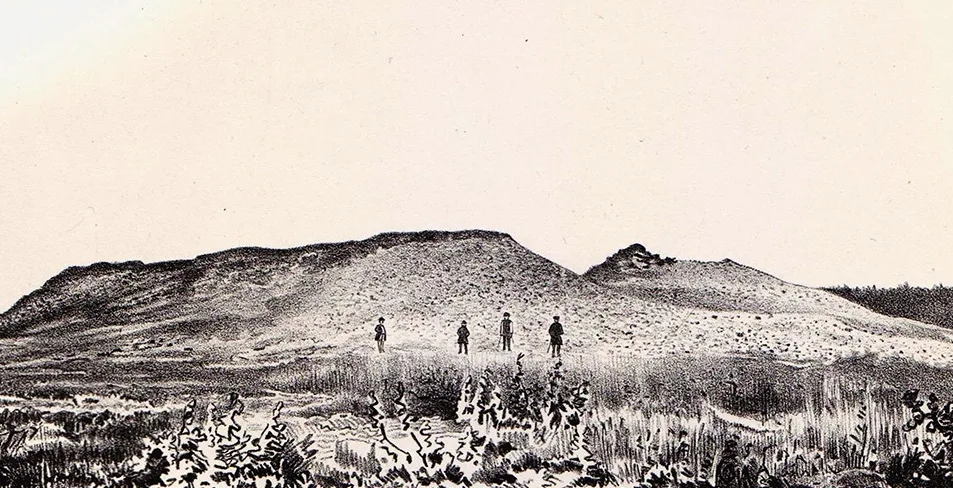
As early as the late 17th – early 18th century these sites attracted the attention of historians. The first researcher of the Prussian hillforts (castle hills) and other earthwork fortifications was Lieutenant Johann Michael Giese, who in 1826–28 recorded more than 300 such sites here. Later other researchers turned to them as well — for example, Emil Hollack, who marked the Prussian hillforts known to him on his 1908 archaeological map of East Prussia. By 1940 most of the Prussian hillforts had been catalogued by Hans Crome, who furnished his catalogue of the Sambian (Samland) hillforts with good landscape plans, some of which are presented in this publication, for instance in the figure above. Carl Engel also studied the Prussian hillforts intensively (much of his work remained unpublished in his archives ).
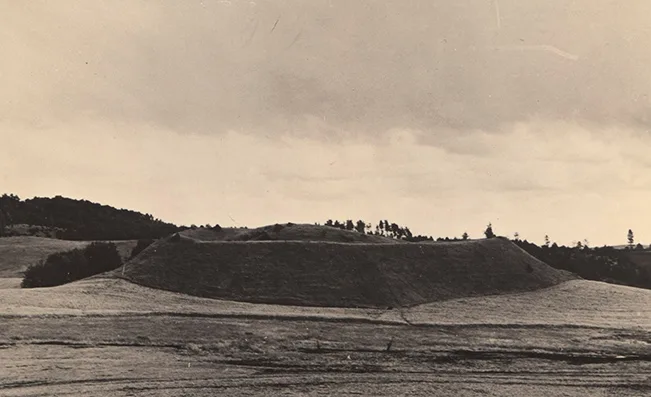
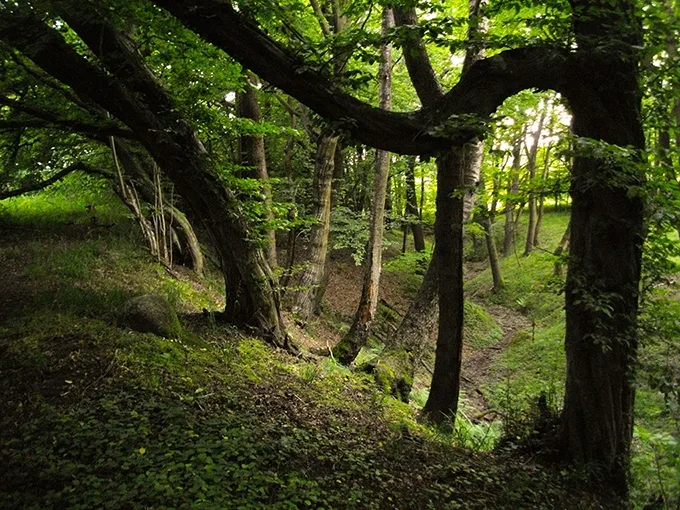
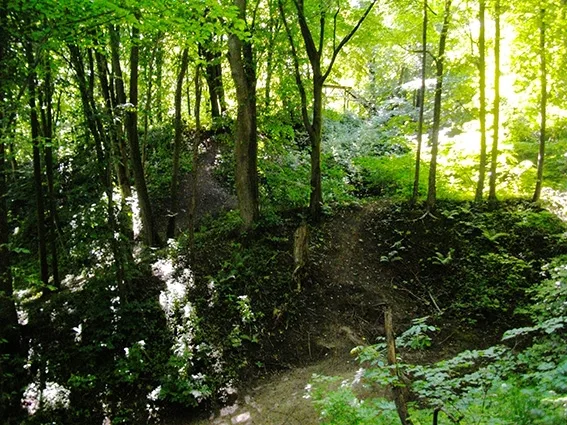
Prussian hillfort at Jeziorki, Poland.
Carl Engel Archive, part of the R. Grenz Archive, Schleswig.
Soviet researchers also worked on the Prussian hillforts as far as they could: Frida Gurevich (excavations at the Grachevka-Pillenberg/Kraam hillfort), Vladimir Kulakov and others. A fuller historiography of the study of these monuments is given in Leonid Yefremov’s 2005 article “Prussian Hillforts”. The comprehensive work on the hillforts of Sambia is the dissertation of Antje Wendt, defended in Kiel in 2011. One could talk for a very long time about the archaeological, landscape and tourist value of the castle hills of the Prussians.
But of greater interest to me is what the descendants of the builders of these hillforts themselves thought about them — people who by the 19th century had become part of the German-speaking civilisation of the Baltic Sea. What did they and the other inhabitants of East Prussia see in these earthen “pyramids” left by someone in the shady forests?
The East Prussian tales about the Prussian hillforts, recorded by Reusch, Temme, Engel and others in the 19th and the first third of the 20th century, despite what may seem to some their frivolity, preserve more archaic layers of world view — if not going back to the period when these sites were built (many of them are more than 2,000 years old), then reflecting the moment of collision and confrontation between the Prussian and German cultures, as well as the reaction of the everyday Christian world view to a different way of life, culture and customs — the paganism of the Prussians.
The earthen pyramids of Sambia
Let us turn first to the tales connected with the hillforts of the Sambian Peninsula — the most important administrative and cultural centre of the Prussians. More than fifty such legends are known. Their plots often overlap with folklore sources from other regions of the Baltic Sea, which points to a common layer of pre-Christian beliefs later woven into the fabric of the superstitions of Christian Europe.
Since the largest hillfort of the Sambian Prussians, Galtgarben, and the legends connected with it have been discussed here separately, let us turn to an equally impressive Prussian castle known as Gross-Hausen — Gross Hausen or Hausenberg, located a few kilometres north-west of the village of Russkoye/Germau (Zelenogradsk District). The hillfort has impressive dimensions of 120 x 50 m and a height of about 20 m from its foot. It is surrounded by three high ramparts and deep ditches.
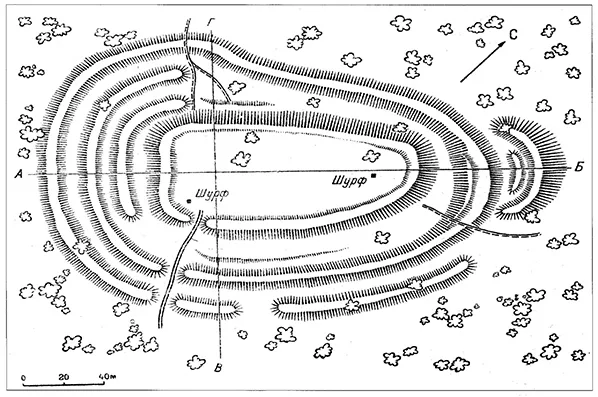
Plan of the Prussian hillfort of Gross-Hausen (the Russkoye-II site).
Drawing from Frida Gurevich’s 1960 book.
Such a hill, rising 89 metres above sea level, could hardly go unnoticed by the people living around it and by travellers passing by.
One of the tales about the Hausenberg runs:
“A man from either Gross or Klein Kuhren once set off for Germau on New Year’s Eve. When he approached the bald hill of Hausen, to his no small surprise he found a magnificent castle standing on it. He had never in his life seen this castle, though he often travelled that road. Without thinking twice, he turned his cart up the hill. The castle gates were open. When he went in, he saw smartly dressed underground dwellers making merry at a feast. They invited him to the table. The peasant ate, drank and danced. But then he remembered that he had to go back. When he began getting ready for the road, the underground dwellers called out to him that it was not right to leave empty-handed. ‘Give us your sack!’ — they shouted. The peasant thanked them for their kindness, heaved the full sack onto his shoulder and went to his cart. Having thrown the sack into the cart, he decided to look at what they had given him after all. Oh, how displeased he was — the whole sack was full of horse dung! But the sack itself might still come in handy, so he shook the muck out and went on his way. But back at home, shaking out the sack, he found in its corners, where the remains of the dung were, coins of pure gold! Many local people know that every New Year’s Eve a beautiful castle rises from under the earth on the Hausen.”
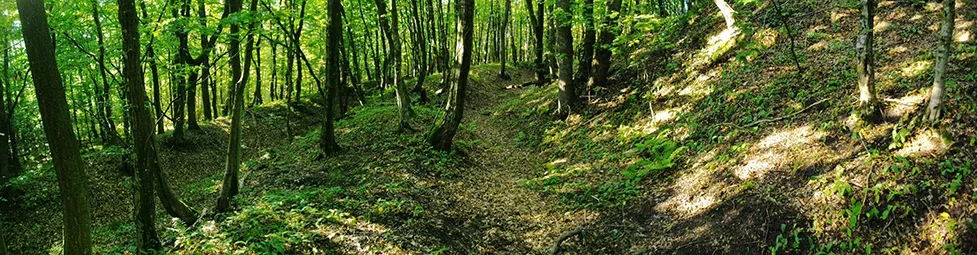
Panorama of the ramparts of the Prussian hillfort of Gross-Hausen (Russkoye-II).
Photo by the author.
The second legend tells of “The Maiden of Gross Hausen”:
“In the cursed castle on the Hausenberg lived an enchanted maiden. To free her, one had to drive up the hill backwards in a cart in which all the parts were turned the other way round. One young man rearranged all the parts of his cart as required and set off up the hill. But he forgot to turn round one nail in the shaft. The maiden, seeing him, began to cry: ‘Turn the nail in the shaft, turn the nail!’ But it was too late. And in that very hour the castle sank into the earth together with the maiden.”
There is also a third legend about the Hausenberg hillfort near Germau, from Reusch’s collection:
“The Hausen is the highest hill in Samland after the Galtgarben. In this hill, they say, a great treasure is hidden. And these are not empty words — some have had the chance to see it with their own eyes. The grandmother of the widowed Schulz, who still lives in Rauschen, served as a housemaid in Germau in her youth and was once sent with a farmhand to the Hausen to gather mushrooms. In the dense undergrowth they soon lost sight of each other. Then the farmhand noticed right in front of him a big heap of gold shining brightly in the sun. Around it, coiled in a ring, crawled a thick black serpent. The serpent kept looking at the farmhand as if it wanted to say: ‘Go on, take the money! Take the money!’ — until at last the farmhand could bear it no longer and scooped up so much gold with his basket that it was full to the brim. To the farmhand this seemed a great deal, but the golden heap seemed not to have grown any smaller. Then the farmhand quickly pulled off his shirt and stuffed it with gold. But he could not carry any more, and he remembered that it would be good to call the poor girl so that she could take the rest. And no sooner had he begun to call his companion than such a noise and whistling arose on the hill that his weak voice was lost in it. From the thick clouds a piercing voice was heard: ‘Pour out the money! Pour out the money!’ The farmhand was badly frightened and, after hesitating a little, staring now at the gold, now at the clouds, poured all the gold, first from the basket and then from the shirt, back onto the heap. And at once the storm died down. The serpent sank into the hill together with its treasure, and the earth closed behind it. The sun shone brightly again and at last the girl heard the farmhand’s cries. Though there was no longer any point in her running up, for the treasure had vanished and only a few coins that had fallen outside the circle described by the serpent were lying there. Had the farmhand poured the gold out a little further away, he might have got more. Later many others tried to dig up these treasures, but no one found anything. Only once did another farmhand see a golden object there. Having climbed the Hausen, he stumbled as if over a juniper branch, but, looking closer, he saw that it was a precious hunting horn with an elegant baldric, such as might once have belonged to the pagans. He picked it up and took it to the estate office, from where the horn is said to have gone to Berlin.”
Thus the local people knew of the existence of a castle on what is now a “bald hill” before any scholarly interest in it arose.
They explained its disappearance by some curse. The castle was considered “cursed”, perhaps also because it belonged to a different — pagan — era, and hence to the moment “before history”, to the mythological time of Darkness and Giants. That is why the castle becomes visible only once a year — at a magical time, New Year’s Eve.
And the people who had once lived in it became, in the minds of ordinary folk, ghosts or “underground dwellers” — mythical ancestors, predecessors with whom the narrator might feel some kind of connection. Perhaps the “underground dwellers” here are Prussian supernatural beings: the kaukai, barzdukai and markopoli, who partly embodied the functions of ancestral totems. According to other written sources, such beings, especially those connected with the world of the dead and therefore with inexhaustible riches (let us recall the thousands of Prussian burials with rich grave goods and horses), can bring and take away property. Apparently that is why the plot of “underground dwellers” giving gold that appears to a person as dung, coals or clay sherds is so popular in European — and not only European — folklore. Since no traces of the Order’s presence have so far been found on the Gross-Hausenberg (all the pottery found by archaeologists belongs to the Prussians, as the very shape of the site also testifies), it can be assumed that the wooden palisades of the Prussian stronghold, once no longer needed, gradually fell into decay, becoming overgrown with forest and fading from the memory of the local people. This gave the structure a new, gradually changing meaning — an abandoned cursed castle inhabited by evil spirits, which opens its depths to a curious traveller once a year.
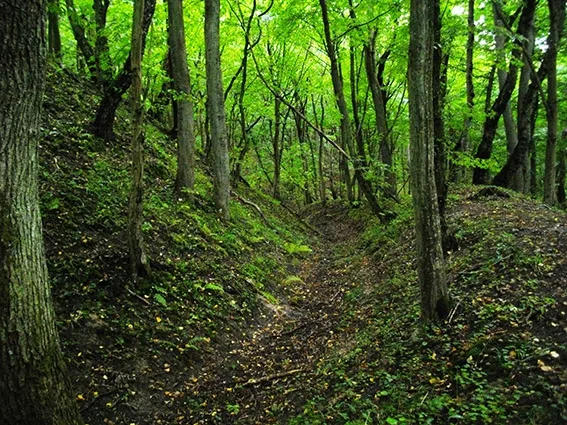
View of the ditch and rampart of the Prussian hillfort of Gross-Hausen (the Russkoye-II site).
Photo by the author.
In the second, romanticised legend, however, the curse of the castle passes to a certain princess who can be saved in an interesting way — by driving up the hill backwards in a cart, having first turned everything in it inside out. The same plot recurs in one of the legends about Galtgarben and about the castle on the Korallenberg near Rossitten (the village of Rybachy). Such a transformation, the deformation of things “the other way round” during the transition to another state, for example into the world of the ancestors, has been known since the most ancient times: the breaking and bending of weapons in European burials from the Bronze Age onwards, ethnographic customs and rites involving dressing up in other clothes, and so on. In the third legend about the Hausen the treasure comes to the fore — a hoard guarded by a serpent. On the one hand, this is a common plot, characteristic of other European peoples as well. On the other, I would note that hoards of bronze and silver objects and ingots were occasionally found at the foot of Prussian hillforts. Perhaps the legend reflected, and later exaggerated, as happens, just such an archaeological discovery of a hoard. In addition, the grass snake and drinking horns occupy a special place in the mythology and rituals of the Western Balts, which deserve a separate story.
Judging by its design — several entrances (added later?) and, importantly, the absence of a river or other water source at the Gross-Hausenberg (apart from bogs), which would have been necessary for a permanent settlement — the hillfort was used by the Prussians for public assemblies of the Novgorod veche type, as a refuge from enemies and/or as a sanctuary. According to legend, a sacrificial stone was also known at Gross Hausen; I will tell about it later in a publication on the “sacred stones of the Prussians”. Incidentally, traces of cult activity by followers of Old European and New Age religions are found on this Prussian monument even today, especially by the large flat stones in the ditches that resemble ancient altars.
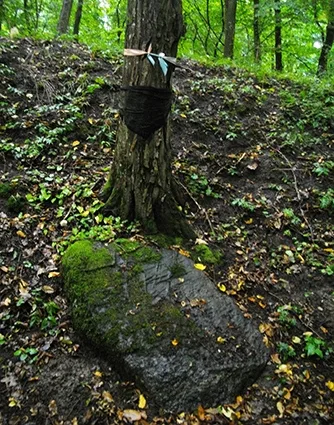
A flat stone at the foot of the outer rampart of the Prussian hillfort of Gross-Hausen
and modern offerings in the form of cloth knots. Photo by the author.
The plot of a ghost maiden and enchanted treasure recurs in the legend about another Sambian hillfort — the “Hünenberg” (Giants’ Hill) near Ekritten (not far from the village of Sirenevo, Zelenogradsk District). This striking hillfort lies on a height measuring 130 x 120 m and is surrounded by a rampart up to 4–5 metres high.
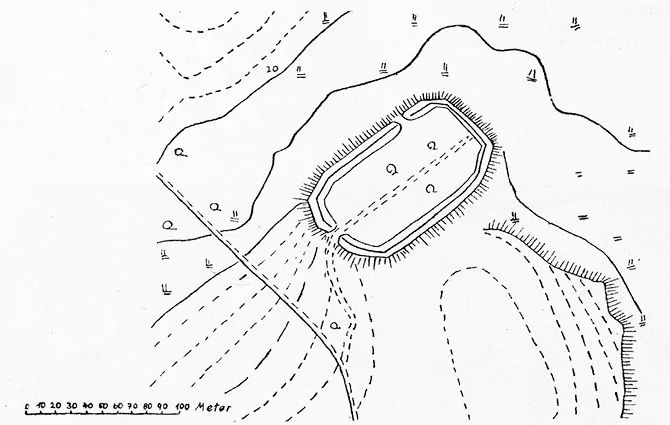
Plan of the Prussian hillfort of Ekritten (now the village of Sirenevo).
Drawing from H. Crome’s 1940 article.
And this is what the legend tells about it:
“The Giants’ Hill at Ekritten was once a sanctuary on which the pagan Prussians made sacrifices to their gods. Today ghosts live there, and one woman appears particularly often. A peasant had heard about this many times and decided to ride up the hill on horseback to see the ghost with his own eyes. And so, having gone up the hill, he noticed the ghost of a woman combing her long straight hair. He was frightened and at once turned away, whispering prayers. But the woman was kind to him and gave him something she had combed out of her hair. The peasant, shaking with terror, thanked her and, without looking, stuffed the gift into his bag. Riding headlong down the hill, as soon as the ghost was out of sight, the peasant threw away the gift, which, of course, he should have kept. Only at home did he discover a few golden grains in the corners of his bag.”
Again in the plot of the tale we see the images of a chthonic being as giver (a ghost) and of “gold” from the world of the dead that at first does not look like gold. Interestingly, the woman’s ghost combs the gift out of her hair. The comb, hair and combing had magical significance among many peoples of Europe. The presence of combs in Prussian burials from the Viking Age onwards possibly points not only to the cosmetic use of exquisite horn combs but possibly also to their ritual aspect.
Moreover, in the legend recorded by Reusch from the words of local people, the Giants’ Hill at Ekritten is called “a sanctuary on which the pagan Prussians made sacrifices to their gods”, which may well have been one of the functions of this structure.
Travelling in search of interesting places in the west of the Sambian Peninsula, it is hard not to notice the high Ziegenberg (Goat Hill) near the former Wischehnen (east of the village of Nivy, Baltiysk District). On the summit of the hill lies a Prussian hillfort measuring 58 x 45 m, surrounded by ramparts up to 3 metres high.
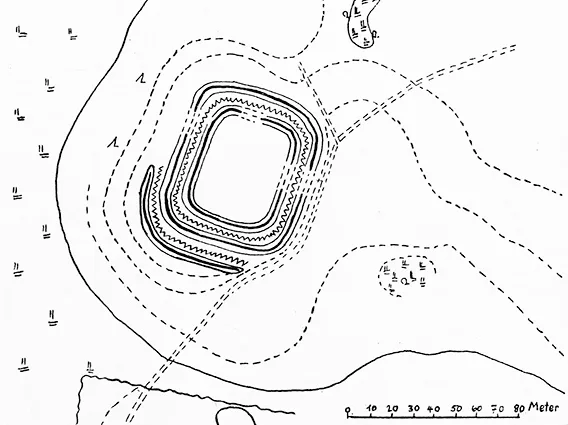
Plan of the Prussian hillfort of Ziegenberg.
Drawing from H. Crome’s 1940 article.
From the end of the 13th century the Germans began to use the Prussian hillfort as a refuge from Lithuanian raids. And this is what a legend tells about the Ziegenberg:
“Near the little village of the same name lies the Ziegenberg. At first this hill rises slowly above the surrounding landscape, then its slopes become almost sheer, and its top is perfectly flat. On its summit lies a large stone, smooth as a table and round, as if made specially for smoking tobacco at it. What this stone is, no one knows. But it is known that a magnificent castle once stood on the Ziegenberg. On the first holy day of every Easter a beautiful maiden would come out of it and go down to wash in the mill pond. Once a peasant woman was going to the market in Fischhausen. The maiden who had come down from the Ziegenberg saw her and greeted her. The peasant woman walked past in silence. But the maiden did not leave her alone and, coming up to the peasant woman, politely asked where she was going. The peasant woman replied that she was going to the market — in Fischhausen. And then the maiden gave her money and asked her to bring back a piece of linen, and told her on no account to haggle. The peasant woman agreed. But when she was already at the market, the thought came to her to save some money. Hey, thought the peasant woman, it would be too much to throw away such a lot of money on linen! In short, she decided to make a little on it. And so, when buying the linen, she managed to bargain down a few groschen. And now she is approaching the Ziegenberg. The maiden began to come down, but as soon as she caught sight of her, she cried out at once: ‘Be cursed, be cursed for ever!’ — and vanished on the spot.”
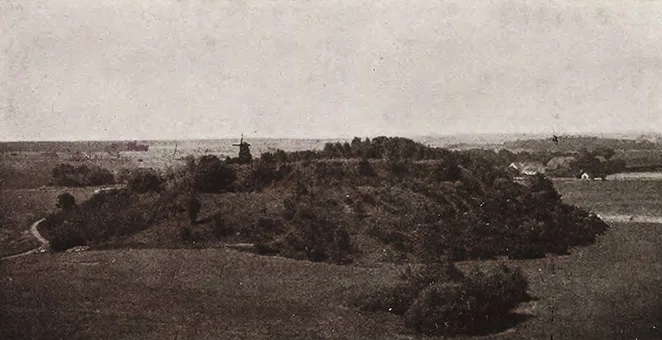
View of the Ziegenberg hill and hillfort.
Photo from O. Schlicht’s 1922 book.
Here the image of a ghostly being recurs, this time asking for a service. What reward might have followed the fulfilment of the request we do not know, since the woman deceives the ghost. Probably the stereotypical visions of “ghost women” on Prussian hillforts may be similar to other manifestations of the Christianised world view (visions of the Virgin Mary, of angels) layered over the pagan picture of the world, visualising certain ghostly guardian spirits of the place and, probably, notional ancestors. Interestingly, the motif of linen or cloth is found in Latvian folklore and ethnography, which tell of special “places of power” (mostly large stones) where pieces of cloth or leather left overnight turn by morning into ready-made dresses and shoes.
And indeed, in the era of growing industrialisation, when these legends were written down, manual labour (of the smith or the tailor) acquires magical features in popular perception. What was once ordinary and familiar, now being displaced by mass production, becomes “sacred”.
In Sambia, besides Gross Hausen and Galtgarben, other Prussian castles that “sank into the earth” are known too. For example, the picturesque hillfort of Rodmannshöfen, situated on the right bank of the Lauth mill pond (the village of Bolshoye Isakovo).
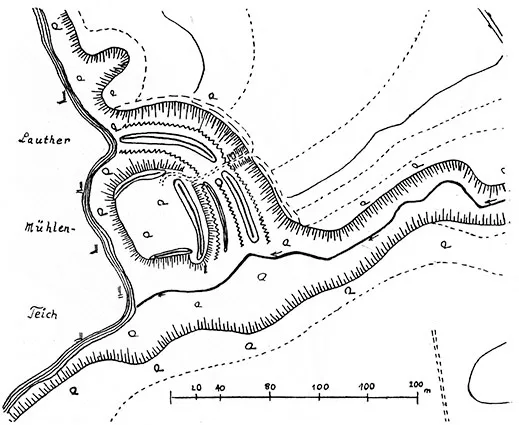
Plan of the Prussian hillfort of Rodmannshöfen.
Drawing from H. Crome’s 1940 article.
This is how people explained to themselves the hollow behind the rampart of the hillfort, resembling a semicircular valley edged with ditches: “Once a castle with a chapel stood here. But because the people of the castle had a name as sinners, in one night the castle and the chapel sank into the earth. And now every Sunday at midnight one can hear someone playing the organ here from under the ground.”
Earthen ramparts and ditches of the Prussian hillfort of Rodmannshöfen.
Photo by the author.
Behind the somewhat comical, romantic-Gothic façade of hyperbole, such tales convey the spirit of the time when these texts were created and written down, as well as deeper layers of an archaic perception of the world: the memory of the old castle and its former inhabitants, who did not fit into the framework of the everyday “positive” Christian paradigm.
It must be noted that many of these picturesque and interesting monuments of our history are being actively destroyed: from sand quarries dug in them to bicycle and motorbike tracks or simply rubbish dumps.
That is why I would like to end the first part of the “legends of the Prussian hills” with a message from Carl Engel from the mid-1930s:
“Those who today plough the ramparts of ancient Prussian strongholds, or dig them up for clay and sand, do so with the same disrespect for heritage as those people who, for the sake of quick profit, destroyed the Order castles of Marienburg and Balga, using them as quarries.”
One can take different attitudes to the German and Prussian periods of our region’s history — from complete indifference to acute politicisation. But it seems that the Prussians are our “Maya”, and we have something to preserve and something to lose.
The second part of Prussia’s “earthen pyramids” is just around the corner!
Translated from Russian with the help of AI (Claude, Anthropic), October 2026.