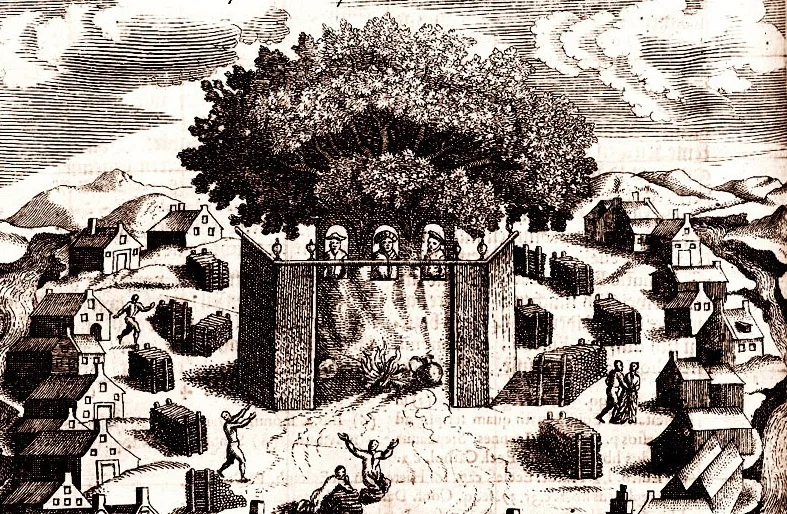
"Since they did not know God, it came to pass
that in their delusion they worshipped all of nature
in place of God, namely the sun,
the moon and the stars, thunder, birds, and four-footed beasts too,
down to the toad. They also had sacred
forests, fields and rivers, so that they dared not
fell trees in them, or plough, or fish."
Peter of Dusburg on the Prussians, 1326
Our guides on this journey will be not only the texts of East Prussian legends, topographic maps and old publications1, but also Robert Klimek's catalogue of Prussian cult stones, published in Olsztyn in 2010.
In folk memory and on maps such stones most often appear as "sacrificial" (Opferstein), "holy" (Heiligestein), "devil's" (Teufelstein), pagan (Heidenstein) and "erratic"/glacial (Erratische Stein, Block/Err.Bl.) stones, among others.
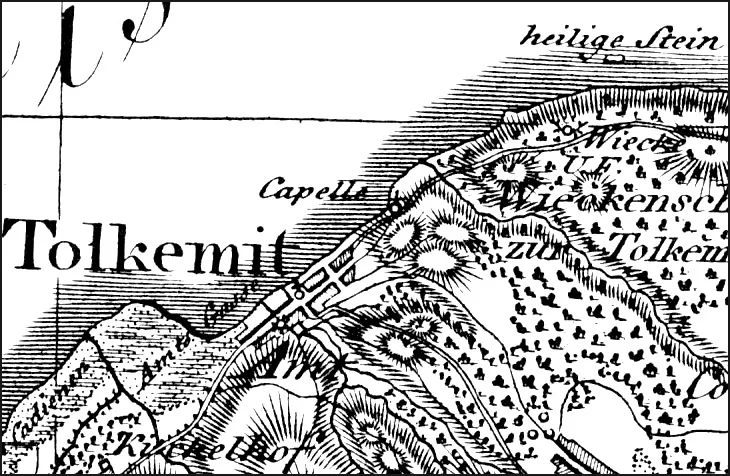
Heilige Stein — the Holy Stone near Tolkemit (Tolkmicko, Poland), in the upper right corner of F. Schrötter's map.
(Drawing from Robert Klimek's catalogue, 2010)
There are also personified names of cult stones, such as the "bishop's stone" — Bischofstein — which gave its name to a small town near Rössel/Reszel. Of particular interest is the so-called Stone of Lies, located near present-day Pionersky.
Most often such stones are set in a special landscape context. This is attested not only by concentrations of archaeological sites, but also by mentions of such stones on the edges of sacred groves ("ad sanuotam silvam"), near sacred trees and on the borders of the Prussian lands. And, of course, the location of cult stones, often marked on maps simply as "erratic", is frequently tied to curious toponymic relics that survived in our region until 1945 in the form of Heidenberg (Pagans' Hill), Höllen-Berg (Hell Hill) and others.
It is likely that before Christian dogma took hold in the minds of the local people, these stones performed sacred functions which changed over time under the influence of religious reforms and external factors, just as the religion itself did: from an ancestor cult to a fertility cult, from the "great" chthonic gods to local "demons" and guardians of the hearth.
Drawing on the texts of the legends, I will tentatively divide these stones into "sacrificial and sacred" and "devil's" stones, and separately I will tell you about the already mentioned Stone of Lies and some other curious stones. All of them played an important role in the cultural landscape — no less important than the cinemas and cafés so familiar to us today — as points of contact between people within one culture. Let us call them "portals of everyday life".
Of course, the legends reflect an extremely distorted perception of such stones in the 19th century by the newcomer and local Germanised population of Prussia, a perception that has little in common with what the stones may have meant to the adherents of Prussian paganism. Even so, these grains of information can be useful in reconstructing a large-scale picture of our region's past.
Sacrificial and sacred stones
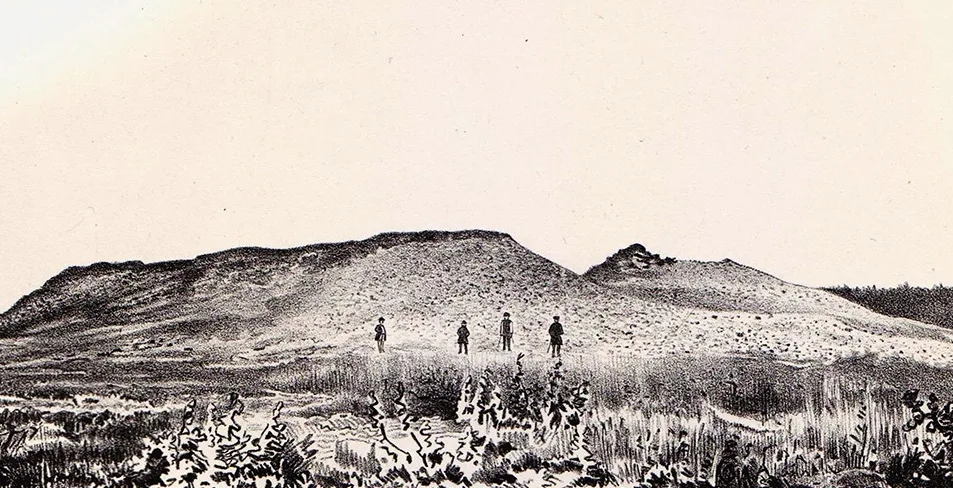
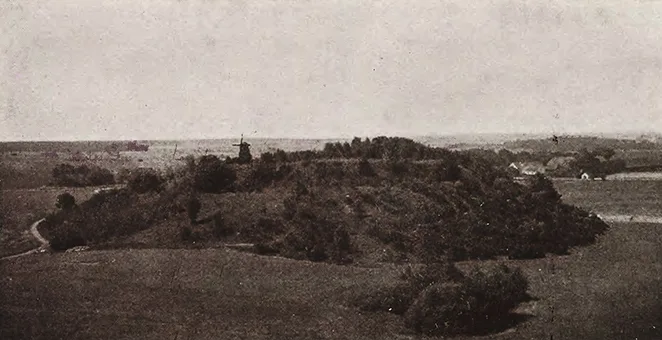
Some of these stones lay in the immediate vicinity of the Prussian "earthen pyramids". One sacrificial stone is mentioned in the legend of Gross-Hausen, the second-largest hillfort in Sambia, which was discussed in one of my previous articles:
"People say that to this day, in the bog at the foot of the high hill of Gross-Hausen Berg, there lies a large stone hollowed out on one side.
This stone was called the "sacrificial stone", since it was the altar on which the Prussians made sacrifices to their bloodthirsty gods.
The little village of Romehnen, where the sanctuary of Romove was located, is only about a quarter of a mile from the stone."
Thus a large stone with a hollow or hole, sometimes called "sacrificial", is mentioned as a pagan "altar" which not only lies at the foot of a Prussian hillfort but was also situated in the vicinity of the Sambian Ramava.
This may have been one of the presumed locations of the chief sanctuary of the Prussians (the historian J. Voigt placed it here), known in the sources as Romove Rikoyto.
Perhaps in the fields between today's Russkoye and Shatrovo (Zelenogradsk District) there really once was a local sacred centre of the Sambian Prussians, or perhaps something even more important.
Today there is only a small rise cut through by a half-ruined road, and abandoned fields surrounded by picturesque glacial hills.
The stone at Gross-Hausen, in the opinion of Lieutenant Giese, who made an inventory of Prussian fortifications in 1826–28, may have been in the south-western part of the hillfort. Hans Crome was unable to find the stone in 1940. The same can be said of the site's present condition. A visual inspection of the rampart structures revealed nothing resembling a large "sacrificial" stone with an artificial hollow. Nevertheless, in the ditch at the foot of the lower rampart there are several stones, and at one of them neo-pagans, New Age followers, or simply participants in "orienteering" still leave their traces today.
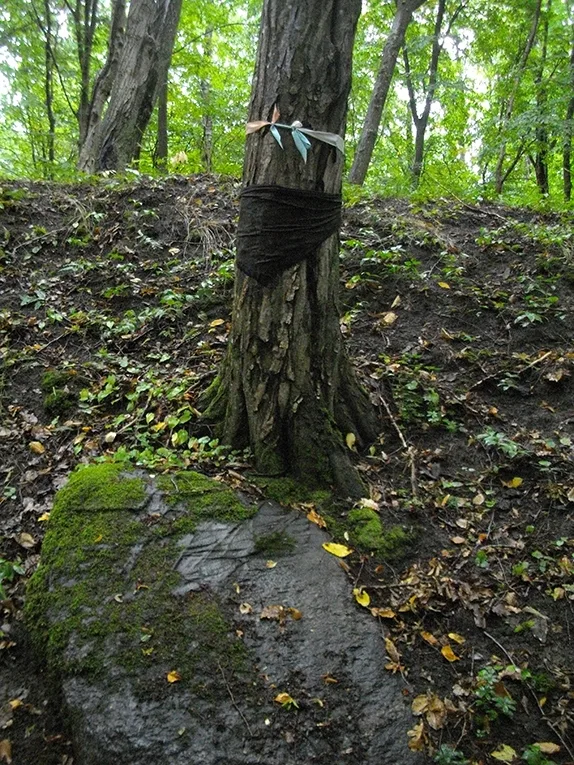
One of the "sacrificial" stones at the foot of the lower rampart of the Prussian hillfort of Gross-Hausen (Russkoye-II).
Photo by the author.
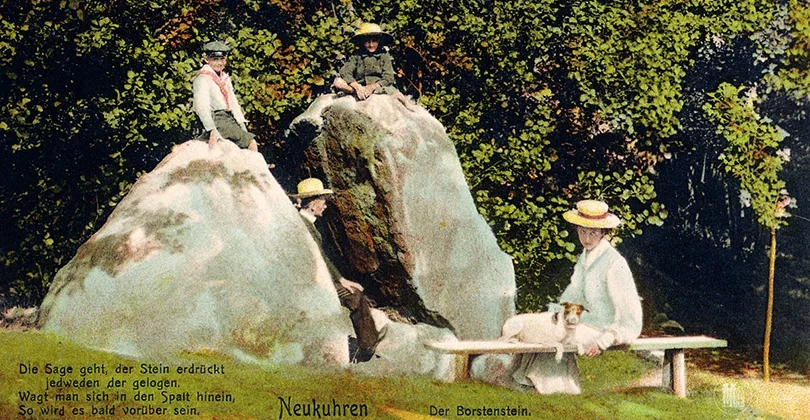
You can get an idea of what the stone at Gross-Hausen may have looked like by visiting a surviving glacial boulder with a hollow near the former Grünfeld (German for "green field") in the vicinity of the village of Dolgorukovo in the Bagrationovsk District. It is a massive stone measuring 1.2 x 1.0 m. This is how local people explained the origin of the "sacrificial" hole in the top of the stone:
"Once the devil played cards on it with a shepherd and lost. The devil got angry and in his rage struck the stone with his fist!"
According to K. Beckherrn, at the end of the 19th century the local people attached special importance to this stone and remembered its sacrificial functions, making offerings to it unconsciously, in this author's opinion.
A few dozen metres west of the stone there is a Prussian hillfort, and around it several more archaeological sites from different periods. The fact that some "sacrificial" stones are at the same time called "devil's" stones, together with their location in wet, boggy places in river bends, unambiguously hints at their chthonic aspect and their link with an "underground and funerary" deity — in the case of the Prussians, Patalas (Lat. Patollo).
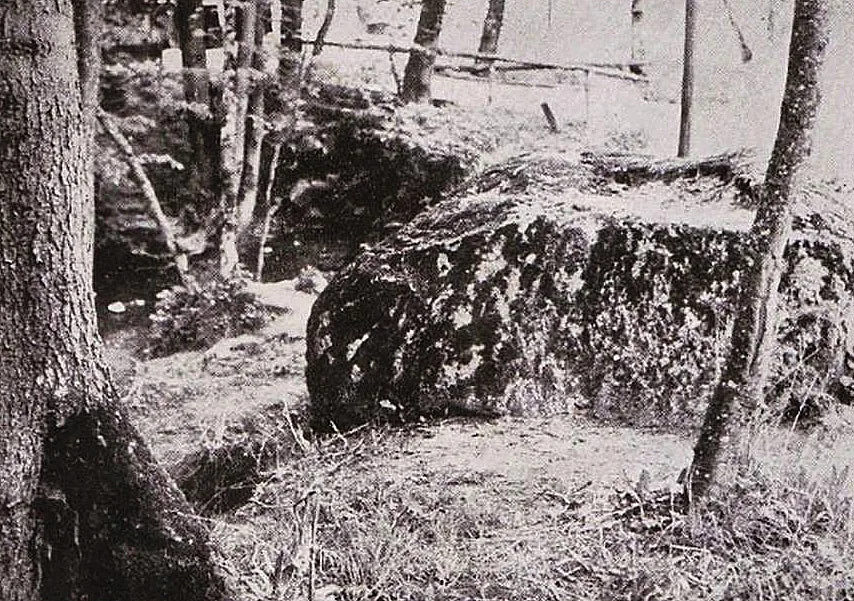
The "Sacrificial" or "Devil's" Stone in Grünfeld (Dolgorukovo).
Photo from W. Sahm's article of 1943.
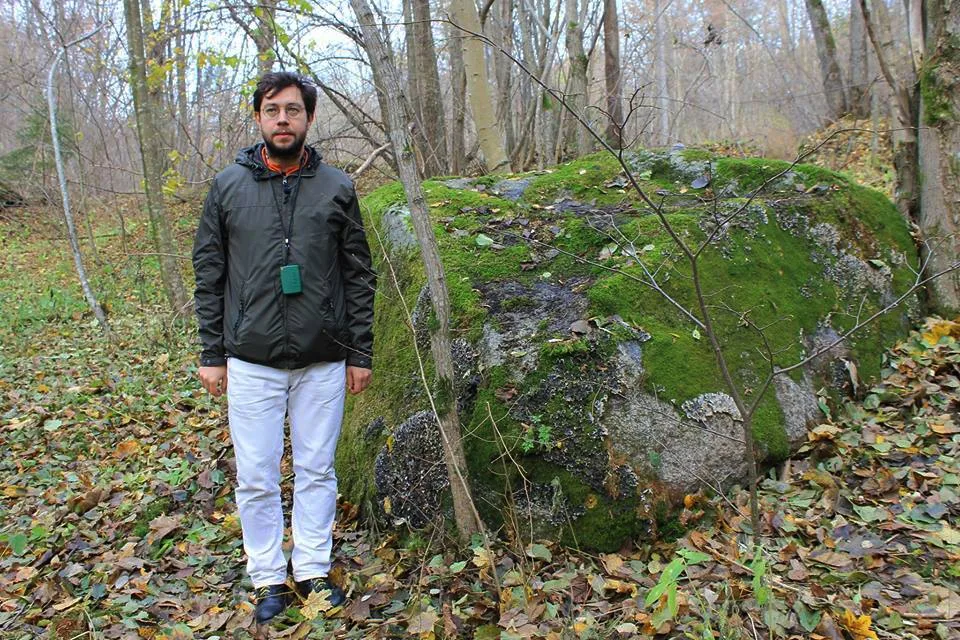
The same stone (see above) today, with the author of the article for scale.
Photo by N. Potapov.
Another interesting example of Prussian sacrificial stones is the "Sacred" or "Holy" Stone (Heiligen Stein) in the lagoon near Tolkemit (Poland), an hour's drive from Frombork towards Elbląg. The legend about it was first published by F. Bentler in 1865, and later, in 1915, by K. Krollmann:
"Long, long ago, on the seashore near Tolkemit and Kahlberg (or Naito Castle on the Vistula Spit), there lived two brothers, mighty giants. To chop firewood they had one axe between the two of them, and they would throw it across the sea whenever one of them needed it. But one day they quarrelled over whose axe it was. The brother who lived on the spit refused to give it back. Then the giant who lived in the so-called Wieck forest between Tolkemit and Luisenthal seized a large stone to kill his brother with it. But just as he was about to hurl it, it slipped out of his hand and fell into the sea, where it still lies. That is how the granite block came to be, rising 10–12 feet above the water [a foot — about 0.3 metres], and the giant's fingers can be clearly seen on it. Sailors, for whom the stone is very dangerous, call it the holy stone in order to avoid evil spells."
According to another version of the legend:
"The giants were at enmity, and the first to throw a stone was the one who lived in Naito Castle, but the stone fell short and landed on a shoal not far from the shore, where it lies to this day."
According to legend, this stone was dedicated to Curcho (Curco, Curca), the god of harvest and fertility, and the Prussians made sacrifices to him of the first fish caught, the first ears of grain gathered or flowers, burning them on a fire in the hollow of the stone.
Near the stone a pole bearing an image of Curca was dug into the bottom of the lagoon. In connection with this deity, whose main area of worship may have been the south of Natangia, Barta and Warmia, the "Holy" Stone near Tolkemit is mentioned in the 16th century by Simon Grunau, a monk and author of the "Prussian Chronicle".
C. Hartknoch and M. Praetorius, at the turn of the 17th and 18th centuries, write that this stone was especially revered by the Prussians. Thus, long after Christianity had been grafted on, this stone was still revered by local fishermen, who offered it their first catch. Like the stone at Grünfeld-Dolgorukovo, it is still in place and is quite popular with travellers interested in the most ancient past of our region, who now offer it their energy and attention.
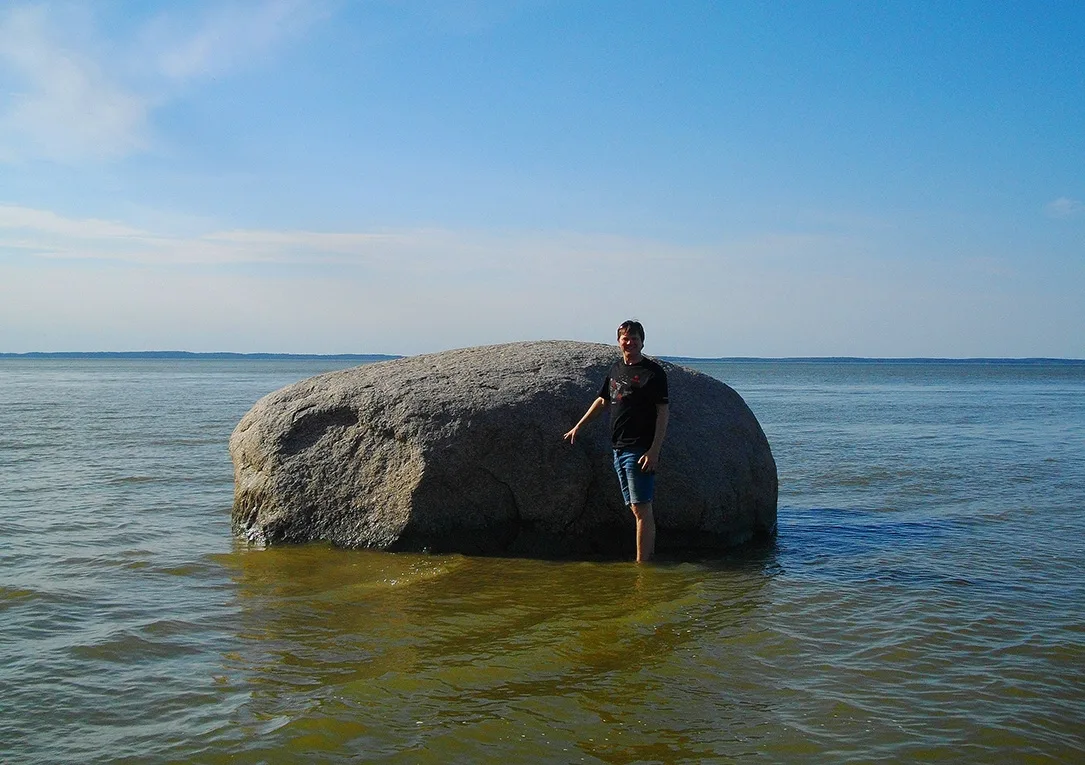
The "Holy" Stone near Tolkemit, with the archaeologist Dr Arkadiusz Koperkiewicz for scale.
Photo by the author.
"Sacrificial" stones are no rarity in the East Prussian landscape. J. Voigt and K. Beckherrn mention ancient Prussian sacrificial stones near Heiligenbeil (Mamonovo — perhaps by that very oak?), in Nordenburg (Krylovo, Pravdinsk District) and Kreuzburg (Slavskoye, Bagrationovsk District), several near Gumbinnen (Gusev) and in Wargen (Kotelnikovo, Neman District). K. Beckherrn himself tells an interesting story that happened around 1843, when, near the parish village of Abschwangen (Chekhovo, Bagrationovsk District), a slope that had collapsed after rains laid bare a large, tall stone with a hollow in its rounded top, surrounded by charcoal, ash and burnt earth left, as the author claims, from rituals performed there.
The best-known sacrificial stone in East Prussia was, of course, on the sacred hill of Rambynas (remember the legend "The Ghosts of Rambynas"?). As described by K. Beckherrn, the "sacrificial" stone had an elongated rounded shape, 15 feet long from north to south, with a sloping surface. At its northern end the stone was 9 feet high, and at its southern end 5 feet. The surface of the stone was covered with numerous impressions resembling the footprints of people and various animals. This is what a 19th-century tradition, preserved in various versions and based, as they say in Hollywood, "on real events", tells about it:
"Near Ragnit, only on the other bank of the Neman, a pine-covered hill with several summits and ravines rises above the water. Its name is Rambynas. In ancient times there was a sanctuary of the Lithuanians (Skalvians) here, and there stood a large sacrificial stone on which the Lithuanians made sacrifices to their very highest god, Perkunas, for from there goodness and happiness spread throughout the land. The stone stood on the top of the hill. The god Perkunas had set it there for himself. A golden dish and a silver harrow were buried beneath the stone, since Perkunas was also a god of fertility. And so later the Lithuanians came to it and made sacrifices, especially in more recent times, to beg abundance for their homes and fields.
An ancient tradition says that happiness will not leave this land as long as the stone and the hill stand together; but the hill will vanish if the stone is taken from it.
And so, in 1811, in the village of Bardinai, north-west of Rambynas, a miller named Schwarz was building two mills and needed two millstones. Having examined the sacrificial stone on Rambynas, he decided that good millstones could be made from it. This miller was a German. When he learned that the Lithuanians would not give up the stone of their own free will, he went to the state council and obtained written permission to take the stone. The peasants of the neighbouring villages raised a great outcry as soon as he wanted to touch the stone, but they had to submit to the council's order. A long time passed before the miller set to work on the stone; apparently he could not hire any workers, as people said that misfortune would befall anyone who dared to disturb the last sanctuary of the gods. In the end the miller hired three workers, strong and bold journeymen, who for a large reward agreed to take the stone and carry it to the mills in Barty. These men were not local: one was from Gumbinnen, another from Tilsit, and the third from a Prussian village near Tilsit. With this trio the miller climbed Rambynas and began the work. But as soon as the man from the Prussian village struck the sacrificial stone, a splinter flew into his eye, and that same day he went blind in both eyes. He lived on in Tilsit for a long time, but remained blind until his death. Then the journeyman from Tilsit set to work on the stone, but at the second blow he broke his arm; he could not work any longer and had to return home. In the end the journeyman from Gumbinnen split the stone and delivered it to the mill. But he too, on the third day, just as he was returning home, suddenly fell ill, took to his bed and died without ever reaching home. Thus the god Perkunas avenged his sacrificial stone, at which he had been worshipped for millennia. The golden dish and the silver harrow were never found, although they were searched for many times. After the stone was taken away, the current of the Neman began to eat away under Rambynas, and the wind began to blow sand onto the hill, so that the place where the famous sacrificial stone once lay no longer exists. More and more often large pieces of earth were washed into the Neman, and the worried Lithuanians watched the ever-growing landslide."
And indeed, according to K. Beckherrn, the promontory of Rambynas where the "sacrificial" stone had stood collapsed into the waters of the Neman-Memel around 1835. A holy place never stays empty. The local people never forgot the special significance of Rambynas. What is more, from the end of the 19th century to this day, regardless of political circumstances, various Lithuanian societies and simple lovers of antiquity have celebrated various festivals here, including the summer solstice.
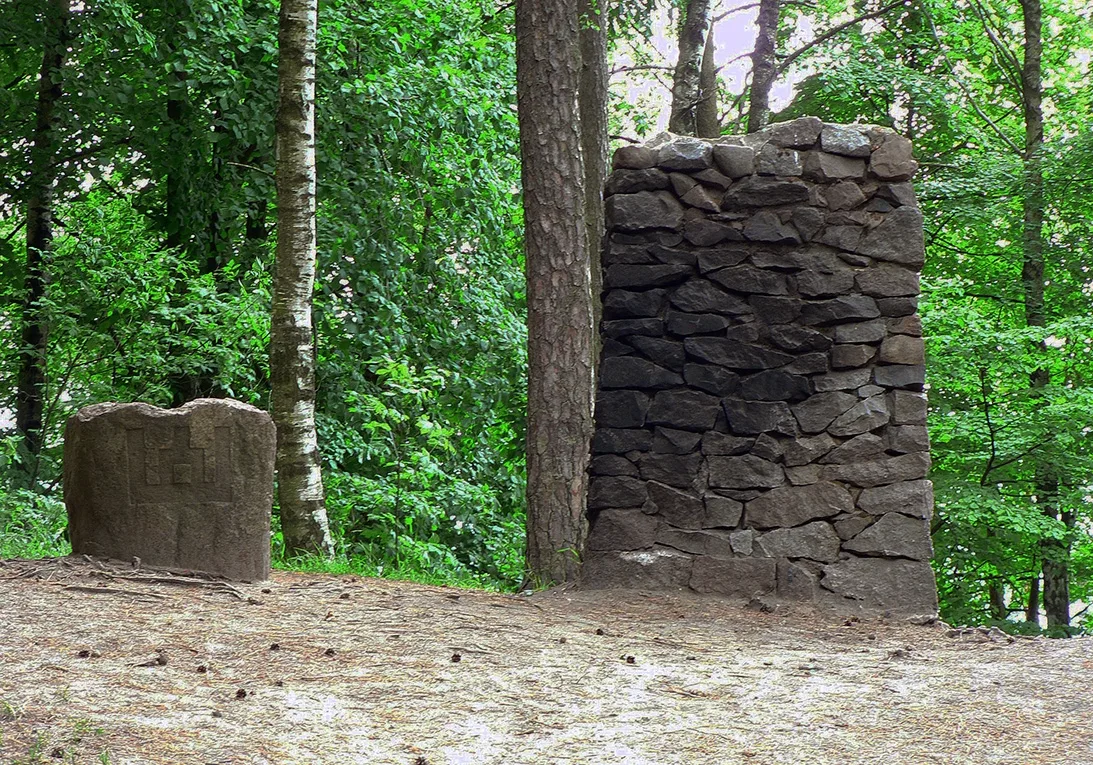
The modern "altar" and "sacrificial stone" (aukuras) on the top of Rambynas (Lithuania).
Photo: Wikipedia.
Devil's stones
In later times some of the Prussians' "sacrificial" stones came to be called "devil's" stones. Many legends of an aetiological character explain the popular origin of this name. As it happened, the chthonic gods of the Prussians and their neighbours, which lay beyond the bounds of what Christians could perceive as "good", never managed to be embodied in the images of saints, and became devils, demons or the Devil himself. Some of these stones are directly marked on old topographic maps as "Teufelstein" (German for "devil's stone").
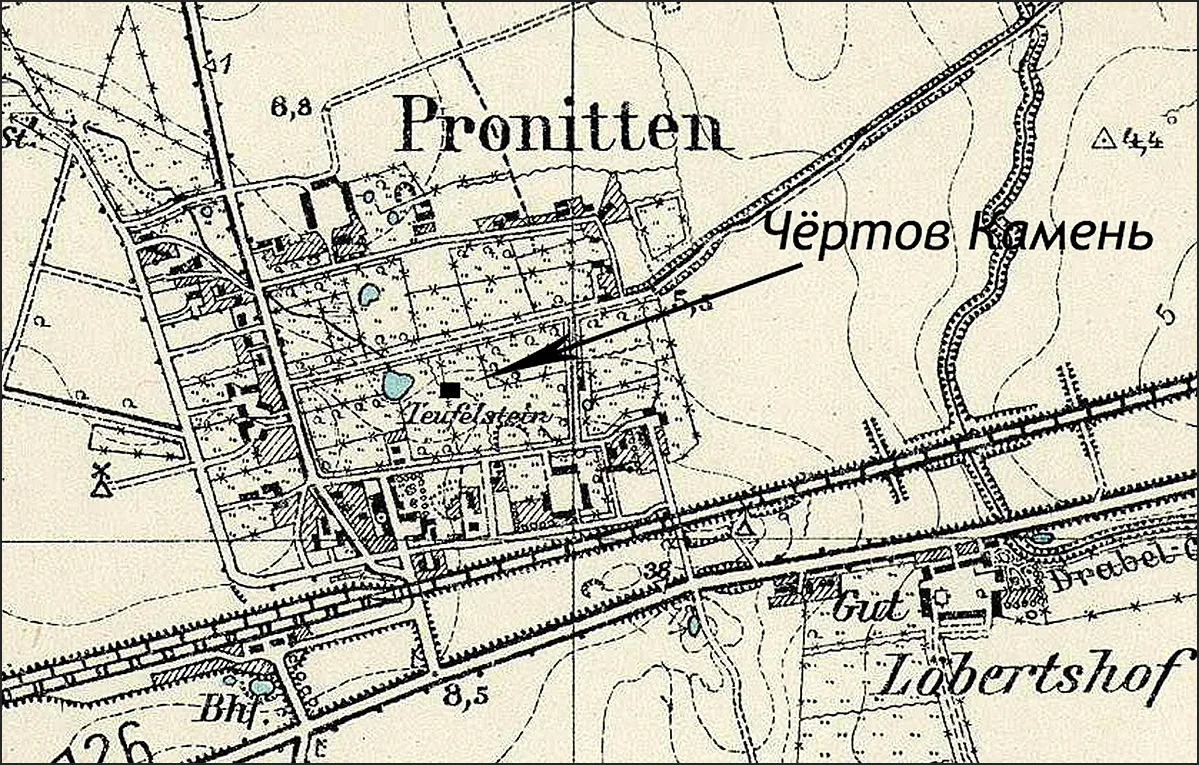
The "Devil's" Stone in Pronitten (Slavyanskoye) on a pre-war topographic map.
This, along with the size of the stones, is what betrays their special significance for the local population, as in the case of the impressive "devil's" stone in Pronitten (Slavyanskoye, Polessk District), which lies in a suspiciously unbuilt-on marshy field by a river bend in the centre of the village.
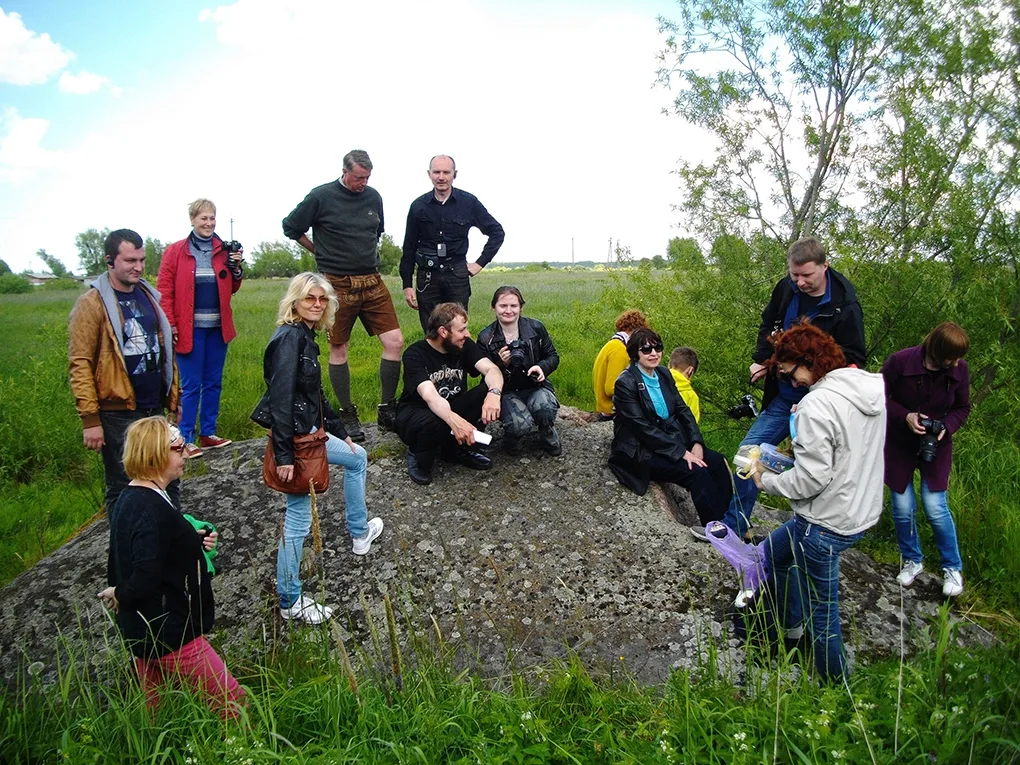
The "Altes Haus" travellers at the "Devil's" Stone in Pronitten (Slavyanskoye).
Photo by the author.
The "demonic" nature of other such stones is betrayed by folk traditions recorded in the 19th century. One of the best-known such stones in Sambia was the sacrificial stone from the Pillberg hillfort (Prussian-German "Castle Hill") near Kraam/Grachevka (Zelenogradsk District). A tradition published in 1838 by R. Reusch says:
"On the slope of the Pillberg, in the Hölle (a ravine between Kraam and Plinken), there lay a strange stone which later sank into the bog. The stone looked like a table. On each side of it children seemed to be sitting, playing cards. The prints of children's hands could still be seen, although the top of the stone had become almost smooth. Besides that, an untouched pack of cards seemed to be lying on it. And there were also holes on both sides in which money could have lain. Rumour has it that the devil played cards here with children during the sermon. The parishioners cursed those children, while the devil, as always, slipped away."
Beckherrn, in his publication of 1893, calls it outright the "Devil's Stone" and mentions a "sacrificial" hole in its top. Repeated visual inspections of this impressive Prussian earthen pyramid have found nothing resembling a "devil's table". It seems that neither H. Crome at the end of the 1930s nor F. Gurevich, who excavated the hillfort at Grachevka in 1949–51, saw it either.
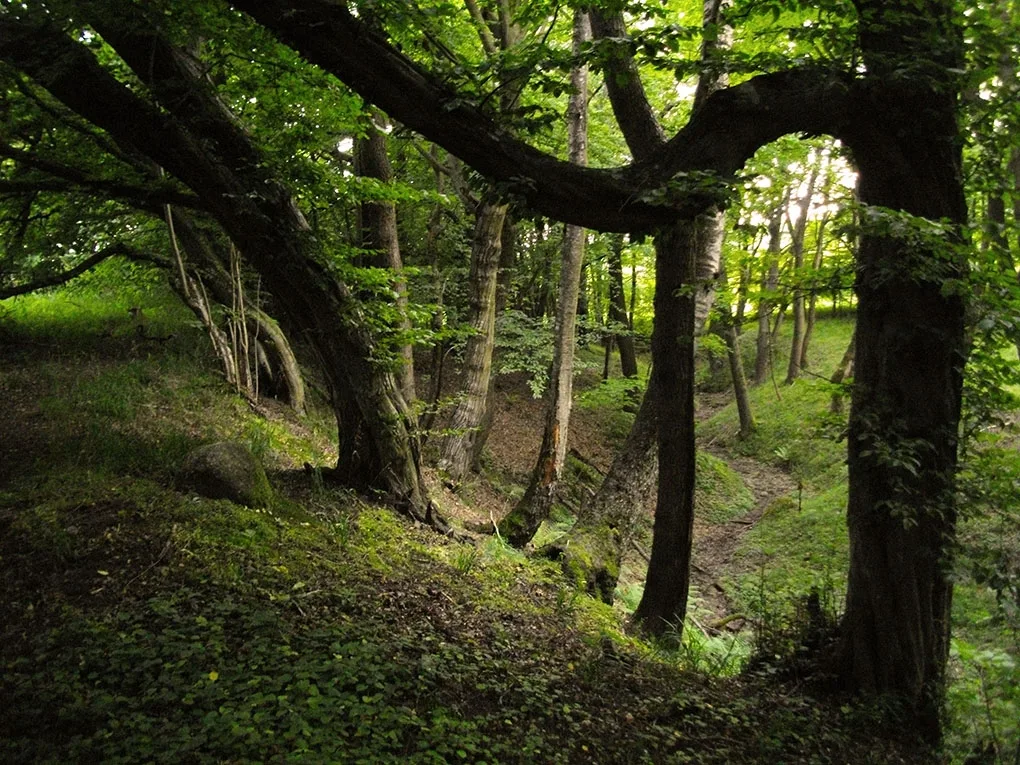
The "Hell" hollow near the Pillberg-Kraam hillfort (Grachevka), where the sacrificial stone may have lain.
Photo by the author.
The motif of gambling with a devil or the Devil during Mass on former Prussian sacrificial stones was quite popular. Here is what a legend published in 1865 by W. Tettau and J. Temme tells about another such incident, which took place in the east of Natangia, in Domnau (Domnovo, Pravdinsk District):
"A quarter of a mile from the town of Domnau a medium-sized stone lies in a field. In it there are 3 square depressions, as if for 3 large dice. And this is how they came about. Long, long ago there lived in Domnau a carpenter's journeyman. Usually a pious and God-fearing man. One day, though, he was a little tipsy. And he boasted so much that he said he could beat the devil himself at dice right now. And there was the devil, right on cue. So they went together into the field to this stone. They began to play for big money, which the devil staked against the lad's soul. The devil threw first and at once scored the highest number. The lad sobered up with fright and understood what a fix he was in. He raised his hands to heaven and began to pray to the Most Holy Virgin. And when he threw the dice, one of them split in two, which gave him a higher score. The devil at once vanished in a rage, and in the stone there remained three holes from the dice the carpenter had thrown."
Thus we get an interesting explanation of holes that were more often called the print of "Satan's hoof" or else "God's foot" or that of some saint. According to J. Voigt, north of Domnau there was a holy forest dedicated to the Prussian god of the underworld, Patals. The stone mentioned may well have been in this grove.
Stones with footprints or hoofprints often attracted the attention of local people and may well have played a special role in the Prussian worldview, acquiring demonic features in the modern era.
Such stones were known in Sambia near Pobethen-Romanovo, and many in the area of Kirtigehnen (south-east of Rauschen-Svetlogorsk). The impressions on some of them were supposedly left by the devil's "soft spot" when he was fleeing from Perkuns, which is typical of notions about the relationship between thunder gods and chthonic "unclean spirits". One such stone with "strange" impressions of geological origin lies among others at the foot of the Prussian hillfort, and probably sanctuary, known as Pokirben.
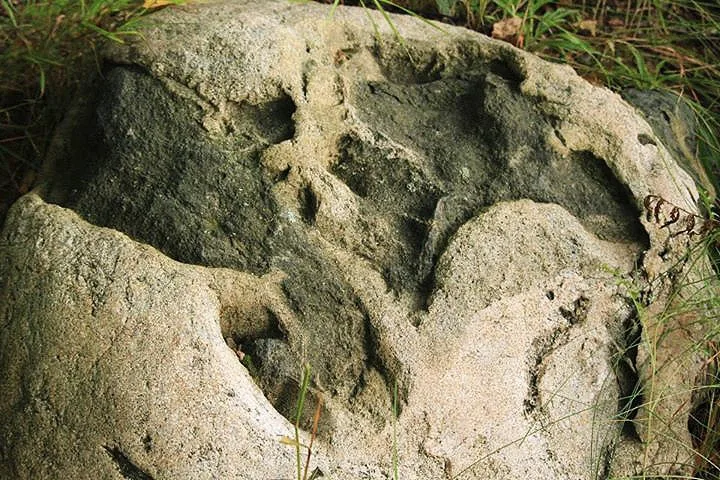
A stone with footprints near the Prussian hillfort of Pokirben (Zelenogradsk District).
Photo by G. Surotkin.
"Devil's" stones marked with the "devil's hoof" or with a hollow in their top were also found before the Second World War in the part of East Prussia that passed to Poland: in Braunsberg-Braniewo, Marienburg-Malbork and Rehfeld-Sarniki (almost on the border with our region).
The "Devil's Stone" near Kreislacken (south of Donskoye), which lies on the seashore and in this respect resembles the stone near Tolkemit, is mentioned in 1922 by Oskar Schlicht, author of the inimitable two-volume work "Western Samland". Originally the massive granite block, measuring 12 x 3.5 m, lay on the steep coast (where it caught the Prussians' attention), but in 1907, on the night before Good Friday, it fell down onto the beach. Now this stone, it seems, is already in the depths of the sea. As is the huge glacial boulder, 5(!) times larger, mentioned in 1661, which, according to O. Schlicht, was already 10 m out to sea in 1850 and had disappeared under the water by 1865.
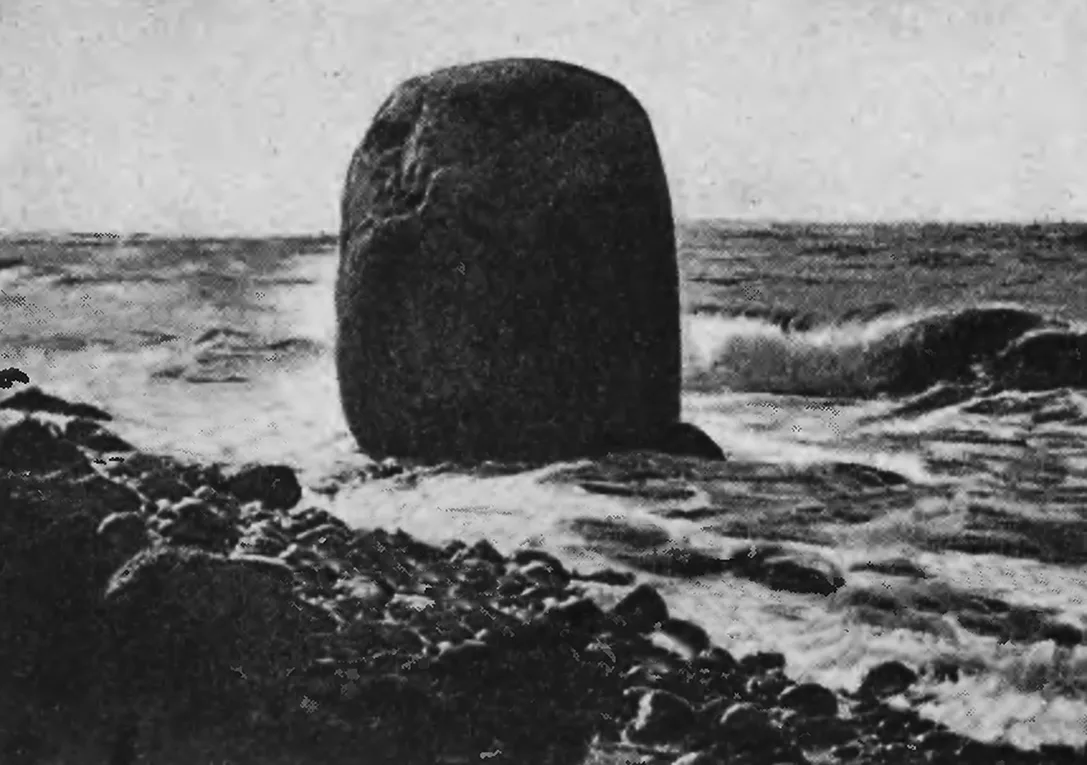
The "Devil's" Stone near Kreislacken (south of Donskoye).
Photo from 1907 from O. Schlicht's book of 1922.
"Devil's" stones are also known in the east of historical Prussia, on the border between the Prussians and the Yotvingians — in Rominta, known as the Rominten Heath/Krasnolesye. Here is what a legend published by Frida Borbstadt in 1931 tells about one of them:
"In the Rominten Heath, in the very depths of the forest thicket, lies a huge glacial boulder, the devil's stone. They say the devil himself threw the stone there, and this is how it happened. When the church was being built in Tollmingkehmen and the walls were already rising above the foundations, the devil suddenly appeared. The devil comes up and asks the workers: 'And what's that you're building there?' The workers were afraid to tell the devil the truth and said that there would be a tavern here. The devil was delighted and promised to help with the building. And he set about diligently hauling stones there. But when he saw that within a few days the church windows had already been built, he realised that he had been tricked. And in his fury he decided to throw the large stone, which he was already carrying through the air, onto the church under construction in order to smash it. As the devil was getting ready to throw, he heard a cock crow three times in the pastor's house. And the devil, who, as everyone knows, cannot stand that, began to shake, and the stone fell from his claws. And so it lies there in the forest to this day."
This is how the local people explained to themselves the existence in forests and fields of stones so unusual in size and shape. Today in Rominta, within the Kaliningrad Region alone, at least two boulders are known that claim a role in the legend. Both are of impressive size. One lies deep in the forest, and the other can be viewed and lies 300 metres into the forest, to the right of the road leading to Schwentischken-Pugachyovo, almost at the fork itself.
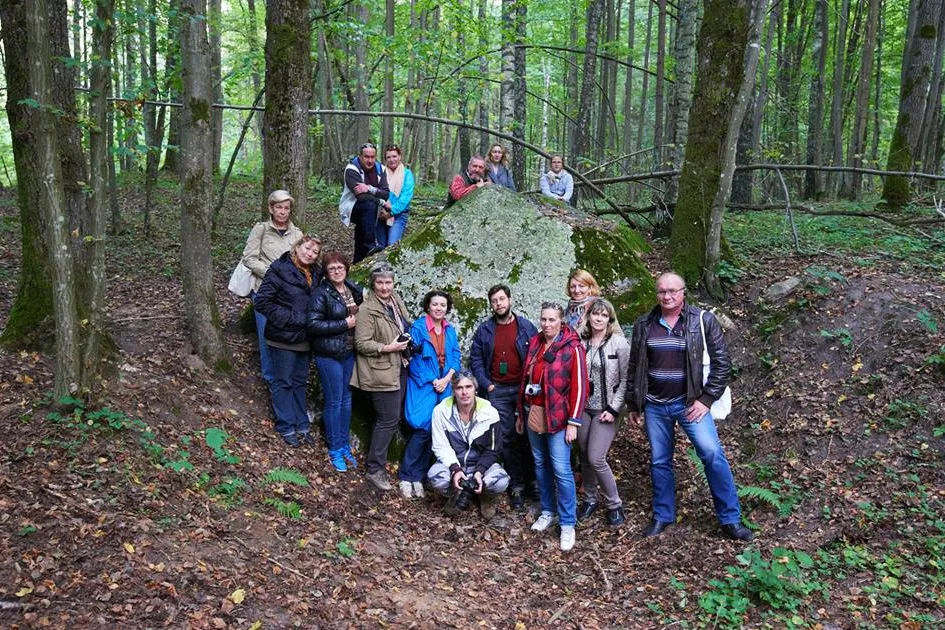
The "Altes Haus" travellers at one of the "devil's" stones in Rominta.
Photo by S. Kurov.
And in my next article I will try to tell you in as much detail as possible about what is perhaps the most interesting Prussian stone in the Kaliningrad Region — the famous Stone of Lies!
___________________
1. In his article "Strange Stones of East and West Prussia", published in 1893 in the "Altpreussische Monatsschrift", Carl Beckherrn collected information on more than 50 cult stones from the area inhabited by the Prussians.
Translated from Russian with the help of AI (Claude, Anthropic), October 2026.