Thanks to Bernstein
French artists were the first to rebel against academic painting. On 13 November 1872*, Claude Monet ushered in the era of Impressionism with his painting “Impression, Sunrise”. Soon Impressionism (a word then considered almost a term of abuse!) crossed the borders of France and became an international phenomenon.
According to the Swedish artist Oscar Reutersvärd, the “father of the impossible figure”, Germany first encountered the painting of the masters of the new movement in the autumn of 1882. That was when Professor Carl Bernstein, a wealthy Russian collector living in Berlin (in the opinion of the French poet Jules Laforgue, “the only connoisseur of contemporary French culture in the German capital”), bought a dozen canvases by Manet, Monet, Sisley, Pissarro and Berthe Morisot and invited artists and art connoisseurs “to view the new acquisitions”. Naturally, the connoisseurs were seriously alarmed... But not the artists!
The principle of “painting what you see amid light and air” was taken up almost immediately by painters opposed to official academic art. Yet the German school did not copy the French one. For the German Impressionists, the composition of a picture mattered more, while the painterly execution came second. That is why German Impressionism is generally regarded as a phenomenon in its own right.
Incidentally, the ground for it on German soil had been prepared by Wilhelm Leibl, the son of the Kapellmeister of Cologne Cathedral, a “master of genre scenes and character portraits on the borderline between Romanticism and Symbolism” who was renowned in the late 19th century not only in Germany but also in France. It was his technique of painting “in a single sitting” (alla prima) that the German Impressionists took as their model. What fascinated everyone most was his manner of painting: Leibl mixed his paints directly on the canvas. Among his admirers was Lovis Corinth from Tapiau in East Prussia (today Gvardeysk).
Total Recall…
Lovis Corinth was not only a painter. He wrote many books on art, and at the age of 47 he set about writing his “Autobiography”. It seemed as if only yesterday he, a five-year-old schoolboy, had run up to his mother and asked her the date of his birth. She answered with a riddle: that day falls right at the start of the rye harvest. What this meant only dawned on Louis when his parents began taking him with them into the fields. But only as an adult did he understand what his mother had gone through on 21 July 1858, when the whole family and the farmhands set off to harvest the rye before cockcrow, hoping to finish quickly and get home in time for her to give birth. They did not make it. On 8 August he was baptised in the local church. He was christened Franz Heinrich Louis Corinth**. He was the only child Heinrich and Wilhelmine had together, although she already had five children from her first marriage.
His parents ran a large farm and a tannery.
To the end of his days Louis remembered the pungent smell that came from it. The enormous yard, full of all kinds of animals, was his world. He would watch the carcasses being prepared for the tannery, and the workers cutting off scraps of meat and tossing them to cats greedy for fresh flesh. The blood dripping from the carcasses formed little puddles from which the hens drank. A sight not for the faint-hearted, but little Louis saw it every day.
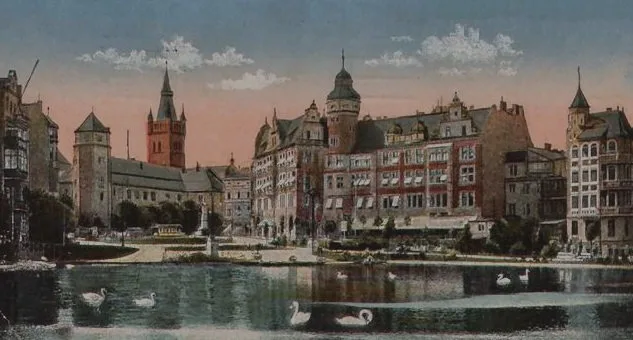
In time, new horizons opened up for Louis. He already knew that the river on whose bank their house stood was called the Deime. Over there were the meadows where he carried bread to his father during haymaking. Next to the Corinths' land stood a long Empire-style building with a pointed red roof.
Black, white and brown figures scurried back and forth around it like bees in a hive. Above the gate was an inscription in gold letters: “East Prussian Correctional Institution for Wayward Children”, or, as the locals called it, the “Schtidut”.
It had once been a castle of the Teutonic Order, built at the confluence of two rivers, the Pregel and the Deime.
It was here that Louis met a real landscape painter for the first time: Knorr, whose father worked at the correctional institution.
The Schtidut was directly connected with the Corinths. Its matron lived in a small room in their house with her daughter, the one-eyed Emilie. Louis often visited their little room, furnished with antique furniture and all sorts of porcelain knick-knacks. The chests of drawers had lion's paws and gilded rings on the drawers.
As Corinth himself admitted, Emilie knew many legends and awakened his interest in art, for which he remained grateful for the rest of his life. One day she showed Louis a picture of King Frederick William III on a magnificent horse and told him that there was just such a monument in Königsberg. From then on the boy longed to see it “in real life”. The opportunity came when his father was taken into hospital in Königsberg and eight-year-old Louis went with his mother to visit him.
He also remembered the marksmen's festival and the fair in Wehlau (today Znamensk), which took place during the summer holidays. The streets of the little town, lined with pear trees, filled with the sound of fanfares, and the marksmen's guild formed up on the main Market Square. An officer, who was also the shooting king, sat astride a richly decorated horse. Silver medals the size of plates gleamed on the sashes of the king and his retinue. The procession made its way to the spruce forest that stretched between Tapiau and Wehlau and was crossed by a broad highway. The edge of the forest was festively “decorated” with stalls selling invigorating drinks, and people flocked there to celebrate until their strength gave out. After sunset the festivities moved on to their next stage: tipsy lads and lasses from the neighbouring villages slipped off into the woods in pairs. In the morning, “hordes” of the drunk and the lovestruck made their way home.
The Wehlau fair was perhaps the biggest event in the Corinths' life.
The leather that his father intended to sell there was loaded onto two carts. “Two hours later we reached a long wooden bridge, almost entirely occupied by beggars,” Corinth writes in his memoirs. “Mother gave them alms and we drove on… I went to the fair with my father... It was considered the largest in the province, and many Russian horses were brought here.” Whole streets were taken up by shoemakers from Tilsit. And the boy's memory forever retained the endless rows of stalls selling gingerbread, sweets and drinks.
“I dreamt of the Pregel, the church and my yard…”
In the autumn of 1866 Lovis went to Königsberg. His parents had carried out their long-held plan and sent him to the Kneiphof Gymnasium. They gave him a couple of fat ducks and a sack of potatoes and sent him to lodge with his aunt at Magisterstraße 41. So began life in a strange place, something the boy from Tapiau was not at all used to. Things were even harder at the Gymnasium, where all the pupils spoke standard literary German and laughed at his dialect. So, on top of his regular studies, he had to spend a great deal of time learning Hochdeutsch. “I was homesick all the time,” Corinth recalled of his school years. “I dreamt of the Pregel, the church, my yard…” Once he wanted to give it all up and leave, but his aunt locked him in the cellar. He had to wait for the next holidays.
Lovis also remembered an episode from his school days when the singing teacher fell asleep during a lesson and he drew him. Waking with a start, the teacher looked at Corinth questioningly. The boy grew flustered and began looking around… The teacher slapped his face several times, but when he saw his own portrait he softened and advised: “Become a portrait painter.” He kept the drawing as a souvenir, by the way. “Never were slaps so pleasant as on that occasion,” the artist recalled.
When Lovis was 13, his mother died. All the responsibility for his upbringing fell on his father, who wanted nothing more in the world than for his son to receive a good education. So when he recognised his son's artistic talent, he sold the farmstead in Tapiau, moved to Königsberg and paid for his studies at the local Academy of Arts.
It Didn't Work Out…
“Fate smiled on me,” Corinth wrote. “I would be a painter. I remained faithful to my profession and never once thought of betraying it.”
The fundamentals of painting and history painting at the academy were taught by Otto Günther, a close friend of his father. He was an admirer of the German painter Ludwig Knaus, a master of the Düsseldorf school, and of Marc Louis Benjamin Vautier the Elder, a German painter of Swiss origin. For a time their manner of painting appealed to Corinth as well.
Together with Günther and other students, Corinth travelled to Berlin and Thuringia and visited the studios of renowned artists. In his own work he concentrated on portraits and landscapes. All would have been well, had the idyll not been spoiled by East Prussian punch, which became a frequent “companion” of the young artists. They drank a great deal. Some of Corinth's fellow students went downhill, could not stop, drank themselves into ruin and died.
One occasion, when Louis once again got plastered with his friends, made him stop and think. Thoroughly drunk, the students decided to go for “another round” at the Gambrinushalle on Tuchmacherstraße.
This low-class place of entertainment, where the young academy students were practically regulars, had a bad reputation in Königsberg. The owner was always glad to see guests and welcomed sober ones with open arms, but refused to serve those who were drunk. When the artists tried to start a brawl, the bouncers threw them out onto the street one after another. A fight broke out, which ended in arrest and a cell at the police station.
The academy, of course, found out about everything: the drinking, the drunken brawl, the arrest, how one of the bouncers had been bitten on the finger and another had nearly had his ear torn off, and the resistance to a representative of the law… The academy's management feared that the story would leak to the press. Günther did everything he could to help settle the matter. Some very influential people in Königsberg were brought in to "resolve the conflict". In the end, the brawlers got off with a fine. For Corinth it was a valuable lesson, but Günther had to leave the academy. He left for Weimar, having first found places for his favourite students at various other institutions, knowing that they would no longer be allowed to finish their studies in peace.
Trying Out the Brush
So it was that in 1880, on Günther's recommendation, Corinth came to the Academy of Fine Arts in Munich, where he created his first fully fledged painting, which he called "The Black Plan". Critics mocked him for the title, and he had to rename it "The Conspiracy" ("Ein Komplott"). At the London Salon of 1884 the canvas was awarded a bronze medal. Then, having moved to Antwerp, he created one of his best-known works, "Negro Othello". It was here in Antwerp that Lovis received the sad news of Günther's death.
His students published an obituary in a newspaper, which provoked the anger of the Königsberg Academy's management, who hated him even in death – "in a purely East Prussian way", as Corinth put it in his "Autobiography".
In October of the same year he enrolled at the private Académie Julian in Paris, where he learned to paint the nude female body. This institution had been founded, as Corinth put it, by "a gifted speculator", and it existed mainly on the money of the foreigners who studied there. Lovis's teachers were William Bouguereau and Tony Robert-Fleury.
Having achieved no particular success in the French capital, three years later Corinth returned to his father in Königsberg with 20 large-format canvases. But he was haunted by the dream of moving to Berlin, which came true a little later... Life in the capital was in full swing. It was here, in Berlin, that he painted his first self-portrait. The following year Corinth returned home to Königsberg to his gravely ill father and managed to paint several portraits of him. On 10 January 1889 Lovis lost his last parent.
In 1890 Corinth's painting "Pietà", submitted to the Paris Salon, caused a sensation. He ventured to move to Munich once again, where he took up open-air painting, so popular at the time. His principal work that year was the large-format "Diogenes", which, however, failed to arouse the public's enthusiasm. Corinth then created a "provocative" series of paintings with slaughterhouse scenes, which finally impressed the critics.
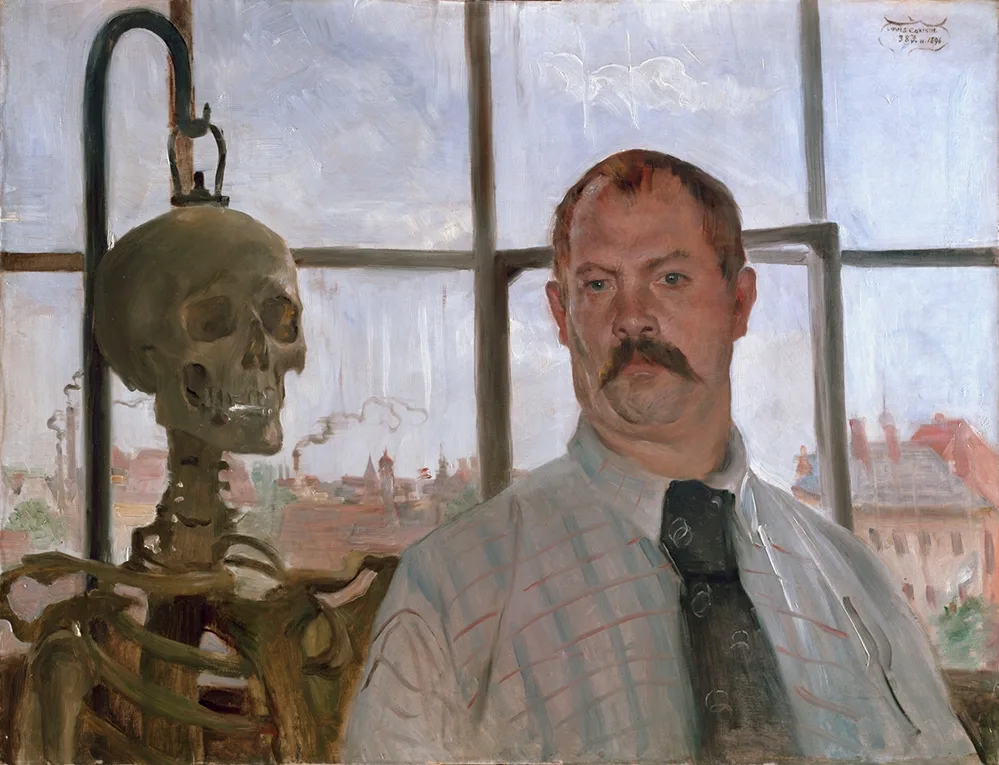 "Self-Portrait with Skeleton", 1896.
In the 1890s Corinth was associated with the "revolutionaries" of Munich art, who met in the painters' society "Allotria". From this association emerged the Munich Secession, whose members, besides him, included Max Liebermann, Otto Eckmann, Thomas Theodor Heine, Hans Olde, Hans Thoma, Wilhelm Trübner, Franz von Stuck and Fritz von Uhde. The artist from Tapiau became a "major figure" in Berlin and worked tirelessly. "Deposition from the Cross", painted in 1895, was the first of Corinth's works to sell well. That same year it was awarded a gold medal at the exhibition in the Glass Palace. His other works failed to win public recognition. Then came his own "Self-Portrait with Skeleton", as well as "Witches", "The Temptation of Saint Anthony" and "Salome", on which he pinned great hopes. But it was refused by the Munich Secession exhibition.
Corinth then decided to move to Berlin, where his old friend Max Liebermann and Paul Cassirer had founded the Berlin Secession***. And here "Salome", as indeed its author, was well received.
Besides "Salome", two more of his paintings took part in the Berlin exhibition – "Susanna and the Two Elders" and "Crucifixion". And in 1901 the painting "Perseus and Andromeda" was shown at the Secession exhibition at Paul Cassirer's alongside canvases by Vincent van Gogh, Wilhelm Leibl and Arnold Böcklin. Friends helped Lovis find a studio on Klopstockstraße, and on 14 October 1901 his art school opened there. Corinth the teacher's first pupil was Charlotte Berend. She became not only his pupil and model, but also his faithful life companion. On 26 March 1903 they married. And on 13 October of the same year their first child, Thomas, was born. The family moved to Händelstraße. Six years later a daughter, Wilhelmine, was born.
Career
Things could not have been going better. Corinth was soon elected to the board of the Secession. He worked a great deal. "Portrait of the Poet Peter Hille", "Samuel Curses Saul", "The Graces" and "Self-Portrait with Model" were exhibited at the Secession in 1902 – alongside canvases by Édouard Manet and Edvard Munch.
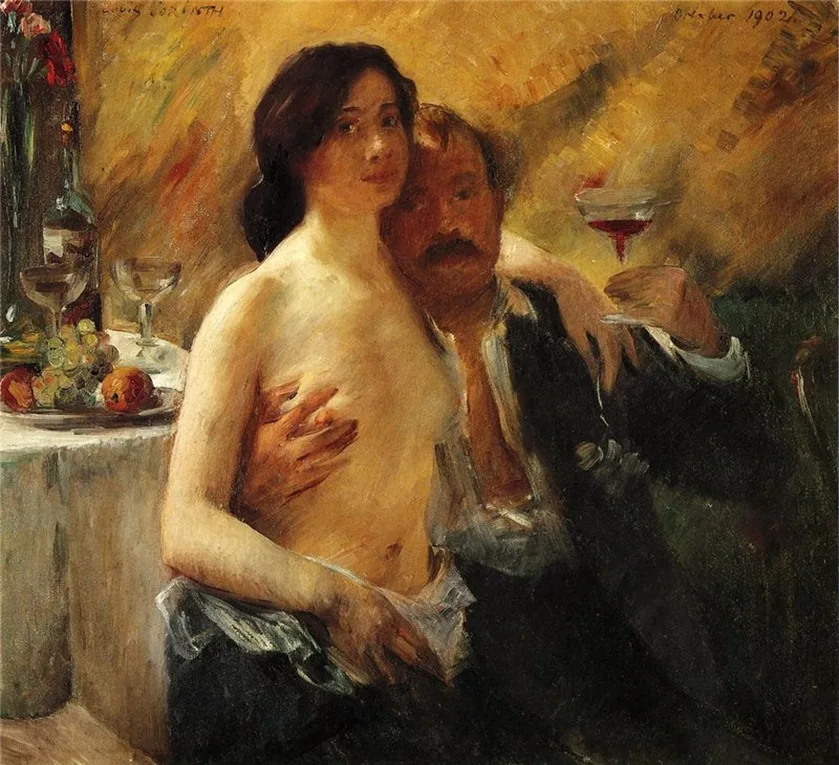 "Self-Portrait with Charlotte Berend and a Glass of Champagne", 1902.
At the annual exhibition of 1903 Corinth presented his "Girl with a Bull" and "Odysseus Fighting the Beggar"; in 1904 he painted "Tini Senders" and "The Entombment". That same year Cassirer held an exhibition of the Frenchman Paul Cézanne in his own gallery, which made a strong impression on Corinth. New works followed: "The Childhood of Zeus", "After the Bath", "Rudolf Rittner as Florian Geyer", "The Capture of Samson", "The Great Martyrdom", "Self-Portrait with a Glass", the "Reclining Nude" that caused no small amount of gossip, "Susanna in the Bath", "Orpheus"…
Lovis Corinth was regarded as one of the most popular and influential painters of the Berlin Secession. His paintings sold well.
In 1911 the president, Max Liebermann, and board members Max Slevogt and Paul Cassirer resigned. Corinth was elected the new head of the Secession.
But soon afterwards he suffered a heart attack, after which he was forced to spend more time at the resort of Nienhagen near Bad Doberan. Nevertheless, he did not stop painting. In 1912 "The Blinded Samson" came from his brush. The First World War, which began in 1914, entered his work in the paintings "Cain" and "Portrait of Grand Admiral Alfred von Tirpitz".
In March 1918 the Berlin Secession held an exhibition to mark Lovis Corinth's 60th birthday. At this time the Berlin National Gallery began building a collection of his works, and the Berlin Academy of Arts conferred on the painter the title of doctor.
Seclusion
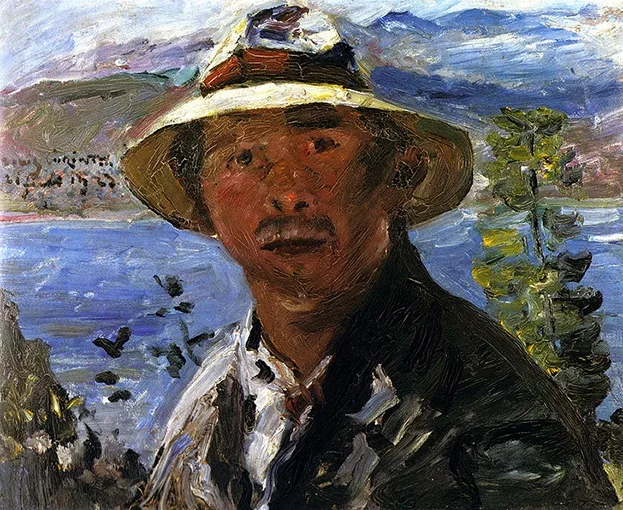
After the end of the war, and in view of the political events that followed it in the country, in 1919 Corinth and his wife withdrew to the village of Urfeld on Lake Walchensee, where Charlotte had bought land and built a house. Here he painted landscapes, portraits, still lifes… The paintings sold like hot cakes. The artist admitted that he had never before sold so many works. They were literally snatched from the easel.
On 15 March 1921 Corinth was awarded an honorary doctorate by the Albertina in Königsberg.
In the years that followed came his canvases "Red Christ", "Flora", "The Trojan Horse", "Carmencita" and portraits of his children, Thomas and Wilhelmine. From memory Corinth painted portraits of his friends and colleagues – Bernt Grönvold, Leonid Pasternak, Georg Brandes. His last major work was "Ecce Homo". He finished it just before leaving for Düsseldorf and Amsterdam on 16 June 1925. He planned to visit the best local museums once again...
But a month later Lovis Corinth was gone. He died of pneumonia in Zandvoort near Amsterdam. Charlotte brought her husband's body back to Berlin and buried him in the Südwestkirchhof cemetery in Stahnsdorf.
During the Third Reich, Lovis Corinth's works were declared "degenerate art".
Good collections of Lovis Corinth's works can be found at wikiart.org and museumsyndicate.com.
______________________
* The exact date the canvas was painted was established in 2014 on the basis of topographical and meteorological data.
** Although the name the artist was given at birth was Franz Heinrich Louis Corinth, he went down in history as Lovis Corinth. The reason lies in the Low German dialect (Plattdeutsch), which is close to Dutch and was spoken across northern Germany, including his native East Prussia. Since Lovis's father was an educated man who knew High German (Hochdeutsch), he had his son christened Louis. As a child, his parents called him either Louis or Luis. But Corinth remained "faithful" to the end to the Low German dialect he had spoken since childhood. Naturally, he signed his works Lovis Corinth.
*** The Berlin Secession (German: Berliner Secession) — an association of Berlin painters and sculptors of the late 19th century who rejected the academic art that dominated at the time.
Translated from Russian with the help of AI (Claude, Anthropic), October 2026.