The life of Countess Marion von Dönhoff spanned almost the entire 20th century. She was born in her family's ancestral castle and received a classic aristocratic upbringing, absorbing noble manners… Yet the world of high society, with its rituals, ceremonies and conventions, always irritated her. From childhood she far preferred the company of the ordinary peasants who worked on the family estate. At the same time, the young countess was proud of her name, conscious of belonging to one of the oldest noble lineages. In East Prussia, however, even though the nobility was a privileged class, nothing came to anyone for free. It was a time when women were assigned a fixed role: Kinder-Küche-Kirche (Children-Kitchen-Church). Marion was one of the few who managed to step beyond these conventions, obtain an excellent education, confidently run her vast estates and, what is more, find herself in a new life that began with a series of tragedies.
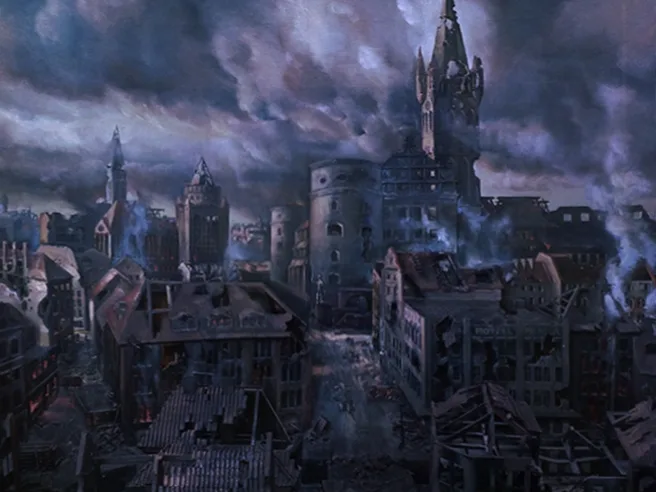
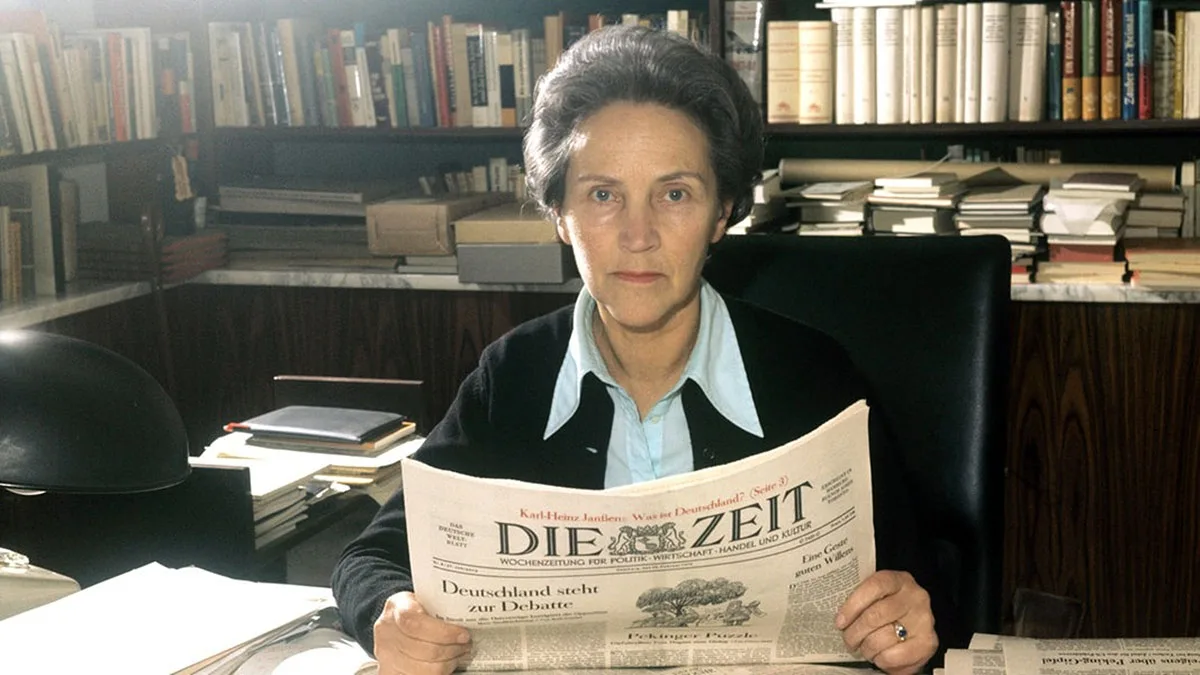
When the Nazis came to power, Marion, still a student, became an active opponent of the regime. In 1939 her brothers and nephews went off to the front. Then the death notices began to arrive. In 1944 she joined the Resistance. After the failed attempt on Hitler's life she managed to escape the gallows, while all her fellow conspirators were executed. The last and no less cruel blow of fate came in January 1945, when Soviet troops entered East Prussia and Countess Dönhoff fled to the West, losing in a single night not only her estate but her homeland. Once and for all. The fact that she was shaped as a person precisely in the Nazi era determined her interest in politics. By a lucky chance she ended up at the Hamburg weekly Die Zeit, and over 56 years in journalism she built a remarkable career. The countess knew how to rise above all things petty. To this day she is called a fantastic woman, the grande dame of German journalism, the conscience of the nation, one of Germany's most influential political commentators, who helped save the reputation of the German people.
Childhood
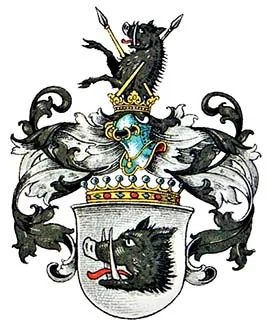
Where the Dönhoffs Came From
Like many German aristocratic families, the Dönhoffs moved east in the Middle Ages. They originated from Dunehof on the Ruhr (Westphalia). Their second family seat, also called Dunehof, was built in 1330 near Riga in Livonia, where eighteen generations of the family lived out their lives. The senior Livonian branch, known as Dönhof, produced eminent Polish magnates: palatines, hetmans, starostas and cardinals. The Prussian Protestant Dönhoffs descended from the Livonian Magnus Ernst von Dönhoff, Polish envoy to Saxony and Brandenburg, who settled near Königsberg in 1666. His grandson Otto Magnus, governor of Memel and Prussian envoy at the conclusion of the Peace of Utrecht, built the entire grand complex of Friedrichstein in 1709–1714.
Countess Marion Hedda Ilse Dönhoff was born on 2 December 1909 at Friedrichstein Palace, a couple of dozen kilometres east of Königsberg (today the village of Kamenka). Marion's mother, née von Lepel, had once been a lady-in-waiting to the last Empress, Augusta Victoria, and even at home she retained a taste for the strict etiquette of the Kaiser's court, requiring the servants to address her as nothing other than Your Excellency. Her father, Count August von Dönhoff, served as a diplomat at the German embassies in St Petersburg and Washington and was a member not only of the hereditary Prussian House of Lords but also of the elected German Reichstag. He was, moreover, a great connoisseur of art and an avid traveller. The count died when Marion was 10.
Splendour in public, austerity at home and Lutheran piety defined the style of the large Dönhoff family.
The youngest of seven children, Marion was by no means the favourite. On the contrary, her relationship with her parents, especially her mother, was cool. Only much later would she revise her childhood impressions of her father; for the time being she avoided him in every way: “In the study there was a very long table on which lay the Noveau Bulletin, all the German newspapers, the London Times… I always read them aloud to my father, as his eyesight was poor. And I hated doing it.”
The only one she got on well with was her disabled sister Maria. Disciplined, witty and Prussian to the core, Marion gradually grew apart from the rest of the household, turning, in protest, into a wilful, restless tomboy who considered aristocratic stiffness and pompous etiquette superfluous. She preferred to spend her time in the stables, the carpentry workshops or the garden, learning from the groom how to care for horses, from the chauffeur how to repair cars, and from the coachman how to whistle through two fingers.
And during the years of hyperinflation, when money had become utterly worthless and a single dollar cost more than four billion German marks, she and the estate workers' children loved to roll up million- and billion-mark banknotes, stuff them into bottles and bury them.
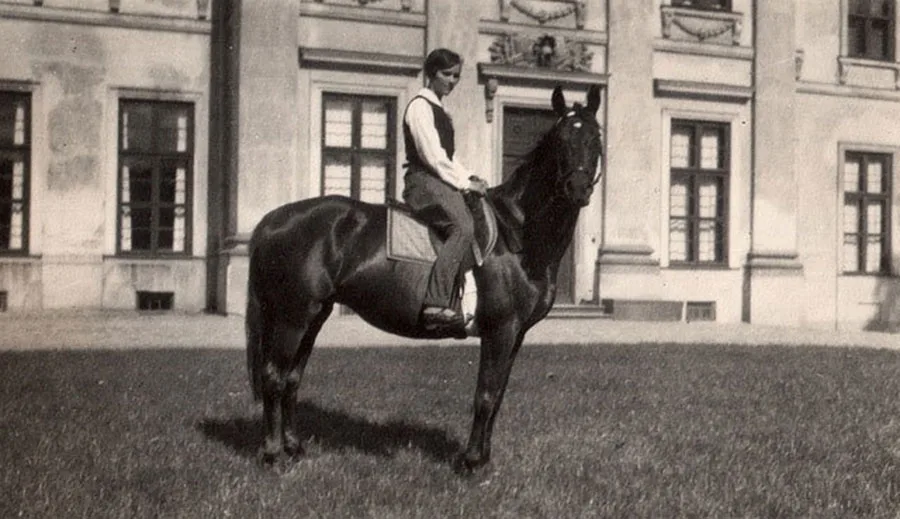 Marion the rebel on her horse by the walls of Friedrichstein Palace.
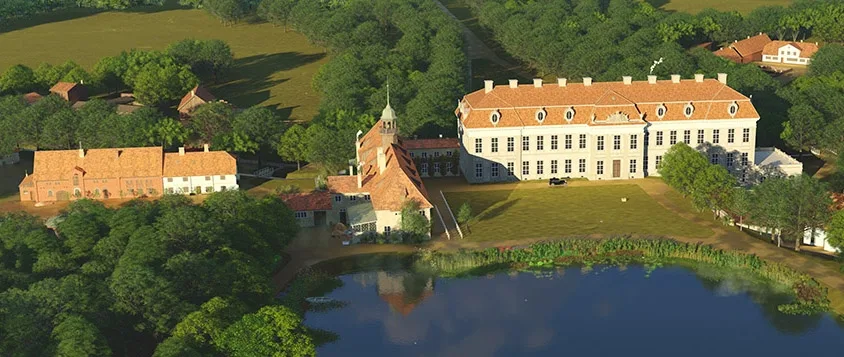
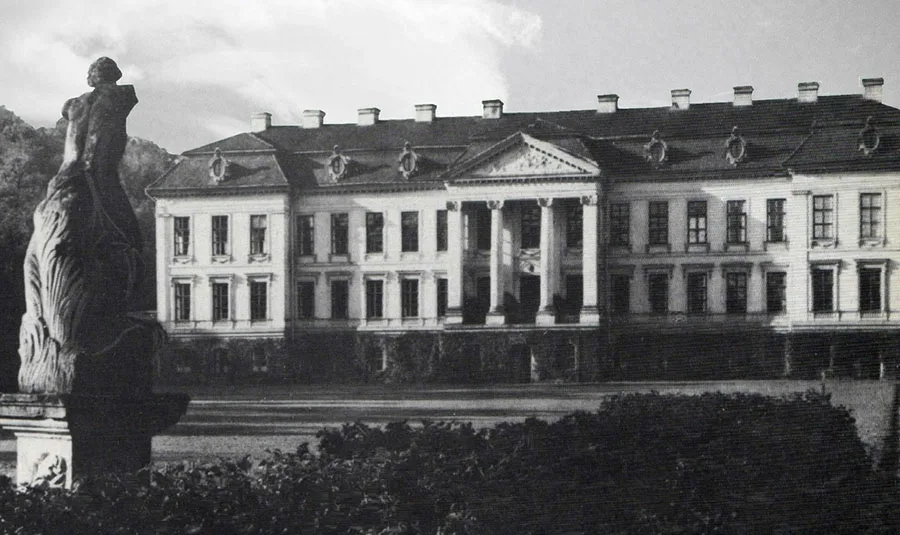 Friedrichstein was the largest country palace in East Prussia.
The fact that her parents paid little attention to their youngest daughter suited her perfectly. Marion found the circle of her aristocratic family utterly dull, especially when distinguished guests came to call. One of them, the Prussian Field Marshal Paul von Hindenburg, who stayed with the family for a whole week after the end of the First World War, the seven-year-old countess remembered for the rest of her life: “I was terribly disappointed in him then. I thought a dashing young hero would walk in, sword in hand. Instead in came an old man with a bristling moustache and a shuffling gait… He looked like the Nutcracker from my favourite picture book.”
Marion's best friends were her cousins Heinrich and Sissi Lehndorff from the neighbouring estate of Steinort.
They spent their free time together in the open Masurian countryside and took lessons together with private tutors. In those days Marion loved drawing funny caricatures of people who interested her: for example, the “eccentric bachelor” Uncle Carol Lehndorff, who held contests for his nephews and nieces in cooking dishes from gulls' eggs, or the head coachman Grenda, whom the children bribed with a cigar pinched from the house so that he would let them go riding.
One day a tragedy occurred that changed Marion's fate. On the way back from a trip to Kranz (now Zelenogradsk), the car in which she was travelling with friends, also teenagers, plunged off a steep bank into the Pregel and almost immediately sank to a depth of ten metres. “I got out onto the bank after about five minutes,” Marion recalled. The others died. Afterwards her parents sent her to a girls' boarding school in Berlin, far from the scene of the tragedy. But she soon rebelled against the strict rules that reigned there. “It's strange that grown-ups never understand children; they don't take them seriously, they graciously laugh at everything and try in every way to show that they believe in it too,” was the first entry in the diary she began keeping at 16. Thanks to her stubbornness, Marion secured a transfer: as an exception, she was admitted to a boys' grammar school in Potsdam. She was the only girl in her class, but that did not bother her in the slightest.
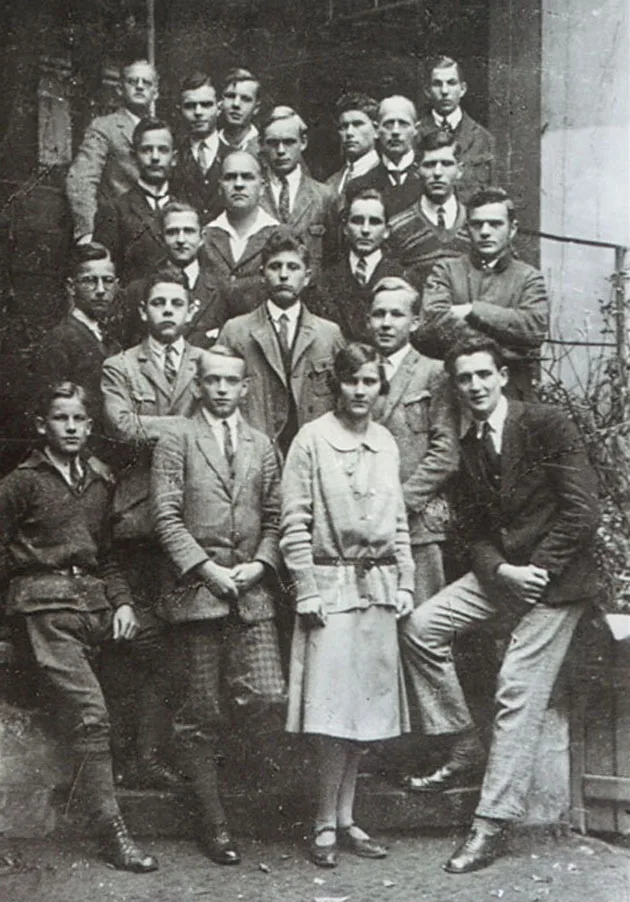 Schoolgirl Marion Dönhoff and her graduating class in Potsdam.
In 1928, after passing her school-leaving examinations with flying colours, Marion decided to continue her education at university, but her mother disapproved. Only after her elder brothers talked her round did she agree, and even then on one condition: Marion first had to complete a year-long course in home economics in Samedan, Switzerland. Having acquired the housekeeping skills then considered obligatory, which held little interest for her, she travelled around the USA and then went to stay with her brother Christoph in South Africa. He often took her along on safari. After accidentally shooting a leopard, she swore off hunting once and for all.
University Years
Marion belonged to the first generation to reap the fruits of the women's movement: higher education had become available to German women only in 1908. And so by 1932 the young countess from Friedrichstein was already learning the basics of economics at the University of Frankfurt am Main. Her studies, however, were overshadowed by the Nazis' rise to power: 90 professors and lecturers were driven out of the “red university”.
"Most of my fellow countrymen welcomed the new regime with satisfaction … At first I, too, thought that 'national' and 'social' made a good combination of words. And when I read that Adolf Hitler was going to speak in Berlin, I went," Marion Dönhoff recalled. "I sat two metres away from him for two hours. His speech had a horrifying effect on me. His arguments were utterly insane… And I realised that I would never have anything to do with that party."
As a student she attended communist meetings and handed out leaflets, which earned her the nickname "the Red Countess".
When her communist fellow students were expelled from the university, she feared persecution and transferred to Basel. There, in 1935, she successfully defended her doctoral thesis on the centuries-old history of the Dönhoff estate: "The Organisation and Management of a Large East Prussian Estate. The Friedrichstein Property from the Time of the Order to the Emancipation of the Peasants". The archive that her father had carefully preserved proved invaluable. And it was then that she saw the head of the family through new eyes: an interesting, intelligent and far-sighted man with the broadest of horizons.
After university, Marion was gripped by a passion for travel. In an inexpensive and rather modest white roadster made by Röhr, a little-known firm long since defunct, which her brother Heinrich had given her, she drove through almost the whole of Southern Europe. And never without her Leica: photography was her passion, as were cars.
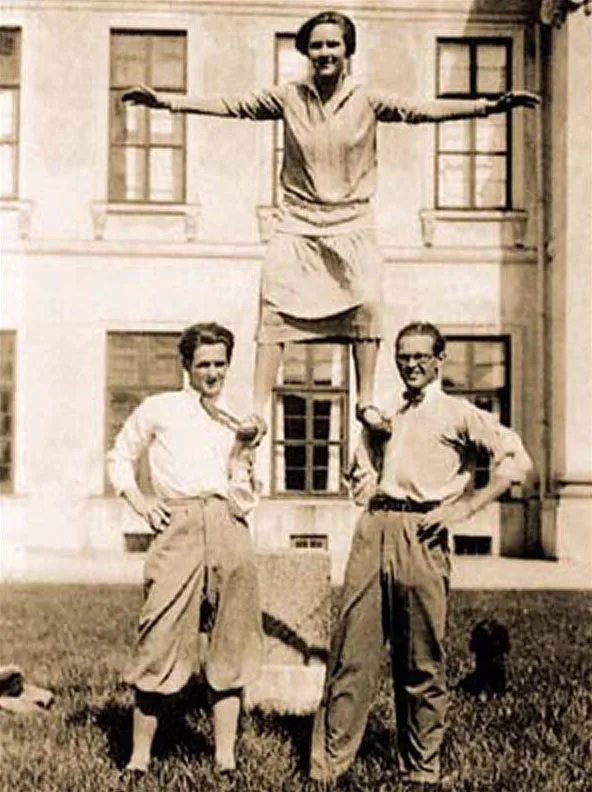 Countess Dönhoff with her brothers at Friedrichstein.
Back from her travels, Marion managed the family estate of Quittainen (now Kwitajny, Poland) near Elbing (now Elbląg, Poland) from 1939 until January 1945. She did not actually live there, however, but in a charming little house not far from Friedrichstein, because Quittainen was occupied by her uncle, Count Bogislav Dönhoff, who had long been at odds with the family.
By then the family's circumstances had changed as well. Her sisters Christa and Yvonne had married. Maria, the most beloved of them, had to go to Bielefeld, to a church-run institution known as a medical centre for the rehabilitation of patients with severe mental disorders, which bore the biblical name of Bethel, "House of God".
War
In 1939, when Marion's brothers went off to the front, she also took over the management of their estate at Friedrichstein. "I cannot describe the unbearable pain I felt when they were killed at the front," Marion confessed.
By the autumn of 1941, Hitler's invasion of the Soviet Union was entering its third month. Marion foresaw that it would all end badly. Together with Sissi Lehndorff she spent five days riding on horseback through Masuria. It was a kind of farewell to their homeland. With sadness they watched the young men leaving for the front, never to return.
As the inflammatory speeches of the National Socialists grew ever more frequent, Marion joined the Resistance, which her childhood friend Heinrich Lehndorff had told her about in confidence, and played an indirect part in preparing the attempt on Hitler's life. She acted as a liaison. The anti-Hitler Resistance was highly diverse and consisted mainly of German officers. Foreseeing inevitable defeat in the war, they resolved to eliminate Hitler physically and then hoped to conclude a peace treaty in order to spare Germany total ruin. The assassination was carried out by a young colonel, Claus Schenk von Stauffenberg, who had regular access to Hitler and brought a briefcase full of explosives to a briefing on 20 July 1944. The blast wounded 17 officers and killed four. Hitler himself escaped with a mild concussion, thanks to a massive oak table. Within a few hours the arrests began, after one of the conspirators betrayed the others. Her cousin Heinrich Lehndorff was executed along with other members of the Resistance.
She too was arrested, denounced by her uncle, the National Socialist Bogislav Dönhoff — the very man who lived in her manor at Quittainen.
The countess was interrogated by the Gestapo and released for lack of evidence. She described these tragic events in her book "For Honour's Sake: Memories of My Friends of 20 July", which she closed with the words: "Nothing can be worse than losing all your friends and being left alone."
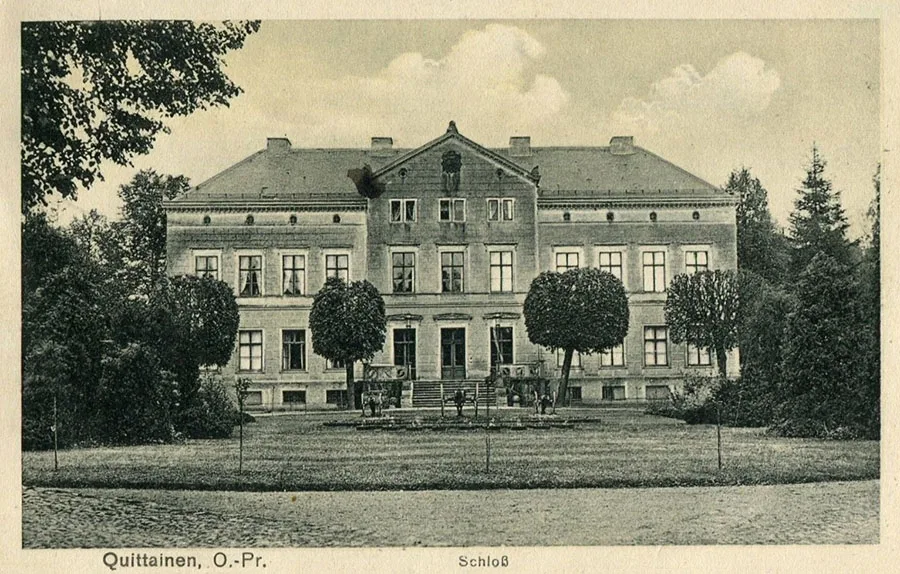 Quittainen Palace.
The Quittainen Estate
The estate dates back to the time of the Teutonic Order. In 1281 it belonged to Prussians who had converted to Christianity. From 1525 to 1538 part of the estate was held by Eckhard von Reppichau. From 1571 to 1681 it was home to the von Borcke family, and from 1681 the estate (together with neighbouring properties) belonged to Field Marshal Georg von Derfflinger, who defeated the Swedes at the Battle of Fehrbellin in 1675. In 1691 he sold Quittainen to Christoph zu Dohna, who in turn sold it to Count Albrecht von Barfus, a scion of an old Brandenburg family, field marshal and commander of the fortress of Spandau near Berlin. Barfus married Eleonore, daughter of Count Friedrich von Dönhoff of Friedrichstein Castle. As the couple had no children, the property passed by inheritance in 1744 to Philipp Otto von Dönhoff and remained in his family until 1945.
Count Philipp Otto Dönhoff, married to Amalie (1723–1798) of the Dohna-Schlodien family, outlived all 11 of his children and was thus left with no direct heirs. In 1771 he bequeathed the vast estate to a family charitable foundation, which existed until 1945. The last curator of the foundation, with its 11 villages and 12,000 hectares of land, was Heinrich von Dönhoff, the owner of Friedrichstein, who was killed on 15 November 1942 when his plane crashed near Kaunas.
The manor house at Quittainen was built in 1699, commissioned by Christoph zu Dohna to a design by Jean de Bodt. However, the design was implemented with serious deviations, and construction dragged on until 1740, by which time Albrecht von Barfus was the owner. The palace survived the Second World War, was occupied by Red Army soldiers and was later used by an agricultural cooperative. At one time it housed a school, and later administrative offices. Several pieces of furniture, a flag bearing the coat of arms of the royal House of Vasa and 20 rescued photographs from the palace, including portraits of members of the Dönhoff family, are now held in the museum in Olsztyn (Poland).
By mid-January 1945 it was already clear to Marion that the Red Army would enter East Prussia. In an interview in the early 1990s she would say: "We understood that the war was lost and that we were losing East Prussia. And the Russians ought to be pleased, because everything here was well kept."
For a long time no evacuation order came. On the contrary, flight was punishable by death as a sign of "doubting victory"… Then, in mid-January, the regional office of the National Socialist Party suddenly announced that the population had to leave the district by midnight. In other words, people were given just 24 hours to pack.
Relentless propaganda that the Russians would come and shoot everyone filled people with fear. They began to pack in haste. Through the night they gathered their belongings, opened the barn doors and untied the livestock — it all happened as if in a dream. "I quickly stuffed into my rucksack everything that seemed most essential: a few clothes, some photographs and documents," Marion recalled. On 24 January the countess, like thousands of others, fled west — an exhausting seven-week journey of 1,200 kilometres on the back of her faithful Alarich. Though "fled" is rather too strong a word.
In the January frost of minus twenty, along roads as slippery as glass, a dense stream of people with bundles and horses with carts trudged on, day after day.
"The great exodus from the Promised Land had begun, but not as in the days of Abram — 'unto a land that I will shew thee' — instead, without goal or leader, we set off into the night … They gathered from every village, from every street … hundreds, thousands of people … They streamed from north and south onto the broad Ost-West-Straße … An endless procession moved on to the rhythmic clatter of hooves. Frightened, hungry, having lost in a single stroke not only their homeland but also their faith in the future … It was unbearably hard, unbearably sad … Children and old people were dying of hunger. Corpses lay by the roadside. They could not be buried. The ground was frozen …" Marion Dönhoff wrote in her diary. To begin a new life, people headed west — "bewildered, without homeland or goal, like hunted animals… And is this all that is left of a people?.." Marion asked herself.
Her feelings at the time were mixed: on the one hand, the joy of liberation from the Nazis; on the other, despair at the loss of her native East Prussia. In time Marion came to terms with what she had lost and gave no thought to the possibility of recovering her estate: “When I think of the forests and lakes of East Prussia, I am certain that they are still as incomparably beautiful as they were when they were my home. Perhaps this is the highest form of love: to love without possessing.” It was a terrible chapter of her former life, in which she, the last representative of the ancient aristocratic Dönhoff family, lost not only her land but also relatives and close friends.
In December 1945, Marion Dönhoff travelled to the Nuremberg trials together with Richard von Weizsäcker, the future Federal President of Germany (1984–94), and Axel von dem Bussche, a former Wehrmacht major and member of the Resistance. Like her friends, Dönhoff believed that the tribunal should try the Nazis not only for the atrocities committed against other nations, but also for the crimes committed against their own people.
A Leap into Icy Water
It was not until 20 March 1945 that Marion Dönhoff reached Westphalia, where a refugee camp had been set up in the moated castle (Wasserschloss) at Vinsebeck. There she left her Alarich in the stables of Count Metternich’s stud farm and made herself a second vow: never to sit on a horse again.
Marion Dönhoff’s journey then took her to Lower Saxony, to Brunkensen, the estate of her friend Albrecht von Görtz, where the countess found temporary refuge. “With nothing better to do”, she wrote a memorandum for the authorities of the British occupation zone, setting out her thoughts on the recent war, on why Hitler had come to power and on the measures the Western Allies ought to take. As she had expected, the memorandum went unanswered, yet somehow it found its way to the young newspaper Die Zeit, whose licence Lovis Lorenz and his colleagues had received from the British military governor of Hamburg on 15 February 1946. The first issue appeared as early as the 21st. Exactly a month later, the weekly published the first article by the newly minted journalist Marion Dönhoff:
“I never even dreamed of becoming a journalist; it was pure chance. It was like a leap into icy water.”
Without a formal contract, Dönhoff – whom her colleagues never called anything but “the Countess” – began working in the politics department of Die Zeit for a monthly fee of 600 marks. One of her first pieces in the paper was the article “Flight to the West”, about that terrible night when she lost her homeland forever. Dönhoff felt deep pain both at the loss of East Prussia and at the misfortunes of ordinary Germans forced to leave their homes. After her flight, her second beloved place would become a small house in Hamburg’s Blankenese district, a gift from Gerd Bucerius. The publisher’s gesture moved Marion deeply: “Buc, I would so much like to express what I feel, to convey how happy this gift has made me – but it is beyond my power. Perhaps you will understand what moves me if I say that you have given me back a small piece of home, though I had thought that word had vanished from my vocabulary forever…”
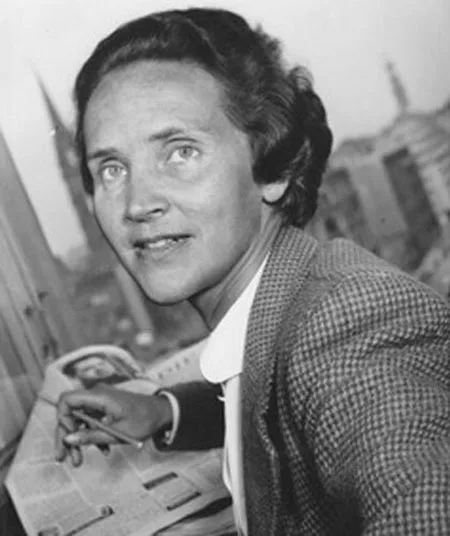 1960s. Journalist Marion Dönhoff,
Like her colleagues, she wrote articles demanding an end to the arbitrary rule of the occupation authorities. At the time this was far from a safe subject: such publications could lead to the newspaper being shut down. The censors were ever watchful. The paper was not closed, as it turned out, but Ernst Samhaber lost his post as editor-in-chief. Her writing covered a wide range of topics, and she took a critical stance on many political issues, among them Adenauer’s policies, the building of the Berlin Wall and apartheid in South Africa… When a huge scandal, the so-called “Spiegel affair”, shook West Germany in October 1962, Marion Dönhoff wrote a pointed editorial entitled “Who Still Thinks of the State?”, in which she lamented the decline of political morality in Germany. But what concerned her most was reconciliation with Poland and the restoration of relations between the eastern and western parts of Germany. She consistently opposed the Cold War between West and East. Her colleagues noted that Marion’s popularity stemmed from the simplicity of her style.
She wrote “as if she had to explain the course of world events to her aunt in the simplest terms”.

The Spiegel Affair
Following the publication of a scathing article on the poor combat readiness of the West German army, “Conditionally Ready for Defence” (10.10.1962), the offices of Spiegel magazine were searched, and its publisher and editor-in-chief, the 38-year-old Rudolf Augstein, was arrested along with several of his colleagues on charges of “betraying state secrets” and “endangering the welfare of the Federal Republic”. They faced up to 10 years in prison. The “Spiegel affair” cost Franz Josef Strauß his post as Minister of Defence, while the magazine’s circulation rose from 500,000 copies to 953,000 by 1969. Rudolf Augstein was released after 103 days, the last of those arrested to be freed. The charge of betraying state secrets against him and his staff was dropped. While the investigation was under way, Spiegel was for a time produced on the premises of Die Zeit.
After the war, writings by former ideologues of the Hitler regime occasionally found their way into newspapers. In August 1954, for instance, the editor Richard Tüngel published in Die Zeit the article “In the Antechamber of Power” by the jurist Carl Schmitt, who had worked for the Nazis in the past. Marion took a principled stand – either she or he – and resigned in protest. The editor-in-chief of Die Welt offered her the post of head of its politics department, but she declined and, moving to London, began working for The Observer. In a letter to Gerd Bucerius she spoke enthusiastically of its success and described the paper’s journalistic principles in glowing terms: take foreign policy seriously, avoid any party-political bias or affiliation, and respect readers as one’s equals.
The journalist’s departure was never announced anywhere; her name was simply removed from the Die Zeit masthead. However, word of the conflict at the newspaper reached the Office of the Federal President. Theodor Heuss – a liberal politician, journalist and Federal President of West Germany (1949–59) – summoned Gerd Bucerius, a member of the Bundestag in Bonn since 1949, for a dressing-down. Soon afterwards Tüngel was dismissed by court ruling. At Bucerius’s request, Dönhoff returned to Hamburg and wrote to Schmitt that there was no place in the paper for anyone who preached the spirit of National Socialism:
“I refuse to accept that we would be doing Germany a good service by giving traitors and well-pressed nihilists the opportunity to air their political views once again.”
While the court cases dragged on, the paper went without an editor-in-chief for several months, and the editorial work was de facto directed by Marion Dönhoff and Josef Müller-Marein. The year 1957 is regarded as the beginning of a new chapter in the life of Die Zeit: Bucerius became the paper’s sole owner and appointed Müller-Marein as editor. After the Carl Schmitt scandal, Dönhoff’s name became associated with a principled determination to rid the paper of the right wing and to keep it on a conservative-liberal course.
Immediately after her return from England, Marion Dönhoff was appointed head of the politics department. Largely thanks to her and Bucerius, the weekly’s circulation leapt within a year from 40,000 to 330,000 copies. The countess placed her bets above all on young staff members – Theo Sommer and Haug von Kuenheim. Both were not only talented journalists but also embodied the ideal image of a man: tall, slim, blue-eyed and blond. Theo Sommer would look after the countess until her last days. To Marion he became not merely a close friend but practically an adopted son.
Career
Die Zeit
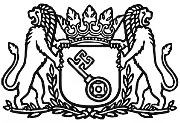
The first issue of the weekly came out on 21 February 1946 in a print run of 25,000 copies. The Die Zeit masthead, with its elegant typeface, was designed by Carl Otto Czeschka. His very first version included the Hamburg coat of arms and was used from the first issue through the 12th, published on 9 May 1946. It then had to be dropped because the authorities banned the use of the city's symbols for commercial purposes. On 27 June 1946 the Hamburg coat of arms was replaced with that of Bremen (the so-called “Bremen key”). This too was designed by Carl Czeschka, and it remains the logo of the newspaper and the entire publishing group to this day.
Today Die Zeit is a respected national newspaper. Besides it, the Zeit-Verlag publishing group runs several other projects: Zeit Online, Tempus Corporate, Convent Kongresse, and a publishing house specializing in art books.
Dönhoff rose rapidly through the ranks, and on 1 July 1968 she was appointed editor-in-chief of Die Zeit, one of the most influential newspapers in Germany. Thanks to her many connections, her excellent command of foreign languages and her poise, she quickly found common ground with the world's leading politicians. Her friends included Mikhail Gorbachev, George Frost Kennan, Henry Kissinger, Nelson Mandela, Lev Kopelev, Rudolf Augstein, Helmut Schmidt... and even West German Chancellor Konrad Adenauer, whom she accompanied on his trip to Moscow in 1955. Marion was deeply dissatisfied with the outcome of the negotiations and reproached the chancellor for making concessions. This despite the fact that the extremely difficult talks produced an agreement to exchange ambassadors and to release the last ten thousand German prisoners of war held in Soviet camps. At first her relationship with the chancellor did not go well. Which is hardly surprising.
First, anything Prussian affected Adenauer like a red rag to a bull; second, as a fierce anti-communist, he shunned any contact with people who had even the slightest connection to the Resistance.
Her relationship with Rudolf Augstein, editor-in-chief of the magazine Spiegel, on the other hand, was excellent. He respected Marion so much that once, on her birthday, he parked a Porsche outside her front door, knowing that racing cars had long been the countess's passion. To Augstein's surprise, she was so principled and independent that she refused such an expensive gift from a wealthy competitor, with all due respect to him. In fact, sports cars were the only luxury Dönhoff ever allowed herself. She drove them well into old age and gave up her license only at the age of 90.
West German Chancellor Willy Brandt also admired Marion. Through her articles Dönhoff successfully shaped public opinion and did much to help him get elected. In December 1970 Brandt invited her, together with the German writers Günter Grass and Siegfried Lenz and the publisher and journalist Henri Nannen, editor-in-chief of the magazine Stern, to accompany him on a trip to Warsaw for the signing of an important treaty. Marion accepted and was even pleased at first, but as the date approached she suddenly realized that the question of the Polish-German border would of course be on the table: “I did not want to be present when a glass of champagne would have to be raised to the loss of my homeland. I felt I could not bear it.”
Dönhoff declined to accompany the chancellor, calling herself a “coward” in a letter. At the same time, she admitted that writing the article “A Cross on Prussia's Grave” had been extremely hard for her: “I am ashamed to say that I cried all night afterwards.” And yet Marion supported Willy Brandt's Ostpolitik with regard to the German-Polish border. As recently as September 1964 she had been convinced that no one who had come from the East would ever renounce their land: “… If I were told today that I would die in an accident in three days, I would come to terms with it far more easily than with the loss of my homeland.” In the 1970s she finally accepted that East Prussia was lost forever, that the cross on her native land had been placed there by Adolf Hitler, “whose cruelty and megalomania wiped 700 years of East Prussian history off the face of the earth”:
“Today no one can hope that the lost territories will ever become German again.”
 1980s. Publisher Marion Dönhoff (right) with Chancellor Helmut Schmidt.
In 1972 Theo Sommer became editor-in-chief, and Marion Dönhoff joined the publishers of Die Zeit. Soon after this appointment, Chancellor Brandt offered her the chance to run for Federal President on the SPD ticket, but was turned down once again.
Her new position left her a little free time, and the countess allowed herself to take up public causes and charity work. She also found time to work on books. From the 1970s on, all of Germany knew Countess von Dönhoff as more than a journalist. She wrote more than twenty books, the best known of which are “Childhood in East Prussia”, “Names No One Speaks Anymore”, “Human Rights and Civic Spirit”, “Power and Morality: What Will Become of Our Society?” and the previously mentioned “For Honor's Sake: Memories of My Friends of 20 July”. And, of course, she kept writing for the newspaper, lecturing the newly minted editors along the way: “Gentlemen, your articles must be understood not only by a professor at a German university, but also by a Hamburg dockworker.”
Paradise Lost
In 1989 Marion was finally able to travel to her former homeland, East Prussia, where for the first time since the war she visited her native Friedrichstein. The place now bore a different name, one unfamiliar to German ears: “Kamenka”. “I was already half an hour's drive from my birthplace. Should I visit it, or keep it in my heart the way I remember it? I was anxious … I wondered whether the avenue was still standing. Yes, it was. On the right was the Waschtauch pond. There is no water to be seen anymore. The pond has vanished, and there are no graves to be seen in the cemetery. We drive on to Friedrichstein. The dear palace has been destroyed down to its foundations. The old mill is gone. The stables are gone. Everything is overgrown with bushes and trees. Civilization has abandoned this place,” the countess wrote. Nothing remained of the German heritage. And yet, to the end of her days, she remembered her native land:
“If someone asks me today where my homeland is, I will answer without hesitation: East Prussia. There is one reason for this: I miss the landscape, the nature, the animals of that lost world.”
Marion's second visit to Kaliningrad came in 1992, for the unveiling of a replica of the monument to Immanuel Kant that had been lost during the turbulent war years. That is a story in itself...
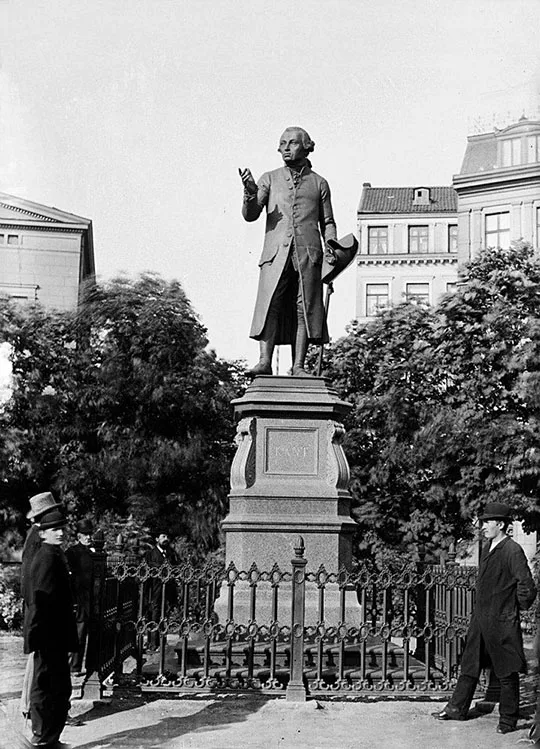 Monument to Immanuel Kant in Königsberg, 19th century.
In 1944, fearing the approach of the Red Army and the bombing raids, the authorities of Königsberg (today Kaliningrad) asked the countess to hide Christian Rauch's Kant monument on her estate. She gladly obliged: the sculpture was taken to Friedrichstein and set up in the park. There is no evidence that the monument was placed in any hiding place or buried before the retreat. Whether the Friedrichstein staff managed to hide Kant is a big question. Perhaps they had other things on their minds. In the mid-1980s, when a whole expedition set out from Kaliningrad in search of the local relic, the bronze statue of the philosopher could not be found; it had vanished without a trace. In the early 1990s, believing that what had once been taken from the city ought to be returned, Marion Dönhoff organized a fundraising campaign to have a replica made. People in Germany raised more than 100,000 marks. She contributed a substantial part of the sum from her own funds. A life-size bronze replica was cast to a design by the sculptor Harald Haacke. In 1992 it was installed outside the university building on the original pedestal, which had fortunately survived.
“The only thing I consider an important achievement of my life is the restoration of the Kant monument in Königsberg,” the countess said.
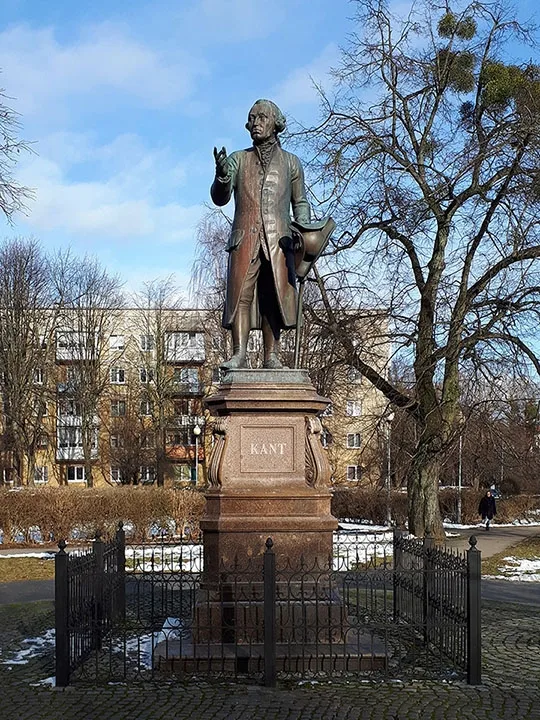 Replica of the monument to Immanuel Kant in Kaliningrad, 21st century.
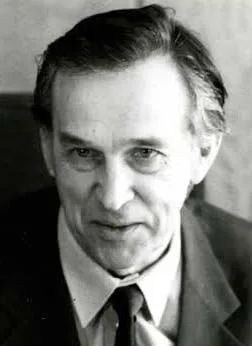
Valentin Falin
(1926–2018)
A great diplomat, an intellectual and a man of deep culture, an aide to Gromyko and Khrushchev, a Doctor of Historical Sciences and a political commentator for Izvestia, impartial and aloof from bureaucratic games, Valentin Mikhailovich served in the 1970s as Ambassador Extraordinary and Plenipotentiary of the USSR to the Federal Republic of Germany. In 1992 he moved to Germany, where, at the invitation of the German politician Egon Bahr, he worked as a professor of history at the Institute for Peace Research and Security Policy (Institut für Friedensforschung und Sicherheitspolitik) at the University of Hamburg. In 2000 he returned to Moscow. Valentin Falin was a friend of Marion Dönhoff. Their dialogue, in person and by correspondence, lasted three and a half decades. They shared their thoughts and doubts sincerely, without embellishment or flattery.
“A sincere admirer of Immanuel Kant, who did much to establish the glorious image of the great philosopher in present-day Kaliningrad, she seems to have committed herself, for the sake of ‘perpetual peace’, to the search for a model of renouncing humanity’s obsessive, vicious companion — violence and all the beliefs that serve it,” wrote the Soviet diplomat Valentin Falin. “… When I had the good fortune to meet M. Dönhoff and talk with her at length, I became convinced that this fragile-looking yet far from timid woman was the last person to strive for originality by adapting to fashion. Her character and views were shaped under the blows of grievous losses, on the ruins of a familiar way of life that had collapsed … She did not allow her soul to be shackled by hatred and fatalism, nor did she wish to content herself with an explanation of what had happened that was convenient and safe in the conditions of the FRG. Countess Dönhoff preferred to search for her own reading of wartime and postwar history in order to answer the fateful question: how can peace be preserved, how can a new catastrophe be prevented? … At times I was struck by her devotion to the hope that, in defiance of the logic of ‘point against point’, everything would turn out well, that if not higher reason, then at least the instinct of self-preservation would prevail.”
Epilogue
In the late 1990s Marion Dönhoff was diagnosed with cancer, and she underwent three operations. “Her boys”, Haug von Kuenheim and Theo Sommer, stayed by her side until the end of her days, recording a final interview that was never completed. The Countess died on 11 March 2002 at Crottorf, the estate and residence of her nephew Hermann Hatzfeldt.
For the Countess’s 100th anniversary, thanks to Friedrich Dönhoff and Irene Brauer, the book “Countess Marion Dönhoff: A Life in Letters” was published. To mark the same occasion, the Federal Government issued a commemorative 10-euro silver coin bearing the quotation “Lieben ohne zu besitzen” (To love without possessing) from the book “Childhood in East Prussia” and a portrait of Countess Dönhoff, an honorary citizen of the city of Hamburg.
In 1988, using the money she had received in prizes and in royalties for her many books, Marion Dönhoff established a foundation that promotes friendly relations between Germans and the peoples of Eastern Europe, contributes to securing peace, and provides financial support to Eastern European students and scholars.
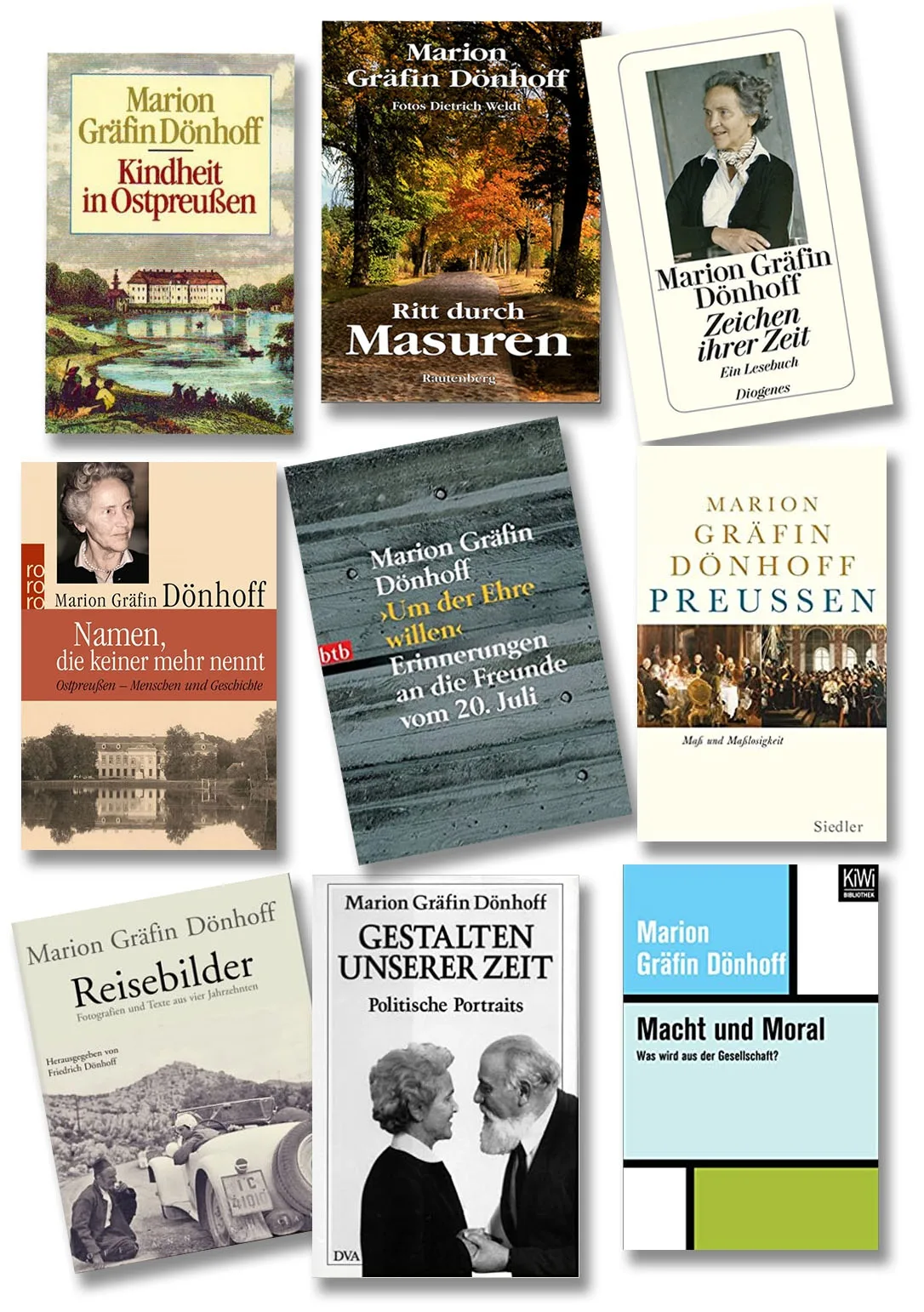 Books by the writer and photographer Marion Dönhoff.
The Countess Dönhoff programme enables talented young journalists from Eastern European countries to form their own picture of politics, the economy, culture and public life in Germany.
They are given a unique opportunity to become acquainted with the standards and principles of German journalism by working in the editorial office of one of the country’s well-known newspapers. In 2003 the Foundation established a prize of 20,000 euros, awarded to individuals who promote international understanding. In 2010 this prize “For International Understanding and Reconciliation” was awarded, among others, to the former President of the USSR, Mikhail Gorbachev.
Today the Marion Dönhoff Foundation is run by Irene Brauer, a remarkable woman who kindly provided photographs from the Foundation’s archive for this publication.
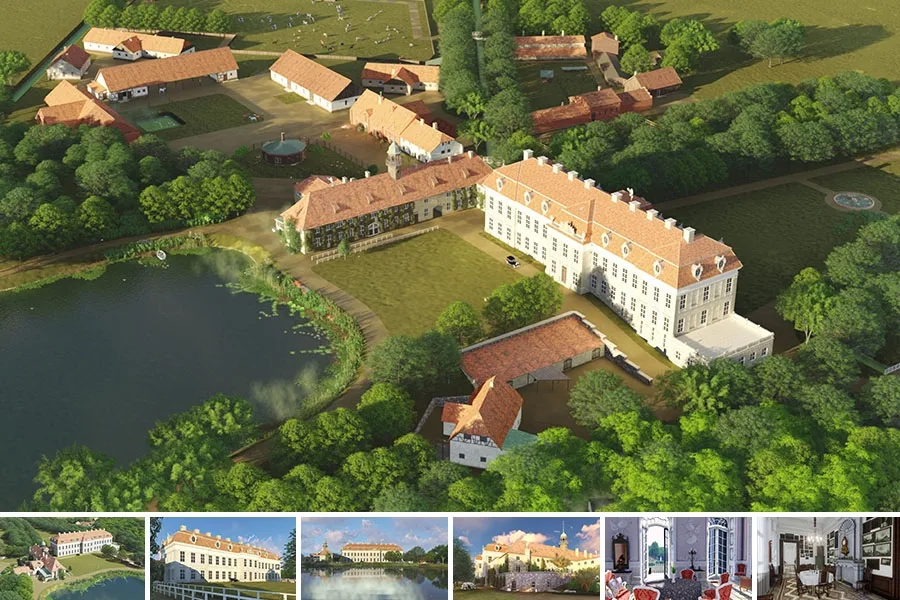
P.S. In 2016 the Kaliningrad architect Arthur Sarnitz (Arthur Sarnitz), commissioned by the Herder Institute (Herder-Institut), created a 3D visualisation of the Friedrichstein estate (Kamenka), which was lost in the postwar years. The project included modelling the main building (the palace) and more than ten other structures located within a 100 m radius of it. A gallery of the renderings can be viewed on the palace page.
Sources:
- Marion Dönhoff Stiftung (Marion Dönhoff Foundation);
- Marion Gräfin Dönhoff – vom Heimatverlust zur Aussöhnung mit Polen;
- Marion Gräfin Dönhoff – Mit Mut Meinung bilden;
- Марион Дёнхоф, совесть Германии;
- Marion Gräfin Dönhoff wäre 100 geworden;
- Marion Gräfin Dönhoff: Wer darf hier schreiben?;
- Marion Gräfin Dönhoff;
- Marion Gräfin Dönhoff, eine selbstlose Gerechte;
- Die Welt im Sucher;
- Marion Gräfin Dönhoff: Ein Leben in Briefen, herausgegeben von Irene Bauer und Friedrich Dönhoff;
- Immanuel Kant ;
- Preußens große Soloreiterin;
- Marion Dönhoff;
- Dönhoff:
- Марион Денхофф: преданность надежде
- Marion Gräfin Dönhoff, Haug von Kuenheim,Theo Sommer. «Was mir wichtig war: Letzte Aufzeichnungen und Gespräche»;
- Von der ostpreußischen Gutsbesitzerin zur kapitalismuskritischen Publizistin.
Translated from Russian with the help of AI (Claude, Anthropic), October 2026.