Although the origin of marzipan is still disputed, most historians favour the "Eastern" version. After all, it was there that almond trees were grown and Indian sugar cane was cultivated in the Middle Ages and earlier. The Persian physician Rhazes, who lived from 850 to 923, praised in his book an excellent remedy for nervous disorders that he himself had made from these ingredients (almonds and sugar cane).
Spain deserves a special mention in connection with marzipan. It turns out that marzipan was made there as early as the 8th century, though to its own recipe. In Toledo, for example, pine nuts were and still are added to it, in La Rioja lemon zest, while in Andalusia it is made in slabs with a filling of candied fruit. However, there are other contenders in Europe for the title of the birthplace of marzipan: France, Germany, Estonia, Hungary and, above all, Italy. In the 13th century small boxes of "Mataban" sweets were indeed sold in Venice, Naples and Sicily. Their name was clearly of foreign origin.
Later this mysterious word was borrowed and adapted by Italian as "Marzapane" (Marci panis, "the bread of Mark", the patron saint of Venice).
It reached France as "Massepain", and in Germany it was reshaped in the local manner as "Marzipan". Scholars also link the origin of the word "marzipan" with the Greek "maza" (flour porridge) and the Persian "märzäban" (prince).
At the same time, in the 13th century, the outstanding thinker, Catholic philosopher and theologian Thomas von Aquin (none other than Thomas Aquinas), having "studied" marzipan thoroughly and with relish, concluded that the product was quite spiritual and "did not break the fast".
The Dutch also made their contribution to the marzipan recipe: they pound almonds, mix them with icing sugar, egg white, a drop of lemon juice and liqueur, roll the paste into sheets 3 cm thick, wrap them in foil, leave them in the refrigerator for two to seven days and then cut them up.
The 13th century saw the rise of the Hanseatic League, a trading alliance that united some 80 European cities.
Besides all sorts of spices, the huge ships of the Hanseatic merchants brought top-quality almonds and oriental sweets from the East, marzipan among them. The exotic delicacy quickly conquered northern Europe. The first in Europe to enjoy its taste were kings and the wealthy. The German emperor Charles IV, nicknamed "the first merchant on the throne" for his support of trade, received a gift of marzipan covered with gold leaf in 1368.
A story handed down from generation to generation has it that Queen Elizabeth I of England (1533 – 1603), "a passionate lover of sweets", held marzipan in high regard and considered its taste fit for royalty. However, the very notion of a "royal taste" for marzipan came into use only during the reign of France's "Sun King", Louis XIV. A lover of lavish balls and a great gourmet, he ordered festive tables to be decorated with marzipan creations: all kinds of fruit, berries, poultry, game… And all life-size, so that they could not be told from the real thing.
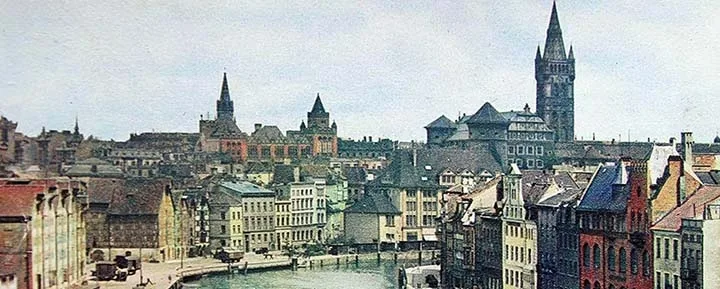
East Prussia in its day laid claim to leadership in marzipan making.
True, there is a legend that it was first made here not out of plenty but because of impending famine, when the storehouses of Königsberg were almost empty. All that was left were almonds and sugar, and rose water in the pharmacies. On the orders of the city authorities, the cooks made from a mixture of these products something shaped like small loaves of bread... Whether this is fact or fiction, the taste of that "bread" evidently appealed to the starving population.
At the beginning of the 16th century, back in the days of Albrecht, Grand Master of the Teutonic Order and first Duke of Prussia, marzipan was sold in East Prussian pharmacies as a remedy. Later confectioners' shops also obtained the right to sell it. And at the very beginning of the 19th century real marzipan factories began to appear in Königsberg. The first was opened in 1809 by the Pomatti brothers, who were rewarded with the title of "confectioners to the royal court". Thanks to the export of Königsberg marzipan, the world came to know the names of such local producers as Gehlhaar, Pluda, Sterkau, Steiner, Siegel, Petschlies, Liedtke...
As Marion Lindt, a collector of old recipes, writes in her book "Traditional Dishes of East Prussia", Königsberg marzipan is not as sweet as, for example, Lübeck marzipan.
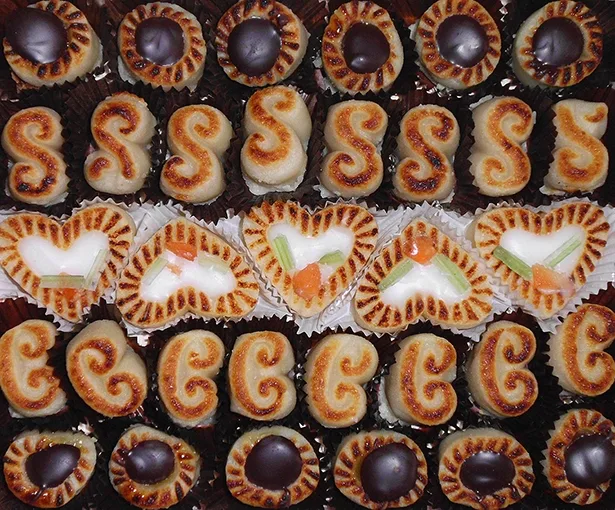
Making it is not complicated, but it takes a fair amount of time and, above all, attention: the marzipan must not "roast" in the oven but only brown. And it must do so quickly, with top heat only, at the highest setting.
As a rule, marzipan was made without a filling or any additions. Marion Lindt gives one of the recipes of her family, who once lived in East Prussia:
500 g of sweet almonds,
20 g of bitter almonds,
500 g of icing sugar,
1 tbsp of rose water,
the white of one egg for glazing.
Scald the almonds with boiling water and leave them to stand briefly so that the skins loosen; remove the skins, then put the peeled kernels into cold water so that they do not darken, and then dry them thoroughly.
Grind the prepared almonds finely and mix them with the icing sugar and rose water.
Knead the mixture thoroughly and for a long time (about 50 minutes) with wet hands.
Leave it overnight in a covered dish.
The next day, shape the marzipan paste, which has the consistency of modelling clay, into various figures (hearts, balls, pretzels, little loaves), brush them with beaten egg white, place them close together on a baking tray lined with baking parchment and put them in the oven with the top heat at its highest setting (today you can use the "grill" function).
Brown until a golden-brown crust forms.
Incidentally, Königsberg marzipan was traditionally shaped like a heart, which was one of its distinctive features.
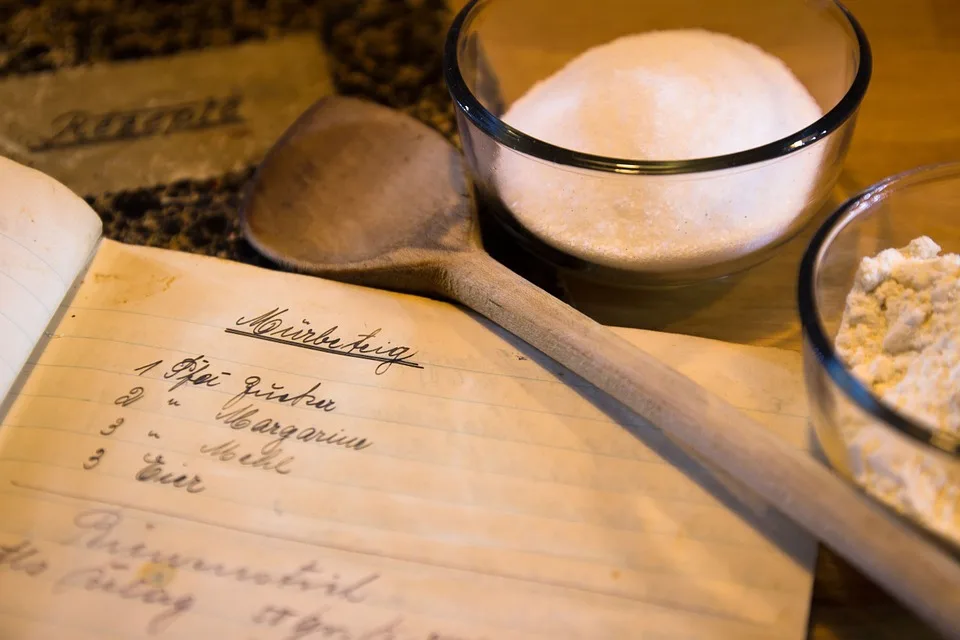
Marzipan recipes were religiously preserved in almost every family cookbook. East Prussian housewives made marzipan with great pleasure, although it was painstaking work. Harald Saul, one of the best-known historians of East Prussian cuisine in Germany, gives in his book "Unforgettable East Prussian Cooking" a late-19th-century marzipan recipe from the cookbook of the Lube family of Königsberg:
Mix 1 pound of finely ground sweet almonds with one pound of icing sugar and four tablespoons of rose water.
Knead the mixture until it can be rolled out.
Using a cutter, cut out circles (or hearts) the thickness of two knife blades, brush them with beaten egg yolk and decorate them with figures modelled from the marzipan paste.
A pattern can be made with a fork or a needle.
Place the marzipan in a cool place.
After a day or two it is ready to eat.
A note in the margin of the book reads: "The best rose water is sold in Bulgaria."
It is hard to say which of these two recipes is considered the true Königsberg one. Some sources claim that the local marzipan was browned in the oven, with sugar paste and fruit placed around the edge. A special piquancy came from a kernel of bitter almond ground together with the sweet almond paste.
According to other available sources, Königsberg marzipan differed from, say, the Berlin variety in being more thoroughly baked and darker, with more bitter almonds added to the paste, which gave the delicacy a sharp taste and aroma.
The Prussian princess Louise Charlotte, having become the wife of Nicholas I and thus Empress of Russia, also treated her courtiers to marzipan creations. She had it sent specially from Königsberg.
Königsberg marzipan has a long tradition. Even today it can be bought in some German cities. In Berlin, for example, Ralf Bentlin carries on the business of his father Paul Wald, a native of Königsberg, who in 1939 opened a small shop selling Königsberg marzipan in Charlottenburg. Today, as before, it is enormously popular.
According to Bentlin, the distinctive feature of Königsberg marzipan is that its surface caramelises when it is baked. "For me, marzipan means almonds, rose water and sugar," he says. "Königsberg marzipan contains a higher proportion of bitter almonds than Lübeck marzipan. That's all I can tell you. The rest is a secret."
Ralf Bentlin notes only that genuine Königsberg marzipan must contain no flavourings, no preservatives and no other additives of any kind.
Today Kaliningrad enthusiasts are trying to revive the local tradition of marzipan making. Shops have appeared where it can be bought. In one of them, on Nevsky Street, customers can see old Königsberg marzipan moulds. The city has a Marzipan Museum, whose exhibition is currently housed in the Kaliningrad Art Gallery. All this inspires a certain optimism: perhaps one day Kaliningrad will regain its fame as the marzipan capital of all Europe, which would benefit the region's tourism industry and its economy.
Translated from Russian with the help of AI (Claude, Anthropic), October 2026.