IF NOT FIRE, THEN PLAGUE
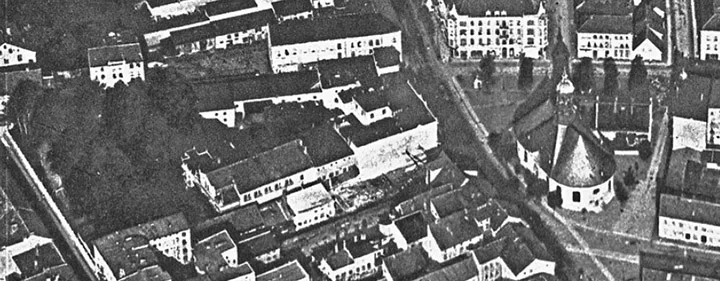
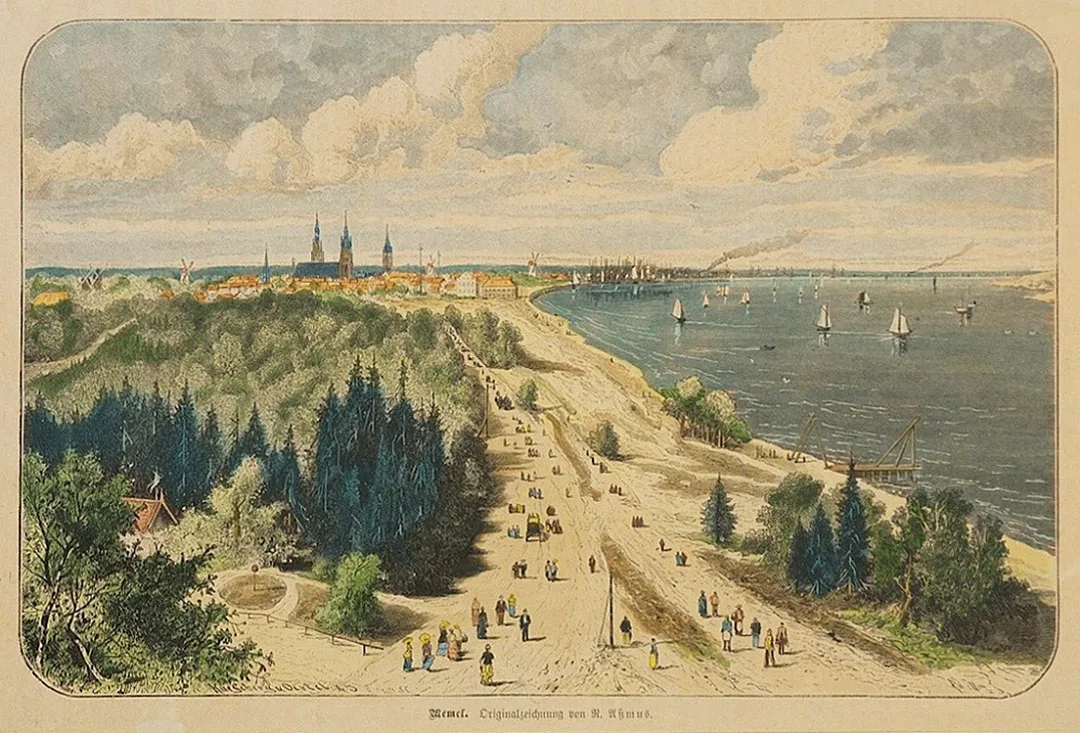
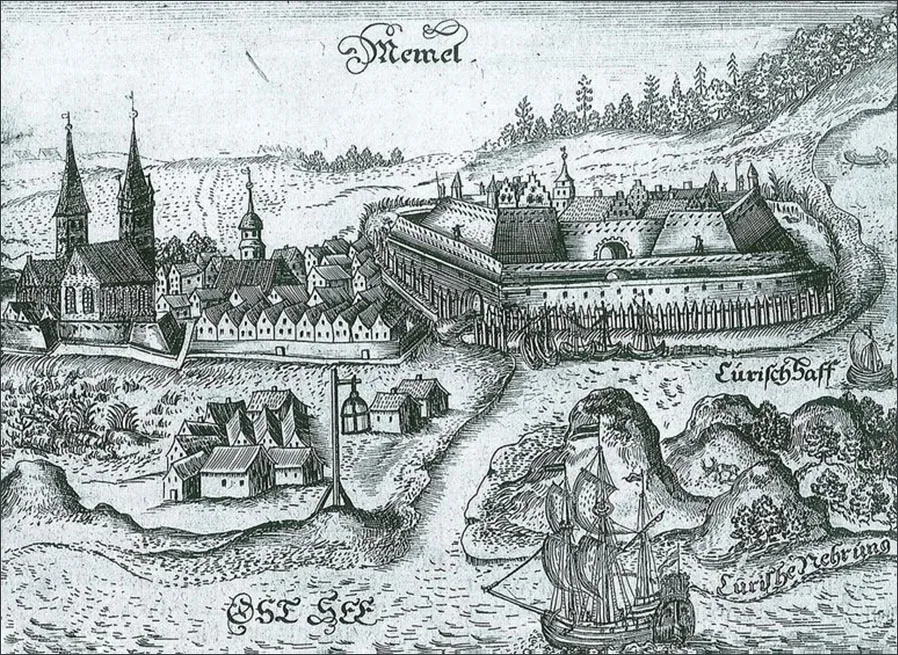
On 29 July 1252, Eberhard von Sayn, Master of the Livonian Order, and Bishop Heinrich of Courland agreed to build the castle of Memelburg and the town of Memel on the site of a burnt-down village called Klaipėda. On 1 August 1252, the bishopric's chancery issued a document confirming the agreement of 29 July. Under it, the bishop undertook to support the Order with money for 5 years, counting from the day construction began, and to provide 500 men for the works for one year. Once the agreed term had expired, the parties were to divide the castle, the town and the adjoining lands between them: two parts to the Order and one part to the bishopric. The castle was completed that same year, 1252. It was a rather cumbersome wooden structure, and it soon burned down during a Samogitian attack. A stone castle was built quite quickly in its place, and beneath its walls rose the town of Memel, named after the Neman River (German: Memel).
Under the agreement, coins were to be minted at Memel Castle and to circulate throughout the Diocese of Courland, while the subjects of the Order and of the bishop were to enjoy the right of free trade throughout Courland.
On 8 February 1253, the boundaries of the town were formally confirmed, and, in accordance with the agreement, a third of it passed to the bishop. Such harmony between spiritual and secular authority was of strategic importance and was explained by Memel's rather advantageous location: it served as a link between the Prussian possessions of the Teutonic Order and the Baltic lands of the Livonian Order. In the summer of that year, Samogitian and Sambian forces besieged Memel Castle but failed to take it. In response, Master von Sayn laid waste to the Samogitian lands, and in the autumn he rebuilt and strengthened the castle.
Samogitians
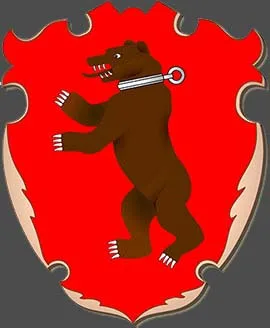
The Samogitians, or Žemaičiai, also known in older sources as the Zhmud, are the people of the historical region of Samogitia, an ethnic group within the Lithuanian nation in Western Lithuania. The name is believed to derive from the Lithuanian “žemas”, meaning “low, low-lying”. According to another theory, the word comes from the Lithuanian žemė, “land”. In the 5th century, the ancestors of the Samogitians inhabited the basin of the Šventoji River. The tribe then moved west as far as the Samogitian Upland, in the upper reaches of the Dubysa and Jūra rivers. Samogitia is first mentioned in 1219. From the 13th century onwards, the Samogitians waged a constant struggle against the Teutonic Order for their independence, and in 1422 they became part of the Grand Duchy of Lithuania, forming their own Eldership of Samogitia. Casimir's Privilege of 1441 established Samogitia's autonomy, including the right to elect its elder and its tiūnai (local officials). In the 15th century, the Samogitians became the last Europeans to be converted to Christianity. In the first half of the 20th century, a separate Samogitian written language based on the Latin alphabet was created.
Memel was originally destined to become the capital of all Courland, since the plan was to house there not only the province's only mint but also the residence of the Courland cathedral chapter. As for the internal organisation of the new community, it was initially intended to grant it Dortmund town law. The Order was even inclined to name the town Neu-Dortmund. In 1257, however, Memel received Lübeck law. This law was rather harsh, especially in its penalties for crimes against the state. Counterfeiters, for example, were executed “by boiling in water or by scalping”. Memel was also meant to become a place of settlement for colonists and to serve as a “gateway” to Livonia. By 1258 the town already had two churches. One (St John's) served the still small number of colonists, the German townspeople, while the other (St Nicholas's) served Lithuanians from the surrounding area. The castle church of St Mary appeared somewhat later and stood on the grounds of the cathedral chapter.
Lübeck was assigned the role of chief organiser of the colonisation process, as evidenced by a charter sent on 27 April 1261 by the Order's Vice-Landmeister in Livonia to the authorities and citizens of Lübeck. It called on them to come to Memel by sea before the onset of winter. The Order promised to grant the settlers as fiefs “the vacant lands that had formerly belonged to slain Curonian apostates. The size of the land allotment depended on the colonists' social estate. The largest allotment (40 Saxon hides) was granted to a knight or to an ‘honest burgher arriving with a horse clad in armour’”. Thus, for townspeople, taking part in colonisation offered a chance to raise their social standing and come closer to the status of knights.
The first German colonists came to Memel from Holstein, Westphalia (Dortmund) and Lübeck. Their numbers, however, long remained small. At the beginning of the 16th century, some twenty families lived within the town limits — around 100–150 people.
The suburbs were more populous. Some 143 families of non-German origin were registered there; in the Middle Ages such families were denied town rights. Members of various ethnic groups settled outside the castle, but only Germans were permitted to live within the town limits.
According to the original plan, the town was to be the seat of the bishopric, but because of the constant raids by the Samogitians, who inhabited Western Lithuania, it did not remain so for long. Peter of Dusburg, a 14th-century priest-brother of the Teutonic Order and author of the “Chronicle of the Prussian Land”, described the tragedy of 1323: “... The Lithuanians of Samogitia with their army took the town of Memel ... the town itself and three nearby castles of the newly converted, the boats and other vessels, and everything that fire could consume, save only the castle in which the brethren lived, they reduced to ashes ...”.
In 1328 (according to other sources, in 1326), the Livonian Order, no longer able to defend Memel and its environs against the Samogitians, handed the castle and town over to the Teutonic Order in exchange for possessions in Estonia. The bishop was forced to leave the town together with the brethren of the Livonian Order. At that time the Teutonic Knights also made a decision that would shape the fate of the Memel Territory for a long time to come. The border between the two provinces of the Order was moved north of the Neman River, which meant that Memel passed from Livonia (the territory of future Latvia and Estonia) to East Prussia. The new authorities stepped up the recruitment of German settlers for Memel. German peasants, however, were reluctant to move to this alien, distant and still undeveloped land, so the Order had to invite Lithuanian refugees, who had been driven out of Lithuania for converting to Christianity, as well as Christianised Curonians, who became Germanised fairly quickly.
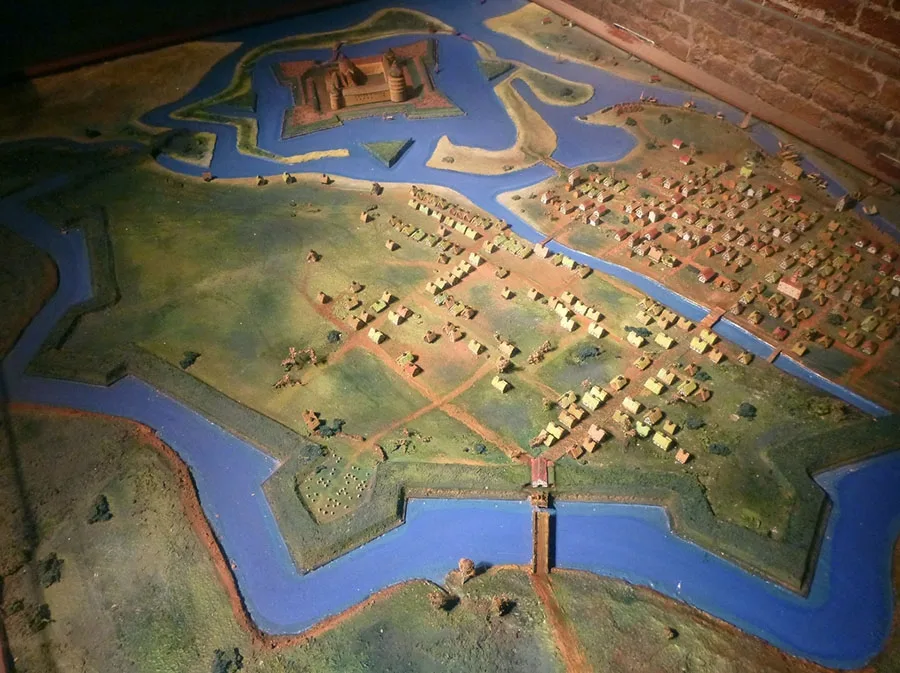
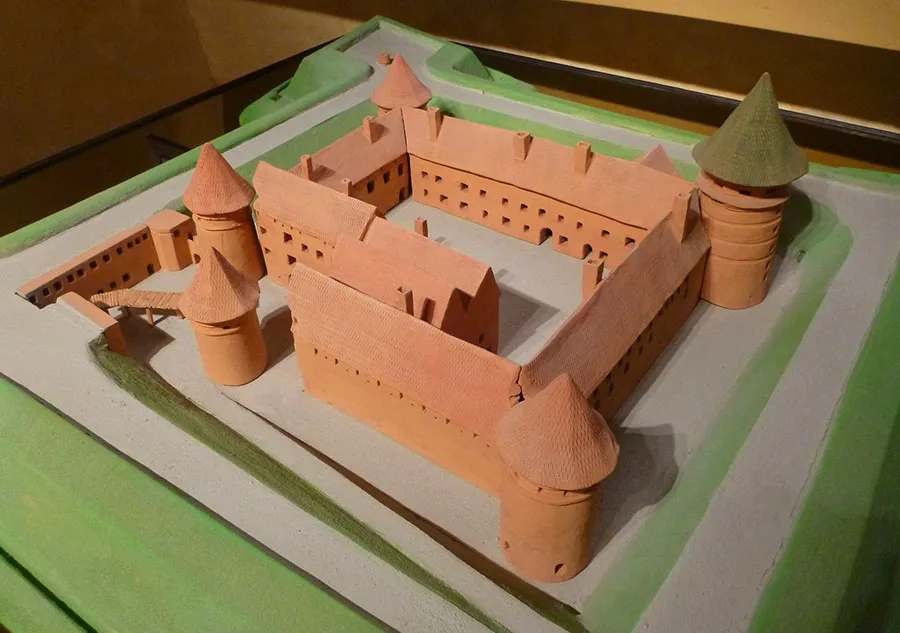
A model of medieval Memel in the Memel Castle Museum (top) and a model of the castle in the Museum of Lithuania Minor.

Curonians
An ancient West Baltic tribe that inhabited the Baltic Sea coast in the 1st and 2nd millennia AD. Their name was given to the Courland Peninsula, the Curonian Lagoon and the famous Curonian Spit. Historical chronicles mention the Curonians as formidable warriors and skilled seafarers. Their constant sea raids on Scandinavian lands and merchant ships earned them a reputation as the “Baltic Vikings”. Scandinavian sagas often portrayed them as dangerous and unpredictable neighbours with whom fierce naval battles had to be fought. Besides raiding, the Curonians were successful fishermen, traders and farmers, and they worked amber. From the 13th century onwards, the tribe's fortunes changed with the expansion of the German crusaders. The Curonians resisted the Livonian Order long and desperately, but by the end of the century they had been completely subjugated. Over the following centuries they were gradually assimilated, becoming one of the most important ethnogenetic components of the Latvian and, in part, the Lithuanian people.
The Teutonic Knights knew all about the warlike nature of this tribe. Not only had the Curonians plundered the Swedish island of Öland in 1170 and seized and sacked Sigtuna, the political and religious centre of Sweden, in 1187, but in 1193 they also dealt a heavy blow to a crusader army of Bremen Germans, Danes and Swedes that had landed in Courland. So heavy, in fact, that the Danes even came up with a prayer: “Lord, protect us from the plague and the Curonians.” The medieval North German chronicler, canon and scholasticus Adam of Bremen advised Christians to keep well away from their shores — Curonian pirates were considered the most merciless on the Baltic Sea.
For a long time the Curonians remained confirmed pagans. Albert von Buxhoeveden, the first Bishop of Riga, tried to convert them to Catholicism, but to no avail. Nor did the Brotherhood of the Knights of Christ, founded in Riga in 1202 and better known as the Order of the Sword Brothers, which was later transformed into the Livonian Order. In 1210 the Curonians marched on Riga and held it under siege for three days. Later, in Memel, they made excellent maritime customs officers.
In 1413 Vitovt (Vytautas), Grand Duke of Lithuania, reproached the Grand Master of the Teutonic Order in a letter for seizing foreign lands, namely Klaipėda (Caloypede).
This was the first time that the Lithuanian name of the place, "Klaipėda", appeared in a written source. Although cartographers usually marked the town as Memel, on the map included in Christoph Hartknoch's 1689 book "Old and New Prussia" it was called Caloypede.
In 1525, when the Teutonic Order ceased to exist, Grand Master Albrecht of Hohenzollern-Brandenburg converted to Protestantism and proclaimed the first Protestant state in Europe, the Duchy of Prussia. By then Memel had become an important Prussian trading port, competing with neighbouring Königsberg and Danzig. In 1538 Memelburg Castle was surrounded by an earthen rampart with four bastions and a wide defensive moat, spanned by a wooden bridge. The resulting fortress, in which the castle now served as the citadel, was the first bastioned fortification in the entire eastern Baltic.
By the middle of the 16th century the town was already quite strongly fortified, but in 1540 it suffered a terrible fire that left only six houses standing. The fortifications were then expanded. Yet none of them could save the inhabitants from the Great Plague that raged across the Memel land in 1709–10. It claimed more than 2,000 lives, roughly half of Memel's entire population at the beginning of the 18th century. Unsanitary conditions made matters worse. The town had neither running water nor sewers. Water was drawn from the river or from wells. Waste was dumped into the town ditches, straight into the river or into special cesspits that were emptied only irregularly. Sometimes they were simply filled in and new ones dug next to them. Whole villages in the region were left deserted. And, just as after the great fire (1540), people set about rebuilding their land anew.
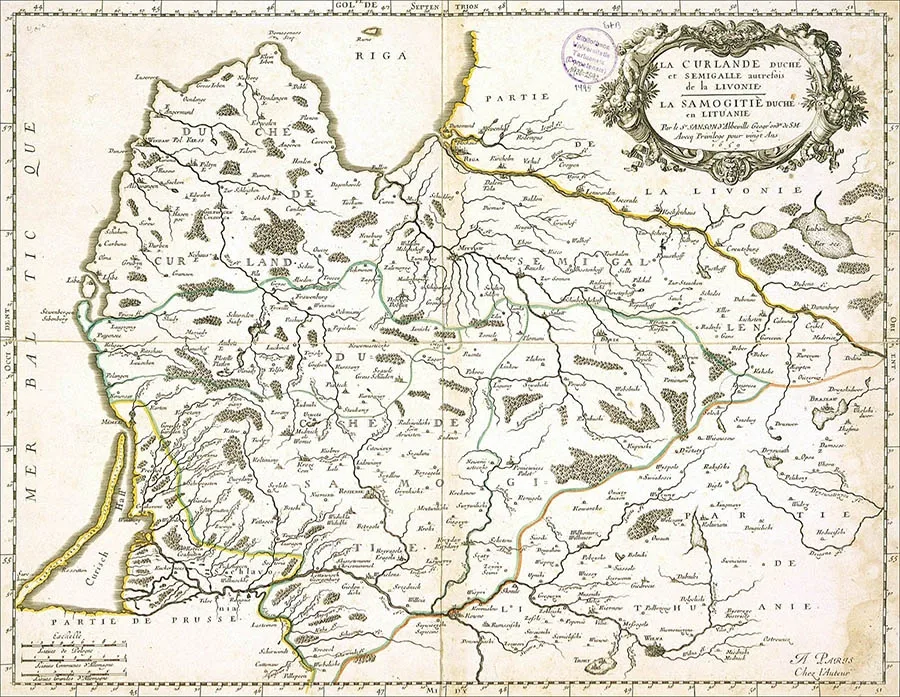 Map of Courland and Žemaitija (Samogitia), 1659.
THE RUSSIANS IN TOWN
Semigallians
One of the Baltic peoples who lived in southern Latvia and northern Lithuania, renowned for their long resistance to the German crusader knights. The Semigallians were also formidable military opponents for the Russian principalities during the era of feudal fragmentation in Rus. Some historians maintain that the Semigallians were the first of the Baltic peoples to establish centralised power. However, it was weakened by struggles between their clans. The leader who reconciled them was the powerful Viestarts, or Viesturs, who created a unified state at the beginning of the 13th century. To defeat his external rivals, Viesturs concluded an alliance with the Livonian Order. But after the Germans broke the treaty of alliance and invaded his lands, Viesturs joined forces with the Lithuanians and in 1236 routed the Livonian Order at the Battle of Saule (today's Šiauliai).
In 1756 the Seven Years' War1 broke out, engulfing almost the entire world: Europe, North America, the Caribbean, India and the Philippines. It involved not only the great powers but also small states and even some Native American tribes. Historians regard it as a colonial war, since it was a clash of the colonial interests of the leading European powers. At that time Russia and Austria were bound by a treaty of mutual assistance. Taking advantage of this, Maria Theresa of Austria literally called on Elizabeth to help her fight off the invasion of Frederick of Prussia.
The Russian Empire entered the Seven Years' War in the summer of 1757. The first town in the Russian army's path was Memel.
"The corps of General-in-Chief Villim Villimovich Fermor was dispatched to take the town. The commander of the Russian army, Field Marshal Stepan Fyodorovich Apraksin, was in a hurry and sent Fermor an order to take Memel as quickly as possible by any means. He believed Fermor's forces would be sufficient: according to the plan, his corps was to consist of 27,000 men, but in reality it numbered only 16,000," writes Maksim Yuryevich Anisimov, Candidate of Historical Sciences and senior research fellow at the Institute of Russian History of the Russian Academy of Sciences, in his study "Russian Sieges of the Seven Years' War, 1756–1763". "On 7 June 1757 Apraksin informed Fermor that, according to his information, Memel had 'a small garrison, quite insufficient and incapable of defence, and there is no covering force nearby either…' Indeed, under the commandant, Lieutenant Colonel Christoph Ernst von Rummel, Memel had only 800 men of the Landmiliz and 80 guns. ... Fermor, a cautious and far-sighted man, prepared for a siege in advance and trained his soldiers to dig siege approaches. On 19 June the Russians reached Memel and began to dig in; they had no thought of storming it. Fermor called on the garrison to surrender, but Rummel refused and set fire to the suburb. At night, lit by the flames of the burning houses, the Russian soldiers brought their guns (4 howitzers, 5 twenty-four-pounders, 5 eighteen-pounders and 6 mortars) up to the fortress and on 20 June, together with a Russian squadron of 6 ships that had arrived, bombarded Memel. Several times fires broke out in the fortress, but they were put out in time. The bombardment continued over the following days. On 23 June Rummel asked permission to write to Field Marshal Johann von Lehwaldt, commander of the Prussian forces in East Prussia, about surrendering the fortress, but Fermor refused. The next morning the commandant sent an envoy offering to surrender on his own terms: the Russians would let the town authorities, the treasury, state property and the garrison leave with their arms and with honours. Fermor replied that he was prepared to let only the garrison go, with arms but without honours. Rummel had no choice but to surrender the town, and on 25 June it was occupied by the Russians. Field Marshal Apraksin, incidentally, was dissatisfied with the terms of capitulation, believing that the garrison should not have been released with its arms. He was also displeased that Fermor had not included a clause in the capitulation allowing the soldiers and officers of the garrison to leave the Prussian army and live wherever they wished."
The Austrian Queen Maria Theresa expressed her satisfaction at the capture of Memel to the Russian ambassador in Vienna, Count Keyserlingk, in the hope that, thanks to the successful actions of the Russians, the enemy could soon be compelled "to conclude a glorious and lasting peace".
After the death of Empress Elizabeth Petrovna, the new emperor Peter III, who supported the policies of the Prussian king Frederick II, concluded the Treaty of Saint Petersburg with Prussia in 1762, under which Russia ceased hostilities and renounced all the lands it had captured. In addition, the two sides signed a treaty of alliance providing for military support to the Prussian army. The Russian Empire neither lost nor gained anything in the Seven Years' War, but it strengthened its influence in Europe by demonstrating its military capabilities.
Although Memel was, figuratively speaking, a town with a hard fate, suffering from numerous wars, fires, famine and plague, it nevertheless found the strength to recover economically, mainly through shipbuilding, woodworking and fishing. And, as a centre of trade, it exported timber, grain, flax… Trade links with Great Britain were especially important. At the beginning of the 17th century a group of Scottish merchants settled in Memel, and later the English formed a large community here.
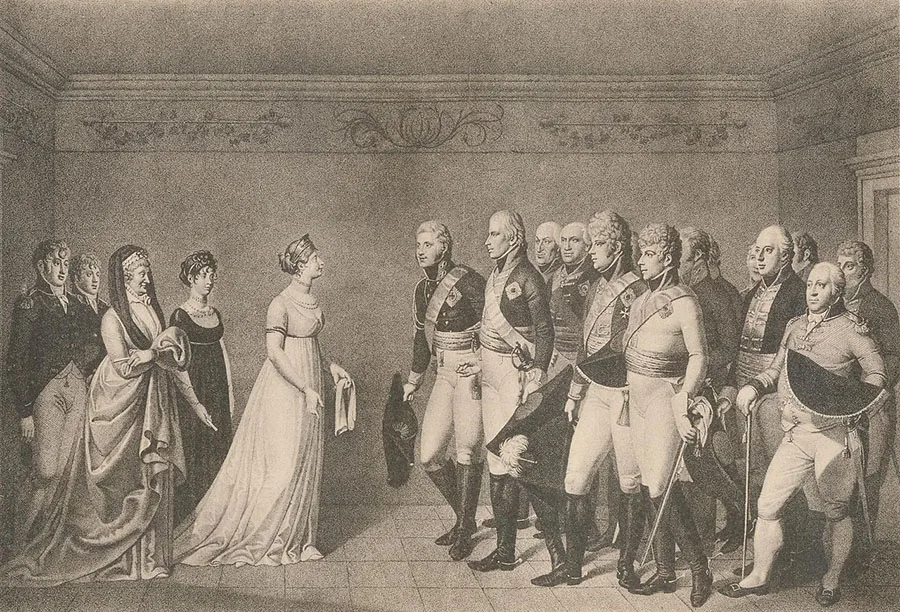 The meeting of Emperor Alexander I with the King and Queen of Prussia in Memel in 1802. From an engraving by Woldt after a painting by Dähling. Scan from Nikolai Schilder's book "Emperor Alexander the First: His Life and Reign", Vol. II, St. Petersburg, 1897.
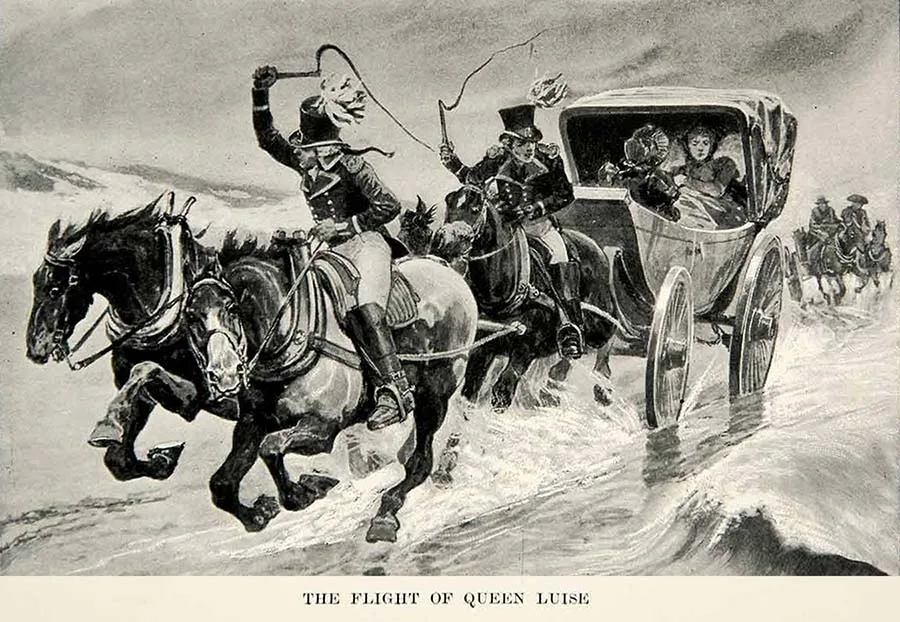 In January 1807 Queen Louise fled from Napoleon along the Curonian Spit to Memel.
The traveller Gottfried Peter Rauschnick-Rosenwall, who visited the town in 1814, described Memel in his diaries: “...although the town is irregularly laid out, it is not badly built. Some of the streets would do credit to any capital... There is bustle here all day long. The river is full of ships being loaded and unloaded, and of smaller craft carrying provisions and other goods to market; shipowners, sailors, merchants, Lithuanian labourers, Russians, Jews, Poles and Englishmen jostle in the commotion; ships are tarred, goods are packed, curious customs officers clamber about. And, finally, a hundred windmills spinning briskly within the town.” As if there had never been any wars, plague or fires at all.
During the war against Napoleon, Memel was the only Prussian town that the fighting passed by. For this reason, after Napoleon's troops occupied Berlin, King Frederick William III took up residence here, and the town even had the chance to serve as the capital of Prussia, albeit a temporary one.
Soon afterwards a commercial port was built in Memel2, and the woodworking industry and shipbuilding continued to develop: by the end of the 19th century the fleet already numbered 80 vessels. Large-scale industry began to emerge in the town. The Union chemical products factory appeared. In 1899 a large plywood factory began operating, and in 1900 construction was completed on a pulp mill, which became the largest enterprise in the town. In addition, electricity arrived and an electric tramway was put into service.
Memel entered the 20th century as a small industrial and port town of the German Empire with a population of 20,685 (according to the census of 1 December 1905). Of these, 17,870 identified themselves as Germans, 1,071 as Lithuanians and 851 as Jews.
In 1907 Kaiser Wilhelm II visited Memel to take part in the unveiling of the Borussia monument (Borussia being the Latin name for Prussia), erected in front of the town hall to mark the centenary of the victory over Napoleon. The four-metre bronze sculpture was brought by train from Berlin. Could the emperor have imagined then that as early as 1923 “Borussia” would be torn down?
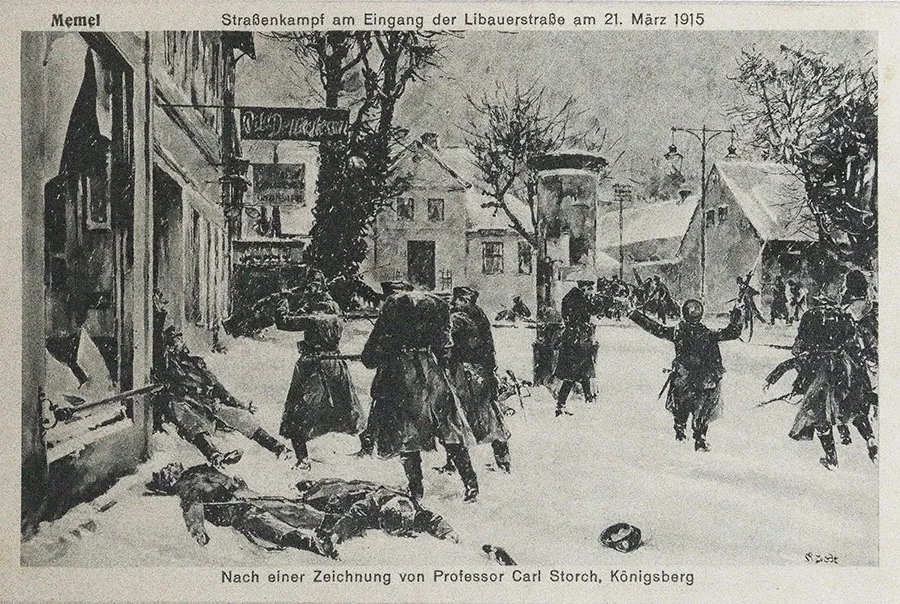 21 March 1915. Fighting on Libauer Straße in the centre of Memel.
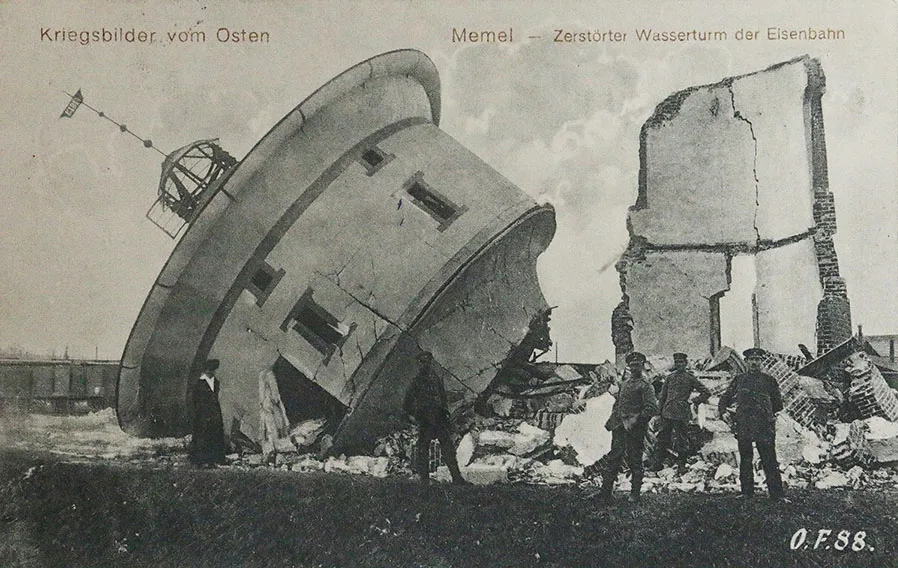 The blown-up water tower at the railway station.
The 20th century as a whole proved a very turbulent time for Memel, as it did for the whole world. On 18 March 1915 the town was taken without a fight by the Russian army under the command of General Potapov. The news of Memel's capture caught the German General Staff off guard. Precise information about the Russians' entry into Memel came from a telephone operator who kept talking to a German officer right up until the post office was occupied. Her last words were: “Here they are, coming up the stairs.” However, the Russian army did not manage to stay in the town for long. Having received reinforcements from Königsberg and regrouped, on 21 March the Germans drove the Russians out of Memel, which had been plundered and laid waste in three days. Even so, the episode did not cause any particular damage to the town's infrastructure. The only losses were the water tower and a bridge near Dawillen, which were blown up, and several navigation markers in the port, which were destroyed.
OPERATION “MEMEL”
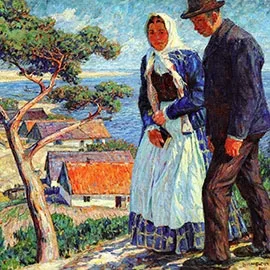
Lietuvininkai
This was the name given to the Prussian Lithuanians (also known as Lithuanians of Lithuania Minor) who, until 1945, inhabited the north and east of East Prussia, that is, Lithuania Minor. It comprised the eastern part of today's Kaliningrad Region and the Klaipėda Region. In the late 19th and early 20th centuries the number of Lithuania Minor Lithuanians declined very rapidly owing to their Germanisation and emancipation in the German-speaking towns of East Prussia. The rights of this ethnocultural group were consistently championed by the German philosopher, polyglot, translator, publicist and poet Georg Sauerwein (pen name Girėnas), who wrote in 30 languages, spoke 62 and understood another two hundred languages and dialects. In 1875 the scholar lived in Klaipėda, where he campaigned for the rights of the Lithuanian language in East Prussia. From the 16th century onwards, the Lithuanians of Lithuania Minor were mostly Lutherans. In the early 20th century some of the Lietuvininkai set themselves apart from the Lithuanians of Lithuania Major, the Samogitians: they not only used a different orthography for Lithuanian but also Gothic script, and, being German patriots, felt closer to the Germans than to their Lithuanian kin.
After the First World War, part of the territory of Lithuania Minor on the right bank of the river, known as the Memel Territory, was separated from Germany under Article 99 of the Treaty of Versailles. The situation became dramatic. Poland and Lithuania began a struggle for possession of the severed lands, or in essence for an ice-free port, even though the local Lithuanians in Memel (the Lithuanians of Lithuania Minor, the Lietuvininkai) did not feel particularly close to Lithuania: almost all of them were quite loyal to the Reich, professed Lutheranism and used the Gothic script typical of Germany at the time.
The Memel question was called “the hot potato of diplomacy”. Because of the unclear political situation around the town, and in Lithuania Major itself, the victorious powers placed the region in the hands of the French.
On 13–14 February 1920 a small battalion of 200 men arrived in Memel under the command of General Dominique Odry, who handed the reins of power to a local self-government, the Directorate, made up of local Germans. It was they who dealt with all the day-to-day affairs of the region. On 7 July 1920 General Odry was replaced by the French commissioner Petisné, who attempted to reorganise the region's administrative apparatus, but in practice the old Prussian administration retained its influence.
During its three years under French protection, Memel revived somewhat: in practice, though not yet officially, it became a free city. It had the right to conclude trade agreements with foreign states, it had its own court, flag and customs sovereignty, and the old laws remained in force. One after another, commercial firms and banks opened. Foreign capital poured into the town. Maritime shipbuilding traditions were revived as well: in 1922 the shipyard of the engineer Lindenau built the first large-displacement iron steamship in the town's history. At the same time, however, tension could be felt between the various ethnic groups. Against the backdrop of apparent prosperity a new problem emerged: unemployment. An economic crisis was brewing, especially in the woodworking industry. It is believed that it was precisely because of the crisis that the idea of a “free city” was left hanging in the air. “...this idea was energetically and persistently promoted by the Germans, regardless of the economic difficulties and the possible losses for industry that implementing the project would have entailed. The nationalist-minded part of the region's Lithuanians, who did not support this idea and called on their compatriots from Lithuania for help, raised an armed uprising against the government of the Memel Territory,” wrote the Lithuanian Prime Minister Ernestas Galvanauskas (1882-1967) in his memoirs.
Memel was never officially proclaimed a free city. In 1923 it ceased to be German and became part of Lithuania. For the Germans, Memel fell victim to Lithuanian aggression, while the Lithuanians sought to deliver it from seven centuries of German subjugation.
The Lithuanian government chose the moment to seize Memel very shrewdly: in the winter of 1922–23 Germany and France, the parties with an interest in the Memel question, were embroiled in a dispute over the Ruhr. On 18 December 1922 the Committee for the Salvation of Lithuania Minor was set up in Memel. The operation, code-named “Memel”, was coordinated by the Lithuanian counter-intelligence officer Jonas Polovinskas. On 10 January more than a thousand armed soldiers of the regular Lithuanian army arrived in the Memel Territory by rail (different sources give different figures). They were dressed in civilian clothes and wore armbands bearing the abbreviation MLS, which stood for “Volunteer of Lithuania Minor”. Only a couple of hundred locals sided with the “insurgents”. Memel was defended by 250 Frenchmen, 350 German policemen and 300 local civilians.
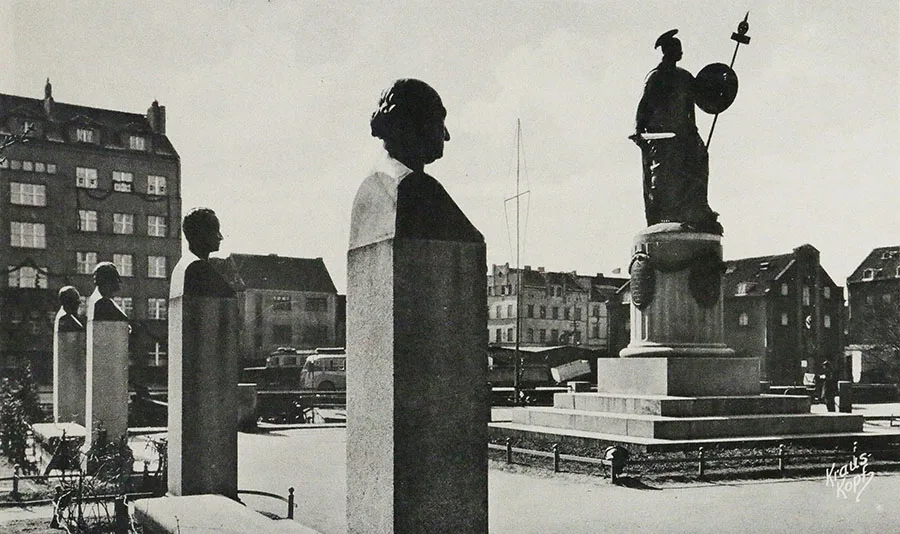 On the site of the “Prussia” sculpture (Borussia) on the bank of the Dange in the centre of Klaipėda there now stands a monument to a Lithuanian fisherman.
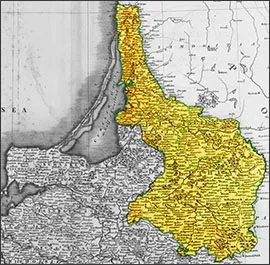
Lithuania Minor
This historical region on the lower reaches of the Neman River took shape by the early 16th century on Teutonic Order territory secured to the Order under the Treaty of Melno of 1422. It was inhabited by Prussians and Lithuanians, who by the early 16th century had formed a distinct ethno-cultural group, the Lietuvininkai. The term Kleinlittaw, mentioned in Simon Grunau’s “Prussian Chronicle”, is the German form of the name “Lithuania Minor”. It came into wide use only in the 19th and 20th centuries, mostly in the works of historians and ethnographers. It was in Lithuania Minor that the Lithuanian literary language took shape: the first book in Lithuanian was published here in 1547, and the first grammar of the Lithuanian language in 1653. Until 1945, Lithuania Minor was part of Germany (Prussia), with the exception of the Klaipėda Region, which after the First World War was placed under a League of Nations mandate. After the Second World War, its territory was divided among three states: Lithuania, Russia and Poland.
On 11 January, the first villages outside Memel were taken without resistance. For the attackers, the bigger problem was not so much the fighting itself as the conditions in which it took place. Most of the “volunteers” had no experience of fighting in winter. One of the Lithuanian riflemen later wrote that the insurgents had trouble with the unfamiliar German rifles they had been issued on arriving in Memel, so that after just a few shots they could no longer use them. The water-cooled German machine guns were no good either — they simply froze in the cold.
Serious clashes broke out in the suburbs of Memel on the night of 13–14 January. Polovinskas contacted Kaunas and received orders from Ernestas Galvanauskas to take Memel, but with as few casualties as possible. Vygantas Vareikis, one of the authors of the Encyclopedia of Lithuania Minor, described in detail the situation before the uprising and the role of the Lithuanian Riflemen’s Union in the occupation of the Memel Territory, since until the early 1990s this subject was among the least studied in Lithuanian historiography. He also noted that the sources contradict one another and that each side describes the events as it sees fit, sometimes seriously distorting what actually happened. Different figures are given both for the casualties of the operation and for the so-called insurgents, whose role was in fact played by the regular Lithuanian army and the Lithuanian Riflemen’s Union. Vareikis’s point is confirmed by Galvanauskas himself in his memoirs: “History is often ‘bent’ this way and that in an effort to find explanations in the past for what is happening in the present. One of the active participants in the annexation of Memel to Lithuania wrote to me in a letter dated 27.12.1956: ‘Our young Lithuanian generation not only falsifies the history of the Memel uprising, but also invents participants who never existed, endowing them with invented courage.’”
But however the history of the uprising may be “bent”, the outcome is the same: on 15 January 1923, Memel was taken by the combined forces of local insurgents and the military. The following day, the Entente’s Conference of Ambassadors agreed to hand the Memel Territory over to Lithuania, but issued an ultimatum: the region was to retain its autonomy, freedom of transit and Poland’s use of the port of Memel were to be guaranteed, the German and Lithuanian languages were to have equal status, and foreigners and residents of the autonomous region were to enjoy equal civil and commercial rights.
Lithuania accepted all the conditions, which were enshrined in the Convention signed on 8 January 1924 between Lithuania and the Allied Powers — Britain, France, Italy and Japan. Annexed to the document was the “Memel Statute”, which formed an integral part of it. That same year, 1924, Memel was formally handed over to Lithuania — as was emphasised unofficially, as a kind of compensation for the loss of the Vilnius Region, which had been given to Poland a few years earlier under circumstances that, in the Lithuanians’ view, were highly dubious.
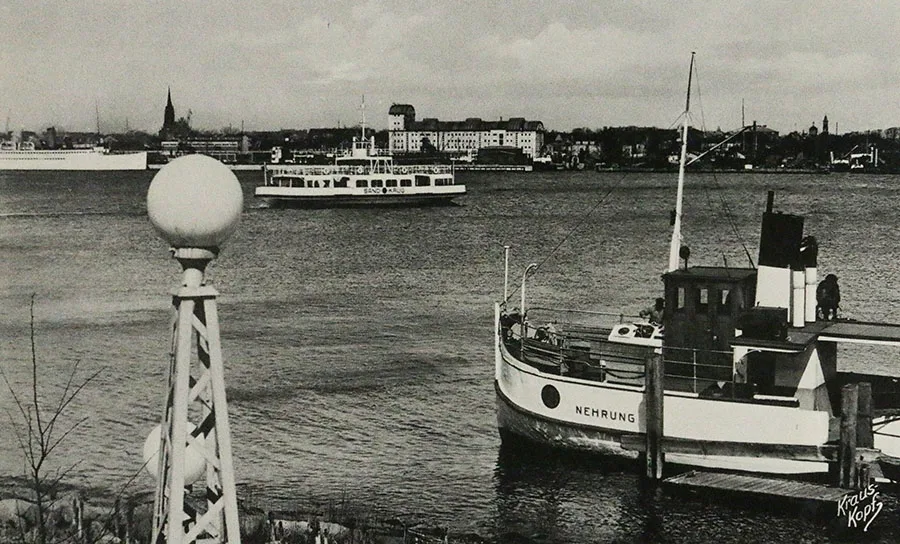 The ferry crossing linking the city with the Curonian Spit is the first thing in Klaipėda that tourists encounter when arriving from the direction of Neringa (and Kaliningrad).
The historian Alfred Erich Senn called the occupation of Memel “the boldest step in Lithuania’s foreign policy of the interwar period”, even though this step violated the Versailles agreements.
Having become Klaipėda, the port city at the mouth of the Neman remained a bone of contention. Germany never concealed that it would seek the return of its territory, where the majority of the population spoke German and regarded themselves as Germans. The Lithuanians, for their part, held firmly to their position, as is clear from a report by Antanas Smetona published in the Riflemen’s Union magazine “Trimitas”: “Memel must become part of Lithuania for economic reasons, even if not a single Lithuanian lived here.” Those who certainly lost out from all these changes were the indigenous Lietuvininkai. In 1945 they fled to Germany en masse.
A COMPLETE “ANSCHLUSS”
Germany put its idea of regaining its lands into practice in 1939. Step by step, the Lithuanian government was forced to meet virtually all the demands of the Germans, who methodically stoked tension in the region, subjected the local population to ideological indoctrination and instigated unrest in the port whenever passenger liners from Germany arrived in Klaipėda.
In her article “Some Specific Episodes of the Anschluss of Klaipėda/Memel in March 1939”, based on archival documents and an analysis of historical research on diplomatic relations between Lithuania and Germany, Arūnė Arbušauskaitė — Doctor of Social Sciences, associate professor at Klaipėda University and senior researcher at the Institute of Baltic Region History and Archaeology — describes a seemingly minor but very telling episode that captures the situation in the city: how the population welcomed and saw off German ships: “On 4 June 1938, a large crowd gathered there to see off the ship ‘Tannenberg’. As soon as it cast off from the quay, those standing on deck began to shout: ‘Memelers, hold on!’ It was like pouring oil on the fire. On the quay, the crowd began chanting Hitlerite slogans: ‘We want to return to the Reich! One nation — one leader!’ When the ship ‘Preussen’ was welcomed on 31 June, the Nazi slogans, anthems and songs rang out even more boldly.”
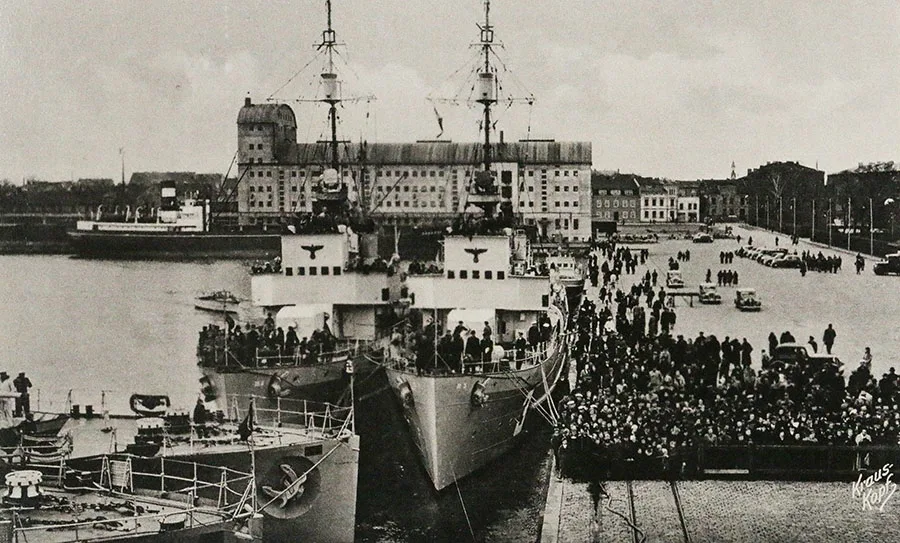
Subsequent events unfolded even more rapidly: “Why, no one could explain. Everything was in turmoil: the Nazis threw stones at the Lithuanians, the Lithuanians at the Nazis, and all of them together and each on his own ‘fought’ the police; shots rang out and the first wounded fell… About 15 policemen and roughly the same number of demonstrators were injured. The brawl spread from the port to the streets of the city and went on until midnight.”

Lithuanian Riflemen’s Union
A state-supported voluntary paramilitary organisation, it is a special component of the Lithuanian Armed Forces whose purpose is to train civilians in self-defence and in waging partisan warfare. The Union was founded in 1919 as a militia. Lithuanian riflemen took part in all of Lithuania’s wars in the 20th century, including the operation of 1923 in which Klaipėda was annexed to Lithuania. Until 1940 it was the most powerful organisation in Lithuania. Its members included ethnic Lithuanians, Belarusians and Russians alike. After Soviet troops entered Lithuania in 1940, the Lithuanian Riflemen’s Union was banned and most of its members were arrested. In the post-war years, the surviving Lithuanian riflemen joined the “Forest Brothers”, and in 1989 the Union was revived. Today it has more than 10,000 members. By comparison, before the Second World War the Union had 61,000 members.
On 11 December 1938, elections to the local self-government body, the seimelis, were held in Klaipėda. The majority of votes — 87 per cent — went to the joint list of German parties. As a result, the Nazis took the key positions in the institutions.
The new Directorate was headed by former bank director Vilius Bertuleitis, deputy commander of Ernst Neumann’s stormtrooper units. He set out the main lines of its activity: “The new Directorate, guided by the principles of the National Socialist worldview, regards it as its aim to pave the way for our native land to a happy future… Propaganda against National Socialism will under no circumstances be tolerated.” All employees were immediately made to join the stormtrooper units; otherwise they faced exile “to where neither the sun nor the moon shines”. Selection for the units was strict. The politically unreliable, those with previous convictions and the morally unstable were not accepted. Teenagers were recruited into the ranks of the Hitler Youth.
Neumann became commander of the Klaipėda Region's security service. To unite all the German organisations active in the region, he set up a Union of Commanders, which included every member of the directorate and the heads of all services and institutions. In this way, the men capable of bearing arms were kept under control.
The Nazis staged noisy mass rallies. Many residents began to believe that the region really would return to the Reich. Fritz Walgahn, a Nazi and the leader of all German sportsmen, proclaimed: “No German will ever raise the white flag; the people want to be reunited with their nation, blood with its own blood, and no one will be able to prevent it.”
And indeed, no one prevented it. Arūnė Arbušauskaitė writes: “… it all happened in a single night. ‘Klaipėda was – and now there is no Klaipėda. On Tuesday we went to bed under Lithuanian rule, on Wednesday we woke up under German rule…’, a correspondent of the newspaper XX amžius (‘The 20th Century’) quipped bitterly. 22 March 1939, Wednesday, 8 a.m. Heilsberg radio (today Lidzbark Warmiński in Poland) announced that the governments of Germany and Lithuania had agreed to hand the Klaipėda Region over to Germany that very day. Half an hour later the news was broadcast by the radio stations in Moscow and Kaunas. Around 9 o'clock the factory sirens begin to wail and swastika flags are hung out on the houses. That Wednesday morning is etched most deeply in memory. Swastika flags, the ringing of church bells, the sirens of factories and ships, aeroplanes in the sky, nothing but light music on Lithuanian radio, while German radio repeats a single phrase every half hour: Memel ist frei! (Memel is free!), crowds of people in banks and savings offices, queues at the telephones…”
On the same day, the editorial board of the newspaper Vakarai (“The West”), bidding farewell to its readers in its final issue (No. 68, 1939), wrote: “Whoever must retreat must do so the way a sailor leaves his ship. Those who have become rats will never be able to take pride in what they did. But… some people will, after all, remain here, whatever their fate may be. You who remain, strengthen your spirit, learn to be firm and cautious. Let us not forget that the wheel of history never stops.”
At 11:55 p.m. on 22 March '39, in Berlin, the foreign ministers of Lithuania and Germany (Urbšys and Ribbentrop) signed the treaty transferring the Klaipėda Region to Germany. By the next day, storm troopers were already in Klaipėda. Together with the Nazi Order Service (Ordnungsdienst) and the local police, they occupied the post office, the customs house, the port and public institutions. Arrests of Lithuanian activists began. That same day, Nazi Memel welcomed Hitler. He arrived aboard the cruiser Deutschland, escorted by 40 warships, several seaplanes and military aircraft, and addressed the local population from the balcony of the city's drama theatre.
As the same Arūnė Arbušauskaitė writes, Hitler's speech was printed in full or recounted in fragments by almost every Lithuanian newspaper. However, no official Lithuanian translation has been found. There is a quotation, in one version of the translation, from the newspaper Lietuvos aidas (“The Echo of Lithuania”) of 24 March: “...the Germans have no intention of doing harm to anyone in the world, but an end had to be put to the suffering inflicted on the Germans by the whole world for 20 years… Germany once before abandoned the Memel Germans to their fate, when it resigned itself to disgrace and dishonour. Today the Memel Germans… are once again becoming citizens of a mighty Reich, determined to take its destiny into its own hands, even if half the world does not like it.” Hitler symbolically handed the Memel Territory over to Neumann and returned to Germany.
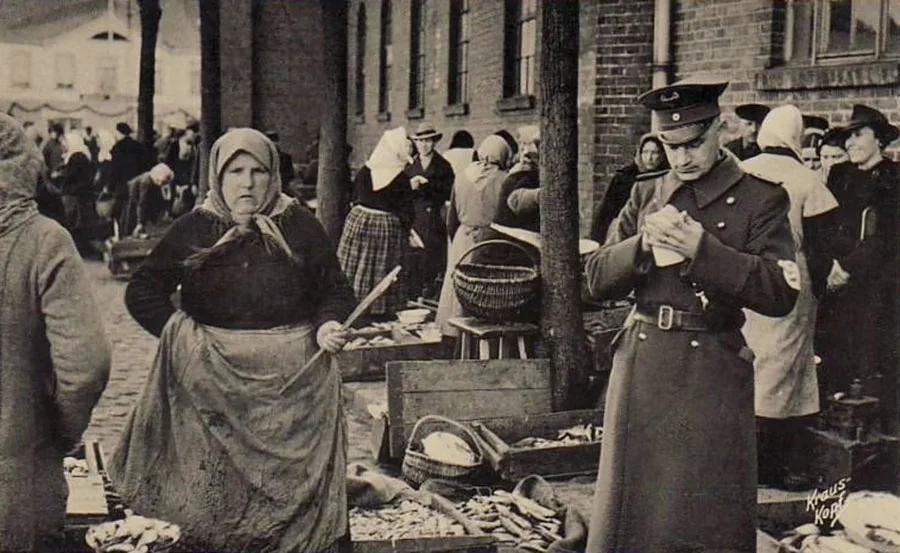
Once again, Klaipėda officially ceased to exist: it became part of the German Reich and was incorporated into East Prussia under the name Memel. A swastika flag was raised over the building of the provincial administration.
Julius Deksnis, chairman of the Lithuanian national organisation of Second World War veterans who fought on the side of the anti-Hitler coalition, recalls: “From 23 March 1939 the Germans were in charge there, but there was also a Lithuanian colony. Lithuanians worked in the port and at the weaving mill … there was poverty everywhere, no prospects and fear of what tomorrow would bring. Memel in 1939–40 was a thoroughly German city, where social inequality was felt especially keenly. The port worked for greater Germany and Prussia. Some made millions, while others barely survived. And the Lithuanian colony always felt itself second-class. The local Jewish community had already been destroyed.
On public transport there were signs reading ‘Germans only’. There was public entertainment, the cinema for example, to which only Germans were admitted. Even Lutheran Lithuanians were only allowed to stand on the threshold of the Lutheran church. Only Germans had the right to enter.”
It should be noted here that the people deprived of rights were those who did not hold German papers, and most local residents received them almost immediately after the Anschluss.
Along with Klaipėda, the statue of Ännchen von Tharau that stood in front of the theatre also vanished without a trace – the girl celebrated in verse by the famous local poet Simon Dach. Some suppose that a bust of Hitler was to be put up in its place; others, that the statue stood with its back to the theatre balcony, which might have offended the Führer. Later, a copy of it was installed on the same spot.
Ännchen von Tharau was a real person. According to one version, the girl was the daughter of Pastor Neander, who died in 1630. After her father's death, seventeen-year-old Ännchen married the preacher Johannes Portatius. Simon Dach was also in love with her. But, holding the modest post of a teacher at the cathedral school in Königsberg, he was in rather straitened circumstances. At her family's insistence, the girl married another man.
After its annexation by Germany, Memel became a German naval base and a sea fortress. As early as April '39, construction began here on a military airfield, permanent fortifications and an underground fuel depot. The Reich was preparing for war. The city's economic potential fell sharply. Thousands of Lithuanians and Jews hurriedly sold their little shops and property and hastily left their native places.
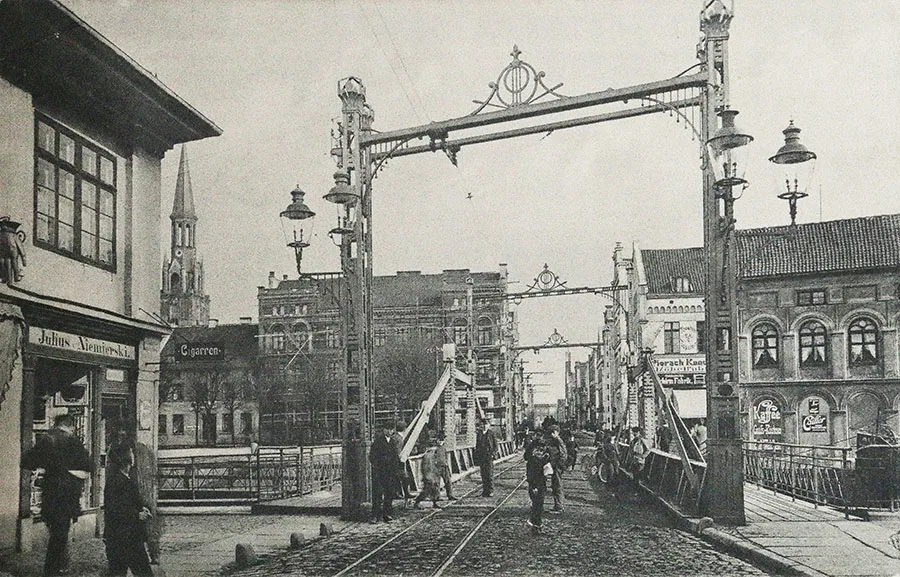 The Exchange Bridge (Börsenbrücke) once looked like this...
In April 1939, Gauleiter Erich Koch, Oberpräsident of East Prussia, paid a visit to Memel. He declared that the city was to become the second largest and most important in the region after Königsberg, and painted the rosiest of prospects to lift the townspeople's spirits. But fine speeches did not help. Soon food shortages set in, shop shelves gradually emptied and prices rose. The first to suffer were businesses that relied on foreign raw materials. Only the factories whose output served military purposes stayed afloat. The Lindenau shipyard, for example, built minesweepers.
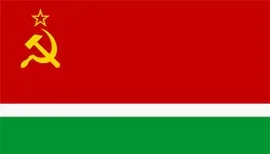
In Soviet times
Lithuania, like all the Baltic republics and many other Soviet republics, received far more from the Union budget than it contributed. First of all, thanks to the USSR it gained considerable territory. In 1940 its area was a third smaller. Moreover, Lithuania kept its enlarged borders in 1991 as well, after leaving the USSR. The Vilnius and Klaipėda districts and part of the Suvalkija region passed to Lithuania from Poland under the 1945 border treaty. The republic's war damage has been estimated at 30 billion dollars. Almost all of its power generation, factories, transport, bridges and ports had been destroyed. The Union budget invested fabulous sums in creating Lithuania's machine-tool, light and chemical industries. Two fertiliser plants, a synthetic fibre plant and an oil refinery were built. The republic acquired a food industry and mechanical engineering. Houses, roads and ferries were built, the Klaipėda port was restored, and a ship repair yard appeared in Klaipėda itself. The Kaunas hydroelectric power station, the Elektrėnai thermal power station and the Ignalina nuclear power plant, shut down in the post-Soviet period, are also part of the Soviet legacy.
In the weekly Klaipėda of 30 March 2019, Asta Dikovienė cites the view of the historian Šarūnas Liekis, who concluded that “in 1939 Lithuania had no chance whatsoever of keeping the Klaipėda Region given the obvious imbalance of forces; besides, it did not have all that many supporters among the local population. The loss of the Klaipėda Region was a painful blow for Lithuania.” And in the weekly cultural supplement of the newspaper Lietuvos aidas of 24 March 1939, the poet and essayist Faustas Kirša sadly summed it up:
“Klaipėda has fallen out of the bounds of our state. Along with Klaipėda we have lost part of the Baltic coast and the dunes, Rambynas, the Curonian Lagoon, the mouth of the Nemunas, the deer. We have lost one of the hearths of our culture, a part of our heart, and tears well up, as though we were parting for centuries.”
THROUGH WAR TO SOVIET RULE
During the Second World War the Germans declared Memel a fortress and turned it into the centre of a powerful defensive area. The Memel Offensive, which Marshal of the Soviet Union Ivan Khristoforovich Bagramyan called in his memoirs “decisive for the entire Baltic strategic offensive operation”, began on 5 October 1944. Its aim was to reach the Baltic coast and cut off the land forces of Army Group North from their routes of retreat into East Prussia. For about two months three German divisions held the defence of Memel. Surrounded and deserted, with only military units, the Volkssturm and special detachments left inside, the city did not surrender until the end of January 1945. The last to leave Memel, on the frosty night of 28 January, were the demolition squads, and in the morning soldiers of the Soviet 16th Lithuanian Klaipėda Red Banner Rifle Division appeared in the streets of the burning city. The division had been formed in Balakhna, Gorky Oblast, mainly from refugees and evacuees from Lithuania. That same day, 28 January, the city was liberated from the fascists, who blew up industrial facilities and bridges as they retreated. According to the People’s Commissariat for Internal Affairs of the Lithuanian SSR, 65–70% of Memel was destroyed, including 60% of its industrial enterprises and 50% of its cultural buildings.
In August 1945 the Potsdam Conference, the third and last official meeting of the leaders of the “Big Three” — the USSR, the USA and Great Britain — de facto transferred Memel and its suburbs to the USSR. The city was finally renamed Klaipėda. Three years later a law on the administrative and territorial division of the Lithuanian republic was passed, in which the Klaipėda Region was mentioned for the first time as part of the Lithuanian SSR. All residents of Klaipėda of Lithuanian nationality received Soviet citizenship. Germans from Klaipėda could apply for citizenship of the USSR on an individual basis.
Since the civilian population remaining in the city after the liberation was small, settlers from across the Soviet Union began arriving to rebuild its industry. Klaipėda began to speak Russian.
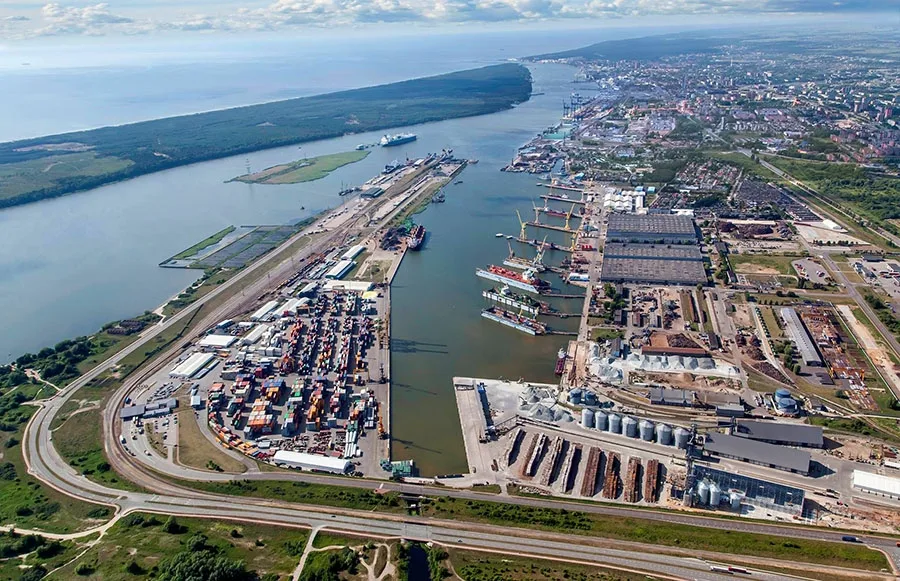
The port is the heart of Klaipėda! © portofklaipeda.lt
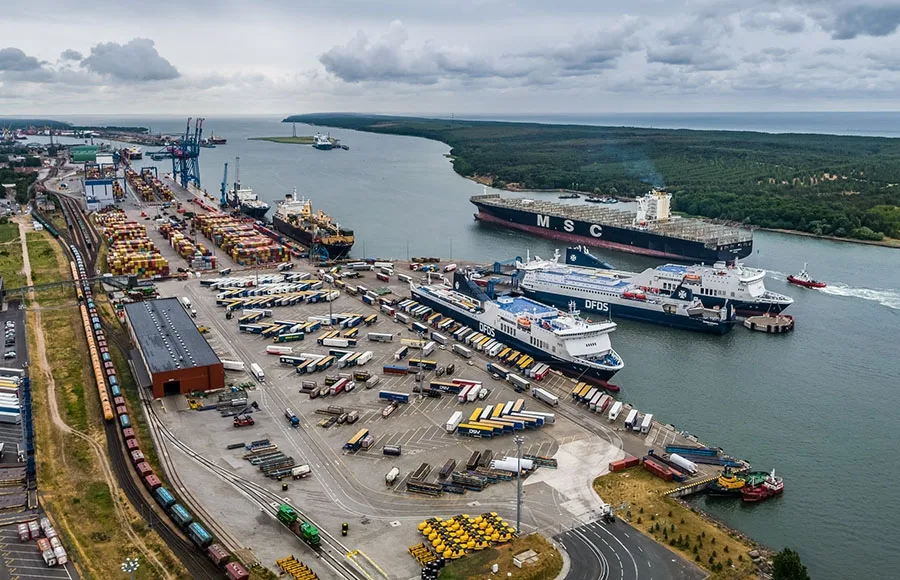
Reconstruction and building work began in the city immediately after the war. True, because of its associations with the fascist past, the new Soviet authorities’ attitude towards historical architecture was, to put it mildly, not always positive. In building a new Klaipėda and clearing away the ruins, they erased the distinctive appearance of the old town that had taken shape over centuries. By 1946 a regular ferry service across the Curonian Lagoon to the Spit had been set up, and some enterprises had resumed work. Once again, Klaipėda’s economic development was determined not by local needs and resources but by the interests of the Union as a whole. After reconstruction the port became the base of a huge fishing fleet and supplied fish and other fish products to the entire European part of the USSR.
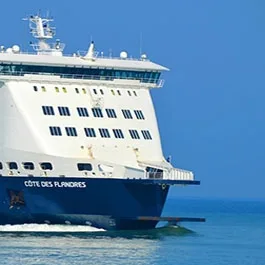
Ferries
These workhorses of the sea are perhaps the most convenient way to travel from Lithuania to other European countries. A sea ferry from Klaipėda will take you in comfort to Karlshamn in Sweden, Kiel in Germany and the Danish capital, Copenhagen. The routes are served by vessels of the Danish company DFDS Seaways, founded in 1866 and listed among the largest ferry operators in the Old World. Seeking to meet the needs of every passenger, the company offers various types of accommodation, from economy-class seats to Commodore Deluxe cabins. Depending on the class chosen, the voyage can turn from a practical journey into a genuine first-class sea cruise. If needed, you can take your car with you. The ships also offer special facilities for people with disabilities. A ferry crossing links mainland Klaipėda with the Curonian Spit. The old passenger terminal at the mouth of the Danė handles ferries carrying foot passengers only, without vehicles. In 2013 a modern waiting hall and a restaurant opened at this crossing. The new crossing is in the southern part of the city and is intended for passengers with cars.
Between 1952 and 1970 a large new fishing port was built, home to five fishing enterprises, along with two ship repair yards, the Baltija shipyard, a fish processing plant, a cannery, a fishing gear factory and the Progress cooperage and packaging works. In 1966–69 they were joined by the Western Ship Repair Yard, the largest enterprise in Klaipėda. The old part of the port was enlarged and became the gateway for Soviet exports to the West — oil, coal, grain and metal. In 1986 a grand strategic project was completed at the Port of Klaipėda: the world’s largest sea ferry crossing for railway trains. It linked Klaipėda with the port of Mukran on the German island of Rügen. And all of this meant new jobs.
In the 1970s, owing to a massive influx of new workers — Lithuanian peasants moving to the city — Lithuanian became the predominant language in Klaipėda.
Cultural and educational institutions were not neglected either. In 1946 the drama theatre was restored, and in 1956 the People’s Opera Theatre welcomed its first post-war audience. As early as 1959 local students could study at the newly opened Klaipėda branch of the Kaunas Polytechnic University. Many museums opened, among them the famous aquarium museum and the clock and amber museums... The Martynas Mažvydas Sculpture Park was laid out. Although the city was filled with standard grey Soviet “boxes” (supplied with gas, incidentally, from 1961), it preserved its distinctive character thanks to the few architectural monuments that had survived all the wars.
Nevertheless, a great many architecturally interesting industrial structures were lost as well — such as the Exchange building, known since the 17th century, which stood near the bridge of the same name on the site of today’s Rebirth (Atgimimo) Square and for a long time was one of the city’s most important cultural, financial and political centres. Or one of the first fire stations in Europe, and the Elephant House (Dramblio namas), an old half-timbered warehouse not far from Lietuvininkų Square (Lietuvininkų Aikštė). Nor did the oldest Lutheran church survive — St John’s (Johanneskirche), whose history went back to 1258. It was destroyed many times, burned down and changed location. It is believed that after the Reformation the church already stood at the eastern end of the Old Town island, but it burned down in 1540. In 1696–1706 a three-aisled St John’s Church with octagonal star vaults was built at the end of Market Street. The building was 37 metres long and 22 metres wide, with a tower 50 metres high. In 1790 the building was renovated, and its tower, raised by 11 metres and given a viewing balcony, an English clock and a weathervane in the shape of a sailing ship, took on Baroque features.
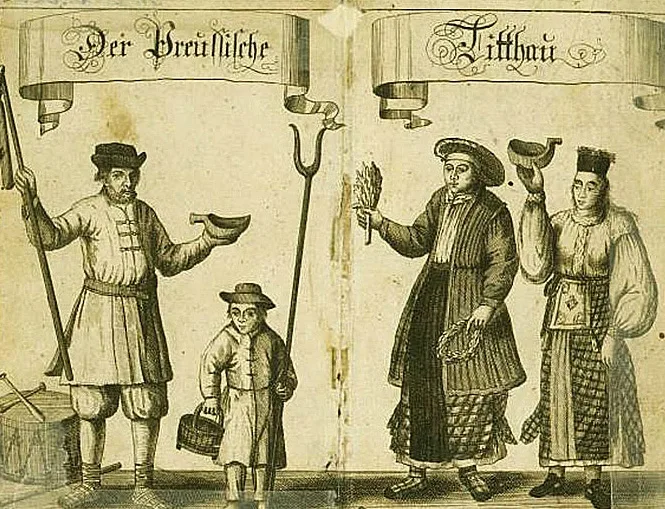
The church held a portrait of Matthäus Prätorius, a native of Klaipėda — a Protestant pastor who later became a Catholic priest, a historian and an ethnographer educated at the universities of Königsberg and Rostock. His work on the history and culture of Prussia, Deliciae Prussicae oder Preussische Schaubühne, contains a wealth of ethnographic information about the Prussian Lithuanians and the Old Prussians.
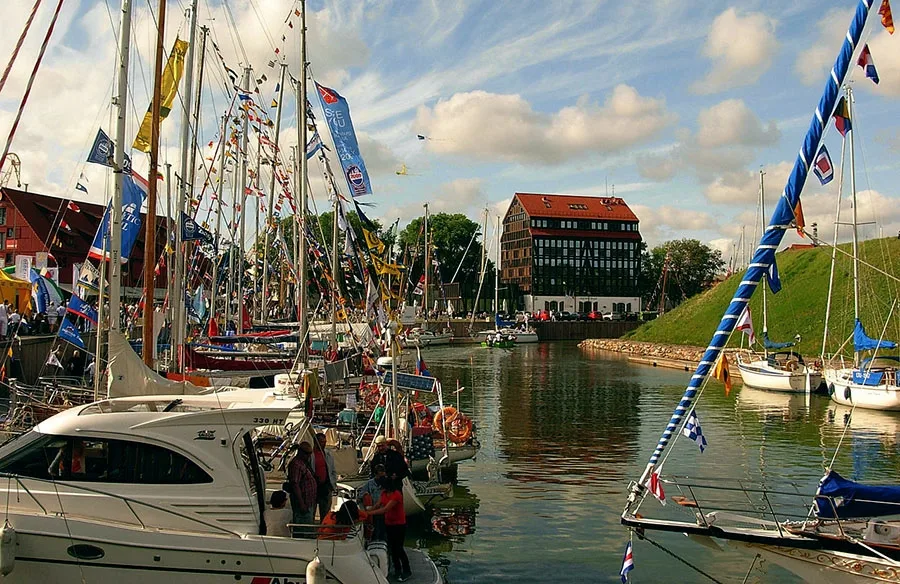 The moat around Memel Castle is now used as a marina.
KLAIPĖDA HAS A CHARACTER ALL ITS OWN
The Old Town
The Danė River divides Klaipėda into two parts. The Old Town lies on the left bank. It has preserved both the layout and the atmosphere of bygone times: narrow medieval lanes where many small tile-roofed houses stand close together, forming a peculiar labyrinth of blocks laid out strictly at right angles. Old half-timbered houses, coexisting peacefully with modern buildings, recall the German past of the town on the castle island.
In 1571, Duke Albrecht Friedrich allotted plots of land here for the building of new homesteads. The northern part, or Old Town, where only German merchants and craftsmen were permitted to settle, was separated by an old riverbed from the Tanners’ Quarter (the future Friedrichstadt). That quarter was home to people in the “dirtier” trades, such as tanners, bathhouse keepers, barbers and fishermen, and to members of ethnic groups.
By the end of the 17th century, the Old Town was so small that there was no longer enough room to settle within its administrative boundaries. More and more German merchants and craftsmen began moving to the Tanners’ Quarter, and they pressed for it to be joined to the Old Town. Instead, in 1693 the authorities granted the Tanners’ district a charter, an emblem and a flag, and named it Friedrichstadt. It was governed by a seigneur and was subject to the decisions of the Memel magistrate, while legal cases were heard in the Old Town. Friedrichstadt was incorporated into the administrative boundaries of the Old Town only in 1722, and the riverbed that divided them was filled in at the same time. (According to other sources, it was filled in a quarter of a century before Friedrichstadt’s “official” appearance, around 1665.)
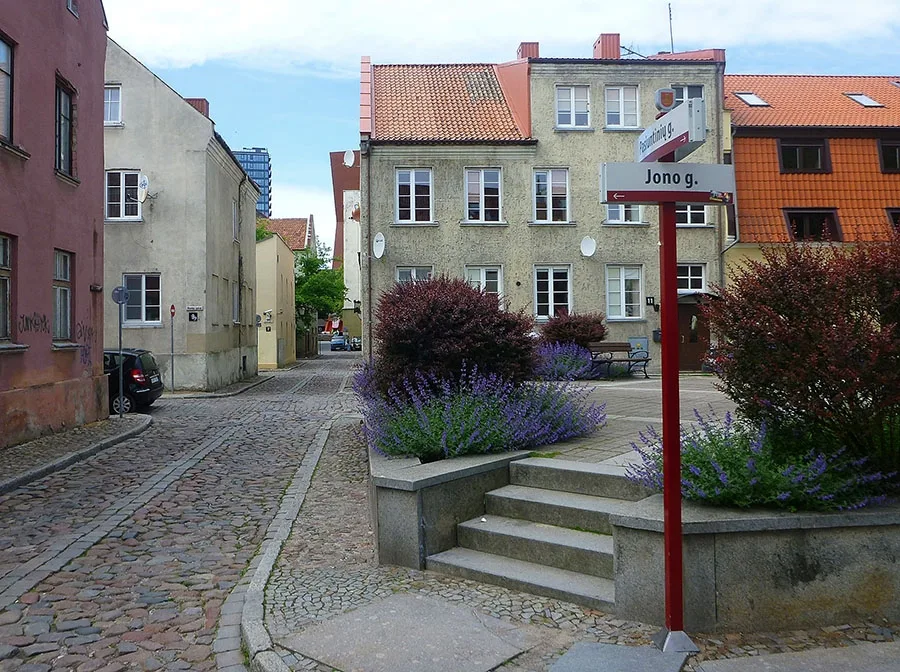 The historic quarters have an almost magical allure!
The Old Town (Altstadt) was laid out in keeping with the town-planning traditions of the Crusaders. The castle came first, the town was then built next to it, and the castle was protected by water-filled moats through which the river flowed. In 2002 a museum opened on the site where the castle once stood, displaying artefacts found during excavations. Some of the fortress’s underground structures, dating from the 16th to 18th centuries, have survived in rather good condition and are now open to visitors.
The Old Town is classed as a monument of urban planning because of its chessboard-like network of streets and lanes, which took shape between the 13th and 15th centuries. Wooden and brick town houses survive here, sitting harmoniously alongside modern buildings. Quarters of half-timbered3 warehouses are typical of this part of Klaipėda, and there are also houses built in this style. However, after a catastrophic fire in 1854, the construction of half-timbered residential buildings was banned because they caught fire so easily.
Of historical value is the Drama Theatre on Theatre Square, built in 1893 on the site of its predecessor, which had burned down. Wagner himself once conducted there.
Modern symbols have also taken root on Klaipėda’s streets. Among them are quirky little sculptures of a big-eared mouse, a cat named Klaipėdis, a Doberman peering out of a house near the old market, and the Chimney Sweep (by sculptor Klaudijus Pūdymas), who sits on the roof of a house on Kurpių Street. As in many Baltic towns, chimney sweeps were in great demand in Klaipėda, and seeing one was considered a sign of good luck.
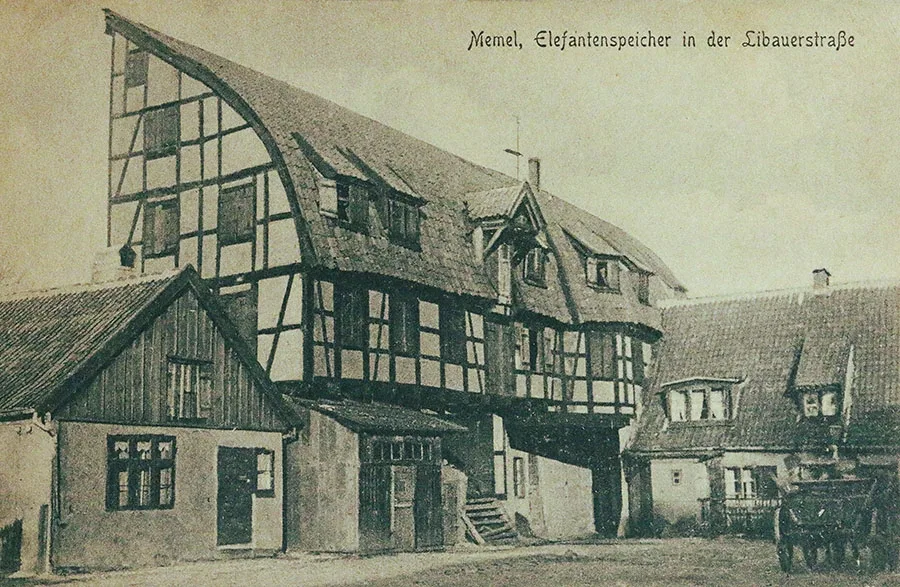 Memel’s famous half-timbered “Elephant House” sadly has not survived to the present day.
On the wall of one of the houses is a sculpture called “The Dragon”. When it rains, water runs from its nostrils into the imprint of a human foot carved in stone. It illustrates the legend of how the city of Klaipėda got its name:
Long ago, on the banks of the Akmena River, today’s Dane, there lived a tribe that worshipped the Sun and Fire. When the time came to leave their old home, the tribe chose its finest hunters, the brothers Deer and Wolf, to search for a new one. They followed animal trails until they came out onto a hill, and from its top they saw the sea stretching from one horizon to the other. The brothers decided to make their way to it, but forests and a marsh stood in their path. They argued for a long time about which way to go, yet could not agree.
Each set off his own way. Deer reached the seashore, saw the soft yellow sand and decided to bring the tribe there. Wolf walked along the riverbank and vanished. Deer searched long for his brother, but all he found on the clayey ground was the print of his foot: klai peda.
Another symbol of Klaipėda is the legendary sailing ship “Meridianas”, once a training vessel of the Klaipėda Maritime School. Built by the Finns in 1948, the ship found its home in Klaipėda in 1969. It was later restored and turned into a museum, and since 2013 it has housed a seafood restaurant. Not far from it, beneath the Exchange Bridge, stands a romantic sculpture of the “Little Mermaid”. From the grounds of the Klaipėda cruise terminal, you can not only admire yachts and ships but also see the sculpture “The Wind”, an openwork metal weathervane with a soaring seagull, and the “Boy with a Dog”, who stands on the quay greeting and seeing off the ships. Lurking by the swing bridge, which is still opened by hand according to a timetable, is the “Black Ghost”. According to legend, it appeared to a watchman one night and foretold that the city “might run short of grain and firewood…”.
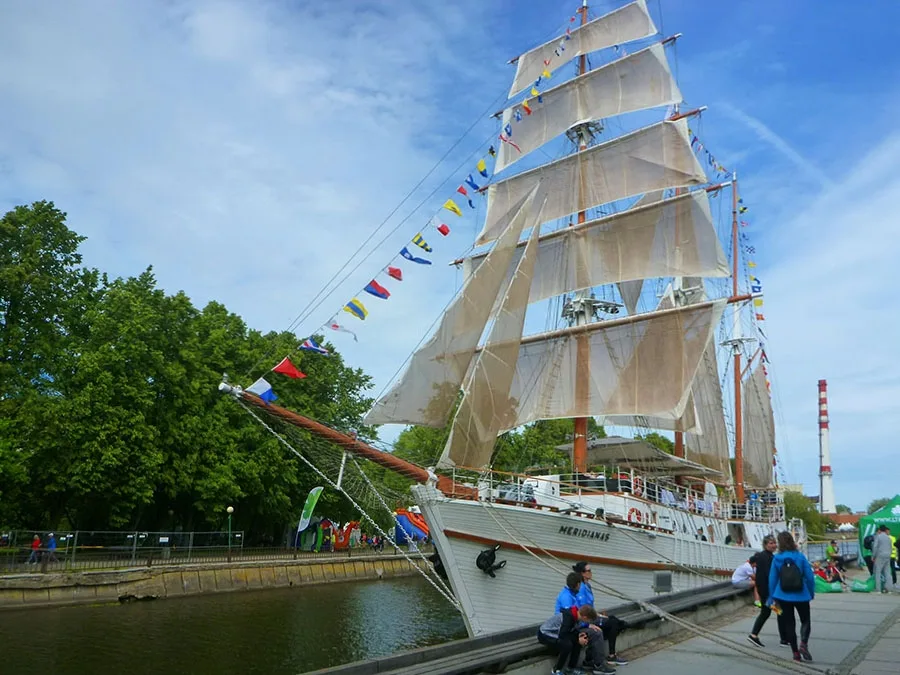 The sailing ship “Meridianas” is a true adornment of the city! The chimney of AB Klaipėdos energija, however, is not.
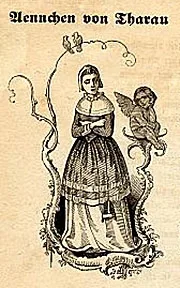
Ännchen von Tharau
According to one version, the famous Memel poet Simon Dach was a friend of Ännchen’s bridegroom. In 1637, the church in the village of Tharau (now the settlement of Vladimirovo, Kaliningrad Oblast) saw the wedding of Pastor Johannes Portatius from Trempen (the settlement of Novostroyevo, Ozyorsk Urban District, Kaliningrad Oblast) and seventeen-year-old Ännchen Neander. Dach was invited to the wedding and wrote a poem for the occasion as a kind of wedding gift. A century later it had become a popular song. The German writer Johann Gottfried Herder translated the text into literary German, and the composer Friedrich Silcher wrote a new melody for it (the first had been composed during Simon Dach’s lifetime by the organist Heinrich Albert). The song has remained very popular ever since. The poet carried his love for Ännchen throughout his life, but his dream was never to come true. She lived to the age of 70 and married twice more, neither time to him.
One of the most fascinating places in Klaipėda is rightly considered to be the Museum of the History of Lithuania Minor, housed in Friedrichstadt’s oldest town palace. The museum introduces visitors to the way of life of the Lietuvininkai and to the history of German-Lithuanian relations and of Memel. Equally unique is the Blacksmith Museum, which opened for Klaipėda’s anniversary in 1992. Openwork crosses, railings and gates typical of Lithuania Minor, blacksmith’s tools, wrought-iron household utensils… Most of the items were collected by the Klaipėda metal restorer Dionizas Varkalis. They include grave crosses, railings from old cemeteries and old weathervanes of a kind found only in a port city.
Above all, the museum’s collection vividly illustrates the stages in the development of the unique craft of the blacksmith, which has all but disappeared today.
On 1 June 1973, the Picture Gallery, a branch of the Lithuanian Art Museum, opened its doors. The gallery occupies an entire complex of 19th- and 20th-century buildings. Its collection includes paintings from Western Europe, Lithuania, Latvia and Russia, as well as sculpture and graphic art. Since 2001 it has hosted a permanent exhibition (about 600 works) of Pranas Domšaitis, the Lithuanian expressionist painter of European stature after whom the gallery is named. Works by the marine painter Česlovas Janušas and by Vytautas Kašuba are also on display.
New Town
Klaipėda’s New Town grew up on the opposite bank of the Dane between the 19th and early 20th centuries. It is much larger than the Old Town and is today a bustling commercial centre. The New Town has a large square, Lietuvininkų Square (Lietuvininkų aikštė), named after the Lithuanian inhabitants of Lithuania Minor. In Soviet times it held a monument to the Red Army soldiers buried there. After Lithuania regained its independence, the cemetery was relocated, and in its place a monument was erected to Martynas Mažvydas, the Lithuanian pioneer of printing and writer who compiled and published the first book in the Lithuanian language, “The Simple Words of the Catechism”, printed in Königsberg. The monument was created in 1997 by the Lithuanian sculptor Regimantas Juozas Midvikis, a member of the Union of Artists of the USSR, to mark the 450th anniversary of the famous catechism’s publication.
That same year saw the unveiling of a memorial by Juozas Genevičius to the Lithuanians deported to Siberia. Besides the statue of a victim, the memorial includes slabs engraved with the surnames of those who died in exile. Every year on 22 May, the people of Klaipėda come here to honour their memory. Every Lithuanian remembers Operation “Spring” of 1948. Over the course of two days, the Soviet organs of repression deported some 40,000 people to Siberia, women and children among them. The NKVD leadership demanded that the republic be “cleansed” of anti-Soviet elements who had collaborated with the partisans, and of well-to-do peasants unwilling to join collective farms. Not only Lithuanians were deported, but also local Belarusians and Poles. The main aim of “Spring” was to intimidate the population. “Thousands of people were destroyed, and not only physically. Countless lives were broken,” says the Lithuanian historian Arvydas Anušauskas.
The New Town is also of interest for its historic architecture. Liepų Street, the longest in the New Town, boasts several fine examples at once. One is a handsome 19th-century mansion built by Johann Simpson, an Englishman of Jewish descent and the wealthiest citizen of Memel. After 1913 it was home to the banker Johann Kirchberger, under whom the building acquired its present appearance, with a façade adorned by four columns and two sculptures symbolising trade and craft.
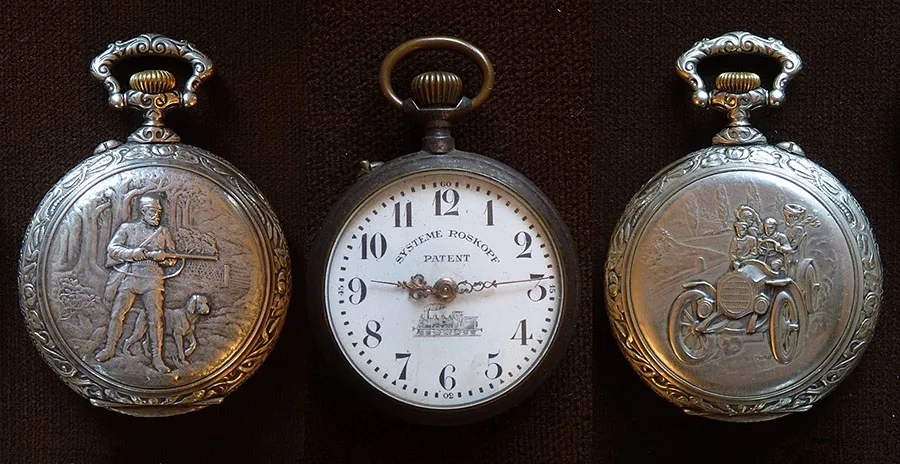
Since 1984 the mansion has housed the Clock Museum, whose exhibits are devices for measuring time from different historical eras: sundials, star clocks, fire clocks, water clocks, hourglasses and even flower clocks, as well as later mechanical clocks from the 16th to the 19th centuries. The collection is complemented by old lunar and lunisolar calendars and modern timepieces.
Next door stands the Central Post Office, built in 1893 in the Neo-Gothic style. Inside and out, it has barely changed.
The only exception is the 42-metre tower, which was damaged after the Second World War and has since been reconstructed. A little further on lies a park with a statue of the 18th-century Lutheran pastor Kristijonas Donelaitis, who won fame as the author of the first epic poem in the Lithuanian language, “The Seasons”.
One of Klaipėda’s most distinctive sights is the Sculpture Park. Every year, sculptors not only from Lithuania but also from abroad come here to show their work. What makes the park unique is that it occupies the site of a former German cemetery. In 1977 decorative sculptures by Lithuanian artists were installed here. At first the townspeople were wary of this former sacred place, but gradually they not only got used to the park but grew fond of it, especially once a children’s playground and tennis courts appeared. In the northern part of the park stands a memorial to the Soviet soldiers who fell during the liberation of Klaipėda in January 1945.
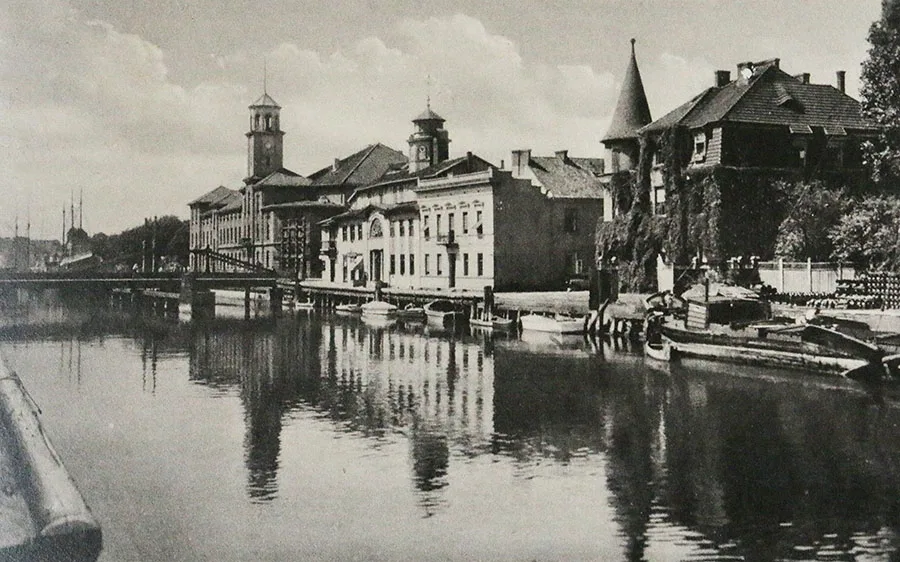 The view of the river in the centre was once a sight to behold. Sadly, none of these buildings has survived.
The 19th-century Kopgalis fortress, built by the Germans to defend Memel at the entrance to the Curonian Lagoon, now houses the Lithuanian Sea Museum. Several themed sections present the history of Lithuanian shipping from the very first fishing boats, alongside a Curonian Spit nature museum, an aquarium and a dolphinarium, next to which stands the 12-metre “Albatross” monument. It was erected in memory of ships lost at sea. According to a Lithuanian legend, great albatrosses circle crying over sunken vessels, mourning the drowned sailors.
The museum’s exhibition also includes an ethnographic fishermen’s farmstead from the century before last, with wooden cottages, thatched roofs, carved gable ornaments and wattle fences. The everyday life of an ordinary Lithuanian fisherman is laid out before you: typical household objects, fishing tackle, a cowshed and a pen with live farm animals. In the yard are outbuildings, an icehouse for fresh fish and a smokehouse.
Fish is a perishable product, so every fishing family invariably had this fixture of rural life. In the villages they smoked not only fish but also meat, sausages and, of course, the famous Lithuanian salo.
You can wander the Sea Museum for hours, examining models of ships from different eras and their rigging. There are some rather unusual exhibits, too, such as the wreckage of the boat of Gintaras Paulenis, a Klaipėda fisherman with a fanatical love of the sea. He built the vessel with his own hands, following sketches of old Newfoundland ships, and set off on a sea voyage. In 1994 he crossed the Baltic single-handed and reached Sweden safely. On the way back he was caught in the storm that, at that very time, sank the ferry “Estonia”, claiming 852 lives. The wreckage of Gintaras’s boat was found on the shore on 5 October 1994 and placed in the museum.
On 3 December 2017, after three years of repairs and restoration, the museum opened a 25-metre transparent tunnel and 24 renovated aquariums with a wide variety of sea and ocean fish, starfish lying on the bottom, fragments of sunken ships and anchors. Its rich collection of rare corals and seashells is of immense scientific value. Thanks to this diversity, the museum stands apart from most similar museums in the countries neighbouring Lithuania.
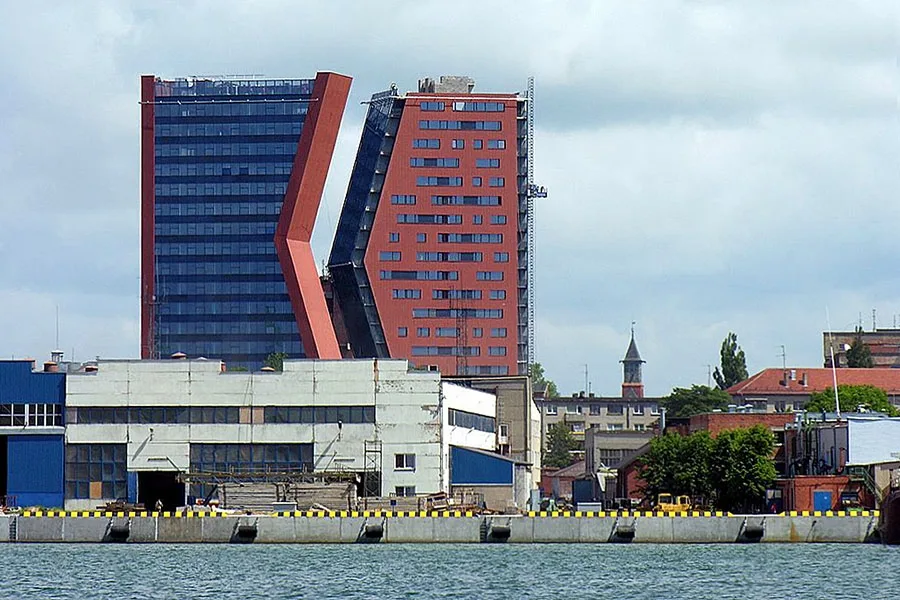 Construction of the architectural landmarks of modern Klaipėda, the “K” and “D” high-rises, was completed in 2006. Time will tell how successful this decision proves to be.
Recently, a Klaipėda civic activist proposed a law to protect the region’s German architecture: “...in towns that were part of East Prussia, people must not be allowed to build whatever they please … they should be required to adhere to a particular style characteristic of this unique region.” Denis Kishinevsky, a correspondent for the weekly “Express-Nedelya”, asked the expert on the city’s history Dainius Elertas what he thought about Klaipėda’s architectural heritage: “What has survived here can now be found in other towns too … Of course, this is a former East Prussian town with a special character, but it isn’t quite right to say that we should preserve only the German style here. One style took shape in the town itself, another in the suburbs. In the 19th century, for example, everything was fairly standardised.” As an example, Dainius Elertas cited the façade of the main library in the city centre:
“It’s a beautiful old building, but there is nothing specifically German about it. One can talk at length about the ‘unique’ half-timbered houses, but buildings in this style can be found not only in Klaipėda but also in Švėkšna, in Kėdainiai and even in Vilnius. Half-timbering in itself cannot be called a purely German style…”
According to Elertas, Klaipėda’s main problem today is that the buildings going up are robbing it of its distinctiveness. In his view, the new constructions are no better than the Soviet “Khrushchyovkas” and standard-design apartment blocks; what is more, contemporary construction continues to cultivate Soviet traditions: “The things that are appearing do not create distinctive features or individuality in terms of style. Take the ‘K’ and ‘D’ high-rises towering in the centre, which have become a symbol of the city… There’s nothing special about them, their architectural quality is fairly low, and that is saddening. We need to create something new: we can create silhouettes, we can build modern, original buildings that convey the city’s style, shape Klaipėda’s uniqueness and carry on its special character.”
KLAIPĖDA’S MAYOR: A MAN WITH THE CHARM OF THE SEA IN HIS SOUL
In March 2019 Klaipėda held a mayoral election. For the third time, voters placed their trust in Vytautas Grubliauskas, who promised to live up to the expectations of the city’s residents. In his view, they see him as a guarantor of stability, not given to empty promises.
In his previous terms, the mayor concentrated on building industrial and residential facilities and on cultural and social infrastructure. The reconstruction of the Klaipėda Drama Theatre was completed in 2015, and the Musical Theatre has been under reconstruction since 2016. The “Culture Factory” has opened. “We now have a wonderful conference centre in the rebuilt part of the castle site. We opened the ‘Danė’ social centre with three units for the elderly, orphaned children and patients with mental disorders, as well as a new unit for people with disabilities, ‘Klaipėdos lakštutė’,” Vytautas Grubliauskas told Yelena Listopad, a correspondent for Kurier.lt. “We manage to balance our attention between cultural and social infrastructure on the one hand and industry and municipal services on the other. The infrastructure of the Free Economic Zone continues to develop; around 20 companies with Lithuanian and foreign capital are already operating there successfully. We also have a cooperation agreement with Kaliningrad.”
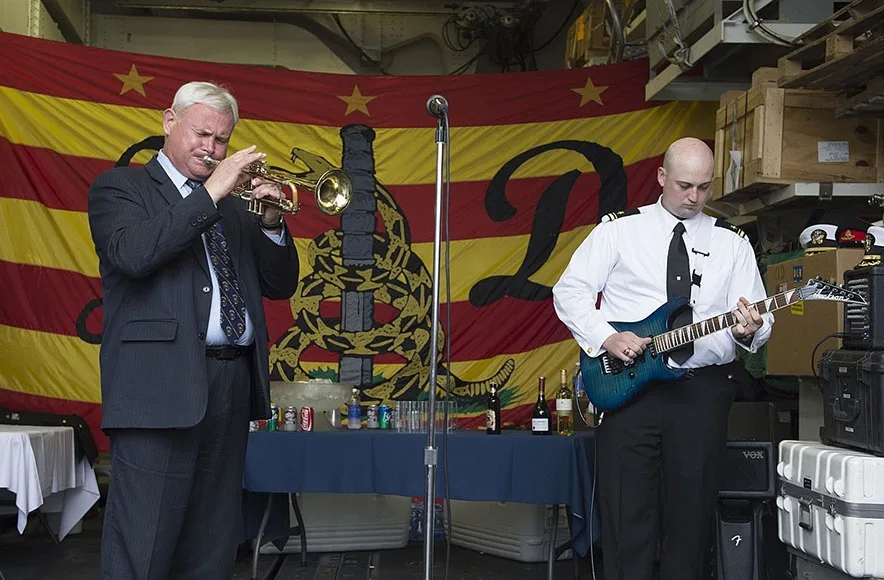 Klaipėda Mayor Vytautas Grubliauskas is a great jazz lover (pictured left).
The Port of Klaipėda naturally plays a major role in the city's development; according to the mayor, it is the calling card for guests arriving by sea. With its help, the access road to the sea ferry terminal has been put in order, and the opening of the Klaipėda Central Terminal is attracting new shipping lines. The marine container distribution centre set up by the company Klaipédos Smelté has also given the city greater standing. Thanks to its port, Klaipėda benefits from maritime tourism as well.
Vytautas Grubliauskas is concerned about the shrinking population of Klaipėda, especially of the Old Town, and is trying to do something to stop people from leaving. For example, he has granted entrepreneurs several kinds of incentives. But even this does little to keep people from leaving. Sadly, depopulation is a problem almost everywhere in Lithuania.
For several years Klaipėda's municipal government was named the best in Lithuania. “Being proud of your city is a fine thing, of course, but I believe every resident should lend a hand and do something useful, something the city needs,” says Mayor Grubliauskas. “On your own staircase, in your entrance hall, in your building, on your street, in your neighbourhood. Like a true master of the house. Love for the city must be active, and then our Klaipėda will become even better and even more beautiful.” In an interview with 15min.lt he described the city, despite its venerable age, as playful and fresh, yet serious at the same time. And he urged residents and visitors to “awaken souls striped like sailors' vests and feel like the true masters of a maritime city and country … What matters is that there should be more maritime charm in our souls. If it isn't there, you can paint every wall in nautical stripes and nothing will come of it.”
Today the mayor dreams of a healthy, green, ecological Klaipėda: “There should be no smoking chimneys, no noise, no unpleasant smells left. I imagine access to the water and the sea that is as easy as possible. The Danė River properly and tastefully landscaped, a beautiful city centre. Perhaps three or four theatres. I don't rule out an entertainment island near Giruliai either.”
Vytautas Grubliauskas is a fascinating person, a wonderful musician and improviser who takes part in the jazz festivals held in Klaipėda every year.
THE SURROUNDINGS OF KLAIPĖDA

Klaipeda Castle Jazz Festival
Traditionally, on the first weekend of June, Klaipėda hosts one of its largest annual cultural events, the international Castle Jazz Festival. Every year it grows brighter and more interesting, bringing together many foreign bands as well as Lithuanian ones. Over the years the festival has featured Tower of Power, Sugar Blue, Joe Sample, Toots Thielemans, Eric Marienthal, Randy Crawford, Candy Dulfer, Maynard Ferguson, Sheila Raye Charles and Igor Butman. And these are only a small number of the world jazz stars who have come to Klaipėda for the Castle Jazz Festival. The circle of performers widens with every festival. The festival was founded 25 years ago by the wonderful musician and current mayor of Klaipėda, Vytautas Grubliauskas, who has thereby made his city famous throughout the world.
The Curonian Spit
The Kuršių nerija (“Curonian Spit”) National Park covers an area of 26,474 hectares on the Lithuanian part of the spit. Of this, 9,774 hectares is land; the rest consists of the waters of the Baltic Sea and the Curonian Lagoon. Some of the dunes here are covered with vegetation and trees that hide their original appearance. The zone of the so-called “dead dunes” stretches for 10 kilometres south of Juodkrantė. They differ from the high, shifting, wandering dunes that begin south of Nida. The sandy landscapes of Nida attracted artists from the Königsberg Academy of Arts. And the hotel of the German patron Hermann Blode brought together Expressionist painters and became the centre of the so-called Nidden artists' colony. The artists left some of their paintings to the hotel's owner.
Among those enchanted by the beauty of these parts were the leading German Expressionist Max Pechstein, the modernist theorist Karl Schmidt-Rottluff and the famous German Impressionist Lovis Corinth, born in Tapiau (now Gvardeysk). The German writers Ernst Wiechert and Carl Zuckmayer were also captivated by Nida.
More than half the trees in the national park are pines of various species, including mountain and dwarf pines brought over from Sweden. There is also a great variety of deciduous trees: beech, elm, acacia, birch, poplar, maple, lime… The wildlife is just as diverse, with 37 species of mammals and 100 species of birds. Great cormorants and grey herons live in the park in whole colonies.
Within the boundaries of the national park lie five settlements: Juodkrantė, Pervalka, Preila, Nida and Smiltynė. Together they form the single municipality of Neringa, named after the mythical creator of the Spit. According to legend, Neringa, the giant daughter of the goddess Laima, gathered sand in her apron and poured it out into a long rampart stretching from Cranz (Zelenogradsk) to Memel (Klaipėda) to protect the local fishermen from the storms that were destroying their homes.
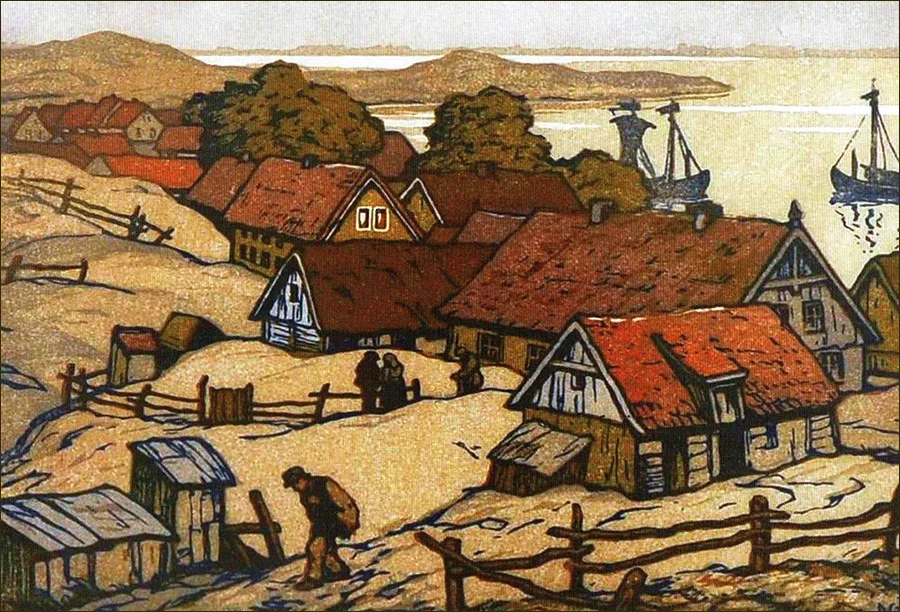 Daniel Staschus. “Fishing Village”.
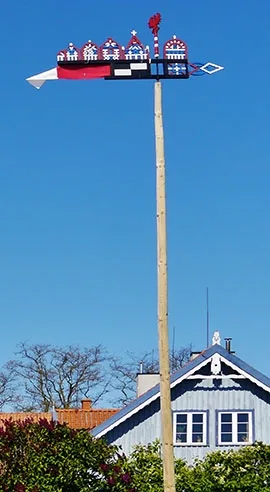
Curonian Pennants
Until the second half of the 20th century, Curonian fishermen went out onto the lagoon in flat-bottomed oak sailing boats called kurėnai. They could be up to 14 metres long. A local peculiarity was the weathervanes, the Curonian pennants, fixed to the masts of the kurėnai. Each fishing family had its own weathervane with an original design. Identifying boats by their pennants was introduced in 1844 at the initiative of the fisheries inspector Ernst Beerbohm, to make it easier to enforce fishing regulations. Breaking the rules carried a fine of one to ten thalers. And anyone who sailed under a pennant they had no right to fly had to pay a fine of 10 to 50 thalers. Over time the pennants became more elaborate and were adorned with various carved symbols. Eventually decorating them turned into a true art form. The pennants became an attraction in their own right. You will see this for yourself, especially in Nida, wherever you go! The kurėnai, however, vanished after the Second World War. But the Lithuanian Sea Museum in Klaipėda recreated the vessel and launched its first kurėnas on 11 July 2001. Examples of these boats can now also be seen in Kaliningrad.
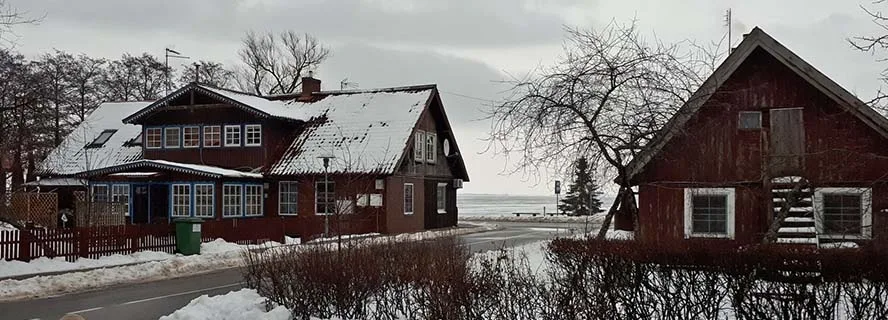
The villages used to be much smaller, but there were far more of them. Many disappeared without a trace under the sands of the dunes driven by the wind. A distinctive feature of the local villages is their modest wooden fishermen's houses, painted in characteristic colours: reddish brown and blue. As a rule, their façades face the lagoon. Interestingly, almost every one bears the initials of its first owner and the date it was built. The gables are decorated with crossed horses' heads or birds, which guarded the homes against evil spirits. Every house had a weathervane. Besides religious symbols, believed to protect the fisherman and his family from misfortune, a weathervane might carry several other symbols or even inscriptions. A weathervane could tell you a great deal about the fisherman's family: a cross meant the fisherman was married, lines showed the number of children, holes indicated that he had helpers…
One of the villages of Neringa, Juodkrantė, is full of legends about witches and deities. The Hill of Witches was considered the most sacred place of the Curonians and the Sambians, who inhabited these lands before the arrival of the crusaders in the 13th century.
It is first mentioned in written sources in 1429. From the mid-19th century it began to develop into a resort. By the turn of the last century, the fishing village of 160 inhabitants had begun to urbanize rapidly, thanks to the large firm Stantien & Baecker, which mined amber in the lagoon. Amber Bay, north of Juodkrantė and once the company's base, "still recalls those times, even though today it is no more than a shadow of the thriving port and town that once stood on this spot," writes Gordon McLachlan in his book "Lithuania." From there a road leads to Lapnugaris, the highest dune in Juodkrantė (53.2 m), now overgrown with trees. On its summit stands a lighthouse with a viewing platform from which almost the entire Spit can be seen.
The Hill of Witches, one of the most popular sights on the Curonian Spit, occupies the rear part of a dune that, before it became overgrown, was known as "Fair-Haired Eve" for its golden sand. In the early 1980s wooden sculptures appeared here, illustrating scenes from Lithuanian fairy tales and legends. Some of them are so large that they count as monumental works.
From Juodkrantė, the road along the lagoon shore leads to the remarkably well-kept and well-appointed Nida, four kilometres from the Russian border. The earliest mentions of the village date from 1385. Because of the shifting sands, it moved from one site to another.
The Neringa museum brings together everything that can tell the story of the traditional way of life and daily routine of the Curonian Spit's inhabitants: fishing, for example, amber hunting and catching crows (yes, people ate those too in times of hunger!).
Today Nida is a fashionable resort, much loved by visitors from Germany. They are keen to visit the house museum of their compatriot Thomas Mann. The writer first came to the Curonian Spit in 1929 and was so enchanted by its beauty that he spent his Nobel Prize, awarded for his outstanding novel "Buddenbrooks," on building a summer house here. "It is a wooden house with a thatched roof, its gable adorned with two crossed horses' heads. Below is an open veranda adjoining the dining room. All the other rooms are bedrooms, except for one on the ground floor, which serves as my study. From here there is a view across the lagoon, beyond which lies the coast of East Prussia, though it can be made out only now and then," Thomas Mann wrote in his essay "My Summer House." It was here that he worked on the novel "Joseph and His Brothers." After the Nazis came to power, however, the writer left Nida and never returned.
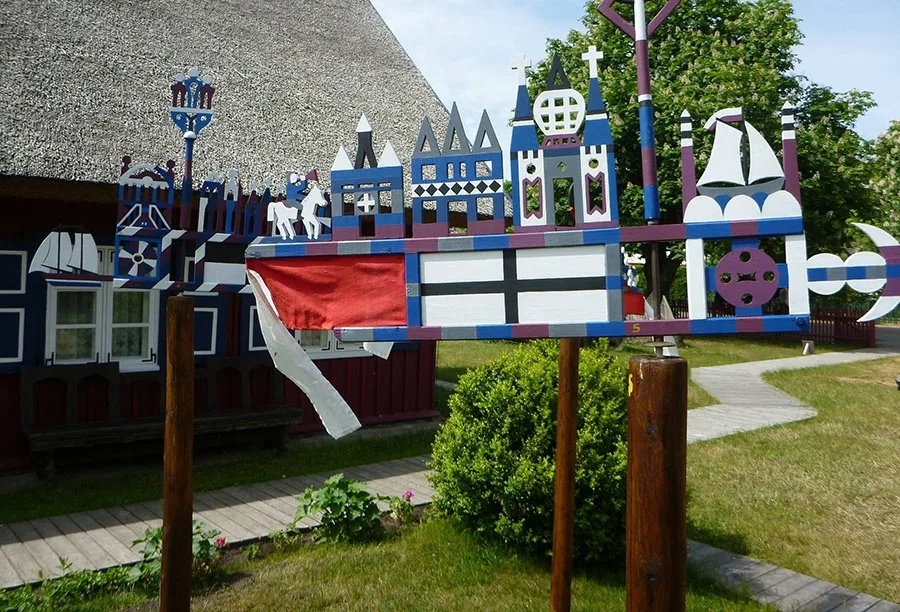
Black-and-white pennants distinguished the boats of Curonian Spit fishermen from the craft of their mainland counterparts, whose pennants were red and white.
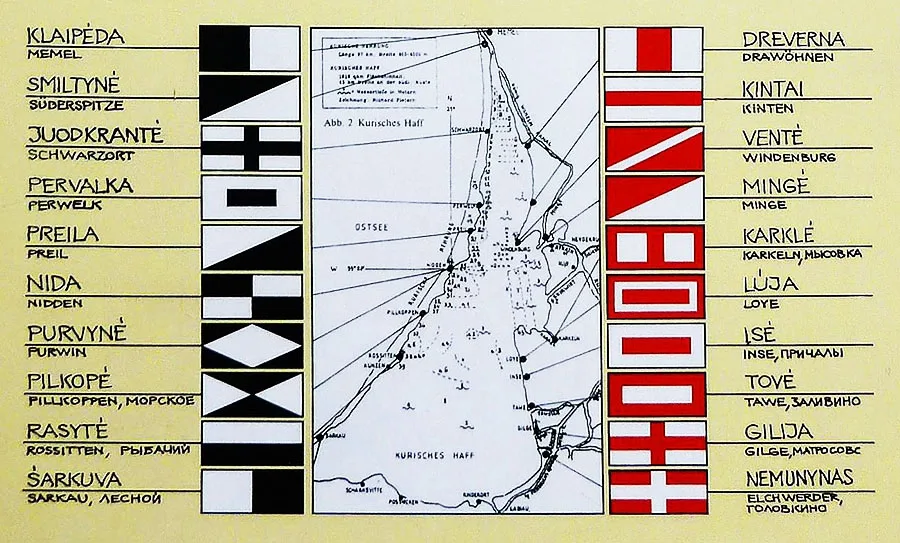
Palanga
Lithuania's stretch of the Baltic coast is short. In ancient times this shoreline was inhabited by Baltic tribes, the Curonians (or Kurs, from the German Kuren), whose name lives on in the Curonian Spit and the Curonian Lagoon, both partly within the Kaliningrad Region of the Russian Federation. The Spit is recognised as one of the most remarkable natural phenomena in Europe. So too, for that matter, is the resort town of Palanga, 30 kilometres from Klaipėda, whose sandy beach is hidden behind the belt of dunes running along the entire Lithuanian coast.
Palanga's history has some rather interesting moments. After the Treaty of Melno in 1422, for instance, the Teutonic Order renounced its claims to this southern stretch of the Baltic coast. Lithuania became the rightful owner of part of the territory around the mouths of the Šventoji and Ražė rivers, which gave the country its long-awaited access to the sea. For Vytautas, Grand Duke of Lithuania and a somewhat sentimental man, Palanga was dear for another reason too: his mother Birutė was born here.
Plans to build ports in Palanga and in the village of Šventoji to the north failed, to put it mildly, because the rivers flowing into the sea were shallow and suitable only for small vessels. Help came from the Polish king Jan Sobieski, who brought in English merchants to develop a harbour. In 1701, however, the Swedes destroyed it, and Palanga remained an ordinary fishing village. In the 19th century it turned into a holiday area with a fine sandy beach. After the First World War, as former Courland territory, it passed to Latvia, but in 1921 it returned to Lithuania.
Today Palanga is a prestigious resort town whose population (20,000) multiplies in summer thanks to tourists, Russians among them. One of the favourite spots is the pier, which stretches 400 metres out into the sea. It draws especially large crowds in the evenings – Baltic sunsets are irresistible.
Palanga is quite cosy and wonderfully laid out. The landmark of the town centre is the Church of the Assumption, built in 1907 in the Neo-Gothic style and rather untypical of the town. More characteristic here are the wooden buildings from the turn of the 20th century, such as the Old Pharmacy, which is still in business, or, not far from it, a branch of the National Museum of Lithuania, the Jonas Šliūpas House Museum.
Jonas Šliūpas was a man with what might be called an unusual destiny. In 1880, after finishing grammar school in Mitau (today the Latvian town of Jelgava), he enrolled at Moscow University and two years later at St Petersburg University, where he took part in the student movement and joined the First Proletariat party, for which he was expelled that same year and barred from entering any Russian university. After emigrating, he returned from the USA to Lithuania and from 1933 to 1938 served as mayor of Palanga.
Palanga has another famous house museum, dedicated to the Lithuanian painter, sculptor and modernist Antanas Mončys, who spent many years in emigration. In the 1980s he took part in exhibitions of art by Lithuanian émigrés in Vilnius and Kaunas. And in 1992 he donated his works to Palanga. "At last I have drawn up a list of the works I am giving to Lithuania. They are a part of my life, which I gladly give to Her, since I myself belong to Her," Antanas Mončys wrote in a letter of 16 October 1991 to Darius Kuolys, Minister of Culture and Education. Incidentally, under the terms of the artist's will, visitors are allowed to touch his works.
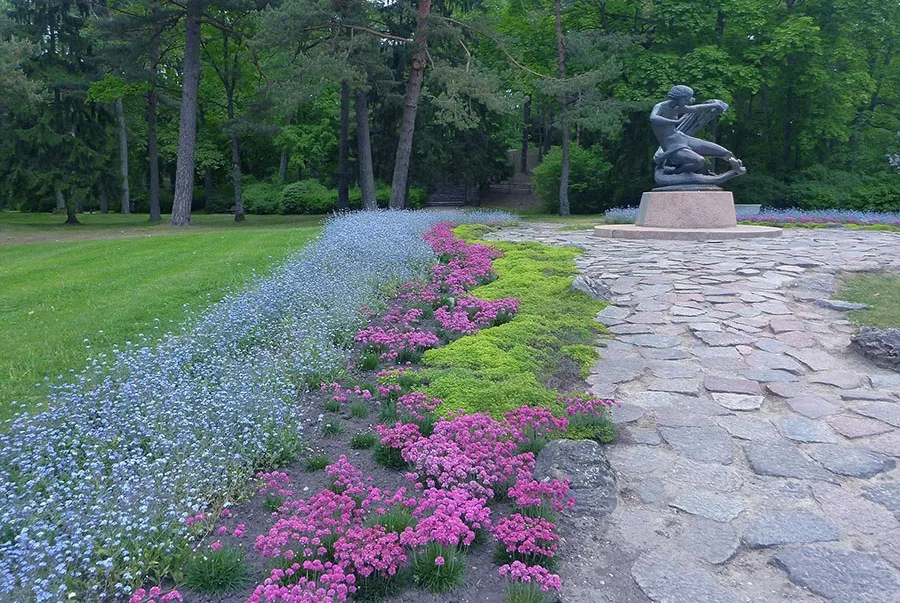
Just a century and a half ago, the site of the Palanga Botanical Park, one of the most beautiful parks in Lithuania, was covered with dense thickets and marshland. Everything changed when Count Feliks Tyszkiewicz bought land here, built a palace on it and decided to surround it with a magnificent park. It was laid out at the end of the 19th century to a design by the French landscape architect Édouard François André, in the classical manner with elements of the naturalistic English style.

The Japanese Garden in Mažučiai
Twenty kilometres from Palanga lies the village of Mažučiai. In 2007, on the site of the former Old Hill sanctuary, work began here on a huge forest-fringed field with a hill, covering 16 hectares, to create the Madzuhai Japanese garden – this is how the village's name is pronounced by the Japanese who look after it. All the trees, shrubs and flowers growing here were brought from Japan. Although still very young, the Madzuhai garden is the largest Japanese garden in Europe. Besides admiring the flora of the Land of the Rising Sun, you can meditate in the rock garden and learn about the tea ceremony. And near the entrance to the garden there is a little shop where anyone can buy genuine Japanese planting stock or an exquisite bonsai (pictured) to decorate their home!
The statues "The Archer" and "Eglė, Queen of Serpents" – the latter honouring a popular figure from Lithuanian mythology (pictured above) – were made especially for the park. The Botanical Park, with 600 species of trees (including rare and endangered ones) and shrubs, covers 100 hectares.
The Tyszkiewicz Palace itself was built in 1897 in the Neo-Renaissance style to a design by the German architect Franz Schwechten. In 1963 it became home to the world’s first Amber Museum, which brings together everything there is to know about this stone, its geology and how it is worked. Two halls on the first floor house a unique collection of amber with inclusions: insects and reptiles trapped in resin that has preserved them for eternity. The ground floor displays jewellery, true works of art from different eras, ranging from pieces made by ancient Baltic tribes to intricate creations by contemporary Lithuanian craftsmen. Baltic amber has always been highly prized and was the region’s main export.
There is a legend about how amber came to be. One day a local fisherman named Kastytis was casting his nets. This displeased the goddess Jūratė, who lived in an amber castle at the bottom of the sea. She sent her mermaids to ask Kastytis not to stir up the water and frighten her fish. But the fisherman paid no heed and went on casting his nets into the sea. Jūratė wanted to see for herself who dared to defy her will. She rose to the surface and instantly fell in love with Kastytis, forgetting that immortal gods are not granted the joys of human happiness. The young man won the goddess’s heart with his songs, and she carried him off to her amber castle on the seabed. When Perkūnas, the ruler of the gods, learned of this, he punished them both cruelly: he struck Kastytis down with a bolt of lightning, destroyed the amber castle and chained Jūratė to its ruins with golden chains. To this day the inconsolable goddess grieves for her beloved. Sometimes her grief makes the sea rage, and afterwards people find tiny drops of amber on the shore: Jūratė’s tears. In 1961 a sculpture of the two lovers was erected in Palanga. The poet Joseph Brodsky mentions them in his poem “Cognac in the carafe is the colour of amber…”:
The season’s over. Tables upside down.
The squirrels revel, full of cones at last.
A Russian agronomist snores in the buffet,
like a knight long used to roads of mud.
The fountain murmurs, and beyond a window somewhere
Jūratė and Kastytis bill and coo.
Seven and a half kilometres north of Palanga lies an international airport that connects Lithuania’s Baltic coast with Belarus, the United Kingdom, Germany, Denmark, Latvia, Poland and Russia.
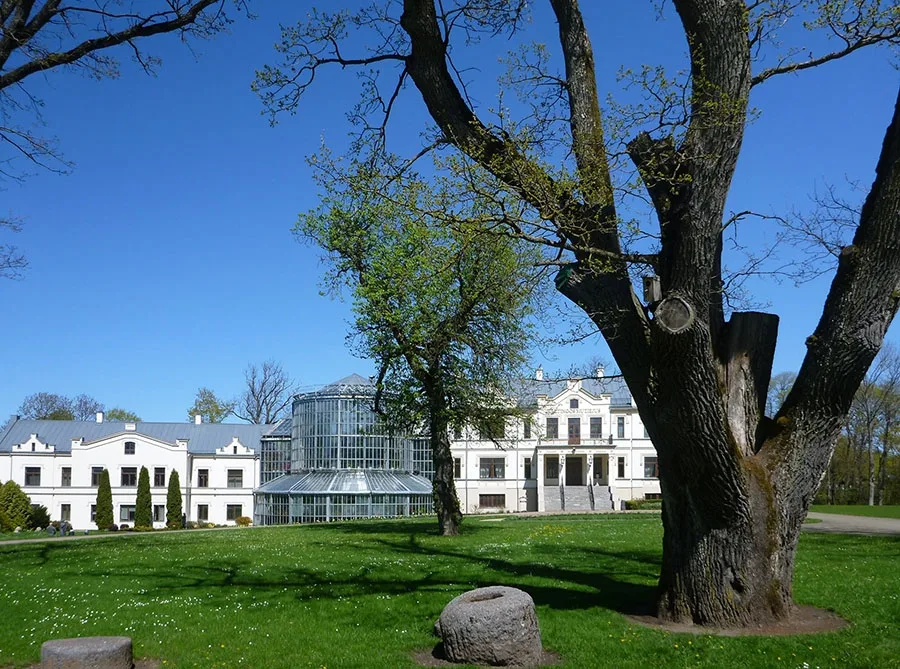 The promising exterior of the Winter Garden in Kretinga – inside, a true extravaganza of nature awaits you!
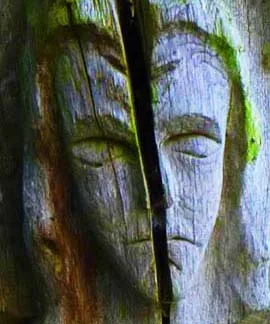
The Museum of the Absurd
Not far from the small town of Salantai in the Kretinga district lies one of Lithuania’s most fascinating museums. Throughout his adult life, the Samogitian Vilius Orvidas created mysterious and strange compositions on his ancestral farmstead. They feature giant boulders, crosses, wooden pagan idols, old rusty weathervanes… The exhibits are scattered across the entire 16-hectare site according to some design that is hard to make out. Soviet officials called Orvidas’s exhibition a rubbish dump and an example of unsanitary conditions. In 1980 the future president of the USSR, Mikhail Gorbachev, visited the place. Rumour has it that it was he who first called the farmstead the “Museum of the Absurd”.
Kretinga
Thirteen kilometres from Palanga lies the beautiful old town of Kretinga, first recorded in 1253, when it belonged to Bishop Heinrich of Courland. From 1534 the growing settlement and its estate were owned by Lithuanian princes. In 1572 the estate passed to Hieronim Chodkiewicz, the Elder of Samogitia, and then to his son Jan, who at his own expense built a Franciscan monastery and the Church of the Annunciation of the Blessed Virgin Mary. Its tower still rises above Kretinga’s central square today.
After the death of Jan Chodkiewicz, the town changed hands many times, being sold and given away, until in 1862 it was acquired together with the estate by its last owner, Józef Tyszkiewicz, who also owned estates in Palanga, Trakai, Lentvaris and elsewhere. He had the palace rebuilt to his own design and the park transformed; it became known as the Summer Garden. In 1882 one of the first telephone lines in Lithuania was installed here, running from Kretinga to Plungė and Rietavas and linking the estates of Count Tyszkiewicz, Prince Ogiński and Count Zubov, the last owner of the Tyszkiewicz estate.
Kretinga’s true calling card, however, was the glass conservatory that housed the Winter Garden. Exotic plants and many species of flowers grew there, a waterfall cascaded down an artificial rock face, and ornamental fish swam in its streams.
The walls were decorated with corals and climbing plants. The Winter Garden, filled with plants brought from all corners of the world, was the count’s gift to his beloved wife Anna, whose frail health did not allow her to travel far. During the Second World War the Winter Garden was completely destroyed. It was not until 1987 that restoration began on the manor, the park and the Winter Garden, which once again appears in all its splendour: its glasshouses currently contain around 1,500 plant species.
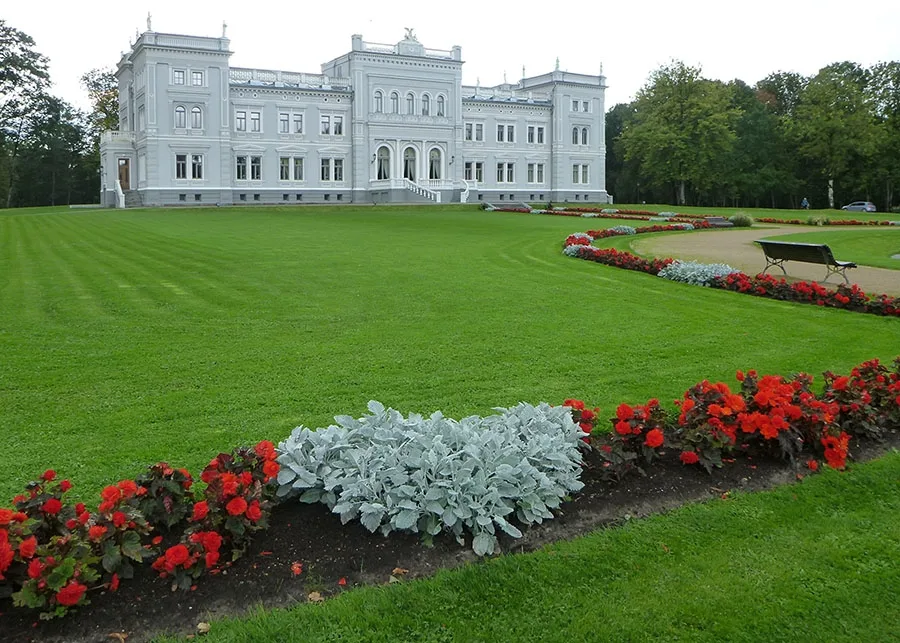 The park and palace in Plungė will pleasantly surprise even the most discerning connoisseurs!
Plungė
One of the most famous architectural monuments not only of the Klaipėda County but of all Lithuania is the estate of the Ogiński family, a Lithuanian-Belarusian noble and princely line, in the small town of Plungė.
In 1873, on the orders of Prince Ireneusz Ogiński, the family residence was rebuilt. A small two-storey house gave way to a magnificent Neo-Renaissance palace. The picturesque 55-hectare park surrounding the estate, laid out as early as the 18th century, became even more attractive with the addition of man-made ponds and a splendid fountain.
Great lovers of music, the Ogińskis opened a music school on their estate in 1873 and kept their own orchestra. During nationalisation, the family’s heirlooms were handed over to the Lithuanian Museum. The estate was badly damaged by a fire in 1941. Restoration work was not carried out until 1961, after which the premises were occupied by various organisations.
The Ogiński estate began a new life on 16 July 1994. On that day the Samogitian Art Museum opened its doors here, and contemporary artists now exhibit their paintings in it.
The Ogiński lineage dates back to 1246 and to the holy Prince Michael Vsevolodovich of Chernigov, whose great-great-grandson, Prince Tit-Yury Fyodorovich Kozelsky (15th generation from Rurik), had two sons: Prince Vladimir Titovich and Prince Grigory Titovich, nicknamed Ogon (“Fire”). Gennady Aleksandrovich Vlasyev, a lieutenant general of the Admiralty, historian and author of genealogical studies, writes in his book “The Descendants of Rurik”: “The Ogiński family descends from ancient princes and, from 1547 onwards, was referred to by the princely title in all Polish royal rescripts, Sejm resolutions and court records.”
This family is a veritable treasure trove of celebrities and talents. Grzegorz Antoni Ogiński, for example, was a statesman and military leader of the Grand Duchy of Lithuania who was three times elected envoy from the Vaŭkavysk district to the Sejm of the Polish-Lithuanian Commonwealth. On 23 June 1698 he was chosen Elder of Samogitia, and he took part in the civil war of 1696–1702. During the Great Northern War he supported Augustus the Strong and Peter I. In November 1703 he became Field Hetman of Lithuania, and two years later a Knight of the Order of the White Eagle. Shortly before his death in 1709 (he died at the age of 45), Grzegorz Antoni was granted the rank of Grand Hetman of Lithuania.
Another member of the Ogiński family, Prince Michał Kleofas, not only played several musical instruments but also composed operas, mazurkas and songs himself, and became world-famous for his polonaise “Farewell to the Homeland”, more often simply called Ogiński’s Polonaise. He improved the design of the harp and wrote an article about it for the “Encyclopaedia, or a Systematic Dictionary of the Sciences, Arts and Crafts” by the philosopher and writer Denis Diderot.
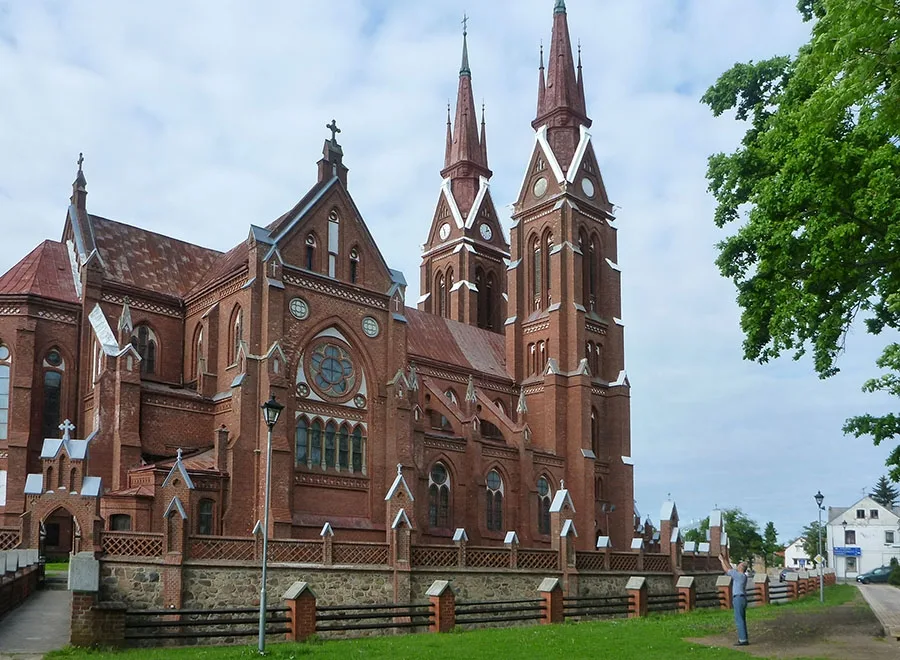 The unexpected splendour of Švėkšna.
Švėkšna
The small, ancient town of Švėkšna, 50 kilometres from Klaipėda and home to just over two thousand people, is first mentioned in written sources in 1503. In 1509 the town’s first church was built.
In the 19th century, Švėkšna was home to the Platers, a family of powerful Lithuanian magnates. Their manor, Villa Genowefa, built in 1880 in the neoclassical style, still stands in the town. It is surrounded by a beautiful old park with 70 species of trees and a large pond. Every year, the park hosts the largest Halloween celebration in Lithuania.
People come here from almost every corner of Lithuania, bringing their handmade pumpkin lanterns. In the evening, thousands of candles bathe the old park in a truly magical light.
Not far from the Plater palace stands the strikingly beautiful neo-Gothic Church of St. James the Apostle, built in 1905 to a design by Carl Eduard Strandmann (pictured above; its towers are 65 m high!). Adam and Aleksander of the Plater family donated 50,000 roubles towards its construction and allowed the bricks for the building to be made free of charge at their factories. The church interior is just as magnificent, with beautiful stained-glass windows and a richly decorated altar. The organ was installed a little later, in 1907. In the churchyard stands a copy of Michelangelo’s Pietà, “The Lamentation of Christ”.
Švėkšna’s other sights include the Lutheran church built in 1867, a copy of a sundial whose original is kept in the Louvre, and a statue of St. Florian, the patron saint of firefighters, erected after a great fire in 1925.
Ventė
On the eastern shore of the Curonian Lagoon, in the Neman delta, south of the village of Ventė, lies Lithuania's longest peninsula, the Ventė Cape. It is five and a half kilometres long and more than two kilometres wide. Translated from Old Prussian, wenter means a fish trap, an ancient piece of fishing gear. Naturally, the village's name is linked to fishing, the main livelihood of the people who inhabited the Neman delta.
The Teutonic Order once took a liking to this fish-rich spot, and in 1360 built Windenburg Castle on the cape. Together with the neighbouring castle of Rossitten, on the other side of the lagoon in today’s village of Rybachy, it served the knights as a place to spend the night during their raids into Lithuania in the 14th and 15th centuries. Over time, the castle was destroyed by the waters and ice of the lagoon. In 1626, a church was built on the cape, possibly using stones from the castle. But the church was no luckier: it, too, was destroyed by the waves.
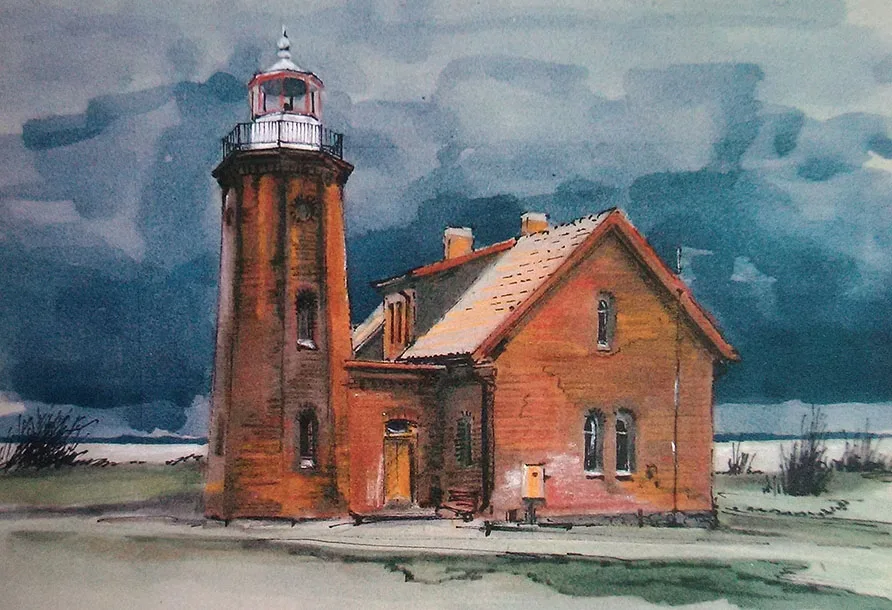 The Ventės Ragas lighthouse. Watercolour by Romanas Borisovas.
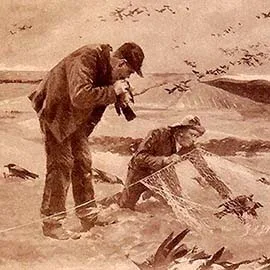
Krähenbeißer: the crow biters
Every autumn, flocks of crows flew over the Curonian Spit from the north of Europe to their wintering grounds, and here they were caught with nets. The crow catchers set out while it was still dark so as to build a hide and prepare the bait before dawn. The bait consisted of a few small birds, tied by their feet to a peg driven into the ground and placed on a net sprinkled with sand, grain and offal. When a passing flock of crows landed on the bait, the hunter pulled a rope from his hide and the prey was caught in the net. The Krähenbeißer killed the crows by biting the bird’s skull at a particular spot. The method was not exactly elegant, but it was considered quick and humane. Crow catchers needed a permit, and the plots where they hunted could be passed down from generation to generation. Salted, boiled and smoked crow was regarded by East Prussian gourmets as a special delicacy.
Because of its great length and strong winds, the cape was considered dangerous for shipping, and many merchant vessels were wrecked here. To solve the problem, a wooden lighthouse was put up at Ventė in 1837, and later, in 1863–73, the Wilhelm Canal was dug, linking the Neman with Klaipėda and bypassing the Curonian Lagoon. In 1860, work began at Ventė on a stone lighthouse, which was completed three years later (the lighthouse is no longer in operation and now serves a symbolic purpose). In addition, the very tip of the cape was paved to protect it from the waves. The tip of Ventė Cape was reconstructed much later, in 1975–86: the shores were raised, reinforced and paved with stone. A 250-metre mole was also built, which serves as an icebreaker in spring. This work halted the erosion of Ventė Cape.
In 2015, with EU funding, one of Europe’s oldest bird-ringing ornithological stations, founded in 1929 by Professor Tadas Ivanauskas, was reconstructed here.
The station now has an excellent themed museum. Bird migration routes pass over Ventė Cape, and the birds rest here before their long journey to warmer climes. Since the ornithological station was founded, some one and a half million birds of two hundred species have been ringed.
Minija
The Minija is one of the most beautiful rivers in the Klaipėda region. In its lower reaches lies a village of the same name. What makes Minija unique is that the river takes the place of a main street. To visit their neighbours on the opposite bank, the locals have to cross by boat; every household has one, and the boats make the village wonderfully picturesque. Naturally, the main occupations of the inhabitants have always been, and still are, fishing and tourism: thousands of people from all over the world come every year to enjoy the beauty of this place. Minija has been mentioned in official records since 1540. By the beginning of the 19th century, 270 people lived in the village’s 30 houses. After the Second World War, many residents fled to Germany, and new settlers from all over Lithuania took their place.
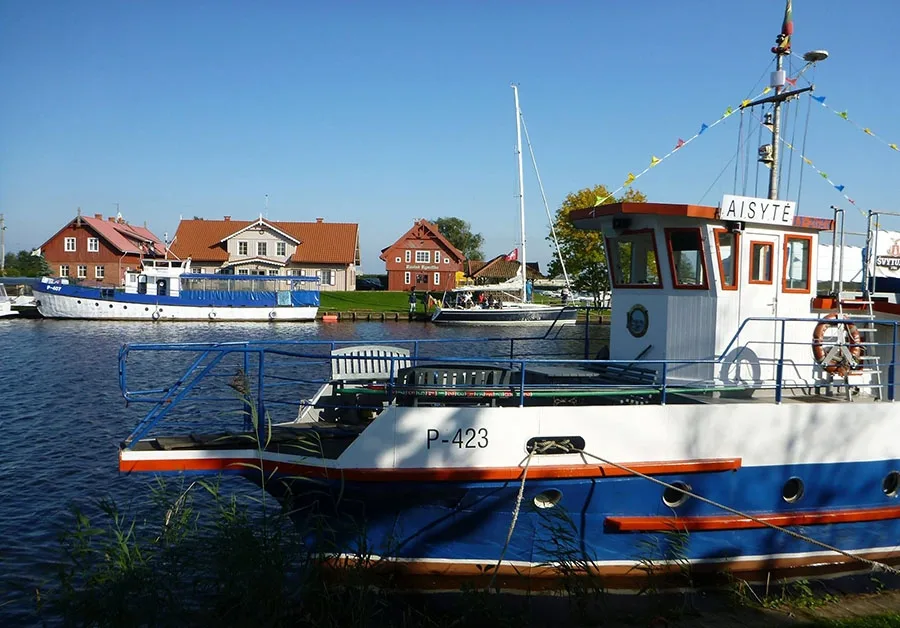
Today Minija is a protected architectural monument. The growing popularity of rural tourism gives the locals confidence in the future.
A HISTORICAL CALENDAR OF MEMEL AND KLAIPĖDA
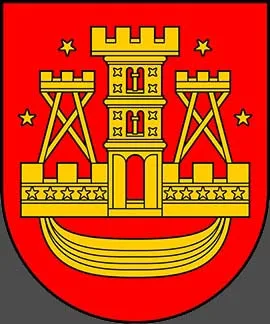
The coat of arms of Klaipėda
“Gules, a crenellated masonry wall Or with three towers, the central one larger. Around the towers, four five-pointed mullets. Below the wall, the hull of a ship.” This is the description of Klaipėda’s coat of arms, approved by a resolution of the Presidium of the Seimas of Lithuania on 1 July 1992. The reference design was created by Klaipėda Design Centre JSC (designer Kęstutis Mickevičius). The coat of arms has barely changed since the town was founded. Most historians and heraldists believe it depicts Memel Castle. According to another theory, the two wooden towers are navigation beacons symbolising the port of Memel, while the boat stands for an important transport hub and for shipping. On one of Klaipėda’s 18th-century houses, a relief of the Memel coat of arms has survived, set in an oval shield with a crest in the form of a boy. And on Mažvydas Alley, a 45-centimetre sculpture entitled “The Coat of Arms of Klaipėda” was unveiled in 2002 to mark the city’s 750th anniversary; it, too, features a boy, resting his right hand on a shield bearing the arms in relief. The oldest surviving version of the coat of arms is found on a town seal from 1446 — or, according to other sources, from 1619, or, if the book Klaipėdos tapatumo ženklai: antspaudas, herbas, vėliava (“Symbols of Klaipėda: Seal, Coat of Arms, Flag”) is to be believed, from 1258.
2nd century – In Scandinavian sources, the site where Memel would later be built was called Aldayaborg, while the river Neman was known at the time as the Aldeska.
1 August 1252 – The founding date of Memel-Klaipėda.
12 March (or 14 March) 1323 – Lithuanians from Samogitia, led by Grand Duke Gediminas of Lithuania, burned Memel, its suburbs and the ships moored at its quays. They failed to take the castle.
1379 – Lithuanian and Samogitian troops under Grand Duke Kęstutis of Lithuania burned the town and killed the Komtur.
1406 – The first brick production in Memel began.
1407 – A visit by monks to inspect the building works. Among the guests was the outstanding architect of Teutonic castles Nikolaus Fellenstein. This is why the castle in Klaipėda did not differ much architecturally from other castles built by the crusaders.
1409 – The seal of the town’s Komtur was approved, bearing three symbols representing the oldest churches in Memel: St. John’s on the left, the castle chapel (cathedral) of St. Mary in the middle, and St. Nicholas’s on the right.
1413 – The name Klaipėda (Kaloypede, Coloypede) appears in documents for the first time.
1525 – Memel passed into the possession of the Duchy of Prussia.
1585 – The first craft guild, that of the bakers, was established.
1600–1629 – The Polish–Swedish wars, as a result of which the Swedes occupied Memel and ruled the town until 1635.
1627 – Work began on rebuilding the Order’s castle into a citadel.
1657 – Memel’s merchants were granted the privilege of freely developing maritime trade, which allowed the town to grow more rapidly as a port.
1678 – During the first Northern War, the Swedes burned Memel to the ground. Rebuilding the city took decades.
18 January 1701 – Elector Frederick III proclaimed himself King Frederick I in Prussia. Memel came under the rule of the Kingdom of Prussia.
1725 – The first tannery was built.
1756–63 – During the Seven Years' War, East Prussia was conquered by Russian troops. The first town to be taken, on 6 July 1757, was Memel.
1762 – Catherine II, upon ascending the throne, withdrew all Russian troops from Prussia.
1775 – The first export exchange was founded.
1784 – A brewery opened in Memel.
1807 – The royal edict abolishing serfdom in Prussia was proclaimed in Memel itself.
1807–08 – After most of Prussia had been occupied by Napoleon's troops within a week, Memel became the temporary capital of the Kingdom of Prussia. It was here that King Frederick William III of Prussia waited out the war together with his wife Louise, their children and the court. Memel was the only Prussian town not occupied by Napoleon's troops.
1840 – The first metalworking enterprise opened. Construction of the first steamship began at the town shipyard.
1842 – The first cheese factory opened.
1847 – Memel got its first officially employed postman. He delivered the mail twice a week.
1854 – The last great fire in the city's history, which damaged 40 per cent of its buildings.
1861 – Gas street lighting was introduced.
1871-1919 – Memel as part of the German Empire.
1875 – The railway station was built. Construction of the Klaipėda – Tilsit railway was completed.
1888 – The telephone came to the city. By 1904 the number of subscribers had exceeded 300.
1900 – The first power station and a pulp mill were put into operation. A fishing port was being fitted out.
1902–04 – Ten light metal bridges were built across the Wilhelm Canal.
1902 – The municipal water supply began operating, followed in 1915 by the sewerage system.
1904 – An electric tram began running in Memel.
1907 – In Memel, in the square opposite the Town Hall, the "Borussia" monument by the sculptor Peter Breuer of Charlottenburg was unveiled to mark the centenary of the victory over Napoleon. Emperor Wilhelm II, who also took part in the unveiling, personally made corrections to the design.
1919 – After the signing of the Treaty of Versailles on 28 January, the Memelland was separated from Germany and placed under a League of Nations mandate. Memel became a free city.
1922 – Lithuanian Prime Minister Ernestas Galvanauskas began preparations for Operation "Memel".
1923–39 – Klaipėda as part of Lithuania.
1923–34 – The port of Klaipėda was reconstructed and expanded.
22 March 1939 – Klaipėda became part of Nazi Germany and was renamed Memel.
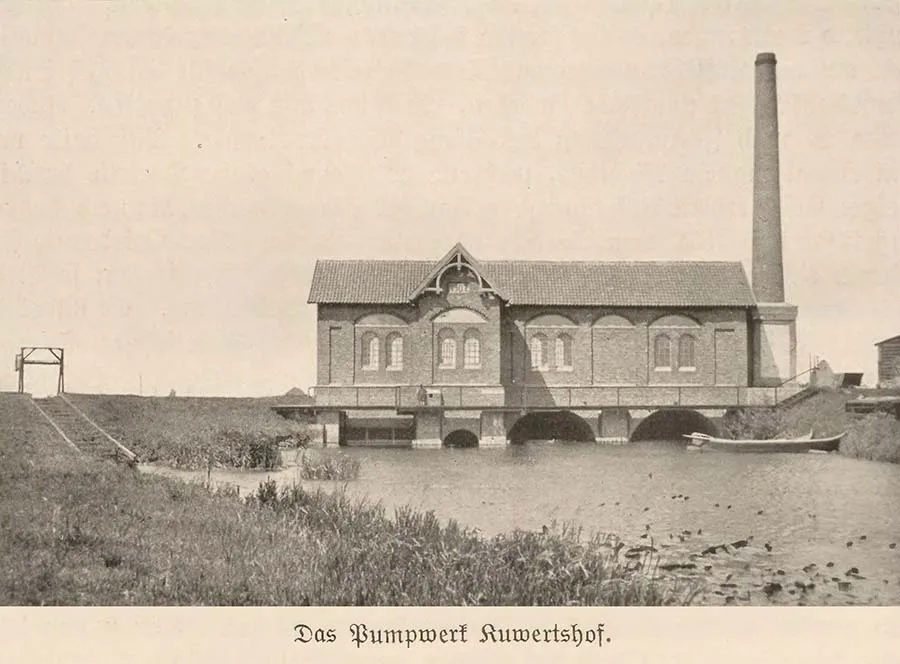 Pumping station at Kuwertshof (Uostadvaris).
28 January 1945 – The Workers' and Peasants' Red Army (RKKA) liberated Memel and returned it to Lithuania.
August 1945 – The Potsdam Conference confirmed the transfer of the Memel Territory to the USSR. The city once again received its Lithuanian name, Klaipėda.
1945 – The "Progress" packaging factory, a fish cannery and the Klaipėda construction administration were established.
1952 – The "Baltija" ship repair yard was built.
1961 – Gas supply to city apartments began.
1986 – The International Sea Ferry Crossing was built.
1990 – Free democratic elections to the City Council were held.
1991 – Two separate ports, the commercial port and the fishing port, were merged into a single Port of Klaipėda. The Lithuanian Seaports Directorate was established.
1992 – The Port of Klaipėda was granted the status of a state seaport.
1996 – A law on the Klaipėda State Seaport was passed, under which the land, water area, berths, hydraulic structures, navigation routes, channels and other port infrastructure are state property and cannot be privatised.
1999 – Construction of a modern cargo terminal was completed within the port. The Port of Klaipėda is able to handle all types of cargo.
2000 – The Curonian Spit was inscribed on the UNESCO World Natural and Cultural Heritage List.
2003 – A cruise terminal was built, offering full service for passengers and yachts.
2004 – Lithuania joined the European Union.
BIBLIOGRAPHY
- В. Воротынцев. Конструкция норвежских каркасных домов.
- В. Канале, М. Степерманис. История Латвийской ССР.
- Ю. Жукас. Клайпеде — 750 лет.
- Л. Шкловский. Полная иллюстрированная история Мемеля — Клайпеды.
- Л. Шкловский. Как Клайпеда превратилась в Мемель. (https://www.litprichal.ru/work/284596/)
- H. Lauenroth. Zur Geschichte Seeburgs — Von den Anfängen bis zur Gegenwart.
- В. Татищев. История Российская
- Г. Власьев. «Потомство Рюрика»
- http://discoveric.ru/mesta/litva/kretinga/pomestie-oginskih
- https://in-w.ru/интересные-факты-о-клайпеде/
- Выгантас Варейкис. Участие литовского Союза стрелков в оккупации Мемельской области.
- А. Экземплярский. Черниговские князья.
- И. Колчинский, А. Корсунь, М. Родригес. Астрономы. Биографический справочник.
- http://we-russian.ru/archives/65
- Петр Дуйсбургский. «Хроники земли Прусской».
- Вопросы всеобщей истории архитектуры: материалы международной научной конференции 28-29 мая 2018 года.
- Аста Диковене. Трансформация: Мемель-Клайпеда-Мемель… Как Клайпеда стала нацистским Мемелем. Еженедельник «Клайпеда», 30 марта 2019 (http://klaipeda.diena.lt)
- Аруне Люция Арбушаускайте. Некоторые специфические эпизоды аншлюса Клайпеды/Мемеля в марте 1939 года.
- Борьба за Мемель. Воспоминания Э. Галванаускаса и В. Креве-Мицкявичуса.
- Н. Hecker. Deutschland, Litauen und das Memelland.
- К. Forstreuter. Wirkungen des Preußenlandes.
- А. Senn. Die Besetzung Memels im Januar 1923.
- Н. Kurschat. Das Buch vom Memelland.
- Annaberger Annalen. Jahrbuch über Litauen und deutsch-litauische Beziehungen.
- Die Wiedervereinigung des Memelgebiets mit dem Deutschen Reich, Vertrag vom 22. März 1939.
- Е. Рукавишников. Мемель — первая победа России в Семилетней войне 1756—1763 гг. Военно-исторический журнал.
- Нида. Географический энциклопедический словарь.
- П. Мартинкус. Важнейшие даты истории Клайпеды.
- Е. Митина. От немецкого Мемеля к советской Клайпеде.
- https://www.klgd.ru/city/history/almanac/almanac12.pdf
- Sagen aus dem Kreis Heydekrug.
- Е. Neumann. Persönlichkeiten des Memellandes
- Daten aus dem genealogischen Ortsverzeichnis.
- Windenburger Ecke (Мыс Вянте). GenWiki (немецкий проект по генеалогии и локальному краеведению). http://wiki-de.genealogy.net/Geschichte_des_Memellandes
- Н. Кабанов. Как Мемель стал Клайпедой. «Мятеж», который кончился удачей ( http://vesti.vesti.lv/culture/theme/history/74236-kak-memel-stal-klajpedoj-aquotmjatezhaquot-kotoryj-konchilsja-udachej.html)
- Д. Кишиневский. Какие сокровища таят улицы старого Мемеля?, «Экспресс-Неделя», № 50.
- К. Черняускас. Перспективы развития города Клайпеды. «Советская Клайпеда», 9 марта 1954
- В. Грубляускас: «Давайте почувствуем себя морским государством».
- Е. Литсопад. «Мэр Клайпеды: Любить свой город — значит заботиться о нем». Клайпедский вестник.
- BALTNEWS.lt
- http://ports.lt/ru/
- https://krovli.club/fakhverk
- https://germanexpert.ru/faxverk/
The illustrations include postcards from the collection of Egidijus Baranauskas, photos from the VisitPrussia.com editorial archive and Wikipedia. Other sources are credited in the image captions.
______________
1. The Seven Years' War (1756–63) was one of the largest conflicts of the early modern era. It was fought both in Europe and overseas: in North America, the Caribbean, India and the Philippines. All the great European powers took part in it, along with most of Europe's medium-sized and small states and even some Native American tribes. Winston Churchill called it the "first world war". Because it brought the colonial interests of Great Britain, France, Portugal and Spain into collision, it is regarded as a colonial war; it is also considered the first trench war, owing to the large number of redoubts and other quickly built fortifications, and the first artillery war. In Europe, the main confrontation was between Prussia and Austria over Silesia, which Austria had lost in the two previous Silesian Wars of 1740–42 and 1744–48. For this reason the Seven Years' War is also called the Third Silesian War. This conflict between states led several European powers to realign their foreign policy, a shift known as the "Diplomatic Revolution", or the "reversal of alliances". After Frederick II came to power in 1740, Prussia began to lay claim to a leading role in European politics, thereby weakening the traditional rivalry between Austria and France. In Russia, Prussia's growing strength was seen as a threat to the country's western borders and to its interests in the Baltic and northern Europe. Russia's position was also shaped by its close ties with Austria, with which it had signed a treaty of alliance as early as 1746. The fighting went well for Russia: General Villim Fermor's corps took Memel, and the first serious clash between the main Russian army and the Prussian army, at Gross-Jägersdorf, ended in a victory for Russian arms. While East Prussia was under Russian rule (1757–62), it was administered by a succession of governors-general. The first was Villim Villimovich Fermor, followed by Baron Nikolay Andreyevich Korf, then Vasily Ivanovich Suvorov, father of the great military commander Alexander Vasilyevich Suvorov, and then Pyotr Ivanovich Panin. The fifth and last governor of the province was Fyodor Matveyevich Voyeykov, a scion of an ancient noble family. His ancestors, who came from the Baltic region, had served Dmitry Donskoy. Voyeykov himself had been governor of Riga and envoy extraordinary and minister plenipotentiary to Poland. His governorship in Königsberg was short but the most turbulent of all. In Russia, one ruler succeeded another. The Seven Years' War ended in victory for the Anglo-Prussian coalition. As a result, Prussia became one of the leading European powers and, in the late 19th century, led the process of German unification.
2. The northernmost deep-water port on the eastern coast of the Baltic Sea is today Lithuania's largest transport hub and the leader in container traffic among the ports of the Baltic states. The main shipping lines to European ports run through it, and here sea and land routes heading east and west meet. Even in the coldest winters the port does not freeze, which guarantees year-round navigation. Fourteen major stevedoring (loading and unloading), ship-repair and shipbuilding companies operating in the Port of Klaipėda provide every kind of service related to maritime business and cargo handling. The port can accommodate large-tonnage vessels: bulk carriers, tankers and container ships. Some 58,000 jobs have been created in the port, which accounts for 6.13 per cent of Lithuania's entire GDP, and more than 800 enterprises, including foreign ones, are directly connected with its operations.
3. Fachwerk (German for half-timbering) is a framed construction whose load-bearing basis is a three-dimensional section made up of vertical load-bearing posts and diagonal beams set at various angles. The spaces between them were filled with clay daub. The clay was reinforced by mixing it with reeds, twigs, straw or building rubble. The beams themselves were left visible on the outside: they visually divided the white walls and gave the building a striking appearance and a special expressiveness that became the defining feature of half-timbering. Half-timbered buildings first appeared in Germany and later became popular throughout Europe. One of the oldest half-timbered buildings, built in 1347, stands in Quedlinburg in Germany. Such structures are thought to have appeared as early as the 10th–11th centuries. Timber-framed houses were built wherever wood was available and the level of technical development, including the carpenter's craft, created favourable conditions for them. Half-timbered buildings can be seen in France, the Netherlands, Belgium and Great Britain. Particularly many have survived in Germany. Today this type of construction has been revived thanks to the trend towards environmentally friendly building.
Translated from Russian with the help of AI (Claude, Anthropic), October 2026.