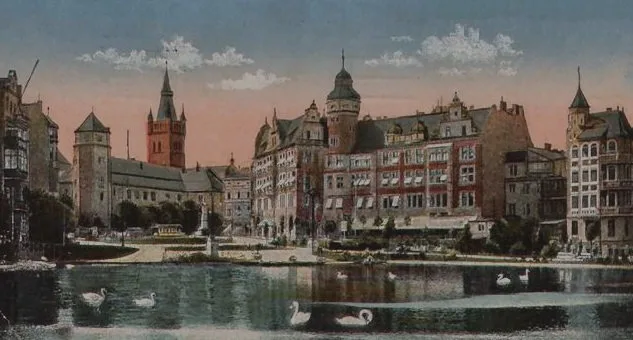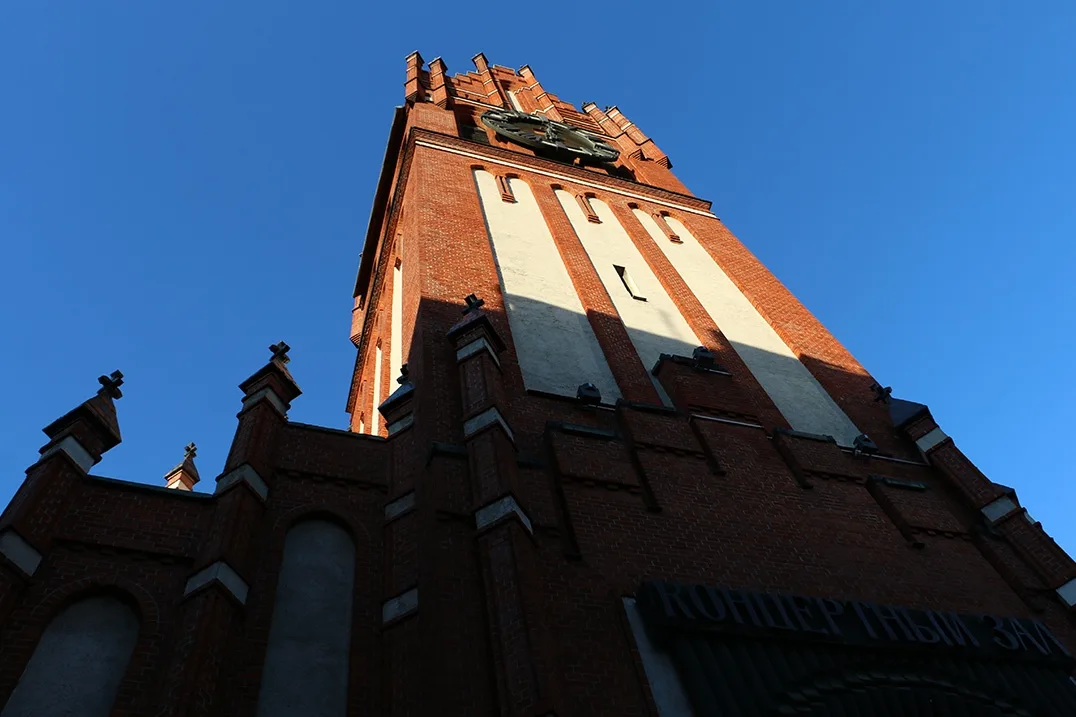
Michael Willmann was born in Königsberg, in the Rollberg district (today's landmark is the hill on which Kopernika Street lies), into the family of the painter Christian Peter Willmann, one of ten children. The family were recent Calvinist immigrants and lived modestly. In keeping with the custom of the time, a son usually inherited his father's trade, and Michael acquired his first artistic skills in his father's workshop. The young artist quickly made progress and did not stay long in Königsberg. Having discovered his son's talent, Willmann senior sent him to the Netherlands, his own homeland, where the finest artists of Northern Europe were working at the time. His many years of independent travel towards the heights of mastery probably began in 1649 or 1650. It is hard to reconstruct the details of his nearly decade-long path to fame, but a few strokes can be sketched in.
The young man arrived in Amsterdam by sea.
It is often written that Willmann entered Rembrandt's workshop, but this is unlikely, since training with the great master was expensive. Willmann probably studied with Jacob Adriaensz Backer (Jacob Adriaenszoon Backer, 1608–1651), a talented portraitist and pupil of Rembrandt.
From him the young man from Königsberg adopted the techniques of working with light and shadow characteristic of Rembrandt's manner. Amsterdam also offered many opportunities for self-education: the city was literally filled with works of art available for copying. The churches were veritable treasure houses. Every artist's workshop had collections, including works by Italian masters, assembled for teaching purposes. We may assume that he also met Rembrandt himself. One way or another, the decisive influence on the development of Michael Willmann's talent was the work of the great Netherlandish masters Rubens, Van Dyck and Rembrandt.
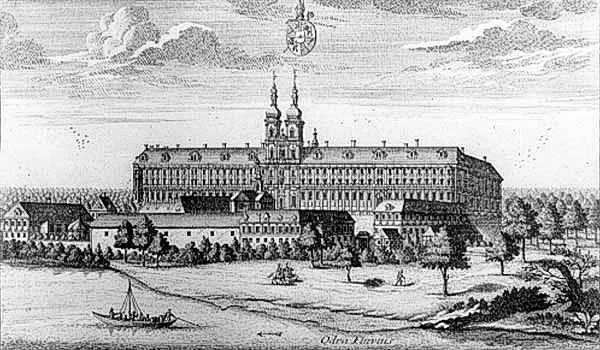
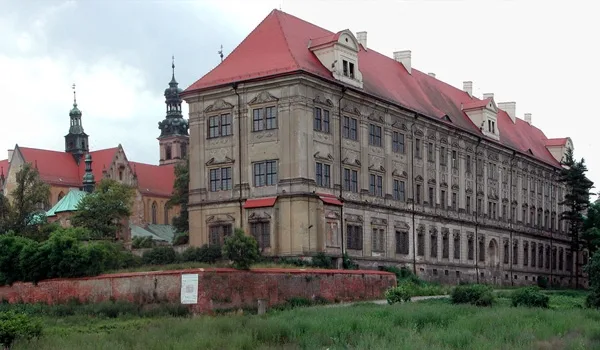
After the requisite two years of training, Willmann returned home and passed the examination for the title of master. Probably because there were few patrons in Königsberg, he went first to Danzig and then to Prague, where he stayed from 1653 to 1655. At that time Karel Škréta* reigned supreme in Prague, and competing with him was difficult, to say the least, for a young artist. Later Willmann would paint pictures for the high altar of the Strahov Monastery in Prague. For now, however, he decided to move to Breslau (Wrocław, Poland), the capital of Silesia, which had suffered less than other Silesian towns from the horrors of the Thirty Years' War. There he received his first major commission, from Abbot Arnold Freiberger, to decorate the Cistercian monastery at Leubus (Lubiąż, Poland) in Lower Silesia, which was being rebuilt after the war.
Somehow Michael Willmann found his way (did someone recommend him?) to the court of the Great Elector: in 1657–1658 he served at the Berlin court of Frederick William and painted several mythological pictures for Königsberg Castle (?). This work already placed him among the respected European artists of his time.
His ties with the Prussian court continued afterwards: in 1682 Willmann painted "The Apotheosis of the Great Elector" for the audience chamber of Königsberg Castle (the painting has miraculously survived).
Returning to Silesia in 1660, the painter bought a property not far from Leubus and set up his own workshop on the model of those he had seen in Holland. The spacious studio occupied the entire upper floor of the house. It was lit by six tall pointed windows, two facing west, two north and two east; on the west side there was also a large round window for overhead light; all the windows, like church windows, were glazed in lead frames… Today nothing remains of the artist's house; it burned down in a great fire in 1849.
In 1661 the same Abbot Freiberger commissioned from him the large cycle "The Martyrdom of the Apostles", consisting of 12 paintings (3×4 m each), on which the artist worked for many years.
Having achieved financial stability, Michael Willmann married the beautiful Helena Regina Lischka of Prague; it was her second marriage. The wedding took place on 26 November 1662, and in May 1663 he converted from Calvinism to Catholicism and took the names Leopold (in honour of the emperor) and Lukas (in honour of Saint Luke, the patron saint of painters). The change of faith removed the obstacles to receiving commissions from Catholic monasteries.
Willmann's chief patron remained the Cistercian abbey at Leubus, although he carried out many works for other monasteries in Silesia, Bohemia and Moravia, for the Breslau city council and for wealthy aristocratic families.
Willmann's versatility was astonishing. He was a master of altarpieces and painted landscapes, portraits and mythological scenes for private patrons with virtuosity.
Having quickly won popularity, Willmann became the foremost painter of Silesia.
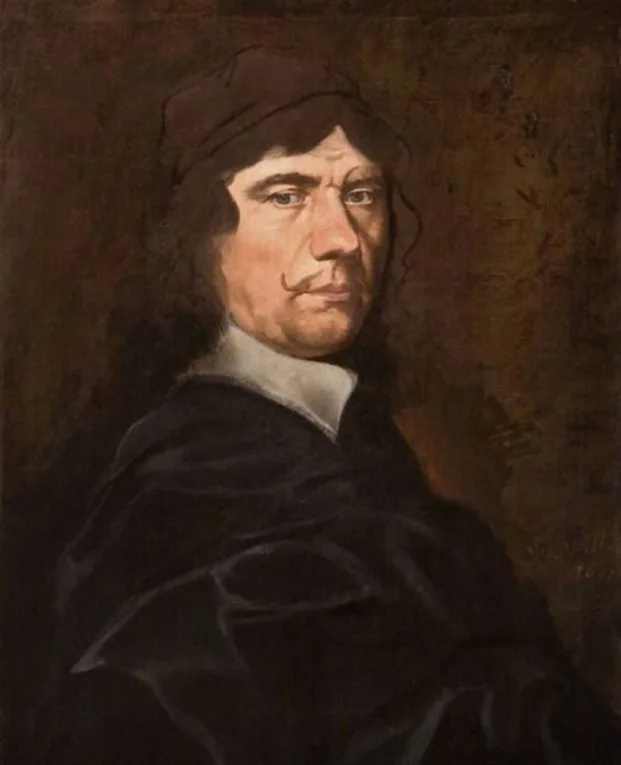 Self-portrait. 1682.
Thanks to the organisation of his workshop on the Dutch model, the work was very productive. He also developed his own method for quickly creating complex compositions. During his training in Holland Willmann had assembled a large collection of sketches after paintings by the great masters. The artist saw in them ready-made compositional solutions, which he used like modules, often combining fragments of different compositions. This rationalisation made it possible to carry out vast projects decorating large spaces with paintings, greatly eased the work and saved a great deal of time. Within his first two years at Leubus alone he produced twelve large works.
Willmann is often compared with Rembrandt. Willmann's artistic style was, however, innovative, and only his general approach was based on Rembrandt's painterly manner.
With a few brushstrokes, without working out the details, he rendered the outlines of background figures, while emphasising the main subject with intense colour and elaborating it carefully in accordance with the artistic aim. His best pupils — Johann Lischka, Anna Elisabeth Willmann and Michael Willmann the Younger — used this method, though in their own way.
Willmann took a major step in his work in the second half of the 1680s, when he tried his hand at fresco painting. His first attempt was the ceiling painting of the abbot's refectory at the Leubus monastery: the allegory "The Triumph of Virtue" surrounded by fourteen emblems. In fresco the artist used the techniques of easel painting. Lightly laying in the backgrounds in brown tones, with sketchy modelling of the background figures, he actively placed accents of light to highlight what was happening in the foreground. In 1691–1693 he completed the decorative painting of the chapel dome at Leubus. The artist's mastery reached its peak in another work, the fresco decoration of the Church of St Joseph. The frescoes, created in 1692–1696 at the commission of Abbot Rosa, head of the monastery of St Joseph, fill almost the entire interior of the church with scenes from the saint's life.
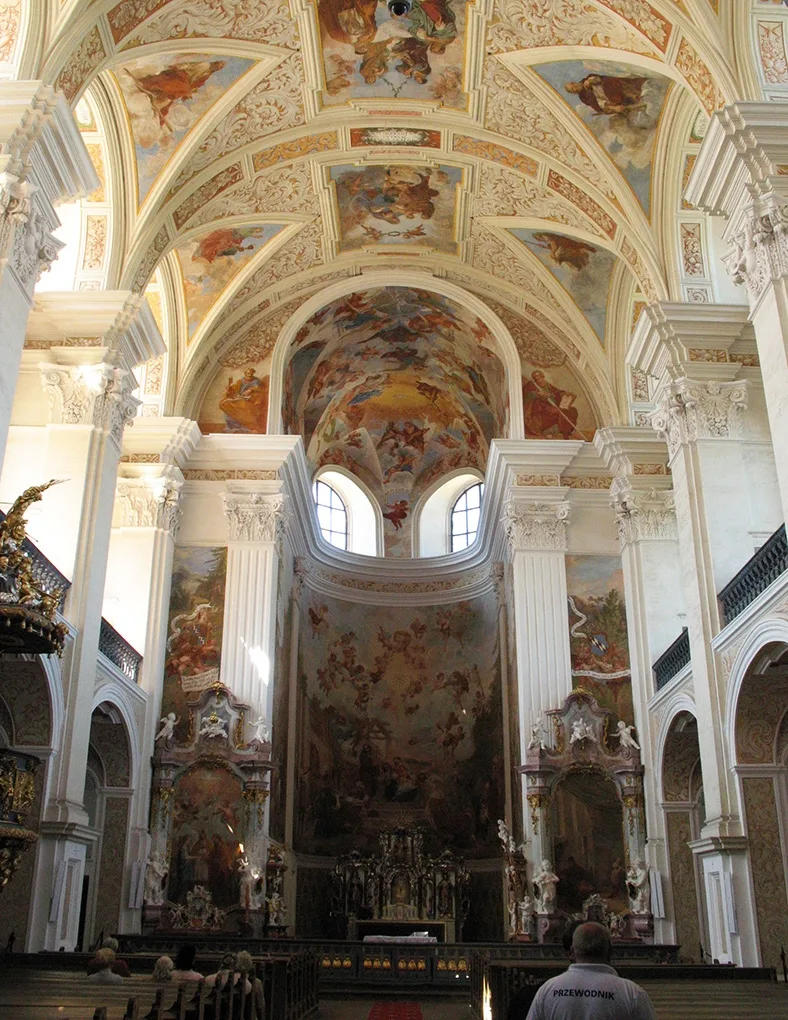 Interior of the Church of St Joseph in Krzeszów (Poland).
Willmann carried out commissions for the monasteries at Grüssau, Heinrichau, Kamenz, Rauden and Himmelwitz — at that time Cistercian monasteries became artistic centres whose abbots sought to display their high social standing.
The fame of the monumental paintings produced by Willmann's workshop spread far and wide, and his work was of outstanding importance for the development of Baroque painting in Silesia. His contemporaries were in the habit of calling Willmann "their Apelles", "the Silesian Raphael" and "the Silesian Rembrandt".
Unlike other artists of his time, Willmann was hardly influenced by the Italian Baroque at all. His individual style took shape during his training in Amsterdam, mainly thanks to Rembrandt. His palette, in the best traditions of the Dutch masters, the clarity of his compositions and his brilliant command of drawing attracted many connoisseurs of painting, and not only in Silesia. Willmann's considerable talent and enormous capacity for work were the foundation of his success.
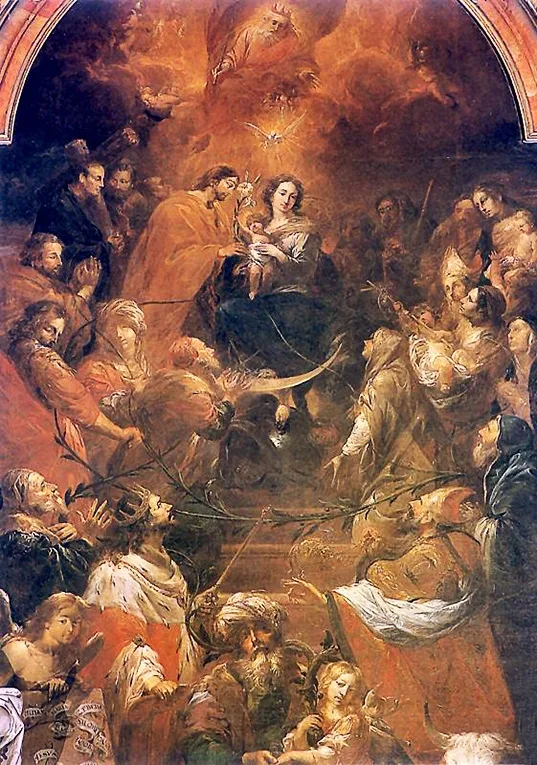 "The Family Tree of Jesus Christ". A painting from the Church of St Joseph.
It should be said that at the start of his career Michael Willmann worked alone. Over time his workshop grew to a considerable size, but it remained a family business. Willmann did not belong to any painters' guild. The large workshop employed his son Michael Leopold Willmann the Younger, his stepson Johann Christoph Lischka, his daughter Anna Elisabeth, her husband Christian Neuenhertz and their son Georg Wilhelm Neuenhertz. The workshop's prosperity enabled Willmann to give his son and stepson an artistic education in Italy. Willmann's stepson Johann Christoph Lischka became his best pupil. Willmann also influenced the work of other Bohemian artists, such as Peter Brandl and Wenzel Lorenz Reiner. Johann Kretschmer of Glogau, Johann Jakob Eybelwieser of Breslau and the Cistercian Jakob Arlet of Grüssau are also counted among Willmann's studio. For many artists of later generations his work served as a model.
It is believed that, with the help of his pupils, Michael Willmann created some 500 frescoes and paintings in all. The pinnacle of his work, as already mentioned, was the cycle of frescoes in the church of the monastery of St Joseph, created in 1692–1696 at the commission of Abbot Bernardus Rosa.
The house at Leubus became a blessed place for the artist, and his happy marriage gave him six children, two of whom followed in their father's footsteps. Michael Willmann died on 26 August 1706, aged 76. His body was embalmed and, contrary to the rules, buried in the abbots' crypt as a mark of respect for the artist's talent and in recognition of his work in decorating the monastery.
A year later (probably from illness) the artist's son died, and the workshop passed to his stepson, Johann Christoph Lischka, and in 1712 to his grandson, Georg Wilhelm Neuenhertz; it closed in 1734. In 1849 Willmann's house was destroyed by fire.
But the artist's fame was so great that many painters unconnected with his workshop, who had access to the numerous works of the "Silesian Rembrandt", sought to imitate his manner. Today Willmann is recognised as the greatest painter of the Baroque era in Silesia.
Artistic Legacy
The monastery at Leubus was secularised in 1810. The archive, the library and the art treasures (including 63 paintings by Willmann) passed for the most part to the national collection in Breslau, but the monastery's unique Baroque interior was lost.
In recent years the Institute of Art History at the University of Wrocław has been studying and identifying the works of Willmann and his pupils. It is known that of the 43 paintings by Willmann and his workshop in Poland, 3 belong to the National Museum in Warsaw, 28 are in Warsaw churches and in monasteries, and the remaining 12 are held by the National Museum in Wrocław. A famous painting of St John from the Church of St James is considered lost. To this day the artist's numerous frescoes adorn churches and monasteries in Silesia, Bohemia and Moravia. His works are also found in other countries.
In January 2010 unknown works by Michael Willmann were discovered in the attic of the Church of St Anthony in Wrocław, including a rare depiction of the Catholic saint John of Capistrano. A few months later, in April, another painting in the same church — the central image of the altarpiece "The Vision of St Anthony of Padua" — was also attributed to his brush. In the 19th century it had been incompetently restored, and the characteristic features of Willmann's painting, like the artist's signature, had been hidden beneath later overpainting.
Königsberg kept alive the memory of its great native son. A street not far from the Academy of Arts, running north of the Landgraben stream and parallel to Steffeckstraße, was named after Michael Willmann.
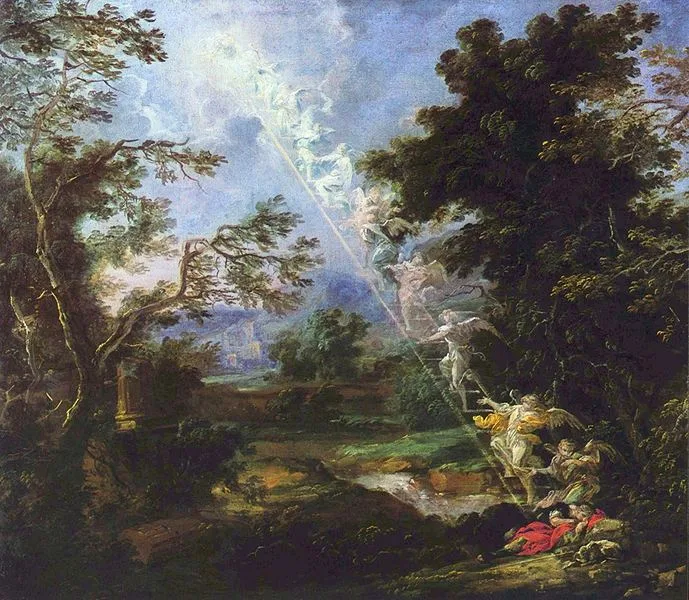
At the very top: Michael Willmann's painting "Jacob's Dream", 1691.
______________
* Karel Škréta (1610–1764) was a Czech Baroque painter whose main subjects were mythological and religious scenes.
Translated from Russian with the help of AI (Claude, Anthropic), October 2026.