Why Is Mistletoe Called Mistel?
The German name «Mistel» became the established name for mistletoe throughout the Germanic languages. Interestingly, until the 18th century the word was masculine: «der Mistel». Yet people had begun confusing the gender and using the word as feminine («die Mistel») much earlier, in the 16th century. The origin of the word itself is not entirely clear, but the main theory holds that it derives from the noun der Mist (dung, droppings), since mistletoe spreads through the droppings of birds that feed on its berries. Even here, though, things are not clear-cut: according to some botanists, birds can also carry the sticky seeds on their beaks and feet.
There are older names for mistletoe as well, and different parts of Germany, Austria and Sweden each had their own. Among them are Affolter, Affolterbach (the same as Apfelbaum, apple tree), Kleister (glue, paste, because of the stickiness of the berries) and Heiliges Kreuzholz (holy cross: in the Middle Ages, and even earlier, small crosses were made from mistletoe stems). In Russian the plant was called «armyashka», «vedmino gnezdo» (witch's nest) and «omila». In East and West Prussia, alongside Mistel, the names Wösp, Wespe (wasp, perhaps because the bush resembles a wasps' nest) and Wintergrün (evergreen) were in use.
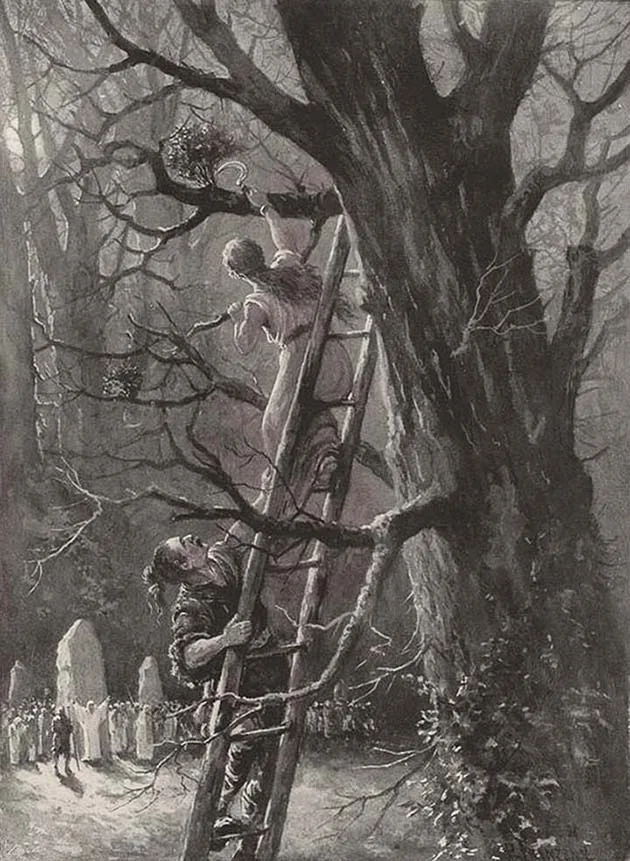 In the time of the druids mistletoe was regarded as a magical plant.
Mistletoe is found not only in Europe and subtropical Africa but also in tropical Asia and northern Australia. It is plentiful in Russia, too: in the Leningrad Region, towards the Caucasus and the Black Sea, in Primorsky Krai and in the Belgorod Region.
How Mistletoe Lives
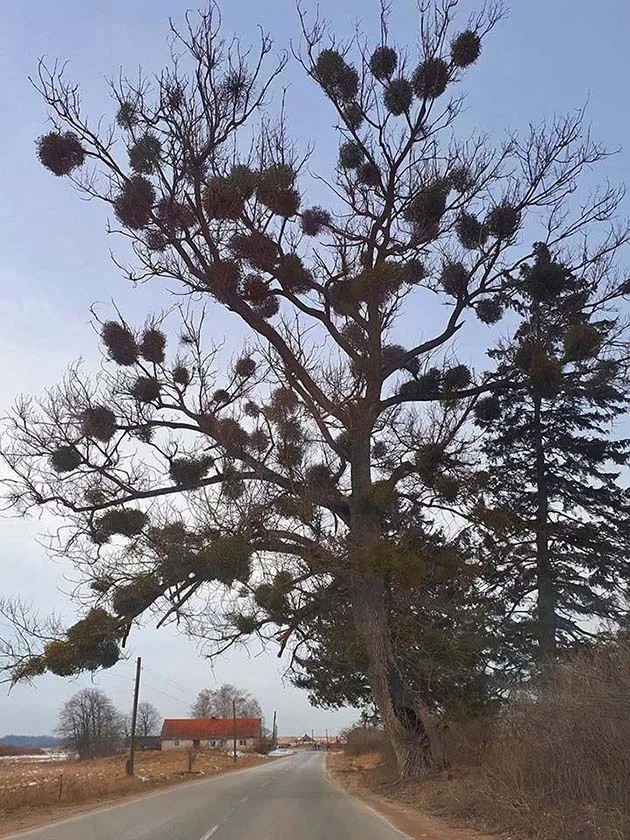
European mistletoe (Viscum album ) is an evergreen hemiparasite. It grows as a spherical bush 50–75 cm across, sometimes reaching as much as 120 cm. It is long-lived, sometimes surviving up to 40 years. It attaches itself to branches by means of numerous sucker-like roots. In a heavy infestation, a single tree may host several hundred bushes of different sizes and ages. Mistletoe draws minerals from its host tree by pushing its roots beneath the bark, but produces organic substances itself through photosynthesis, which is why it is considered partly independent. By infesting trees, it causes disease and premature death.
Mistletoe blooms in March and April with inconspicuous yellowish-green flowers gathered in groups of three to six into false half-umbels at the tips of the shoots and in the forks of the stems. Its sticky, slimy fruits appear on the plant towards winter. They were used to make a glue for luring and catching small songbirds, which is why mistletoe became known among ordinary people as «bird glue». It was also used against pests of fruit trees and against flies.
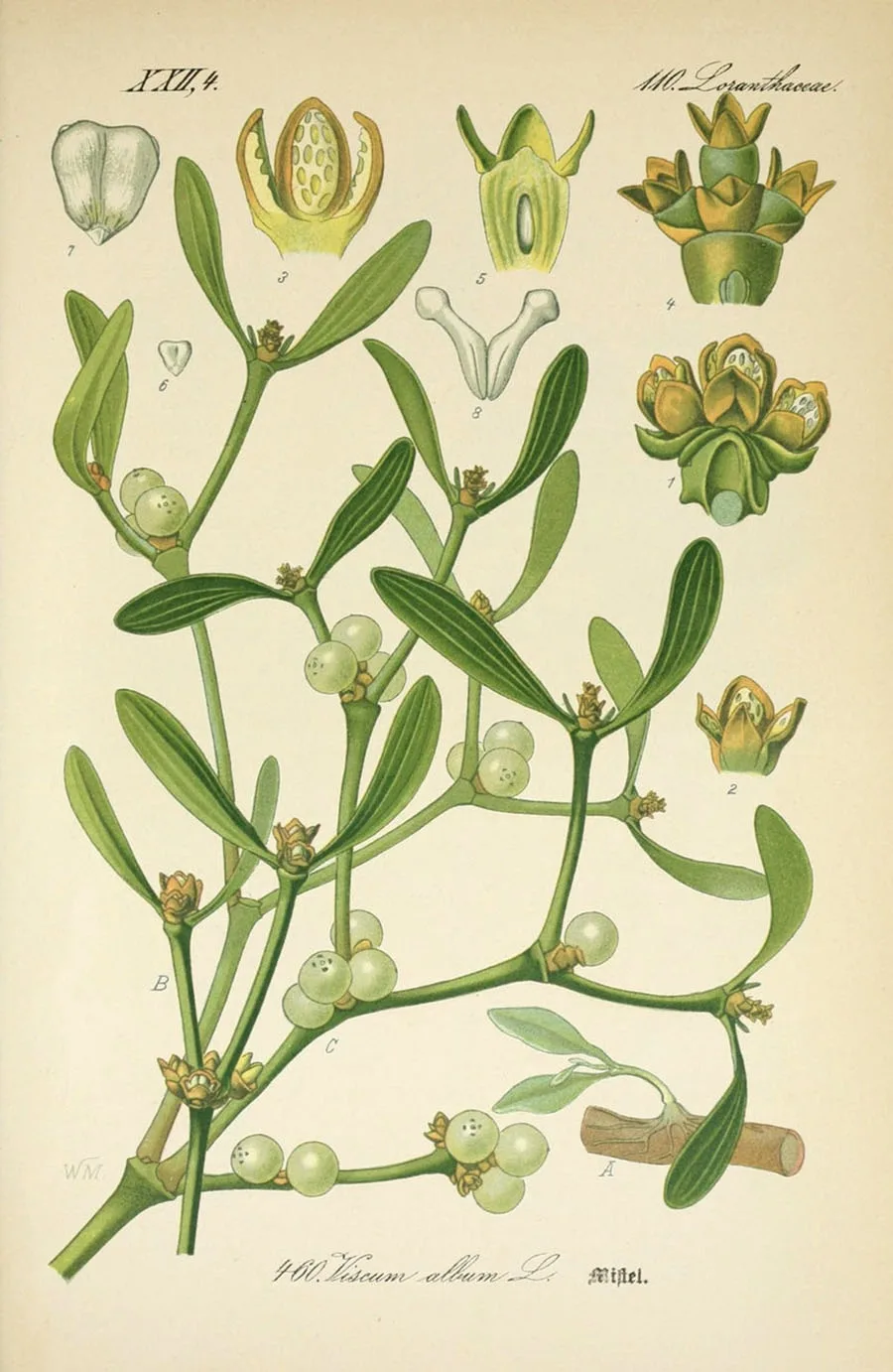
The berries of European mistletoe are eaten by birds, chiefly omnivorous mistle thrushes and waxwings. They carry the sticky seeds onto a tree, where in spring the seeds germinate, first forming «rootlets» and then a swollen disc on the bark.
A thin sucker-like outgrowth penetrates the wood. Year by year the number of suckers grows and the root system becomes more powerful, supplying the whole bush with water and full nourishment from the host tree. Mistletoe grows slowly; the stem forms only in the third year.
Mistletoe is far from choosy. It parasitises poplar, lime, willow, maple, birch, elm, hawthorn and some conifers (though this, as botanists put it, is a different physiological race of mistletoe). It is less often found on oak, walnut and hornbeam, and almost never settles on beech or plane trees. Fruit trees, such as apples, pears and plums, are highly susceptible to this semi-parasite.
Mistletoe in Mythology
For centuries mistletoe has been surrounded by myths and legends. The German scholar of medieval Germanic studies and Old Norse, Gustav Neckel, paid particular attention in his works to two mythological mistletoes. The first is the «golden bough», which in an episode of Virgil's «Aeneid» guides Aeneas through the underworld. The second is the sprig of mistletoe used to kill the Germanic god Baldr. Aeneas's bough, however, is never directly called mistletoe; it is merely a fairy-tale image of it, and what is said about it is no more than an ornamental touch that the poet weaves effortlessly into the story. By contrast, in the «Prose Edda» by the medieval Icelandic writer Snorri Sturluson, written between 1222 and 1225, the mistletoe that killed Baldr, god of spring and light, is real and forms an essential part of the gripping tale retold by Neckel.
One day the fair Baldr began to have ominous dreams, which he immediately told to his father, Odin, the supreme god, leader of the Aesir, sage and shaman, and to his mother, Frigg, the supreme goddess and ancestress of the Aesir. Mounting his eight-legged Sleipnir, Odin rode to the realm of the dead. There a sorceress and seeress told him that Baldr would die at the hand of his own brother, Höd, the blind god of fate. Odin was deeply grieved, but Frigg devised a way to save her son. She took an oath «from fire and water, from the metals of war, from stones and trees, from sicknesses and poisons, from birds and beasts» that they would never harm Baldr. The young god became invulnerable, and the Aesir often amused themselves by hurling stones, arrows and spears at him. Loki, the god of cunning, deceit and fire, was displeased by Baldr's invulnerability. He changed himself into a woman and wormed the secret out of Frigg. The goddess told the treacherous Loki that the only thing she had not taken an oath from was a shoot of mistletoe growing west of Valhalla: it had seemed to her too young and weak. Loki found the place where the mistletoe grew and pulled the shoot out of the ground (here we may smile, remembering that mistletoe grows on trees). Placing it in Höd's hands, he suggested that he throw it at the invulnerable Baldr, telling him it was an arrow. The sprig pierced the young god's body, and he fell dead. The enraged god of vengeance, Váli, killed his blind brother, while Loki escaped punishment.
It is mistletoe that appears before the seeress's eyes at the very beginning of the saga: first as a little tree on a bare plain, and then as a flying missile.
The mistaken notion of mistletoe in this legend as a tree rooted in the ground is explained in the Old Norse sources by the fact that mistletoe grows neither in Iceland nor in northern Scandinavia. The distortion does not matter, however, because the story is concerned above all with the plant's fantastic power. And that power is awakened not while it grows, but after the plant has been brought to people.
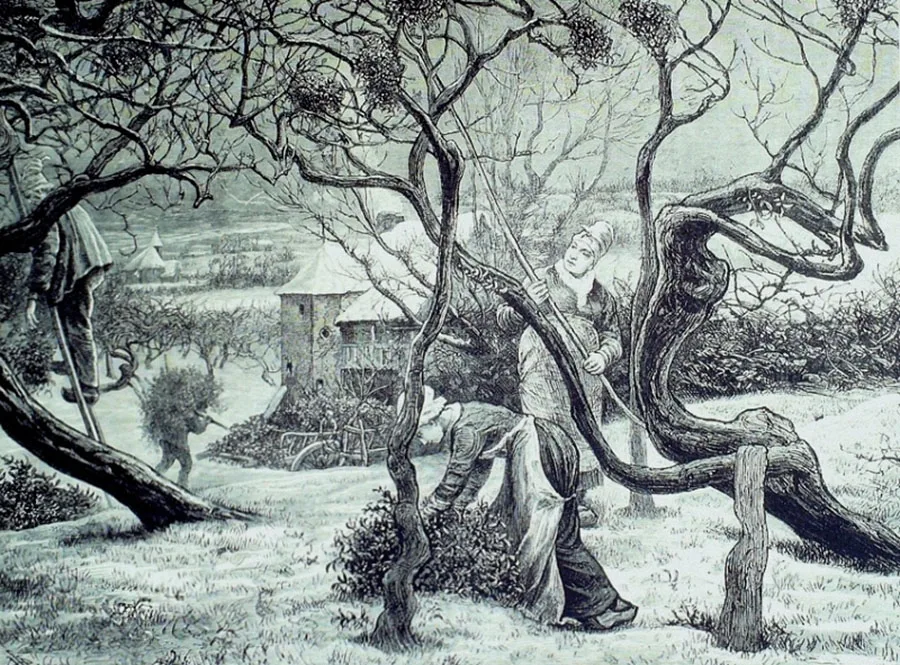 Gathering mistletoe in Normandy. Unknown 19th-century illustrator.
The Cult of Mistletoe
In 1866 the Swiss palaeobotanist Oswald Heer, in an article published in the journal An die Zürcherische Jugend, stated that the oldest finds of mistletoe date from roughly 2000–1000 BC: «The Celts regarded it as a sacred plant, so it is remarkable that twigs and remains of leaves were found in their village, though it is not known for what purpose this plant was brought into their dwellings.»
So why such reverence for a spherical parasite that lives on another's sap? Why was evergreen mistletoe considered one of the most venerated cult plants?
The first to write about the druids' cult of mistletoe was Pliny, and his is the only description from that time. For their priests nothing was more sacred than mistletoe and the sessile oak. They believed that anything growing on an oak was a gift from heaven and a sign that the tree had been chosen by God himself. The oak was especially revered as a sacred tree by the Celts, the Italic peoples and the Germanic tribes, so the mistletoe growing on it was bound to possess magical properties. While other plants are rooted in the earth, mistletoe grows high up in the trees, serving, as it were, as a link between earth and heaven. Yet European mistletoe (Viscum album) is quite rare in the crown of the sessile oak. So when the druids found it, they gathered it with particular ritual pomp. The sixth day after the new moon, when the Moon had not yet reached half its size, held special significance.
They firmly believed that the plant cured all ailments and called it «all-healing».
A feast was held beneath the oak bearing the miraculous plant. Wreaths of mistletoe were placed on the horns of two white bulls chosen for sacrifice. But first a priest, robed in white, climbed the tree, cut the mistletoe with a golden sickle and threw it down onto a white cloth spread out below (the plant was not to touch the ground, lest it lose its magical power). The sacrificial animals were then slaughtered with a prayer that the Almighty would accept the offering and look more kindly upon those who gave it.
Pliny wrote that some believed mistletoe gathered from an oak at the new moon, as custom prescribed, was most effective against epilepsy and helped women conceive. And if one always carried it, chewed it and applied it to a wound, the wound would heal faster. Sprigs of mistletoe were hung in the house and used to “revive” livestock and fruit trees. In times of war it served as an amulet.
A Christmas Tree for the English, Mistletoe for the Germans
As late as the end of the 19th century the Germans regarded mistletoe without any enthusiasm, yet very soon no Christmas was complete without it. In 1923 the “Monographie der Mistel” (Monograph on Mistletoe) was published. Karl von Tubeuf, a professor at the University of Munich, and Gustav Neckel, a professor at the University of Berlin, devoted almost 900 pages of scholarly work to the plant. Tubeuf wrote in it: “In January 1891, in an article entitled ‘Northern Mistletoe’ in the Münchener Neuesten Nachrichten, I drew attention to mistletoe as a plant used for decoration during the Christmas season. At that time only a few baskets of mistletoe were on sale in the whole of Munich. In other words, just a handful of bunches were offered for sale at two or three Christmas markets. They were bought mainly by English families living in Germany.”
In East Prussia the mild, damp climate favoured the spread of mistletoe. When, at the beginning of the 20th century, mistletoe became firmly fashionable as a Christmas decoration, the local Nature Conservation Committee viewed its sale abroad with concern, fearing the plant might disappear, while the defenders of fruit orchards called for the parasite to be wiped out altogether. Later, however, people realised that selling it could also turn a profit.
Christmas mistletoe was shipped mostly to England, and not only from Germany. It was exported by the ton from France, where it was grown specially for the purpose. In the Hamburger Fremdenblatt of December 1906 we read:
“English Christmas mistletoe. Where does it come from? In December this business flourishes in Brittany, in northern France. Albion’s demand for mistletoe is dozens of times greater than for German Christmas trees. Every house is decorated with mistletoe. Before Christmas the ports are humming with activity … Every day, consignments packed to bursting with mistletoe are sent across the Channel…”
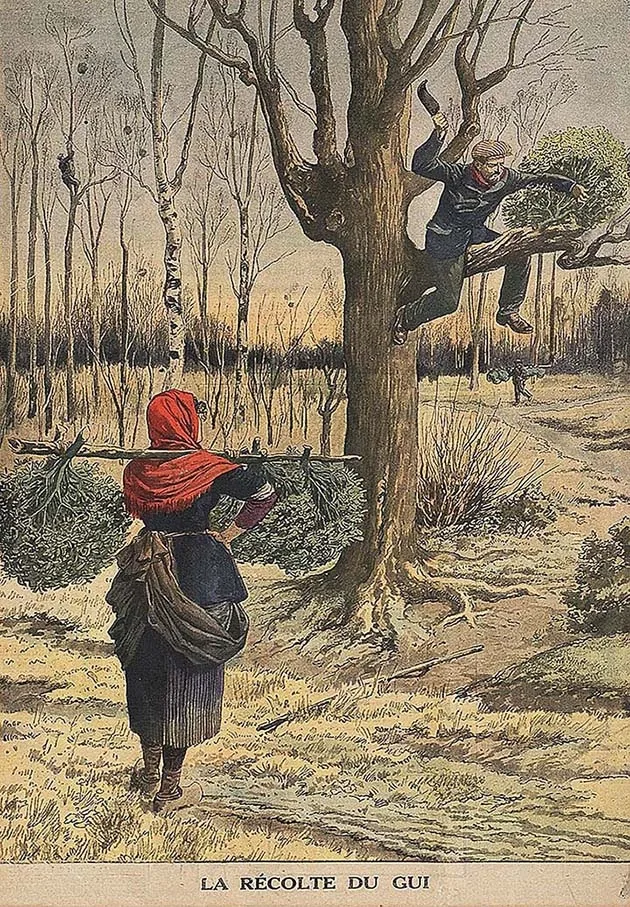 Harvesting mistletoe in France.
Illustration from the Paris weekly Le Petit Journal, 1914.
The Freiburg newspaper Freisinnige Zeitung wrote on 31 December 1907: “For Christmas, 380,000 kilograms of mistletoe branches were imported from Brittany… In the land of our Anglo-Saxon brothers it takes the place of the Christmas tree, of which England had no notion before 1850. The tradition of decorating a tree was first introduced to the English by the German Prince Albert, consort of Queen Victoria. Since then the German Christmas tree has taken root in foggy Albion just as English mistletoe has in Germany.” In the same year London’s Board of Agriculture and Fisheries reported: “Imports of mistletoe in 1907 were lower than in previous years because the French authorities ordered it to be destroyed in orchards.” During the First World War the German press cursed the Christmas berry because the tradition had come from England. But in time interest in it returned. In Russia mistletoe never caught on as a New Year or Christmas decoration. Nor, for that matter, did it in Asia. In Tokyo, for example, it was delivered at Christmas only to the British Embassy.
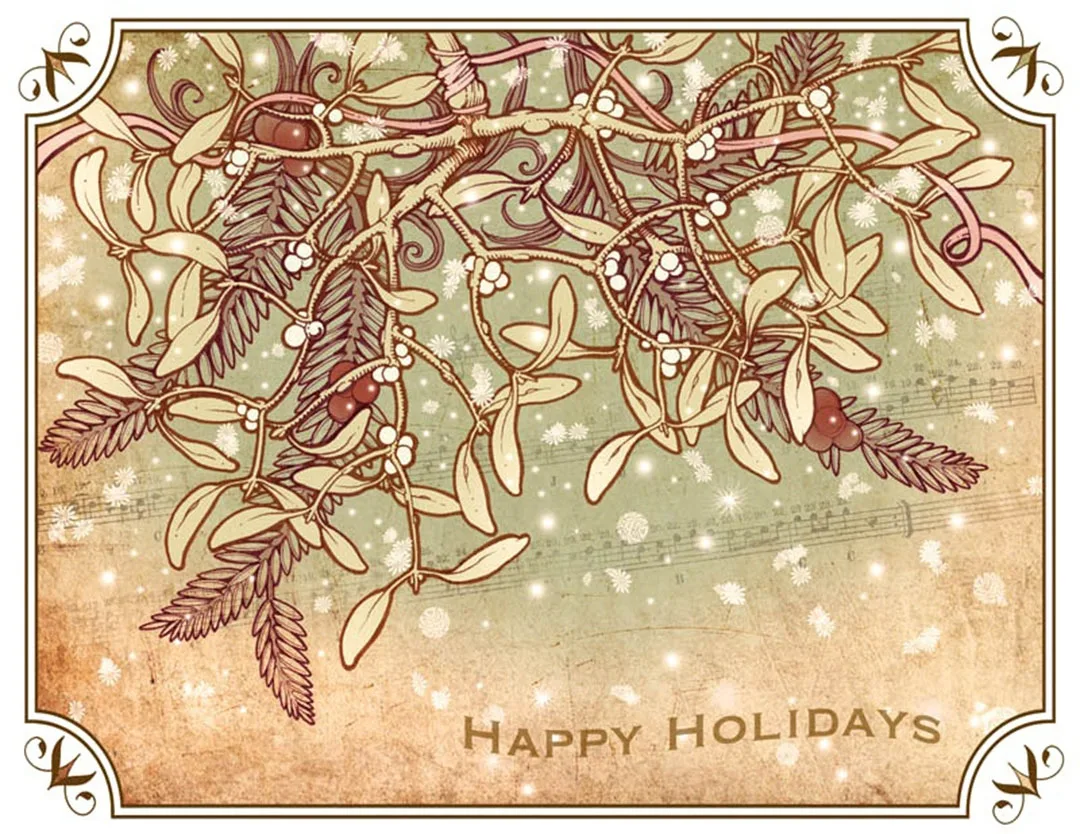
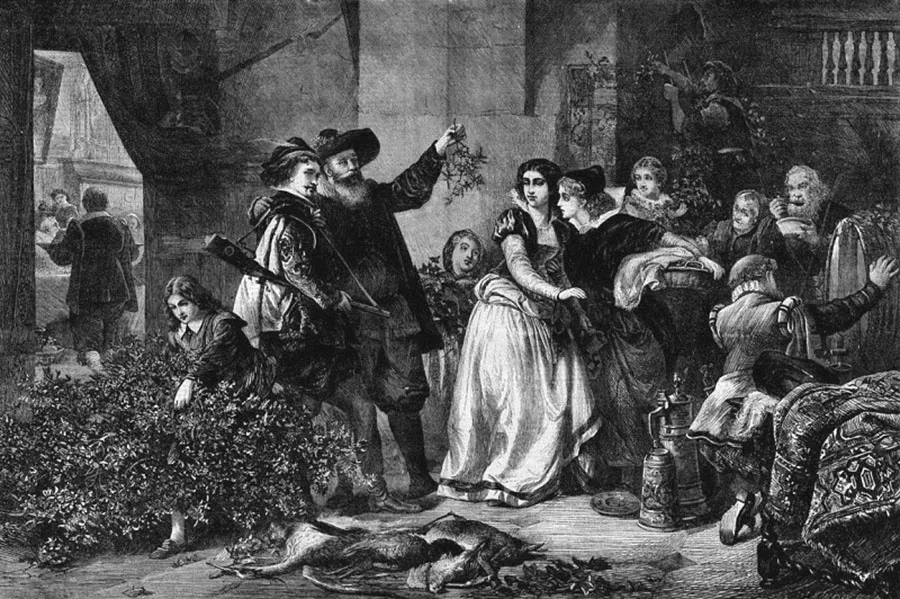
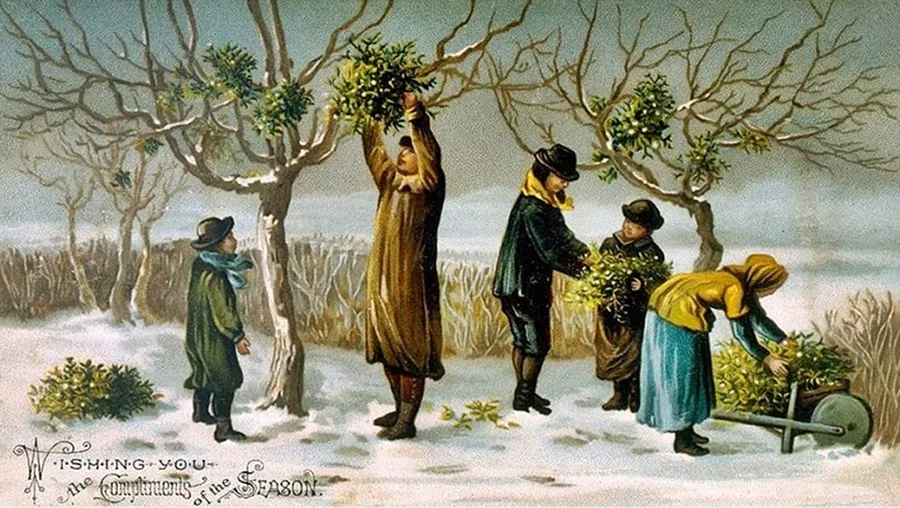
At the beginning of the 20th century mistletoe set the fashion in European postcards. Christmas cards featuring mistletoe and holly were very popular in England. In Germany the craze for Christmas cards depicting mistletoe peaked roughly between 1900 and 1914 and lasted for several years. They were printed in thousands of variations and in a range of reproductions in Germany, Austria and Switzerland. Mistletoe often appeared on the covers of leading illustrated magazines. Every winter the press carried a wealth of fascinating stories about this magical plant.
The mistletoe motif was used to decorate all kinds of stationery that could be given as Christmas presents: boxes large and small for odds and ends, envelopes, writing paper, covers of pocket calendars, notepads, notebooks and so on.
Other industries kept pace with the fashion too. Mistletoe was embroidered on tablecloths, napkins, fans, silk handbags, scarves and handkerchiefs. The jewellery trade also paid tribute to the pearly berry. Brooches of precious metals, bracelets, clasps, pins, combs, hair slides and necklaces of gold, silver and other metals, set with natural or artificial pearls in the form of mistletoe berries, were in great demand. The fashion extended to cigarette cases, clocks and watches, tableware, vases, beer mugs and household ornaments. One could even buy silver matchboxes engraved with mistletoe.
Want to Get Married? Stand Under the Mistletoe
On Christmas Eve, homes in Europe were traditionally decorated with mistletoe combined with conifer branches and red-berried holly (holly is said to embody the masculine principle, and mistletoe the feminine). Wreaths were hung on doors, and arrangements with candles were made to decorate tables. Bunches of mistletoe were suspended from the ceilings of rooms. According to ancient belief, mistletoe protects the house, the household and the livestock from lightning, fire, sickness, evil spirits and other unclean forces, and brings the family happiness and prosperity.
A favourite Christmas custom was kissing a girl standing under the mistletoe. The kiss was supposed to bring the couple happiness and guarantee a long life together. But even people who met under a sprig of mistletoe by chance were “obliged” to kiss. One theory holds that the custom reached Britain and other countries from Scandinavia. According to another, the tradition is an echo of the ancient Roman Saturnalia at the winter solstice, when it was permitted to kiss even complete strangers.
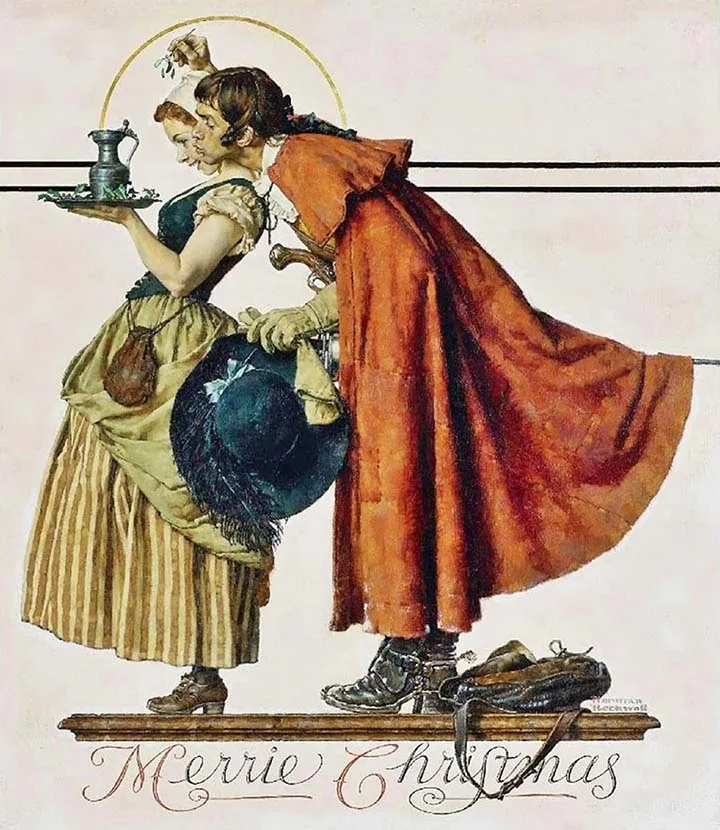
If a woman refused such chance kisses, she had no hope of marrying in the coming year.
The green branches with white berries were so popular that at Christmas they could be seen in shop windows between pigs’ heads, among stationery, next to gingerbread and pastries… Everything that could be decorated was decorated.
Mistletoe in Art
It is hardly surprising that mistletoe features in the work of many artists – for example, in the painting “Hanging the Mistletoe” by the English Pre-Raphaelite Dante Gabriel Rossetti, created in 1860. Christmas sprigs can be seen in paintings by John Millar Watt (John Millar Watt, “Day before Christmas”), Walter Dendy Sadler (Walter Dendy Sadler, “Christmas Carols”), Edward Frederick Brewtnall (Edward Frederick Brewtnall, “For Snow Comes Thick At Christmas Tide”), Francis Davis Millet (Francis Davis Millet, “Between two Fires”), Samuel Edmund Waller (Samuel Edmund Waller, “A Christmas Romance”), Frederick Dielman (Frederick Dielman “Under the Mistletoe”), Herbert Paus (Herbert Paus, “The Conspirators”), Alphonse Mucha (Alfons Maria Mucha, “Mistletoe. Portrait of Mme”), Norman Rockwell (Norman Percevel Rockwell, “Under the Mistletoe”), Robert Alexander Hillingford (Robert Alexander Hillingford, “Mistletoe Christmas Berries”), Walter Crane (Walter Crane, “Christmas Day, design for a Christmas card”), Edward Charles Barnes (Edward Charles Barnes, “The Seller Mistletoe”) and Émile Vernon (Emile Vernon, “Season's Greetings”).
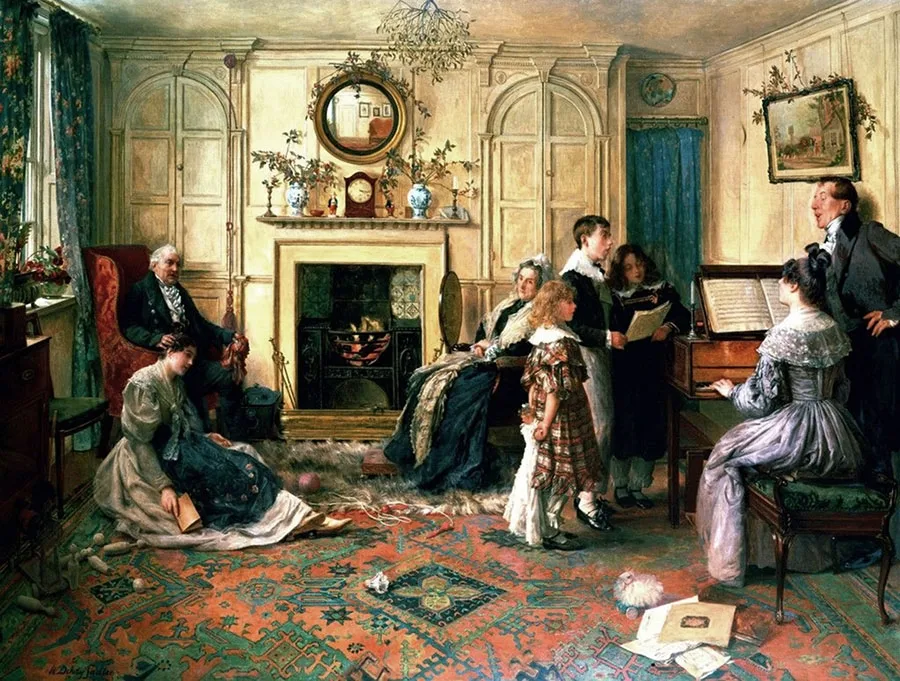 “Christmas Carols”, Walter Dendy Sadler, c. 1890.
Mistletoe also inspired writers and poets to take up the pen. It appears in Adam Mickiewicz’s poem “Konrad Wallenrod”. In Shakespeare’s earliest and bloodiest play, “The Most Lamentable Roman Tragedy of Titus Andronicus”, mistletoe is described as a baleful parasite with the stifling smell of the swamp.
In his "Savonarola", the Austrian poet Nikolaus Lenau sets the plant against the true Christian faith because the pagan Celts revered it. In Vincenzo Bellini's famous opera "Norma", the druids perform their mysterious rites on a moonlit night in the forest, beneath a sacred oak whose branches bear the equally sacred and magical mistletoe. Hardly a Christmas song goes without a mention of it. One example is "The Christmas Song", beautifully performed by Nat King Cole, which features in Wong Kar-wai's film "2046". In 2001, Barbra Streisand recorded "It Must Have Been the Mistletoe".
The magical and healing power of mistletoe
Since ancient times, mistletoe has attracted close attention among a great many peoples. In northern Switzerland, people believed mistletoe cured all childhood illnesses and waited for the sun to enter the constellation of Sagittarius. The plant was shot down from the oak with an arrow about one, three or four days before the new moon and caught with the left hand (according to Pliny's writings, magical plants are usually plucked precisely with the left hand!). In Sweden, Midsummer Day was considered the time for gathering it. Houses were decorated with mistletoe on the outside as a sign that a traveller would find shelter there. If enemies happened to meet beneath a tree bearing mistletoe, they were obliged to lay down their arms and not take them up again that day. According to Germanic beliefs, the plant drove away nightmares and the ghosts that sat on the chests of sleepers at night.
Mistletoe was regarded not only as a remedy against all kinds of witchcraft but also as a cure-all for many diseases. Doctor Carrichter, who lived in the 16th century and was blamed for the death of Holy Roman Emperor Ferdinand I (1564) through improper treatment, prescribed him a balm made to his own "recipe": 4 ounces of pure liquid dog fat, 8 ounces of bear fat and 12 ounces of capon were to be mixed with three crushed sprigs of young mistletoe taken from a hazel. The same Carrichter recommended that in cases of impotence caused by witchcraft, the genitals be rubbed with an ointment made from oak mistletoe. Ancient healers prepared decoctions from it for jaundice, diseases of the spleen, tuberculosis and epilepsy.
Modern medicine, however, does not reject the plant's healing properties either. Thanks to the active biochemical substances contained in its green parts, it has anti-inflammatory, diuretic, astringent, sedative, laxative and anthelmintic properties.
Mistletoe is rich in saponins, alkaloids, organic acids, histamines, vitamins and minerals. The saponins and alkaloids are what make mistletoe poisonous. It has been observed that the composition of the biologically active substances in the plant depends largely on the species of tree on which it has been growing as a parasite.
Are mistletoe berries poisonous?
In 1895, the naturalist Andreas Schimper wrote in his botany textbook: "Mistletoe berries have frequently caused poisoning in children," which was confirmed by Hans Wossidlo, a well-known German physician of the time, in his 1904 "Guide to Botany", where he called the plant poisonous. Professor Albert Wigand, author of a textbook on pharmacognosy, believed mistletoe berries to be narcotically poisonous. This sparked heated debate: what about the thrushes and waxwings that feed on them?! Suggestions then emerged that the seeds, coated in a mucilaginous layer, pass through a bird's gut too quickly to release their toxins.
A case of poisoning was described by the Irish physician Emily Dixon in the British Medical Journal in 1882. Doctor Friedrich Kanngiesser tested the effect of mistletoe berries experimentally on his own body. He wrote about his observation in a collection on Prussian botany in 1912: «According to Dixon, a little boy, presumably after tasting mistletoe berries, behaved as if drunk. He had hallucinations and lost consciousness. Cyanosis, dilated pupils, laboured breathing and a slowed pulse were also observed.
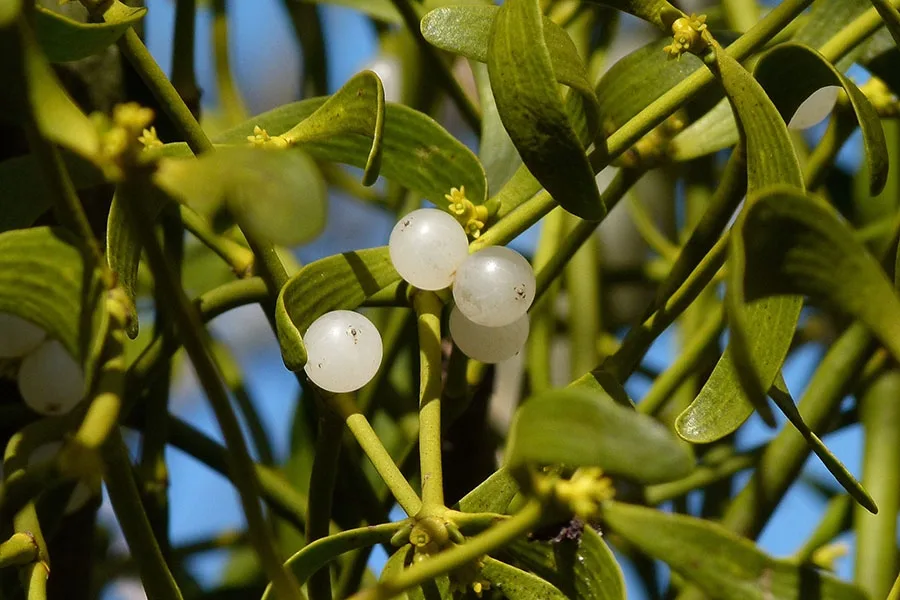
My own observations: I chewed and swallowed 25 mistletoe berries from an apple tree. The rather firm, sticky berries with their seeds taste bland and grassy, and are very unpleasant because of their gluey consistency. They are hard to swallow and leave white threads in the mouth.
There were no signs of poisoning. On this basis, Dixon's claim that the child was poisoned specifically by mistletoe berries is highly questionable. Had they really been poisonous, people in England, where the cult of this plant is most developed, would hardly decorate cakes with its berries. I therefore believe that Dixon's case had a different aetiology. Perhaps the children had eaten other berries that are easily confused with mistletoe, such as those of Loranthus.»
Nevertheless, modern medicine has recognised the berry in its pure form as poisonous. Preparations containing it should be taken only as prescribed by a doctor.
Bibliography
- Karl von Tubeuf, Gustav Neckel. Monographie der Mistel
Translated from Russian with the help of AI (Claude, Anthropic), October 2026.