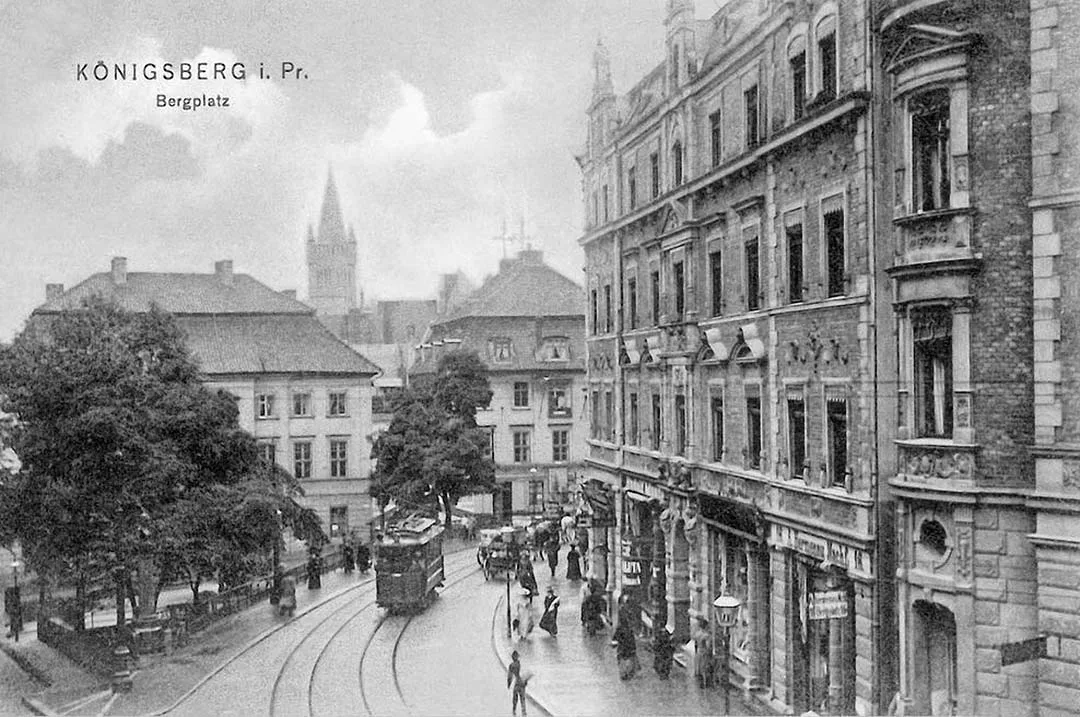
Walking along Bergplatz, or the Crooked Hill (Schiefer Berg) as it had been called1 since time immemorial, past the Burow column towards Tuchmacherstraße, one could come to the house at Bergplatz 10. This was the Tettau Court (Tettauscher Hof), one of the oldest aristocratic town residences, which would keep its stucco ceiling and Baroque fireplace to the very end. In its stable one could find the last surviving fragments of the Löbenicht town wall. Next to it stood the low Fools' Gate (Narrentor), covered only by a gable roof, which probably got its unusual name from something once painted on it. The Tettau Court was demolished in 1735.
In front of it, on the right, still quite new, rose the stately Baroque palace of Count Dohna-Schlodien, with the expressive silhouette of its Baroque half-hipped roof, a fine work by the chief director of building of Königsberg, Joachim Ludwig Schultheiss von Unfriedt (1678–1753 ). Later it passed into the hands of the Counts Dönhoff and Kalckreuth (Dönhoff und Kalckreuth), and then returned to the ownership of the Dohna family.
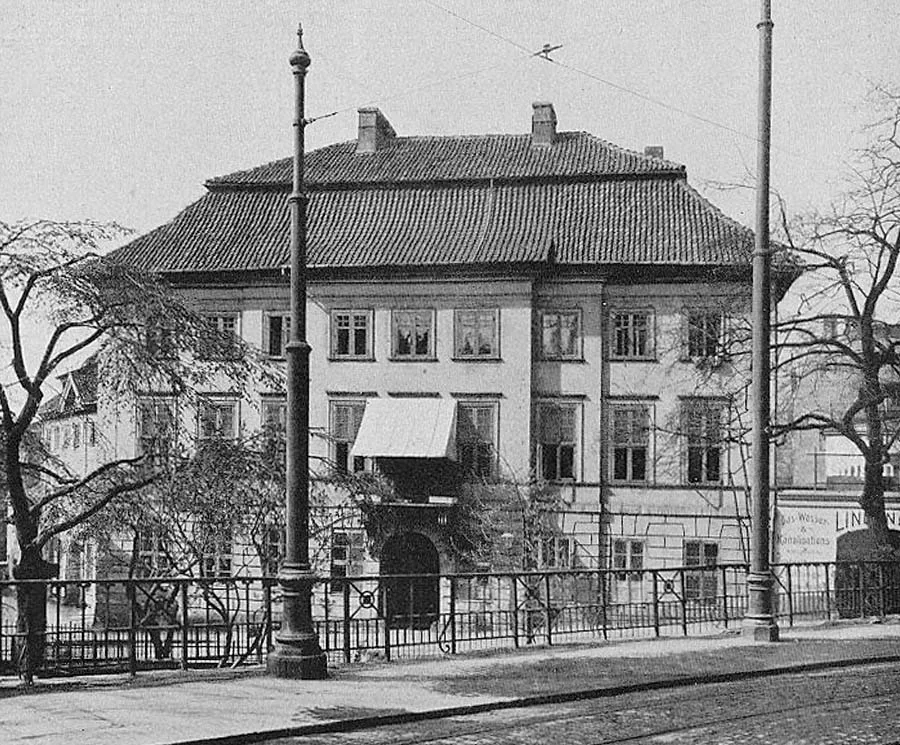 The palace of Count Dohna-Schlodien on Bergplatz.
A true representative of the Baroque, the palace in its day welcomed guests with a wide gateway crowned by a balcony. The gateway opened onto the garden, forming a spacious rotunda with niches for sculptures.
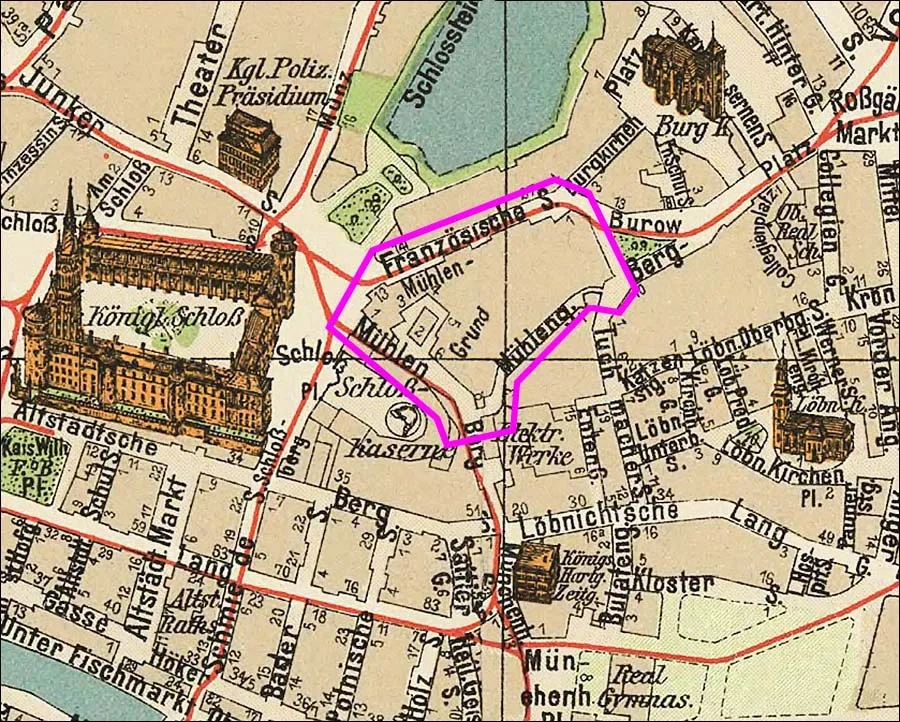 The Mill Quarter lay between the castle to the west and St Barbara's to the east. Map of 1901.
From here a wide, beautiful carved staircase led to the upper floor. The carving depicted a boar and weapons, the arms of the Dohna family2, and was painted in ochre, brick red and light green. I remember them as even more beautiful, in their original deep brown. But even now one can fully appreciate this jewel of the town.
Just past the Fools' Gate, from Tuchmacherstraße, which in the Middle Ages was called Webergasse, the Mill Passage (Mühlengang) turned off to the right. It was reached through a gateway in a decrepit Baroque house. After this house was demolished at the beginning of the 20th century, two other old houses remained on either side. One, half-timbered with two overhanging storeys3, was the only one of its kind in Königsberg; the other had a hipped roof.
They seem to guard the entrance to the Mill Passage to this day.
The Mill Ditch (Mühlengraben) appears neither on Bering's map (1613) nor on the later map of 1720: at that time there were gardens there.
From this corner a poetic, winding path, which one could walk only in the evening by moonlight, with a thrilling, eerie feeling, led to the Mill Hill (Mühlenberg), roughly to where the malt mill, or Lower Mill (Malz- oder Untermühle), once stood on the Cat Brook (Katzbach), which babbled openly down the slope.
A little further down, beyond the Lower Mill, towards the Krumme Grube, was the Lower Mill Gate (Unteres Mühlentor), where the town musician of Löbenicht lived.
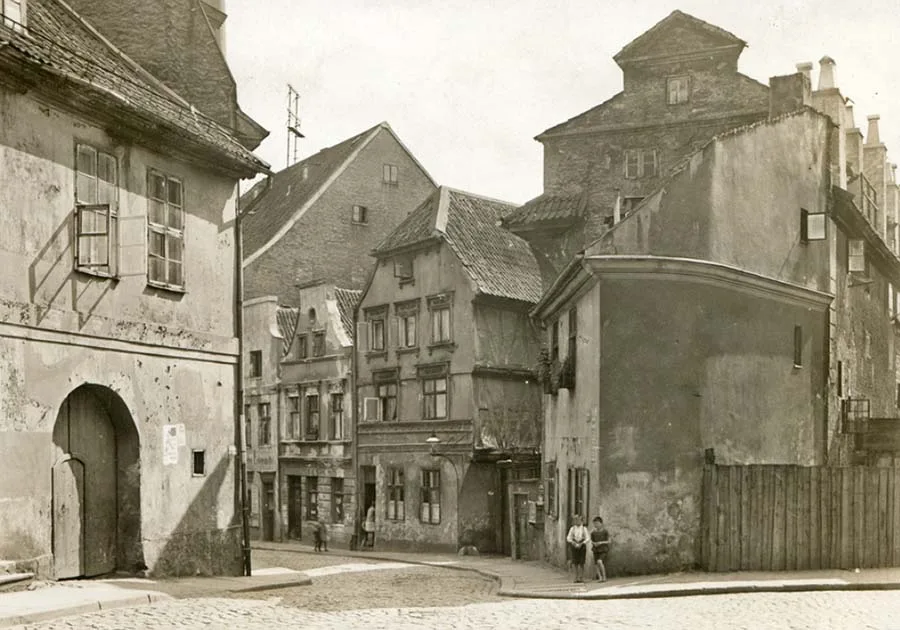 A view down Tuchmacherstraße and the entrance to the Mill Passage between the houses (centre).
On the bank of the Mill Canal stood house number 8, which had once been a smithy. Next to it was Aunt Fischer's tavern, the "Wolf's Glen" („Kabackche" der Tante Fischer, die „Wolfsschlucht"), a local pub with its regulars and celebrities.
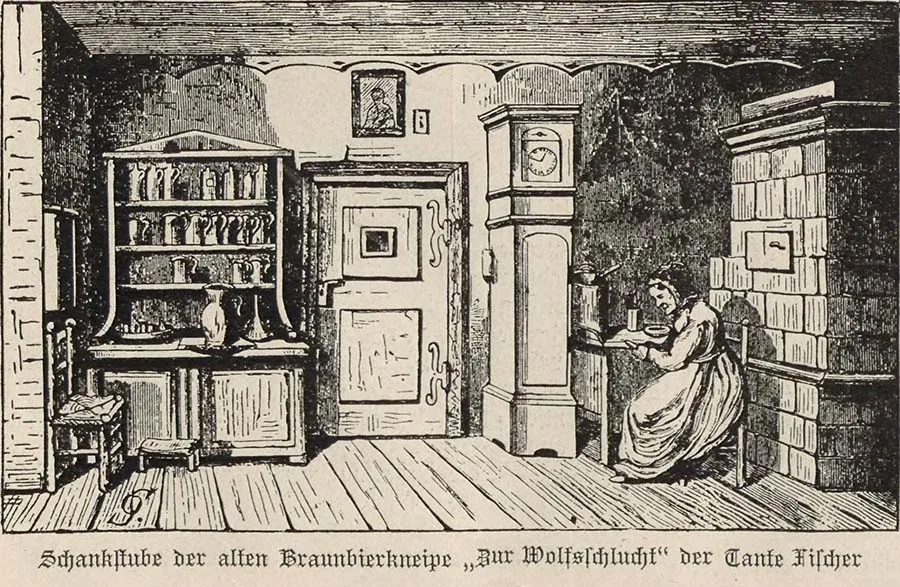 The interior of Aunt Fischer's "Wolf's Glen" and its landlady.
Aunt Fischer usually treated the customers of her establishment, many of whom were students, for very little money to pork knuckle and two kinds of cheese: "Seehundche" (curd cheese) and "Moorhundche" („Seehundche" und „Moorhundche") — and all of it spotlessly clean. She never served Fleck, however, a very characteristic local speciality; she had a strong aversion to it. And she knew how to entertain her guests splendidly, talking to them in the East Prussian dialect, which she had mastered to perfection.
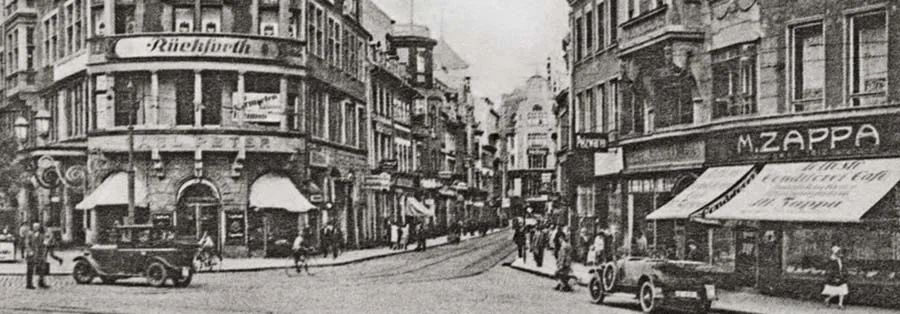
Going up the Mill Hill, one could see on the right, next to the Zappa confectionery (Konditorei Zappa), the Middle Mill (Mittelmühle), a thick-walled building with a gable roof, blackened with age. It stood opposite the Albrecht Gate (Albrechtstor) in the eastern wing of the castle and crowned the steep Mill Hill.
The Lower Mill Gate long ago fell victim to the pickaxe; next the Cat Brook was hidden underground, then the Lower Mill was demolished, and finally the remains of the angular Mill Quarter, together with Aunt Fischer's tavern, shared their sad fate. The last to sink into oblivion, at the beginning of the 20th century, was the Middle Mill. The construction of the New Power Station (Neue Elektrizitätswerke) in the early 1920s dealt the final blow to the picturesque townscape of this area. Only the name of the street now recalled the milling past here. Only the palace of the Dohna family and two houses next to it survived until the night of horror in August 1944.
Translator's notes:
1. Bergplatz had two popular names. Besides the Crooked Hill (Schiefer Berg), it was also called the Jingling Hill (Klimperberg). Perhaps because there were as many as five churches nearby? True, two of them, the Reformed ones, had no bell towers...
2. Here neither the author nor his editor checked: the arms of the Dohna family show two silver stag antlers crossed diagonally on a blue field. The brown boar is the symbol of the Dönhoff family. Evidently the residence was decorated in this way during the period when it belonged to the Dönhoffs.
3. Overhanging storeys were built to increase the usable living space of the upper floors and also to protect the foundations from running rainwater.
Translated from Russian with the help of AI (Claude, Anthropic), October 2026.