What we know of "whence the Russian land began" comes mainly from the words of the chronicler Nestor. It was he who, whiling away the long medieval evenings, wrote the story of how the elders of Novgorod came to the Varangian prince Rurik and said: "Our land is great and rich, but there is no order in it. Come and rule over us." Rurik did not need to be asked twice. He at once gathered his modest belongings and, together with his brothers Sineus and Truvor, hurried off to Rus to bring order.
On the whole Nestor set out the course of events correctly. The only thing the old man got wrong was Rurik's nationality. Ten years ago members of the Kaliningrad club "Münchhausen's Grandchildren" proved convincingly that he was no Varangian at all but a thoroughbred Old Prussian.
It is amazing that academic scholars never thought of this before! After all, it is perfectly obvious that the elders of Novgorod could never have gone to the Vikings for order, since the Vikings themselves had no order whatsoever in those distant times. Whereas Prussia did have order. There was more order there than you could shake a stick at. Wherever you looked, there was order. No wonder the Prussians exported it very actively, just as the Rus exported honey, hemp or, say, tar.
The question naturally arises: where exactly did the Prussians get so much order? It turns out that in ancient times Prussia possessed the Sceptre of Order – a source of discipline, law-abidingness and all sorts of other tolerance. When leaving for Rus, Rurik wanted to take it with him, but during the unofficial part of the farewell ceremony, which was accompanied by noisy popular festivities, he lost this priceless object somewhere around the Königsberg hill. This explains why order never took root in Rus.
They say Peter I knew that the Sceptre of Order was somewhere in Königsberg. He even came here to find it.
Practically every German he met told him "Ordnung muss sein" – meaning "there must be order". Once Peter lost his temper and even shouted at some burgher: "So where is it, this order, damn and blast it!" But the man did not answer, because he did not know where it was himself.
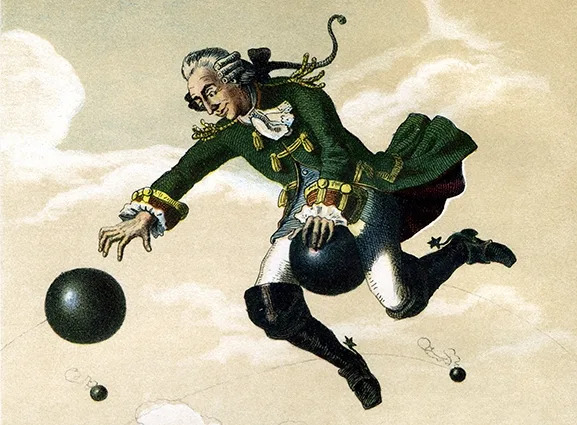
But what Peter I failed to do, Baron Münchhausen succeeded in doing: during one of his visits to Königsberg he did find the Sceptre of Order and hid it securely, which he wrote about rather confusedly in his diary. In fact, it was painstaking study of the baron's papers that helped find this rather elegant object, made by an unknown Old Prussian craftsman at the end of the ninth century AD.
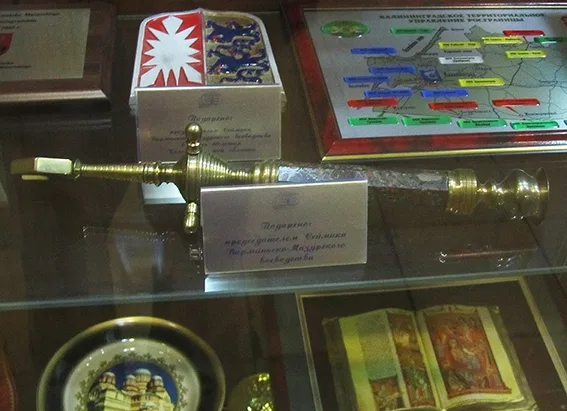 A copy of the Sceptre, kept in the lobby of the Duma.
In appearance it resembles a gilded 22 mm spanner, so it can be used to tighten ordinary nuts. However, it is intended for tightening (and, of course, loosening) extraordinary nuts – namely, the ones that hold together freedom (including freedom of speech), justice and order.
The importance of this find can hardly be overestimated. In essence it is an epoch-making event that completely overturns our understanding of the place of Kaliningrad-Königsberg in the history of the country.
It turns out that this is precisely the place from which our land actually began. And if Kiev is the mother of Russian cities, then our city may well be called their father.
In the autumn of 2006 the chairman of the "Münchhausen's Grandchildren" club, Aleksandr Zakharov, ceremonially (the event took place in the King's Gate) presented this Sceptre to the then chairman of the Regional Duma, Sergey Bulychev, so that he could pass it on "up the vertical of power". Bulychev promised to fulfil the request, warning, however, that he would order a copy of the instrument for himself and his fellow deputies.
Apparently that is just what was done. A copy of the Sceptre can now be seen in the lobby of the Duma, to the right of the entrance, on a shelf with gifts from various official delegations. True, the plaque for some reason says that the Sceptre was presented to the local deputies by the chairman of the Sejmik of the Warmian-Masurian Voivodeship. Perhaps this is some cunning move made for the sake of secrecy, or perhaps simply a mistake.
As for the original Sceptre, it must long since be in the Kremlin. And judging by the changes in the country over recent years, the Sceptre is being actively used there. But apparently not quite correctly. Or rather – not correctly at all.
There is practically no freedom of speech left, but there is no more order for it. Some nuts are tightened all the way, others have long since had their threads stripped, still others have come as loose as they possibly can. Any moment now they will slip off their bolts and roll away who knows where…
The problem is that the Sceptre should have come with instructions, but these have not yet been found. And without them, using the Sceptre is a rather risky business. That is exactly why Münchhausen, having found the Sceptre of Order in Königsberg, did not hand it over to any of the mighty of this world (and he was, as is well known, on friendly terms with almost all the prominent monarchs of the day) but simply hid it. A wise man, what more can one say…
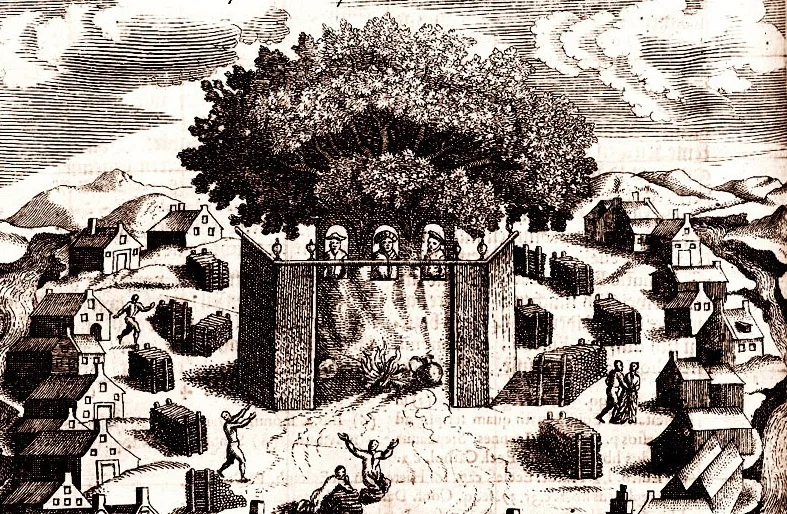
Illustrations: fragment of a drawing by August von Wille, 1872. Photo by the author
Translated from Russian with the help of AI (Claude, Anthropic), October 2026.