
East Prussia first became part of Russia as early as 1758, during the Seven Years' War. The entire population of the province, including the great philosopher Immanuel Kant, was sworn in to the Russian Empress Elizabeth Petrovna. Had the province remained part of Russia, the whole history not only of Russia and Germany but of Europe and the world would have taken a different course (and for us a much better one than what actually happened). Alas, in 1762 Peter III committed an outright act of national betrayal, returning all the Russian conquests to Frederick and, in effect, handing him victory in the Seven Years' War.
Less than half a century later the Russians were back in East Prussia, but under completely different geopolitical circumstances. Prussia was now our ally – though in effect a former one. In 1805 Napoleon routed the Russian and Austrian forces at Austerlitz, and in the campaign of autumn 1806 he inflicted a crushing defeat on Prussia, destroying its army and occupying almost the entire territory of the country in just three weeks. Only East Prussia remained unoccupied. It was there that Napoleon advanced – and there he met the Russian army, which had recovered from its defeat of the year before.
At that time it was not customary to wage war in winter, but the East Prussian campaign of 1806–1807 was an exception.
Neither side saw any need to withdraw into winter quarters. In December 1806 the first, still limited, engagements took place between individual corps and divisions of the two great armies, and these battles invariably ended in a draw. Napoleon had hoped to encircle and destroy the Russian army at a stroke, but nothing came of it. What is more, the Russians managed to capture Napoleon's order containing his plan of campaign, though they were unable to make serious use of it. After a series of complicated manoeuvres in very harsh weather (now severe frost, now thaw and impassable mud) and a series of "drawn" battles, at the beginning of February the armies met near the small town of Preußisch Eylau (now Bagrationovsk in the Kaliningrad Region). The forces of the two sides were roughly equal. True, the generalship of General Bennigsen, who commanded the Russian troops, was clearly no match for Napoleon's genius. But in all other fighting qualities the opponents were quite evenly matched. The balance might have become complete had the Cossacks captured Napoleon and his headquarters (which very nearly happened on the evening of 7 February 1807), but the French guardsmen managed to rescue their emperor.
The general battle, at the start of which each side had 75,000 men and 450 guns, began on the morning of 8 February in a raging blizzard that drastically reduced visibility and mobility on both sides. Early in the battle Marshal Augereau's corps, having lost its way in the snowstorm, ran into a 70-gun Russian battery and was almost completely wiped out by its fire. The Russian infantry began to "push through" the centre of the French position and almost reached Napoleon's headquarters. For the second time in a single day the emperor was in danger of being taken prisoner by the Russians, but once again the guardsmen rescued him. In response, Napoleon struck with all his cavalry (more than 12,000 horsemen) under the command of Murat. No army in the world could have withstood such an attack. At first the Russian centre, too, was crushed.
Nevertheless, the French attack faltered when it ran onto Russian bayonets. More than 1,500 French cavalrymen were killed; the rest turned back.
In the middle of the day the strongest reinforcement arrived for the French – the corps of Marshal Davout. It crushed the left flank of the Russian army, threatening it with encirclement. The situation was saved by the artillery under General Yermolov (the future conqueror of the Caucasus), which halted Davout's corps. Then the corps of the Prussian general L'Estocq came to the aid of the Russians (it was all that was left of the Prussian army by that time) and helped to restore the position. After that the battle was reduced to an artillery cannonade, which ceased only late at night, when the two sides could no longer see each other.
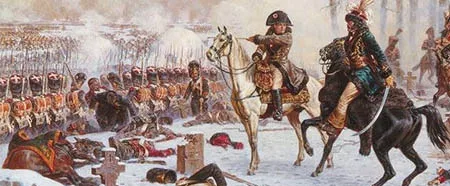
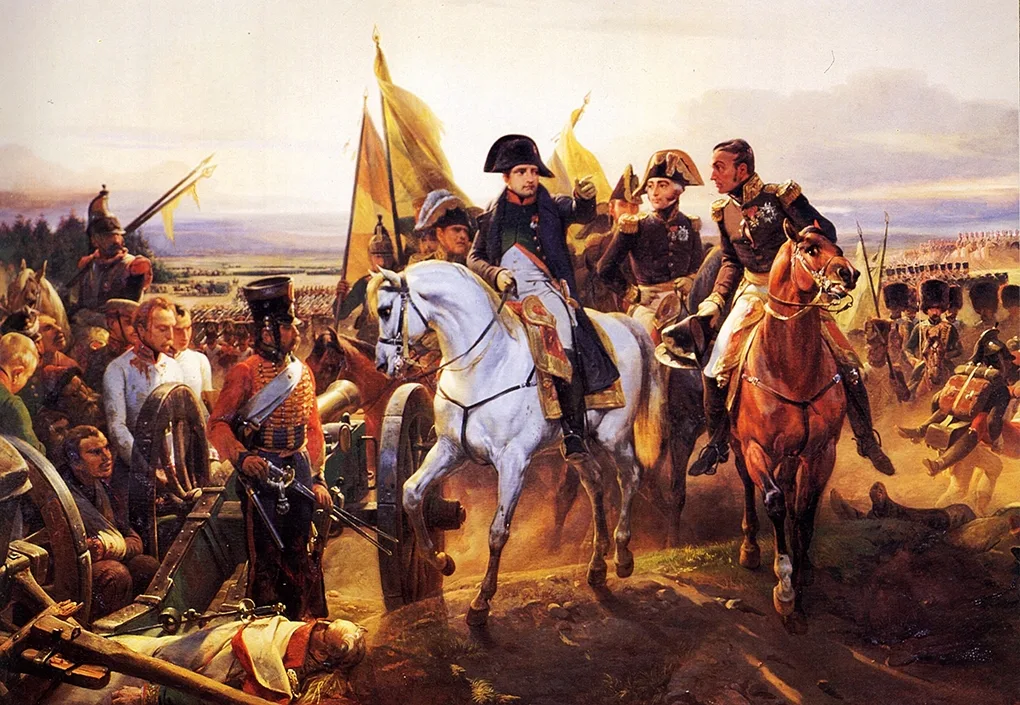
During the night Bennigsen ordered the Russian army to withdraw from the battlefield, which allowed Napoleon to proclaim victory. Yet the French emperor understood perfectly well that he had won no victory at all. The battle, like the previous engagements of this campaign, ended in a draw, with roughly equal losses (20,000–25,000 killed and wounded on each side). When Napoleon rode along his troops after the battle, for the first time in his career he heard not "Long live the Emperor!" but "Long live peace!"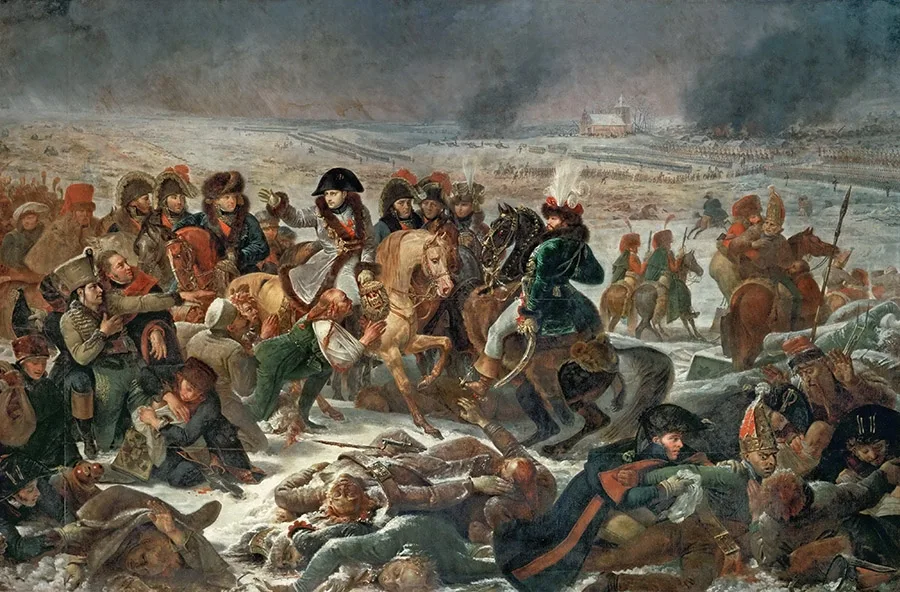 Napoleon on the battlefield of Preußisch Eylau.
For the first time, the general battle that Napoleon had so desired brought him nothing but enormous losses.
What is more, after Preußisch Eylau problems with recruitment in France began for the first time: ever younger soldiers had to be called up, and draft evasion became widespread. Foreigners (Germans, Italians, Poles) had to be enlisted, and as a rule they were fit only for service in the rear.
Nevertheless, by the end of spring 1807 Napoleon had achieved a twofold numerical superiority over the Russians – about 230,000 against 115,000. In early June two more "drawn" battles took place, at Guttstadt and Heilsberg. Perhaps no campaign in military history has seen as many "draws" as the East Prussian campaign of 1806–1807. It truly brought together the two best armies in the world, and so Napoleon's personal superiority over Bennigsen in particular could not by itself secure victory for the French. All the same, the campaign did end in their favour thanks to the second general battle – at Friedland (now Pravdinsk, likewise in the Kaliningrad Region) on 14 June 1807.
In this battle the French had numerical superiority, though not a decisive one – 80,000 against 60,000. Much worse was the fact that the Russians, by the will of their undistinguished commander, had taken up an extremely unfavourable position, cut in two by a deep ravine, with the even deeper river Alle behind them. Moreover, the entire Russian position was clearly visible to Napoleon, while the Russians could not see the French dispositions at all.
At the beginning of the battle the Russians tried to attack, but without success. Just before sunset the French launched a counterattack that ended in complete triumph. The Russian troops were driven into the Alle, and only their extraordinary tenacity saved the army from total destruction. Nevertheless, the battle of Friedland became the heaviest defeat the Russians suffered at Napoleon's hands in the whole history of the wars against him (formally Austerlitz was bigger, but there we shared the defeat with the Austrians, whereas here we lost alone). Russian losses amounted to at least 20,000 killed and wounded, French losses to about 8,000. Yet there were practically no prisoners (by comparison, in 1806 the French had taken more than 100,000 prisoners in Prussia, and another 50,000 or so Prussians had deserted). 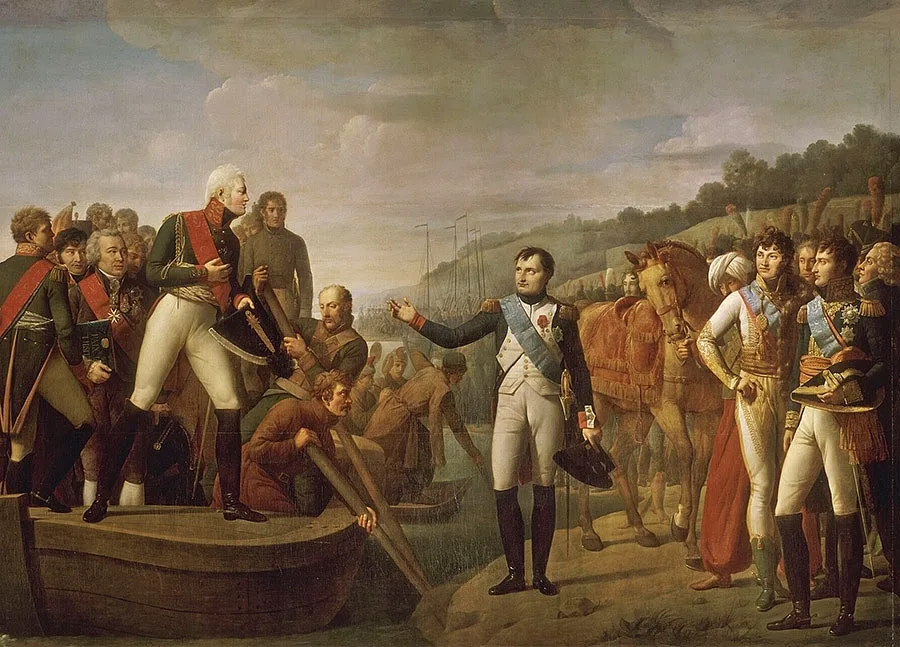 Napoleon receives Alexander I at Tilsit.
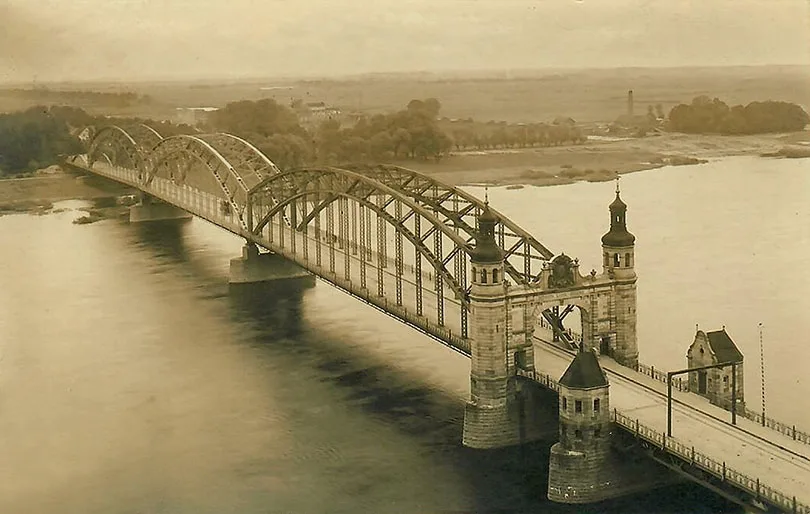
The Russian troops withdrew to their own territory, after which, at the beginning of July, the Peace of Tilsit was signed on French terms – which, however, were not too burdensome (today Tilsit is called Sovetsk, so the treaty might now be called the "Soviet" peace).
France annexed almost half of Prussia, and Russia became, as it were, France's ally in the war against England, although this alliance had no practical consequences (unless one counts Russia's victory over Sweden in the war of 1808–1809, but that is a very indirect consequence). Except that five years later the war came to our own land. However, no one had ever doubted that it would.
The East Prussian campaign of 1806–1807 is, of course, firmly forgotten in Russia today. Yet it was of enormous military significance. Although Russia lost it, it showed that Russia alone was capable of fighting Napoleon on practically equal terms. In the process, however, the Russian army suffered very heavy losses: most of Suvorov's "miracle heroes" were killed. On the other hand, it was in this very campaign that the French army, too, lost its best soldiers, who had gone with Napoleon through all his earlier triumphs. The quality of both armies fell sharply, but they still remained the best in the world. And they were still good enough for the war of 1812. But after it, having suffered new huge losses and once again lost their best, both countries and their armies moved, at different speeds and along different paths, towards their decline. Austerlitz, Preußisch Eylau, Friedland, Smolensk, Borodino, Maloyaroslavets, Leipzig and Dresden cost them too dearly.
Translated from Russian with the help of AI (Claude, Anthropic), October 2026.