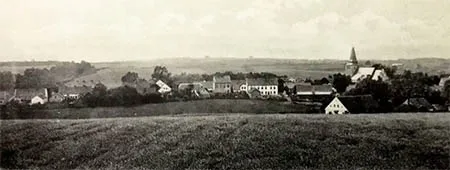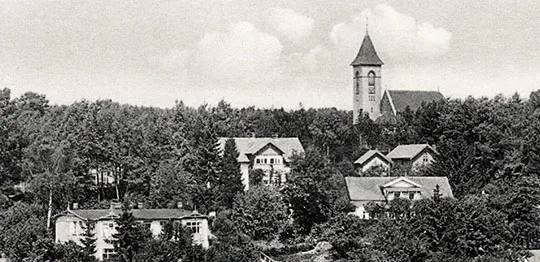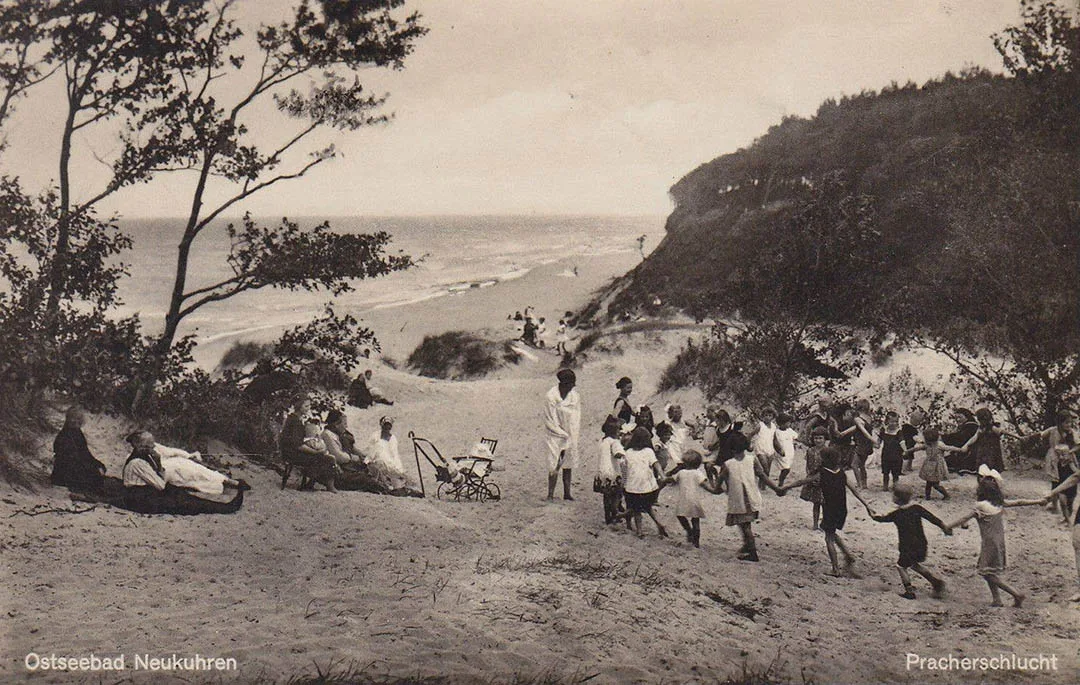
The fishing village of Neukuhren is first mentioned in documents of the Order in 1254. At the beginning of the 19th century it had 16 houses. For many centuries its chief asset was its sheltered bay, the only one between Pillau (Baltiysk) and Memel (Klaipėda)
In 1837 the entrepreneur Carl Douglas founded a resort complex in Neukuhren, after which Neukuhren was granted resort status. In 1849 the first hotel opened; its owner was Lieutenant Gebauer.
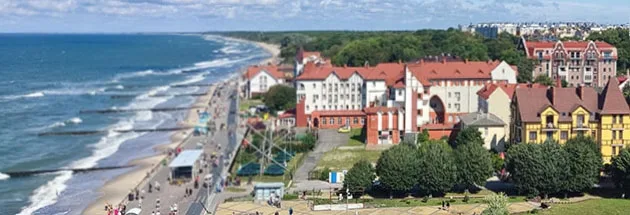
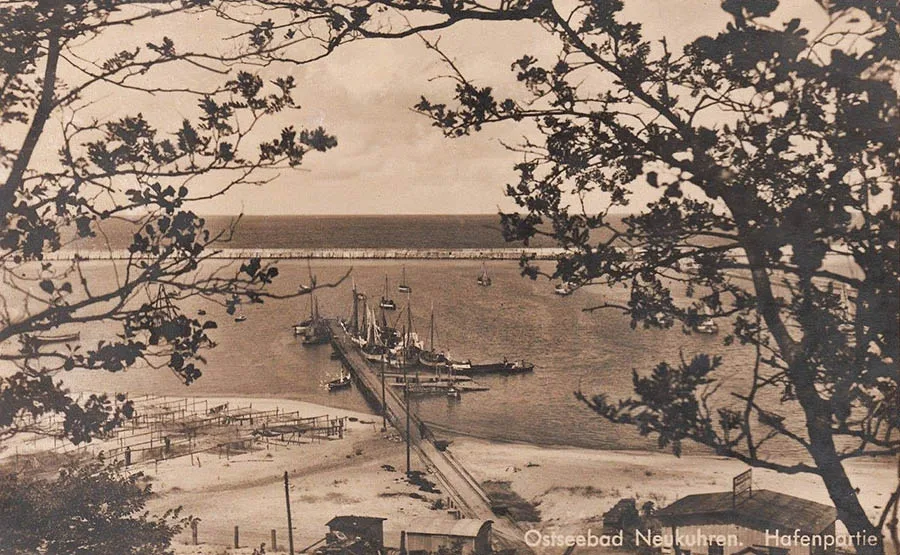 The bay of Neukuhren – the only one between Pillau (Baltiysk) and Memel (Klaipėda).
In 1900 a railway branch line was laid from Cranz / Cranz (Zelenogradsk) to Neukuhren and on to Rauschen / Rauschen (Svetlogorsk).
In 1910 the Empress Auguste Victoria Home was opened in Neukuhren. In 1921 the first courses for women teachers in East Prussia were established on its premises. By 1911 Neukuhren had become the finest resort complex on the Baltic coast of Prussia, with numerous hotels, a pier for yachts and boats, several dozen aquariums with marine fauna, restaurants, billiard rooms, medical facilities, pharmacies and a telegraph office.
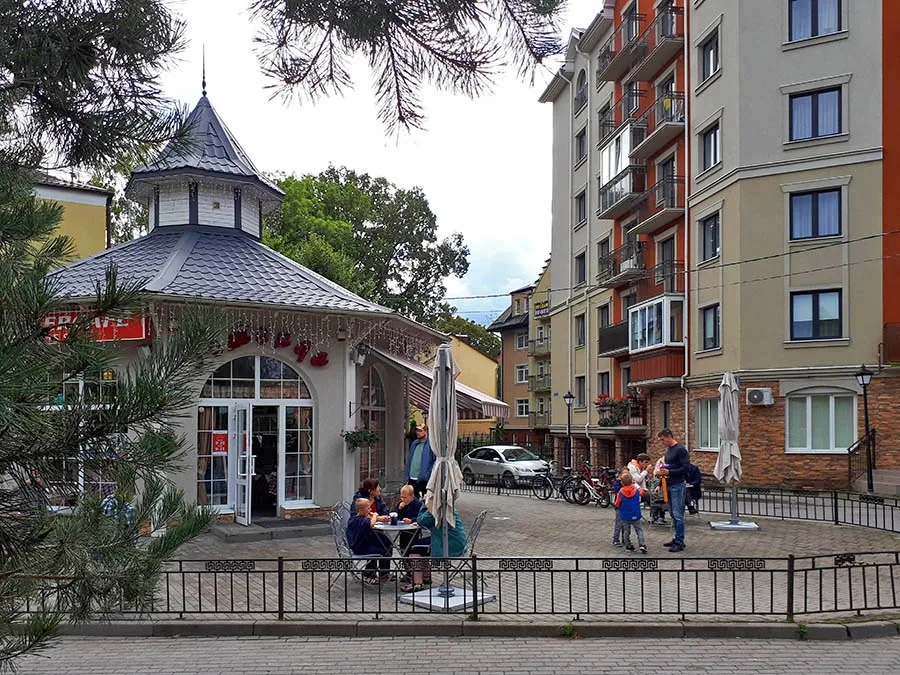 The local café “Rotonda” on Parkovaya Street is perhaps the best on the entire coast.
In 1913 Neukuhren received central water and gas supply, and a promenade was built along the shore to neighbouring Rauschen (Svetlogorsk). In 1919 a nature reserve was established in Neukuhren.
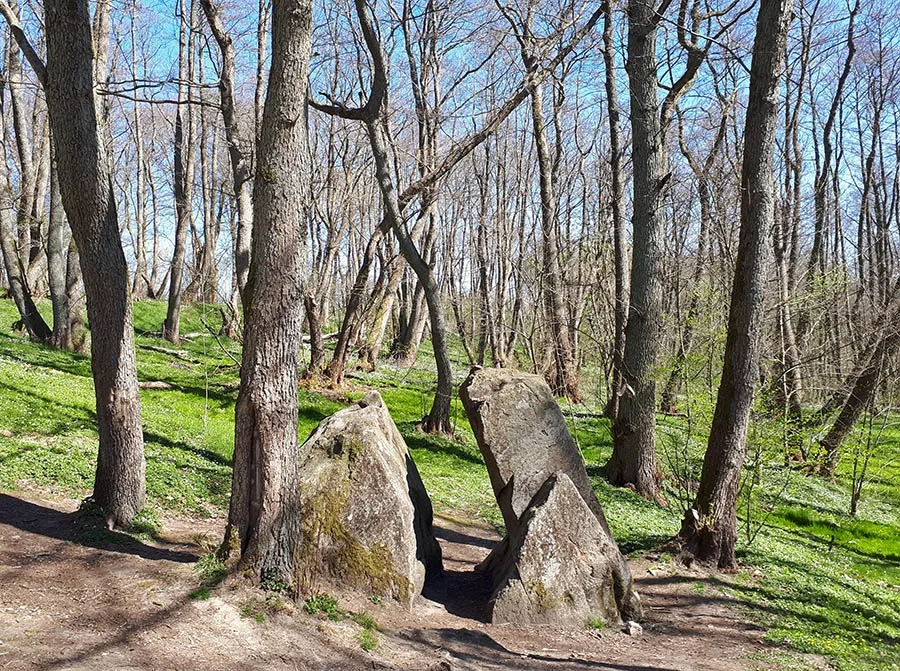 The famous Lie Stone in the valley of the Salmon Brook (the Chistaya River).
In 1935 a military airfield was opened in Neukuhren, and on 1.01.1936 a school for military pilots.
On 14.04.1945 Neukuhren was taken by soldiers of the 292nd and 576th Rifle Regiments of the 115th Kholm Red Banner Rifle Division of the 103rd Rifle Corps of the 2nd Guards Army. In the course of the fighting about 500 soldiers of the German 551st Infantry Division were taken prisoner.
In 1945–53 the 1st Guards Mine-Torpedo Aviation Regiment was stationed at the Neukuhren-Pionersky airfield. In February 1946 the Neukuhren fish processing plant was set up. In August 1946 a children's sanatorium was opened on the basis of the German “Kurhaus” complex. Also in 1946 a school was opened in Neukuhren.
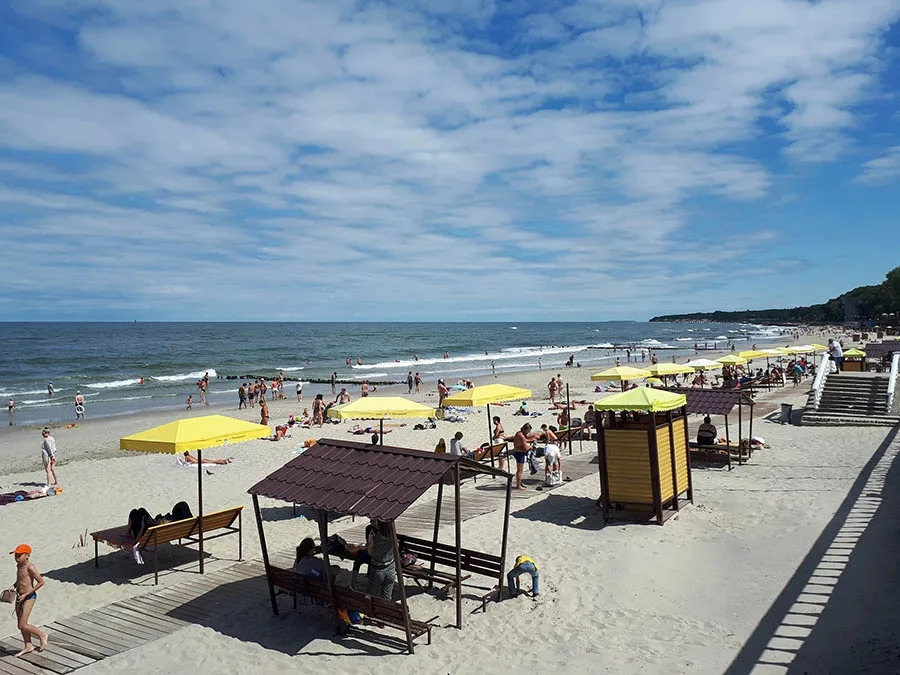 The beach in Pionersky is such that the locals are envied in Zelenogradsk and Svetlogorsk.
On 26.07.1947 Neukuhren was renamed the settlement of Pionersky and granted resort status.
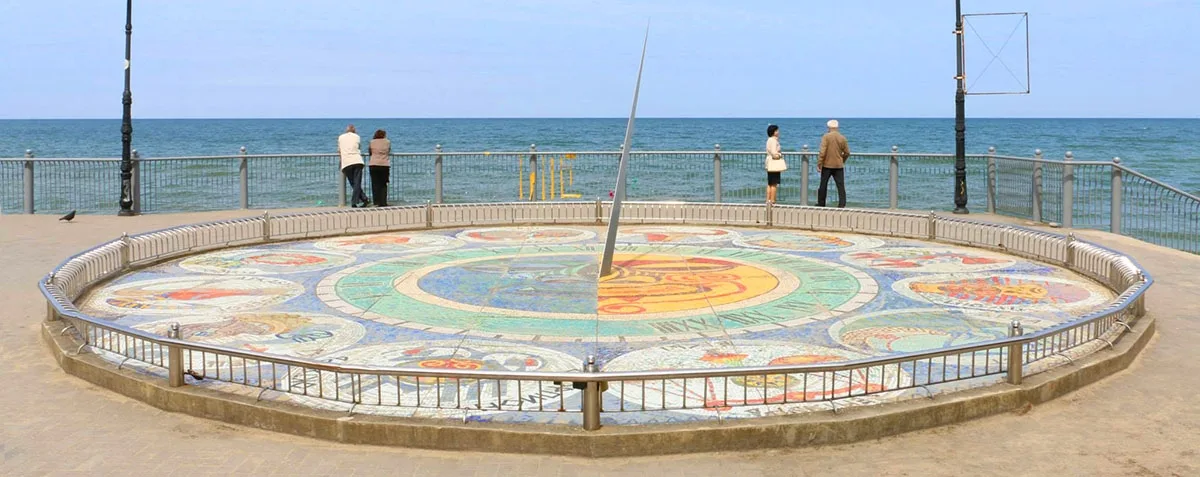
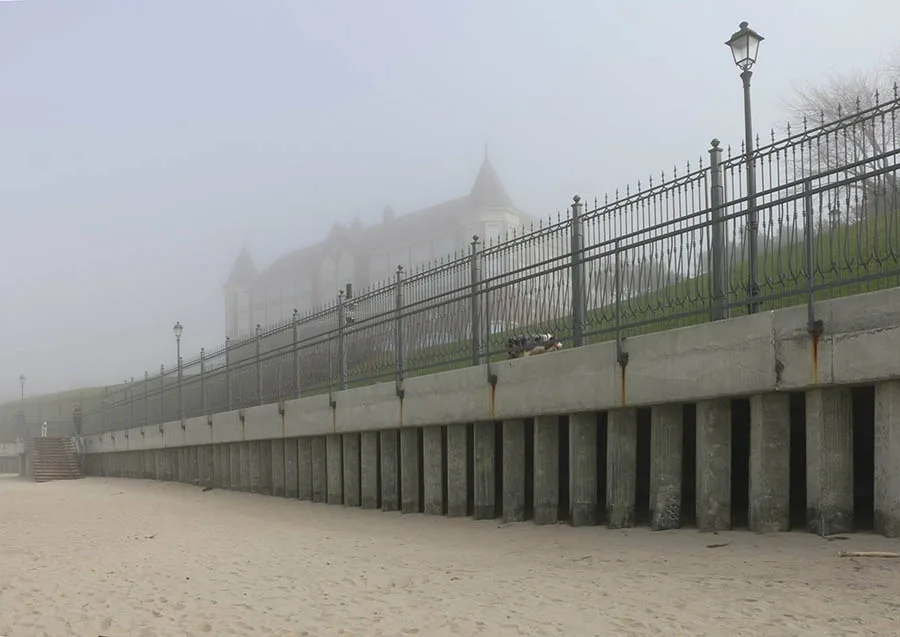 Residence of the President of the Russian Federation.
The settlement became part of Primorsk District (from 1963 Zelenogradsk District). On 26.12.1952 Pionersky was granted town status. In 1954 the Pionersky Trawler Fleet Administration was created on the basis of the trawler fleet administration, the fish processing plant and the seaport; in 1966 it became the Pionersky Ocean Fishing Fleet Base. In 1966 the town of Pionersky became part of the Svetlogorsk resort and industrial zone. On 22.03.1993 Pionersky became a town of regional subordination. On 31.03.2004 the town was granted the status of an urban okrug. In 2009 a residence of the President of the Russian Federation was opened in Pionersky.
Sights: about 10 pre-war villas have survived (mostly from the early 20th century), but all of them have been heavily rebuilt and have lost some of their architectural details; some administrative, residential and hotel buildings survive in the same condition; there is a quarter of officers' buildings and buildings for housing the personnel of the Neukuhren air base (1930s), the railway station building (1899), and a memorial on the mass grave of Soviet soldiers (1971, approx. 180 people).
Population dynamics: 1905 – 333, 1910 – 339, 1933 – 1,168, 1939 – 4,779, 1959 – 7,637, 1970 – 10,132, 1979 – 10,132, 1989 – 11,635, 2020 – 11,816, 2010 – 11,017 inhabitants.
For reference
In 1874 Amtsbezirk No. 37 Neukuhren was established in the Landkreis of Fischhausen, comprising 9 rural communities: Deutsch Battau / Deutsch Battau (from 1898 Battau / Battau, Bobrovka), Cobjeiten / Cobjeiten (Selsky), Klein Battau / Klein Battau (from 1910 Preußisch Battau / Preußisch Battau, Dobroye), Loppöhnen / Loppöhnen (Rybnoye), Neukuhren (Pionersky), Rauschen / Rauschen (Svetlogorsk), Sassau / Sassau (Zarechny), Schlakalken / Schlakalken (Yaroslavskoye) and Tenkieten / Tenkieten (Lyotnoye), as well as 4 Gutsbezirke: Herrenwalde / Herrenwalde (“Stepnoy” garden partnership, 54°56'28'' N, 20°12'57'' E), Kohnkenhof / Kohnkenhof (“Stepnoy” garden partnership, 54°56'27'' N, 20°13'12'' E), Schönwalde / Schönwalde (Svetlogorsk, Maysky settlement) and Wangenkrug / Wangenkrug (Pionersky, around Rabochaya Street, 54°57'13'' N, 20°12'27'' E).
From 1902 the heads of the Amtsbezirk were residents of Neukuhren.
By 1881 the rural community of Lixeiden / Lixeiden (Obukhovo) had joined the Amtsbezirk of Neukuhren, while the Gutsbezirk of Kohnkenhof was abolished and the estate itself incorporated into the forest Gutsbezirk of Warnicken / Warnicken, Forst. On 26.01.1893 the Kohnkenhof estate was incorporated into the rural community of Loppöhnen (Rybnoye), and the Herrenwalde estate into the community of Preußisch Battau (Dobroye). On 4.05.1898 the community of Deutsch Battau (Bobrovka) was converted into the Gutsbezirk of Battau. On 1.07.1901 the communities of Rauschen (Svetlogorsk), Cobjeiten (Selsky) and Sassau were merged into the new rural community of Rauschen (Svetlogorsk). Thus by 1908 the Amtsbezirk of Neukuhren consisted of 8 rural communities: Lixeiden (Obukhovo), Loppöhnen (Rybnoye), Neukuhren (Pionersky), Preußisch Battau (Dobroye), Rauschen (Svetlogorsk), Schlakalken (Yaroslavskoye) and Tenkieten (Lyotnoye), as well as 3 Gutsbezirke: Battau (Bobrovka), Schönwalde and Wangenkrug (Pionersky, partly).
On 25.05.1910 the rural communities of Alknicken / Alknicken (Pribrezhnoye) and Rantau / Rantau (Zaostrovye) were transferred to the Amtsbezirk of Neukuhren from the Amtsbezirk of Strobjehnen / Strobjehnen (Kulikovo). At the same time the Amtsbezirk of Rauschen (Svetlogorsk) was separated from the Amtsbezirk of Neukuhren, comprising only the community of Rauschen itself.
On 30.09.1928 the community of Preußisch Battau (Dobroye) and the Gutsbezirk of Battau (Bobrovka) were merged into the new rural community of Battau. The Gutsbezirk of Wangenkrug (Pionersky, partly) was abolished and incorporated into the rural community of Neukuhren. On 17.10.1928 the community of Alknicken (Pribrezhnoye) lost its independence and became part of the rural community of Rantau (Zaostrovye). The communities of Lixeiden (Obukhovo), Schlakalken (Yaroslavskoye) and Tenkieten (Lyotnoye) merged into the new rural community of Schlakalken. The Amtsbezirk of Neukuhren now consisted of five rural communities: Battau (Dobroye), Loppöhnen (Rybnoye), Neukuhren (Pionersky), Rantau (Zaostrovye) and Schlakalken (Yaroslavskoye); its composition did not change after that.
Population dynamics of the Gutsbezirk of Wangenkrug: 1905 – 79, 1910 – 61 inhabitants.
Herrenwalde: 1905 – 21 inhabitants. Kohnkenhof: 1905 – 3 inhabitants. Schönwalde: 1905 – 2 inhabitants.
Present-day photos by Mikhail Ogorodnikov
Translated from Russian with the help of AI (Claude, Anthropic), October 2026.