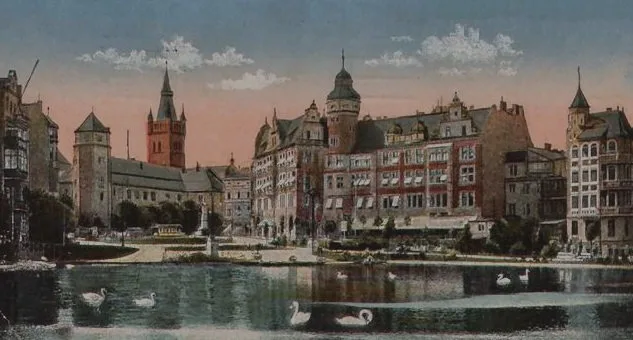
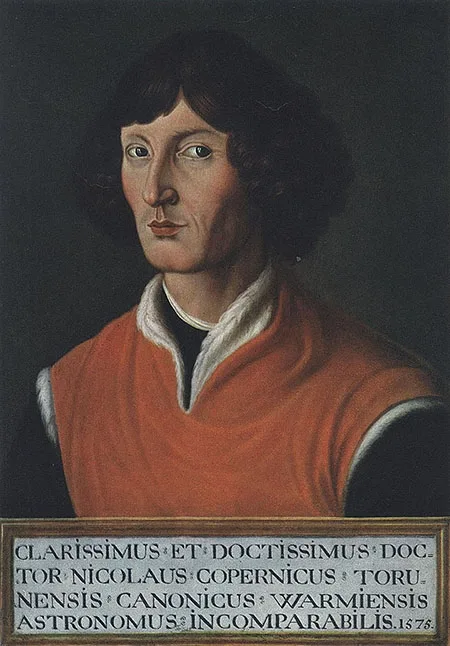
Nicolaus Copernicus was born on 2 (17) February 1473 in the town of Toruń, in the "Chełmno Land", which formed part of Prussia. By the middle of the 14th century the coast of the German (North) and Baltic Seas, from the Vistula to the Neman, was under the rule of the Teutonic Knights.
Built by the Order, Toruń had by then already become an important trading post of the famous Hanseatic League, and by the time the future astronomer was born it was a Polish town with a mixed population, most of whom were Germans. In the 19th century Mikhail Engelgardt wrote that "…Copernicus's discovery stands at the threshold between old and new Europe, his homeland lies on the border of two peoples, the Slavic and the Germanic, and he himself is neither quite a Pole nor quite a German".
The Copernicus family is believed to have come from Upper Silesia, from the village of Koperniki. Its inhabitants (Coperniks to a man) mined and worked copper and traded in copper wares. Around 1396 many of them moved to Kraków, then the capital of Poland. Among the settlers were the well-to-do ancestors of the future astronomer.
Many tall tales circulated about his father, "a devoted son of the Catholic Church". Some claimed he was a peasant farmer, others a baker, a brewer, a stonemason… In fact, like his forebears, he was a merchant, a wealthy and influential man. Having moved from Kraków to Toruń in 1458, he obtained a high position in the town court. In 1464 he married Barbara Watzenrode, the daughter of a rich Toruń patrician (the president of the town court). She bore him four children: Barbara, Katharina, Andreas and Nicolaus.
Very little is reliably known about Copernicus's childhood. He grew up in a prosperous family. He most likely received his elementary education at the school attached to St. John's Church, not far from his home. He often visited his grandmother, from whom he heard legends of Poland's past, folk songs and fairy tales in Polish. At school he was taught Latin. So by the age of ten the boy had an excellent command of three languages.
The Copernicus household was often visited by educated people well known in the town. Nicolaus listened to their conversations and absorbed like a sponge everything the adults discussed. For the future destroyer of ancient doctrines, it was a most fitting atmosphere.
Under the "Devil's" Wing
In the winter of 1483 a terrible plague epidemic struck Europe. One of its first victims was Nicolaus's father. His mother, driven out of her mind by grief, recovered only when her brother Lucas Watzenrode appeared in the house. The future Bishop of Warmia (made guardian of the orphans by the will of their late grandfather) quickly put the family's affairs in order. He sold the house on St. Anne's Street. One niece took the veil, the other made a good marriage. And Nicolaus and his brother he sent to the cathedral school attached to the University of Kraków, where boys from all over Poland were educated.
The Copernicus brothers were extremely lucky to come under the guardianship of Uncle Lucas – a stern man, but clever, educated and highly influential, and, moreover, free of puritanical narrow-mindedness. He had received a brilliant education, holding a master's degree from Kraków and a doctorate in canon law from the University of Bologna. Since Watzenrode had chosen a career in the Church, he was obliged to observe celibacy – a vow not to marry (which, admittedly, did not prevent him from fathering a son on the side).
Lucas played a most active part in the political life of the country, and his opinion carried weight. It was written of him that this Watzenrode "so vexed King Casimir IV that the king called him 'the devil' and did everything in his power to oppose Watzenrode's election as bishop". Such was the man under whose influence the 10-year-old Nicolaus Copernicus came. And never once in his life did he regret it.
"Toruń gave me birth, and Kraków adorned me with learning"
In the autumn of 1491 Nicolaus and Andreas, having each paid a quarter of a grzywna for tuition (a large sum in those days), became students of the Faculty of Arts at the University of Kraków. The freshly enrolled students – the "foxes" – faced their first ordeal: the rite of "baptism". The "elders" dragged them into a tavern, made them drink themselves silly on beer and got half-dead drunk themselves. Then they gave the foxes a good drubbing and smeared their heads with honey and ashes.
Young people came from all over Europe to study at the University of Kraków, even from Germany, Sweden and Italy. Many different sciences were taught here, but astronomy flourished above all.
Nicolaus saw for the first time several voluminous parchment manuscripts, weighty volumes of early printed books and four bronze astronomical instruments – a celestial globe, an astrolabe (an ancient Greek instrument for determining latitude), a sundial and a triquetrum made by the hands of Regiomontanus himself, the most authoritative German astronomer. The university was also renowned for its scholars. Seventy-six professors – no small matter!
By that time new trends were just emerging in medieval higher education, and a spirit of free inquiry was awakening. Humanists, who preferred antiquity to the fumes of the Middle Ages, entered the arena of cultural life. The old, venerable scholars and teachers defended the medieval traditions of instruction, while the young wished to read the works of the Hellenes in the original rather than in mediocre Latin translations.
The humanists were also supported by the teacher of mathematics and astronomy, Wojciech Brudzewski, a university professor known throughout Europe. It was to him that Nicolaus would be grateful all his life for his love of the science of the stars. "Toruń gave me birth, and Kraków adorned me with learning," Copernicus wrote of his student years.
But the "free spirit" brought to Kraków from the other side of the Alps soon began to fade from the university. The confrontation between scholastics and humanists ended more and more often in brawls, since neither side was distinguished by refined manners. After three years of study, Nicolaus returned to Toruń in 1495. Without a degree.
A Time of Great Ferment
His uncle, alarmed by such an unexpected turn of events, gave thought to Nicolaus's career. He insisted on a career in the Church and, to begin with, advised Nicolaus to seek election as a canon of the Diocese of Warmia in Frombork. This was perhaps the most lucrative position of the medieval era. The diocese's numerous estates, landholdings and hunting and fishing rights brought in enormous revenue. The activity of the chapter (the college of clergy) consisted mainly of managing the estates and collecting and dividing the income.
Then again, a canon's work was hardly strenuous: services in the cathedral, requiems, simple tasks and errands… Canons were entitled to a substantial income – prebends – both in money and in the form of land, estates and so on.
Of course Copernicus chose a career in the Church – though, as his biographers suppose, not for the sake of serving the Lord, but tempted by a cushy post.
Copernicus, however, lost the election. So many candidates stood for the single vacancy that had opened up that even his all-powerful uncle could not help. Perhaps the main factor was his lack of an academic degree – by tradition, canons were expected to hold a university diploma.
In the summer of 1496 Nicolaus Copernicus went to Italy to complete his studies at the University of Bologna, reputed to be the best school of law in Europe. While the student was pursuing his studies, he was nevertheless elected canon in absentia and began to receive his share of the revenue. Italy swallowed up a great deal of money. The books needed for astronomical research were no cheap pleasure either. It was here, at the University of Bologna, on 9 March 1497, that he made one of the twenty-seven observations of his own that went into his famous treatise on the heavenly spheres. And, of course, he mastered Greek to perfection.
Canon law interested Copernicus least of all – he received his degree in it somewhat later, in May 1503, in Ferrara, at the archbishop's palace. But for now it was 1501. Nicolaus enrolled as an auditor at the Faculty of Medicine of the University of Padua. Medicine unexpectedly captivated the astronomer and later brought him fame as a gifted healer. At home he was nicknamed a second Aesculapius.
Today some medieval methods of treatment raise a smile, if not a laugh. But… high technology was still oh so far away.
Here is one of Copernicus's notes: "The pills of de Villa Nova may be taken at any time. They improve digestion, bring cheerfulness, delay the greying that comes from the corruption of the vital juices, soothe coughs, strengthen the mind, protect the teeth from decay, deepen sleep and gently purge."
Next comes the recipe for the miraculous pills: “Take two ounces of Armenian bole, half an ounce of cinnamon, two drachms of zedoary root, two drachms each of usik (galangal. – author’s note), dittany (a mountain herb. – author’s note) and red sandalwood, a drachm each of ivory and iron filings, two scruples each of ash and chamomile, a drachm each of lemon peel and pearl, one scruple each of emerald, red hyacinth and sapphire, one drachm each of bone from a stag’s heart, sea locust, unicorn horn and red coral; of gold and silver leaf – one scruple each; of sugar – half a pound.” And a couple of recommendations: “Washing the hands in warm water before meals and in cold water after meals helps against stomach pains”, and “Cat droppings with sulphur cure a rush of blood to the head”.
Yet alongside such “miraculous” remedies, the medicine of Copernicus’s day also possessed sound ideas about the healthy and the diseased human body, thanks to which many lives were saved.
By some accounts Copernicus spent seven years in Italy, by others nine. He studied almost every branch of knowledge of the time. The atmosphere was conducive to grasping everything new.
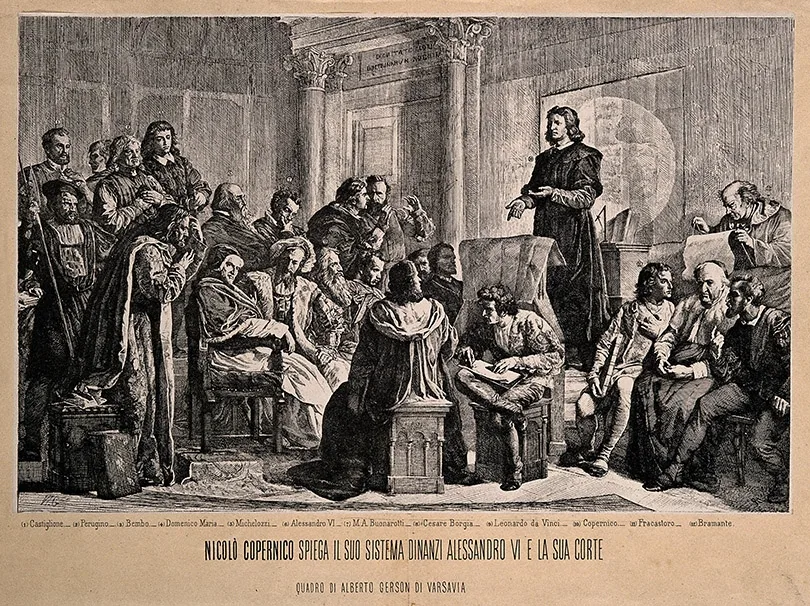
Today it is hard even to imagine the period of great ferment in which the scholar lived and worked. The High Renaissance! The age of titans: Columbus, the great Leonardo, Michelangelo, Raphael, Machiavelli, Erasmus of Rotterdam, Philippus Paracelsus… Every branch of industry was developing, the first printing press appeared, and as a result science began to develop rapidly across Europe. All of this inspired Copernicus. He took a keen interest in art, studied painting, and drew landscapes and portraits. It is therefore hardly surprising that during his years in Italy he lost all interest in the affairs of the Church, although he remained in its service to the end of his days. The canonry was merely a quiet harbour that provided an income, a position in society and the opportunity to pursue astronomy. As for diplomas, honours, fame and rank, he regarded them with contempt.
Return to Frombork
Back home he dreamed of only one thing – watching the stars.
However, his uncle’s grave illness upset all the plans of the 33-year-old Nicolaus. For six years he was his personal physician. He assisted the bishop in everything, accompanied him to all manner of diets and dealt with the Teutonic Knights. And at the same time, almost in passing, he translated from Greek into Latin the collection “Moral, Rustic and Amorous Epistles” by the 7th-century Byzantine writer Theophylact Simocatta.
Łukasz died in 1512 on his way back from one of the diets. The Teutonic Order was rid of a dangerous adversary, while Copernicus lost his patron and his most reliable friend.
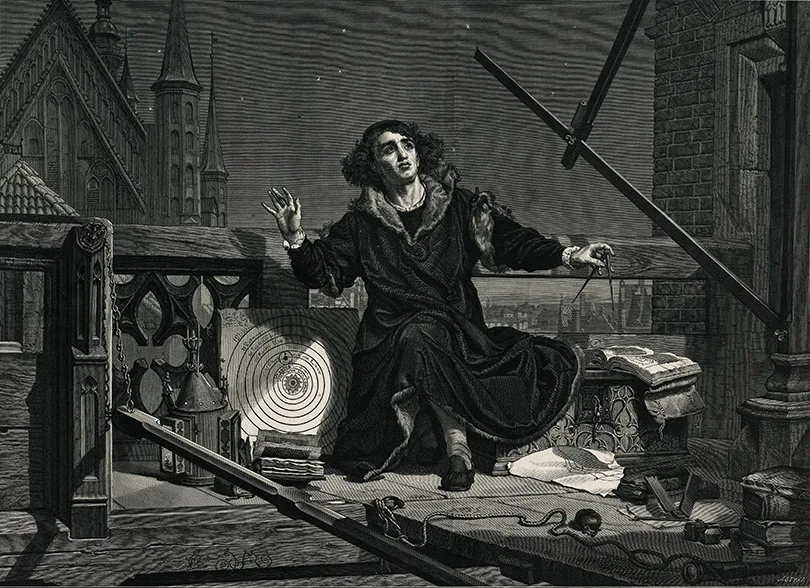
For the first four years after his uncle’s death Copernicus led a rather uneventful life in Frombork. Like all the canons, he lived by the cathedral, in one of whose towers he set up an observatory. In the autumn of 1516 he was elected administrator of the southern estates of the Diocese of Warmia in place of Tiedemann Giese – a friend and a highly educated man – and Nicolaus moved to Olsztyn for four years. His duties included supervising the work of town officials and village headmen, collecting taxes and overseeing the administration of justice in the territories subject to the chapter.
At this time relations with the Order deteriorated sharply. It was a very difficult period for the diocese. Teutonic troops seized part of the Warmian lands, burning and pillaging villages.
Copernicus organised the defence of the towns not yet conquered by the Order and, with a small group of loyal helpers from among the local population, built fortifications and defensive works. the rest hid in the forests, while the members of the chapter fled Frombork in fear in every direction: some to safe fortresses, others abroad.
Copernicus held the defence of Olsztyn to the victorious end, for which the king awarded him the title of Commissioner of Warmia. Thus the scholar took up a leading position in the chapter and set to work on the “Commentariolus”. Now all that remained was to find time to set down his major work. But that was precisely what he was desperately short of. The estates would not let him go.
“Here the conquered waters are compelled to flow uphill”
It is astonishing how much Nicolaus Copernicus knew and could do. In Frombork, for example, a hydraulic installation operated for two centuries, and the scholar – who, as it turned out, was also a superb manager – had a hand in building it. This is commemorated by an inscription on one of the cathedral’s towers:
Here the conquered waters are compelled to flow uphill,
That an abundant spring may quench the people’s thirst.
What nature denied to men, Copernicus overcame by art.
This work, among others, bears witness to his glorious life.
The inscription was, naturally, in Latin. The organisation of water supply in the towns of the Diocese of Warmia and the use of water resources for economic needs are the subject of research by Fyodor Nesteruk, Candidate of Technical Sciences, entitled “Engineering Works of Nicolaus Copernicus”. His findings are also confirmed by the research of Polish scholars. In his book “Nicolaus Copernicus”, Yevgeny Aleksandrovich Grebenikov – a Soviet and Russian astronomer and mathematician who from 1996 taught at the university in Siedlce, Poland, and after whom minor planet 4268 is named – writes that, to Copernicus’s design, a large spillway weir, a dyke, a reservoir and a sluice regulating the water level in the reservoir were built on the Bauda river two kilometres from Frombork. Water was diverted from the Bauda by a channel that came to be called the Copernicus Canal. “In places the course of the canal coincided with the riverbed, but two kilometres short of the hill on which Frombork Cathedral stood, it turned sharply towards it. Owing to the peculiarities of the local terrain, the water noticeably quickened its flow here, and its force turned the wheels of a flour mill built at the end of the canal. The water then passed beneath a tower housing a mechanical device with scoop buckets that raised part of the water to a height of 25 metres for domestic needs. The water flowing on from the canal drove two more water mills and was then discharged into the Baltic Sea. The total length of the entire hydraulic complex was about four kilometres.”
Later research has shown that Copernicus initiated and directed the construction of water supply systems in Toruń, Braniewo, Lubawa, Grudziądz and other towns of the Diocese of Warmia.
Calendar reform
Copernicus’s authority was so great that he was invited to Rome by Bishop Paul of Middelburg, a renowned mathematician who worked on questions of chronology. He asked the scholar to give his opinion on the reform of the Julian calendar. Its year was longer than the actual, tropical year. Between 325 and the beginning of the 16th century the discrepancy had grown to nine days. Changes were certainly needed. But the Vatican needed them most of all, in order to determine correctly the date of Easter and other movable feasts. Copernicus flatly refused to discuss the matter until the finest details of the motion of the Sun and Moon were known. As a result, the reform was carried out only 68 years later, by Pope Gregory XIII. It was based on Copernicus’s own precise calculations.
Monetary reform
As we can see, the astronomer was compelled to spend most of his life on matters that had nothing whatsoever to do with astronomy. He was, for example, deeply concerned about the debasement and depreciation of coinage. Copernicus wrote three works in Latin on improving the financial system: “Reflections”, “On the Method of Minting Coin” and “Treatise on the Minting of Coin”.
The right to mint coin was a highly lucrative privilege, and the Prussian towns were afraid of losing it. In Poland proper, grzywnas and groszes were struck at a single mint. Little Prussia, however, had four. The silver content of Königsberg thalers and shillings was constantly declining. The reason why had yet to be established. Copernicus realised that debasing the currency gave the Order additional funds for war and demanded that only one mint be kept. In his “Treatise” he wrote:
“Although the calamities by which kingdoms, principalities and republics perish are countless, in my judgement the four chief among them are these: discord, mortality, barrenness of the soil and debasement of the coinage. The first three are so evident that no one disputes them, but the fourth is recognised only by the few who look more deeply; it brings about the fall of the state not at once and abruptly, but gradually and covertly.”
In his work “On the Method of Minting Coins” he concluded that any attempt by the state to economise on issuing full-value money and to put “lightened” coins into circulation would inevitably lead to “good” money being driven out by “bad,” which in turn would undermine the economy, “aggravated by the unavoidable corruption in the treasury’s exchange of coins that differ in weight but are formally of equal value.” Copernicus called for urgent measures, otherwise “Prussia will soon have a coinage consisting of nothing but copper. Then all foreign trade will cease. For what merchant will agree to give his goods for copper coins? Inevitably, the goods necessary for life will grow dearer. Everything rises or falls in price according to the value of money. The prices of goods are determined not by copper, but by gold and silver.
Most of Copernicus’s proposals, however, were not adopted. The demand that the state should not try to profit from minting coins seemed as absurd at the time as the hypothesis that the Earth moves. Besides, one question remained unanswered: at whose expense was the reform to be carried out? On this sad note Copernicus’s involvement in monetary affairs came to an end. He returned to economic questions once more in 1531, when he drew up the “Olsztyn Bread Tariff,” recommending that the weight of a one-pfennig loaf be brought into line with the price of grain. Approaching the problem with his characteristic meticulousness, he worked out a sliding scale to account for a wide range of anticipated market fluctuations.
In time, all these medieval problems would be solved in enlightened Europe thanks to his followers.
Private Life
By the age of 60, the scholar finally resolved to devote himself to studying the heavenly bodies and to finish the book he had never quite got round to. A huge pile of manuscripts had accumulated, covered in small handwriting with elegant flourishes. On the top sheet was inscribed the title of the future work: “Nicolaus Copernicus of Toruń, On the Revolutions of the Heavenly Spheres.”
Older now and slightly stouter, Copernicus was still an imposing figure and looked sprightly for his years. His health allowed him to work a great deal. He observed the stars and hurried off to see patients when called. He treated both syphilis and gout. It was high time to think about printing his book, but, as ill luck would have it (and for a canon it truly was a sin), he fell in love with the young beauty Anna, daughter of Matz Schilling, a distant relative on his mother’s side and a renowned medallist and metal engraver of the time. In one of his astronomical tables Nicolaus outlined the sign of Venus with a border of ivy leaves. This was the Schilling family mark, which adorned the coins and medals struck by Anna’s father.
Under church canons, no woman was permitted in the house of a clergyman except a housekeeper – and even she had to be a close relative and no spring chicken.
Copernicus, however, “disobeyed” and brought his beloved into his home. After all, his colleague and friend, Canon Alexander Sculteti, also had a woman living with him who was by no means old – and who had even borne him children.
For several years all was quiet. The church community resigned itself to the presence of a young supposed housekeeper in the scholar’s home. But the happiness did not last. In 1538 Copernicus’s former friend Dantiscus was elected Bishop of Warmia. Of late he had taken a dislike to educated, free-thinking canons and began to enforce church law so zealously that he responded at once to the denunciations of ill-wishers and the envious. Dantiscus decided that Anna’s attractiveness was in fact dangerous and a temptation to the other brethren, and ordered her to leave first Copernicus’s house and then, after a second complaint, Frombork itself. Charges were drawn up against the utterly broken scholar. This sordid affair dragged on for a long time and undermined his health. After a series of cerebral haemorrhages he was paralysed. Sculteti, too, paid for his sins: he was expelled from the chapter and banished from Poland.
“Happy Is the Age That Brought Forth Such a Scholar”
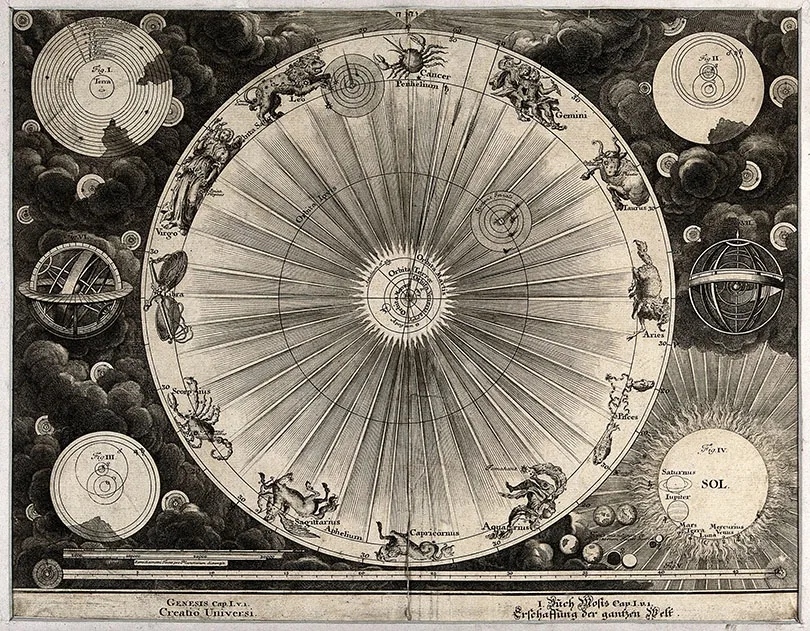
The revolutionary idea that the Earth revolves in an orbit around the Sun – an idea that in those days could bring a trial before the Inquisition followed, for instance, by burning at the stake – came to Copernicus long before his greatest work, “On the Revolutions of the Heavenly Spheres,” saw the light of day. His understanding of the heliocentric system had already taken shape in 1506–1508. But he could not confine himself to putting forward hypotheses. For almost his entire life he searched for proof that the Earth revolves around the Sun. In his time, however, science did not yet possess the methods and instruments capable of demonstrating this visibly. Drawing on all the achievements of mathematics and astronomy then available to scholars, Copernicus proved his propositions essentially in theory. Only in 1851 did the French physicist, mathematician and astronomer Jean Bernard Léon Foucault create his experimental pendulum – a weight suspended on a 67-metre wire that displayed the trajectory of the Earth’s daily rotation.
For a long time Copernicus hesitated to publish his research. Eminent and highly intelligent men urged him to delay no longer and to make his work public “for the common benefit of those who study mathematics.” The scholar gave in.
On the day of his death, 23 May 1543, Copernicus was brought the pledge of his immortality – the book “On the Revolutions of the Heavenly Spheres.” According to tradition, “his friends placed it in the sick man’s hands, but death had already claimed its victim.” A few hours later the great son of Toruń passed away. He was spared the indifference with which even some educated people of the time received his work, and the persecution that the Church would later unleash upon his teaching.
“Happy is the age that brought forth such a scholar,” said of Copernicus his only pupil, the German astronomer and mathematician Joachim Rheticus.
Translated from Russian with the help of AI (Claude, Anthropic), October 2026.