Johann Georg Theodor Grässe
«Sagenbuch des Preußischen Staats»1
Der Ursprung der Preußen und ihr Name
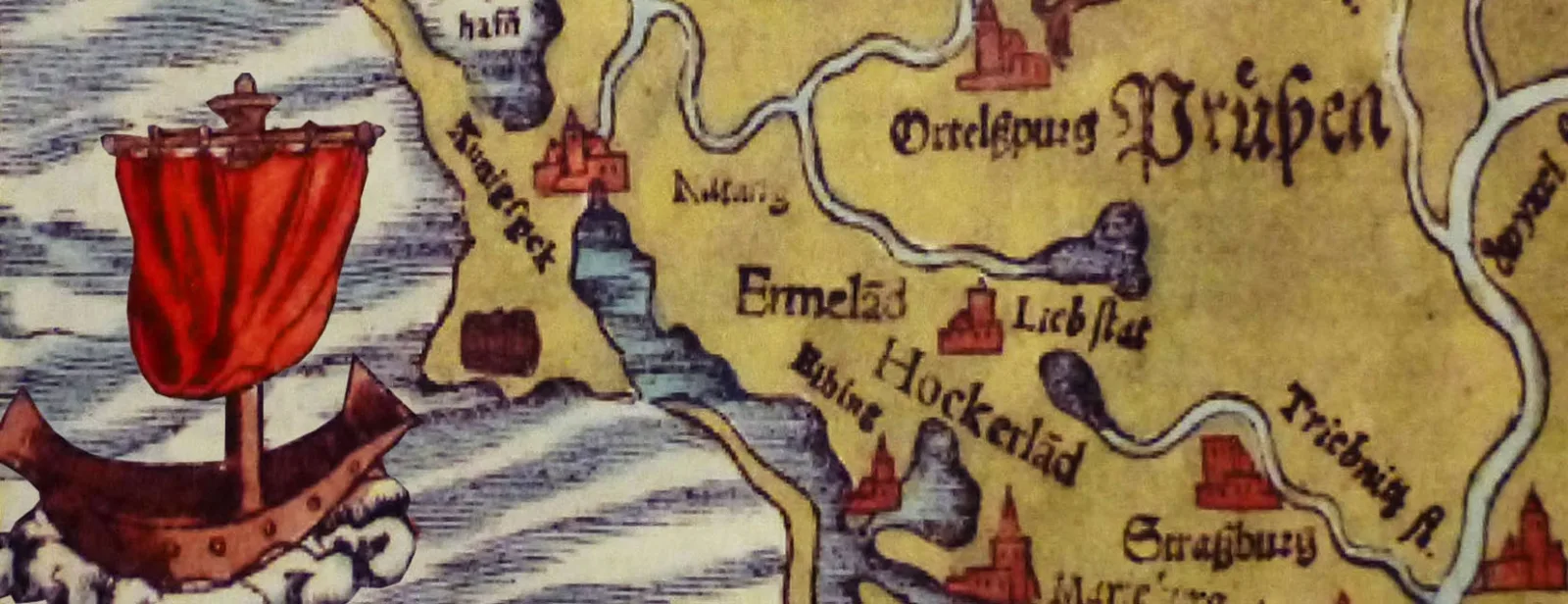
When the greater part of the Goths had left the territory of present-day Prussia, the Prussians came here.
They had once lived in the Riphean Mountains2, which stretch far away to the midnight lands3, not far from the river Tanais4. But, as is well known, eternal snow lies in those parts, and that is why they left to seek a new place to live. At last they came to a country that pleased them greatly. It was rich in fertile fields and pastures and abounded in waters, so the newcomers did not leave but stayed, choosing this land as a new homeland for themselves and their children. And that people was called the Porussians. In time one letter dropped out of the name, and it turned into Prussians. Porussians, or Borussians — this name means "those living among the Russes / beneath the Russes".
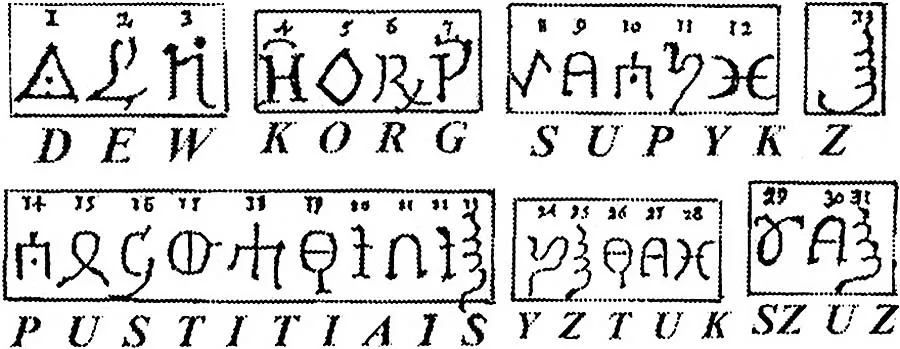
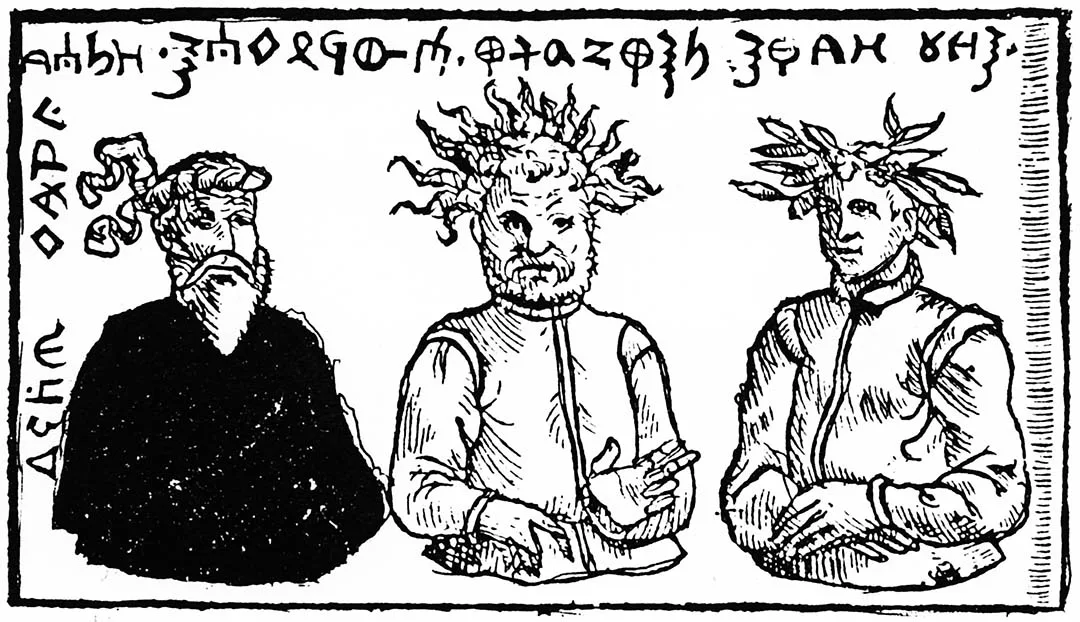
The Prussian alphabet.
* * *
There is, however, another legend. The Masovians, who had accepted Christianity earlier than their neighbours the Bruteni, called the Bruteni "bruti", that is, "senseless" and "stupid", because of their coarse manners and fondness for drink, taking the word from Latin5. And they so turned the Bruteni against themselves that the latter moved a strong army against the Masovians. The two hosts met near Neidenburg6, and that battle went on for a long time.
In the end the Masovians, worn out by the long confrontation, decided to put an end to the enmity and sent envoys to the Bruteni to find out how their warlike neighbours might be pacified. To this the Bruteni replied: let the Masovians, they said, honour their gods and never again mention the insulting nicknames.
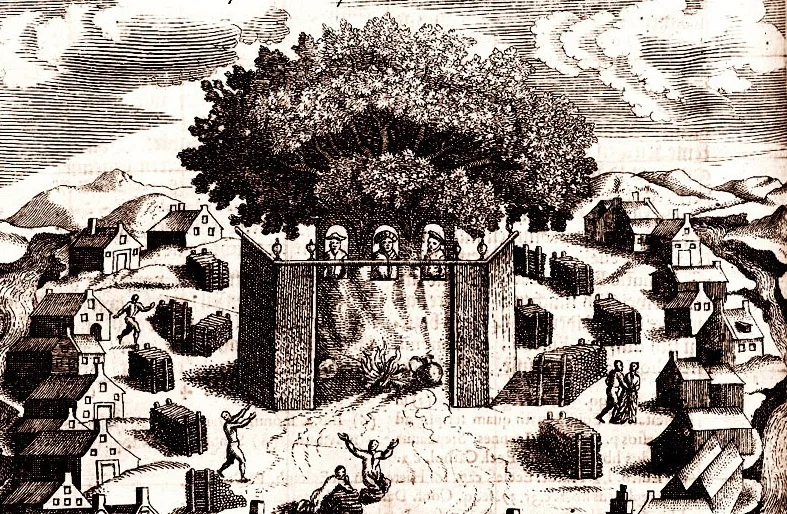
But the Masovians replied that it did not befit them to worship idols. Now, if the Bruteni were to place an image of Christ on their sacred oak, then of course the Masovians would venerate such a sanctuary. And it was certainly not right to give one's neighbours insulting nicknames, for it had to be admitted that the Bruteni could not be called senseless (bruti) — they were knowledgeable and highly experienced people (praescii)7.
This pleased the Bruteni exceedingly. And so it was agreed. In time the Bruteni's name praescii turned into "Prussians", and the territories inhabited by the Prussians came to be called Prussia.
The old Prussian word "prussia" means neither more nor less than "he will understand".
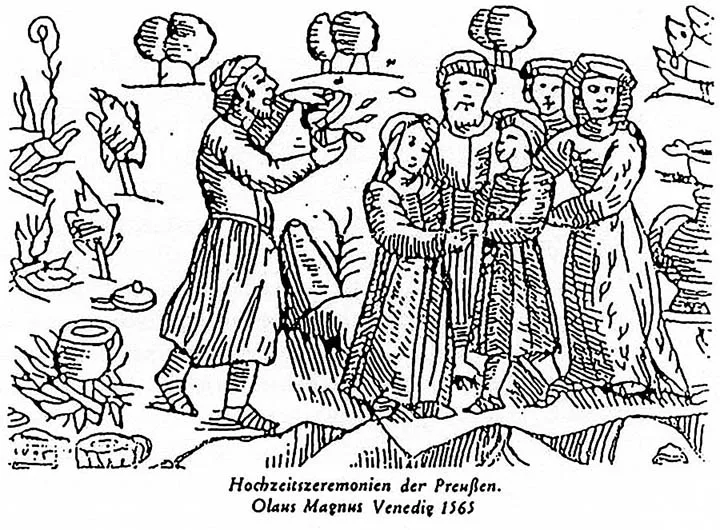
A Prussian wedding.
* * *
The town of Bromberg8 was ruled at that time by a learned and noble lord. And when he heard that the Bruteni had begun to call themselves by so proud a name, he allowed himself to laugh at it, saying to his friends: "If my hounds turned into stags, they too would be such praescii."
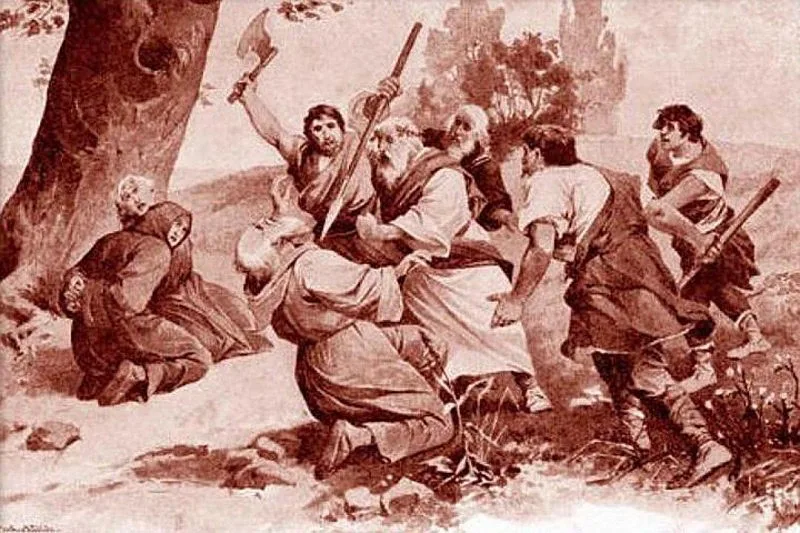
The Bruteni were so offended by these words that they made a raid on Poland and put it to fire and sword. When the ruler of Bromberg realised that this had happened because of him, he rode out to meet them, begging for forgiveness. But he did not receive it. The Bruteni tied him to his own horse and burned him alive together with the steed, thus offering a sacrifice to their gods.
TRANSLATOR'S NOTES
1. In his book Johann Grässe gives references to his sources: S. Waissel, Chronica v.d. Lande Preussen S. 10. Hartknoch Th. I. S. 72 etc. Voigt, Gesch. Preussens Bd. I. S. 607 etc.
2. The Riphean Mountains (Rhipaean Mountains, Rhipaei) — the name for the uplands in which the principal rivers of Scythia rise. The presumed equivalent is the present-day Ural Mountains.
3. Polunoch ("midnight") — Old Russian for "north". Compare modern Ukrainian "pivnich".
4. The Don.
5. bruti /Latin, plural of brutus/ — dull, senseless, stupid, unreasoning.
6. Neidenburg — modern Nidzica (Polish: Nidzica, German: Neidenburg) — a town in Poland, in the Warmian-Masurian Voivodeship, Nidzica County.
7. praescii /Latin, declined form of the verb praescius, i.e. nominative/vocative case, masculine, plural/ — knowledgeable, far-sighted, experienced.
8. Bromberg — modern Bydgoszcz (Polish: Bydgoszcz, German: Bromberg) — a city in Poland, the administrative centre of the Kuyavian-Pomeranian Voivodeship.
● Editor's note: Read on VisitPrussia.com an interview with the translator of German, and in particular Prussian, fairy tales, our regular contributor Tatyana Kolivay, who runs her own blog, where countless other parables, legends and fairy tales in her translation have been published.
Translated from Russian with the help of AI (Claude, Anthropic), October 2026.