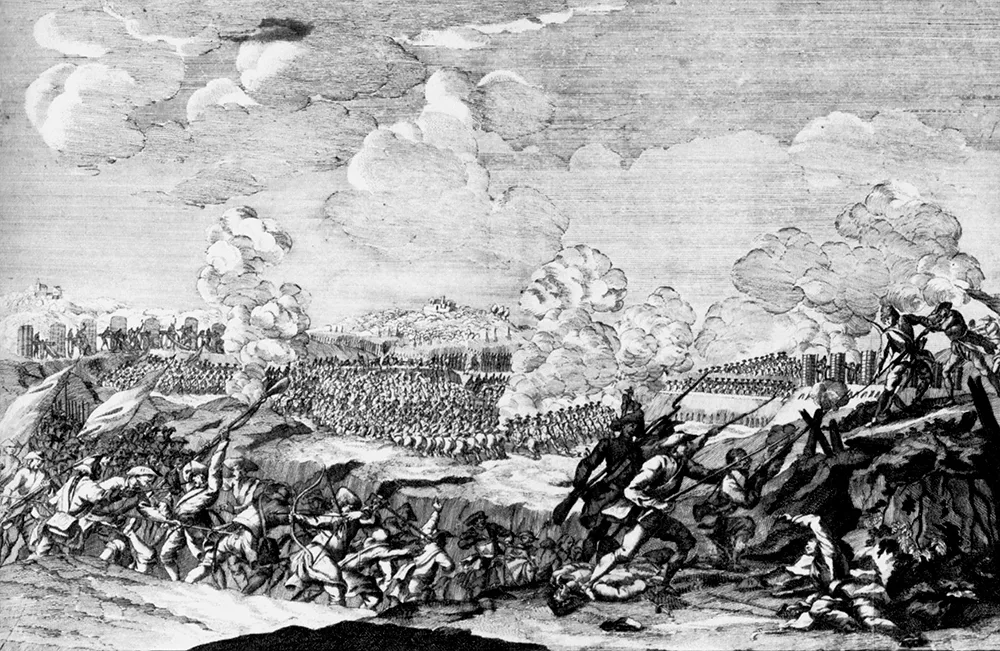
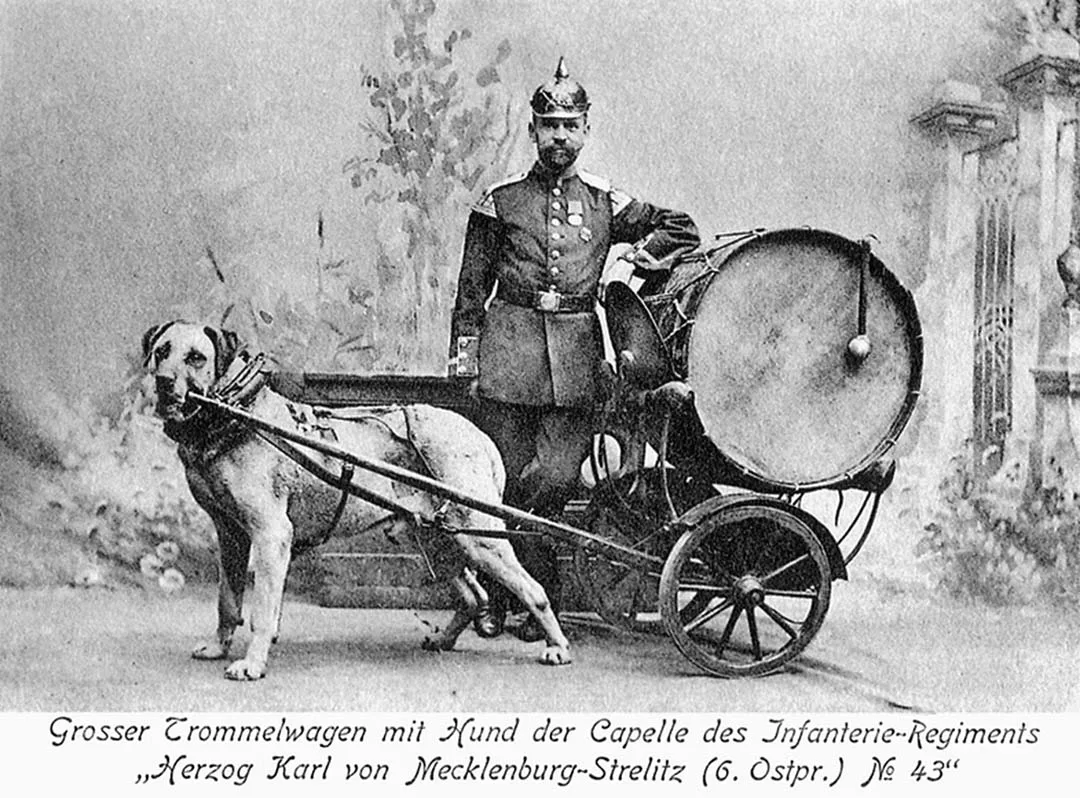
In 1866, at the Battle of Königgrätz (today Hradec Králové in the Czech Republic), the 43rd Infantry (6th East Prussian) Regiment "Duke Charles of Mecklenburg-Strelitz" (Infanterie-Regiment «Herzog Karl von Mecklenburg-Strelitz» / 6. Ostpreußisches) captured an enemy cart with drums, which the Austrians used to celebrate their victories. It belonged to the Austrian 77th Infantry Regiment (Infanterieregiment Nr. 77). The dog harnessed to the cart was killed. The regimental craftsmen managed to repair the cart and the bullet-riddled drum. Like the Austrians, the Prussians took a big, strong St Bernard as the draught dog and named him Sultan. At first Sultan was frightened by the unfamiliar sounds and tried to run away, but he soon got used to his new duties. He was at once promoted to lance corporal and received a lance corporal's badge on his collar. After the end of the war the regiment returned to its garrison in Königsberg. During the triumphal entry into the city Sultan was the centre of everyone's attention: everyone reached out to stroke him and give him a treat. He, however, bore it all with visible indifference. The dog knew his duties.
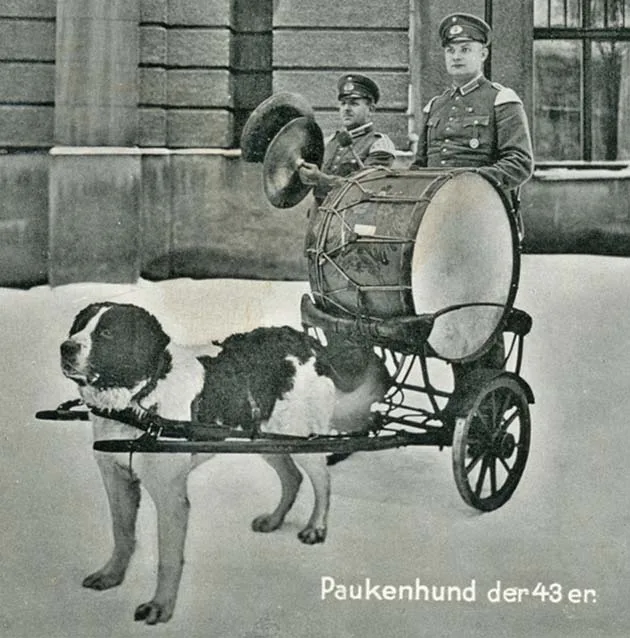
The Königsberg drum dog of the 43rd Regiment in the 20th century.
The cart with the dog harnessed to it was so well received in Königsberg that the St Bernard became the regiment's showpiece.
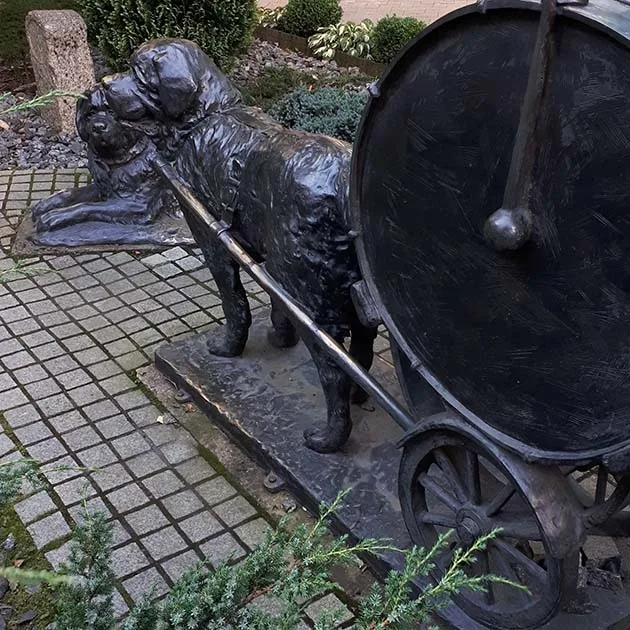
The Kaliningrad monument to the drum dogs on Kashtanovaya Alley.
By a royal order of 9 March 1867, the Prussian King William I granted the 43rd Infantry Regiment "for all time" the right to take dogs into service and put them on the ration strength. Thus, for decades, the drum dogs became a kind of calling card of the 43rd Regiment. They were present at all military parades, at concerts of the military band, and at the changing of the guard at the castle.
In addition to the main dog, a second one was always kept and gradually trained. The dogs were usually given the names Sultan and Pasha.
After the First World War the last dog, Pasha, lived out his dog's life in honourable retirement on the estate of a former officer of the regiment.
When the Reichswehr was formed — as the armed forces of Germany were called from 1919 — the tradition was revived. The story of the Königsberg drum dogs ends in 1945, with the fall of the capital of East Prussia.
LEGENDS OF PRUSSIA on the blog of Tatyana Kolivay.
Photo: Bildarchiv Ostpreußen, Mikhail Ogorodnikov.
Translated from Russian with the help of AI (Claude, Anthropic), October 2026.