L. N. Tolstoy. "War and Peace". Volume Two. Part Two.
Having returned to the regiment and told the commander how matters stood with Denisov, Rostov rode off to Tilsit with the letter to the Emperor.
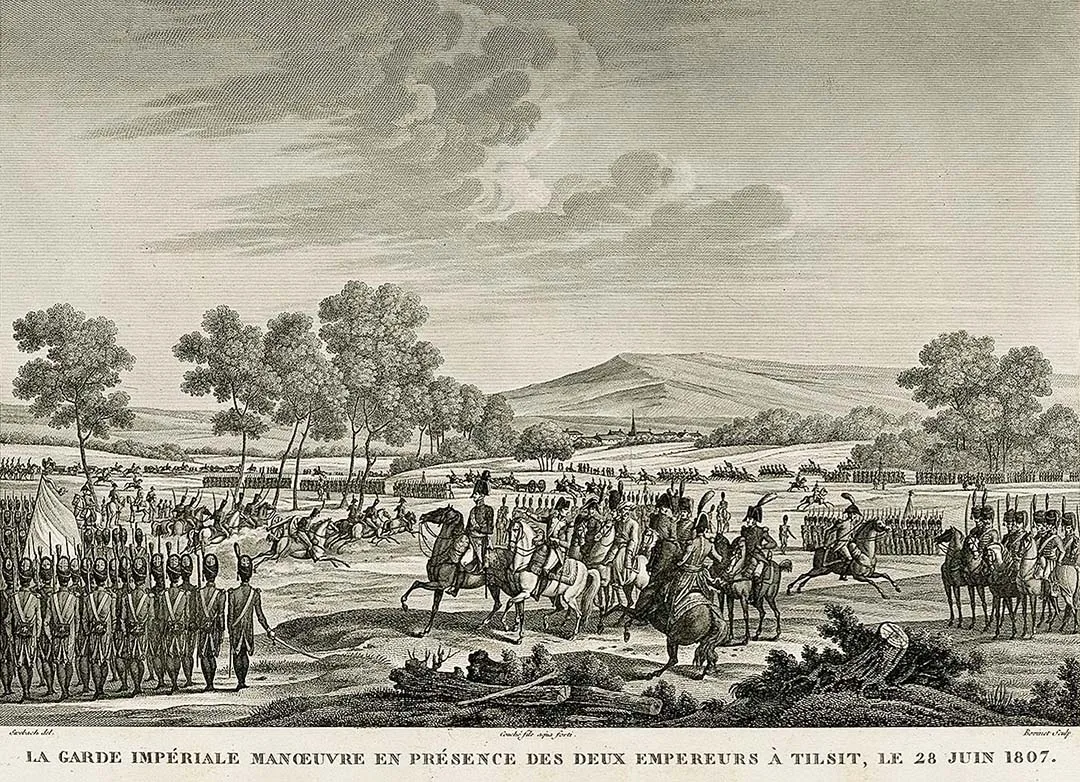
On the 13th of June the French and Russian emperors met at Tilsit. Boris Drubetskoy asked the important personage on whose staff he served to have him attached to the suite appointed to remain at Tilsit.
"Je voudrais voir le grand homme 1," he said, speaking of Napoleon, whom until then he, like everyone else, had always called Buonaparte.
"Vous parlez de Buonaparte? 2" his general said to him with a smile.
Boris looked questioningly at his general and at once understood that this was a jesting test.
"Mon prince, je parle de l'empereur Napoléon 3," he replied. The general, smiling, patted him on the shoulder.
"You will go far," he said to him, and took him along.
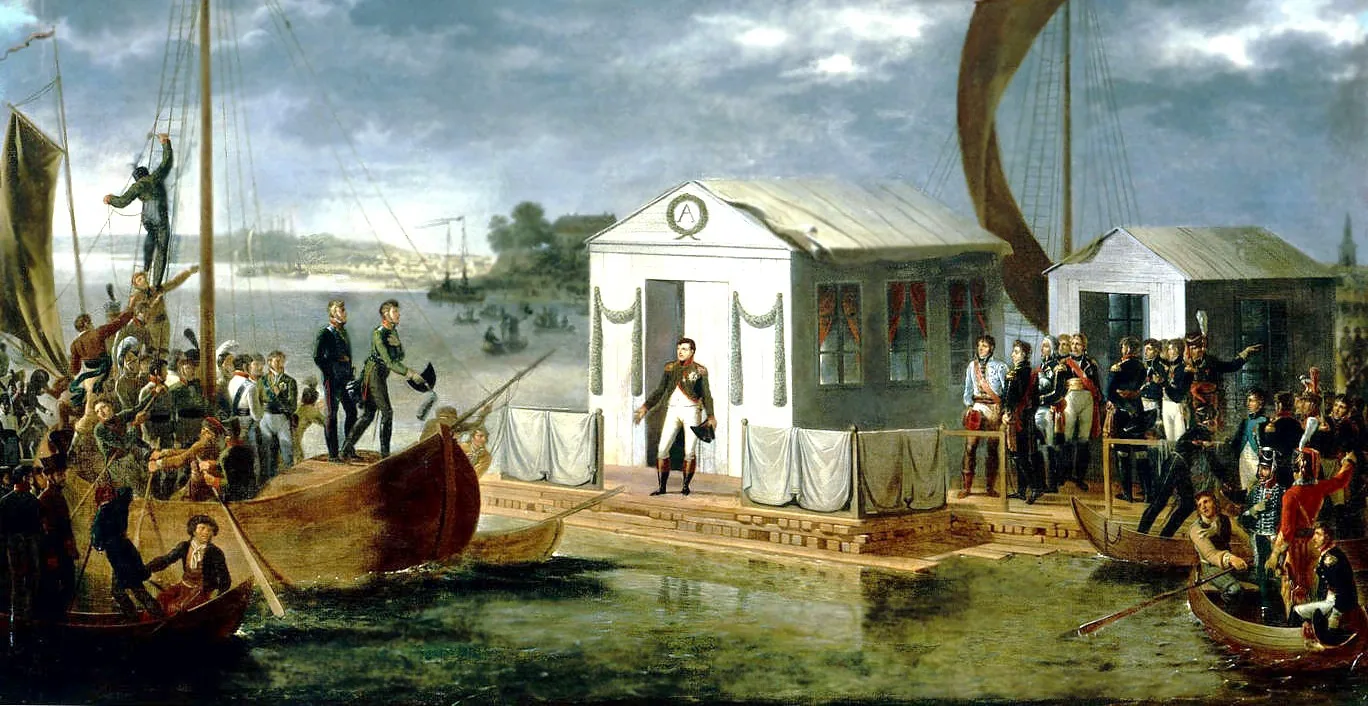
Boris was one of the few who were on the Neman on the day the emperors met; he saw the rafts bearing the monograms, Napoleon riding along the far bank past the French Guard, he saw the pensive face of the Emperor Alexander as he sat silently in an inn on the bank of the Neman awaiting Napoleon's arrival; he saw how both emperors got into boats, and how Napoleon, reaching the raft first, stepped forward with quick strides and, meeting Alexander, gave him his hand, and how both disappeared into the pavilion. Ever since his entry into the higher spheres Boris had made it his habit to observe attentively what went on around him and to write it down. During the meeting at Tilsit he inquired the names of the persons who had come with Napoleon and about the uniforms they wore, and listened attentively to the words spoken by important people. At the very moment the emperors entered the pavilion he looked at his watch, and did not forget to look again when Alexander came out of the pavilion. The meeting had lasted an hour and fifty-three minutes; that evening he wrote this down, among other facts which he believed to be of historical significance.
Since the Emperor's suite was very small, to be at Tilsit during the meeting of the emperors was a matter of great importance for a man who valued success in the service, and Boris, having got to Tilsit, felt that from then on his position was fully established.
He was not only known; people had grown used to him and accustomed to his presence. Twice he had carried out commissions to the Emperor himself, so that the Emperor knew him by sight, and all those close to the court not only no longer shied away from him as before, regarding him as a newcomer, but would have been surprised had he not been there.
Boris lodged with another adjutant, the Polish Count Żyliński. Żyliński, a Pole brought up in Paris, was rich and passionately fond of the French, and almost every day during their stay at Tilsit French officers of the Guard and of the French general staff gathered at Żyliński's and Boris's for dinners and luncheons.
On the evening of the 24th of June Count Żyliński, Boris's fellow lodger, gave a supper for his French acquaintances. At this supper there was a guest of honour — one of Napoleon's adjutants — as well as several officers of the French Guard and a young boy of an old aristocratic French family, Napoleon's page. On that very day Rostov, taking advantage of the darkness so as not to be recognised, arrived at Tilsit in civilian clothes and entered the lodgings of Żyliński and Boris.
In Rostov, as in the whole army from which he had come, the change of attitude towards Napoleon and the French — who from enemies had become friends — that had taken place at headquarters and in Boris was still far from accomplished. In the army they still went on feeling the former mixture of anger, contempt and fear towards Bonaparte and the French. Only recently Rostov, talking with an officer of Platov's Cossacks, had argued that if Napoleon were taken prisoner he would be treated not as a sovereign but as a criminal. Only recently, meeting a wounded French colonel on the road, Rostov had grown heated, insisting to him that there could be no peace between a lawful sovereign and the criminal Bonaparte. That is why Rostov was so strangely struck, in Boris's lodgings, by the sight of French officers in the very uniforms he was used to regarding quite differently from the line of skirmishers. As soon as he saw a French officer leaning out of a doorway, that feeling of war, of hostility, which he always experienced at the sight of the enemy, suddenly seized him. He stopped on the threshold and asked in Russian whether Drubetskoy lived there. Boris, hearing a strange voice in the hall, came out to meet him. In the first moment, when he recognised Rostov, his face expressed annoyance.
"Ah, it's you — very glad, very glad to see you," he said nevertheless, smiling and moving towards him. But Rostov had noticed his first reaction.
"I've come at a bad time, it seems," he said. "I wouldn't have come, but I have business," he said coldly...
"No, I'm only surprised that you could get away from the regiment. Dans un moment je suis à vous 4," he answered a voice that was calling him.
"I see I've come at a bad time," Rostov repeated.
The look of annoyance had already vanished from Boris's face; having evidently considered and decided what to do, he took him by both hands with particular composure and led him into the next room. Boris's eyes, looking calmly and steadily at Rostov, seemed veiled by something, as if some screen — the blue spectacles of social convention — had been put over them. So it seemed to Rostov.
"Oh, come now, please — how could you come at a bad time?" said Boris. Boris led him into the room where supper was laid, introduced him to the guests, naming him and explaining that he was not a civilian but a hussar officer, an old friend of his. "Count Żyliński, le comte N. N., le capitaine S. S. 5," he named the guests. Rostov looked at the Frenchmen with a frown, bowed reluctantly and said nothing.
Żyliński evidently did not welcome this new Russian face into his circle, and said nothing to Rostov. Boris seemed not to notice the constraint caused by the newcomer's appearance and, with the same pleasant composure and the same veiled look in his eyes with which he had met Rostov, tried to enliven the conversation. One of the Frenchmen, with ordinary French courtesy, turned to the stubbornly silent Rostov and told him that he had probably come to Tilsit to see the Emperor.
"No, I have business," Rostov answered curtly.
Rostov had fallen out of humour as soon as he noticed the displeasure on Boris's face, and, as always happens with people who are out of humour, it seemed to him that everyone was looking at him with hostility and that he was in everyone's way. And indeed he was in everyone's way, and he alone remained outside the general conversation that had sprung up again. "And why does he sit here?" said the glances the guests cast at him. He rose and went up to Boris.
"But I'm in your way," he said to him quietly. "Let's go and talk about my business, and then I'll leave."
"Oh no, not at all," said Boris. "But if you're tired, come to my room and lie down and rest."
"Yes, really..."
They went into the little room where Boris slept. Rostov, without sitting down, at once and with irritation — as though Boris were somehow to blame towards him — began telling him about Denisov's affair, asking whether he would and could ask the Emperor about Denisov through his general and pass on the letter through him. When the two of them were alone, Rostov for the first time became convinced that he found it awkward to look Boris in the eye. Boris, with one leg crossed over the other and stroking the slender fingers of his right hand with his left, listened to Rostov as a general listens to a subordinate's report, now looking aside, now, with the same veiled look, gazing straight into Rostov's eyes. Each time this happened Rostov felt awkward and lowered his eyes.
"I have heard of affairs of this kind, and I know that the Emperor is very strict in such cases. I think it ought not to be brought before His Majesty. In my opinion it would be better to apply directly to the corps commander... But in general I think..."
"So you don't want to do anything — then just say so!" Rostov almost shouted, not looking Boris in the eye.
Boris smiled.
"On the contrary, I'll do what I can, only I thought..."
At that moment Żyliński's voice was heard at the door, calling Boris.
"Well, go on, go on," said Rostov, and, refusing supper and remaining alone in the little room, he paced up and down in it for a long time, listening to the merry French chatter from the next room.
Rostov had arrived at Tilsit on the day least suitable for interceding on Denisov's behalf. He could not go to the general on duty himself, since he was in a tailcoat and had come to Tilsit without his superiors' permission, and Boris, even had he wished to, could not do so on the day after Rostov's arrival. On that day, the 27th of June, the first terms of the peace were signed.
The emperors exchanged orders: Alexander received the Legion of Honour and Napoleon the Order of St Andrew, First Class, and on that day a dinner was arranged for the Preobrazhensky battalion, given to it by a battalion of the French Guard. The sovereigns were to be present at this banquet.
Rostov felt so awkward and uncomfortable with Boris that when Boris looked in on him after supper he pretended to be asleep, and early next morning, trying not to see him, he left the house. In a tailcoat and round hat Nikolai wandered about the town, looking at the French and their uniforms, looking at the streets and the houses where the Russian and French emperors were staying. In the square he saw tables being set out and preparations for the dinner; in the streets he saw draperies hung across with flags in the Russian and French colours and huge monograms A. and N. In the windows of the houses, too, there were flags and monograms.
"Boris doesn't want to help me, and I don't want to turn to him either. That's settled," thought Nikolai. "Everything is over between us, but I won't leave here without doing all I can for Denisov and, above all, without handing the letter to the Emperor. The Emperor?! He is here!" thought Rostov, involuntarily approaching again the house occupied by Alexander.
Saddle horses stood at this house and the suite was assembling, evidently preparing for the Emperor's departure.
"I may see him at any moment," thought Rostov. "If only I could hand him the letter directly and tell him everything... would they really arrest me for my tailcoat? It can't be! He would understand which side justice is on. He understands everything, knows everything. Who could be more just and more magnanimous than he? Well, and even if they did arrest me for being here, what harm would that be?" he thought, watching an officer entering the house occupied by the Emperor. "After all, people do go in. Eh! It's all nonsense! I'll go and hand the letter to the Emperor myself: so much the worse for Drubetskoy, who has driven me to this." And suddenly, with a resolve he had not expected of himself, Rostov, feeling for the letter in his pocket, walked straight to the house occupied by the Emperor.
"No, this time I won't let the chance slip as I did after Austerlitz," he thought, expecting every second to meet the Emperor and feeling the blood rush to his heart at the thought. "I'll fall at his feet and implore him. He will raise me up, listen to me and even thank me."
"I am happy when I can do good, but to set right an injustice is the greatest happiness," Rostov imagined the words the Emperor would say to him. And he walked past those who were looking at him with curiosity, up onto the porch of the house occupied by the Emperor.
From the porch a broad staircase led straight up; to the right a closed door could be seen. Below, under the staircase, was a door to the ground floor.
"Whom do you want?" someone asked.
"To hand in a letter, a petition to His Majesty," said Nikolai, his voice trembling.
"Petitions go to the officer on duty — this way, please (he was shown the door below). Only they won't accept it."
On hearing this indifferent voice Rostov took fright at what he was doing; the thought of meeting the Emperor at any moment was so tempting, and therefore so terrifying, that he was ready to run away, but the gentleman of the chamber who met him opened the door of the duty room for him, and Rostov went in.
A short, stout man of about thirty, in white breeches, jackboots and nothing but a cambric shirt, evidently just put on, was standing in this room; a valet was buttoning on him from behind a handsome new pair of silk-embroidered braces, which for some reason Rostov noticed. The man was talking to someone in another room.
"Bien faite et la beauté du diable 6," this man was saying, and, seeing Rostov, he stopped speaking and frowned.
"What do you want? A petition?.."
"Qu'est ce que c'est? 7" someone asked from the other room.
"Encore un pétitionnaire 8," answered the man in braces.
"Tell him later. He'll be coming out in a moment; we must go."
"Later, later, tomorrow. It's too late..."
Rostov turned and was about to leave, but the man in braces stopped him.
"From whom? Who are you?"
"From Major Denisov," answered Rostov.
"Who are you? An officer?"
"Lieutenant, Count Rostov."
"What audacity! Submit it through the proper channels. And you yourself go, go..." And he began to put on the uniform the valet was handing him.
Rostov went out into the hall again and noticed that on the porch there were now many officers and generals in full dress uniform, past whom he would have to walk.
Cursing his audacity, his heart sinking at the thought that at any moment he might meet the Emperor and be disgraced in his presence and sent off under arrest, fully understanding the impropriety of his action and repenting of it, Rostov, with lowered eyes, was making his way out of the house, surrounded by a crowd of the brilliant suite, when a familiar voice called him and a hand stopped him.
"And what are you doing here in a tailcoat, my dear fellow?" asked a bass voice.
It was a cavalry general who had earned the Emperor's special favour during this campaign, the former commander of the division in which Rostov served.
Rostov in alarm began to justify himself, but, seeing the general's good-naturedly jocular face, he stepped aside and in an agitated voice told him the whole affair, asking him to intercede for Denisov, whom the general knew. Having heard Rostov out, the general gravely shook his head.
"A pity, a pity about the fine fellow; give me the letter."
Rostov had barely managed to hand over the letter and tell him all about Denisov's affair when quick footsteps with spurs clattered down the stairs, and the general, leaving him, moved towards the porch. The gentlemen of the Emperor's suite ran down the stairs and went to the horses. The riding master Ené, the same who had been at Austerlitz, led up the Emperor's horse, and on the stairs was heard the light creak of footsteps, which Rostov recognised at once. Forgetting the danger of being recognised, Rostov moved up with some curious townspeople right to the porch, and again, after two years, he saw the same features he adored, the same face, the same look, the same gait, the same union of majesty and gentleness... And the feeling of rapture and love for the Emperor rose again in Rostov's soul with all its former force. The Emperor, in the uniform of the Preobrazhensky regiment, in white elk-skin breeches and high jackboots, with a star Rostov did not know (it was the Légion d'Honneur 9), came out onto the porch, holding his hat under his arm and drawing on a glove. He stopped, looking about him and lighting up everything around him with his glance. To some of the generals he said a few words. He also recognised the former commander of Rostov's division, smiled at him and beckoned him over.
The whole suite stepped back, and Rostov saw this general saying something to the Emperor at considerable length.
The Emperor said a few words to him and took a step towards his horse. Again the crowd of the suite and the crowd from the street, in which Rostov stood, pressed closer to the Emperor.
Stopping by the horse and taking hold of the saddle with his hand, the Emperor turned to the cavalry general and spoke loudly, evidently wishing everyone to hear him.
"I cannot, general, and I cannot because the law is stronger than I am," said the Emperor, and put his foot in the stirrup. The general bowed his head respectfully, the Emperor mounted and galloped off down the street. Rostov, beside himself with rapture, ran after him with the crowd.
In the square to which the Emperor rode, a battalion of the Preobrazhensky regiment stood on the right and a battalion of the French Guard in bearskin caps on the left, facing each other.
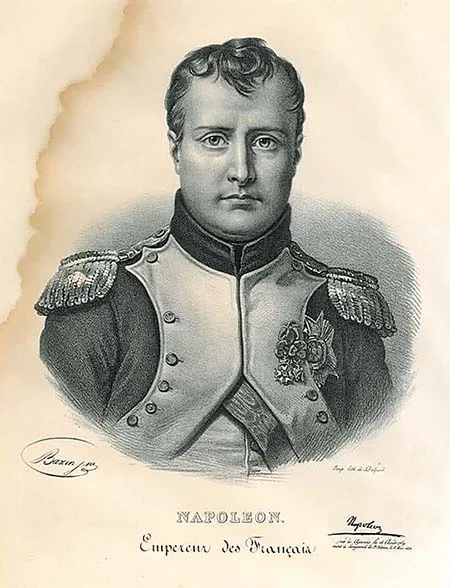
As the Emperor was riding up to one flank of the battalions, which presented arms, another crowd of horsemen galloped up to the opposite flank, and at their head Rostov recognised Napoleon. It could be no one else. He rode at a gallop, in a small hat, with the ribbon of St Andrew across his shoulder, in a blue uniform open over a white waistcoat, on an exceptionally thoroughbred grey Arab horse with a crimson, gold-embroidered saddlecloth. Riding up to Alexander, he raised his hat, and at this movement Rostov's cavalryman's eye could not fail to notice that Napoleon sat his horse badly and insecurely. The battalions shouted "Hurrah!" and "Vive l'Empereur!" 10 Napoleon said something to Alexander. Both emperors dismounted and took each other by the hand. On Napoleon's face there was an unpleasantly feigned smile. Alexander was saying something to him with an affable expression.
Rostov, never taking his eyes off them, despite the trampling horses of the French gendarmes pushing back the crowd, followed every movement of the Emperor Alexander and of Bonaparte. He was struck, as by something unexpected, by the fact that Alexander behaved as Bonaparte's equal, and that Bonaparte, quite freely, as though this familiarity with the Emperor were natural and habitual to him, treated the Russian Tsar as an equal.
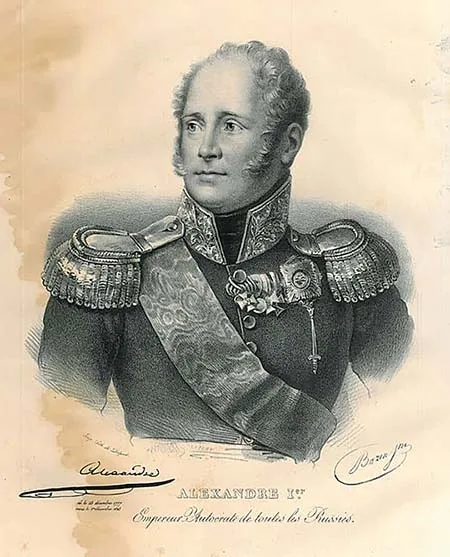
Alexander and Napoleon, with a long tail of suite behind them, came up to the right flank of the Preobrazhensky battalion, straight towards the crowd standing there.
The crowd unexpectedly found itself so close to the emperors that Rostov, who stood in its front rows, grew afraid that he might be recognised.
"Sire, je vous demande la permission de donner la Légion d'Honneur au plus brave de vos soldats 11," said a sharp, precise voice that pronounced every letter to the end.
It was the short Bonaparte speaking, looking up straight into Alexander's eyes. Alexander listened attentively to what was being said to him and, inclining his head, smiled pleasantly.
"A celui qui s'est le plus vaillament conduit dans cette dernière guerre 12," Napoleon added, rapping out every syllable, surveying with a calm and assurance that Rostov found outrageous the ranks of the Russian soldiers drawn up before him, all still presenting arms and gazing fixedly into the face of their Emperor.
"Votre majesté me permettra-t-elle de demander l'avis du colonel 13," said Alexander, and took a few hasty steps towards Prince Kozlovsky, the battalion commander. Bonaparte meanwhile began to pull the glove off his small white hand and, tearing it, threw it down. An adjutant behind him hastily rushed forward and picked it up.
"To whom shall it be given?" the Emperor Alexander asked Kozlovsky, not loudly, in Russian.
"To whomever you command, Your Majesty."
The Emperor frowned with displeasure and, looking round, said:
"But we must give him an answer."
Kozlovsky looked round at the ranks with a resolute air, and in that glance took in Rostov too.
"Can it be me?" thought Rostov.
"Lazarev!" the colonel commanded with a frown; and the soldier first in line by height, Lazarev, stepped briskly forward.
"Where are you going? Stand here!" voices whispered to Lazarev, who did not know where to go. Lazarev stopped, glancing sideways in fright at the colonel, and his face quivered, as happens with soldiers called out in front of the ranks.
Napoleon turned his head slightly back and put his small plump hand out behind him, as if wishing to take something.
The members of his suite, guessing that very second what was wanted, bustled about and whispered, passing something from one to another, and the page — the very one Rostov had seen at Boris's the day before — ran forward and, bowing respectfully over the outstretched hand and not making it wait a single second, placed in it an order on a red ribbon. Napoleon, without looking, pressed two fingers together. The order was between them. Napoleon went up to Lazarev, who, rolling his eyes, stubbornly went on looking only at his own sovereign, and glanced round at the Emperor Alexander, showing by this that what he was now doing he was doing for his ally. The small white hand with the order touched a button of the soldier Lazarev. It was as though Napoleon knew that, for this soldier to be happy, rewarded and distinguished from everyone in the world for ever, it was only necessary that his, Napoleon's, hand should deign to touch the soldier's breast. Napoleon merely put the cross to Lazarev's breast and, letting go his hand, turned to Alexander, as though he knew that the cross must stick to Lazarev's breast. The cross did indeed stick, because obliging hands, Russian and French, instantly catching it, pinned it to the uniform. Lazarev glanced gloomily at the little man with white hands who had done something to him and, still motionless as he presented arms, again began looking straight into Alexander's eyes, as though asking Alexander whether he should go on standing, or whether he would now be ordered to march off, or perhaps to do something else? But he was given no orders, and he remained for quite a long time in this motionless state.
The sovereigns mounted and rode away. The Preobrazhensky men, breaking ranks, mingled with the French guardsmen and sat down at the tables prepared for them.
Lazarev sat in the place of honour; Russian and French officers embraced him, congratulated him and shook his hands. Crowds of officers and townspeople came up just to look at Lazarev. A hubbub of Russian and French talk and laughter filled the square around the tables.
Two officers with flushed faces, merry and happy, walked past him.
"What a feast, brother — all on silver," said one. "Did you see Lazarev?"
"I did."
"Tomorrow, they say, the Preobrazhensky men are going to entertain them."
"Well, what luck for Lazarev! Twelve hundred francs' pension for life."
"Now that's a cap, lads!" shouted a Preobrazhensky soldier, putting on a Frenchman's shaggy cap.
"Wonderfully fine, a delight!"
"Have you heard the password?" one Guards officer said to another. "The day before yesterday it was Napoléon, France, bravoure 14, yesterday Alexandre, Russie, grandeur 15; one day our Emperor gives the password and the next day Napoleon. Tomorrow the Emperor will send a St George's Cross to the bravest of the French guardsmen. He has to! He must answer in kind."
Boris, with his comrade Żyliński, also came to look at the Preobrazhensky banquet. On his way back Boris noticed Rostov, who was standing at the corner of a house.
"Rostov! Hello; we never even saw each other," he said to him, and could not refrain from asking what was the matter with him, so strangely gloomy and upset was Rostov's face.
"Nothing, nothing," answered Rostov.
"Will you drop in?"
"Yes, I will."
Rostov stood at the corner for a long time, watching the feasters from afar. A painful working was going on in his mind which he could not bring to a conclusion. Terrible doubts arose in his soul. Now he remembered Denisov with his changed expression, his submissiveness, and the whole hospital with those torn-off arms and legs, that filth and disease. So vividly did he seem to smell that hospital stench of dead flesh that he looked round to see where the smell could be coming from. Now he remembered that self-satisfied Bonaparte with his little white hand, who was now an emperor, whom the Emperor Alexander loved and respected.
What, then, were the torn-off arms and legs and the slain men for? Now he remembered Lazarev, rewarded, and Denisov, punished and unforgiven. He caught himself in such strange thoughts that they frightened him.
The smell of the Preobrazhensky men's food and his own hunger roused him from this state: he had to eat something before leaving. He went to the hotel he had seen that morning. At the hotel he found so many people, and officers who, like himself, had come in civilian clothes, that he could barely get a dinner. Two officers of his own division joined him. The conversation naturally turned to the peace. The officers, Rostov's comrades, like most of the army, were dissatisfied with the peace concluded after Friedland. They said that had we held out a little longer, Napoleon would have been done for, that his troops had neither biscuits nor ammunition left. Nikolai ate in silence and, for the most part, drank. He drank two bottles of wine by himself. The inner working that had arisen in him, still unresolved, tormented him as before. He was afraid to give himself up to his thoughts and could not get away from them. Suddenly, at the words of one of the officers that it was galling to look at the French, Rostov began shouting with a vehemence that nothing justified and that therefore greatly surprised the officers.
"And how can you judge what would have been better!" he shouted, his face suddenly flooding with blood. "How can you judge the actions of the Emperor — what right have we to reason?! We cannot understand either the aims or the actions of the Emperor!"
"But I said not a word about the Emperor," the officer justified himself, unable to explain Rostov's outburst to himself other than by his being drunk.
But Rostov was not listening to him.
"We are not diplomatic officials, we are soldiers, and nothing more," he went on. "If we are ordered to die — then we die. And if we are punished, it means we are guilty; it is not for us to judge. If it pleases the Emperor to recognise Bonaparte as emperor and conclude an alliance with him — then that is how it must be. Otherwise, if we began judging and reasoning about everything, nothing sacred would be left. That way we'll be saying there is no God, nothing at all," Nikolai shouted, banging on the table — very inappropriately, in his companions' view, but quite consistently with the course of his own thoughts.
"Our business is to do our duty, to cut and slash and not to think, that's all," he concluded.
"And to drink," said one of the officers, who did not want to quarrel.
"Yes, and to drink," Nikolai chimed in. "Hey, you! Another bottle!" he shouted.
The whole novel can be read online, for example, in Aleksey Komarov's Internet Library.
___________________
1 — I should like to see the great man.
2 — Are you speaking of Buonaparte?
3 — Prince, I am speaking of the Emperor Napoleon.
4 — I'll be at your service in a moment.
5 — Count N. N., Captain S. S.
6 — Well built and devilishly beautiful.
7 — What is it?
8 — Another petitioner.
9 — The star of the Legion of Honour.
10 — "Long live the Emperor!"
11 — Sire, I ask your permission to give the Order of the Legion of Honour to the bravest of your soldiers.
12 — To him who conducted himself most bravely in this war.
13 — Allow me, Your Majesty, to ask the colonel's opinion.
14 — Napoleon, France, bravery.
15 — Alexander, Russia, greatness.
Translated from Russian with the help of AI (Claude, Anthropic), October 2026.