Judging by written testimonies of the 16th century (M. Stryjkowski, J. Maletius/J. Małecki and others), the festival in honour of Pergrubrius was characteristic of Semba (Samland), Insterburg (and apparently all of Nadruva-Nadrauen), Ragnit and the environs of Sudovia (the territory east of the Šešupė River and Lake Vištytis). In addition, a similar festival is mentioned for Courland and all the Samogitians living in those lands. Judging by its territorial reach, the festival was current in all the "Prussian" lands, among the Yatvingians (including those whom the Order resettled in Semba), the Samogitians and the remaining Curonians.
So, the festival takes place on the night of 23 (24) April. People from the whole village gather in one large building (a storehouse or barn). Before that, a quarter measure of malt is collected from everyone, or a barrel for beer. The beer is usually bought, or brewed from the harvest of a single field. Here the wurschaite (Prussian priest) raises a cup of beer towards the ceiling (the sky) and calls upon the god Pergrubrius with the words:
"O Wespocie Dewe musu Pergrubios!" [distorted Prussian-Lithuanian, author's note] In winter you drive misfortunes (foulness) away from us, and in spring you make the grasses and flowers grow all over the earth. We now beg you to multiply generously what we have sown and what we will sow, so that it grows and comes into ear, and to trample down all the weeds yourself!"
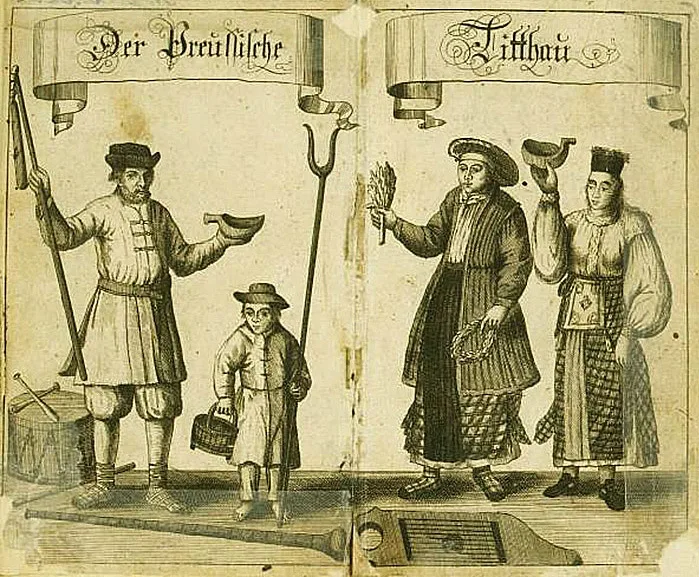
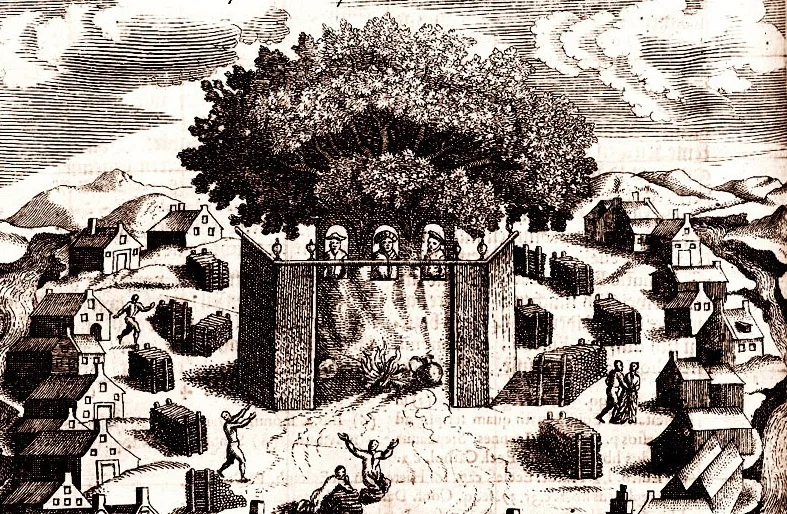
Peasants of Prussian Lithuania.
Drawing from the book by Theodor Lepner, 1690.
The wurschaite holds the cup of beer in his right hand, then takes it in his teeth and, having drunk, throws it over his head without touching it with his hands. Behind him stands the Cziwon (Krivis), or the elder of the district (or one of the community members), who catches the cup and, having filled it with beer again, sets it before the wurschaite. And now he asks Parkuns to protect them from storms and bad weather, drinking a sacrificial cup of beer after the prayer; then he prays to Swaixtix, the god of light, that he may shine graciously on the fields, meadows and flowers. After that they prayed to Pilvitus to help them bring the whole harvest into the threshing barns.
They also pray to the remaining 15 gods, drinking a cup of beer "in praise" to each, again holding it in their teeth without touching it with their hands. Then they sing songs in praise of the gods. If the previous year's harvest had failed, then besides the aforementioned Pergrubrius, Parkuns, Swaixtix and Pilvitus they also pray to Auschauts, so that this year might be kinder to them.
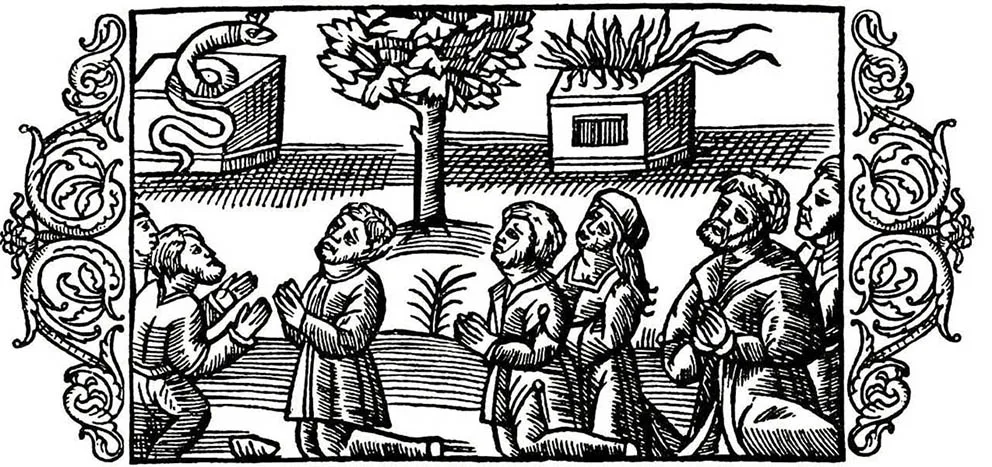
Lithuanians praying to their gods.
Engraving from the book "History of the Northern Peoples" by Olaus Magnus, 1550.
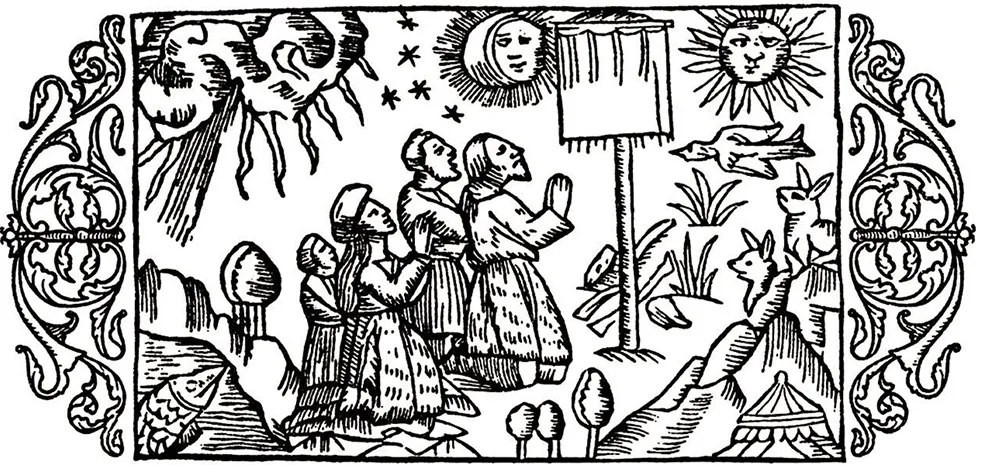
Pagans praying to their gods.
Engraving from the book "History of the Northern Peoples" by Olaus Magnus, 1550.
There is also a known custom in which people from four or six villages gather in one place, collect money, bread and other things and, if there is plenty of money, buy both a bull and a goat with it and go to one house. There they kindle a great fire. And there the women, mixing wheat and buckwheat flour, shape special flatbreads (bread).
The wurschaite, according to custom, puts a crown (a wreath of ears of grain) on his head, lays his hand or hands on the goat or bull and asks the aforementioned gods (each one separately) to accept the sacrifice and the celebration. Then the goat (bull) is led by the horns into the threshing barn or drying barn, where all the men lift it up (hold it above the ground), and the wurschaite, girding himself with a towel (or a bag, according to Maletius), again calls upon the gods with his right hand raised: "This is a sacrifice of praise and a remembrance of our fathers, that we may soften the wrath of our gods...", then, whispering, walks around the sacrificial animal three times ("three steps around the bull") and slaughters it.
Sometimes the ritual is conducted by a blind or lame wurschaite, which points to the chthonic nature of the ritual and its connection with fertility and the cult of ancestors. Let us recall here one-eyed Odin and Baba Yaga with her bone leg.
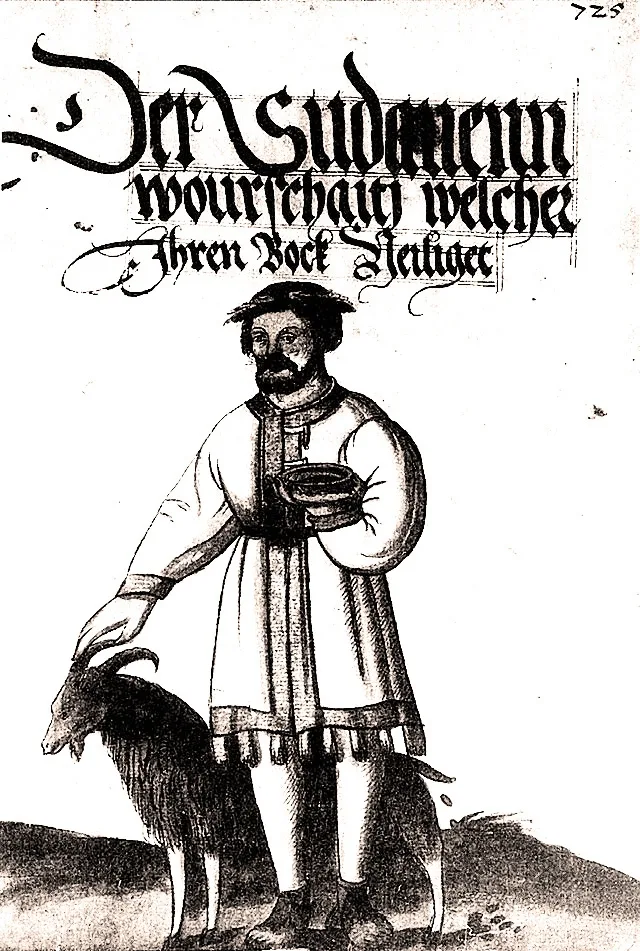
A Prussian (Sudovian) wurschaite priest from Samland and a sacrificial goat.
Engraving. 1520–30.
Then the blood of the bull or goat is not spilled on the ground but collected in tubs, from which it is scooped with a cup or ladle. The wurschaite sprinkles the people with it, and the rest is poured into little jugs and pots and handed out to the people, and each sprinkles the livestock in his own house with it. Brides were forbidden to take part in the rites connected with the first ploughing.
Then the women boil the chopped and butchered bull in a cauldron, while the peasants sit around the fire and the women/wives bring them raw flatbreads, and they in turn, each taking a flatbread, toss them to one another across the fire until they are baked.
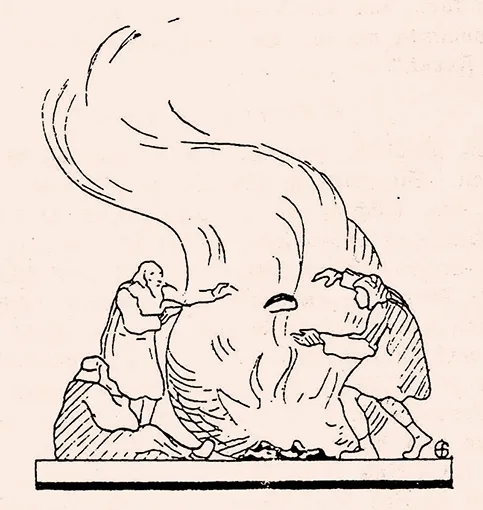
Prussian priests tossing the sacred bread.
19th-century drawing.
.
When the preparations are complete, everyone gathers at the table, after which they all drink and eat, sing and play on "long trumpets" (trembitas). The festival lasts all night. In the morning, as they go through the village to a fork in the road, they carry with them a wheat flatbread and the remains of the festive table and bury it all in one spot, each person adding a handful of earth so that neither a dog nor any other animal can dig it up, and then, leaving this to their gods, they go home.
Interestingly, a similar festival in Prussian Lithuania of the late 17th–18th centuries is also mentioned by Matthäus Prätorius. Thus the ancient pagan customs, changing and in places even "dwindling", survived on the territory of historical Prussia at least until the beginning of the so-called Age of Enlightenment and the onset of Industrialisation. And, nourished by the spirit of Romanticism of the first third of the 19th century, they resurface in the legends and tales recorded here.
Translated from Russian with the help of AI (Claude, Anthropic), October 2026.