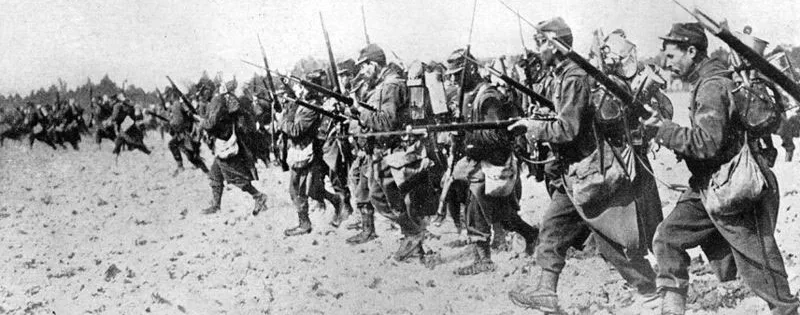
Under the German plan, all the main forces were initially sent to the Western Front. In the first phase of the war East Prussia was to be defended by just one weak army, the 8th, comprising three army corps and one reserve corps. They included 11 infantry divisions (4 of them reserve and 1 Landwehr, i.e. essentially a people's militia), 3 infantry brigades and 1 cavalry division. Facing them were two Russian armies, the 1st and the 2nd. The 1st Army comprised four corps, which included 11 infantry divisions (3 of them reserve) and 5 cavalry divisions, 1 rifle brigade and 1 cavalry brigade. The 2nd Army consisted of five corps, which included 8 infantry divisions and 3 brigades, and 3 cavalry divisions. Counted in tactical units, Russian superiority became even more obvious: they had 352 battalions and 204 squadrons against the Germans' 178 battalions and 24 squadrons. Moreover, the Russian troops were almost entirely regular and professional, whereas the German troops were to a large extent reserve and Landwehr units.
At the start of the war everything, on the whole, went according to the German plan: their troops were advancing rapidly deep into France and were already seriously threatening Paris. Naturally, the French and the British asked the Russians for help. Naturally, the Russians did not refuse. In mid-August 1914, before they had even completed mobilisation, the Russians, "by popular demand" of the allies, launched an offensive into East Prussia.
The 1st Army under General Rennenkampf, advancing from the east, defeated the Germans at Gumbinnen and moved on Königsberg, while the 2nd Army under General Samsonov advanced north from Poland, west of the Masurian Lakes.
And here, at first, everything went according to the Russian plan — if only thanks to numerical superiority. Both Russian armies advanced deep into East Prussia, unhurriedly but confidently. As a result, the nerves of General Prittwitz, commander of the German 8th Army, gave way: he considered the situation hopeless and decided to abandon East Prussia and withdraw behind the Vistula in order to save his army from encirclement and destruction. The troops moved west, and columns of refugees trailed after them. Among the Germans, military and civilian alike, dejection reigned, at times turning into panic.
Unfortunately, the chief of the German General Staff, Moltke, took the only correct decision: he recalled the incapable Prittwitz from the 8th Army, appointing General Hindenburg in his place. General Ludendorff became his chief of staff. These two men were the most talented of all the German generals. They immediately cancelled the withdrawal behind the Vistula. At the same time the Russian 1st Army, content with the successes of the first days, practically came to a halt, thereby greatly easing the Germans' position. And Hindenburg and Ludendorff decided to go over to a counter-offensive with the aim of encircling and destroying the 2nd Army. This plan was exceptionally risky: the German 8th Army did not have numerical superiority even over the Russian 2nd Army alone. Moreover, the 1st Army would then be in the Germans' rear, and at a very short distance. Nevertheless, the German generals assessed the situation quite correctly as regards the almost complete lack of coordination between the two Russian armies and the very poor reconnaissance and logistical support of the Russian troops. Therefore, leaving a single cavalry division against Rennenkampf, they turned the rest of their troops against Samsonov. His 2nd Army was advancing cut off from its rear services (the soldiers were simply starving), on too wide a front (more than 120 km), and its command had practically no full picture of the current situation. In addition, the Germans were reading Russian radio messages, which were transmitted in plain text.
Finally, the success of their operations was greatly aided by East Prussia's well-developed railway network, which allowed rapid manoeuvring of forces of a kind the Russians could not even dream of.
On 26 August the Germans struck at the 1st and 6th Corps on the flanks of the 2nd Army. The fighting unfolded in the area of the localities of Tannenberg, Lautenburg, Gilgenburg, Reichenau, Nadrau, Waplitz, Orlau, Grünfließ, Bartelsdorf, Ortelsburg and Jedwabno (near Olsztyn, on the territory of present-day Poland).
First the 6th and then the 1st Corps began to retreat chaotically, without even informing their direct superior Samsonov, and in so doing exposing the flanks of the 2nd Army. Meanwhile the 1st Army continued to advance very unhurriedly due west, on Königsberg, instead of turning south-west to help the 2nd Army. The Russians lacked coordination not only between armies but even between the corps of a single army, which stood in very sharp contrast to the flawless work of the German staffs.
As a result of the complete disorganisation of the command structures, the 13th and 15th Corps of the 2nd Army continued to advance northwards, knowing nothing of the retreat of the 1st and 6th Corps on the flanks, and thereby drove themselves ever deeper into the "cauldron" the Germans had organised. Meanwhile neither Samsonov nor the higher headquarters of the Russian Army had the slightest idea of what was really happening at the front.
Only on the morning of 29 August did Samsonov begin to grasp, more or less, the essence of what was happening, but he reacted in the most inappropriate way possible: he went to the 15th Corps in order to direct its further advance on the spot, i.e. its further "climbing into the cauldron"! In doing so he lost the last threads of command over his army.
The Germans suffered from a considerable shortage of forces, since they were in fact encircling a larger force with a smaller one, which runs counter to the canons of the art of war. But the chaos of command doomed the Russian army to catastrophe even under these conditions.
On the evening of 29 August Samsonov gave the order for a general retreat of his army, but it reached almost no one and in any case no longer mattered, since the ring of encirclement had practically closed.
The Russian troops were utterly exhausted, and the retreat that had begun completely demoralised them. On 30 August the ring of encirclement finally closed.
Samsonov, who found himself in the "cauldron" together with his army — a brave and honest man, but an incompetent commander — shot himself.
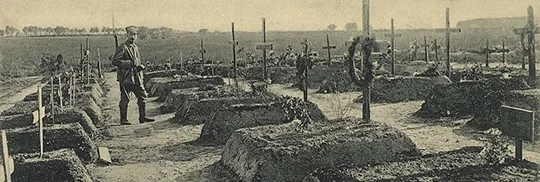
Russian losses amounted to as many as 30–40 thousand killed and up to 90 thousand taken prisoner; German losses were no more than 15 thousand. Rennenkampf not only failed to come to Samsonov's aid by striking the Germans in the rear (even though his cavalry was about 50 km from the epicentre of the Battle of Tannenberg), but after the destruction of the 2nd Army he withdrew from East Prussia without any German pressure, although he could at least have held the German territory already occupied by that time (Stallupönen, Gumbinnen, Tilsit, Darkehmen, Insterburg, Wehlau, Tapiau — today's Nesterov, Gusev, Sovetsk, Ozyorsk, Chernyakhovsk, Znamensk and Gvardeysk respectively), since the German army still had no overwhelming numerical superiority. And only after the operation had ended did reinforcements arrive for the Germans from the Western Front — two army corps and a cavalry division. Hindenburg and Ludendorff no longer needed them. In the end, at the cost of their own catastrophe, the Russians did help their allies. Apparently it was precisely these two corps, no longer required for the defence of East Prussia, that were lacking for the capture of Paris. On the other hand, in 1915 East Prussia became the Germans' most important springboard, from which they invaded the Baltic region and Belarus, aggravating the already very poor position of the Russian army after the Gorlice breakthrough by the German and Austrian armies. In connection with all these events it is impossible not to recall once again the betrayal of Peter III, who returned East Prussia to Frederick during the Seven Years' War. Had it not been for that betrayal, there would have been no such catastrophes a century and a half later, and most likely there would have been no First World War at all.
The author of this article is a convinced anti-communist, yet cannot but agree with the well-known communist propaganda theses: first the Russo-Japanese War and then the First World War demonstrated "all the rottenness of tsarist autocracy". In Russia at the beginning of the 20th century there was a complete decay of the structures of government and a complete loss of ties between the authorities and society. The sacral bond had collapsed, and an institutional one had never been created. The state rested on nothing, and that is why it collapsed at the first strong external blow.
The decay of the state fully affected the army as well, one of the most important institutions of the state.
The destruction of Samsonov's army was a particular, but the most vivid, manifestation of this process. In itself it could not have led to losing the war as a whole (all the more so at its very beginning), but it had enormous moral significance for both sides and showed that Russia had no chance of victory and that its collapse, which followed in 1917, was inevitable.
In August 1914 in East Prussia the Germans won in the full sense "not by numbers but by skill", brilliantly applying the fundamental principle of that very Suvorov who so hated and despised Prussian military ways. A very cruel irony of fate.
Translated from Russian with the help of AI (Claude, Anthropic), October 2026.