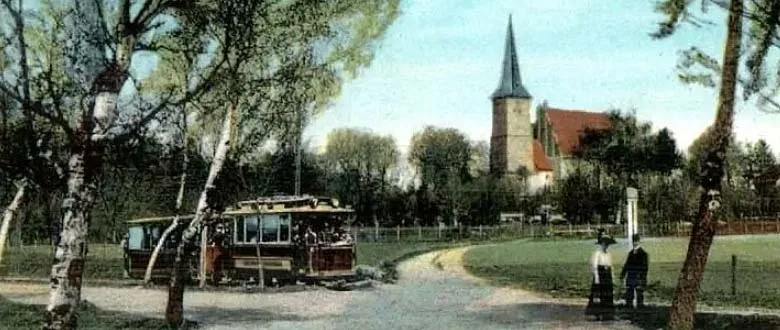
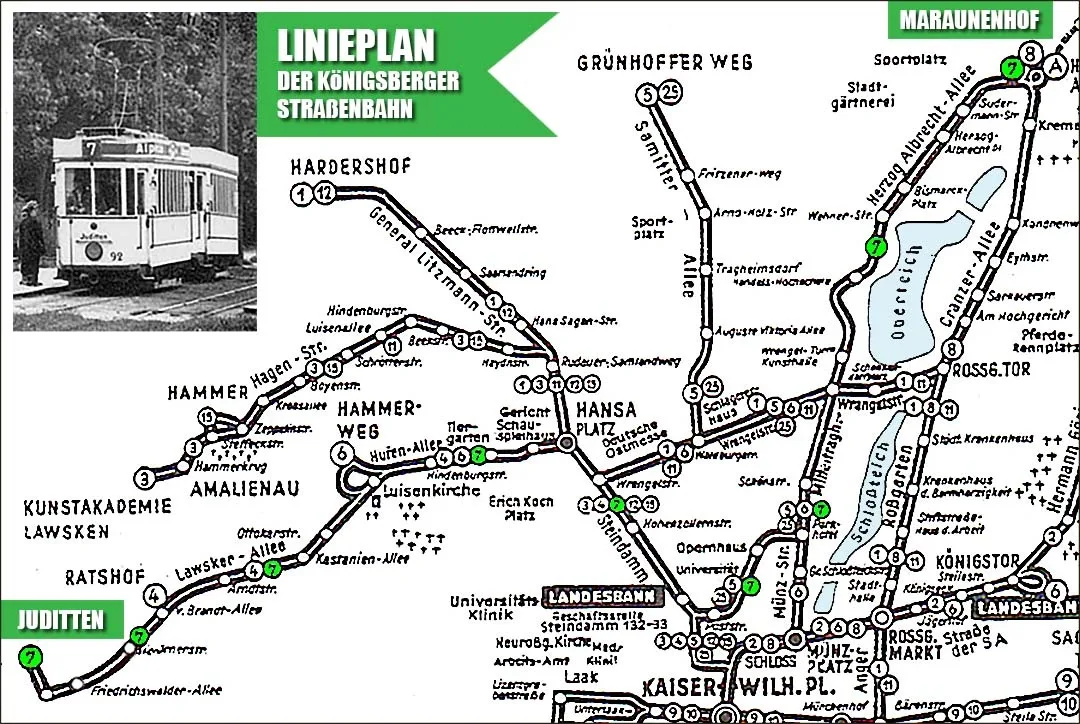
The old church village of Juditten (Juditten) always attracted the people of Königsberg, who came here for a whole day, as is shown by the many little restaurants with verandas here: some stood halfway up the slope in the shade of tall trees, others high up at the edge of the forest. Juditten could be reached by the Old Pillau Road (Alte Pillauer Landstraße) and, closer to our own time, by tram, once line 4, which ended in Ratshof (Ratshof) at the “Korinthenbaum” restaurant, ran from the centre through Amalienau (Amalienau) and Lawsken (Lawsken).
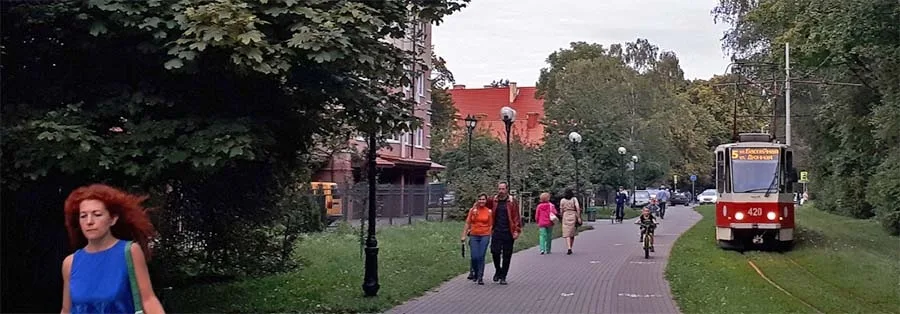
Later still came tram route No. 7, whose terminus was Juditten itself.
The tram delighted not only children, since it spared people a walk that was rather tiring at any age, either along the Hammerweg (Hammerweg) past the twin ponds Zwillingsteichen (Zwillingsteichen) or along the Landgraben (Landgraben) to Wilkie (Wilkie).
A simple country road, laid out later and running straight from the Hammerteich (Hammerteich) through the Friedrichswalde estate (Friedrichswalde) to the “Packheiser” (Packheiser) confectionery, was shorter but entirely treeless, which by no means everyone liked, especially on hot days. Going by tram was quicker and more comfortable.
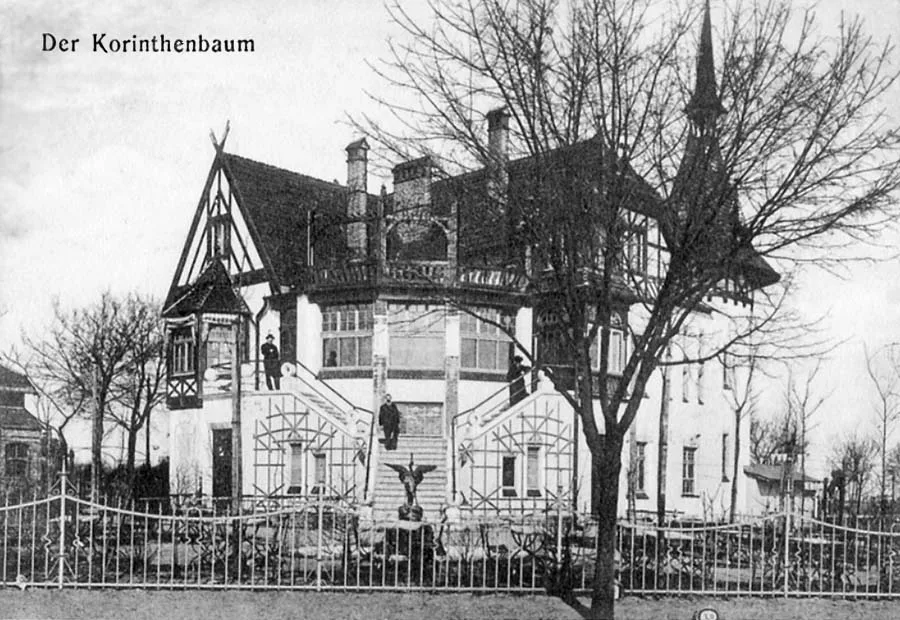
The “Korinthenbaum” restaurant in Ratshof.
As soon as the whole party (grandmothers, aunts and children, of whom there were especially many) got off at the terminus, the colourful crowd would start climbing straight up the slope, amid picturesque greenery, under spreading oaks.
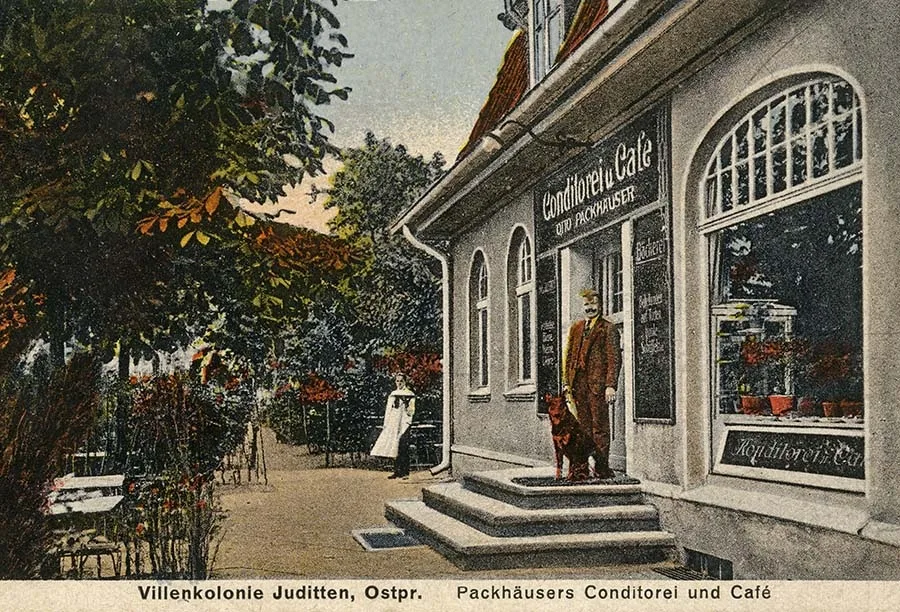 The “Packheiser” confectionery and café in Juditten.
The very first sign with the permission “Families may brew coffee” (Familien können Kaffee kochen) was popular with the grown-ups. But if there were children along, the parents usually had to decide whether to stop here or carry on, for up on the hill, where a little booth with a hand-operated weighing chair used to stand, under the sparse pines, the children had a much nicer time playing, and the grassy lawn seemed to invite everyone accompanying the youngsters to have a quiet rest.
On fine days a lively camp life bustled here, adorned with hammocks strung between the trees, which had become very fashionable at the time.
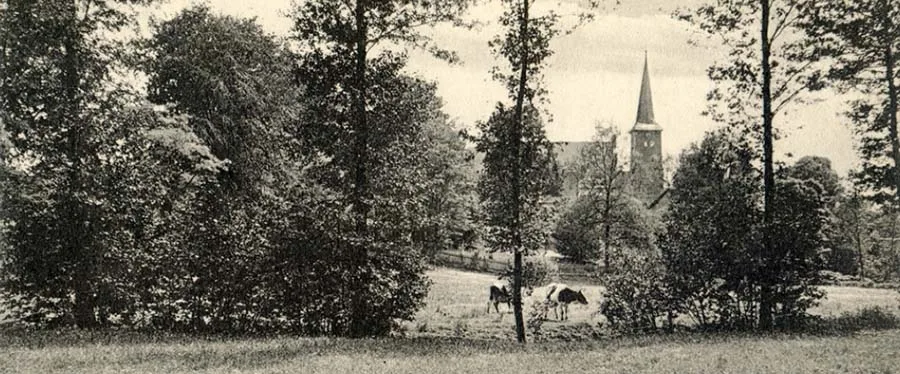
Regular visitors to this quiet oasis, later renamed the Theodor Krohne Grove (Theodor-Krohne-Wäldchen), still remember fondly the many amusements they found here. Secluded paths led to lovely resting places, including down to the meadows, from which there was a view of the old belfry of the Juditten church. If time allowed, one could gather raspberries and mushrooms. The tall oaks on the eastern edge of the grove bordered the gardens of villas, but if you felt like a cup of coffee you could walk past them and head for the “Packheiser” confectionery. We children, though, were fascinated by the pine glade, because there were quite extraordinary trees there: the sand they grew on must at some point have been washed away.
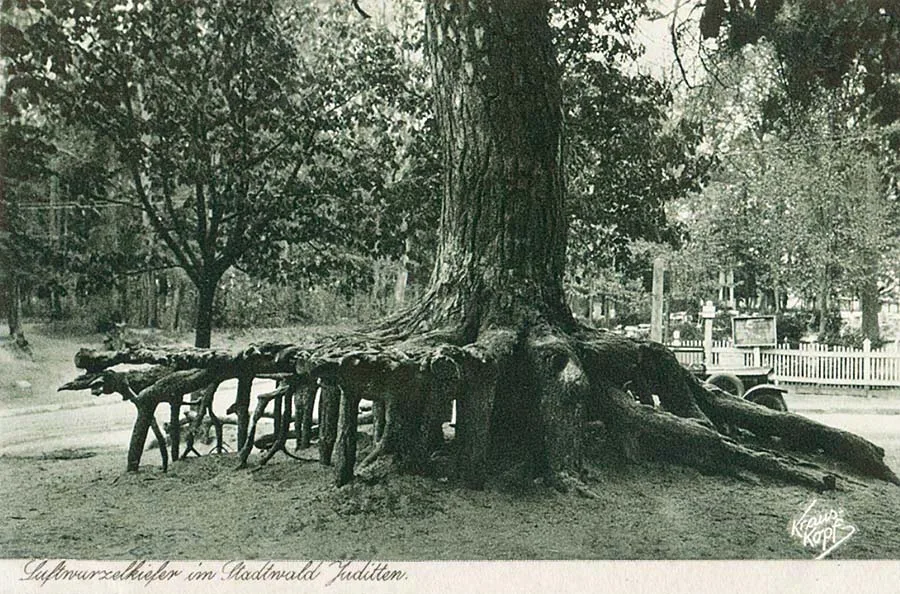
The famous Juditten pine with its exposed roots.
The exposed roots of the trees stuck out of the ground for several metres, forming real caves in which we could hide perfectly!
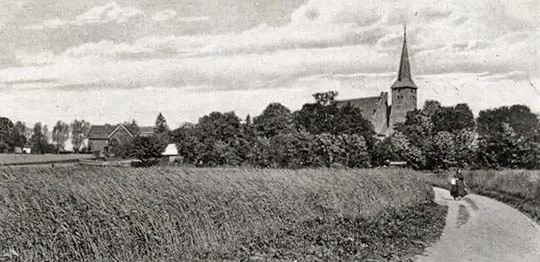
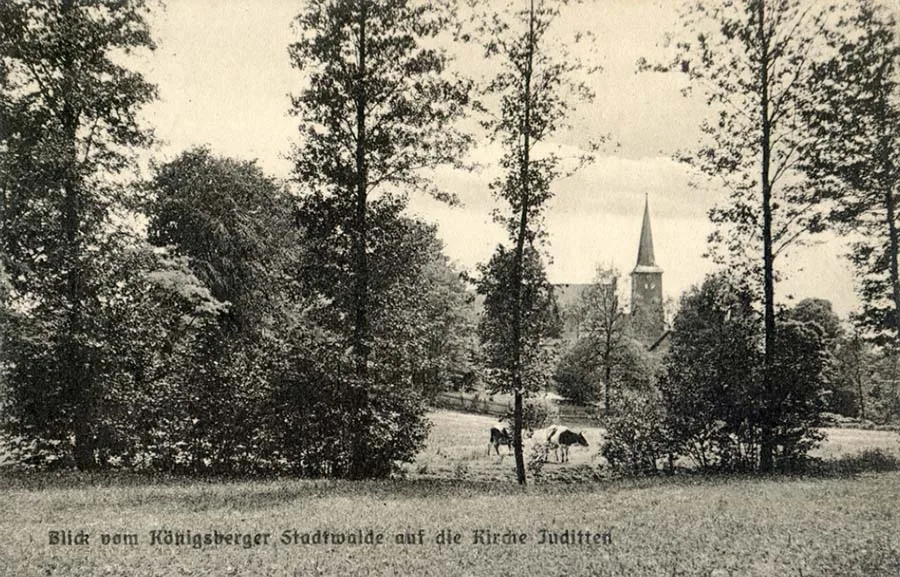 The spire of Juditten church peeps out from behind the trees.
While the little ones were busy with such exercises, the grown-ups could relax carefree on the verandas of the little restaurants across the road. At that time there was hardly any traffic on it. This beautiful Juditten wood was also sometimes chosen for school outings, at least for the younger pupils. Competitions and games were held here, and after all their sporting efforts the children enjoyed well-earned fizzy water or lemonade in the garden of the nearest guest house.
Anyone who wanted to walk a little further west came to the Ring Road (Ringchaussee), where in the evenings there was a particularly beautiful view of the floodplain meadows and the Pregel.
It was just as heartening for everyone returning home along the road from Moditten (Moditten) to see the pointed belfry of the Juditten church appear on the left in the evening haze above the dark green of the trees. And then the tired walkers realised with relief that they would soon be able to board a line 7 tram and ride it home.
Source
https://archiv.preussische-allgemeine.de/1965/1965_08_28_35.pdf
Photos
Bildarchiv Ostpreußen bildarchiv-ostpreussen.de.
● Read on VisitPrussia.com an interview with the translator of German, and in particular Prussian, fairy tales, our regular contributor Tatyana Kolivay, who runs her own blog, where countless other parables, legends and fairy tales in her translations have been published.
Translated from Russian with the help of AI (Claude, Anthropic), October 2026.