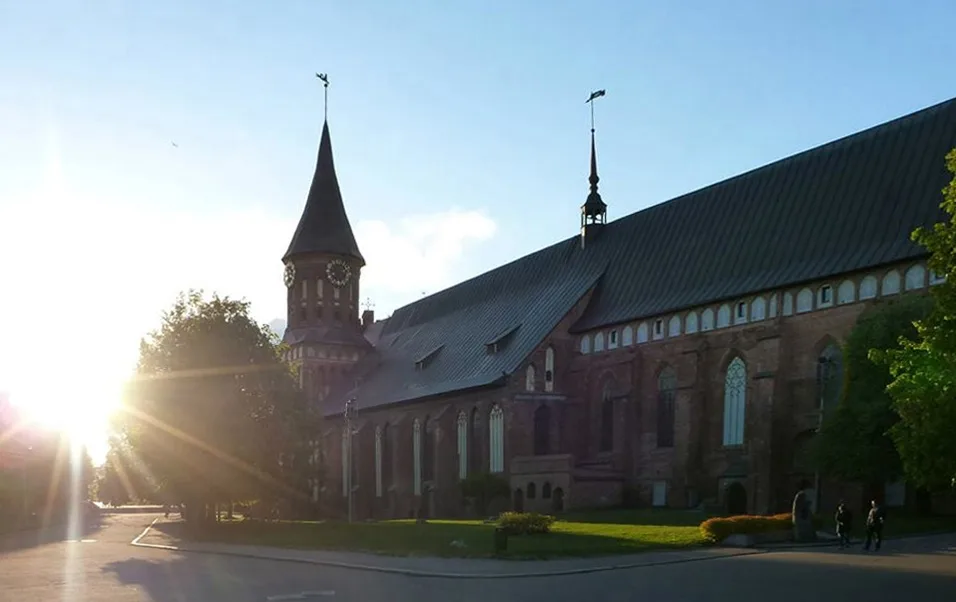
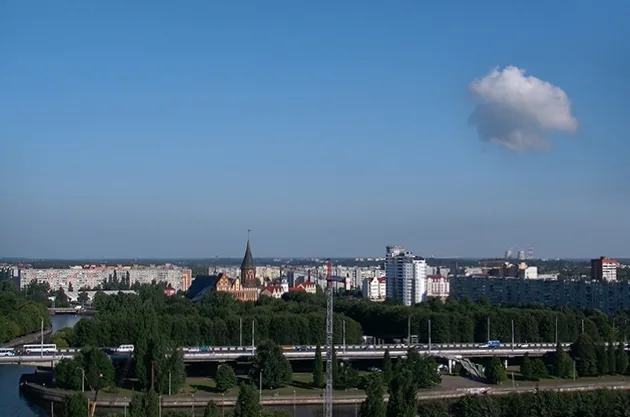
A good discussion is the mark of a serious publication, and I would like to support this initiative and join the debate as another native. I also liked the idea of comparing Kaliningrad not with Moscow or St Petersburg but with cities on the scale of Tula and Penza. Setting the right scale and making sure the objects compared are commensurate is the first condition for sound conclusions, and I will try to develop this line of reasoning.
With all due respect to the previous participants in that debate, from the outside it looks like an exchange of extremely subjective judgements — only in one case they carried a plus sign and in the other a minus sign.
And where one sees a city of "eternal decline and inescapable melancholy", the other sees "the best city on earth". Such an exchange of subjectivities brings us no closer to the answer: why do people choose Kaliningrad as the place to live?
What really drives them? I will try to put that discussion on a more objective footing.
To do so, I will answer four questions as briefly as possible:
1. Who exactly seeks to move to a city like Kaliningrad? (the range of those making the choice)
2. What exactly are they choosing from when they choose Kaliningrad? (the range of options, that is, the space of choice)
3. What criteria do they use?
4. Does Kaliningrad have any advantages by these criteria?
Who moves to Kaliningrad?
Let us leave aside foreign and labour migrants and talk about Russian residents who consciously and voluntarily choose a new place to live. I have no reliable statistics to hand, but I do have several dozen newcomer acquaintances and experience of reading forums for people planning a move. The sample is small, so all that remains is to call on common sense for help.
As far as I can see, three categories of people mainly come to Kaliningrad. As a joke I call them as follows:
"The Frozen" — residents of the northern territories, Siberia and the Far East. The main reason is the harsh climate.
"The Downshifters" — residents of big cities who usually have well-paid remote jobs but are looking for a relatively comfortable urban space with property prices that are more affordable (compared with the megacities).
"The Ambitious" — residents of small towns, villages and depressed regions, for whom moving to Kaliningrad means looking for a place with wider opportunities.
How do people choose their new home?
I think people who are about to move to a new city are least of all interested in what it looks like from "the top floor of some high-rise". Aesthetic criteria matter, but more often than not they recede into the background.
The proximity of the sea and of Europe mentioned in the article "A Hard-Won Happiness" are more important factors in the choice, but far from the main ones, and certainly not the only ones. After all, the sea and trips abroad are for leisure, for holidays and weekends, whereas newcomers, before any leisure, have to learn how to live and earn a living in their new place.
I won't remind you of Maslow's hierarchy of needs, but primary needs are called primary precisely because they make themselves felt constantly and to everyone, whereas secondary needs do so not to everyone and not always — mostly at moments of satiety, comfort and security. Prospective newcomers are usually interested in much more practical and mundane things: the general standard of living, wages, property prices, unemployment, access to high-tech medicine, the presence of serious universities, the crime situation, the environment, the level of infrastructure, the quality of roads. Unlike urban aesthetics, these factors are also remarkable for us in that they can be formalised; they can be counted and presented. In other words, they are objective rather than subjective grounds for a choice.
People choose a city according to their ambitions and means, and the most obvious correlate of a city's opportunities is its size. So size is the primary factor in the choice. Those who aspire to Moscow and St Petersburg won't look in the direction of our exclave; at most they will prefer the Moscow Region, the Leningrad Region or another city of a million. In other words, these are not our people. Then which cities do "ours" choose from? Where can we get that list?
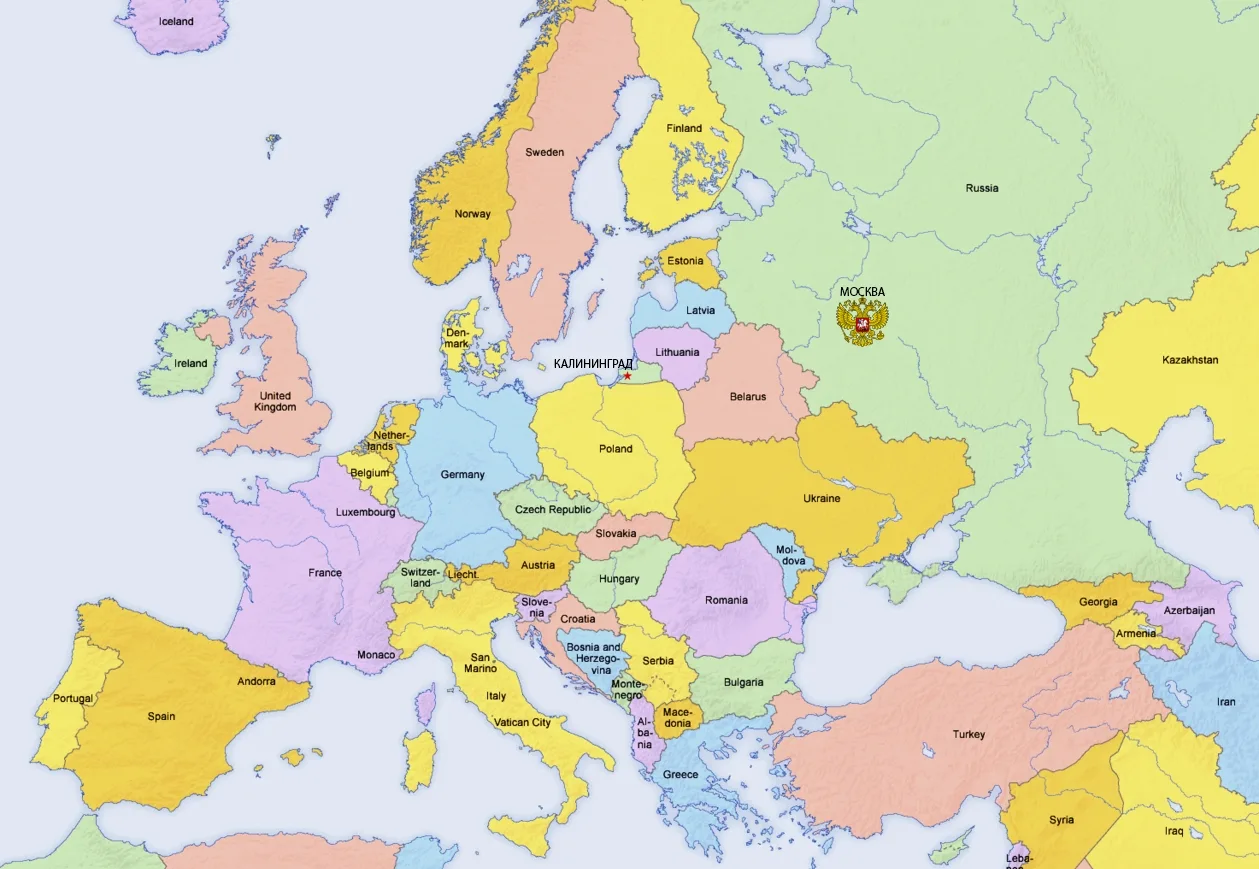
What category of cities does Kaliningrad belong to, and in which segment of the notional market of cities does it sit?
Russia has 85 federal subjects in all — should we regard all of them as our competitors? Of course not. As a starting point, I suggest we recall that Kaliningrad is a medium-sized city: it is one of the administrative centres of federal subjects with a population of less than a million but more than 250,000. We will not touch cities outside these limits (over a million and under 250,000).
Now let us recall that of the 85 federal subjects, 27 are formed on an ethnic basis: these republics, autonomous okrugs and the Jewish Autonomous Oblast are territories where particular peoples live compactly — Buryats, Chukchi, Chechens, Ingush and so on. Clearly, people of other nationalities do not particularly dream of living in these regions, so we will leave them outside our analysis. For now we will also leave aside new federal subjects such as Crimea and Sevastopol, which became part of Russia only very recently. Nor should we take into account the territories of the North, Siberia and the Far East: people usually go there not at the call of the heart but out of work necessity — the climate is too cold and the infrastructure poor. In fact, for exactly these reasons, as I have noticed, it is from there that particularly many people want to move to Kaliningrad.
So, after a series of deletions, our list loses Moscow, St Petersburg and the other 13 cities of a million, along with the Moscow and Leningrad regions, Sevastopol and Simferopol, administrative centres with fewer than 250,000 inhabitants (yes, Russia has those too), and the administrative centres of the ethnic federal subjects and of the regions of the North, Siberia and the Far East.
Now the range of choice becomes far more compact: in reality, on the market of cities Kaliningrad competes in its own special niche, where besides it we find 25 cities of comparable size and status.
These are the medium-sized administrative centres of the krais and oblasts of European Russia, namely (in Russian alphabetical order): Astrakhan, Belgorod, Bryansk, Vladimir, Vologda, Ivanovo, Kaluga, Kirov, Kostroma, Krasnodar, Kurgan, Kursk, Lipetsk, Oryol, Orenburg, Penza, Ryazan, Saratov, Smolensk, Stavropol, Tambov, Tver, Tula, Ulyanovsk, Yaroslavl.
Everything is relative
Now all we have to do is compare the quality of life in Kaliningrad and in these 25 cities (and in the corresponding regions) by the parameters mentioned above (property prices, unemployment, universities, crime, etc.). I do not claim this is a complete comparative analysis; I will note only some data I found in a couple of hours of quick searching online.
For example, you can look at a fairly recent and balanced ranking of regions by standard of living. It is easy to see that of our list only the Kaluga Region ranks above the Kaliningrad Region. The Kaluga Region has in general developed very dynamically over the past decade and has even overtaken the Kaliningrad Region in terms of car ownership.
Then again, of our competitor regions, nobody except the people of Kaluga has managed to overtake Kaliningraders on this score.
Let's see how things stand with jobs.
The unemployment rate in the Kaliningrad Region (the ratio of the number of unemployed to the economically active population) was 5.8% in December 2015. In our list of 26 cities this is somewhere in the middle: in 13 cities the unemployment situation is slightly better than in Kaliningrad, but the difference is within 2%, that is, insignificant.
Some websites offer more integrated indicators, for example a ranking of the labour market attractiveness of Russia's largest cities in 2015. Here Kaliningrad looks even more attractive within its segment: of our list, only Yaroslavl, Ryazan, Vologda, Tula, Lipetsk and Penza are ahead of it.
Let's look at the property market: how are we doing on the price per square metre?
Here the Kaliningrad region has nothing to boast about: in most of the regions on our list property is cheaper. But the difference is usually small; housing prices are substantially lower only in the Astrakhan, Bryansk, Kursk, Saratov and Stavropol regions. Then again, this indicator can be seen differently: perhaps such low prices in these regions are explained by low demand, which in turn is linked to poverty and to the small number of people wishing to move to the region permanently? Does that speak well of a region? Each case has to be examined separately.
Let's move on to other factors. Take education.
There are schools everywhere, and universities too, but where is there top-level higher education — a federal university? Of our list, only in Kaliningrad and, with some reservations, in Stavropol (only part of the Southern Federal University is located there).
Take high-tech medicine. The Kaliningrad Region has many problems here, but who doesn't? Let us remember that cardiovascular diseases traditionally top the list of causes of death, so people are above all interested in access to cardiovascular surgery centres. Remember that marvel, the national project "Health"? Under that project, seven regional cardiology centres were built at the time. Only seven! Including one in Kaliningrad! Isn't that a reason to choose Kaliningrad for a move? Then again, among our competitor cities there are also cardiology centres in Astrakhan, Krasnodar, Smolensk and Penza.
To be honest, the federal university and the cardiology centre came to us somewhat beyond our status. It is fitting to mention here the special attention of the federal centre, thanks to which the exclave region regularly benefits from such lavish handouts. In the same way it managed to snap up a share in hosting the FIFA World Cup and large-scale infrastructure projects such as the Primorskoye Ring. Few of our competitor regions can boast such federal injections (and these mean not only money but also jobs).
As for crime, I did not see in open sources that Kaliningrad stands out much for better or worse; in this respect it is an ordinary middling city. But its natural riches are what make our life here special.
It is not only the sea but also two spits, lagoons, the unique Lake Vištytis, the Rominta Forest. Of course, among our "competitors" there are sunnier and warmer regions — there is watermelon Astrakhan, sunflower Stavropol, there is Krasnodar Krai with a whole garland of Black Sea resorts — but otherwise we are perfectly competitive. To this we should add a unique cultural heritage: there is probably no other city in Russia that has combined so densely (if eclectically) three highly heterogeneous layers of cultural and historical landscape (German, Soviet and post-Soviet Russian culture). However, that is largely an aesthetic question, that is, a matter of taste.
And only after all this would I mention the geographical proximity of the Kaliningrad region to Europe. But the author of the article "A Hard-Won Happiness" seems to have said this very succinctly. I wanted to draw attention to other, no less important reasons why our compatriots leave their native places and become newly converted Kaliningraders. These reasons are usually quite prosaic, rational and pragmatic, which in no way prevents me, as a second-generation native, from saying to all these people: welcome!
Translated from Russian with the help of AI (Claude, Anthropic), October 2026.