On the History of Land Reclamation in East Prussia
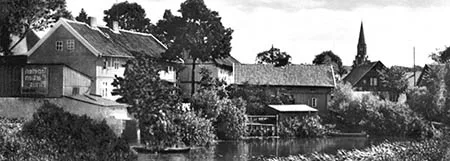
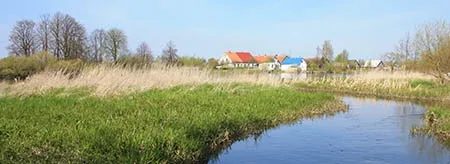
"The climate (excessive moisture) and the structure of the soil (a predominance of clay and loam) in East Prussia made land drainage, that is, the removal of surplus water from the fields, a necessity. It was only thanks to land reclamation that about 72% of the land became fit for agriculture. Drainage work began in East Prussia in the time of the Teutonic Order, which invited the Dutch, who had extensive experience of such work, to settle permanently. Traces of Dutch activity can be found in the Polish part of East Prussia, on the fertile lands that used to be flooded by the waters of the Vistula."
Herrgeist F. Die Deutsche Wasserwirtschaft im ehemaligen Westpreussen.
Auszug aus einer Ostdokumentation für das deutsche Bundesarchiv.
Sonderdruck aus der Schriftenreihe des Kuratoriums für Kulturbauwesen, Heft 15.
Hamburg: Verl. Wasser und Boden. 1967.
According to the Soviet land reclamation services (mid-1950s), the region had 14 hydrological basins comprising 365 drainage systems and about 145 pumping stations, which drained 108 polders (embanked areas) with a total area of 103,000 hectares. The coastal and protective dykes were more than 625 km long. The total length of the canals in the Kaliningrad Region, including the open collectors of the drainage systems, was estimated at 26,317 km (!). The total length of the closed network (underground drains) was estimated at 420,000 km (!): "The length of its underground lines, laid end to end, exceeds the circumference of the Earth at the equator tenfold."

An example of a drainage network plan.
Illustration from the book: Land Reclamation in the Kaliningrad Region.
Eds. S. Brazhnikov, V. Rozin. Kaliningrad: Kaliningrad Book Publishers, 1965.
It is the densest land drainage network in Europe. It required constant and costly maintenance, and building and developing it was also very expensive.
As the East Prussian German economist Dr Hans Bloech wrote, "the continued upkeep of the dykes and drainage ditches, as well as of the lifting gear and pumps, cost a great deal of labour and money, which the German population paid constantly, since these outlays more than paid for themselves."
Bloech, H. Ostpreußens Landwirtschaft. Leer, 1979. Translated by A. Sologubov
"The first systematic land reclamation work on the territory of today's Kaliningrad Region was carried out in 1613–1616 in the Gilge – Tawe – Sköpen area (Herrgeist F., 1983). Large-scale reclamation work began in the 19th century. According to Fritz Herrgeist's estimate, the Germans invested a total of 188 million Reichsmarks in the East Prussian drainage system, which corresponds to roughly 2.3 billion marks at the 1979 rate. Since statistics are missing for some years, the total cost is estimated at 4 billion marks. Initially, reclamation work was financed by the state. In the mid-19th century the state handed over responsibility for carrying out reclamation work and maintaining the drainage system to public associations, the land drainage cooperatives, of which there were 597 in East Prussia as a whole by 1928."
Fritz Herrgeist, a German land drainage specialist
who worked in East Prussia.

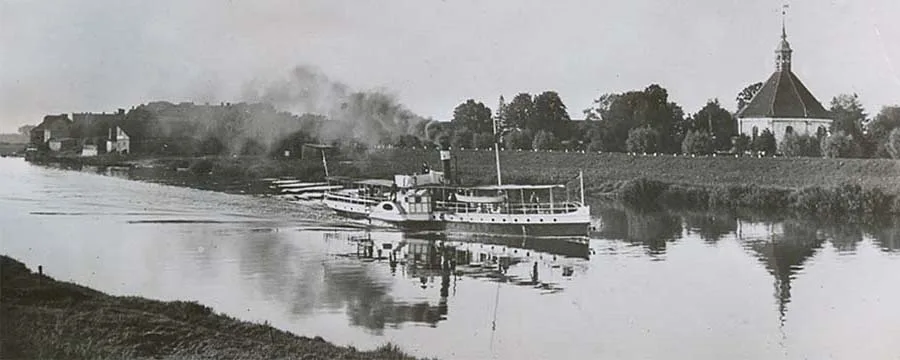
A new canal. Early 20th century. East Prussia.
Photo from the book by H. Bertram. Die Entwickelung des Deich- und
Entwasserungswesens im Gebiet des Danziger Deichverbandes, 1907.
Despite the large number and fragmentation of both the landholders and the drainage cooperatives, reality forced them to cooperate. The drainage system was becoming ever more complex and dense, and its further development called for coordinated action. The State Archive of the Kaliningrad Region holds a small collection of German documents that reflect this trend in the 1920s.
"Such piecemeal action was, admittedly, typical of the construction of all earlier dykes. In Holland, too, at first small areas, those best suited by their natural conditions, were embanked, and only later … did large associations arise which jointly built dykes and other structures that were technically complex and involved great expense. … In the Vistula flood zone, too, numerous small, mutually independent associations recently merged into the large Vistula–Nogat Embankment Association. Where no such merger took place, internecine strife broke out which, as on the East Frisian coast, led to general collapse. As regards the present case, this strife between the associations has already begun and would undoubtedly become extremely acute with every new partial embankment, giving rise to endless lawsuits."
Kurisches Haff. Documents of the Nemonien Embankment Association.
Tawellningken polder. 1922 // GAKO. F. 55. Op. 1–4. File 41.
The German Drainage System and the First Settlers' Collective Farms
The German drainage system proved a curiosity to the Soviet settlers, who had never seen anything like it. For instance, as the first settlers told the author, the clay drainage pipes buried in the ground everywhere were sometimes taken for sapper work the Germans had left unfinished. Naturally, the pipes were regarded as dangerous objects and were removed from the fields and vegetable plots. Deep ploughing, which is unsuitable for local conditions but was used everywhere, also badly disrupted the drainage.
The wrong farming techniques were used, such as haphazard ploughing. In the process, a system of organised surface runoff that had been built up over centuries was destroyed.
The Kaliningrad land and water authorities ran regular information campaigns, notably in the periodical press. So-called "land reclamation months" were organised. The Kaliningrad newspapers of the first decade are full of appeals to preserve the drainage system. Here are a few excerpts from 1947 alone.
"The specific conditions of the region (increased soil moisture) oblige us to make wide use of the drainage system. Therefore, while the weather is dry, the drainage canals must be cleaned and the drainage system repaired. In spring it will be too late to do this work. The district land authorities and the regional land reclamation department must familiarise the collective farmers with drainage and the draining of soil and organise the clearing of blocked canals."
A. Stromsky, head of the Kaliningrad Regional Land Department.
"Kaliningradskaya Pravda", 1947.
"The lands of the Kaliningrad Region are excessively rich in moisture. Drainage pipes have been laid under the fields, leading into drainage ditches. Most of these ditches are choked with debris, and in spring the surplus water, finding no outlet, will pour onto the fields and may turn them into swamps. Almost nowhere is anyone clearing the ditches and inlet wells. … The trouble is that no one has yet explained to the collective farmers why this work is necessary."
"Kaliningradskaya Pravda", 1947.
"On the Stalin collective farm and many others the drainage system is clogged, meltwater stagnates on the fields and threatens to delay sowing. Yet the agriculture department has taken no measures to drain the fields."
"Kaliningradskaya Pravda", 1947.
A territory that had already been developed ought to have prompted certain actions on the part of the settlers. Appropriate new structures should thus have emerged in the new community.
"The reconstruction of the region's old drainage systems and the creation of new ones, as well as keeping them in good order, make it necessary to set up a number of district machine-and-reclamation stations in the region, to organise machine-and-reclamation teams at the machine and tractor stations, and to organise special teams on the collective and state farms that will constantly monitor the drainage system within their own farm."
State Archive of the Kaliningrad Region.
F. 297. Op. 12. File 6. Sheet 204
"…drainage systems cannot do without such a service, otherwise these lands will sooner or later drop out of agricultural use."
Reports on the state of the drainage systems
and on the fulfilment of the water management construction plan
for 1955–1956 // GAKO. F. 86. Op. 1. File 105.
Difficulties in Operating and Reconstructing the Drainage System in the Kaliningrad Region
In operating and reconstructing the existing drainage network, Soviet reclamation engineers faced a number of difficulties, above all of a structural and organisational nature. Many forms of organising the work were tried:
"Since the merger of the state farm administration with the agriculture administration, the state farms' reclamation workers have been operationally and technically subordinate to the system administrations of the regional water management authority, while drawing their wages from the state farms and remaining administratively subordinate to the state farm directors.
This dual subordination has an extremely negative effect on the performance of reclamation work."
"Even we, inveterate water engineers, are beginning to get confused and lost in sorting out the functions of all these organisations. … Isn't it time we returned to the form that existed in Central Asia until 1932, when all water management work in a district was carried out through a single organisation?"
"Forms of organising the maintenance service on the collective farms have not yet taken shape here. We tried setting up reclamation teams, work units, a system of repairmen, but none of these forms took root."
"N. S. Khrushchev expressed the opinion at the time that the maintenance service in the region should be organised along the lines of those in force on the railways."
Materials on the history of the Kaliningrad Regional
Water Management Administration for 1946–1964 (orders, decisions, reports, etc.)
GAKO. F. 86. Op. 1. File 4.
Many inconsistencies arose in the course of restoring the drainage network.
A government decree obliged the various agencies to restore the drainage systems within the boundaries of their landholdings and, once restored, to hand them over for operation to the Regional Water Management Authority, which was entrusted with inter-agency control and supervision. However, not all agencies took up this work, and, understandably, there could be no question of a systematic approach.
"In our region, where agriculture is based almost exclusively on drained land, we have become convinced that in matters of design and survey work, construction and maintenance there must be no departmental boundaries … water management work must be directed by a single inter-agency organisation, and we believe that this organisation should be the Ministry of Water Management."
Materials on the history of the Kaliningrad Regional Administration
of Water Management for 1946–1964 (orders, decisions, reports, etc.)
GAKO. F. 86. Op. 1. File 4.
A further difficulty arose from the fact that the drainage system had originally been designed to operate under individual land tenure.
Accordingly, the drainage network was adapted not only to the terrain but also to the boundaries of the landholdings.
"In a number of cases, when the collective and state farms were organised, the existing drainage systems proved unsuited to the new conditions of large-scale socialist farming. The collective and state farms of the region had to expand and reconstruct them."
Ozhevsky P. G. The Kaliningrad Region
(an economic and geographical profile)
GAKO. F. 297. Op. 128. File 6.
Land management in the region was carried out taking into account only the open drainage network, since there was no technical documentation for the underground drains. As a result, individual drainage systems came to lie within the boundaries of different land users (the lands of collective farms, state farms, forestry enterprises and the state land reserve). Out of the 365 drainage systems in the region, 342 thus ended up spanning more than one farm. This made operating the drainage network extremely difficult. For example, neighbouring land users growing different crops needed different drainage regimes, which were impossible to provide when the boundaries of the landholdings and of the drainage systems did not coincide.
Great complications arose from the "conflict" between the planned economy, with its large farms, and the local soil and climatic conditions.
An expedition of the Dokuchaev Soil Institute found that the region had developed a rich variety of soils: a single field might contain three or four different soil types, which behave differently with respect to water and require different drainage regimes. This "rules out the possibility of applying any single scheme for the mechanical distribution of agricultural crops across the districts and collective farms of the region." Planning considerations meant that the specialisation of some farms did not, from the outset, match the natural conditions and the degree to which the land was drained: "for instance, on low- and medium-level polders there are farms with the same range of crops as on gravity-drained systems."
Reports on the state of the drainage systems and on the fulfilment of the plan
for water management construction for 1955–1956.
GAKO. F. 86. Op. 1. File 105.
Many drainage systems were in an unsatisfactory state. Different explanations were given for this on different occasions. Newspapers and official documents intended for "external" consumption claimed that the Germans had deliberately destroyed pumping stations, bridges and dykes during their retreat, and that all the drainage systems had been put out of action by the fighting.
"Internal" documents point to a whole range of factors behind the condition of the drainage system at the time: the fighting, post-war dismantling, the theft and destruction of equipment, and lack of maintenance.
Later, missing units had to be brought in from the Soviet occupation zone of Germany. The restoration of the drainage networks was further complicated by the absence of German technical documentation, particularly for the underground drains.
A considerable role in maintaining the drainage system was assigned to the population. For example, in order "to secure high yields on the land in use and to bring new areas into agricultural use after their reclamation", the Polessk District Executive Committee adopted a plan of water management measures for 1948 totalling 238,730 roubles, of which the state budget's share was 56,980 roubles and the local budget's 14,600 roubles, while the remainder, 167,150 roubles, was covered by the labour of the population. Land reclamation was declared a people's construction project.
State Archive of the Kaliningrad Region. F. 210. Op. 1. File 3. Sheet 148.
"However, despite the considerable amount of work done to restore the drainage systems, the condition of the drained lands cannot be considered satisfactory, and not only for organisational but also for technical reasons."
Reports on the state of the drainage systems
and on the fulfilment of the water management construction plan for 1955–1956.
GAKO. F. 86. Op. 1. File 105.
Despite the urgent need to restore the drainage system in the Kaliningrad Region, large capital investment and the sincere efforts of reclamation specialists, its restoration and reconstruction dragged on for decades.
Thus a complex spatial and economic structure, which required specialist knowledge, considerable material expenditure and organised physical effort to be used and maintained successfully, was left to decay.
Here is a typical example of the state of the drainage system as of 1985:
"Current state of the drainage network.
The site under design is currently drained by an open network over an area of 132 ha and by selective underground drainage over 78 ha; 177 ha are undrained. The existing drainage system is in an unsatisfactory state. The open canals are silted up and overgrown with trees and shrubs, and the outlets and wells are partly destroyed. Owing to excessive moisture, intensive use of the land in its present state is not possible."
Working design for the restoration and reconstruction of the drainage network
on the lands of the "Pervomaisky" collective farm, Zapgidrovodkhoz. Kaliningrad, 1985.
Copy in the author's possession.
Today intensive farming in the Kaliningrad Region is possible only if the drainage network is restored or created anew.

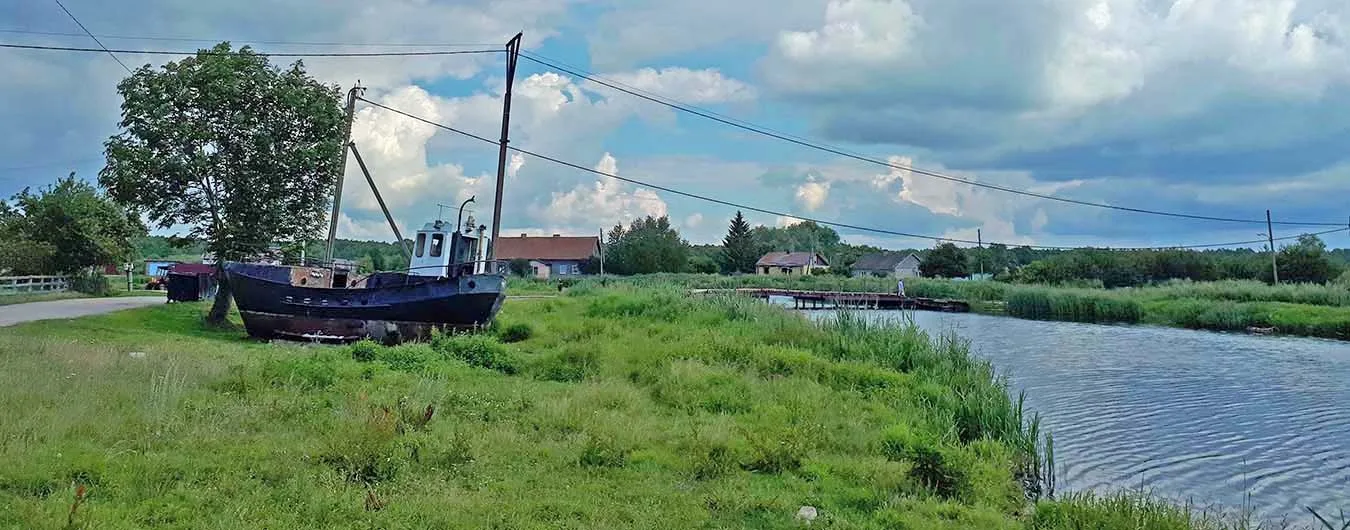
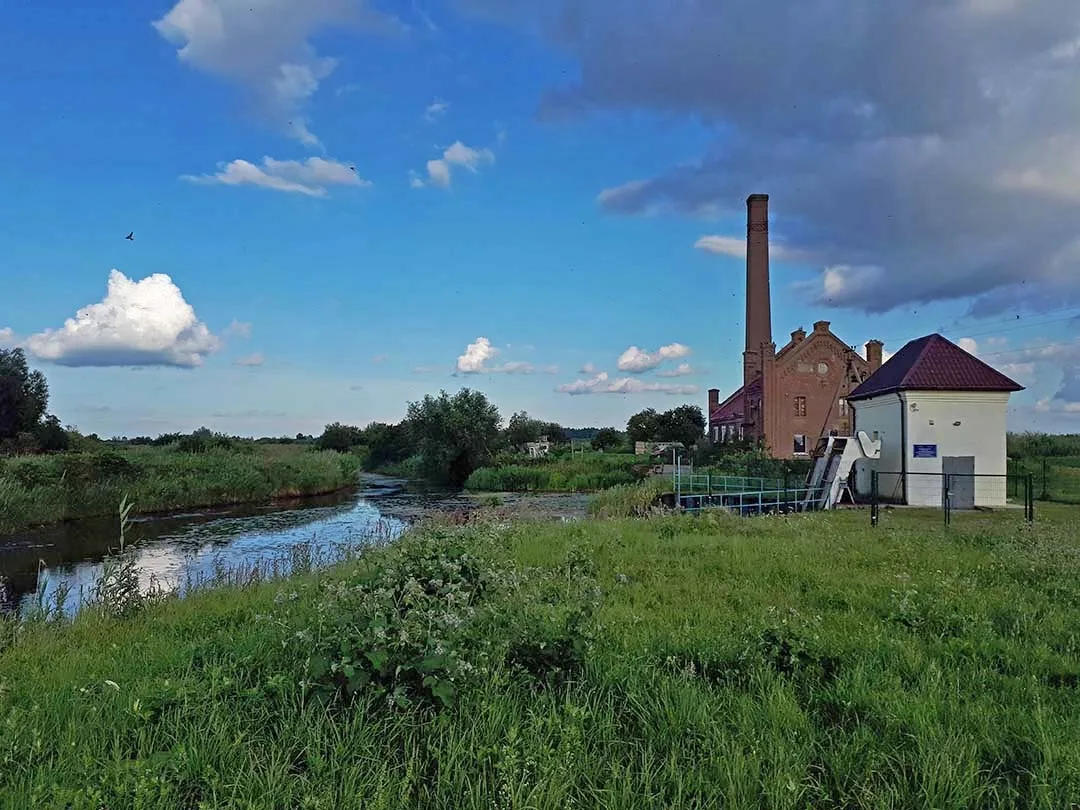
Electric pumping station. 2008. Slavsk District.
This article draws on archival documents and newspaper publications from the 1940s–1950s, as well as on publications by German land drainage specialists and economists who worked in East Prussia before the war.
Photos: Aleksandr Sologubov, Mikhail Ogorodnikov (top).
Translated from Russian with the help of AI (Claude, Anthropic), October 2026.