The interest was explained not only by the romantic aura that surrounded the ideas people living in the USSR had about the Poles and Poland. The neighbouring country owed its popularity in particular to Edita Piekha, a Pole by nationality and the idol of our grandparents' generation, who unexpectedly became a wildly popular singer in the Soviet Union in the 1950s; to the magnificent Anna German with her unforgettable hit "Nadezhda" ("Hope"); and to Barbara Brylska, the elegant Polish actress who for four decades now has been appearing on our television screens on New Year's Eve in the (by now thoroughly tiresome) film "The Irony of Fate".
Yet for a long time the people of Kaliningrad knew their neighbours across the border only from television programmes.
Many watched the broadcasts of the international song contest in Sopot, which Soviet television showed every August. People also listened on the radio to the Festival of Polish Song in Opole, and even to the festival of military song in Kołobrzeg! Polish performers, I dare say, were far better known to Kaliningraders than to other inhabitants of the USSR. The unforgettable Seweryn Krajewski, leader of Czerwone Gitary, with his famous hit Nie spoczniemy; Czesław Niemen with his powerful voice, the creator of a musical world of his own; Maryla Rodowicz, Sława Przybylska, Irena Santor and many other performers opened the door to Polish culture for us. And what about the bands Skaldowie, Budka Suflera, SBB? Those who love Poland remember. In 1978, as part of his tour of the USSR, Czesław Niemen came to Kaliningrad. The excitement was off the charts! The Rossiya cinema, where he gave his only concert, was packed, with people standing even in the aisles.
The love of Soviet citizens for the Poles bordered on the absurd.
Soviet television had a comedy programme, "Kabachok 13 stulyev" ("The 13 Chairs Tavern"), in which actors of the Satire Theatre for some reason pretended to be Poles visiting a Polish café. There they also lip-synced popular Polish songs. The programme was on the air from January 1966 to October 1980. Filming was stopped in November 1980 after the political situation in Poland grew tense.
For interested Kaliningraders, learning Polish began with listening to Polish radio every day, especially its music programmes. A great help to learners were the magazines sold at the Soyuzpechat kiosks. Kaliningrad's fashionable women studied closely, and even tried to read, the magazine Kobieta i Życie ("Woman and Life"), while artists subscribed to the magazines Projekt ("Project") and Sztuka ("Art"). They were very useful: one could not only look at the pictures but also try to read articles that were highly untypical for the USSR. Many people liked the pictures so much that it became ridiculous: some of Kaliningrad's "unofficial artists", members of the association "Vremya i my" ("Time and Us"), simply copied abstract works out of "Sztuka". But it was very "avant-garde", and the progressive intelligentsia was eager to get into the association's exhibitions – especially after the scathing article "Soap Bubbles" in the newspaper "Kaliningradskaya Pravda"...
A Polish-Russian dictionary could not be bought in Kaliningrad. It simply was not on sale.
A friend of mine brought me such a dictionary from Yerevan, where it was freely on sale, of no use to anyone. Armed with a dictionary, one could start learning Polish seriously. Getting into a Polish language course was also difficult. One of the groups met at the regional library, in a tiny room right at the top, and admission was limited precisely because of the small size of the room. To acquire a knowledge of Polish one had to climb on foot to the 6th floor, because the library lift had got firmly stuck at the 4th back in the wild war years. The cleaning lady used the lift car as a cupboard and kept her buckets and mop in it.
A friend of mine learned Polish by translating Stanisław Lem's books on his own. There was a bookshop well known in Kaliningrad, "Znaniye", on Leninsky Prospekt, with a department of literature from the socialist countries. Nothing special – simply literature from the so-called "socialist camp countries": German, Czech, Hungarian and Polish books in the original language. The Polish ones were by far the most popular.
All the more so since in the USSR there was, for some reason, a terrible shortage of decent books.
At that time many people were keen on science fiction, reading Snegov, the Strugatsky brothers and Stanisław Lem. And Lem's books that had not been translated into Russian could easily be bought at the "Znaniye" shop. My friend loved Lem so much that he learned the language in the course of translating his works. And it came in very handy when the border was opened in 1991.
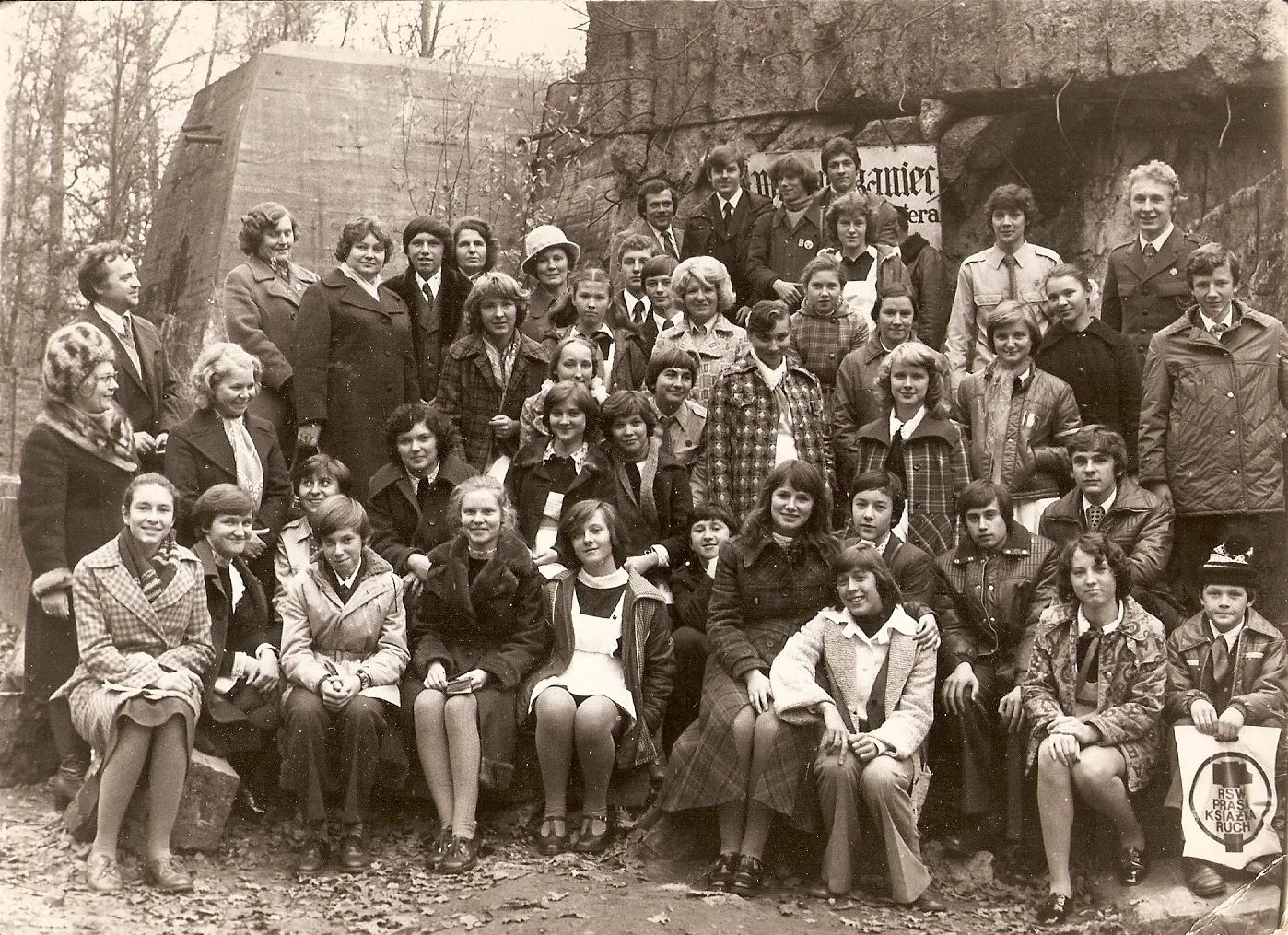
In those far-off days the Soviet leadership was watching events in Poland closely and suddenly, for some reason, decided that the schoolchildren of Kaliningrad should make friends with the harcerze scouts of the Warmian-Masurian Voivodeship. In the spring of 1978, out of the blue, an order went round the Kaliningrad schools to gather three busloads of schoolchildren – top students and good students – who could worthily represent "the student youth" in Poland. Early in the morning the buses crossed the border, specially opened for them at Bagrationovsk, and headed for three Polish towns: Bartoszyce, Kętrzyn and Olsztyn.
The appearance of the schoolchildren from the Kaliningrad Region caused a sensation; they were very warmly received in the Polish schools. That same evening the buses returned. But for some reason the return visit of the Polish schoolchildren never took place.
Judging by the broadcasts of Radio Liberty, something was brewing in Poland... It was then that Kaliningraders first heard the names of Jacek Kuroń, Adam Michnik and Lech Wałęsa. And in July 1980 strikes began at factories in Lublin. The Lublin protests spread to Gdańsk. The legendary strike at the Lenin Shipyard began on 14 August 1980. It was very close. Now we know that Gdańsk is only three hours away by car, but back then we simply followed the events at the shipyard with excitement. At least something genuine and alive was happening there, while in the USSR everything was still as stagnant as a swamp. The Poles, right there next door across the border, were really turning up the heat. And Kaliningrad just listened to what was going on at the neighbours'...
On 13 December 1981 martial law was introduced in Poland. It is no secret that a powerful military force was stationed in the Kaliningrad Region, and many Kaliningraders had acquaintances or relatives in the barracks.
After martial law was introduced next door, people here wondered: would our troops be sent in, as in Czechoslovakia in 1968, or not?
The troops were not sent in, but they carried out strange manoeuvres. As an acquaintance of ours who served in an artillery regiment told us, an order came to move into Poland; the regiment crossed the border in an orderly column, made a circuit on Polish territory and came back. Such manoeuvres continued throughout the whole period of martial law – until July 1983. People were curious: what was really going on there, in Poland? What, for example, was Polish TV showing? And Kaliningraders began to acquire television aerials "for Poland" en masse. They were made by skilled hands – graduates of the radio engineering faculty of KVIMU (now BGA). True, if someone carelessly hung such a thing on their balcony, the local police officer might turn up with a representative of the housing office and demand that the "unauthorised aerial" be removed. So people hung them inside their flats, on windows facing south or south-west.
By this time something had begun to change in the USSR too... On 10 November 1982 Brezhnev died. Then Andropov. Chernenko's rule was marked by a revived interest in cultural contacts with the Poles. Suddenly the regional Party committee asked the local branch of the Union of Artists to prepare an exhibition to show in Olsztyn. It was taken there by the then chairman of the Union, the ceramic artist Vladimir Alekseyevich Andreyev. On his return he said they had been well received, except that at the banquet in the hotel the local artists, having had a few drinks, began to reproach him for the actions of the USSR – Katyn and so on... They nearly came to blows. It was decided not to take any more exhibitions to Poland. However, this incident did not prevent Kaliningrad graphic artists from taking part in Polish biennials. Especially popular was the ex-libris biennial in Malbork. Works could be sent there simply in a postal envelope, which made communication much easier. In this way works by the Kaliningrad masters Sergey Tyukanov and Nikolay Batakov ended up in the unique ex-libris collection of the castle museum in Malbork.
And then came the Gorbachev era – the famous perestroika and glasnost.
In 1987 the Polish airwaves were flooded with Andrzej Rosiewicz's (Andrzej Rosiewicz) song "Mikhail, Mikhail, this song is for you". But the border was still under lock and key. True, "meetings of Soviet and Polish youth" were now allowed near the border on our side. The region was opened to foreign visitors only in 1989, and even then they had to enter via Lithuania. In 1990 the first checkpoint on the Lithuanian-Polish border, "Lazdijai", was opened. Kaliningraders rushed to Poland. It turned out that one could do business there: selling vodka, tinned food, clothes and crockery, and buying hard currency in return. Finally, on 26 December 1991, the Mamonovo–Braniewo border crossing was opened, and a completely different story began.
Translated from Russian with the help of AI (Claude, Anthropic), October 2026.