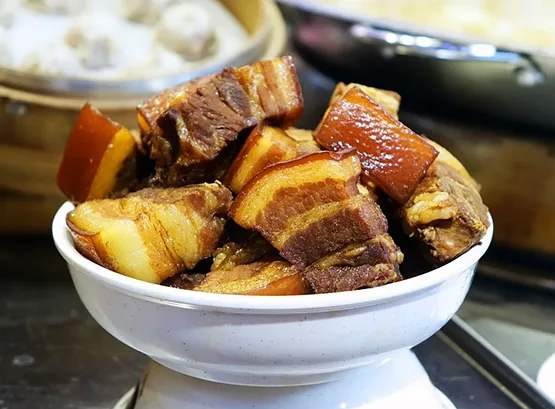
Pork has always been in a class of its own. It is not only tasty but also wholesome meat. It is easily digested and contains vitamins B1, B2, B3, B5, B9 and B12, as well as trace elements and minerals – magnesium, potassium, calcium, iron, sodium, copper, zinc and iodine. It is said that the meat of a pig raised with kindness and care is far tastier and more nourishing.
Thanks to their exceptional thrift and good housekeeping, the people of East Prussia put every part of the pig to use – from snout to tail. The head made delicious brawn, the trotters were boiled into aspic or braised with sauerkraut, the stomach was stuffed and roasted, and the kidneys and heart were stewed. And of course, fatback was laid in, and hams and bacon were salted and smoked, to be turned into all kinds of dishes in winter.
Pork Knuckle
The classic East Prussian pork knuckle was very simple to "perform", with no frills at all. The knuckle (salted, smoked or fresh) was usually boiled with favourite spices and a bay leaf and served with braised sauerkraut.
The boiled knuckle can, of course, also be roasted in an oven preheated to 180 degrees. To do this, rub the (cooled) knuckle with spices – pepper, salt and marjoram – leave it to marinate briefly, then place it on a baking tray lined with foil. While it roasts, melt a tablespoon of honey and mix it with hot mustard. Carefully coat the knuckle with this glaze and return it to the oven for another 10 minutes or so (until a caramelised crust forms).
Ham in Burgundy
(serves 15–18)
1 mildly cured and lightly smoked ham – about 3 kg, 20 small glazed onions, Burgundy sauce.
A mildly cured or lightly smoked ham is suitable for this dish. It can be either boiled or roasted – as you prefer. When the ham is done, remove the rind and, holding it by the bone, stud it with cloves. The finished ham can be sliced and arranged in the middle of a large platter, surrounded by vegetables, mushrooms, pasta, stewed tomatoes, glazed sweet chestnuts or glazed onions. The stock from the boiled ham can be used to make the sauce.
Burgundy Sauce
80 g butter, 120 g flour, 2 onions sliced into rings, 1.5 l meat stock, ¼ l Burgundy, 4 tbsp raspberry juice, salt to taste, cayenne pepper to taste.
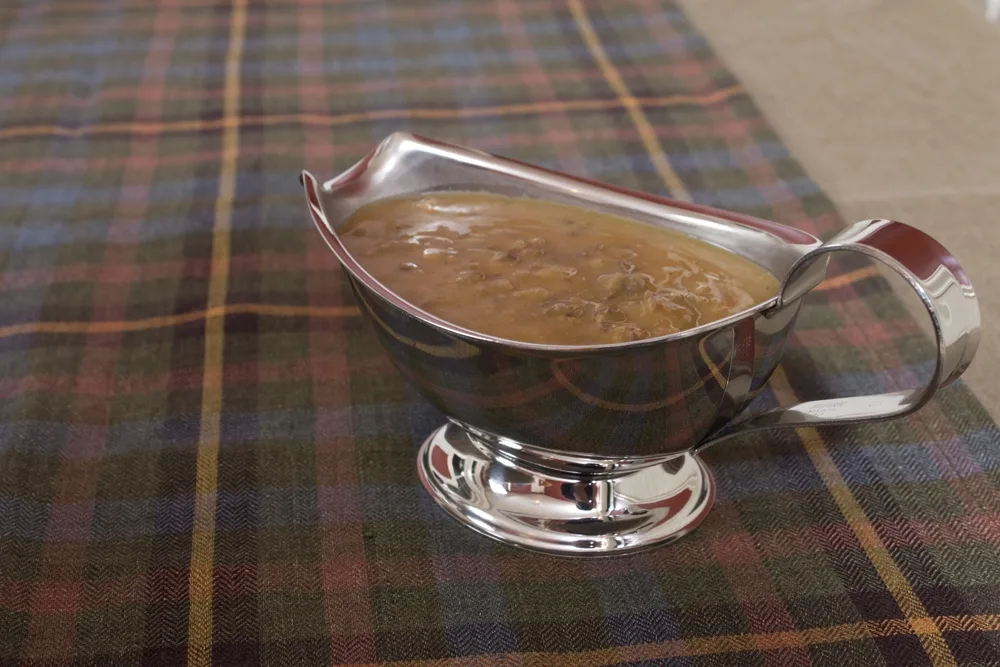
Melt the butter, stir in the flour and fry until light brown. Pour in the stock and a little of the Burgundy. Simmer the sauce for 30 minutes, stirring. Then strain through a sieve, add the rest of the wine, season with salt and add the raspberry juice and cayenne pepper.
Aspic
Aspic is made from a pig's head and pig's trotters. Boil them with salt and soup greens long enough to yield 500 g of meat and 1 l of stock (preferably no less). You will also need 2 egg whites and 2 tbsp of water.
Wash a fresh pig's head thoroughly, dry it and scald it with boiling water so that the stock turns out delicate. Cover both the head and the trotters completely with water, add salt and the soup greens. After about three hours check whether the meat is cooked. If the skin comes off easily, it is done. Strain the stock through a sieve, let it cool and skim off the fat that collects on top. Season the stock with more salt and bring it to the boil again. To make the aspic keep longer, add a little 9 per cent vinegar to the stock. To make the stock clear, it was "cleaned" with egg white.
Divide the picked (chopped) meat among moulds and pour the stock over it. Until the aspic sets, stir it from time to time so that the meat does not sink to the bottom of the mould.
Before serving, turn the set aspic out of its mould onto a plate. It was usually served with boiled potatoes and vinegar.
Braised Pork Chops with Onions
700 g pork chops, water, salt to taste, 3 black peppercorns, 3 allspice berries, 3 onions, 3 tbsp breadcrumbs.
Trim the sinews from the edges of the chops and pound them, pour a little water into a frying pan (so that the meat is not completely submerged) and put it on the heat. Add the spices and the onions sliced into rings. After an hour and a half, transfer the meat to a sauté pan and make a sauce from the braising liquid: mix it with the breadcrumbs and cook for a quarter of an hour. If the sauce is not thick enough, add a little flour mixed with water. Season with salt to taste. Strain the sauce through a sieve, pour it over the meat and braise a little longer.
Pork Medallions Tilsit Style
(From the menu of the railway hotel in Tilsit (Bahnhofstraße), after a recipe by head chef Rudolf Schmidt, c. 1910)
320 g pork medallions (4 pieces of 80 g each), 1 tbsp vegetable oil, 1 tsp butter, 10 ml white rum, 40 ml cream, 1 tsp honey, 1 tbsp green peppercorns, salt and ground black pepper to taste.
Pork medallions are best made from choice fresh tenderloin. Trim it carefully, removing excess fat and membrane, and cut it into portions three to four centimetres thick. Tie them with kitchen string so that they keep their shape while cooking.
Season the meat with salt and pepper, fry it in the vegetable oil and then set it aside somewhere warm. Pour the frying oil off into a bowl and melt the butter in the same pan. Add the crushed peppercorns, rum, cream and honey and simmer, stirring constantly.
Remove the string from the medallions and arrange them on individual plates. Season the sauce with more salt and pepper (to taste) and pour it over the medallions. This dish was usually served with tomato rice.
Rendered Lard
Finely chop leaf fat or fatback, put it through a mincer, transfer it to a cast-iron pot and render it over a low heat until a golden sediment forms on the bottom. Rendered lard was used not only for cooking but also as a spread on bread. It was softened slightly and mixed with finely chopped onion (or apple) and marjoram.
Salted Fatback (or Meat) for Long Keeping
For 8–10 kg of fatback or meat: 500 g salt, 30–40 g saltpetre, 50–80 g sugar, 3 l water.
Mix the salt, saltpetre and sugar thoroughly. Rub the meat with part of the mixture and pack it into a small barrel. Tip the rest of the salt mixture into the water and heat it without letting it boil. Pour this brine over the meat so that it is completely covered. If there is not enough brine, make more and add it. Place a board and a weight on top of the meat. The temperature in the room where the meat is kept must not exceed 10 degrees. Once it is cured, move it somewhere colder. Fatback takes two to three weeks to cure, pieces of belly up to four, and ham up to six weeks. After curing, the meat or fatback could be smoked, which many families did.
Many people joke that salo (a natural antioxidant, by the way) is a strategic product that unites nations. In small quantities it is indispensable: it cleanses the liver, prevents atherosclerosis and cancer, helps the heart muscle and strengthens the immune system (or so medicine believes, at any rate). Besides, salo is an excellent accompaniment to vodka and keeps you from getting drunk quickly. Vodka, in turn, speeds up the breakdown of fats. In short, salo is salo the world over. In one Tanzanian tribe, for example, it is the main part of a bride's dowry.
Pork has held (and still holds) a place of honour at the traditional Russian table. The recipes are extremely varied. Pork is a tasty meat and fairly easy to cook. Pork dishes have been popular in many countries around the world ever since the pig was domesticated some 7,000 years ago.
Germany has proved to be the greatest pig lover of all. The veneration of the pig as a symbol of prosperity, wealth, fertility and strength goes back to ancient times. At medieval knightly tournaments, the loser received a pig as a consolation prize, so that good luck and fortune would be with him from then on. The German cities of Ulm, Amberg, Dormagen and others have "pig fountains" surrounded by piglets. In 1974 a bronze "Herd of Pigs" by the sculptor Peter Lehmann appeared on Sögestraße in Bremen. In the Middle Ages, pigs were driven along this street out to pasture. When they came back from the meadow, the local bakers and brewers threw their food scraps out into the street. A splendid supper for the animals – and the tradesmen solved the problem of disposing of their slops.
There is also a monument to a pig in Lüneburg. According to legend, the animal fell into a pit and scraped its sides. The poor pig squealed so loudly with pain that it woke the swineherd. Large deposits of rock salt were discovered in the pit it had fallen into. In Munich the pig has been immortalised twice. People believe that if you rub its snout, wealth and good fortune will soon come to your home. That is why the snouts on all the monuments gleam. A traditional New Year souvenir in Germany is the "lucky piglet" money box (Glückschweinchen or Sparschweinchen), given as a token of good luck.
Poltava also has two "pig" monuments. One shows a sow surrounded by piglets; in the other, a bronze boy and girl drive a fat sow along with switches. The inscription reads: "To the eternal provider of the Ukrainian people". Mirgorod, too, has found room for a monument to Gogol's famous brown pig, sprawled beside a bronze puddle.
The Poles, Estonians, English, Danes, Portuguese (who have the oldest pig monument in the world), Americans, Australians, Thais… have all paid tribute to the pig. Prague, meanwhile, went for something original: a "Monument to the Unknown Pig", surrounded by all sorts of junk, urges citizens to help keep the Czech capital clean.
Sources:
Das Beste aus der Ostpreußischen Küche. Susanne Rohner.
Alte Familienrezepte aus Ostpreußen. H. Saul.
Doennigs Kochbuch.
Rezepte aus der guten ostpreußischen Küche. M. Haslinger, R.M. Wagner.
Spezialitaeten aus Ostpreußen. M.Lindt.
Translated from Russian with the help of AI (Claude, Anthropic), October 2026.