It is no accident that for centuries poets have sung of beautiful gardens and artists have painted them. A garden is a complete image, filled, as we perceive it, with beauty and harmony.
A garden is a metaphor for paradise. The Old Testament says that "the Lord God planted a garden eastward in Eden". All kinds of trees grew there, "pleasant to the sight and good for food", and there was a river to water the garden of paradise.
The Greek word for paradise, "paradeisos", also means a garden and comes from an Old Iranian word which in turn denotes an enclosed place.
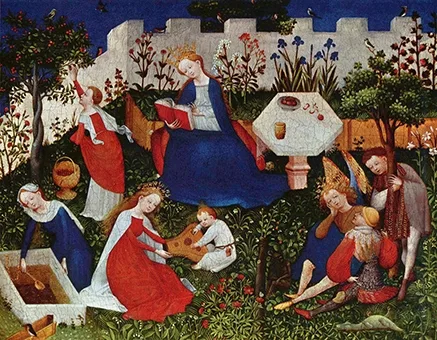 The Little Garden of Paradise, Upper Rhenish Master, c. 1410.
The garden of paradise is enclosed. A garden behind gates, under lock and key, mentioned in the Song of Songs. In the Middle Ages, the Christian image of the enclosed garden of paradise, hortus conclusus, acquired a new symbolic meaning connected with the purity of the Virgin Mary.
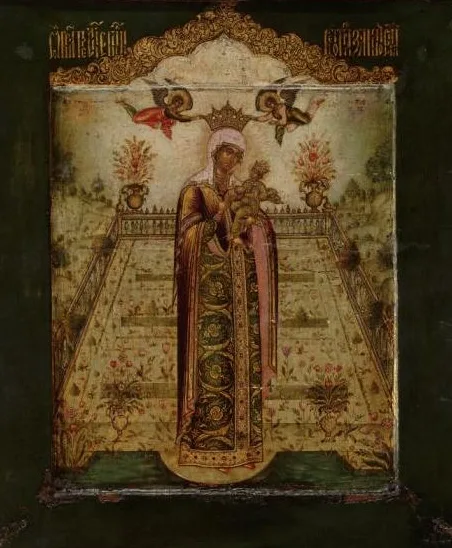
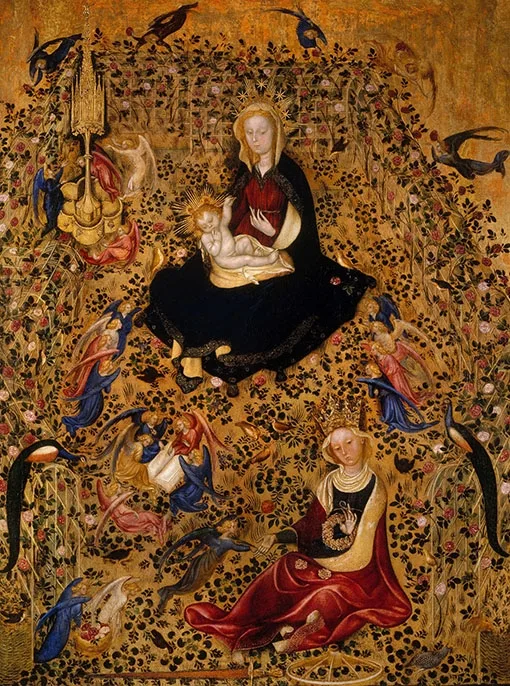
In Islam paradise is called jannat, which means gardens — in the plural, precisely so. These are the "gardens of bliss" where the righteous will go after death — shady, dark green, with springs and wondrous rivers.
The garden was sometimes perceived as the embodiment of paradise, and paradise was associated with the garden.
The city as a garden
In 1898 the English sociologist Sir Ebenezer Howard proposed a new concept of the city. He believed that the old cities had outlived their time, and that their problems — poverty, overcrowding, air pollution, infections and the lack of contact between the inhabitants and nature — could be solved by creating new settlements that resembled both town and village at the same time.
Howard called his concept the garden city.
He proposed creating towns for about 30,000 inhabitants, where the central place in the layout is occupied by gardens and parkland and low-rise housing, while industrial and agricultural areas are moved to the periphery.
Sir Ebenezer Howard illustrated his idea with a variety of diagrams.
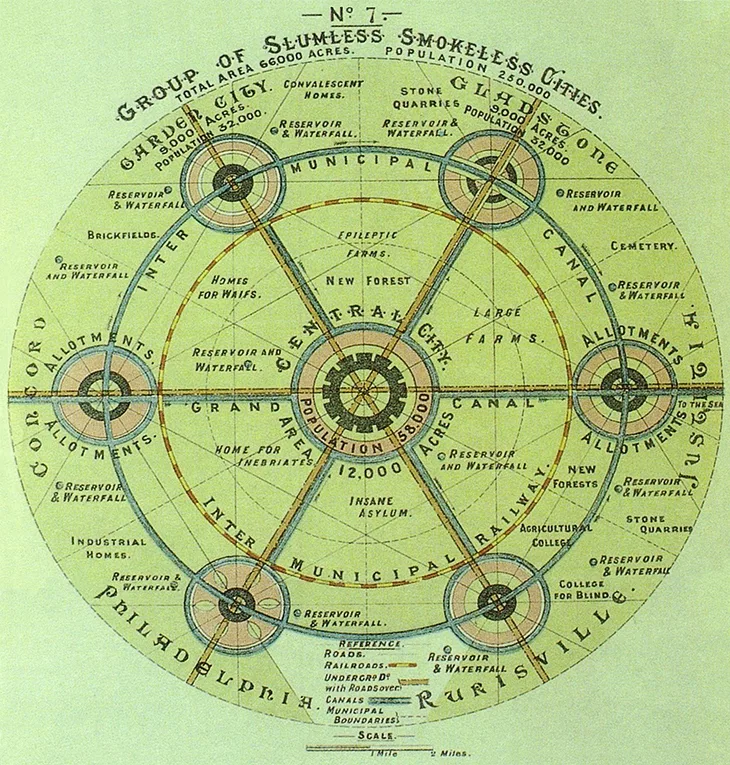 A group of garden cities according to the concept of Sir Ebenezer Howard.
To put the concept into practice, the Garden City Association was founded (later such societies appeared in other countries too, in Russia in 1913).
In Hertfordshire, with Howard's personal involvement, the first garden city was built — Letchworth (1904). The second experimental town was Welwyn (1922). Interestingly, in the 1930s it turned out that morbidity and mortality rates in Welwyn were much lower than in London.
Today, by the way, there is talk of building a new garden city in Britain — at Ebbsfleet in Kent.
In our country, too, the idea of building a garden city was put into practice. There were several pre-revolutionary projects, and in Soviet times the Sokol settlement in Moscow, the "October Garden Settlement" in Vologda and the "Red Garden City" in Rostov-on-Don. There was an attempt to realise the idea of a garden city in Barnaul. But later this concept was forgotten in the Soviet Union, above all for ideological reasons:
Garden cities were created for people, whereas socialist workers' settlements were built to serve industrial production...
In various countries Ebenezer Howard's idea was partly or fully realised in the planning of towns and neighbourhoods: garden cities appeared in the USA, Canada, Peru, Brazil, Argentina, Australia and other countries...
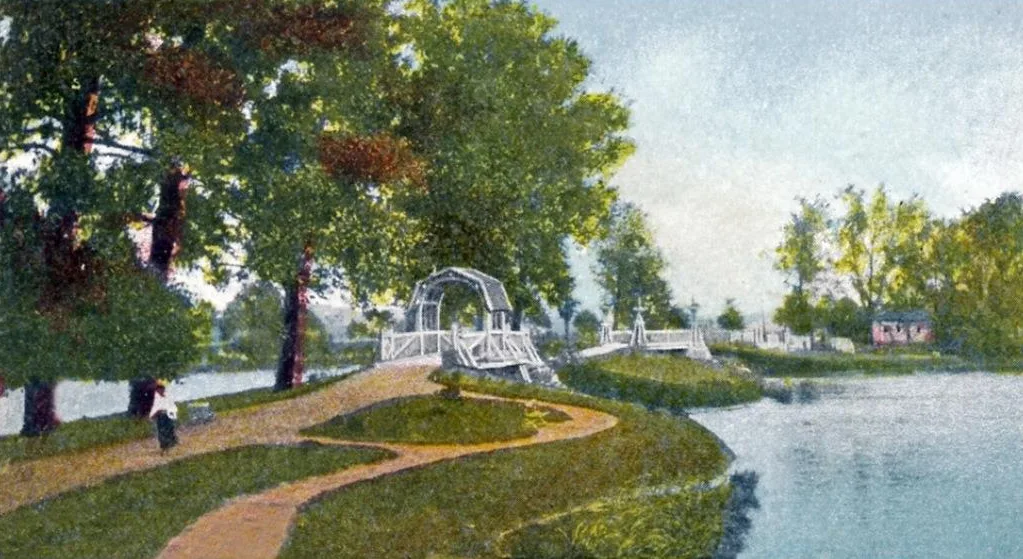
It is believed that in Königsberg the garden city concept was realised in two suburbs — Amalienau and Ratshof.
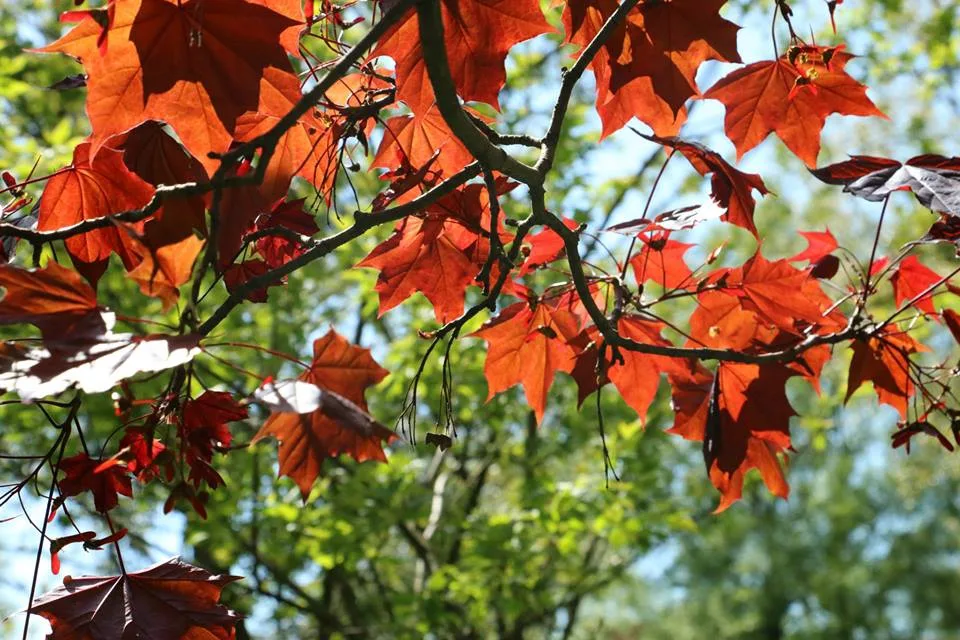
Around Kutuzova Street in Kaliningrad (a particularly striking part of the former Amalienau) there is a great collection of species and ornamental forms of trees and shrubs from North America, southern Europe and East Asia. In Königsberg, introduced plants were specially selected and acclimatised, and they were looked after…
Königsberg was a green city in general. The first post-war settlers noticed the green adornment of the streets, the weeping willows and the spring primroses.
In Soviet times Kaliningraders were proud that there were about 100 square metres of greenery per inhabitant, more than the norms required. This is how the well-known dendrologist, ecologist and teacher Galina Georgiyevna Kuchenyova wrote about our city in 1975 in the introduction to her book "Pearls of the Green World":
"Walk along Kaliningrad's shady avenue-streets, admire the squares, the parks, the magnificent setting of our lakes — and you will understand why Kaliningrad is called a garden city."
The expression "garden city" was often applied to Kaliningrad. It has survived in poems and pieces of music. The most striking example is perhaps the song with lyrics by S. Avramenko and music by V. Simonenko. The lyrical line "my city, blossoming garden city — Kaliningrad" is sung by V. Nechayev and V. Bunchikov.
The ghost of a garden city
What does our garden city look like today? Sadly, it is gradually losing its green attire.
Trees die for various reasons — from root damage during road repairs or construction, for example. Let us not forget that a tree's root system lies not only beneath its trunk and crown but sometimes spreads many metres underground.
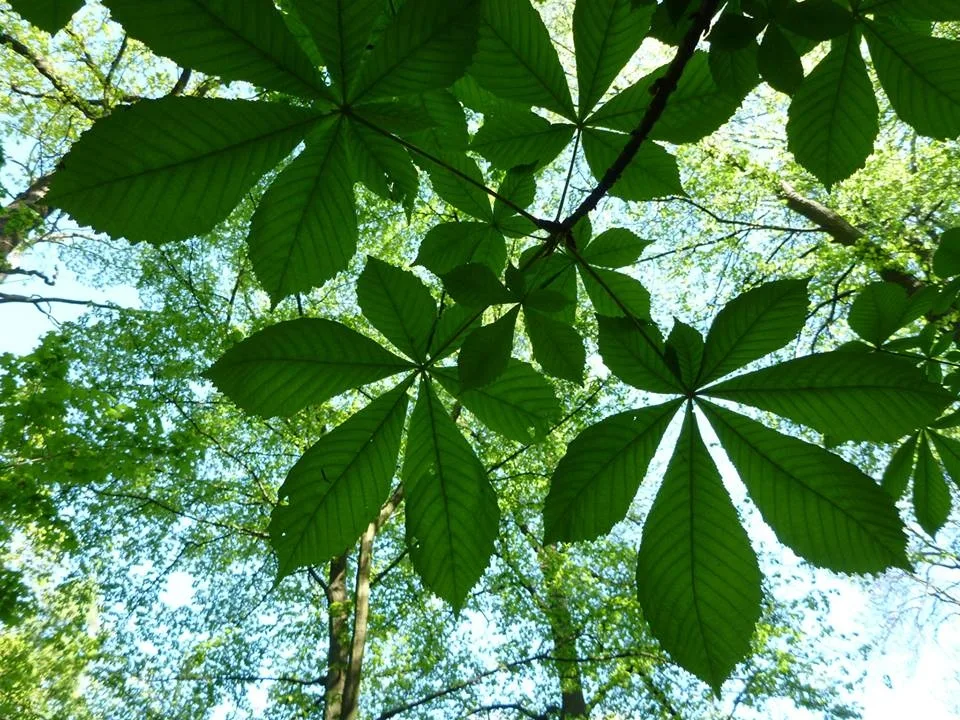
Kaliningrad's green spaces suffer from diseases (remember the horse-chestnut leaf miner that struck the chestnut trees). The soil beneath them in urban conditions is over-compacted and polluted. Sometimes the trees are left almost no soil free of asphalt.
Trees in our city also suffer from improper care, including radical pruning — "topping" them down to bare poles. And finally, they are simply cut down for infill development. The planning structure itself has been deformed.
What we lack most is the holistic vision of a prudent owner, careful preservation and thoughtful development of Kaliningrad's green spaces…
We have to admit it — Kaliningrad as a garden city is no more. There are fewer and fewer trees "pleasant to the sight", and the green necklace of the streets is disappearing. What the townspeople remember, what they love, what they shed tears over — is only the ghost of a garden city.
Translated from Russian with the help of AI (Claude, Anthropic), October 2026.