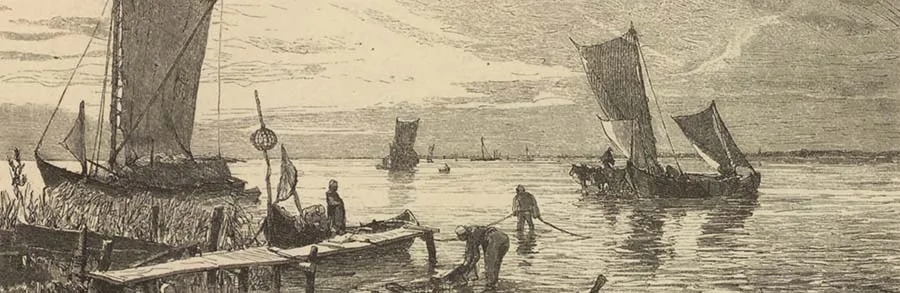
The time before the First World War... For the older generation — calm, peaceful years; for the young — a carefree youth. We boys from Ratshof loved to roam the western outskirts of Königsberg: along the banks of the Pregel between Kosse and Holstein, across the Cuirassier Meadows (Cuirassierwiesen) near the Steinfurt railway carriage works (Waggonfabrik L. Steinfurt), in the Ratshof park, near the Hammerteich and the "Pruddelteich", and above all on the Veilchenberg — Violet Hill.
* * *
One Sunday we were walking on the Veilchenberg. How astonished we were to see there, by the cemetery fence, a man with a pair of canvas wings who, holding on to loops fastened to their inner side, again and again glided down the hill to the willow avenue in the valley.
He would take a short, sharp run-up and then, gliding low over the slopes, come down to earth after flying a few dozen metres.
Every successful landing of the daredevil was greeted with our ecstatic yells. During one of them he suddenly stumbled and fell, the wings broke, and with that the grand spectacle, inspired by the feats of Lilienthal and the Wright brothers, came to an end.
* * *
Almost every year, on the morning of a Sunday, not far from the Veilchenberg, on a hillside sheltered from the wind next to the Neue Bleiche estate, a big balloon race was started. It was grand entertainment for the local adventure-seekers!
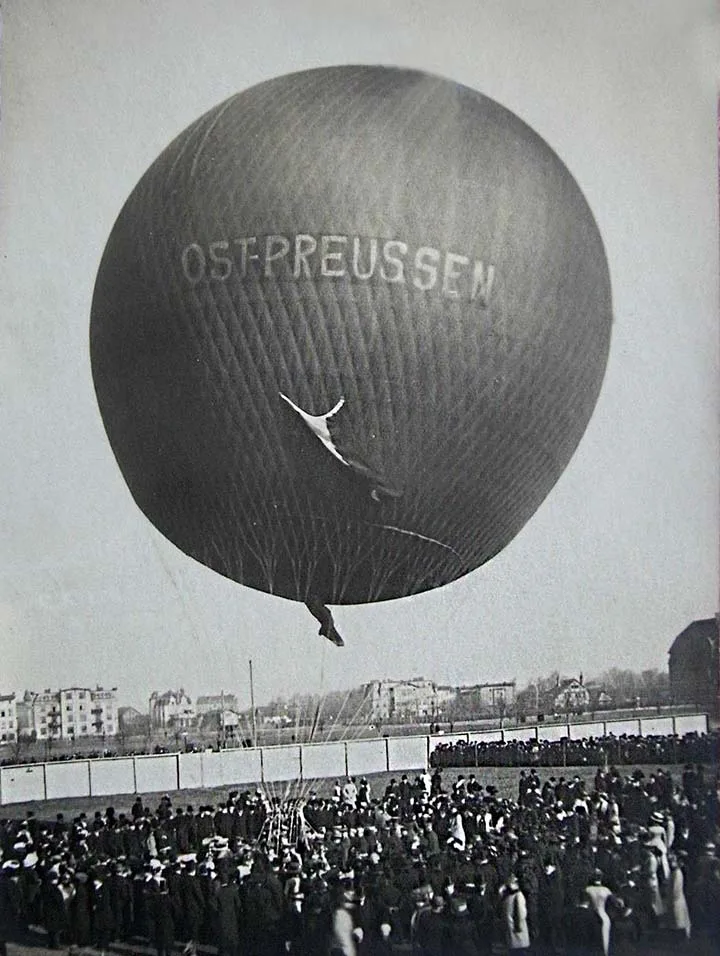 The balloon "Ostpreußen" (East Prussia).
Huge balloons, not yet inflated, lay flat on the ground. One after another they were connected by a hose to a gas pipe whose elbow stuck out of the ground.
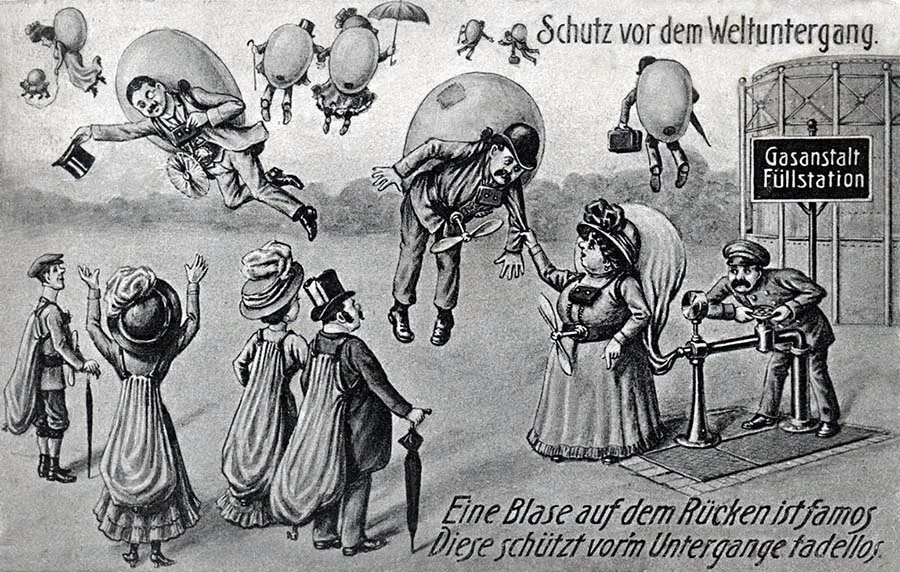 Postcard: "The balloon will save you during the Apocalypse". Note the gas pipe!
Soon they were all filled with gas, and their names, written in large letters, became visible: "Berlin", "Stuttgart", "Leipzig", "Ostpreußen", "Rheinland".
At a signal from the ground crew, two or three intrepid pioneers of aeronautics climbed into the gondola, woven from willow rods, and the balloon floated silently away towards the river Pregel. The balloons could be seen for a long time, their gondolas swaying in the air. All this was accompanied by the frenzied cries of the crowd, waving in greeting — some with flags, some just with their hands.
* * *
In one of the pre-war years Königsberg, as we used to say back then, was "turned upside down": for the first time a powered aeroplane was to make demonstration flights for the local public.
Young and old alike — everyone rushed to the former cavalry training ground at Devau beyond the King's Gate and, eagerly discussing what was going on, gathered along the edges of this large field, where there stood a "flying machine" that looked, at first glance, so fragile.
Hans Grade, one of the pioneers of German aviation, settled comfortably in the open cockpit and started the small propeller… Waddling like a duck, this marvel of 20th-century technology gathered speed and took off. After a few bends and turns at low altitude, to the joyful applause of the delighted spectators, the little aeroplane landed safely.
* * *
Shortly before the First World War, examples of aviation skill were already being demonstrated in Königsberg. Following the example of the Frenchman Pégoud (Pegoud), our daring pilots performed in their aeroplanes the first "dives", as the "loop the loop" was then called.
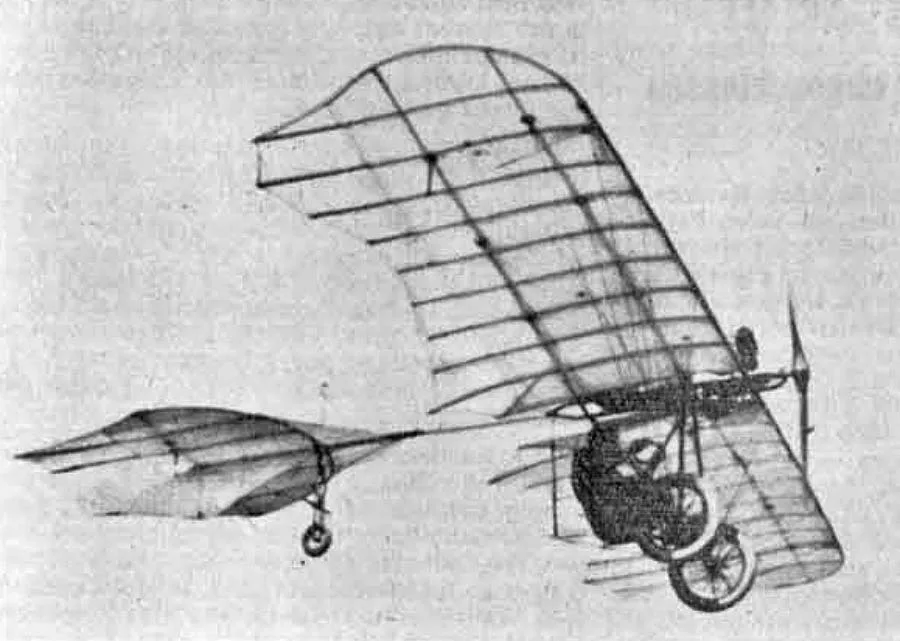 Hans Grade on his famous monoplane with a suspended seat.
As far as I remember, they were Fokker and Sablatnig aeroplanes.
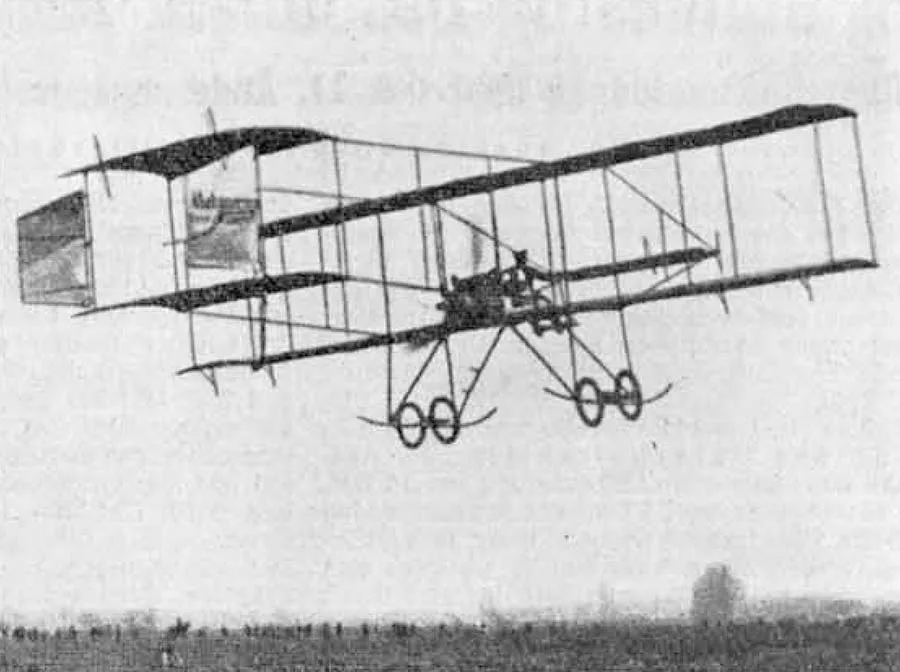 Hans Schirrmeister from Königsberg on an Albatros biplane.
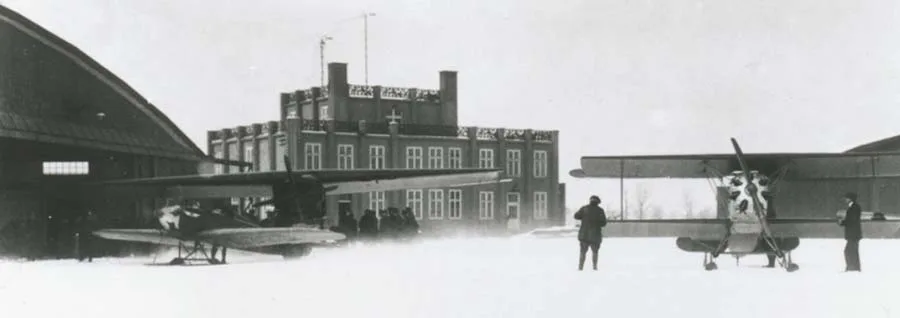
And once, as we boys were walking through Amalienau, we saw an aeroplane landing on the landing ground of the recently built Zeppelinhalle (Zeppelinhalle / Königsberger Luftschiffhalle in Klein Amalienau). We ran there as fast as our legs would carry us and arrived just in time. The aeroplane was piloted by the Russian aviator Abramovich (Vsevolod Mikhailovich Abramovich, 1890–1913). He made an intermediate landing in Königsberg during his long flight from Berlin to Petersburg. This flight caused such a sensation all over the world as only Charles Lindbergh's transatlantic flight would produce later.
* * *
It was thanks to the Zeppelinhalle north of Amalienau that we were able to follow the development of dirigible airships.
How often the bright yellow Schütte-Lanz (Schütte-Lanz), later the Parseval (Parseval), and in 1914 the Zeppelin IV too (the airship LZ IV) flew proudly over Ratshof and Amalienau.
Sometimes, on hot summer days, when we were bathing in the "Pruddelteich" pond, hanging about on the banks of the Ratshöfer Freigraben, fishing with our trousers rolled up in the Fürstenschlucht ravine, or, in autumn, roasting potatoes in the fields, we would catch sight of an airship high in the sky and hear the characteristic drone of its engine, drop everything and dash off towards the Zeppelinhalle. Nothing could stop us then!
The complex landing manoeuvres of the airship were simply mesmerising. The zeppelin's nose would dip steadily, a team of hangar workers would hurry to grab the lowered rope, and then they would quickly haul the seemingly endless cigar-shaped airship through the gigantic doors into the hangar.
Once, during a landing, a sharp gust of wind abruptly tossed the zeppelin up into the air. One of the workers failed to let go of the rope in time and was dragged upwards, after which he had to jump to the ground from a height of six to eight metres. For us boys it was a thrilling moment.
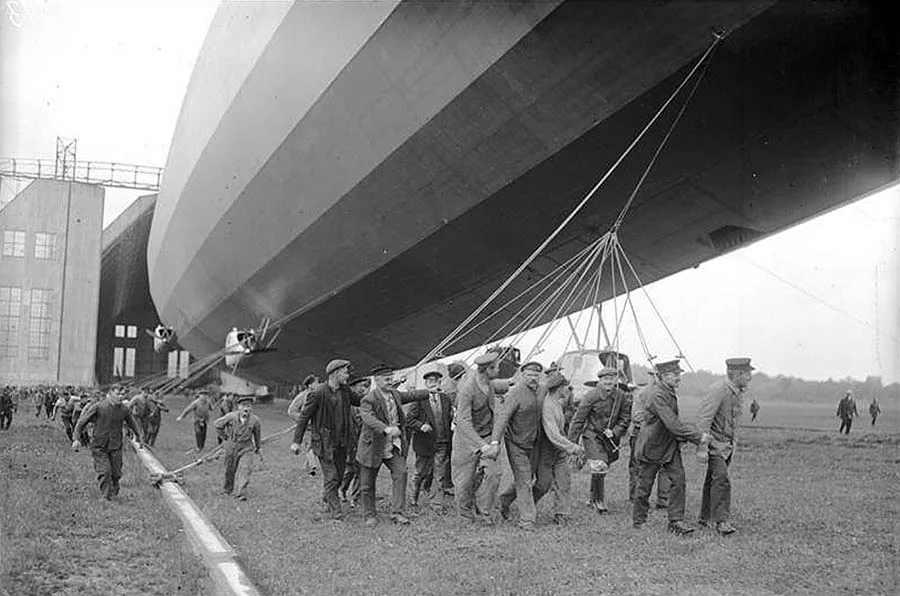 Ground crew help an airship leave the hangar at Klein Amalienau.
At the beginning of the war the zeppelin LZ IV flew slowly over us for the last time. We soon learned that it had been destroyed by shrapnel during a reconnaissance flight over Polish territory.
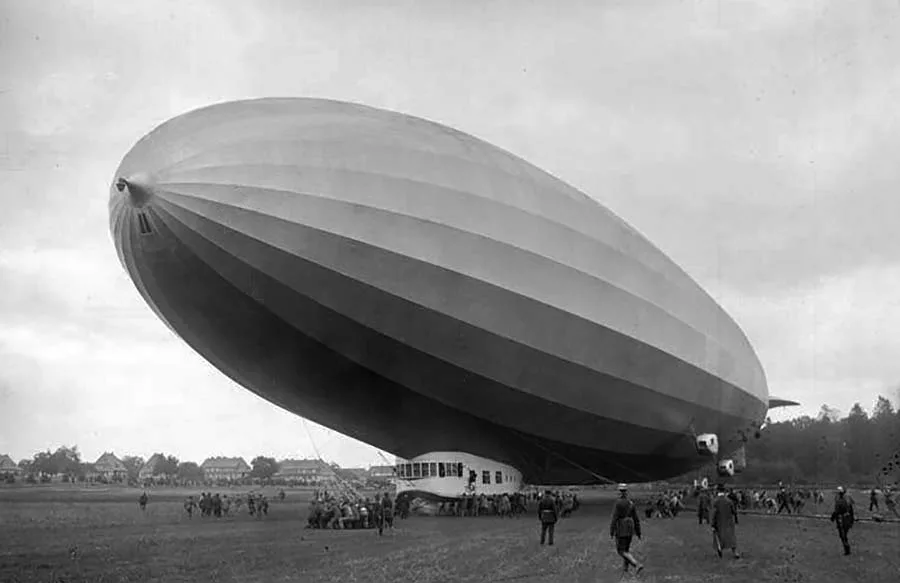 An airship on the airfield at Devau near Königsberg.
Not far from Seerappen (Seerappen, now Lyublino) a second airship hangar was built, with which a sad story is connected for me. In the summer of 1919 we, volunteers of the 2nd Company of the Crown Prince Grenadier Regiment, together with volunteers from other regiments, spent several days there preparing for scrapping the airships rescued from the Eastern Front. This was the end of the military aviation of that time. The two airship hangars near Königsberg also had to be dismantled under the terms of the Treaty of Versailles.
* * *
But life did not stop there. Glider pilots performed magnificent feats over the Curonian Spit. Foremost among them was Schulz, a primary school teacher from East Prussia. My friend and I were able to admire his machine, the "Broom", one rainy day which Schulz had to spend in one of the hangars at Devau, where he briefly answered our questions.
The main aviation event of the year in Königsberg was always the air race "Ostpreußenflug" (East Prussian Flight). Light sports aircraft with whirring propellers took off in front of us spectators from the Devau airfield.
We especially admired the giant Dornier Do X flying boat with its gleaming silver hull and six engine nacelles set one behind the other. It glided upstream over the river Pregel, delighting the numerous spectators on both banks of the river around Contienen, at the Walzmühle mill and in Kosse.
Because of its size, this latest achievement of aviation technology of the time could not alight on the Pregel.
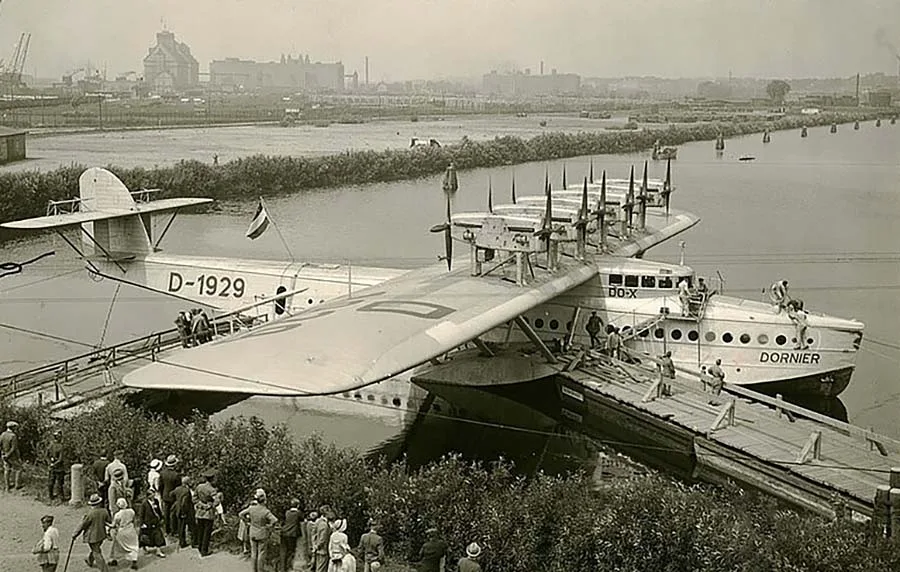 (The Dornier Do X amphibious aircraft did land in Königsberg. In the photo it is in the new port. The grain elevator and the roller mill can be seen in the distance. — Editor's note)
Everyone was also proud when, from the coast near Rauschen, our zeppelin was sighted far out over the sea. It was returning from its great voyage to the North Cape.
And all this splendour has vanished almost without a trace! The aeroplanes and airships and their hangars — sold for scrap, blown up, burned, disposed of. But a new, boundless world of aviation has arisen. Today it amazes everyone just as the first flying machines, storming a sky that had until then been out of man's reach, once amazed us.
A Zeppelin over Insterburg
On 12 August 1913 the people of Insterburg (Insterburg, now Chernyakhovsk) saw a Zeppelin airship for the first time. As part of the East Prussian air tour, LZ1 IV appeared on a beautiful sunny morning at 6:00, flying at a height of 250 metres over the town, performed a magnificent figure-of-eight loop and then, at about 6:30 a.m., flew off again towards Tilsit (Tilsit, now Sovetsk). Everyone who had the chance climbed onto the roofs to see and admire this giant of the air.
An eyewitness described the event as follows:
"Early in the morning the whole town could feel that something special was about to happen. Old and young were strolling through the streets, schoolchildren formed long queues, everyone was hurrying to the Althof Meadows (Althöfer Wiesen). Cars, carriages and cabs forced their way through the never-ending crowd. Early in the morning there was not a cloud in the sky, and the bright sun flooded the dew-covered meadows. The crowd of spectators grew by the minute. Long lines of onlookers waited on the other bank of the river Angerapp (Angerapp, now the Angrapa). The airfield board announced that the airship LZ IV, then based in Königsberg, had left the airship hangar for Insterburg. This news heightened the general excitement that reigned at the first local air show. And when, about a quarter of an hour before the airship's expected arrival, the military pilots wheeled the aeroplanes out of the hangar, the crowd of spectators came alive.
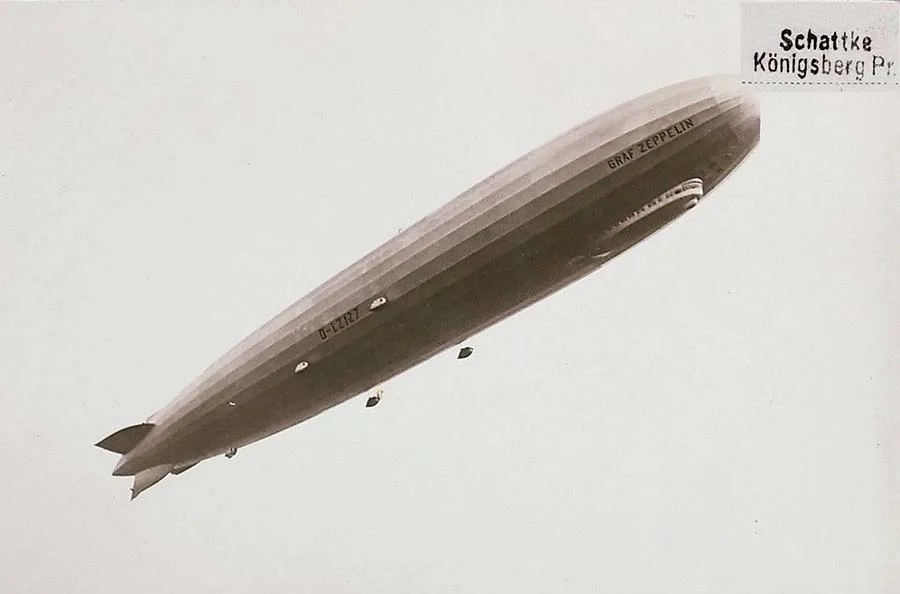
The spacious airfield with its fenced-off grounds proved too small for everyone who had gathered.
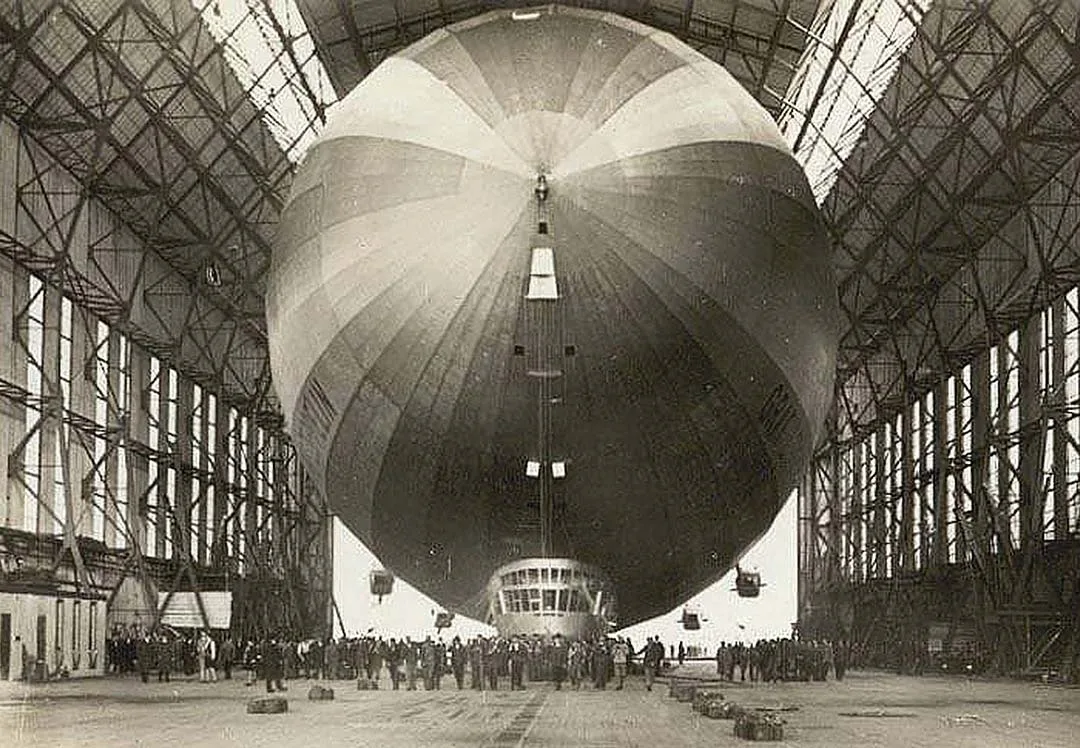
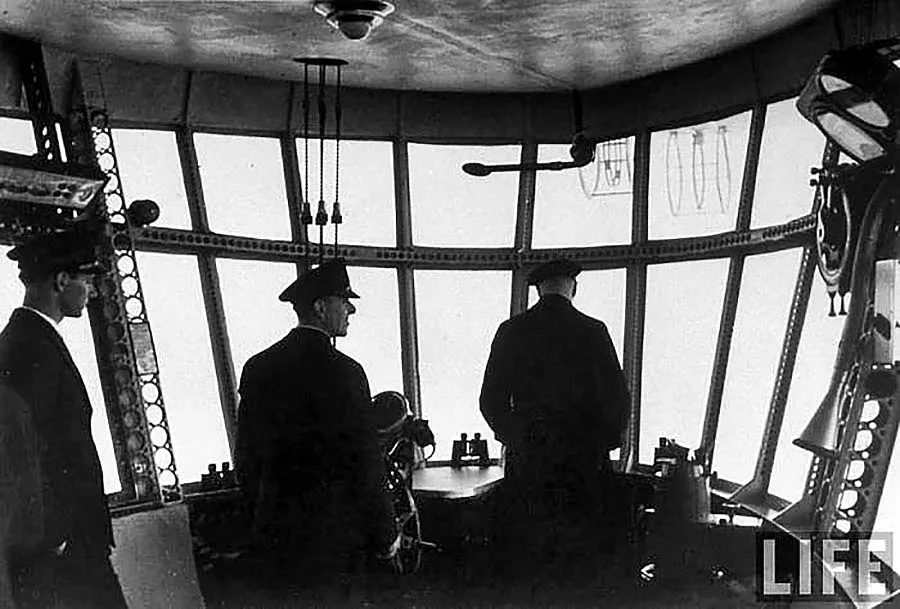 In the control car of the airship "Graf Zeppelin" (see above).
At five minutes to 6:00, after the aeroplanes' engines had been properly checked, two monoplanes and two biplanes took off to meet the guest. The pilots' skill was certainly impressive, but the approaching airship eclipsed the impression made by the climbing aeroplanes. From afar came the dull roar of engines…
Holding a clear course for the town, the airship left the airfield to its left. At a height of 250–300 metres the zeppelin flew majestically over the Pregel valley, brightly lit by the morning sun. All its propellers were humming, turning at moderate speed. A jubilant "Hurrah!" rang out from strong male voices, greeting the giant of the air. Between 6 and 7 in the morning the airship made a magnificent flight in a figure of eight over the town and the airfield.
From the gondola the crew dropped a written greeting to the ground: "The airship LZ IV, bound for Tilsit, wishes the Insterburg air show all the best from Wobeser, Nuppe, Scherzer, Luge, Bode." — The airship circled the airfield once more and then disappeared from view, heading north-east.
TRANSLATOR'S NOTE
1. LZ is short for Luftschiff Zeppelin, which means "Zeppelin airship", Zeppelin being the surname of the German nobleman who devoted his life to aviation and became famous for his airships, Ferdinand von Zeppelin (Ferdinand Adolf Heinrich August Graf von Zeppelin, 1838–1917).
LEGENDS OF PRUSSIA on Tatyana Kolivay's blog.
Translated from Russian with the help of AI (Claude, Anthropic), October 2026.