This church was a place of pilgrimage for fishermen and seafarers. It measured 22 x 12.5 m. A pastor Hermanus is mentioned in 1320. In 1507 it was pulled down, and a new one was built at the southern foot of the hill by Grand Master Frederick of Saxony (1498–1510). In 1687 a hurricane caused it great damage, which was repaired in 1689–99.
The altar was moved from the old church. It bore a life-size image of St. James with the Latin inscription "St. James, pray for us".
At the beginning of 1798 the parish was released from hereditary lease. In 1807 Königsberg was captured by the French. The altar of the Quednau church was removed by the French and taken to their military camp, which stretched in this area as far as the Pregel, to be used for Catholic services.
In 1818 another hurricane badly damaged the church roof; falling beams broke through the vault. In 1828 the police closed the church. In 1830 it was restored.
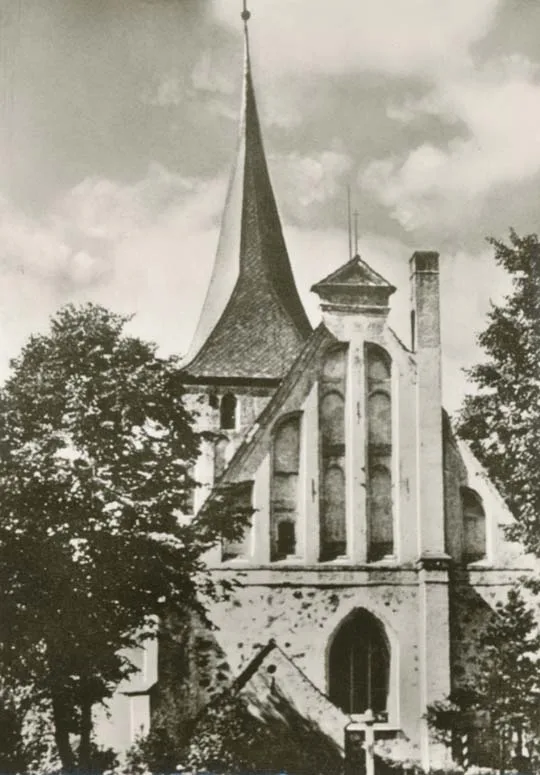
In 1853 the tower, damaged by lightning, was repaired. In 1870–1880 the church was completely restored. Protestant services were held in it, and the king was its patron. It measured 23.5 m by 10.4 m. It was built of fieldstone, with a brick east gable. The lower part of the tower was of fieldstone, the upper part of brick. The sacristy and porch on the north were also of fieldstone. The tower had two buttresses. The north side of the church had one buttress, the south side four.
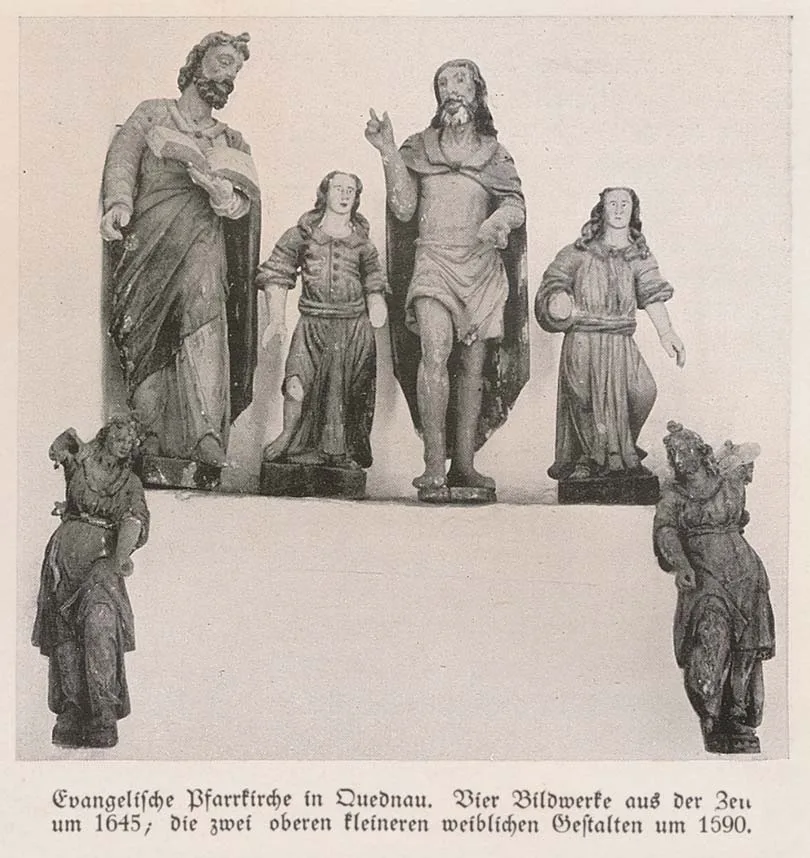 Figures of saints from the Quednau church.
Originally the church had six lancet windows. The tower was roofed with slate, the church with flat tiles.
Inside, a granite spiral staircase led up the tower. The nave consisted of 3 bays with a beautiful low star vault, the middle bay being divided into 16 sections. Galleries (balconies) ran along the walls. The church was rich in epitaphs of the 17th–18th centuries. The sacristy had a flat Gothic barrel vault, the porch an eight-part star vault. To the right of the entrance was a niche for holy water. The doors and windows of the church had pointed arches. Inside, the whole church was whitewashed.
The altar plate was of brass and silver, 19th century. The altar came entirely from the ancient church and was supplemented in the 19th century with paintings and statues of saints. The pulpit of 1687 was made by Johann Christoph Döbel. The organ of 1856 was by the organ builder Scherweit; the old one was sold to Hermsdorf (now the settlement of Pogranichny, Bagrationovsk District). Next to the altar was kept the armour of Henning Schindekopf, who in 1350 was Komtur of Ragnit and was killed in 1370 at the Battle of Rudau. The church had two bells. One of them, cast in 1710, has survived and is now in Stockheim near Hanover.
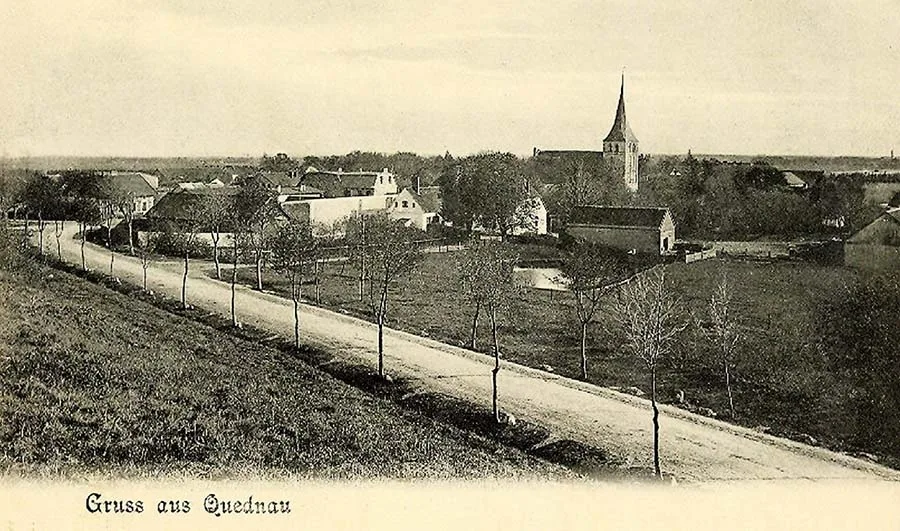
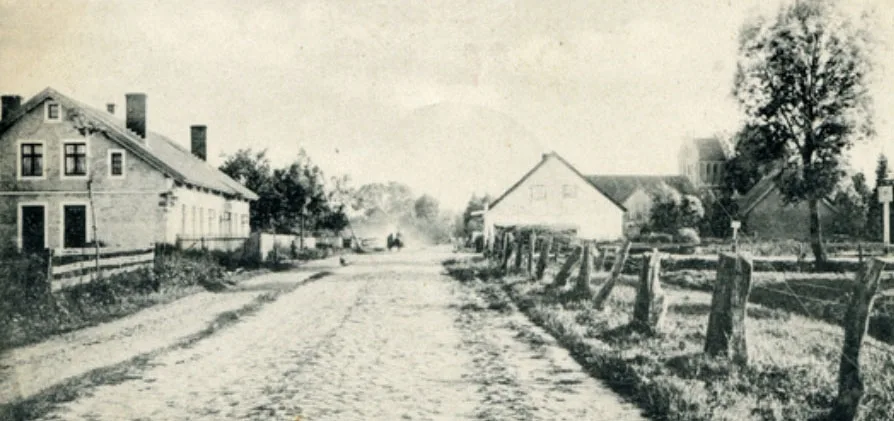
The Quednau church stood at the end of Aleksandra Nevskogo Street, on the way out of the city. When the fighting ended in 1945, the church was almost intact. In the following years, for lack of proper care, the roof structure and the masonry began to deteriorate.
On 18 April 1963 Raisa Grigoryevna Ankudinova, an inspector of the regional culture department, transferred the church under a protective lease agreement to the use of the Leningradsky District Executive Committee.
Received by V. V. Danilova, engineer of the housing and utilities department.
Technical condition of the monument:
The church stands in an old abandoned cemetery. The church was destroyed during the Great Patriotic War.
General condition: unsatisfactory. The interior furnishings of the church, including the altar, had been completely lost by 1964. Before the 1960s up to 50 per cent of the roof structure had been taken apart, the walls broken through, and two ancient window openings and one doorway destroyed. The sacristy and porch survived only as small fragments of walls and foundations. As of 1964 the condition of the church was described as extremely poor and partly unsafe. The church was placed on the state register as an architectural and historical monument. In the early 1970s the church was completely demolished. As of 1990, the cellar beams and the remains of the cemetery could only very faintly be made out.
Translated from Russian with the help of AI (Claude, Anthropic), October 2026.