In the 20th century, the Rominten Heath was crossed by two railway lines built to the so-called “normal gauge”/normalspur1 (1435 mm):
– Stallupönen (Stallupönen/Ebenrode, now the town of Nesterov) — Goldap (Goldap, now in the Republic of Poland);
— Gumbinnen (Gumbinnen, now the town of Gusev) — Schittkehmen (Schittkehmen/Wehrkirchen, now Żytkiejmy, Poland) — Goldap.
The two lines crossed at the junction station of Tollmingkehmen (Tollmingkehmen/Tollmingen, now the settlement of Chistye Prudy).
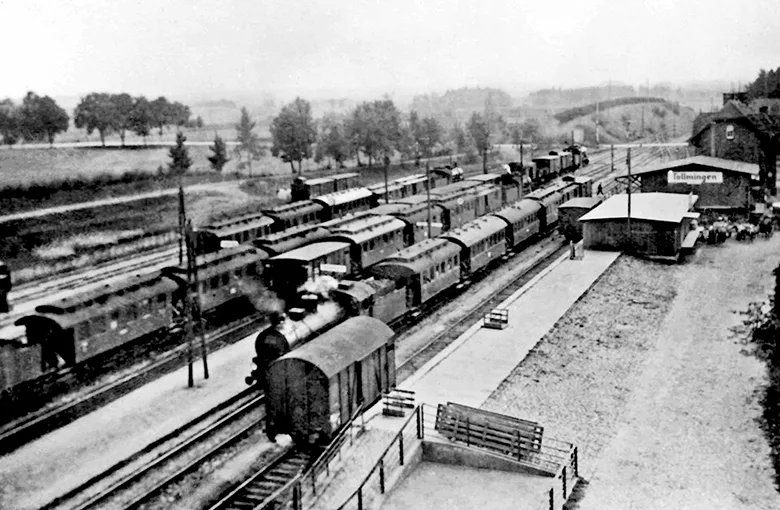 The railway station in Tollmingkehmen (www.bildarchiv-ostpreussen.de).
The first steam locomotive appeared in the Rominten Heath forty years after the Imperial Railway had linked Königsberg with Stallupönen on the eastern edge of the province.
The railway was meant to connect the remote districts of the province, attract new settlers and breathe life into the borderlands of East Prussia. Its arrival in the Heath and the surrounding districts affected many aspects of life, both in the Heath itself and in the villages within it: freight volumes grew, communications improved, trade received a boost and public life became livelier. Suffice it to note that the “Timber Rafters’ Guild”2 in Gumbinnen was dissolved in 1913 – precisely because of the development of rail transport in the Rominten Heath.
The first railway line laid through the Heath was the Stallupönen — Tollmingkehmen — Gross Rominten (Gross Rominten/Hardteck, now the settlement of Krasnolesye) — Goldap branch. Initially, the line was built from Goldap to Gross Rominten, and it was later extended via Tollmingkehmen to Stallupönen. Traffic on it opened in 1901. The line was 50 km long from end to end, with 10 stations between Goldap and Stallupönen. The journey took just over an hour and a half.
It was along this railway3 that Kaiser Wilhelm II, aboard his special imperial train (Hofzug), came to hunt in the Heath from 1900 to 1913. A special pavilion (no longer standing) was built at Gross Rominten station for the emperor and his family, and a special shed was erected on a siding for the imperial train.
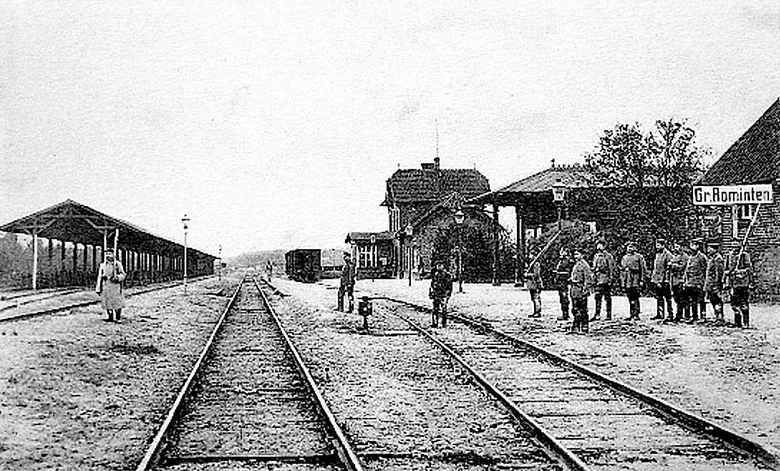 The station building and pavilion at Gross Rominten (www.bildarchiv-ostpreussen.de).
In 1904 the government allocated 4,853,000 marks for the construction of a second railway line through the Heath, from Gumbinnen to Schittkehmen. The plan was for the line to run through picturesque countryside, away from the main roads and highways. And so it turned out: only in a few places did the railway run alongside roads; for the most part it wound over hills and meadows, across fields and through forests.
The Gumbinnen — Tollmingkehmen line opened on 1 October 1907, followed on 15 June (according to other sources, 15 July) 1908 by the Tollmingkehmen — Mehlkehmen line (Mehlkehmen/Birkenmühle, now the settlement of Kalinino), and on 15 August 1908 the “steel road” skirting the Rominten Heath to the north linked Gumbinnen with Schittkehmen. In 1912 work began on a line connecting Goldap and Schittkehmen.
Impressive bridges were built in the course of the railway’s construction. As a result, all the main settlements of the Heath were linked by a reliable freight and passenger transport system.
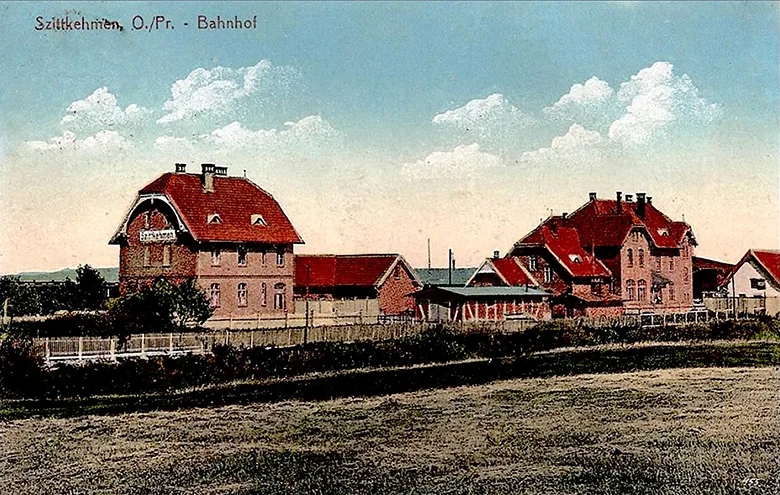 The railway station in Schittkehmen (www.bildarchiv-ostpreussen.de).
One curious episode in the history of these railways deserves special mention: in one of his letters of 1912 to his cousin Nicholas II, Kaiser Wilhelm II proposed considering an extension of the railway into the border areas of the neighbouring empire – towards Suwałki and Kalwaria. This would have promoted the development of the border territories and made it possible to increase the transport of stone, gravel and timber. However, the outbreak of war prevented the plan from being realised, and after the war the project, which had existed only on paper, was “conveniently” forgotten.
Construction was interrupted by the outbreak of the First World War in 1914. During the fighting in the area many bridges, as well as stations and tracks, were destroyed. However, once the Russian troops had withdrawn from East Prussia, everything was restored in the shortest possible time, since the railway was used to transport troops, equipment and the wounded.
Construction of the line resumed only in 1923, and at the same time it was decided to lay a second track, as the line had until then been single-track. From 1 October 1927 the route was finally put into full operation, and trains could run in both directions along the entire length of the line.
The Gumbinnen — Goldap branch was 90 km long. After leaving Gumbinnen, the train passed four stations before reaching the junction at Tollmingkehmen, where the two railway lines encircling the Heath crossed, then another four to Schittkehmen and eight more to Goldap. The whole journey took about three hours. On weekdays three trains4 with second- and third-class carriages ran on the line, and at weekends two additional trains were put on.
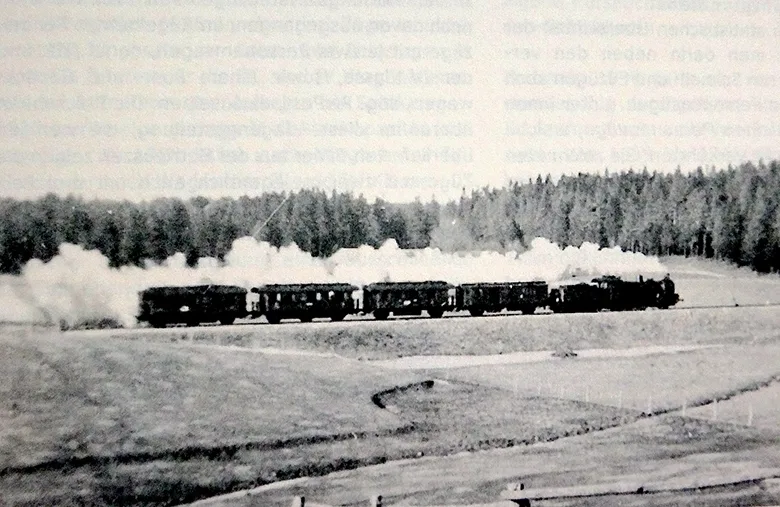 A train passing through the Heath (Kreisgemeinschaft Goldap).
Standard station buildings of a uniform design were built at every station, with virtually no architectural differences between them.
The only exceptions were the station building at the junction in Chistye Prudy and the station complex in Schittkehmen. Water towers – a necessary and important component of the railways of the time – were built at some of the stations.
To give an example, in 1933 a second-class ticket from Goldap station to Gross Rominten cost 1.1 marks, to Tollmingkehmen station 1.8 marks, to Schittkehmen station 3.7 marks, and to Gumbinnen 3.8 and 2.6 marks in second and third class respectively. Travelling by train to the provincial capital, Königsberg, was rather expensive – 11.2 marks in second class and 7.7 marks in third.
Along their entire length, the railway lines in both directions crossed numerous rivers, ravines and roads, which required the construction of a variety of bridges, overpasses and culverts5.
The very first major bridge was the one over the Pissa River on the Stallupönen – Goldap section of the railway. It was a relatively simple bridge, consisting of a railway deck laid on brick piers.
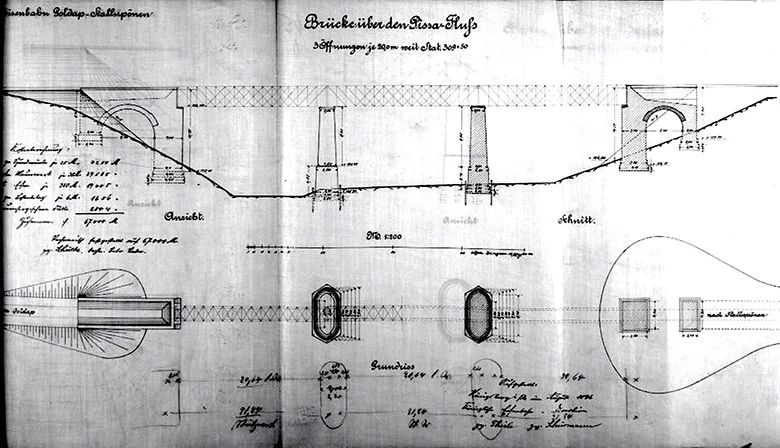 Plan of the bridge over the Pissa River (Archiwum Państwowe w Olsztynie).
But the most magnificent bridge stands in what is now Poland, in the village of Stańczyki (Stańczyki, formerly Staatshausen). Designed by Italian architects on the model of ancient Roman aqueducts, this reinforced concrete bridge still captures the imagination, even in photographs. Its construction lasted from 1912 to 1926. This five-arched bridge (each arch 15 metres in diameter), 250 metres long and more than 36 metres high – or, to be precise, two parallel bridges – spans a steep ravine at the bottom of which flows the small Błędzianka River. Petrified sacks of cement can still be seen on the riverbanks and riverbed. The northern bridge was built in 1912–14 and the southern one in 1923–26. Trains, however, only ever ran over the northern bridge; the southern one was never fully put into service, prevented by the outbreak of the Second World War. After the war the bridges were hardly used, and by 1950 the tracks had been dismantled. Today the bridges at Stańczyki are a regional landmark and are listed in the register of historic monuments. Since the early 2000s the bridge has been privately owned, and restoration work has been under way since 2010.
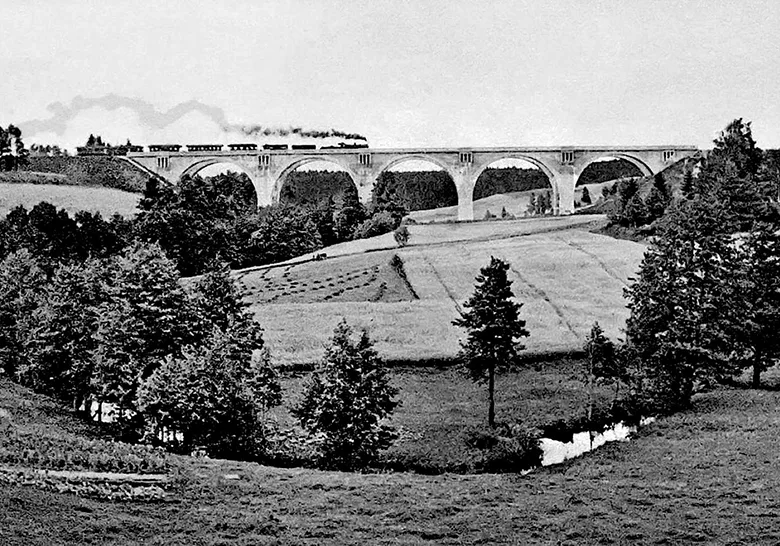 The bridge at Stańczyki (photo from the author’s collection).
The “younger brother” of the Stańczyki bridge stands on the Russian side of the border, in the village of Tokarevka (Makunischken/Hohenwaldeck), on the Tollmingkehmen – Goldap section. Also modelled on ancient Roman aqueducts, this five-arch bridge spans the two steep banks of the Krasnaya River. It is 25 metres high and 60 metres long. The bridge was originally built of brick, but it was later plastered over, and the arched openings between the piers were filled in.
Today the bridge is a local landmark, but it is not listed anywhere as a site of cultural or architectural significance.
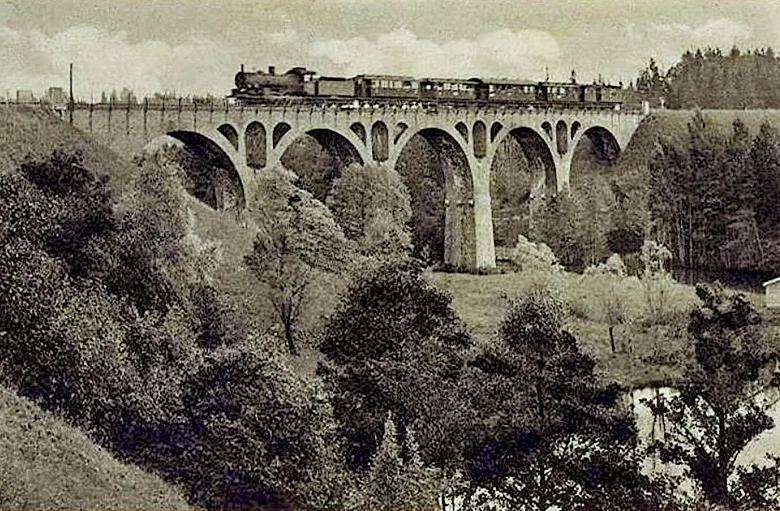 Bridge in Tokarevka (Makunischken). Photo from the author's collection.
Two pairs of identical railway viaducts have also survived:
– a large three-arch bridge (or rather two, as at Stańczyki) spanning the two steep banks of the Jarka River near the village of Dubeninki, Republic of Poland;
– and the three-arch bridges over the Bludzia River at Kiepojcie (Kiepojcie, formerly Eszergallen, Republic of Poland).
Standing 15 metres high and 40 metres long, these bridges were built between 1912 and 1926.
Mention should also be made of a four-arch bridge, which no longer exists, over the Krasnaya River not far from the village of Olkhovatka (Walterkehmen/Grosswaltersdorf).
During the Second World War the railway was of great importance. Trains were used to carry troops and equipment to the Eastern Front. The railway also transported natural stone for building defensive fortifications in the Masurian Lakes area.
Reichsmarschall Hermann Göring, too, came to the Rominter Heide aboard his special train “Asien”. He travelled by rail as far as Tollmingkehmen or Gross Rominten, and from there continued to his hunting residence, the Reichsjägerhof. Göring's route to the Luftwaffe headquarters on the shore of Lake Goldap (Gross Kummetschen station) also ran through the forest.
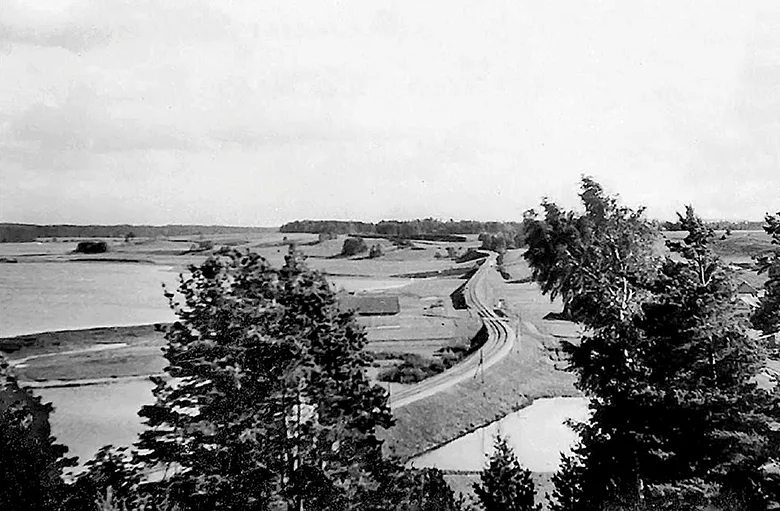 Railway tracks near Lake Goldap (Kreisgemeinschaft Goldap).
After the end of the Second World War the Gumbinnen – Schittkehmen line was deemed unnecessary, having lost its purpose (as a result of the division of the East Prussian lands between the USSR and Poland), and in 1945–46 the line was dismantled.
The Stallupönen — Goldap line survived in part, on the section from Stallupönen (now Nesterov) to Gross Rominten (Krasnolesye, as far as the sand quarry on the outskirts of the village). The most recently built stretch of railway in the Rominter Heide, between Schittkehmen and Goldap, had likewise been dismantled by 1950.
At various times there were also narrow-gauge lines of local importance in the forest, intended for carrying mail and small numbers of passengers:
– Tollmingkehmen — Mehlkehmen (Mehlkehmen/Birkenmühle, now Kalinino) — Nassawen (Nassawen, now Lesistoye)
– Gross Rominten (Gross Rominten/Hardteck, now Krasnolesye) — Iszlaudszen (Iszlaudszen/Schönheide, now Dmitriyevka)
– Pillupönen (Pillupönen/Schlossbach, now Nevskoye) — Wystyniec (Wystyniec, now Vištytis)
– Goldap — Dubeningken (Dubeningken/Dubeningen, now Dubeninki) — Schittkehmen (now Żytkiejmy).
Such is the history of the railway in the Rominter Heide. Today the only surviving stretch of track, from Nesterov to Krasnolesye, is barely used. Yet tourist trains could run on it, following the example of similar routes in Poland, since the line passes through very picturesque countryside. And the dismantled sections, again following Poland's example, could become the basis for cycling routes.
___________
1. Today known as the “European gauge”. It differs from the “Russian gauge”, which is 1520 mm wide.
2. The Gumbinnen Timber Rafters' Guild was founded in 1844. The Guild's main purpose was to transport timber by water from the Rominter Heide to Gumbinnen and on to Königsberg.
3. Before this branch line opened, the Kaiser's route to the hunt in Rominten ran as follows: by train from Potsdam via Marienburg to Königsberg, and from there to Trakehnen station, where he changed to a horse-drawn carriage and continued on to Rominten.
4. The standard train running on these routes consisted of 3–5 carriages, to which flatcars or wagons for transporting equipment and animals were sometimes coupled. A typical train looked roughly like this: a DR class 37 locomotive (Prussian P 6) with tender, a Prussian pr 07/11 mail van, followed by mixed-class passenger carriages — a 2nd- and 3rd-class carriage of type pr 05/06, a 3rd- and 4th-class carriage of type pr 07 and a 3rd-class carriage of type pr 07/14.
5. Along the entire route from Gumbinnen to Schittkehmen and on to Goldap there were more than 50 bridges, overpasses and culverts of various kinds.
Translated from Russian with the help of AI (Claude, Anthropic), October 2026.