Where does the name come from? Usually, among the Prussians and other Balts, places with the root “ram” and “rom” denoted sacred places associated with seclusion and calm, while “rikis” in Old Prussian means “lord” and may be related to Gothic and even Latin roots (cf. Germanic Riks, Reich and Latin Rex). Thus Romowe Rickoyto1 may mean “the chief central Romowe”, “the Romowe close to power”.
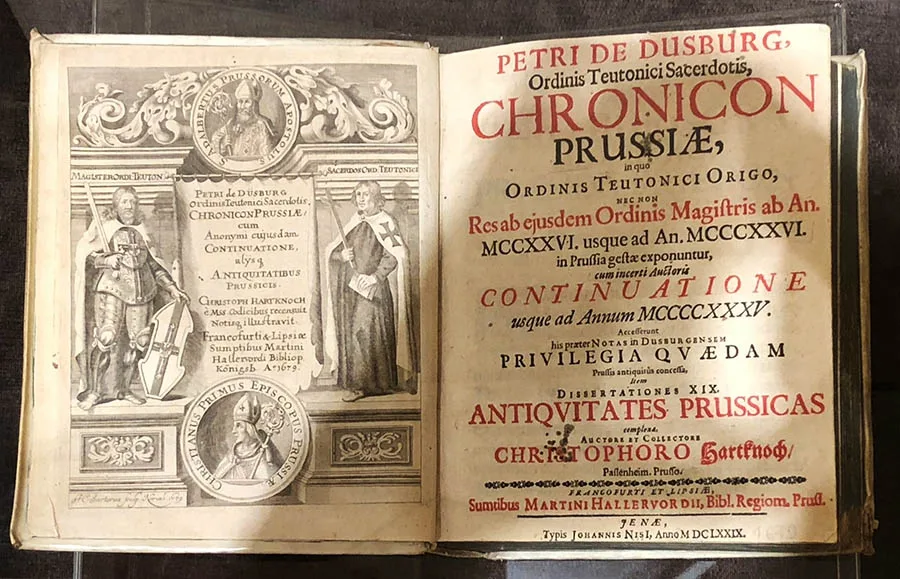
Mythological tradition points to the existence among the Balts of sanctuaries, as specially arranged places of worship, as early as the mid-5th–6th centuries, when the legendary newcomers, the Widiwarians, the brothers Bruteno and Widewuto, founded the sanctuary of the Prussians — Romowe Rickoyto. The first mention of the sanctuary, and the only one until the 16th century, in Dusburg’s chronicle is rather meagre:
“Now in the middle of this people steeped in vice, namely in Nadrovia, there was a place called Romow, which takes its name from Rome, in which lived one named Criwe, whom they honoured as a pope, for just as the lord pope rules the universal church of the Christians, so by his will or command were governed not only the aforesaid pagans but also the Lithuanians and the other peoples of the land of Livonia.”
From this we know that the Nadrovian Romowe-Ramawa was the central sanctuary of the Prussians and their pagan neighbours, the residence of the supreme Prussian priest, Krivis-Criwe.
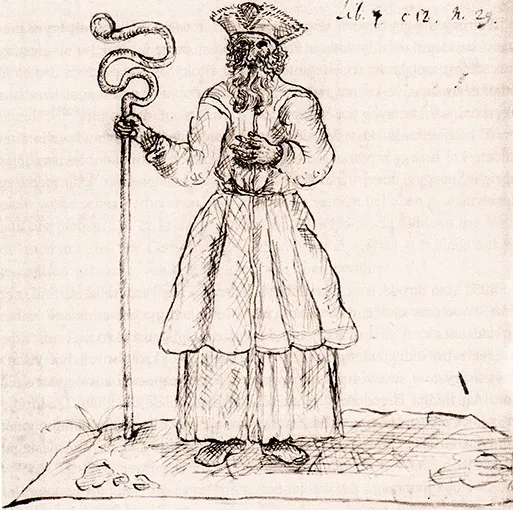
The supreme Prussian priest-krivis — Criwe Criwaito.
(Drawing from the early 18th century, from the book by M. Praetorius).
Peter of Dusburg’s derivation of the name Romowe from Rome is, of course, mistaken, but quite understandable if we take into account his status as a Catholic priest. The mention of a link between the name Romowe and Rome indirectly justifies the origins of the power and functions of the high priest of the ancient Prussians. Let us recall the comparison of Criwe with the Pope: in both cases a peculiar Rome-centred tendency can be traced.
From the 16th century onwards fuller texts about Romowe appear, describing the arrangement of the sanctuary in considerable detail — for example, the works of Simon Grunau, Christoph Hartknoch and Matthäus Praetorius. Thus, judging by the mentions of the 16th–18th centuries, Romowe was a place in a bend of a river where a huge sacred oak grew, whose leaves were green in both winter and summer. The oak was the central place of the sanctuary. Most likely “ramawa-romowe” as a common noun was the name of such a tree, or was associated with a place where such an evergreen oak grew. Around the oak, behind special screens beyond which only the priests could pass, burned undying fires maintained by the vaidelots (a caste of Prussian priests), and sacrifices could also be made there. In the branches of the oak, which formed natural niches, stood the images of the three main Prussian gods2, associated with the main spheres of life, the seasons and the milestones of the Prussians’ lives.
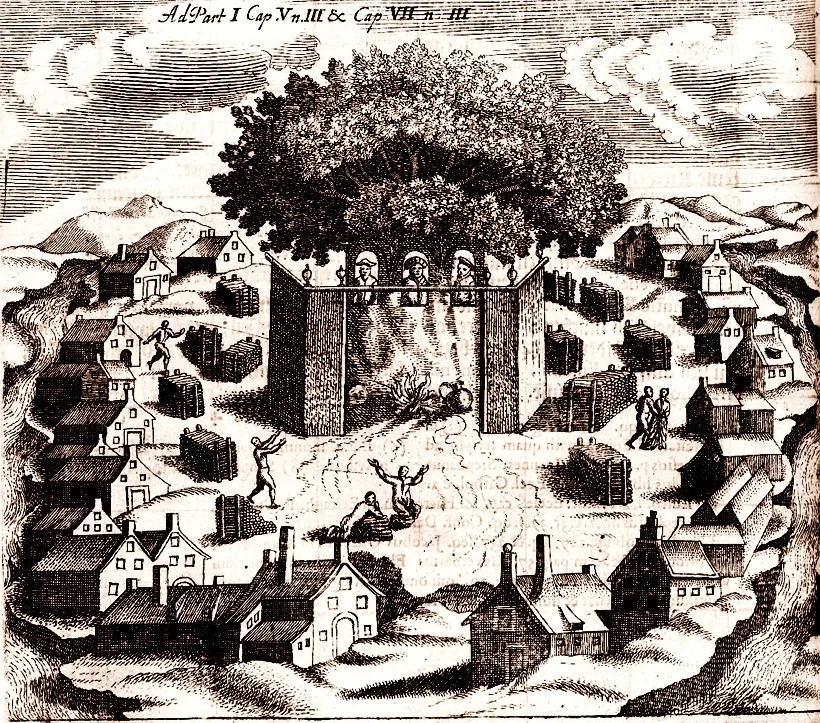
Romowe Rickoyto in Nadrovia.
(Drawing from the late 17th century, from the book by C. Hartknoch.)
The Scandinavians had a sanctuary of similar structure at Old Uppsala before their conversion in the 10th–11th centuries. Uppsala, by the way, was shown quite well in the second season of the much-talked-about series “Vikings”, especially in the context of human sacrifices, which also took place in the lands of the Prussians.
According to Simon Grunau, at Romowe “an eternal sacred fire burned, maintained not only by the supreme priest himself but by the vaidelots; a snake lived there, drinking milk from a large vessel; nearby lay the skulls of a man, a horse and a bull”. All these attributes were used in the performance of cult ceremonies in honour of the Prussian gods mentioned.
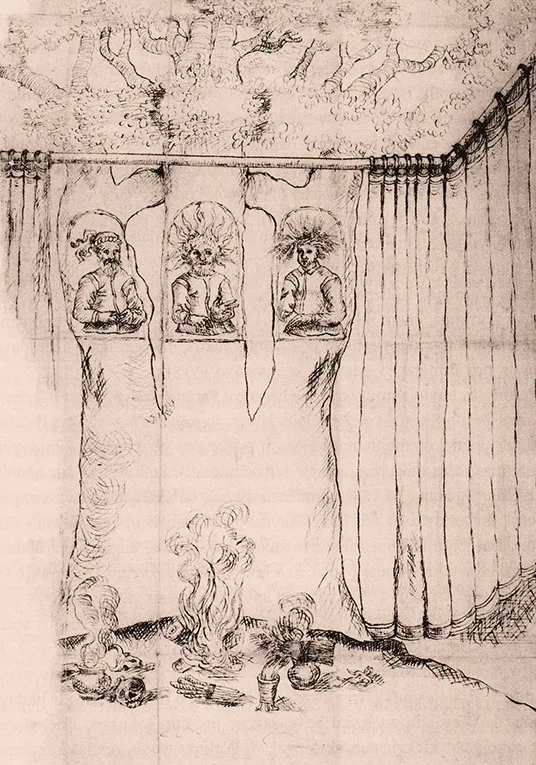
The oak, the gods and their attributes at Romowe.
(Drawing from the early 18th century, from the book by M. Praetorius.)
And, as already mentioned, Romowe was also considered the residence of the supreme Prussian priest — the Krivis (Criwe), also known as Criwe Criwaito. The institution of the Prussian priesthood, like paganism itself, was considered one of the most developed in pre-Christian Europe.
On the territory of historical Prussia there are several place names with the root “ram”/“rom” (for example, Old Prussian Raminta/German Rominten, Rambynas, Romehnen, Romainiai, etc.); many of them are linked with Romowe, but none of them is accompanied by any more or less serious commentary from historians. The chronicler’s words about Romowe lying “in the middle” of the Prussian lands should not be taken literally. They mean only that “Romow” lay among the tribes that revered the Criwe. When it comes to the location of the sanctuary, some researchers (Matthäus Praetorius), following Peter of Dusburg, placed Romowe in Nadrovia. Others, following Voigt, placed it in Sambia (in the hamlet of Romehnen, near Germau), relying in this case on the name and probably on the following legend about a sacred stone, published by Reusch in 1863:
“In the vicinity of the Germau hillfort of Gross-Hausen, in a bog, lies the Sacrificial Stone (Opferstein). On one side it has a hollow and therefore probably served as an altar on which the Prussians made human sacrifices to their bloodthirsty gods. The small estate of Romehnen, to which Romowe was ‘moved’, lies a quarter of a mile from there.”
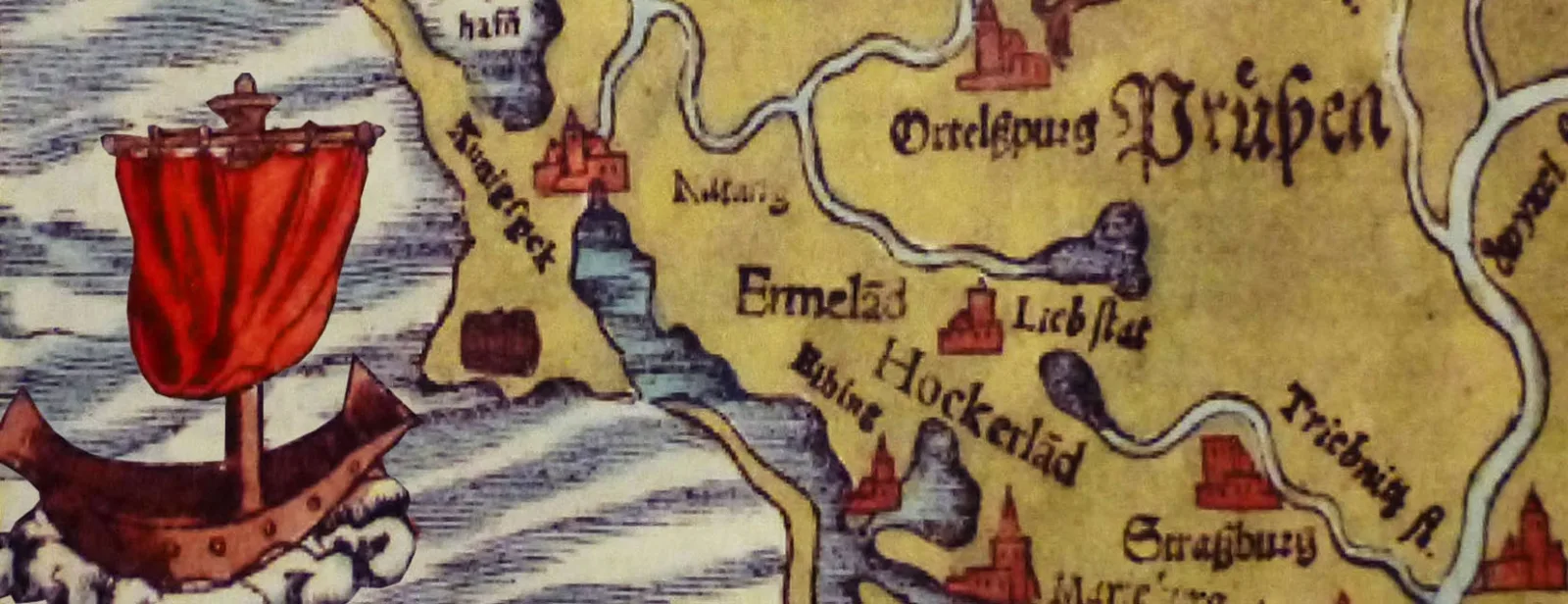
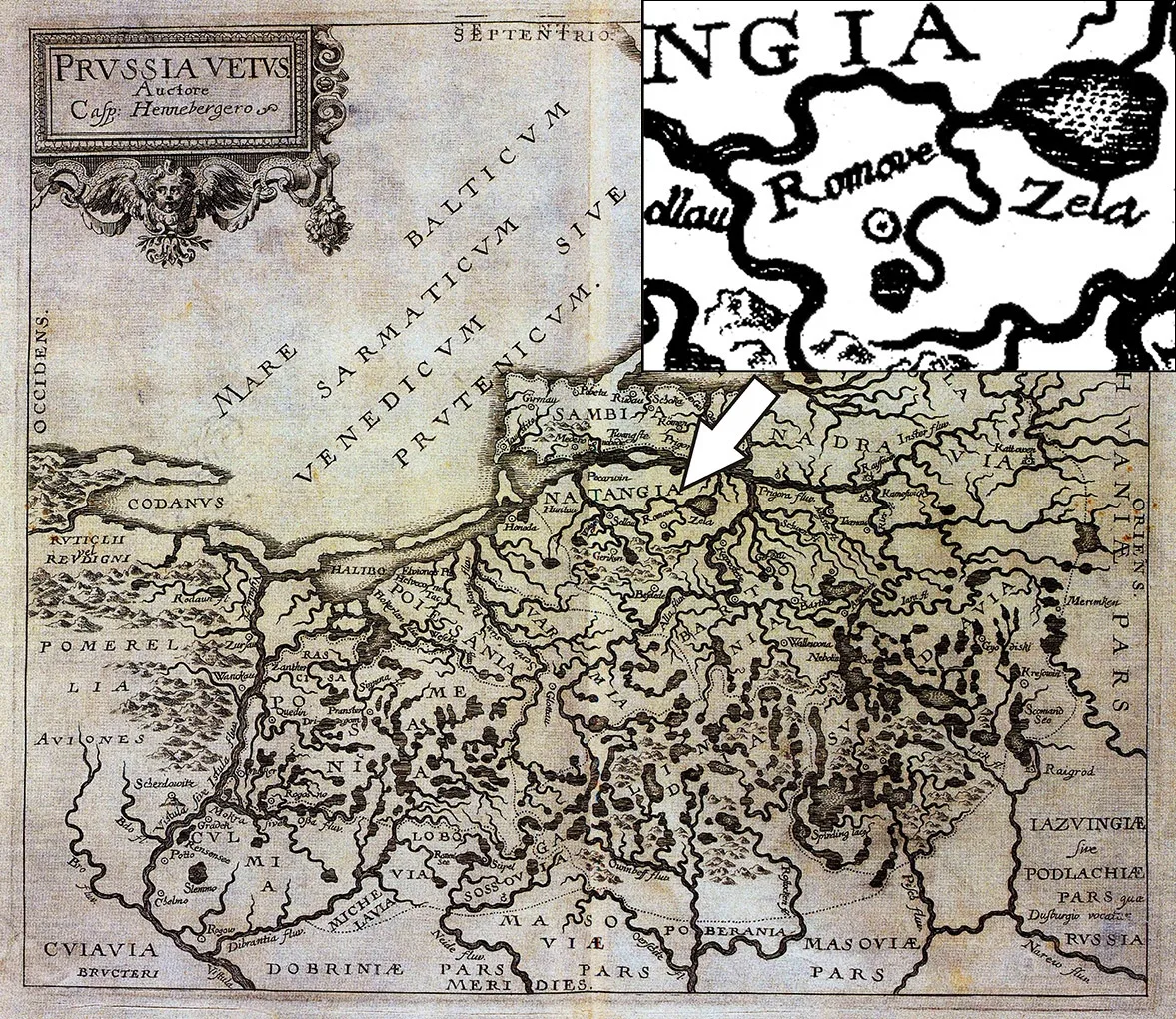
Also known are Romitten in today’s Bagrationovsk District, and Romau (Romau/as Romow in 1394) between present-day Znamensk and Pravdinsk. The latter found its way onto Hartknoch’s map together with other elements of Prussian sacred toponymy.
Scant information. On the other hand, it suggests that the Prussians may have had such a central sacred place — a Ramawa-Romowe — in each region.
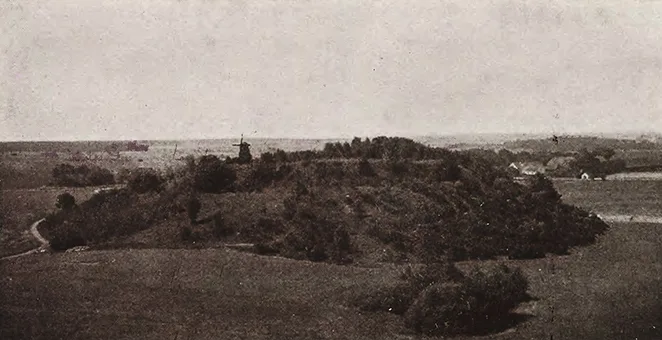
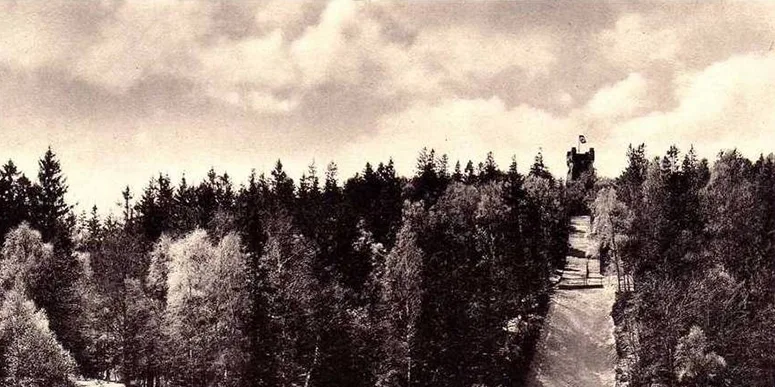
At the same time, two other places — massive Prussian hillforts “guarding” valleys in the bends and loops of rivers — are mentioned most often in connection with “Romowe”. These are the “Schwedenschanze” hillfort near the Lateinerberg by Heiligenbeil (Mamonovo) in Natangia (the village of Lipovka, Bagrationovsk District) and the Warapils-Schlossberg hillfort by the village of Bochagi near Norkitten (Mezhdurechye) in Nadrovia.
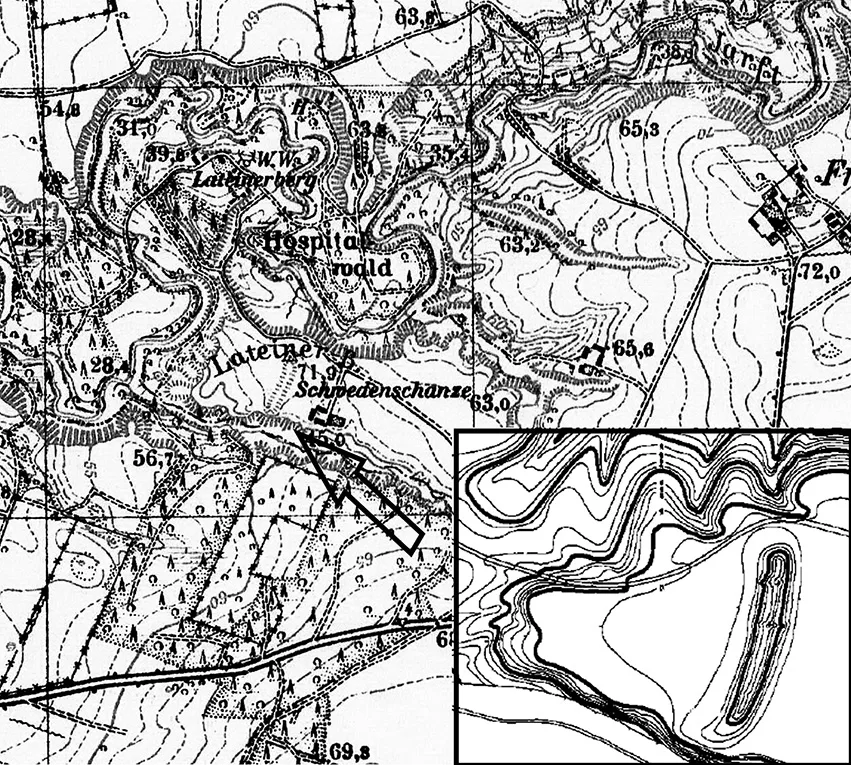
Plan of the "Schwedenschanze" hillfort by the Lateinerberg
near the town of Heiligenbeil (Mamonovo 2).
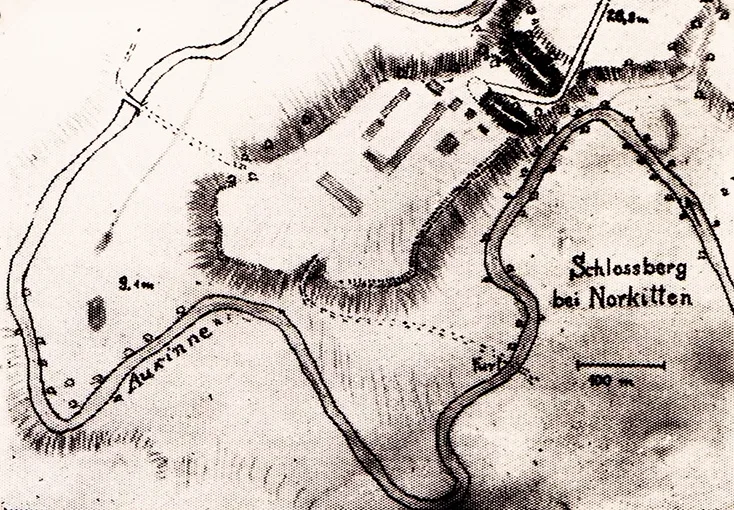
The Prussian hillfort of Warapils-Schlossberg, also known as the hillfort near Norkitten.
(Plan drawing from a 1935 article by H. Crome and W. Grunert.)
It is believed that the earliest Romowe — Romowe Rickoyto — as the residence of the Prussian priests and of the religious cult arose in the 5th–6th centuries in Natangia in connection with the arrival of the brothers Bruteno and Widewuto, who reformed the Prussian religion and everyday way of life. It existed here until it was plundered by the Poles during one of their raids at the beginning of the 11th century, or until the final conquest of Natangia by the crusaders in the second half of the 13th century. Afterwards Romowe moved to Nadrovia (Warapils-Schlossberg), where it most likely remained until the end of the conquest of Prussia by the Teutonic Order at the end of the 13th century. After that the sanctuaries of Ramawa or Romowe, together with the priests, may have gone to Lithuania, which preserved its pagan cults, including as princely-state cults, until the end of the 14th century.
Local tales and legends, however, say that the oak of Romowe itself (sometimes mentioned as an oak near Heiligenbeil) was felled only in the 14th century. According to one version: “It was decided to build a church on the site of the sacred oak in the lower reaches of the Banava. But German axes could not cut the hard wood of the age-old giant. Only after the Bishop of Warmia, Anselm, said a special prayer did the oak crash down under the onslaught of steel.”
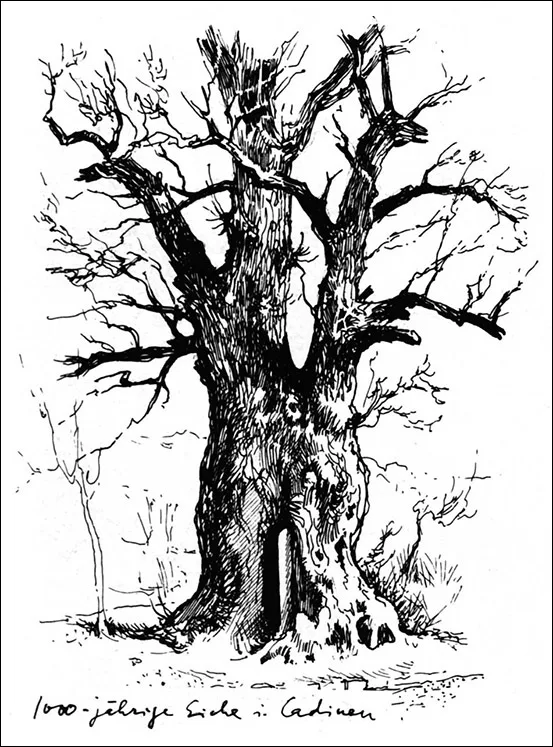
The "thousand-year-old" oak at Kadyny.
(Drawing from before 1945)
According to another legend, the oak of Romowe was felled by the Grand Marshal Henning Schindekopf in the second half of the 14th century on the orders of the Grand Master of the Order, Winrich von Kniprode, who had in turn been asked to do so by Bishop Vito of Warmia. There follows a mystical story about the blood of human sacrifices flowing from the stump of the felled giant. After the sanctuary had been destroyed and the oak felled, people began to hear the rustling of branches and voices here, and saw ghosts and various monsters. And, for understandable reasons, the Holy Trinity Monastery was founded here. But the old gods did not want to leave this place hallowed by prayer, so the ghosts went on frightening the worshippers, now within the walls of the monastery, until an exorcist was sent for from Germany; he buried in the foundations of the almshouse special symbols that no one understood, which were supposedly found in the ruins of the monastery at the beginning of the 18th century.
Where the truth lies here and where fiction begins is hard to say today. But everyone knows the saying “a holy place never stays empty”. The Order’s tradition of building churches and monasteries on the sites of Prussian sanctuaries is attested by a good deal of documentary evidence and reflects the particular features of the sacred landscape of our region.
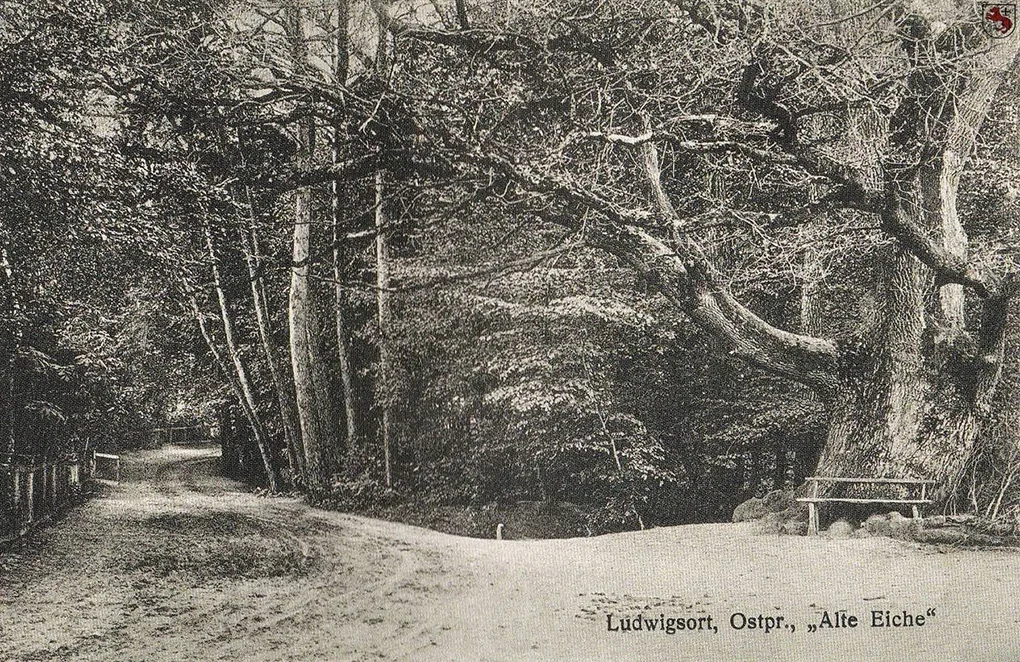
The "thousand-year-old" oak at Ludwigsort-Ladushkin.
Postcard, 1920s–30s.
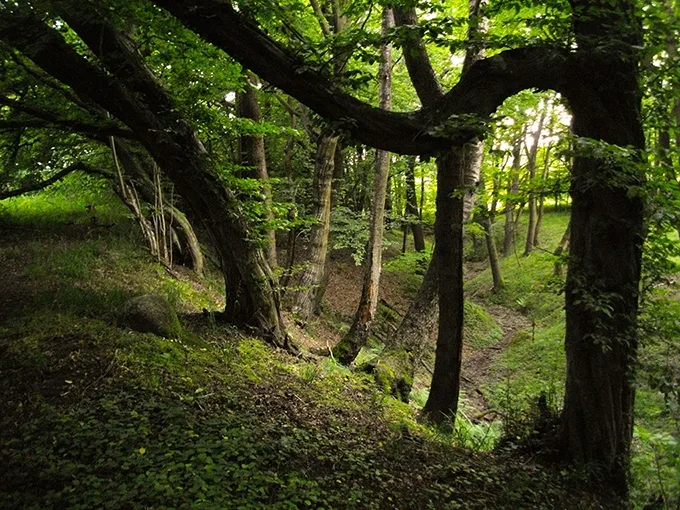
Although the majestic thousand-year-old oaks — the evergreen Ramawas covered with mistletoe — have not survived to our day, having fallen victim to human ignorance and “iconoclasm”, we are reminded of them by the centuries-old oaks, natural monuments in Ladushkin (Ludwigsort in Natangia) and at Kadyny in Warmia, which stand on the ancient road along the lagoon and still remember the Prussians, their rites and their language.
__________
1. Romowe Rokoyto is a Latinised version of the reconstructed Prussian name Rāmawa Rikāita (Ramawa Rikaita).
2. Patrimps (Potrimpo) — god of fertility and war; Perkūns (Perkuno) — god of thunder, atmospheric phenomena and justice; Patals (Latin Patollo) — god of death and magic.
Translated from Russian with the help of AI (Claude, Anthropic), October 2026.