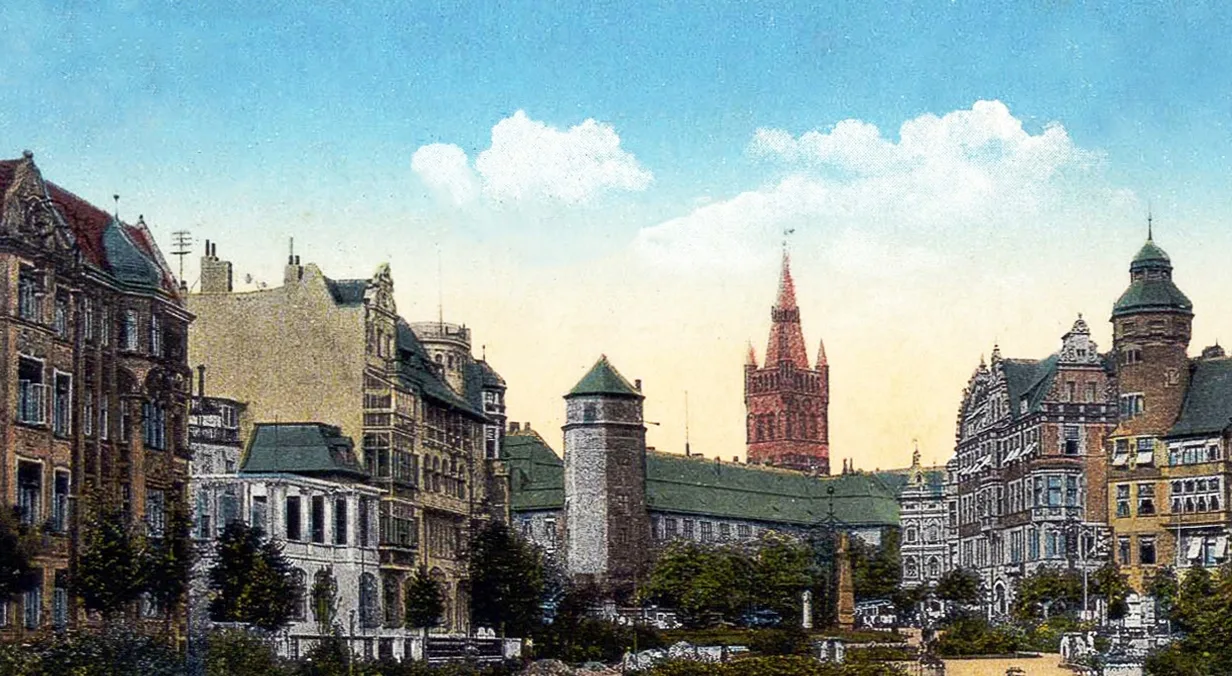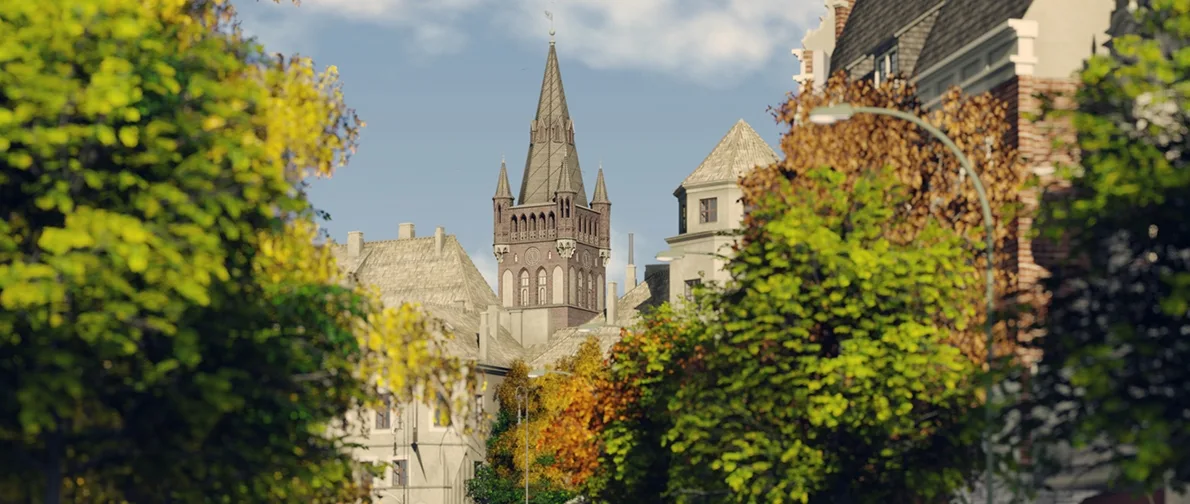
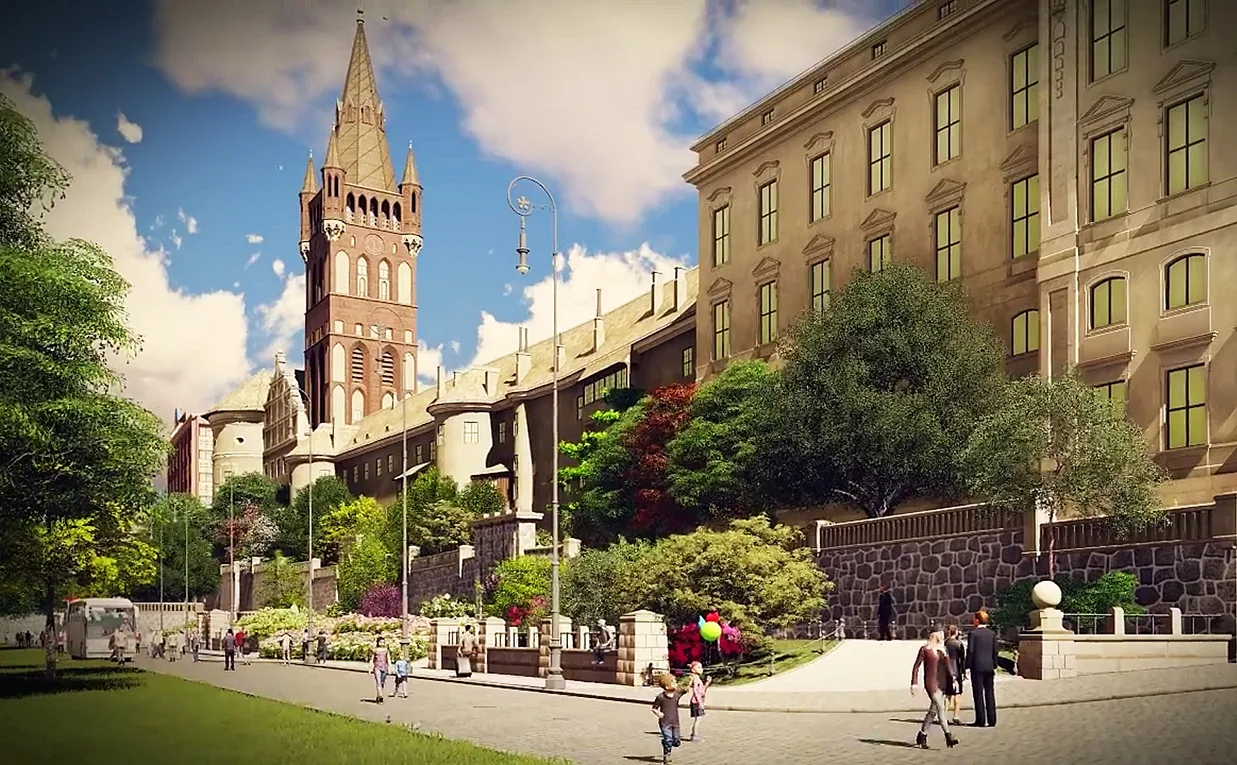
A great many things happened in Kaliningrad over the past year — some interesting, some less so, some important, some hardly worth mentioning. Yet 2015 will most likely be remembered as a turning point in the long-running debate between supporters and opponents of rebuilding the Royal Castle. It seems that this was the year when both the public and the authorities finally recognised the need to recreate the city's former architectural landmark. But before builders can move onto Castle Hill, archaeologists must study it thoroughly.
– A very serious, complex, but extremely interesting task lies ahead, — says Aleksandr Khokhlov, head of the Sambian Archaeological Expedition of the Institute of Archaeology of the Russian Academy of Sciences. — Among other things, we also need to investigate those parts of the castle that most people today know little about: the wide moat, the foundations and cellars of buildings and structures demolished in the past, the castle well, the burial grounds and so on. After that, all of it has to be preserved. And not merely preserved, but turned into a museum site, so that it can be shown to visitors. Beneath the present-day surface of Castle Hill lies unique material of lasting value, capable of drawing tourists here.
At the same time, Aleksandr Khokhlov believes that the idea of preserving the ruins in no way contradicts the idea of rebuilding the Royal Castle.
– The two fit together perfectly, — the archaeologist continues. — Specialists are well aware of cases where an ancient or medieval building has been restored and an exhibition devoted to the actual remains of the architectural structure uncovered during excavation and preserved as a museum site has been set up on its ground floor. We can see something similar at the Louvre in Paris, at the Lower Castle in Vilnius, in Berlin and in many other cities.
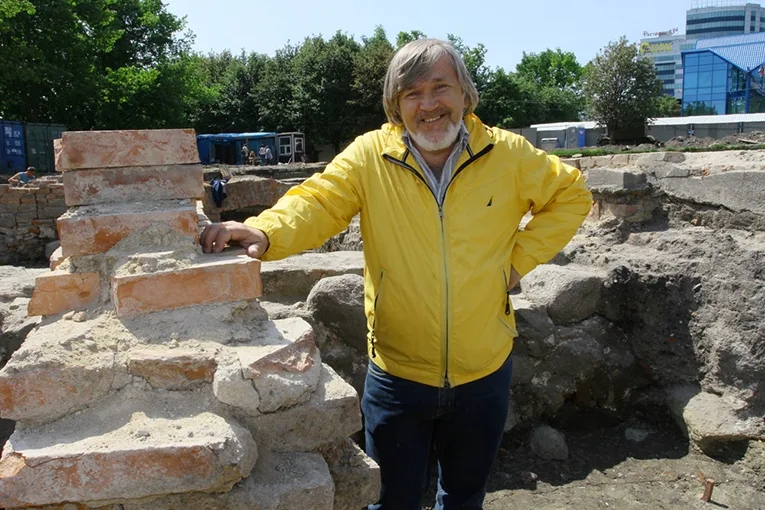
Aleksandr Khokhlov, head of the Sambian Archaeological Expedition of the Institute of Archaeology of the Russian Academy of Sciences.
Moreover, under the Federal Law “On the Protection of the Heritage of the Peoples of the Russian Federation”, any remains of an architectural and archaeological site that have been uncovered must be physically preserved. As practice shows, in such a case there is no other way than restoration.
In view of all this, it is not entirely clear how the organisers of the “Post-Castle” competition could have gone ahead with it without first arranging archaeological investigations and obtaining comprehensive information on the location of the castle's ancient, authentic parts. After all, besides the walls of the castle building familiar from early 20th-century photographs, there were earlier stone and brick structures — the Convent building, walls and towers lost in the 16th–18th centuries, a moat with stone revetments and facing, several castle chapels and medieval burial complexes. The design awarded first prize by the jury can hardly be carried out, since its implementation would inevitably destroy the surviving authentic architectural and archaeological remains.
It is telling that the online vote was won by Arthur Sarnitz's design, which envisages a complete and detailed reconstruction of the castle. So the townspeople, it turns out, proved more far-sighted than the distinguished members of the jury?
– It is extremely important for the city to have a landmark that links the past and present of this land, — says Aleksandr Nikolayevich. — The Cathedral plays such a role only on the Island. The castle, however, could become a landmark for the whole city, one that by its material form and physical presence would remind us that the history of Russia in general, and the history of the Kaliningrad Region in particular, are an integral part of the history of Europe. The competition featured many designs proposing all kinds of modern forms and futuristic structures on the castle site. But central Kaliningrad already has plenty of those. It is my deepest conviction that buildings of that kind belong somewhere that never had an established historical urban fabric. The city centre, in my view, should be developed differently, taking into account the historical experience of the particular city. You cannot cut off a tree's roots and expect it to live. Historical continuity is the most important aspect of an architect's work in a city with centuries of history. The design proposed by Arthur Sarnitz best meets this principle. That is probably why his project won the online vote.
…Continuing on the subject of archaeology, it is worth noting that, in Sarnitz's opinion, the event for Kaliningrad should be not only the reconstruction of the Royal Castle itself but also the archaeological excavations on its site.
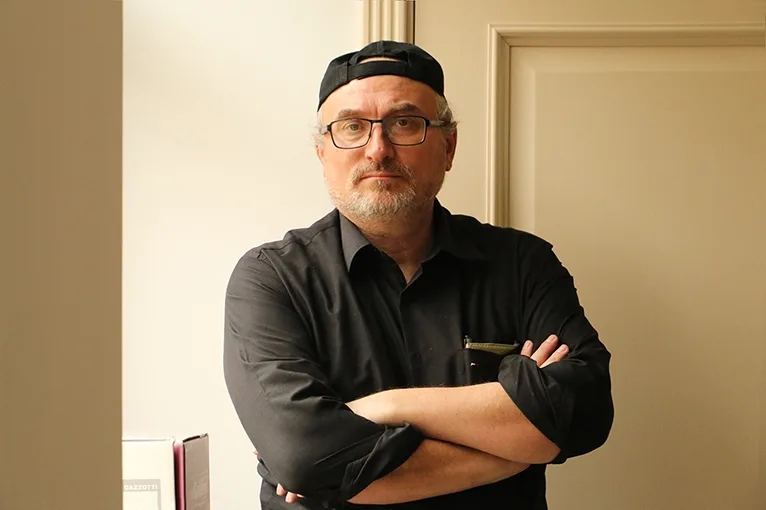 Architect Arthur Sarnitz.
– If you approach this process with intelligence and heart, you can turn it into a magnificent show that the whole world will talk about, — the architect believes. — Excavations could be carried out all year round under large illuminated tents, with big screens showing the progress of the work and the finds. None of this is fantasy — in many countries they have been working this way for a long time. What is more, there are specialists in Europe with solid financial backing who are ready to organise excavations of the highest standard here too. After all, ours is one of the few cities in Europe that no one has yet properly investigated. And yet Kaliningrad-Königsberg is one of the most fascinating places on Earth from an archaeologist's point of view. A crossroads of cultures and civilisations. A place where East meets West.
Who knows, perhaps a new school of archaeology will be born here and become one of the brightest local brands. At any rate, I think that is something worth striving for.
Photos by Aleksandr Matveyev and Mikhail Ogorodnikov.
Translated from Russian with the help of AI (Claude, Anthropic), October 2026.