The Khrushchev-era blocks there were the answer of young, spirited innovators to the fusty, short-sighted conservatives and reactionaries who proposed rebuilding some of the German houses on the site of today's Leninsky Prospekt and pushing the Khrushchev blocks back into the second row, so that they wouldn't be so conspicuous.
Back then most architects indignantly rejected the idea of partially bringing back the pre-war buildings; their bold thoughts were directed towards a future in which there was no place for medieval crowding, absurd curlicues on façades and tiled roofs. And the wise Communist Party supported this approach.
– We are building a new Soviet city, — it said. — There's no need to look back. Give us simplicity, reliability and comfort!
In short, as they sang in the famous "March of the Enthusiasts":
Is it for us to stand still?
In all our daring we are always right.
Our labour — is a matter of honour,
a matter of valour and a feat of glory.
And now what? Now the Khrushchev blocks lined up along the road resemble beggars sitting on the church steps. You feel too sorry for them to drive them away, and you can't bear to look at them.
And it is not even that these buildings need repairs. Many pre-war buildings also need repairs, yet although they are much older than the Khrushchev blocks, they don't look nearly so outdated. Of course, one may recall that the Khrushchev blocks were not built to last for centuries but as a kind of temporary measure. They say the plan was to demolish them after two or three decades and build something new in their place.
But, frankly speaking, a great many good things were planned in the 1960s. For example, it was planned that by 1980 we would already be living under communism, having outdone the whole capitalist world led by hated America. It seems that the schemes for rebuilding the Khrushchev blocks were realistic to roughly the same degree. In any case, today this legacy of the era of voluntarism is a big problem. The city's main street looks like a badly planned and badly built dormitory suburb.
We ourselves are fine — we've got used to worse. But the Football World Cup is just around the corner. Crowds of foreign fans will come, and it will be embarrassing in front of them. It must be said that the first experience of upgrading a Khrushchev block turned out to be very successful.
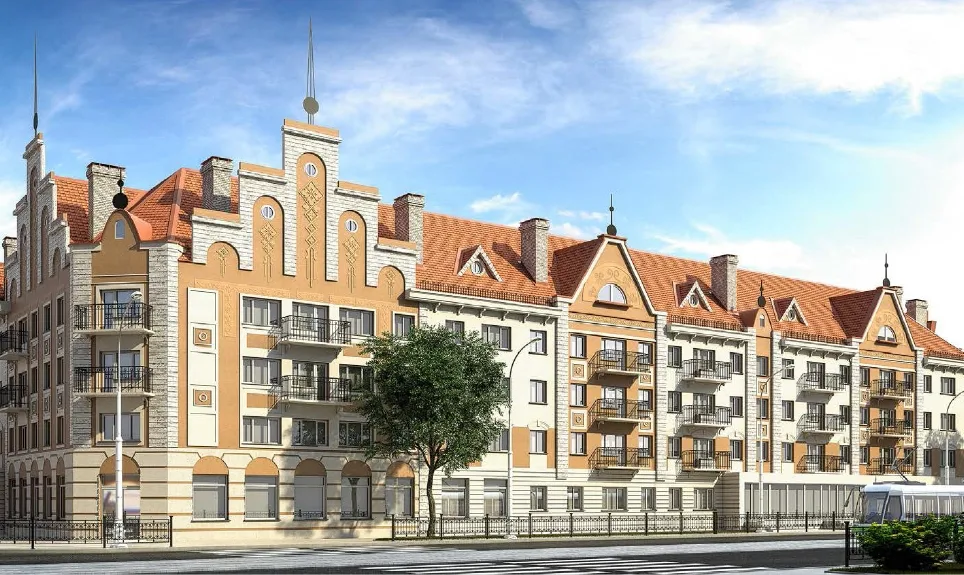
The five-storey block on Leninsky recently remodelled to a design by Arthur Sarnitz has become a new city landmark, written about by many publications in the capital and featured in reports on federal TV channels.
They even say that Ivan Urgant himself joked approvingly about it on his show for a full five minutes. Most local architects, it is true, once again pursed their lips and began explaining that a Khrushchev block ennobled in this way does not fit into the overall concept of Leninsky Prospekt, that people should not be deceived by imitations of old buildings, that new-built replicas are long out of fashion, that tourists will laugh, and so on and so forth.
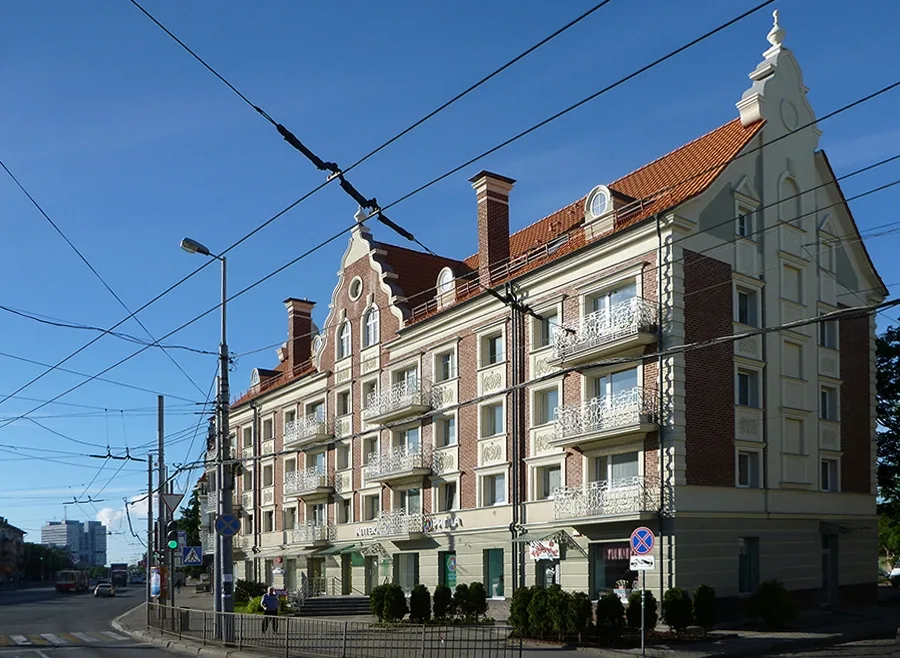
Leninsky Prospekt, 2-4. Architect Arthur Sarnitz.
However, people (meaning ordinary people) for the most part perceived the building's new look differently. No one has yet been seen laughing, but people have been seen admiring it and taking photos in front of what is in effect a new building. In short, as with the Fishing Village, the opinions of townspeople and tourists about this house (and later about two more remodelled in a similar way) diverged sharply from the opinion of most of the, shall we say, expert community. Some scold and criticise, others praise and admire. But whatever the highbrow intellectuals (or people who wish to be seen as such) may say, there is a clear demand in Kaliningrad for pseudo-historical architecture.
A city deprived of its heart tries to compensate for its absence with something else. We Kaliningraders, paradoxical as it may sound, have not yet had our fill of old architecture, the way Europeans have had theirs.
We must first go through this stage, live through it, gain new experience, and only then will we be able to move on. We can, of course, skip the steps once again (we are very fond of doing that), but history will have a laugh and return us to square one, as happened with the Khrushchev blocks. And not only with them. The success of the first remodelled five-storey block was so obvious that it prompted the local authorities to carry on in the same vein, putting all the other Khrushchev blocks on Leninsky Prospekt in the queue for an "upgrade".
It would seem wonderful. One could put a full stop to this story, roll the credits and write the words "THE END" in big letters, all accompanied by some upbeat music. But no. Instead of a full stop, a comma was put, and what will be written after it is not yet entirely clear. Although everything points to a cheap vaudeville.
It is proposed to put into practice a project developed by the Moscow Architectural Institute (MARKhI) for remodelling another 12 buildings. "The appearance of the buildings," the regional government's press service reports, "will resemble the city's historical architecture, by analogy with the three 'Khrushchev blocks' that were handed over after major repairs this year."
"The contractors will completely replace the roofs and raise the height of the ridge board. The balconies facing the main street will be given a uniform appearance — practically all the owners agreed to this measure in order to preserve the stylistic unity of the buildings," explained Oksana Astakhova, General Director of the Capital Repairs Fund.
And all would be well if these buildings really were planned to be reconstructed by analogy with the first three. But in reality it is rather hard to speak of any analogy here. What the MARKhI architects propose is not even "after the motifs" of Königsberg's historical buildings. It is something completely new. Something gingerbread-sweet, fairground- carnival, something desperately frivolous.
As soon as the MARKhI project was published, social media immediately began comparing it with the Fishing Village, but to my mind it looks more like the Residence of Kings, where every possible style is mixed together — everything piled into a heap. As the saying goes — blood, sand, asphalt and sugar.
Besides, the Fishing Village was the first attempt in Kaliningrad to imitate historical buildings. In the eleven years that have passed since it was built, the architects could well have taken account of the mistakes made… For example, avoided the glaring caricature, worked out the façades more carefully, studied and used European (Polish, say!) experience of projects of this kind.
If the first rebuilt Khrushchev block can be compared to a well-made copy of a painting by an old master (a Flemish one, for example), then the MARKhI project resembles a cartoon drawn under the impression of that same painting — some utterly blatant, undisguised pop kitsch.
This, of course, is a subjective opinion. And it in no way claims to be the ultimate truth. What's more, I will be glad if someone convinces me that my judgements are mistaken. But for now it seems that if the project proposed by MARKhI is carried out, the very idea of imitating the old buildings will be discredited once and for all, which one would very much not want.
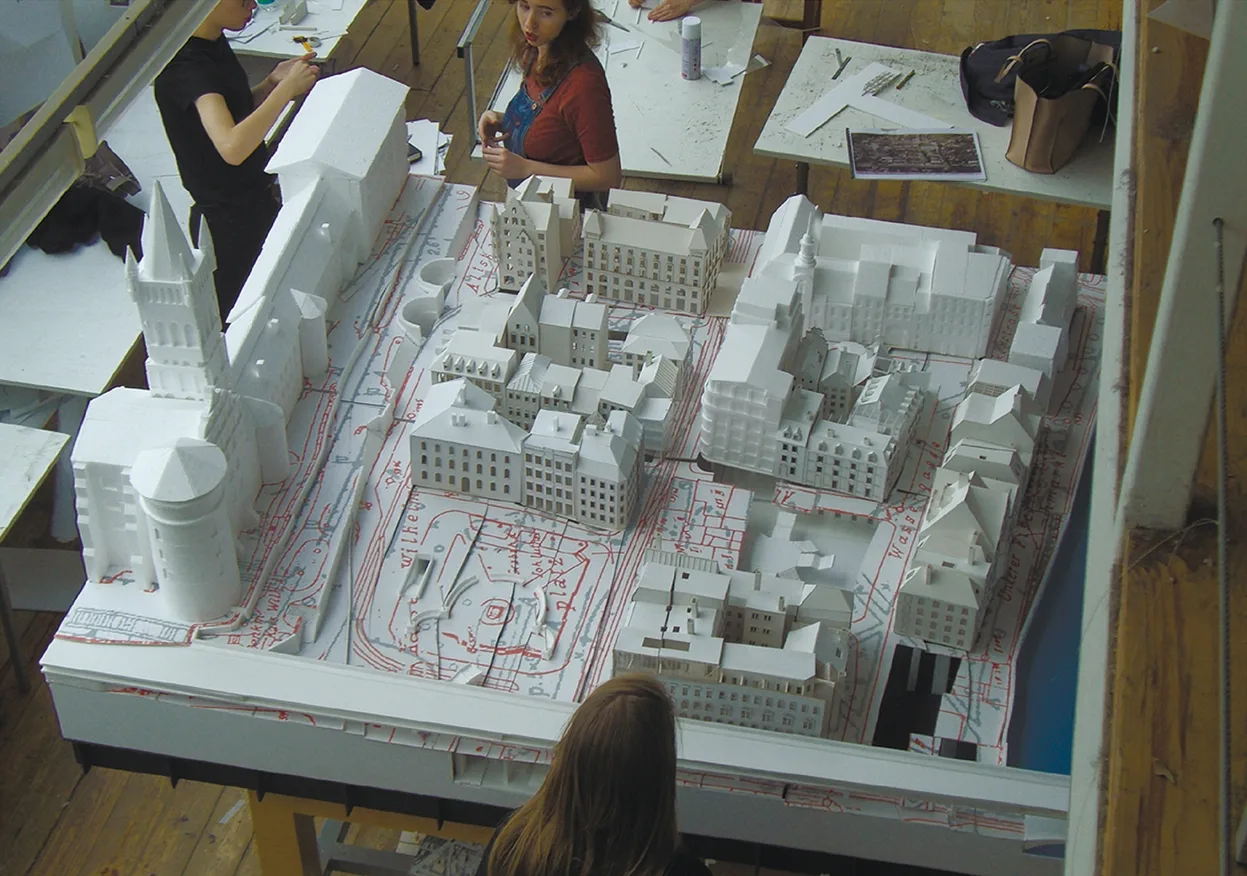
After all, many interesting proposals for changing the face of Kaliningrad are based on this technique. For example, Andrey Nekrasov's project (also, incidentally, from MARKhI) "Eight Blocks of the Altstadt", recently published on Imperative.eu. Take a closer look at this work. Do you feel the difference from what is proposed for Leninsky? That's exactly my point...
Translated from Russian with the help of AI (Claude, Anthropic), October 2026.