LEGENDS OF PRUSSIA in the blog of Tatyana Kolivay.
The northerner is like the Bologna stone1, which absorbs the light of the sun and gives it off in the dark. In the short summer season the northerner tries to enjoy nature's kindness as much as he can, because he knows that summer will be followed by a long, dreary winter. In Königsberg there are many houses with beautiful large gardens, especially on the Steindamm, Königstraße, the Sackheim and the Tragheim, that is, in the newer parts of the city. But in the old quarters there are not only no gardens but, as a rule, not even courtyards. Here the need to be closer to nature grows even stronger in summer, especially among children. And besides, a garden is just a garden. Small and cramped, too small for children to romp about in to their hearts' content. It is surrounded by houses on all sides, and in the evenings and early mornings it is cold and damp.
That is why the people of Königsberg have a very strong inclination to live in the open, and from Shrovetide on they begin to think about where to go in the summer months: whether to rent a cottage in the country or take rooms on the seashore.
Summer lodgings can be rented in the immediate vicinity of the city, for example in Hufen, in the villages of Ponarth, Juditten and Aweiden, or on the shore of the Baltic Sea.
It seems that the people of Königsberg once did not even suspect what beautiful places there are on the seashore from Cranz to Pillau. Only after the Napoleonic invasion did they discover and develop seaside resorts for themselves, and the starting point was the opening of the resort at Dobberan2. All this has led to the entire Baltic coast from Kiel to Riga now being filled with holidaymakers in the summer months.
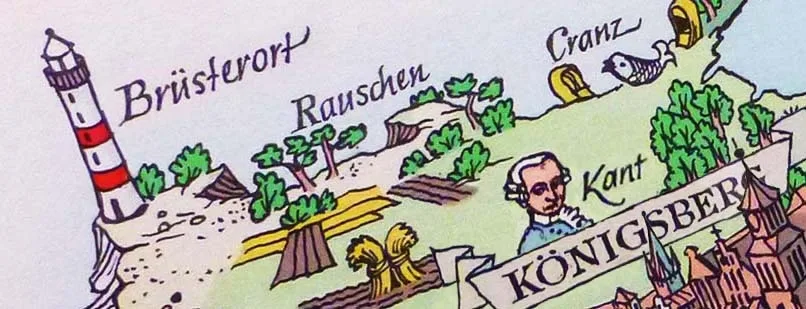
Cranz, Rantau, Neukuhren, Wangenkrug, Loppöhnen, Sassau, Rauschen, Georgswalde, Warnicken with its famous gorge, Klein Kuhren with its picturesque hills and so on: the people of East Prussia truly have plenty of places to rest from their cares, enjoying the sea and every available comfort.
For the doctors of Königsberg the proximity of seaside resorts is a great blessing, for the seaside resorts of the rest of Germany are very far from Königsberg because of its geographical isolation, and visiting them is therefore impossible for many patients. Sea bathing near Königsberg, on the other hand, involves expenses that even people of modest means can afford.
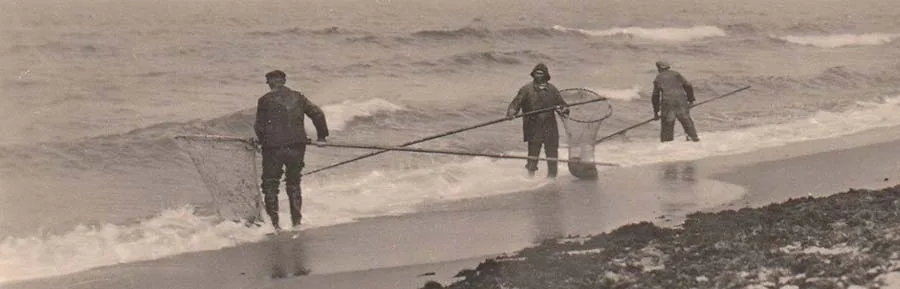
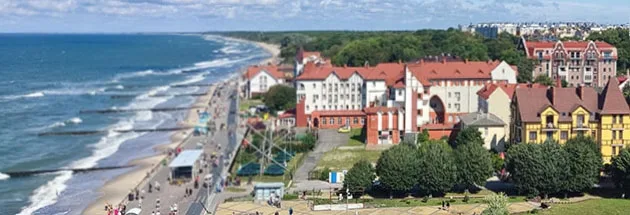
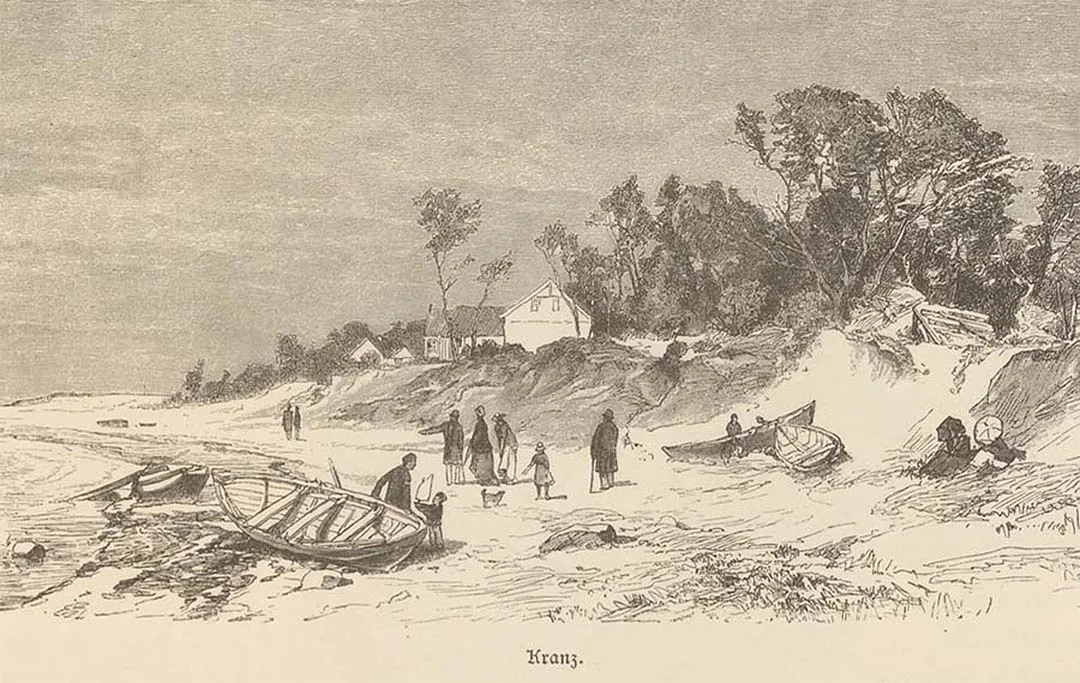
Cranz, until recently a fishing village known only for its smoked flounder, its extraordinarily strong waves, its poor lodgings and its lack of picturesque scenery, has turned into a small town and a popular seaside resort.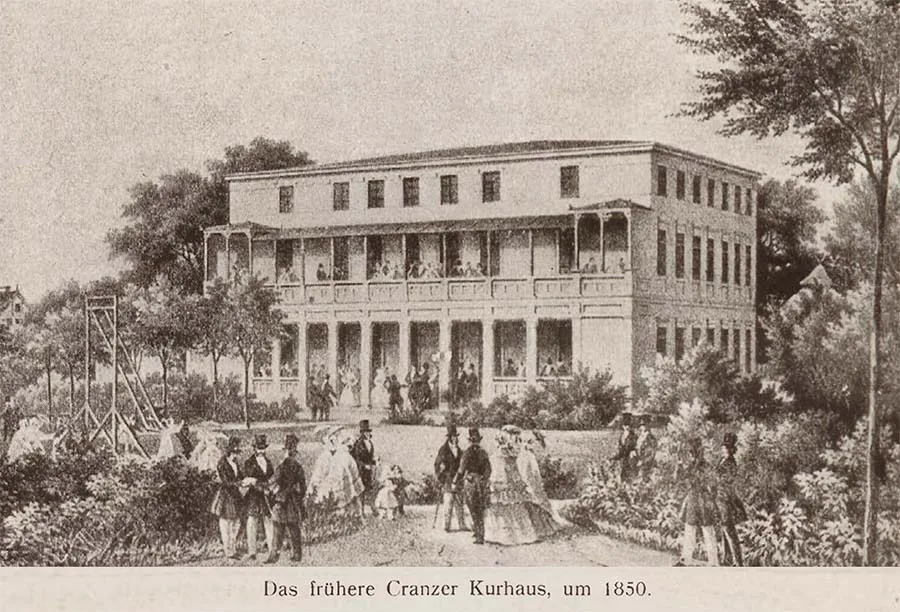 The former Kurhaus in Cranz, around 1850 (German: Kurhaus; archaic Russian: kurgauz, kurzal).
The force of the waves here is so great and the shores so low that very expensive stone structures had to be built in Cranz to prevent the destruction of the coastal zone. There are hotels, a boulevard where concerts are held daily, and a promenade along the shore.
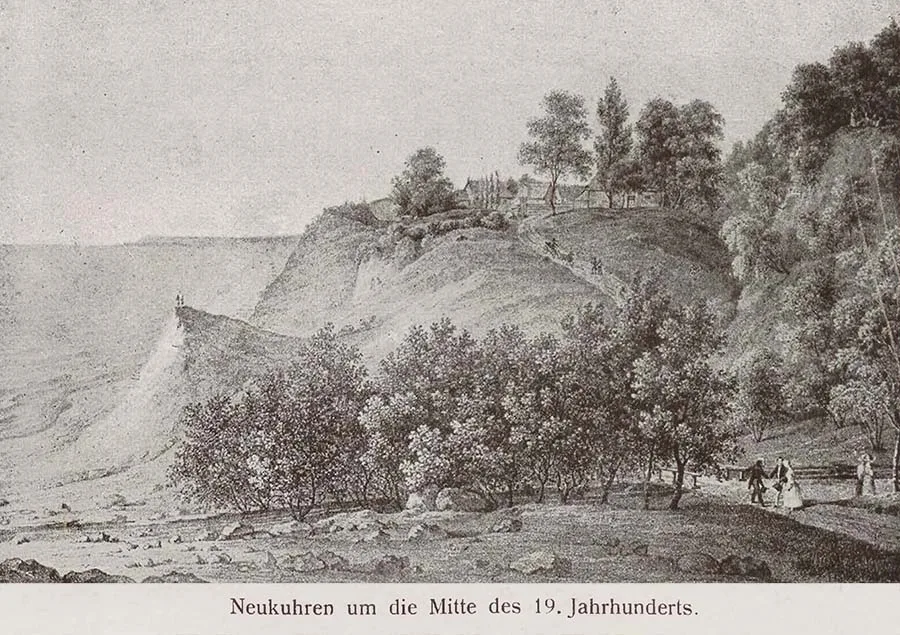 Neukuhren in the mid-19th century.
The beach in Cranz is fully equipped with bathing machines3.
* * *
West of Cranz lies the seaside resort of Neukuhren. It is visited mainly by families with children. The flat, wide sandy beach is especially suitable for children in need of rest. A holiday there is cheaper and quieter than in Cranz.
But the true pearl of the Baltic coast is the resort of Rauschen.
Rauschen has recently changed greatly for the better. While the old, charming village, situated on the eastern terrace of a deep ravine with a picturesque pond at its bottom, has remained almost as it was, the new, aristocratic Rauschen has settled on the dune separating the village from the sea. Handsome modern villas and hotels, a large, imposing hot-water bathhouse, running water, electric lighting and strict building regulations that preserve the natural beauty as far as possible enable Rauschen to compete with the most elegant seaside resorts in Prussia.
The soil of the whitish dunes is being cultivated and made fertile, and beautiful gardens delight the eye... In many respects Rauschen remains the opposite of Cranz. The rural, soothing quiet, the absence of big-city bustle and the wonderful scenery make it a favorite retreat of scholars and artists, who find peace and creative inspiration here.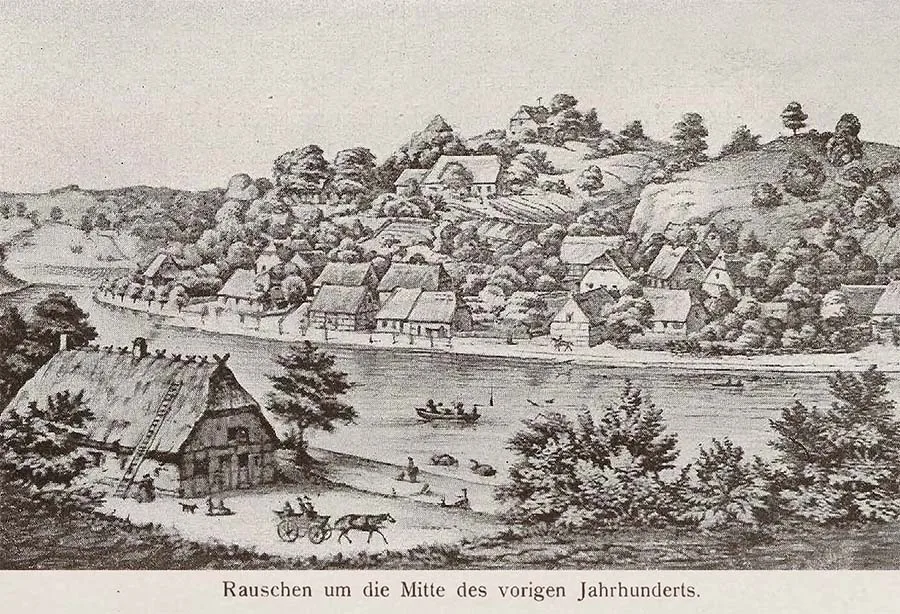 Rauschen in the middle of the century before last.
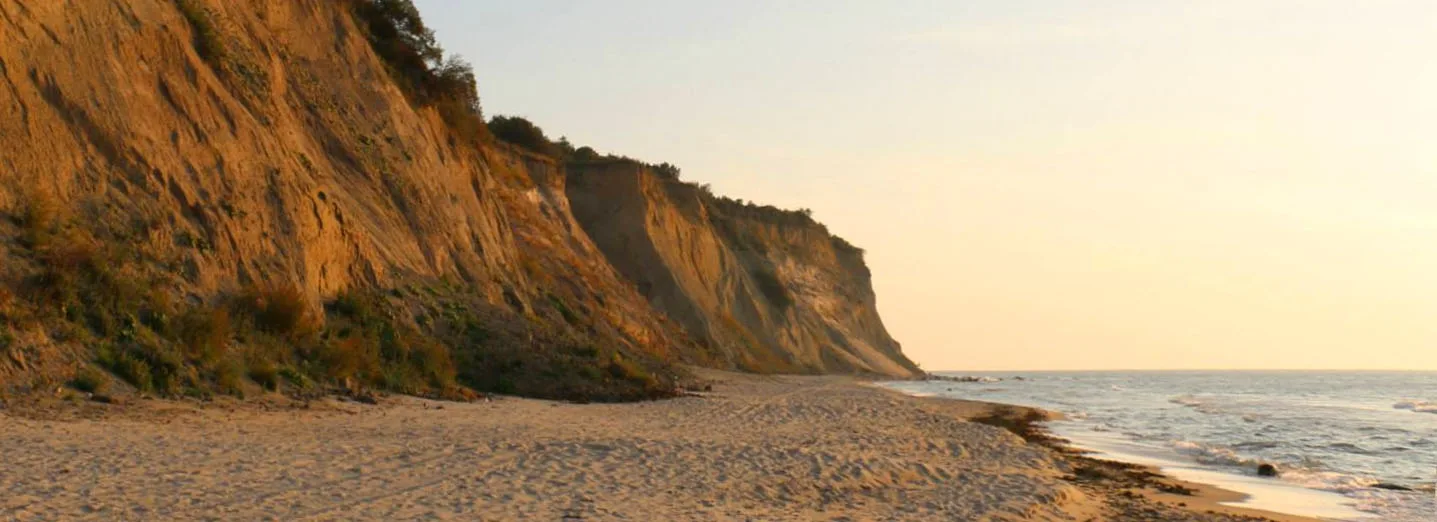
Rauschen has everything one needs for a quiet summer holiday by the sea: a beautiful old forest, a large romantic pond sheltered from the wind, dunes red with heather, a high coastline and refreshing sea bathing.
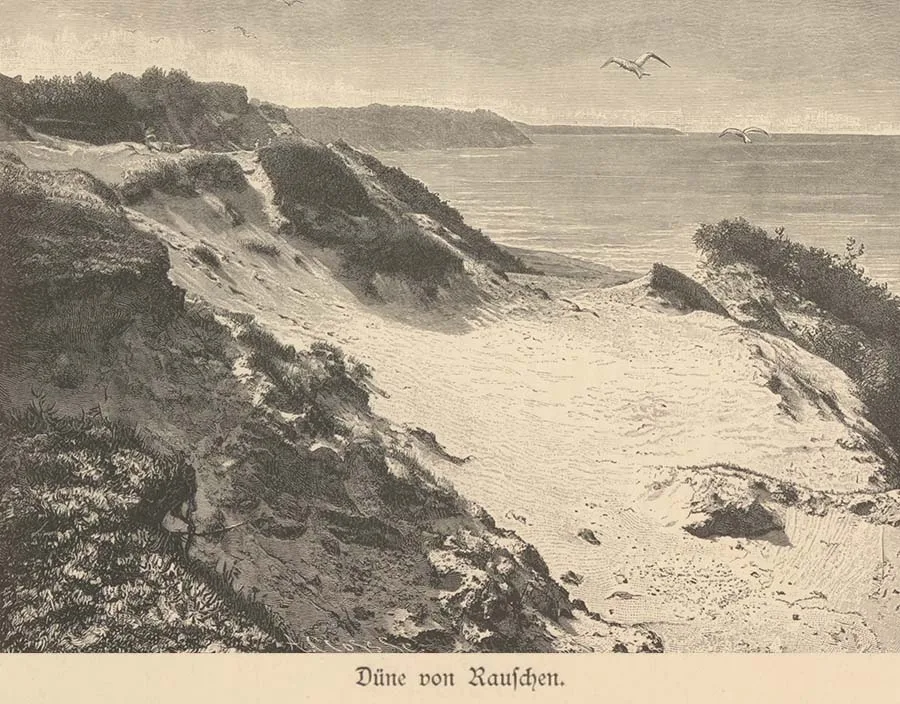
The dune at Rauschen.
Here the sea roars and the winds roar,
And the clatter of the mill rings out.
Here nature greets me with its roar,
For "Roar"4 is what this place is called.
So sang of Rauschen Ernst Wiechert5, an ardent admirer of this resort.
* * *
A walk through the Little and Great Cat Hollows (die kleinen und großen Katzengründe), which begin just beyond the Rauschen forest, offers the wanderer a wealth of interesting, constantly changing scenery. From the old pine forest he comes straight into hilly country where juniper and heather grow beneath clumps of lush, slender birches, or dazzling white sand glistens. The path continues across bare, pale sands, along brimming streams, past mysterious bogs where daphne and cranberries grow, over a lush carpet of green wood sorrel or knee-deep through ferns and grass, over hills and valleys, to an oak grove whose highest point offers an impressive view over the crowns of deciduous trees and the extensive forests of Warnicken. The sea is not visible anywhere along the way, and at times you seem to be among the birches of Finland or on the Lüneburg Heath, at times you suddenly find yourself in a real East Prussian forest, and at times in the lush countryside of Thuringia.
A walk through the forest and the mighty wooded ravines (the Gausup and the Detroitschlucht) from Rauschen to Warnicken, that gem of the Samland coast, reveals completely different scenery. Warnicken, where the head forestry office and an inn are located, is small, and so the number of holidaymakers here is very limited. But every year many thousands of travelers pass through Warnicken and its famous Wolf Gorge from Rauschen or Gross Kuhren. The shores, almost fifty meters high and crowned with wonderful, well-tended forest, drop steeply to the sea. The picturesque Wolf Gorge gradually descends almost to sea level.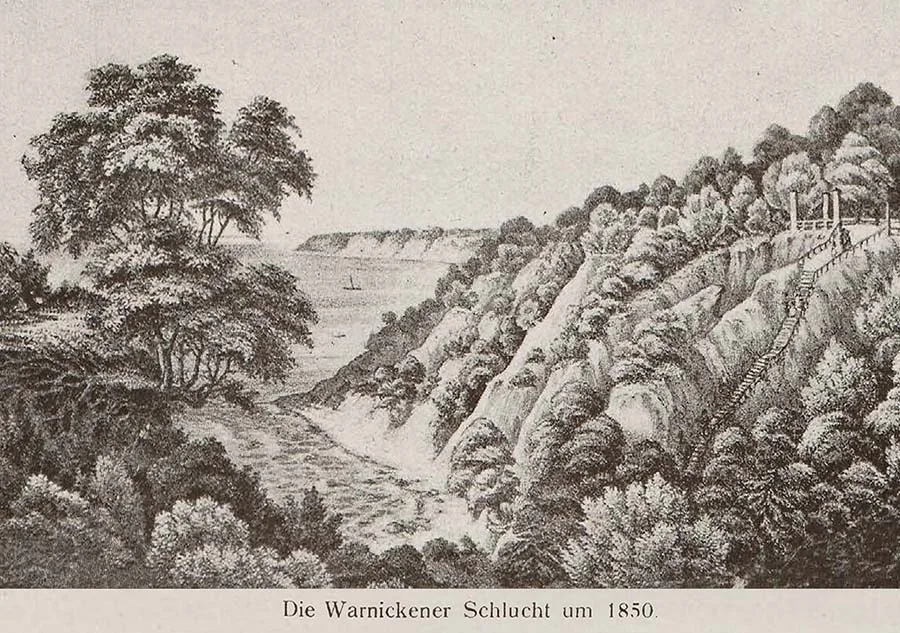 The Warnicken gorge around 1850.
The slopes of the Wolf Gorge are covered with lush undergrowth, and its most beautiful parts can be reached by specially made paths and stairs. From the heights, and especially from the Wolfsspitze, there are magnificent views.
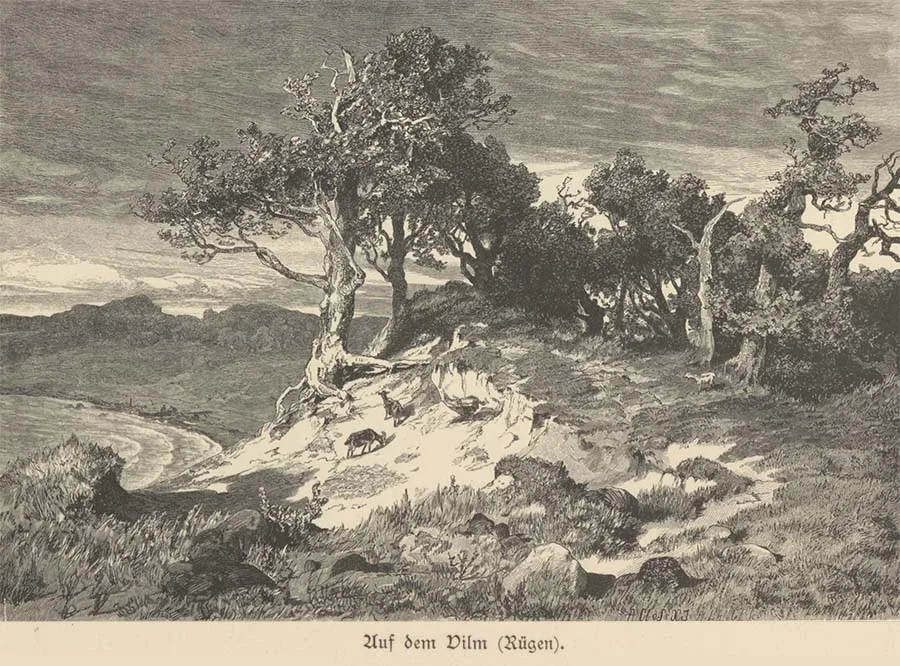 On the Vilm (Rügen).
The shores here consist partly of red and grey-blue marl, whose colors give the landscape a unique look, recalling now the chalk deposits of the island of Rügen, now Alpine rock formations. Here, high above the cliff, an ash tree a meter thick leans out. There a crooked pine clings to the rocks, and here a lush green alder thicket has settled.
The picture is framed by the sea, whose waves break against the countless rocks jutting out from the coast. Add to this the play of light of the setting sun, and you have a unique picture of nature that could not be more sublime and beautiful.
* * *
Everywhere in the countryside you see canvas tents pitched here and there, and you meet pleasure carriages, horsemen and horsewomen, and people out on short and long walks. On the seashore stand straw bathing huts, which often look as if an African village had moved here together with its inhabitants. The entrance of a hut usually faces the land and the closed back wall faces the sea, and while you undress you can hear the wonderful sound of the waves close by. It is an invitation to seek health in them and, at the very least, a good appetite. And without pleasure, bathing would be insipid.
It is regrettable that, contrary to the demands of health, women indulge in prudery, staying in wet bathing costumes the whole time they are on the beach, and as a result often catch cold. Not to mention that these outfits make bathing awkward and uncomfortable. Are bathers not sufficiently protected from immodest glances by the special bathing hours, the hilly Baltic shore and the company of ladies taking sea baths nearby?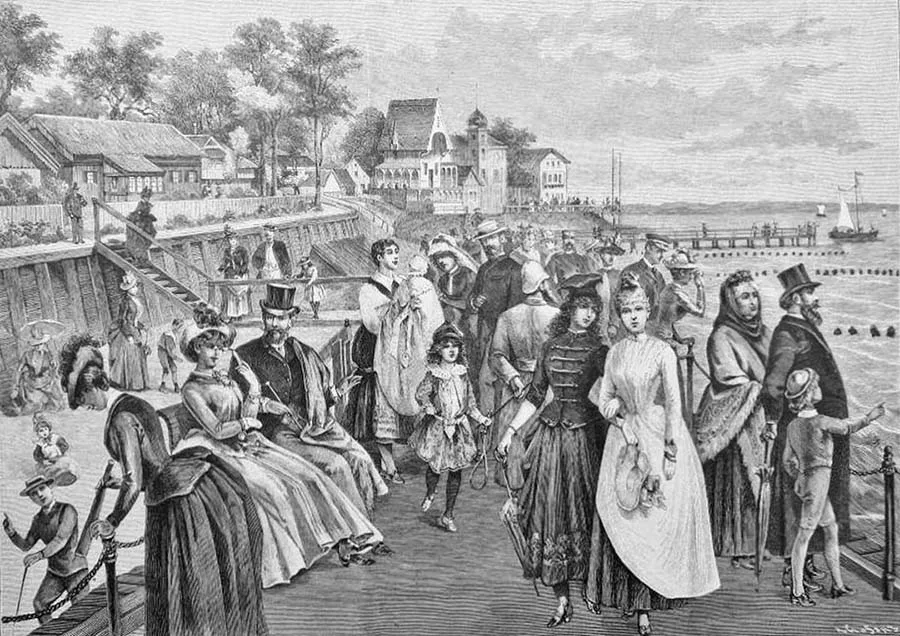 The public on the promenade at Cranz.
Was not a half-blind gendarme posted on the beach at Cranz to keep public order when complaints were once made about some impudent fellows who had trained their lorgnettes on the bashful ladies?
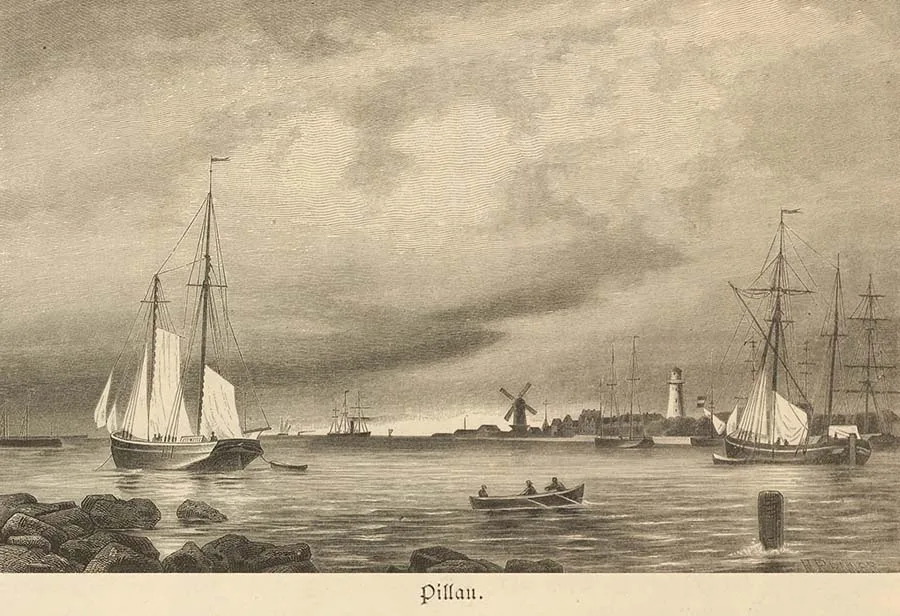 Pillau.
Every resident of Königsberg has a favorite resort village that he visits and whose location, shore and society he prefers. At the resorts themselves people talk of nothing but the sea. From all sides one keeps hearing:
"Have you bathed yet today?"
"Is the water good?"
"What water temperature suits you?"
"Will you be going to the sea again today?"
"Such a storm today! Did you manage to swim?"
"Have you found good company here?" and so on.
And so it goes from morning till night. Admiration of the sea is a constant recitative repeated by every holidaymaker.
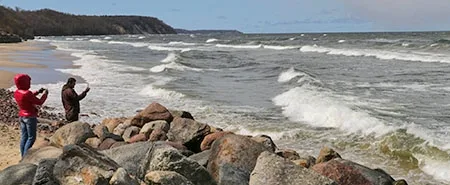
Whether the sea reverently kisses the sand on the shore or, like a primeval monster with a thousand giant heads, threatens with a terrible roar to swallow the land; whether it sparkles like a flowing pale-green emerald or shimmers like dark violet ink; whether it performs a gentle dance of waves or lies still as a grey mass, like crushed ice; whether it boils with foam, raising its waves to the heavens, or whether in its clear waters, as in a smooth mirror, we can clearly make out the stones and moss on the bottom, the sea is always beautiful. You never tire of it, whether it appears before you like a beloved woman in a negligee or dressed in festive emerald robes. Its charms are inexhaustible.
One can sit for hours on a large boulder or in a fishing boat pulled up on the shore, immersing oneself entirely in thought in the blue expanse of the sky above the wide sea, in the radiance of the sun, the moon and the stars sparkling in the soft depths of the night sky.
It seems as if at such moments Homer and Shakespeare are conversing with us, poets who knew the sea well and to whom it revealed all its secrets.
How wonderful that our king's birthday, the third of August, falls in the middle of the high season and is its culmination. Inspired compatriots recite poems, make solemn speeches, set off fireworks, dance and drink to the well-being of Frederick William III the Just!
TRANSLATOR'S NOTES
1. The Bononian (Bologna) stone, or Bologna spar, is a variety of spar containing barium sulfate. It was found near Monte Paterno in the vicinity of Bologna. Around 1600 the shepherd Vincenzo Cascariolo noticed that after several hours in the sun this stone acquired the ability to glow in the dark. Together with the alchemist Begatello and the mathematician Magini, Cascariolo began producing so-called Bologna stones (also known as "sun stones," lapis solaris), which became popular in Europe in the 17th century.
"They say that the Bononian stone, if laid in the sun, absorbs the sun's rays and then glows for a while in the dark…"
Johann Wolfgang Goethe, "The Sorrows of Young Werther"
2. Bathing machine (German: Badewagen; Badekarre).
A bathing machine was a closed wooden cabin on two (Badekarre) or four (Badewagen) wheels that was rolled into the water. In the 18th and 19th centuries it made it possible to bathe in the open sea "decently," that is, unseen by the opposite sex. At that time it was considered impossible and offensive for women and men to bathe in sight of one another, even though the bathing costumes common then covered far more than is customary today.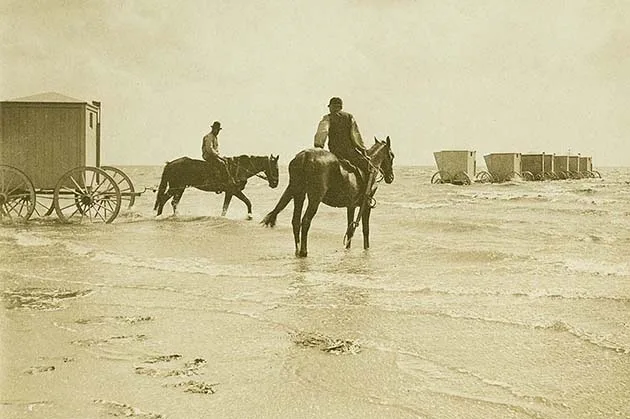
In Germany bathing machines first appeared around 1800. Their use should be understood in the context of "privacy," when bathing was understood not so much as entertainment as a medical treatment.
3. Bad Doberan is a town in the district of Rostock, Mecklenburg-Western Pomerania, Germany. It was the capital of the former district of Bad Doberan.
4. Rauschen (German: Rauschen): a roaring, rushing sound.
5. Ernst Wiechert (German: Ernst Wiechert; 1887–1950): German poet, writer and educator. He taught at the Hufen Gymnasium in Königsberg.
LEGENDS OF PRUSSIA in the blog of Tatyana Kolivay.
Translated from Russian with the help of AI (Claude, Anthropic), October 2026.