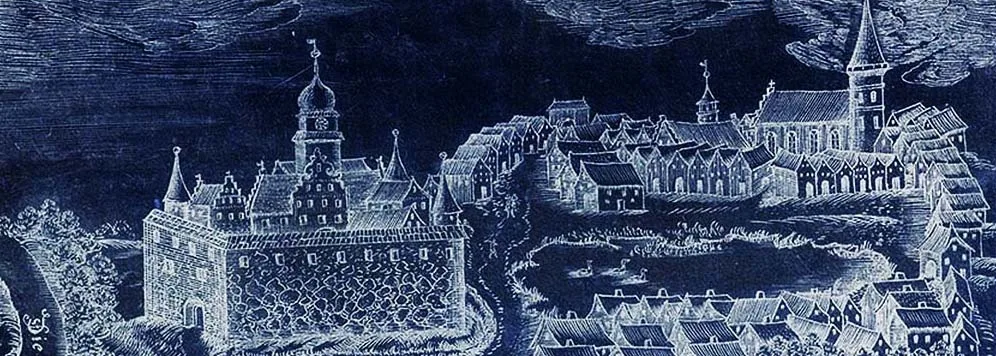
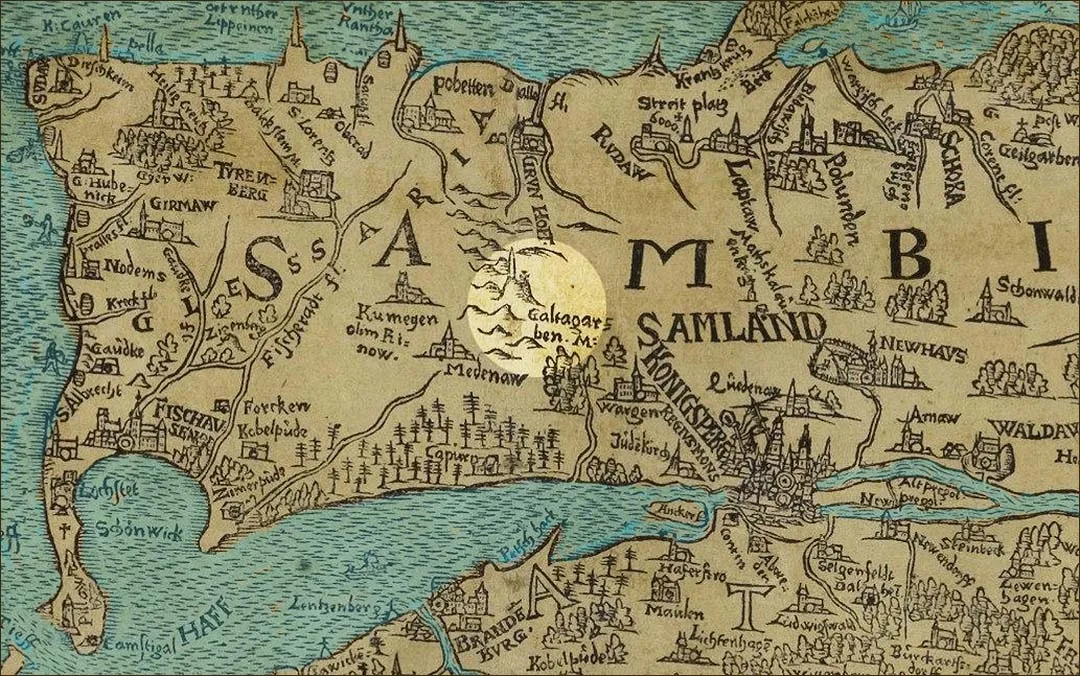
If you look around from the very top, you can see Königsberg and its old quarters spread out below as on the palm of your hand; to the north lie green fields dotted with villages, to the right is the Curonian Lagoon, to the left the endless mirror of the Baltic Sea; between the two expanses of water the thin line of the Curonian Spit shows faintly green in the misty haze, and to the south-east the Vistula Lagoon glitters in the sun.
In pagan times there was on Rinau a sanctuary of Ligo, the god of spring and joy, about whom we know little. Perhaps he is the very god whom the Poles called Ligich, the peacemaker and reconciler. His food was the sacred, never-extinguished flame, which was tended by young maidens who had never known a man.
Once a girl was chosen for this service whose beauty set the heart of a noble youth aflame.
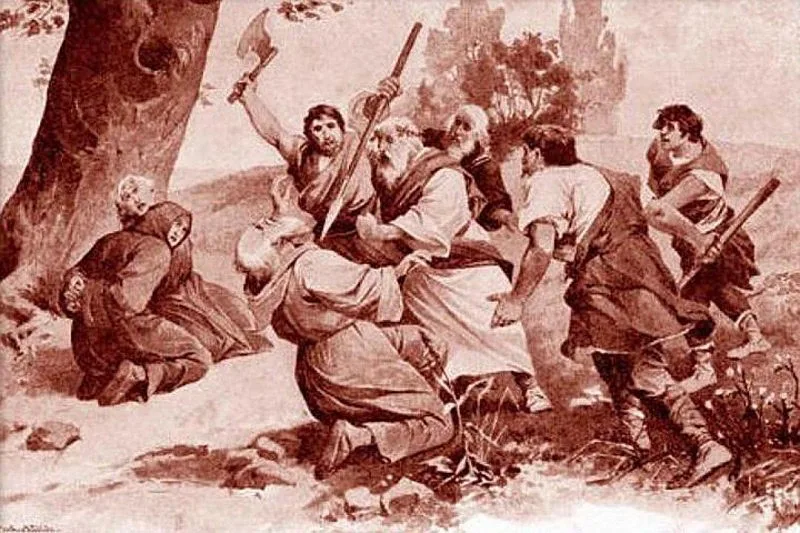
He defied the prohibitions of the high priest Krive and swore to carry off his beloved from the priests and bring her into his house as his wife. Three times he stormed Rinau, and three times the guards of the sanctuary beat back the attacks of his warband; at last the young warrior managed to break through the gates — he was already embracing the maiden he longed for, but then a terrible wind rose, lightning flashed, whirlwinds spun in the sky — it was the Wind's Bride raging1.
Suddenly the walls of the temple collapsed all at once and buried the lovers beneath them. And the sacred flame went out. Ever since then people have heard at midnight on the summit of Rinau the din of battle and the clash of arms, and a flickering little light would suddenly float up out of the ground. Then all at once everything would fall still, and silence would reign again, broken only by the cries of night birds.
It is also told that later the rulers of Samland lived on the hill, descendants of Samo, son of the legendary king Waidewut. There, in a sacred oak grove, they worshipped their gods, and first of all Curcho, or Gorcho, the god of drink and food, Wurschkaito, the god of cattle, and Ischwambrat, the god of birds2. In ancient Prussian mythology these three gods ranked second after the supreme trinity: Perkunos, Pikollos and Potrimpos.
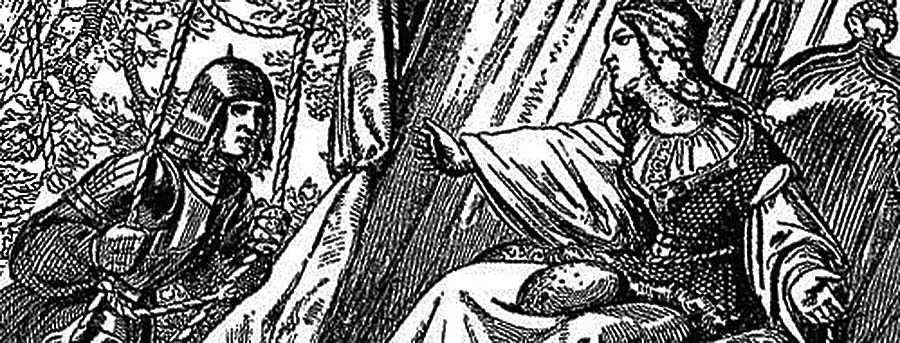
At last the German Order came here, conquered Samland and destroyed the pagan sanctuaries, but later it too was pushed aside by the teaching of Luther: all the monasteries were dissolved, and the monks and nuns were left adrift, like sheep without their shepherds.
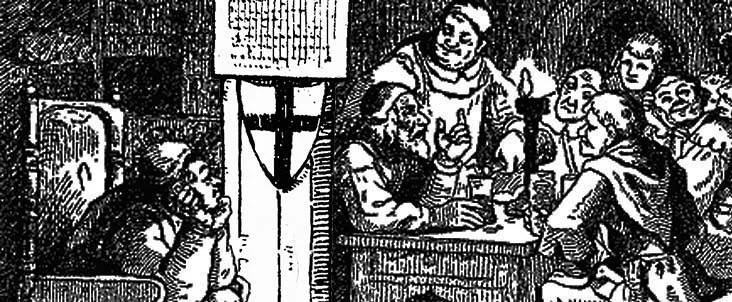
This happened in 1524. There were then in Königsberg monks who had been driven out of their monasteries. Deprived of shelter, they did not know how or on what they were to live from then on.
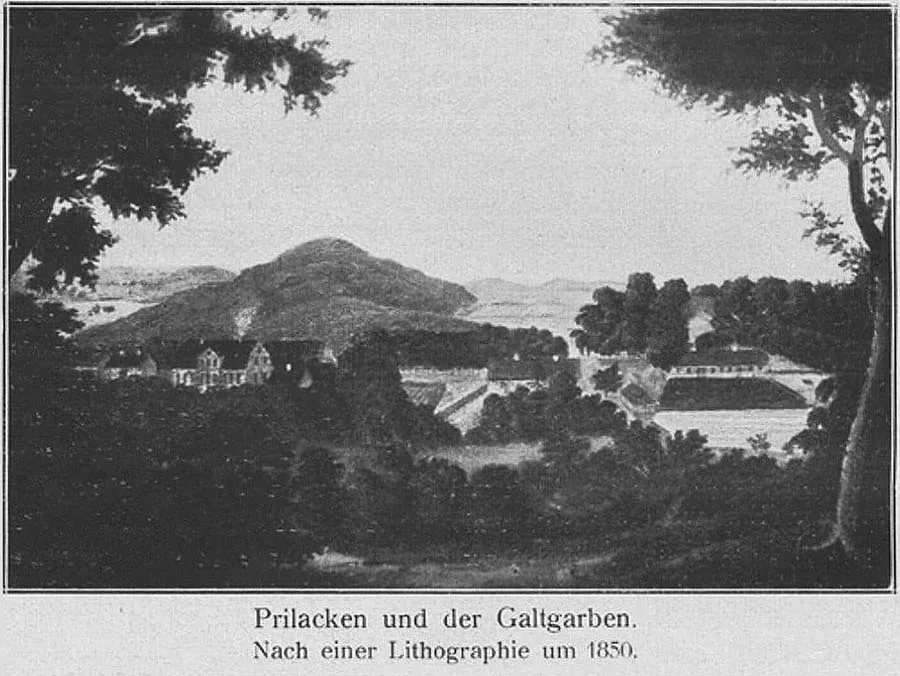
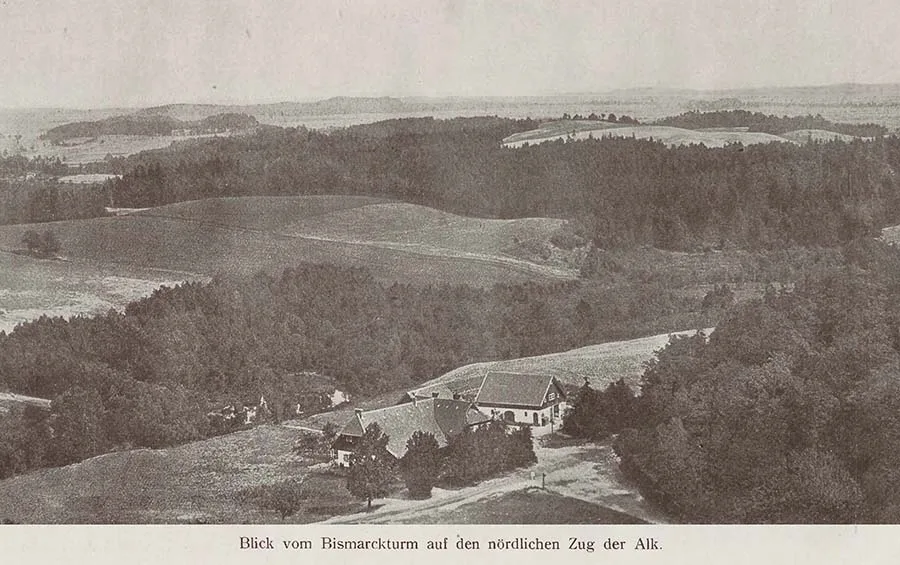 View from Galtgarben towards the Alk Hills.
Among them were fourteen monks who knew a thing or two about hidden and secret matters and knew very well that a good deal of treasure was buried on Rinau. A legend had reached them that in the depths of the hill there were urns holding the ashes of the rulers of Samland, whose bodies had been burned on the pyre, and together with the ashes ancient jewels, much gold and other treasures.
The brother monks set off for Rinau, climbed to the top of the hill, taking with them everything needed for digging, and there at once came upon old fragments of walls and began to break them down. Soon they discovered an underground chamber filled in with earth, in which large urns stood in a row.
But beside each urn sat a huge black dog, from each dog's jaws came vapour, and this vapour was so poisonous that five of the monks immediately fell down dead, and three died the next day. Then the six remaining monks realised that they had prepared poorly for the treasure hunt, took counsel and decided to make a second attempt, but this time to prepare better.
And so they climbed Rinau once more, taking with them holy images anointed with consecrated oil, and also a reliquary with the relics of saints. They set it all on the edge of the excavation and began to celebrate holy Mass, chanting litanies. And lo — the dogs had vanished, and the poisonous fumes had stopped rising. The monks rejoiced greatly: now the urns could be taken away in peace, only they were very heavy.
And it was amusing to watch how each monk, sweating and panting, hauled a big tall urn down the hill on his belly, and the urns were just as pot-bellied as the brother monks themselves.
In the presence of the bishop and the local Komtur they set about a thorough examination of the contents of the ancient jugs. Inside they found a multitude of valuable objects: lumps of clay, sand, small pieces of charcoal, remains of bones, ashes — but nothing made of metal, let alone precious metal. The monks' faces fell. It became clear at once that they were no archaeologists, or else the mere sight of the ancient vessels, even empty ones, would have delighted their eyes. They forgot that they had, after all, come back from the hill safe and sound, which was also a great joy. And since there was no one to vent their annoyance on, they cursed the Evil One in their hearts — it must have been the devil who had turned the gold in the pots into blackened ashes and charcoal! Though he, poor fellow, never found out about it.
SOURCE
Ludwig Bechstein, "Book of German Legends" (Ludwig Bechstein, Deutsches Sagenbuch — German), Leipzig, 1853.
TRANSLATOR'S NOTES
1. See the article "Germanic Fairy-Tale Mythology. The Wind's Bride".
2. Ischwambrat — a god of the ancient Prussians. Together with Curcho and Wurschkaito he formed the triad of the second rank. Ischwambrat was the lord of all birds. It is believed that he embodied the very first high priest, Bruteno, who burned himself in a ritual self-immolation in honour of the pagan gods.
● Editor's note: Read on VisitPrussia.com an interview with the translator of German, and in particular Prussian, fairy tales, our regular contributor Tatyana Kolivay, who runs her own blog, where countless other parables, legends and fairy tales in her translation have been published.
Translated from Russian with the help of AI (Claude, Anthropic), October 2026.