The History of the Rominte Forest
In the days of the Teutonic Order, this dense forest, rich in game, mushrooms and berries, was a favourite haunt of hunters. It was here that the great annual hunt was held, attended by the Grand Masters of the Order and their guests of honour. In 1525 the right to hunt in the Rominte Forest became the exclusive privilege of the high nobility. Fourteen years later, the Prussian king placed the woodland under strict protection and banned all felling of trees.
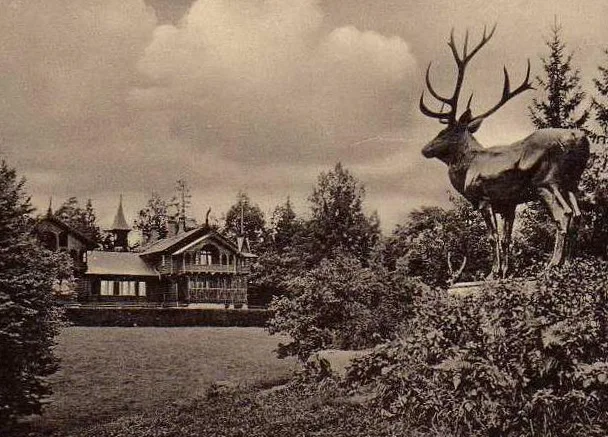
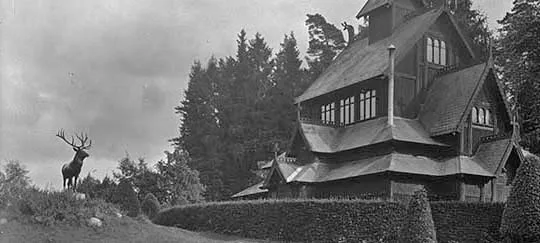
In 1890 Kaiser Wilhelm II visited the picturesque forest. He was so taken with the beauty of the Rominte Forest that he established his own residence here. A wooden Imperial Hunting Lodge with a Chapel of St Hubertus was built in the protected woodland. Both buildings were made in Norway and then shipped in pieces to East Prussia. A few years later the residence was adorned with statues of animals and extended with several more buildings: a forestry house, a post office, a hotel and even a kindergarten.
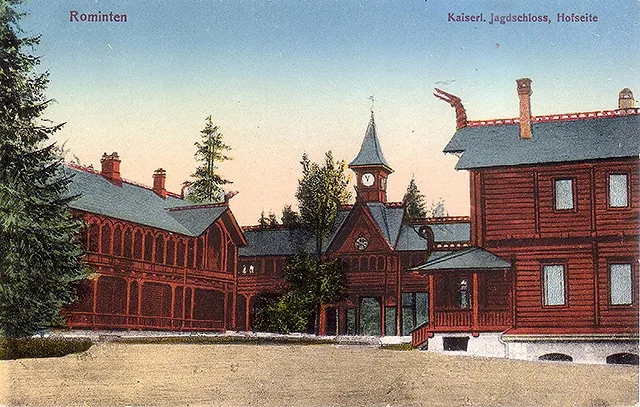 The Kaiser's hunting lodge (postcard courtesy of the editors of www.eastprussia.ru).
The Kaiser used the estate not only for leisure but also for negotiations with statesmen. The Russian Tsar Nicholas II and Count Sergei Witte both visited the Prussian ruler's hunting lodge, as the latter recounts in his memoirs: "… Rominten is a hunting lodge. It is a simple two-storey country house, opposite which stands another house, also of two storeys and of an even simpler design. The upper floors of the two houses are joined by a covered gallery. The large house and part of the upper floor of the smaller one are occupied by Their Majesties, and the rest of the space by the retinue and visitors.
The lodge stands on a high rise. Around it are several small houses for the servants. Close by is a village, and all around are the forests, where the Emperor goes hunting every day during his stay at Rominten. He and his entire retinue, as well as the guests, wear hunting dress. The Emperor is, after all, particularly fond of uniforms. Life there is very simple; the rooms are very simple too, but, as always with the Germans, everything is kept in great order and cleanliness."
After the end of the First World War, the residence passed into state ownership. In 1936, on the bank of the Rominte River (now called the Krasnaya), a few kilometres from the Kaiser's hunting lodge, the Reichsjägerhof, the Reich Hunting Lodge, was built. Its owner was Hermann Göring, Reichsmarschall of Nazi Germany. Among the visitors to the hunting lodge were the Polish ambassador Józef Lipski, Field Marshal Gustaf Mannerheim and other political and public figures from across Europe.
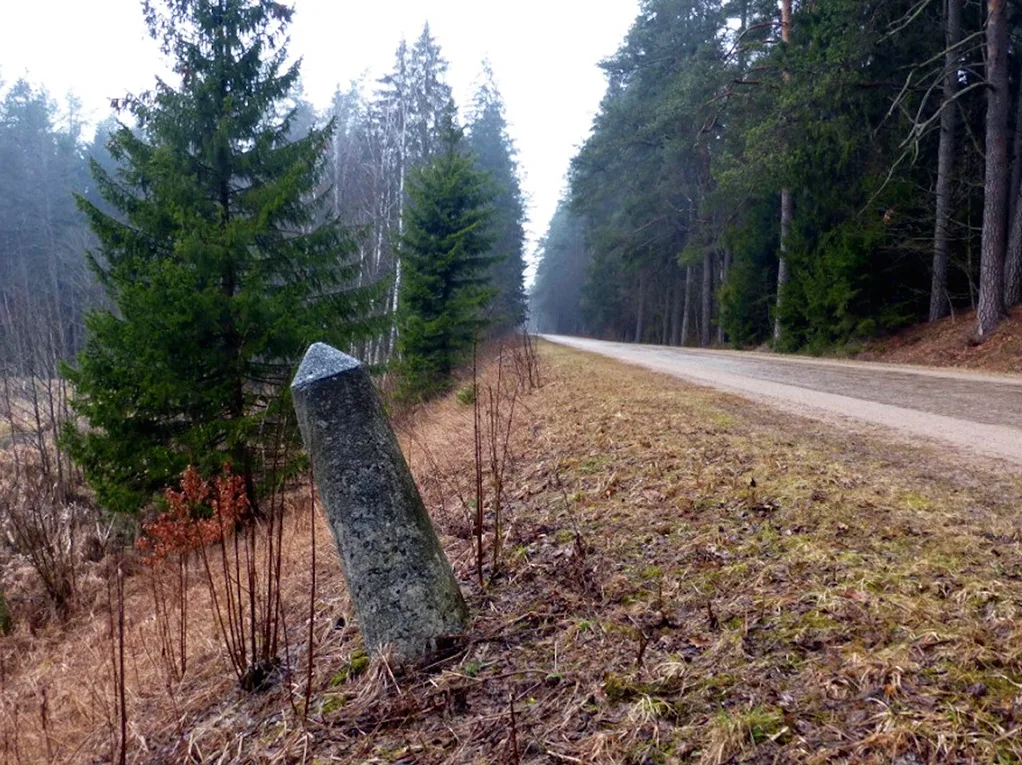
After the Second World War, the Rominte Forest suffered one of the most tragic episodes in its history. In 1945 the state border between Poland and the USSR was drawn right through the forest, and part of the population had to be deported. Logging began in the Soviet part of the woodland, and a large proportion of the trees was cut down, as the "bare" patches still found here and there among the greenery testify to this day.
The Rominte Forest Today
All that survives today are the foundations of the old buildings and some of the animal figures that once adorned the Imperial Hunting Lodge. The forest is recovering rapidly: in the south-east of the Kaliningrad Region, the area under woodland has now doubled. Amid the mighty forests of the Rominte lies the majestic Lake Vishtynets, together with several smaller lakes and a number of picturesque rivers and streams.
Most of the Rominte Forest is mixed woodland. Among the oaks, hornbeams, birches, aspens and spruces, if you are lucky, you may come across red deer, elk, roe deer or wild boar. Many visitors have encountered beavers, muskrats, weasels, martens and even wolves.
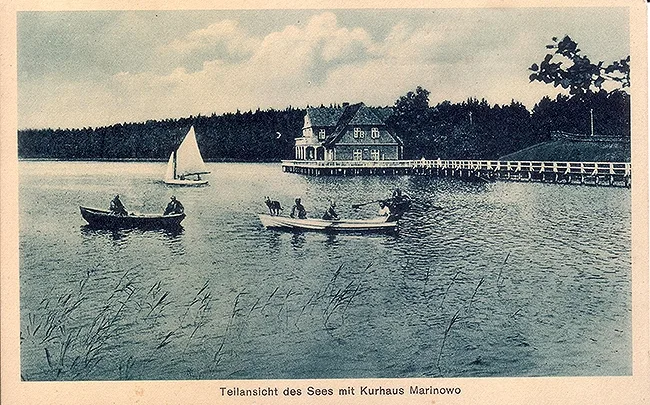 Leisure on Lake Marinovo (postcard courtesy of the editors of www.eastprussia.ru).
Today protected nature parks have been established in the Rominte area on both the Russian and the Polish side. Its many lakes, bogs and meadows, the foundations of historic buildings and the surviving animal figures all draw visitors from every corner of Europe. Within the Forest, in the village of Krasnolesye, is the Vishtynets Ecological and Historical Museum. Here you can learn about the remarkable history of the Forest, hire a guide or buy a souvenir. Various folk festivals held in the Forest have already become a tradition, attracting participants from Lithuania, Poland and the Kaliningrad Region. The popularity of this corner of our region is growing, and large groups of tourists are brought to the Forest.
The Rominte Forest is the place for an unforgettable weekend: enjoy the beauty of nature and see wild animals with your own eyes.
Bear in mind that on the Polish side of the Rominte Forest, driving off public roads is prohibited. The landscape park is open only to walkers and cyclists. In the Russian part of the Forest, too, driving on certain roads has recently been banned. So before setting off there by car, you should familiarise yourself with the park's visiting rules and, if necessary, obtain a permit for your vehicle. These measures deserve understanding, since preserving the Forest is a shared responsibility, not only of all residents of the Kaliningrad Region but also of the tourists who visit it.
It is hard to say what will become of the Rominte Forest in 5, 10 or 15 years, but one thing is clear: such picturesque corners of unspoilt nature will always draw people with their distinctive, incomparable beauty.
Translated from Russian with the help of AI (Claude, Anthropic), October 2026.