In Prussia, where the Holy Trinity monastery once stood, the settlement of Rikayot1, or Romove, was founded in time immemorial. According to one version, the name arose after the Prussians returned from a military campaign against Rome and, in memory of it, founded a fortified settlement which they named New Rome — Roma nova — a name that later turned into Romove.
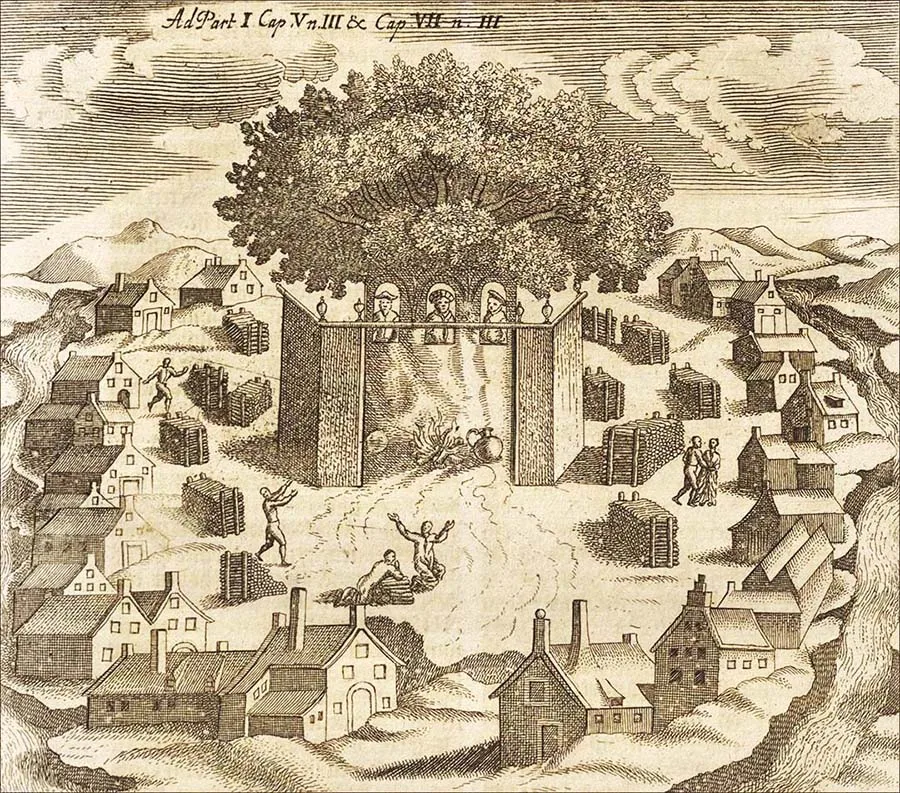
An ancient oak stood there, revered by the Prussians above all its other sacred brethren. It was six ells wide, and its crown was so broad and dense that it let through neither rain nor snow, for its leaves never fell and stayed green even in winter.
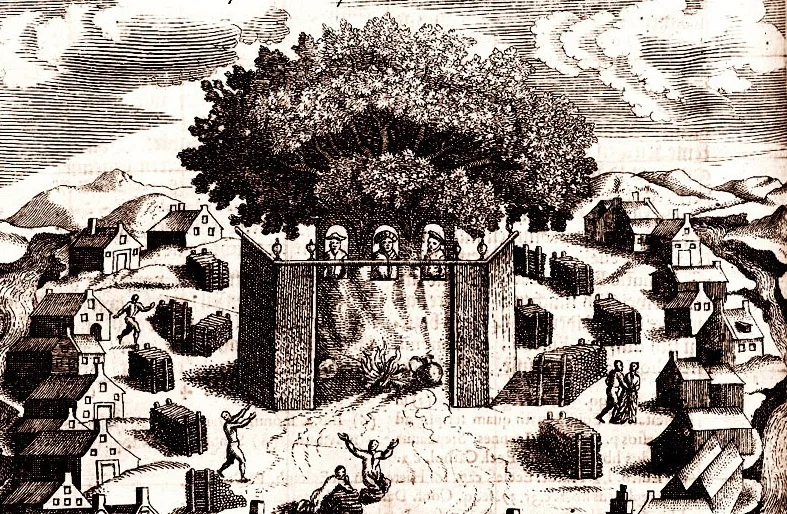
In the trunk of the oak, beneath three branches, three niches had been made, holding life-size statues of the three chief gods of the ancient Prussians. High above, the three strong branches grew back together2, forming a dense canopy, so that the tree itself sheltered the images of the gods from snow and rain with its foliage. Just such an oak once stood in a forest near Insterburg3, but in 1664 it was destroyed by a bolt of lightning.
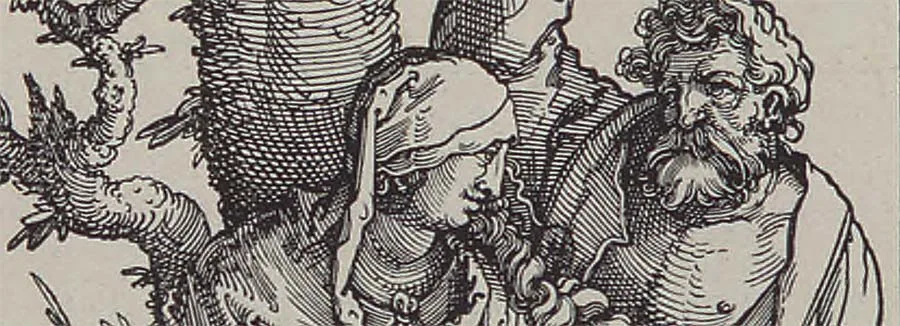
In the first niche of the Romove oak was the image of the god Pikollos, or Potollos. He scowled from under his brows, his deathly face was framed by a long grey beard, and his head was covered with a white veil. His name comes from the word "pekla" (the underworld). His sacred sign was the dead heads of a man, a horse and a cow, which were offered to him in sacrifice, and during the great festivals tallow was melted for him in pots.
The god Pikollos came as a night phantom to the houses of the rich if, after the death of a family member, their offerings to him had not been generous enough. If he appeared a third time, human blood had to be sacrificed. Then the priest, the waidelot4, would cut open his own arm. The blood flowed, and if a grumbling was heard inside the oak, it meant that the god was pleased and the sacrifice accepted.
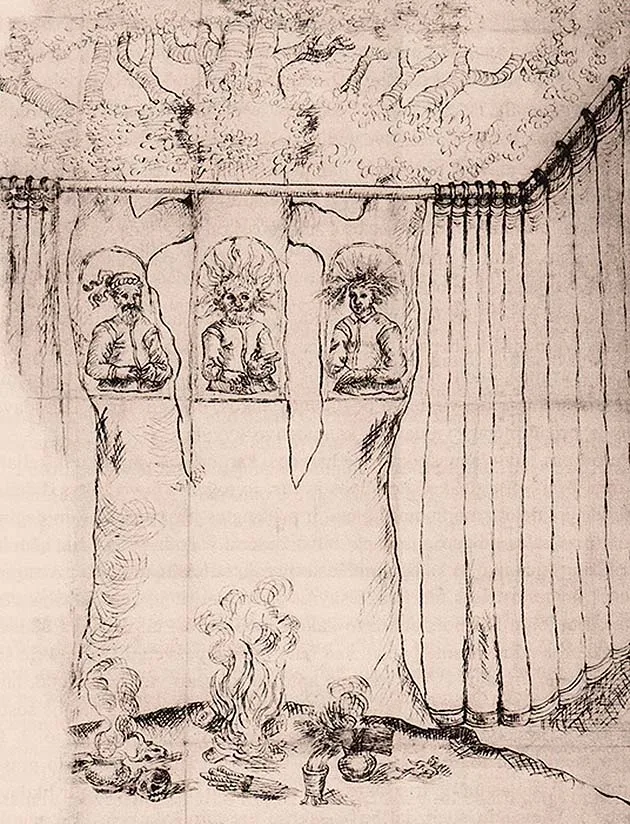
The sanctuary of Romove.
Book illustration, early 18th century.
The second niche was occupied by Perkunos, the thunder god, the chief among the gods. His bearing was haughty and his face red with anger. Perkunos's sacred sign was fire, and instead of hair his head was crowned with tongues of flame. He had a black curly beard.
His menacing gaze was turned towards the third god, Potrimpos. Before the image of Perkunos a sacred fire had to be kept burning at all times, fed with dry oak logs. In this fire the sacrificial offerings were burned. If the fire went out, the waidelot who tended the sacred flame had to pay for this sacrilege with his life.
Finally, the third niche held the image of the god Potrimpos. He was a young beardless man wearing a wreath of ears of grain. He protected the land and gifted people with its fruits. The young god smiled joyfully.
Potrimpos's sacred animal was the snake. It lived in a large pot covered with a sheaf, and the waidelots gave it milk to drink. Wax and incense smouldered on the altar of the god Potrimpos. This god, too, demanded human sacrifices. But only children were pleasing to him.
Three paces from the oak, beautiful cloths were stretched on poles seven ells high. No one but the high priest Kriwaito or the senior waidelots had the right to go beyond these curtains. The dwellings of Kriwaito, and of the priests who served the gods, were arranged around the sacred oak.
For a long time Romove was the capital of the Prussians. But in 1015 Bolesław the Brave, King of Poland, attacked Prussia and ravaged the ancient sanctuary. All the sacred statues were burned. However, after the Polish troops had left, the Prussians restored the images of the gods anew.
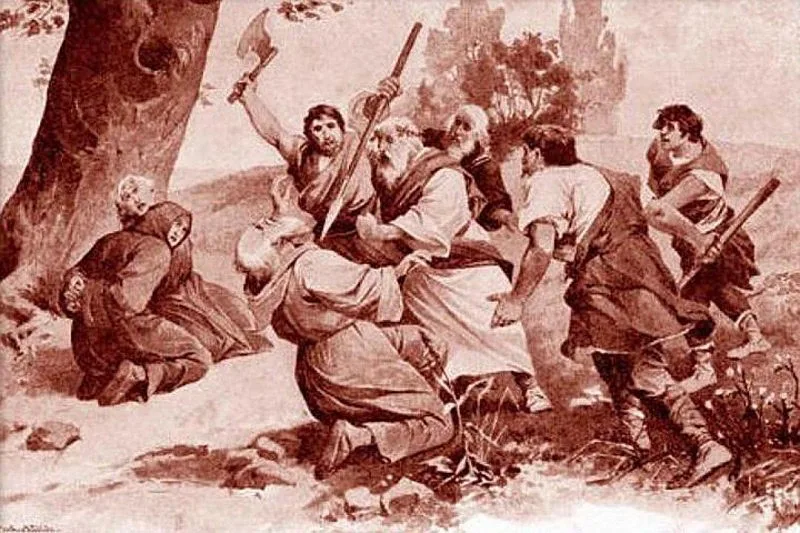
It is told that there lived in Masovia a prince who was carrying on an affair with the wife of a nobleman. The nobleman repeatedly threatened the prince that he would avenge his outraged honour, but these threats did not frighten the prince. And then one day the nobleman chanced to meet his unfaithful wife on the road in the prince's company. He had a spear with him — as was the custom of all noblemen of the time. With this very spear he ran through both the prince and the adulteress, and then fled to Prussia, where he took refuge with Kriwaito in Romove.
The prince's brothers set off in pursuit and soon arrived in Romove with a large retinue; they drove the high priest Kriwaito and the waidelots into their dwellings and set everything on fire.
The nobleman was put to a cruel death. For ten long years the Masovian princelings plundered Prussia, until the Prussians united, drove them out of their lands and forced them to make peace. And the sanctuary was restored once again.
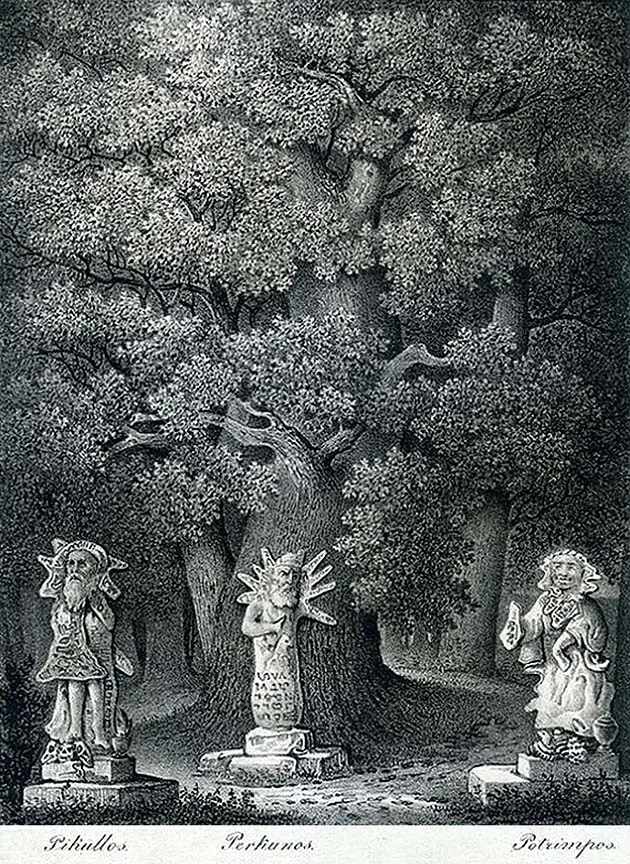
Pikollos, Perkunos, Potrimpos. "Ancient Prussian Gods".
Lithograph, 1839.
The sacred oak stood in Romove for a long time, and the Prussians, even after accepting Christianity, continued to pray to it in secret. It was believed that if a person or a domestic animal wore a leaf from the Romove oak tied around the neck, no harm could come to them.
At last, at the request of Anselm, Bishop of Warmia, Grand Master Winrich von Kniprode ordered Marshal Heinrich Schindekopf to cut down the sacred oak. The Holy Trinity monastery was built on that spot.
But the monastery had a bad reputation: the chronicles preserve a note by a certain priest, Christoph Hennenberger, about the monks of the monastery, who were given to the ruinous habit of drunkenness.
Although the oak had been cut down, the place where it once stood was long considered bewitched — probably because the blood of many human sacrifices had been shed there. At times a loud noise would suddenly arise there and the whistling of the wind could be heard — as if the oak were still standing, its branches swaying and its leaves rustling. Fierce thunderstorms often raged over the spot and lightning flashed. Sometimes terrible apparitions were seen there, now in the form of wood spirits, now of dragons, snakes or balls of fire.
Even in the monastery the monks had no peace: at night ghosts roamed there, frightening the timid inhabitants of God's abode. Finally, to drive out the Evil One, they sent to Germany for an exorcist.
The exorcist made a crucifix of pure gold the length of a finger and a triangular ring on which he engraved a certain inscription. He buried both objects under the cornerstone of the church. From then on the Evil One left both the area and the monastery in peace.
Later, however, the Holy Trinity monastery, like the ancient town of Romove before it, was also destroyed.
In 1708 the owner of these lands, Baron von Kilitz zu Gross-Waldeck, gave orders to remove the remains of the walls of the ruined monastery. It was then, while digging among the ruins, that the crucifix and the ring were found. The baron presented both objects to the city of Königsberg. But no one was ever able to decipher the inscription on the ring.
Johann Georg Theodor Grässe.
The Sacred Oak of Romove. Link.
"Book of Legends of the Prussian State".
... A kind of epilogue to the story of Romove, the last great sanctuary of Europe, and an epitaph to the waidelot priests, are the words of an old Prussian that have come down to us in the records of the priest Michael Praetorius, who in 1664–1685 collected folk traditions in north-eastern Prussia.
"An old peasant from the village of Strigehnen5 told me that he came from a special family...
He said that one of his forebears had been, many centuries ago, here in Prussia, a Kriwo, that is, a high priest. He united in himself all the splendid abilities which today's waidelots possess only separately.
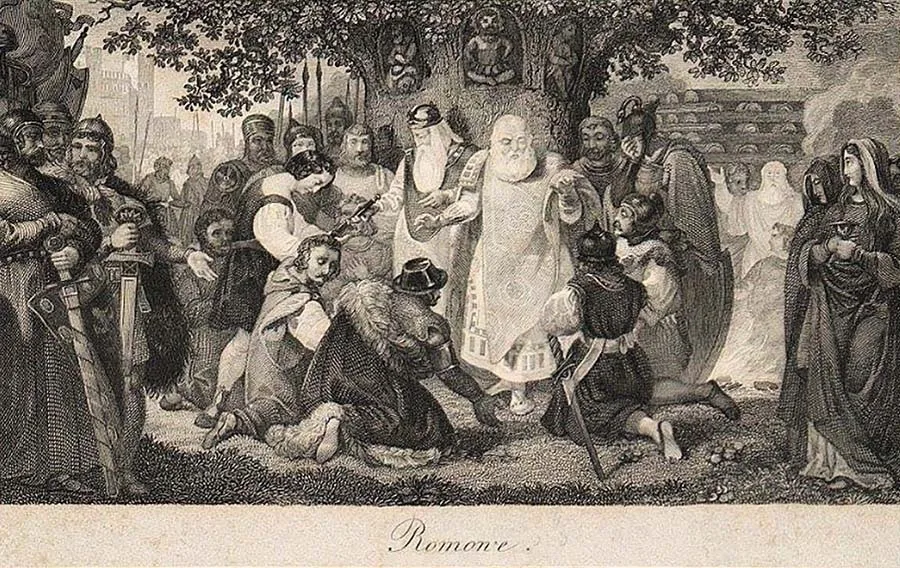
These magic powers of the ancestor are always reborn only in the son or grandson who inherits from him.
Unfortunately, however, it is also usual for these abilities to diminish from generation to generation, and in him this power had almost completely died out, he said sadly. Earlier, especially often in his youth, he had tried to make an effort to revive the old art of magic.
But in vain: the forefather's power is gone and lost. It is impossible to learn this knowledge anew. All this is a sign that his people are dying. All his children have already died, and remained unmarried, so he has no one to pass the ancestral heritage on to. He is empty as a hollow nut, and desolate. The only thing one can state is that he is the last of a once so great family. With this he ended his story..."
TRANSLATOR'S NOTES
1. According to another version, Romove was the sanctuary where the supreme gods were worshipped, and Rikayot the one for the lesser gods (note by J. Grässe).
2. Some historians believe that the name Romove derives from the Old Prussian "ruomot", meaning "grown together into one" (note by J. Grässe).
3. Insterburg is the former name of the town of Chernyakhovsk in the Kaliningrad Region.
4. Waidelots are the general term for the pagan priests of the Baltic peoples (Prussians, Lithuanians, Latvians).
5. The village of Zagorskoye in the Chernyakhovsk District.
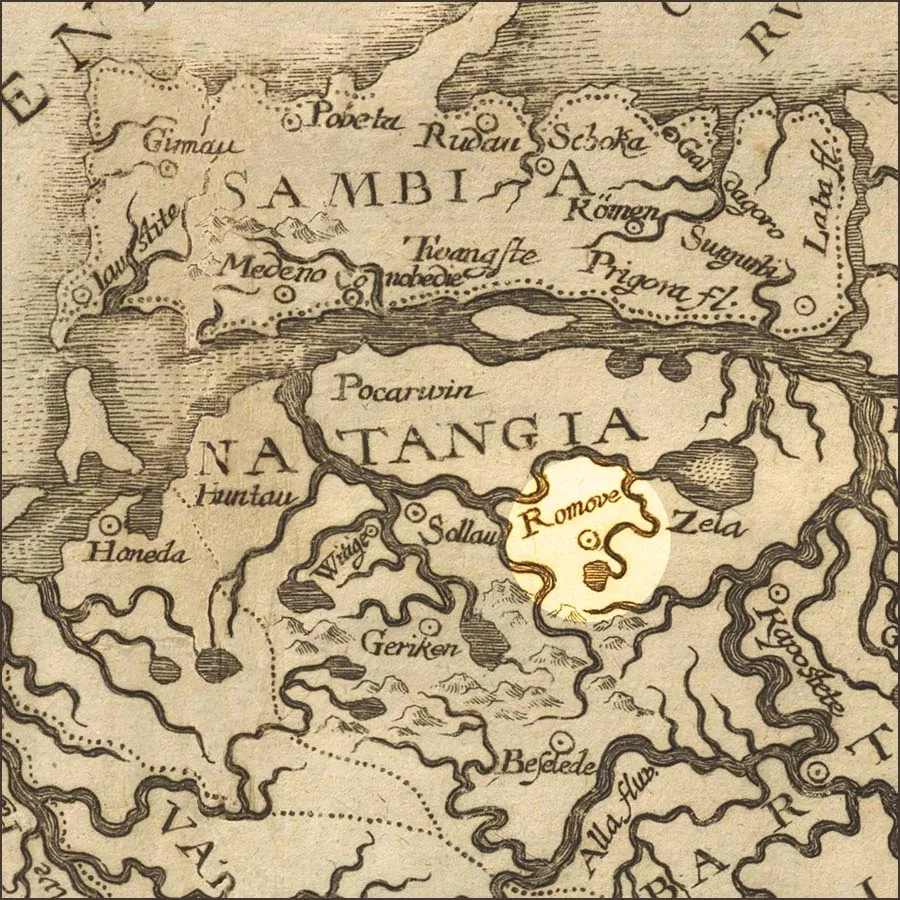
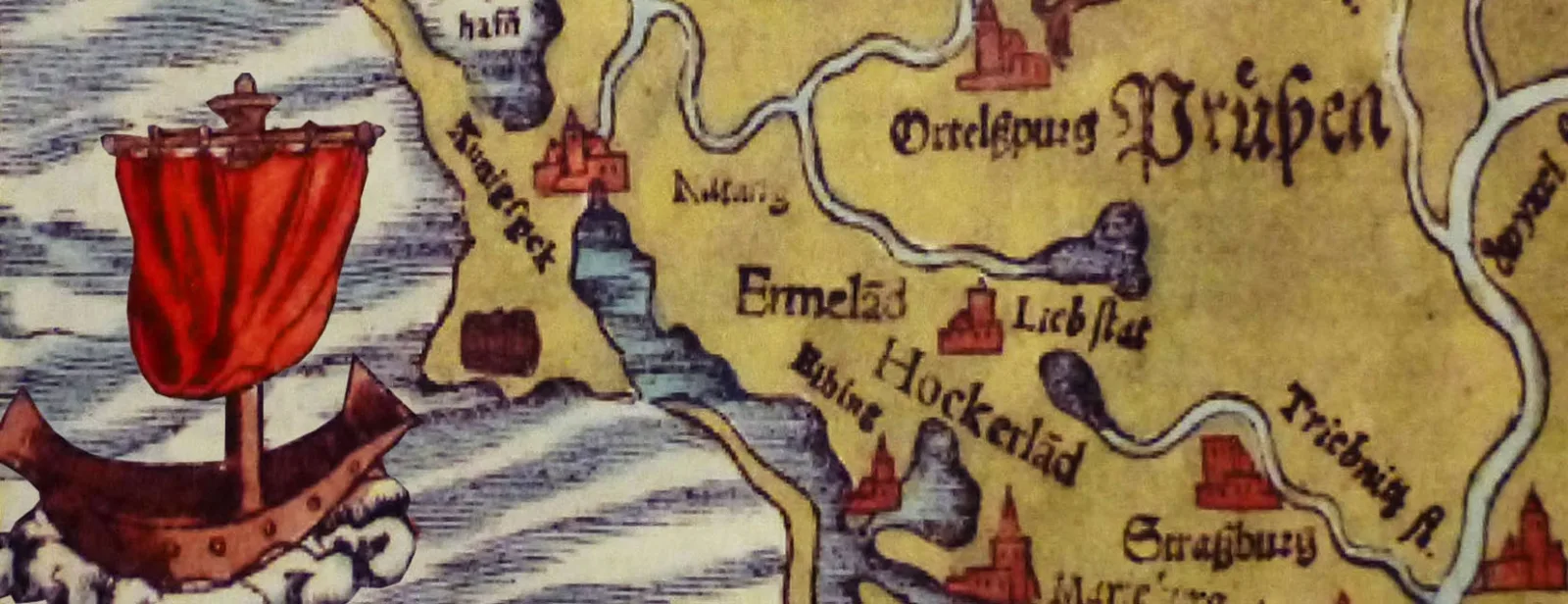
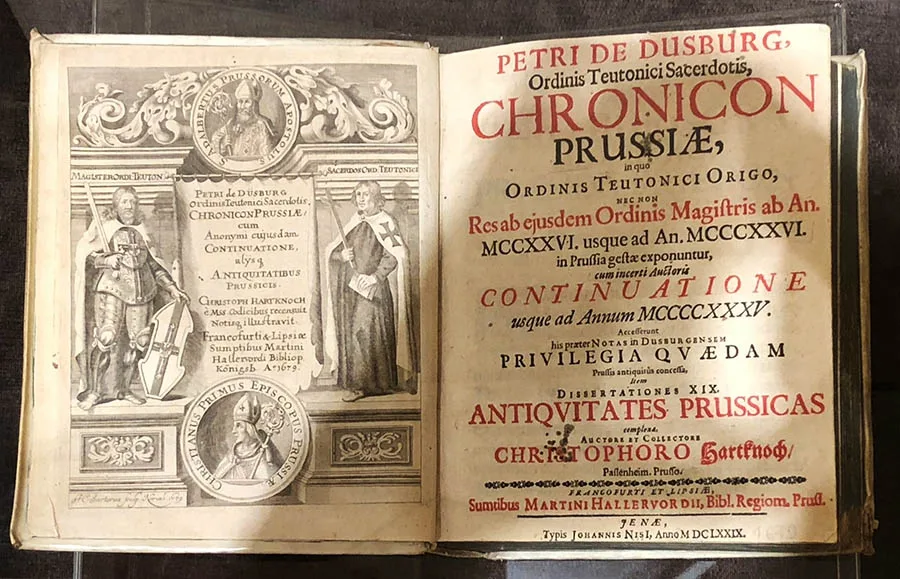
Romove on the map from the book "Old and New Prussia, or Prussian History" (1679).
APPENDIX I
In this connection it is interesting to quote an excerpt from "Stories from Russian History" (1861) by the Russian historian and Slavophile Ivan Dmitriyevich Belyaev.
"... The pagan church of the Lithuanians was one with the pagan church of the Prussians, the kinsmen of Lithuania.
And the Lithuanian church proper was in a certain dependence on the Prussian one; for the chief shrines and the high priest Krive-Kriveito were originally among the Prussians, and the Lithuanians received from there both their priests and various religious rites.
Krive-Kriveito moved to Lithuania only after the Prussian land had been occupied by the Germans, which happened no earlier than the 13th century; it was then that the chief sanctuary, called Romnove, was also established in the Lithuanian land.
Krive-Kriveito, by the very meaning of his name, was the high priest over the priests and the supreme judge over the judges, and the direct interpreter of the will of the gods; consequently he embodied supreme authority in both worldly and spiritual affairs over the entire Prusso-Lithuanian pagan world, and was the chief shepherd of the Prusso-Lithuanian pagans.
He enjoyed such sacred reverence from his flock that his charges considered it the greatest bliss for themselves if any of them was granted the sight of him even once in a lifetime.
The benighted pagans of the remote corners of the Prussian and Lithuanian land even believed Krive-Kriveito to be undying, eternally living — a belief that was, of course, sustained by the fact that an aged Krive-Kriveito, in his last hours, gave himself up to be burned, and this burning was presented to the people as the rebirth of Krive-Kriveito. The nearest high priests, who lived in Romnove and surrounded Krive-Kriveito, deeply guarded from the uninitiated the secret of the election of a new Krive-Kriveito. With such near-deification, the authority of Krive-Kriveito was highly revered in all the lands occupied by the Lithuanian tribe, so that everyone bowed down — princes and great and lesser folk alike — not only before him himself or a person close to him, but even before each of his messengers bearing from him a crooked staff or some other sign, as is attested by the most ancient describer of Prusso-Lithuanian paganism, Peter of Dusburg.
Next after Krive-Kriveito in the Lithuanian church hierarchy came the Vaidelots, which means "those who know"; they were the interpreters of the will of the gods and the keepers and experts of religious rites in general.
The Vaidelots were men and women free from the bonds of marriage. Some of them lived in Romnove near the sacred oak, the chief place of the gods' presence; others were scattered over all the places where Prussians and Lithuanians lived. It was their responsibility everywhere to maintain the sacred rites and keep them pure, to teach the people the knowledge and worship of the gods, to offer sacrifices, to bless the people, to appoint feast days, to give answers in doubtful matters and to summon the people for the proclamation of the will of the gods and for common sacrifices and prayers; they also determined lucky and unlucky days.
The Vaidelots were divided into higher and lower ranks.
The Vaidelots of the higher ranks lived with Krive-Kriveito and took care of maintaining the sacred undying fire; they were otherwise called Krivites, and Krive-Kriveito was elected from among them. After the Krivites came the Sigenotes, who lived around Romnove; they were the stewards of divine service, the guardians of order in the rites.
To the lower ranks of the Vaidelots belonged the Vaidelots who lived throughout the Lithuanian land, obliged to arrange various kinds of divine service and to maintain the purity of religious teaching among the people. After them came still lower ranks of servants and arrangers of religious rites, each in charge of one or another kind of religious belief.
These were:
1st, the svalgons, ministers of the religious rites of marriage; they not only arranged wedding ceremonies but also judged the chastity of the bride and groom and the happy or unhappy future fate of the newlyweds;
2nd, the puttons practised divination by water and sea foam and foretold the future;
3rd, the veyons were diviners by the winds; they not only made various predictions from the nature of the wind, but also knew how, by some kind of sorcery, to direct the winds one way or another;
4th, the pustons healed wounds and other ailments with their own breath;
5th, the seitons drove away illnesses by hanging various amulets on the sick;
6th, the svanons foretold fortune and misfortune by divining from burning flame and smoke;
7th, the burts foretold the future by divining from the shapes formed in melted wax poured into water; they also settled the disputes of quarrelling parties by drawing lots;
8th, the talissons and lingussons, keepers and arrangers of the religious rites at the burial of the dead; they performed the funeral prayers, glorified the deeds of the deceased and consoled the surviving relatives by recounting various visions of the deceased's life beyond the grave.
All these wise men and wizards wandered from village to village and, as possessors of unknown powers and knowledge, guided the people, so that from birth to the grave, in every new and difficult situation of life, the people dared not take a single step without them.
They enjoyed the full trust of the benighted people, who saw in all the phenomena of nature and in all the events of their life the presence of an unknown and supernatural power which, according to their religious belief, could be dealt with only by people possessed of unknown knowledge and a special secret strength of spirit."
APPENDIX II
"An Ethnographic Description of the Baltic Region".
The Tribes That Have Inhabited This Region Since Ancient Times.
Published by the Riga diocese, 1893.
... As for the religion and religious notions of the Latvians, it cannot be said that they reached any particular development or arrived at a more perfect cult, as, for example, among the Greeks and Romans, although in this respect the Latvians nevertheless stood higher than many pagan peoples.
The Latvians, like the ancient Slavs, confined themselves to deifying the surrounding nature with its forces and phenomena; the sun, the moon, the stars, the atmospheric phenomena of lightning, thunder and winds, and finally fire, water and groves were the main objects of their veneration. They believed that, from thunder down to the last dung heap, in every object and every phenomenon there dwelt a special deity to whom worship had to be rendered. They were convinced that to please the gods one had to do everything that is honest and just, but in defining honesty and justice themselves they relied more on the guidance of their feelings and conscience than on the artful interpretations of reason. This exhausted all the religious notions of the ancient Latvians, and these notions were sufficient for them, because they knew no other needs and wants than those offered by the nature around them. In worshipping their gods, the ancient Latvians did not shut themselves up within the four walls of special temples, but honoured their gods in the places where the traces of their might were evident. Thus they honoured the god of thunder under an oak split by a lightning strike, the forest god in forests and groves, the god of waters on the shores, the god who guarded the crops in the fields, and so on. Only the higher deities had a special, fixed abode.
Such a place was sacred Romove in present-day Prussia, where the images of the three chief gods, revered by all the Latvian-Lithuanian tribes, were housed. Here, in a wide valley, stood an old tall oak, twelve feet in circumference, which did not lose its green foliage even in winter.
This oak was both altar and temple. On it, among the richly leafy branches, were placed the images of the three chief gods — Perkuns, Potrimps and Pikols.
The image of Perkuns, as the mighty god of thunder and fire, king of the gods, stood in the middle of the others. In appearance he was a man burning with anger, which is why his face was the colour of fire, with a waving, curly beard, and his head was crowned with twelve fiery rays. He was the god of the sun, of light and of all atmospheric phenomena. In the Latvians' imagination he rode across the sky, leaning with his right hand on the neck of a bull, and in his left he held a flaming rod from which lightning flew. When he was angered by people's iniquities, he blew on his waving beard, and at once a storm arose and peals of thunder rolled through all the clouds; he sent rain, snow and wind down to the earth and made it fertile, for which he was held in special reverence by the people. The boundaries of farmsteads were under his protection and patronage, and those who dared to appropriate someone else's piece of land or move the boundary posts were subjected to very severe punishment. According to Nienstädt, the guilty had to carry a white-hot piece of iron in their bare hands around the disputed plot of land.
Since lightning flew from the hand of Perkuns, fire was considered a sacred element. For this reason an eternal fire burned in Romove before the image of Perkuns, fed with sacred oak firewood.
The care of this fire was the duty of special priests, who paid with their lives if it went out through their fault. In such unfortunate cases the priests struck fire from flint and, crawling on their knees to the oak, kindled the sacred fire anew, into which they threw the negligent priest to appease the angry god Perkuns.
During peals of thunder the people fell prostrate, crying: "God Perkuns, have mercy on us!" And so that the storm would cause no harm to the household, the Latvians carried a ham of pork around the fields and farm buildings, addressing Perkuns with the following words: "Perkuns! We offer you this piece of pork in sacrifice, spare our property!"
After the storm they gathered together and ate the sacrificial ham, singing hymns of praise in honour of Perkuns. The favourite sacrifices with which they tried to appease his wrath were pigs, goats and especially noble prisoners of war; their blood was poured over the roots of the sacred oak in Romove.
As the chief god of the sacred Romove trinity, Perkuns was regarded as the giver, guardian and protector of the people's health. The ashes from his sacred fire and the water from the lakes, rivers and springs dedicated to him were considered the main remedies against all diseases.
To the right of Perkuns was the image of a cheerful beardless youth whose head was adorned with a wreath of ears of grain and green leaves. This was the image of Potrimps, god of springs, rivers and rain, giver of fertility, guardian of fields and crops and helper in war.
To this god sheaves and incense sprinkled into boiling wax were usually sacrificed, and often even children, since he thirsted for human blood.
Before the sacrifice the priests spent three days in strict fasting, slept on the bare ground and from time to time threw incense into the eternal fire. In honour of this god a snake was fed with milk in a large urn under sheaves of grain, and its care was the duty of special priests. For this reason the snake was considered sacred among the Latvians, and meeting one was a sign of special good luck; in their imagination the cheerful Potrimps himself always appears to people in the form of a snake with a human head. According to Menecius and Fabricius, keeping and raising snakes in the house was a universal custom among the Latvians and Lithuanians; they were so tame that they bit neither animals nor people; even children played with them and slept with them in the same bed. Snakes were usually kept in the house under the stove or in the bathhouse. At a certain time of year the priests went round the houses and held a festival in their honour. On this occasion a white cloth covered with various dishes was spread in front of the hole where the snakes hid; the priest called them out of their holes onto the cloth and invited them to taste the food. If they actually came out onto the cloth and touched some dish, this was considered a harbinger of a fruitful year and of success in everything. Therefore, once the snakes had gone back into their holes, a merry feast was held and the dishes laid out on the cloth were eaten.
To the left of Perkuns was the image of the third chief god — Pikols, the god of death. In his actions Pikols was in every respect the adversary of Potrimps, for what Potrimps created, Pikols destroyed. As the one was the principle of creation and fertility, so the other was the principle of destruction and death. The one was loved by all, the other feared by all, because he demanded in sacrifice everything that is dearest to a person. People's torment and fear were the objects of his joy. Accordingly, in the Romove sanctuary he was depicted as an old man with a long grey beard and a deathly pale complexion, and his head was covered with a white band. Three skulls — a human, a horse's and a cow's — always hanging on poles before the image of Pikols, were the symbols of his activity. He was offered in sacrifice a pot of tallow, as well as black horses, pigs, goats, calves and people.
Before the beginning of a war a captured enemy was usually sacrificed to him, and the priests paid attention to whether the blood flowed from the wound in a stream or merely oozed. If the blood streamed, it foretold victory; if it dripped, defeat was to be expected.
Funerals among the Latvians and Lithuanians always had to be accompanied by a sacrifice to the god Pikols; otherwise he brought fear and torment upon the disobedient; if the required sacrifice was not offered to him within three days, the angry god could be appeased only with human blood. He imposed severe punishment even on those who disobeyed the high priest Krive, did not follow the will of the gods and were stingy with sacrifices. As the god of death he had power above all over the souls of the dead, whom he kept in a special dark place called pekle (hell). In view of the fear that Pikols instilled in the people, sacrifices were offered to him everywhere to appease his wrath and avert his punishment.
From the branches of the sacred oak hung a curtain, forming as it were an enclosed place of special sanctity, access to which was open exclusively to the high priests during sacrifices. This Romove sanctuary was surrounded on all sides, to a distance of seven versts, by a sacred grove, which the people were permitted to enter only on certain solemn festivals, and even then not to linger near the sanctuary itself. On such solemn occasions, by moonlight, the sacred curtain that hid the gods from the people was lowered; the high priest Krive himself, surrounded by priests singing sacred hymns, fell prostrate before the sacred oak, while the people only gazed at their gods from afar."
LITERATURE USED
1. Симон Грюнау "Хроники Пруссии" (со стр.78). Ссылка.
2. Johann Graesse. Das Sagenbuch des Preussischen Staates. Die heilige Eiche zu Romove. № 497. Ссылка.
3. Temme/Tettau. Die Volkssagen Ostpreußens, Litthauens und Westpreußens. Die heilige Eiche zu Romove. Ссылка.
4. Этнографическое описание Прибалтийского края. Племена, исстари населяющие этот край. Ссылка.
● Editor's note: Read on VisitPrussia.com an interview with the translator of German and, in particular, Prussian fairy tales, our regular contributor Tatyana Kolivay, who runs her own blog, where countless other parables, legends and fairy tales in her translations have been published.
Translated from Russian with the help of AI (Claude, Anthropic), October 2026.