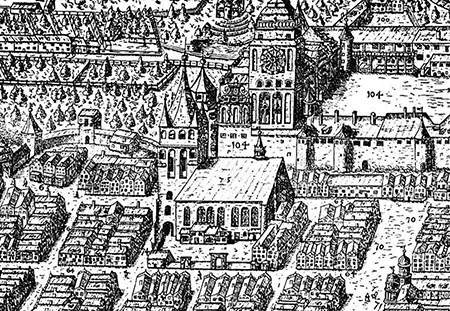
The foundation stone was laid on 14 June 1640. But the parishioners of the nearby Catholic church, backed by the Polish court, opposed the construction. The people of Sackheim then bought the land between the church under construction and the Catholic church and built on it. In this way they were able to continue building their church, which was consecrated by Pastor Neuschilling on 30 August 1648. He was later buried in this church.
By the altar of the church stood a wooden sculpture of King David playing the lute, with Muses around him. A chandelier hung from the ceiling. There were three doors. Around the church lay the cemetery, and there were the lodgings of the pastor, cantor and bell-ringer, as well as a school.
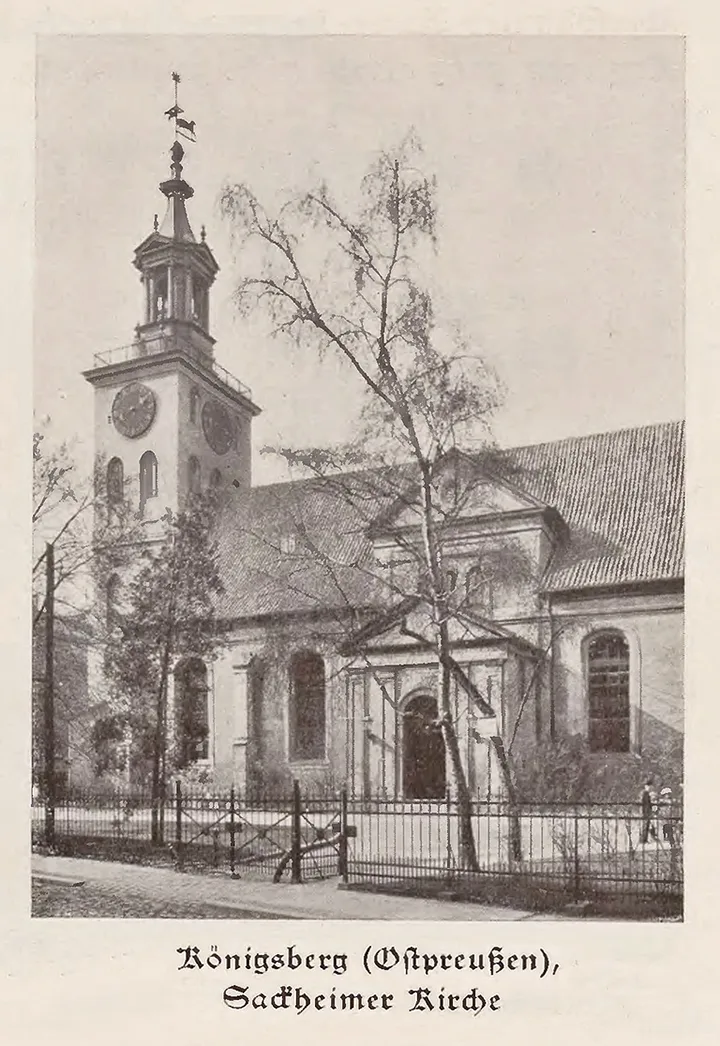
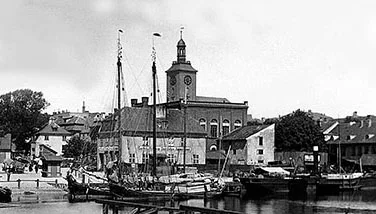
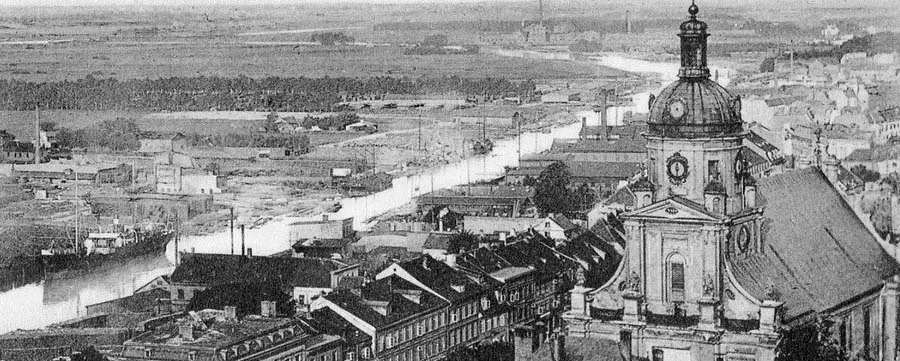
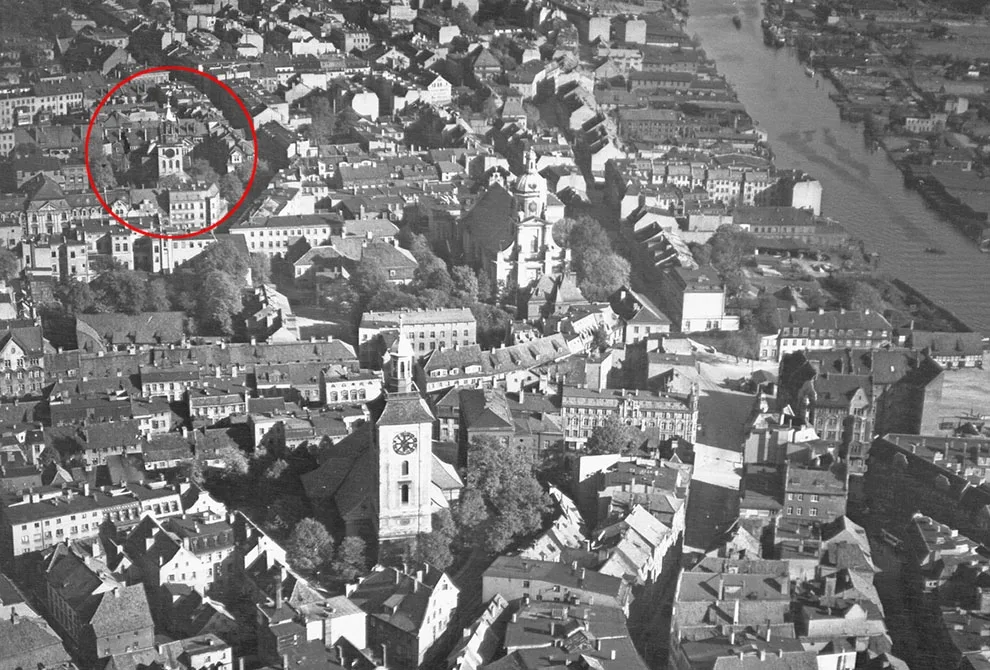
In 1764 a great fire broke out in Sackheim, and the church burned down. The new church, which made use of the walls of the old one, was consecrated on 22 January 1769. Its external length was 35.5 m and its width 14.75 m.
It was a rectangular building of fieldstone and brick, without a choir, with a projecting tower on the west dating from 1640. The top of the tower was completed in 1771. The church was built to a design by the director of works Bergius. A porch with a pediment stood on the south. The exterior and interior forms of the church were in the Classical style. The church had three naves; the ceiling over the central nave was vaulted, while that over the side aisles, which had two-tier galleries, was flat. The naves were divided by Ionic columns. The altar and pulpit were in the Rococo style.
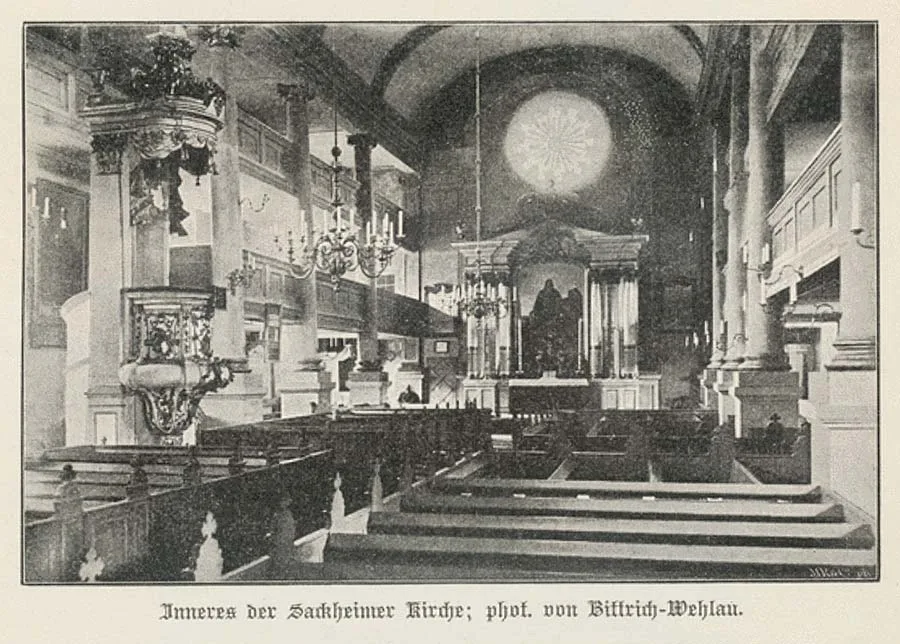
At the beginning of 1878 the painting "Christ Inviting" by Professor Heydeck was placed in the altar. The pulpit was set up on the north side of the central nave.
The altar plate in this church dated from the 17th–18th centuries. It included a baptismal ewer of 1701, another of 1725 with mythological scenes, and a tray of 1672 by Lorenz Hoffmann. The organ dated from the time the church was built (18th century). It was installed across the full width of the central nave. According to more precise information, in 1929 a new 44-stop organ by the firm of Emil Hammer was installed. The church bells were cast in 1766, 1771 and 1827.
During the fighting of 1944–1945 the church was badly damaged, and by the mid-1950s it had been completely demolished.
Photos on this page: Bildarchiv Ostpreußen, bildarchiv-ostpreussen.de
Translated from Russian with the help of AI (Claude, Anthropic), October 2026.