… In the deep gloom of dense cypresses marble basins gleamed white, and from them rose wondrous figures, spraying crystal rays that fell splashing into the shining cups of lilies; strange voices rustled and whispered … and everywhere wonderful fragrances flowed … many strange flowers … were in fact brightly coloured, glittering insects… conversely, pink and sky-blue birds turned out to be fragrant flowers, and the scent … rose from their cups in soft, pleasant sounds that mingled with the splashing of distant fountains and the rustling of … trees into mysterious chords…
E. T. A. Hoffmann
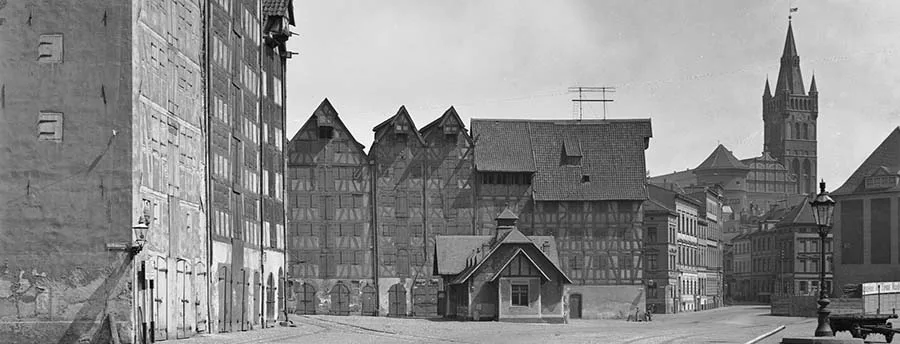
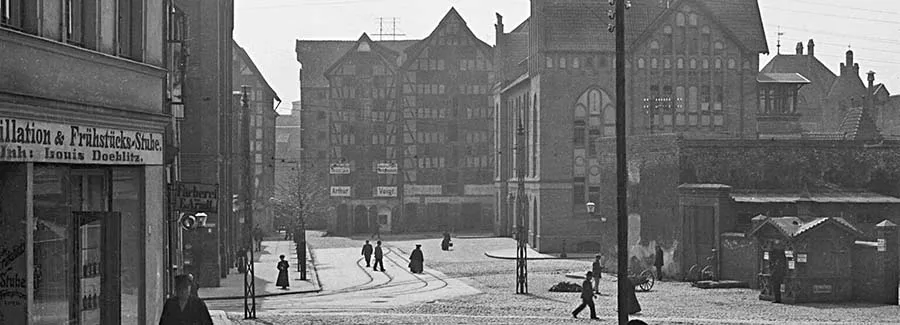
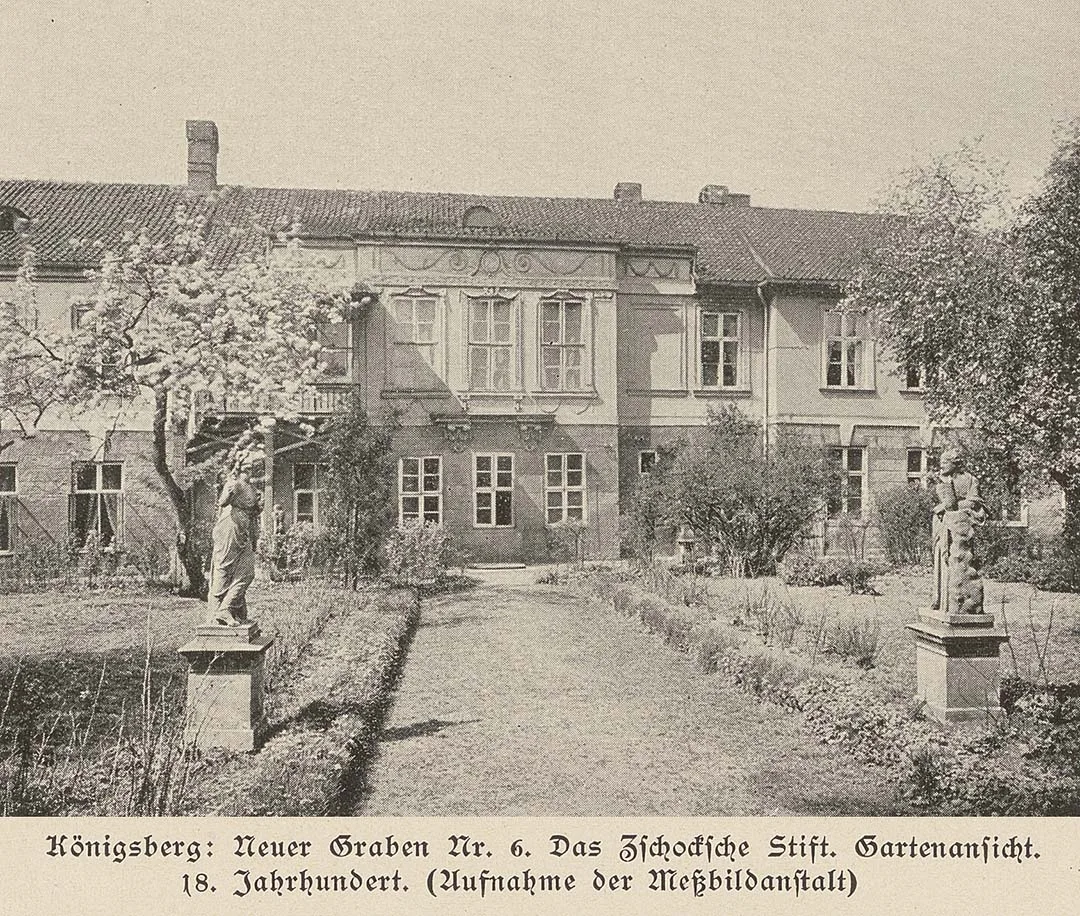
The building of the Saturgus family's town residence dates from the middle of the 18th century. In 1700 Adolf Saturgus died – a successful Catholic merchant from Düsseldorf and the richest businessman in Königsberg at the time. Saturgus's widow, Anna Elisabeth Kayser, who was left with three daughters and two sons, carried on the business and in 1722 bought a house with a garden on the street of Neuer Graben near Lastadie, the loading quay on the Pregel. At that time the area was not built up, but by the end of the 19th century numerous warehouses, trading houses and even a railway for loading and unloading ships had been built here.
After the early death of his elder brother Adolf (1685–1739), Friedrich Saturgus (1697–1754) inherited the family trading firm and a large fortune made on successful supplies to the Russian and Prussian armies, and in 1752 he rebuilt the small rustic-style house into a Rococo palace, surrounding it with a large garden (at that time the northern boundary of the garden was one of the many lanes of the Laak district, Tränkgasse; today the area is occupied by high-rise apartment blocks and the Yunost sports complex).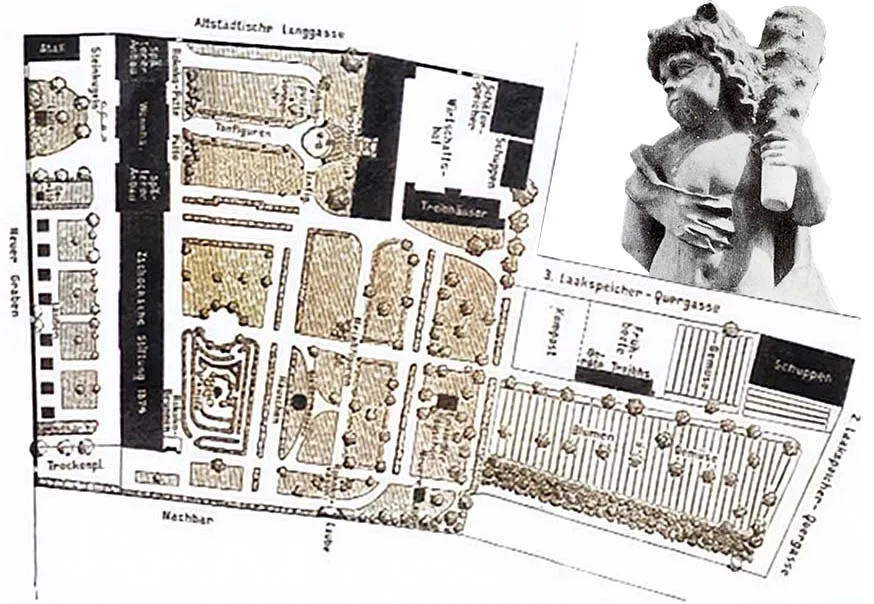 Plan of the Saturgus Garden and the charming "Hercules" that adorned it.
The house and garden on Neuer Graben have gone down in Königsberg's history as models of beauty, fantasy and luxury.
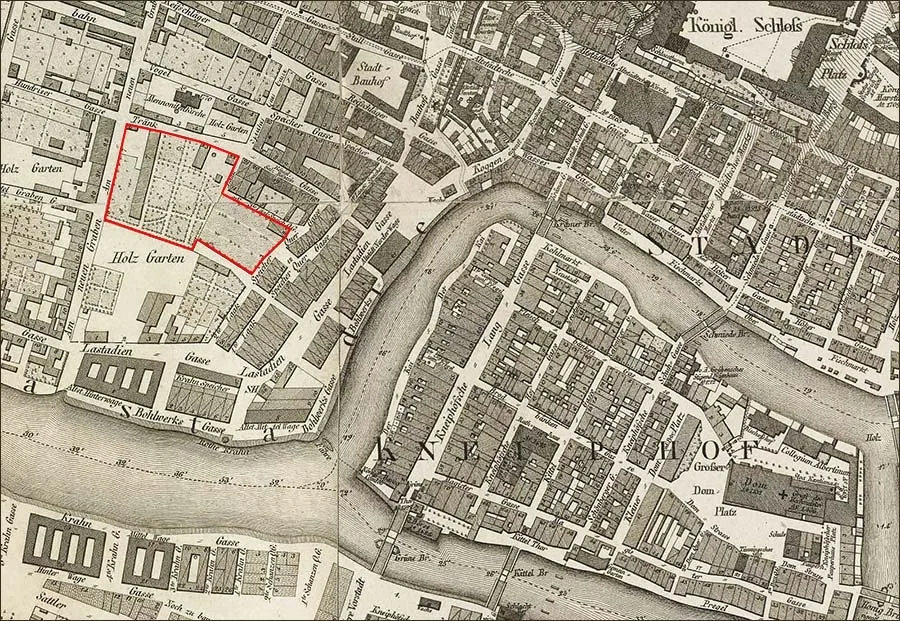 The Saturgus Garden on an 1815 map of post-Napoleonic Königsberg.
Friedrich Saturgus enlarged the family's original landholding by adding a neighbouring plot and laid a water supply to his garden, through which "good" water was to flow from a spring located behind the Neurossgarten Church, in the hollow of the People's Garden (later, in 1780, artesian wells would be built here to supply the Laak district with drinking water), through wooden pipes laid across numerous plots of land. The water of the spring, which Friedrich bought from the magistrate, was a kilometre from his palace, so the Kommerzienrat had to obtain permission to lay the water pipes and to purchase another spring in the meadows by the Pregel. Obtaining permits from the landowners and the magistrate demanded vigorous action and was a very costly business, but Saturgus's energy overcame every difficulty. The "good" water was brought to the intricate fountains of the luxurious garden. The magistrate also granted Saturgus the passage running round his entire walled property. He paved this passage with stone, planted it with limes on both sides and fitted it with two gates. But since under the agreement it was open to the townspeople, nobody lost out from Saturgus's actions – on the contrary, they gained.
Friedrich Saturgus's garden was filled with works of art, and it regularly received guests at frequent balls, festivities with fireworks, concerts, musical evenings, amateur theatricals and performances by the Königsberg theatre company. This private garden was without doubt one of the sights of Königsberg at the time, so distinguished visitors to the city never failed to visit the merchant family's estate. It is known that on 11 July 1776 the 22-year-old Russian Grand Duke Paul and Prince Henry of Prussia, during their visit to Königsberg, dined in this garden and "felt enchanted beyond their expectations".
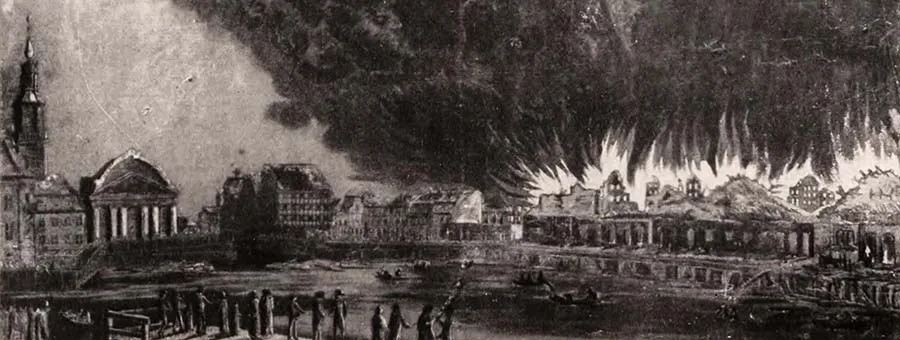
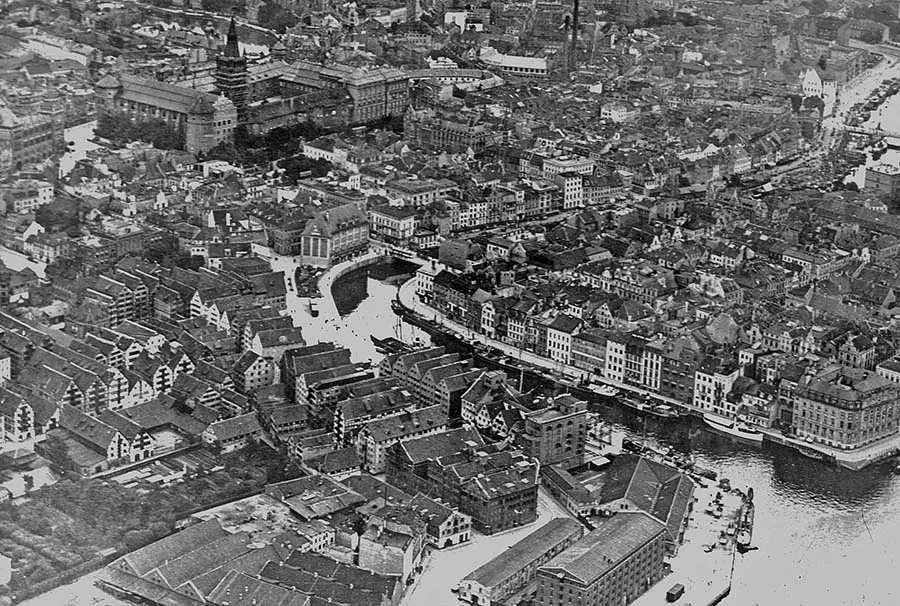 1866, as the scaffolding on the castle tower tells us. The Saturgus Garden is in the lower left corner.
The Russian officer and future memoirist Andrey Bolotov also visited the Saturgus Garden and may have been inspired by what he saw when he created the park ensemble on the Bogorodskoye estate…
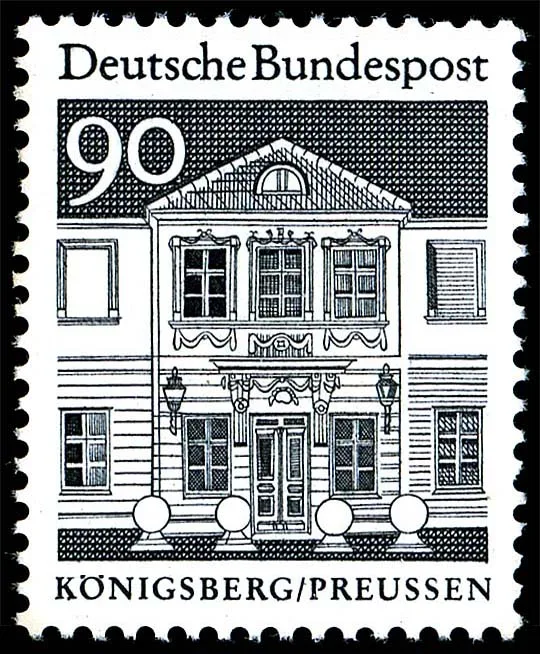
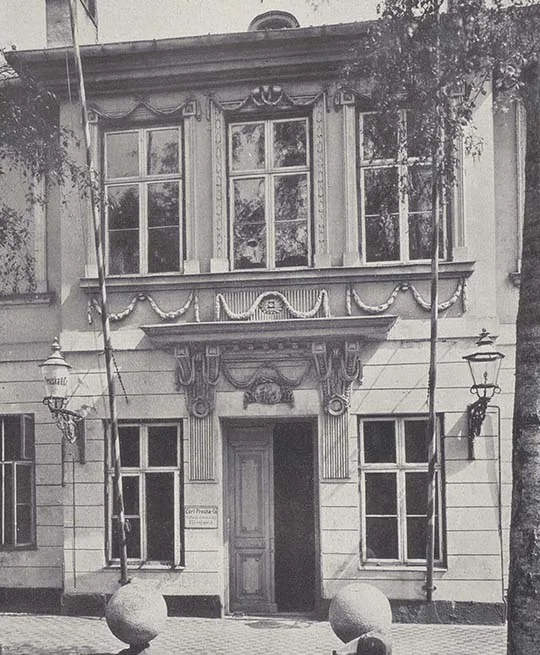
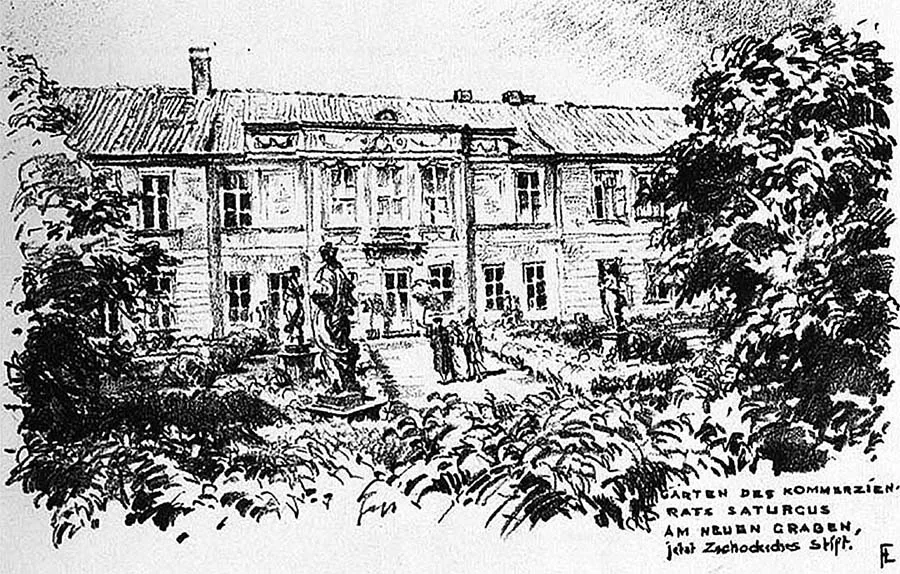 The lithograph "The Saturgus Garden" from the series "The City of Kant. Eight Pictures of 18th-Century Königsberg" by the architect and artist Friedrich Lahrs (Friedrich Lahrs, 1880–1964).
* * *
The following description of the Saturgus Garden is based on the texts of Ursula, Countess zu Dohna (Ursula Gräfin zu Dohna), and Herbert Mühlpfordt (Herbert Meinhard Mühlpfordt).
The earliest period of the garden's creation saw the luxurious fountains called "Running Jets". Part of this fountain system survived later, even after a great fire... In front of an artificial tufa wall stood two nude figures: on the right a long-bearded god of Water, on the left a beautiful nymph. Water streamed down from a vessel placed between them. Above the tufa wall rose a concave stone wall on which, completing the composition, a second nymph reclined.
In front of this elaborate structure was an alabaster circle, giving the impression that it might have been a Rococo sundial set in motion by jets of water from the fountain.
There was also a lattice structure in the form of a trellis, 13 square feet in area and one storey high, surrounding two deities – Earth and Water – made of sandstone. The deities held vessels from which water flowed into a shell, and the movement of the water made little bells ring. Evidently this "Running Jets" fountain was the centrepiece of the whole garden. Nor did the garden lack the illusions so characteristic of the Rococo. The "Garden of Illusions" lay to the right of the passage surrounding it, which had been turned into a lime alley.
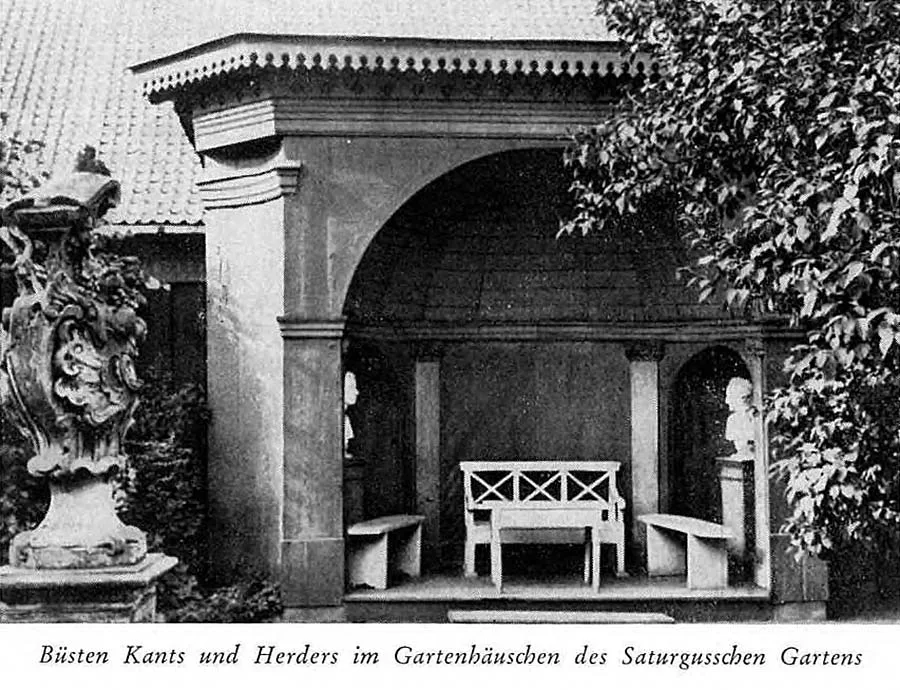 A Rococo vase and a pavilion with busts of Kant and Herder.
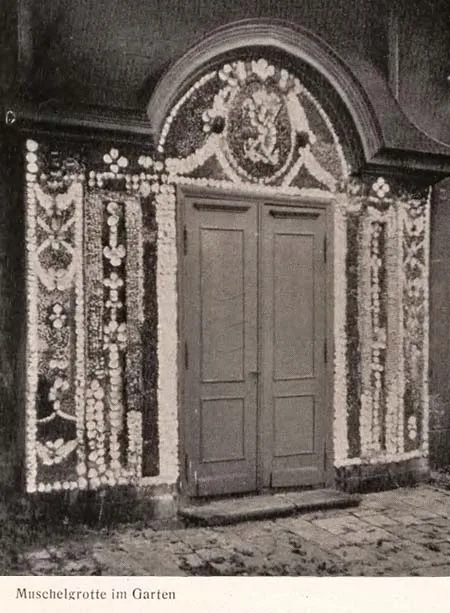
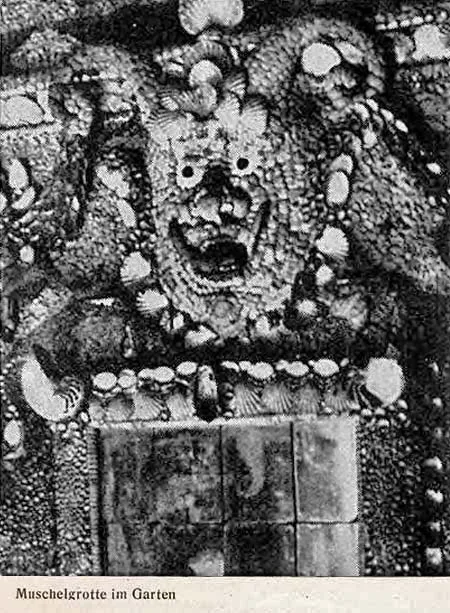
It seemed that far off, at the end of a green corridor, there stood a sandstone statue, but this was merely an optical illusion beloved of the Rococo – just a painting and a perspective narrowing before the eye, so that the image merged with its real surroundings.
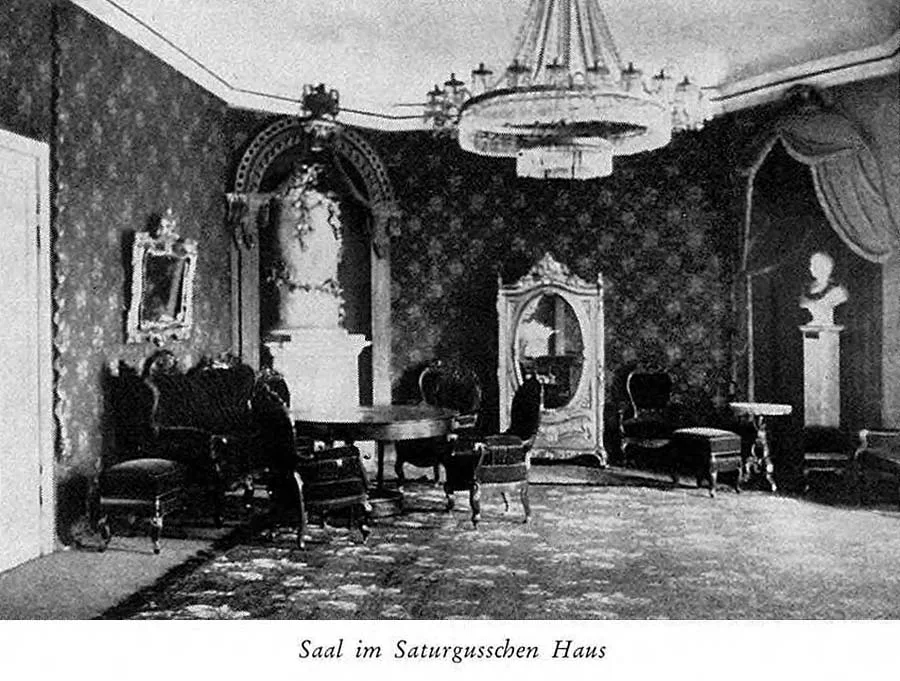
An extremely ornate, complicated fountain four metres high, which could only have been built in the Saturgus Garden with its wild fantasies, rose not far from the "Garden of Illusions" (it survived until 1944). It was a pyramid of feldspar, shaped like the Tower of Babel and crowned with a device that spouted water. A path broken by flights of steps ran along the irregular spirals of the tower, now gentle, now steep. Along the little grooves of the path the water, gathering for a while on the stones, finally rushed down like a silver snake…
In this garden four cherubs leaning on two Rococo vases decorated with shells and angels holding bunches of grapes displayed to the guests, on a curved plinth, the coat of arms of Kommerzienrat Friedrich Saturgus: three five-pointed stars on an oval field.
A special attraction of the garden was a shell-rock grotto decorated with masks, coloured pebbles, shells, magnifying mirrors, porcelain figures and even Chinese nodding figures, which duly wagged their heads and hands (in 1930 the sculptor Treine restored this grotto). At the entrance to the grotto lay a dragon which, instead of fire, spouted water rising to a height of three metres; it was surrounded by frogs and snakes that unexpectedly drenched those entering the grotto, but this zoological splendour was softened by the scent and delicate appearance of a multitude of carnations growing in three rows by the grotto. Inside the grotto, among the shells and mirrors, rose a crown "six cubits high". From under the pebbles, shells and crown, hidden little fountains suddenly showered the guests with jets of water curved like bows.
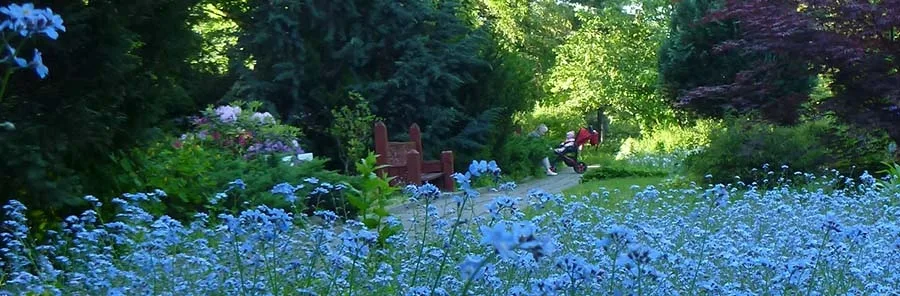
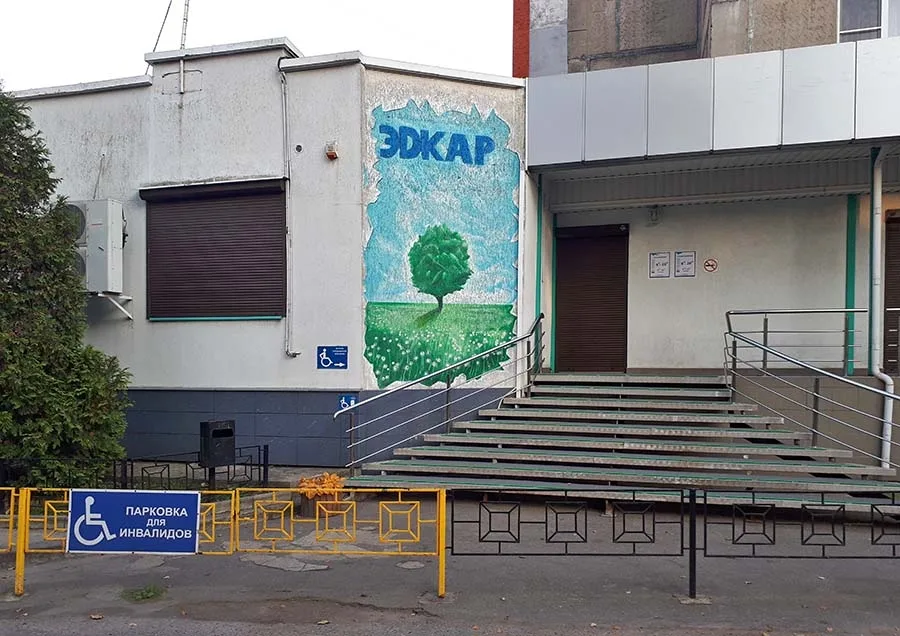 On the site of the Saturgus Garden in Kaliningrad (2024).
Johann Friedrich Lauson (1727–1783), a poet well known in Königsberg at the time, sang the praises of this garden in an endlessly long poem while Saturgus was still alive.
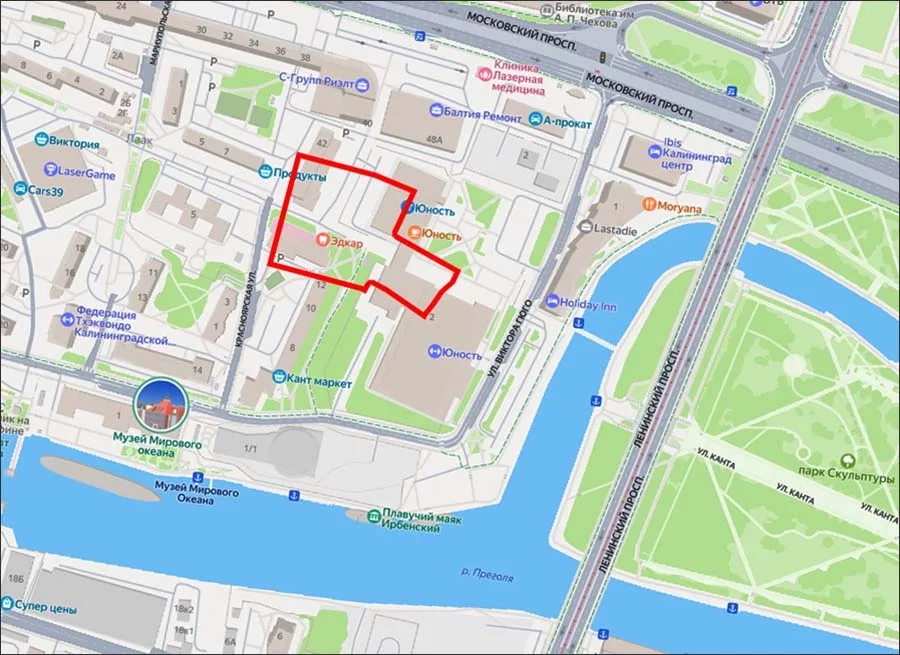 Location of the garden on a modern map of the city.
Thanks to this text we can at least roughly imagine the full variety and charm of the garden, legends about which were passed from mouth to mouth in the following century: "A garden whose charm hovers before the eyes"… "Every two steps bring surprises: a flower garden opening the way to the orangeries, eight stone statues in front of the house – a young Hercules with a lion skin, Flora at his right hand, Mercury beside her, Modesty with downcast eyes leaning against a stone tree, Pomona secretly holding an apple behind her back, Vertumnus with an apple which he openly shows to Pomona, Ceres with ears of grain… In this garden grow laurel and yew as thick as an arm, and espaliered vines, peaches and apricots press against the walls…" The poet lists all the delights of the garden and ends his work with the words: "The whole structure of the grotto is indescribably beautiful; whoever has not seen it will not believe me – it is too beautiful."
The garden's alleys were laid out like the letter T; opposite the house, with seven windows on its façade, was the fantastic grotto; along the wide side of the T lay the flower garden, and behind it the orangeries. In the middle was the alabaster sundial, and somewhere in the garden there was also room for a "menagerie", an essential part of Baroque gardens, with pigeons, peacocks and three roe deer, and for a fishpond with ducks and swans.
With the kind permission of the author.
The complete book "Chronicles of Gardens and Parks (Königsberg–Kaliningrad)", published by the Baltic Institute of Economics and Finance in 2008, is available on the Prussia.Online website.
Modern photo by Mikhail Ogorodnikov.
Translated from Russian with the help of AI (Claude, Anthropic), October 2026.