…To lean one's head against
A chestnut trunk – how sweet!
M. Tsvetaeva, "In Paris"
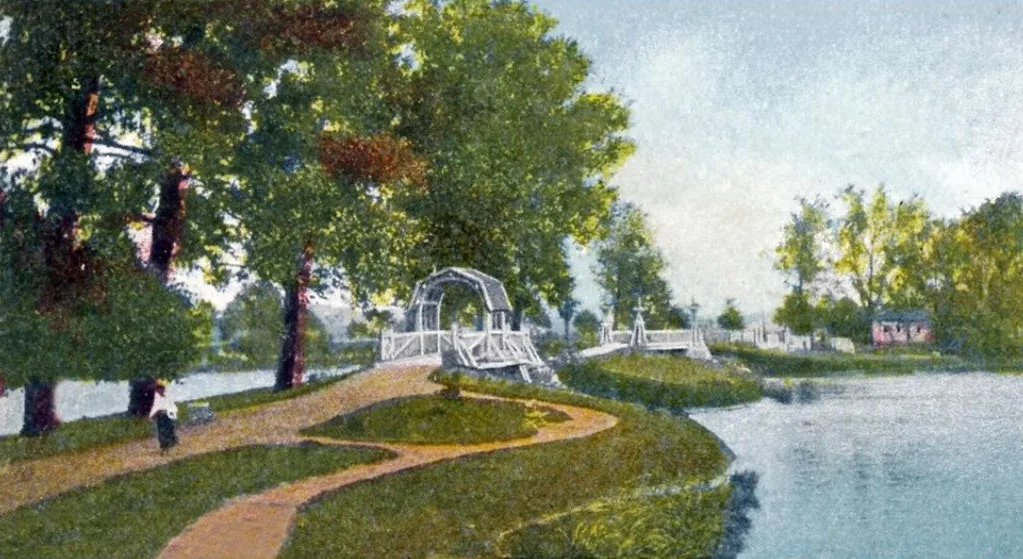
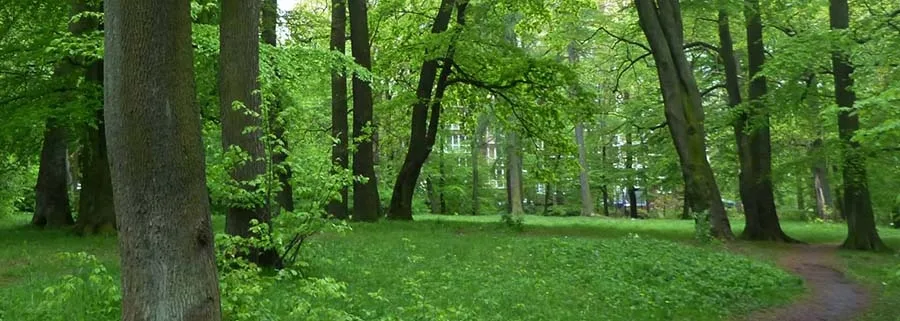
Kaliningrad is a city of chestnut trees. The scientific name of this tree is the common horse chestnut; it is no relation at all to the edible sweet chestnut. Many horse chestnuts grow in our parks and public gardens. One street is even called Chestnut Alley! Interestingly, it bore the same name before the war. There was also another Chestnut Alley in Heinrichswalde (now Slavsk) and a Chestnut Street in Tilsit (Sovetsk).
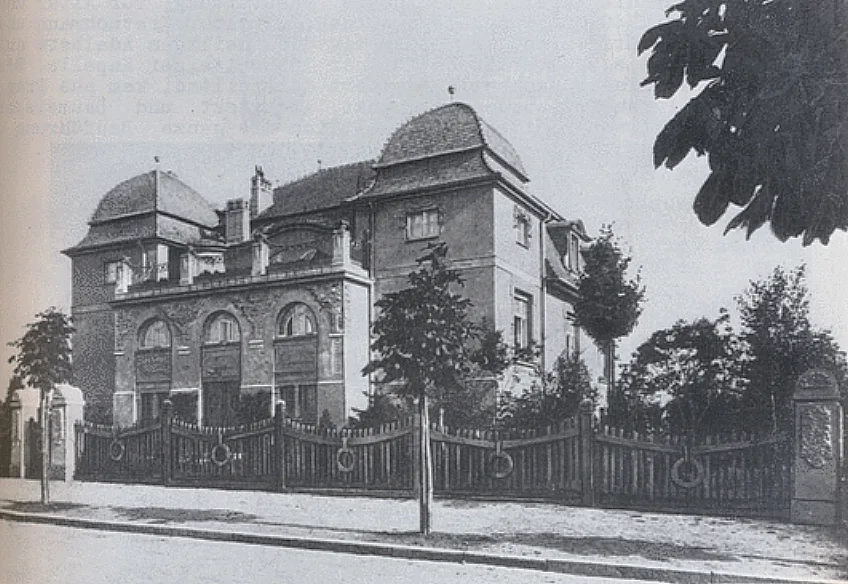
Chestnut Alley in Königsberg (Villa Lewandowski).
The chestnut leaf appears on the logos of various Kaliningrad institutions and decorates websites and brochures. These trees are mentioned in poems about Kaliningrad, often as an inseparable feature of the city, a mark of its identity. Here, for example:
But who belongs here, apart from the chestnuts?
In the Soviet Union, admittedly, our city had a rival for the title of "chestnut" capital – Kyiv.
Trees Get Sick Too
Sometimes the trees and shrubs growing in a city are struck by some ailment. This happened to the elms and the ashes; now it is the chestnuts that are suffering. In recent years an invasion of the horse-chestnut leaf miner has reached the Kaliningrad Region. This small moth with the beautiful Latin name Cameraria ohridella produces three to five generations of offspring in one summer. The larvae bore "tunnels" in the tissue of the chestnut leaf (you can see them in the photograph). As a result the trees weaken, fall ill and may die, since in a city the chestnut is exposed to various adverse factors…
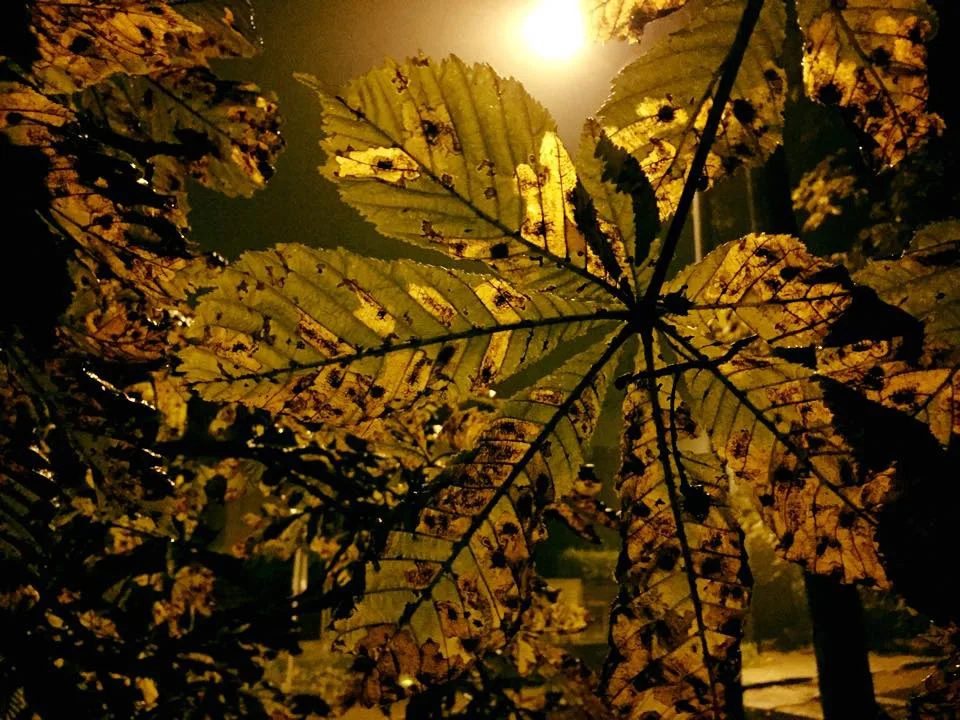
A horse chestnut leaf damaged by the larvae of the horse-chestnut leaf miner.
Scientists still argue about the Cameraria moth: where did it come from? Why did it conquer Europe so quickly? These mottled moths were first noticed in Macedonia, on the shores of Lake Ohrid. In 1986 the scientists Gerfried Deschka and Nenad Dimić described the horse-chestnut leaf miner as a new species. Gradually the insect began to be found ever further north of Lake Ohrid: in 1989 in Austria, in 1994 in Germany, in 2000 in France, then in Denmark and Sweden. The moth's triumphant march across Europe is shown on the map.
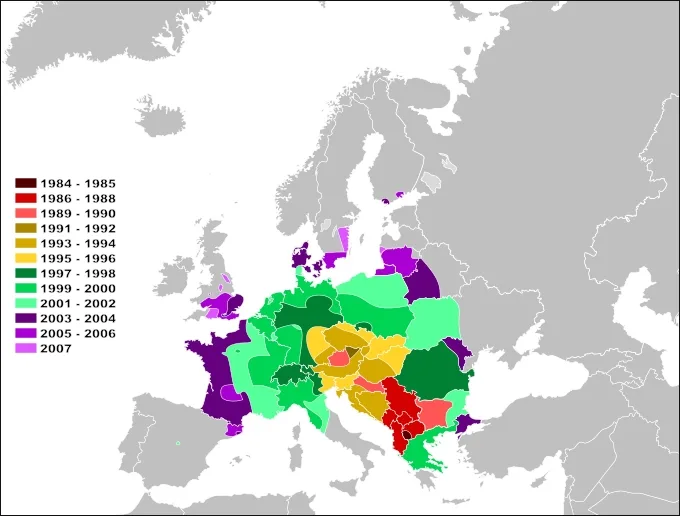
The history of the spread of the horse-chestnut leaf miner from 1984 to 2007.
In the Kaliningrad Region the horse-chestnut leaf miner was first noticed in 2003; in the regional capital the mottled moths were discovered two years later.
Some believe that the leaf miner does not originate from Europe but from Southeast Asia or North America. It is also said that the mass spread of this insect is explained by global climate change, by warming.
The spread of the horse-chestnut leaf miner has caused concern at the highest level. For several years a UNESCO project called CONTROCAM ("Control of Cameraria") was in operation. In various countries the moth was studied, counted and fought at the same time.
Various methods of control have been found. The first is special substances poisonous to the moth – insecticides. Diflubenzuron disrupts the synthesis of chitin, of which the insect's exoskeleton is made. Imidacloprid, in turn, acts on the central nervous system. This method is expensive, and experts also doubt that it is environmentally friendly.
The second method involves the use of pheromones (the pheromones of the horse-chestnut leaf miner were identified in 1998 in the Czech Republic). These are substances that attract insects of the opposite sex. Pheromones are used in sticky traps: the male moths fly towards them, sensing the females' pheromones, and get caught in the trap. This is a "natural", environmentally friendly method.
Scientists are still working on a third approach to fighting the leaf miner – using the mottled moth's natural enemies. Various species of insects and spiders feed on the moth, tits eat it (though not the adult moths but the larvae and pupae), and fungi attack Cameraria.
The fourth method is called mechanical.
Essentially it is very simple: clearing away the leaves under the horse chestnuts.
The point is that the pupae of the Ohrid leaf miner remain in the fallen leaves in enormous numbers. Rain, snow and even frosts down to -23°C do them no harm. Collecting the leaves in autumn sharply reduces the number of moths in the first generation of the season, in spring. It is best if the leaves that fall from the chestnuts are gathered as early as possible, from summer onwards. In European countries burning leaves is prohibited; they are sent to special incinerators or composting plants, where they are kept at 40–50°C for several weeks. This is enough to neutralise all the numerous pupae. In ordinary compost heaps the pupae do not die. In any case, leaves must not be left under chestnut trees. Clearing them away not only helps to neutralise the numerous pupae but also strengthens the trees against other pests, for example the fungus Guignardia aesculi.
So What Is Happening in Kaliningrad?
The moth is feasting, because we have tens of thousands of horse chestnuts. So far there has been no reaction from the authorities to the problem of preserving our green heritage… But a group of precisely such residents has emerged – caring and active people who decided to test one of the methods (or rather two at once, in combination) of saving the trees from Cameraria.
Proactive Kaliningraders, ecologists and teachers have united around a common idea, and schoolchildren have come to help.
The "locomotives" of the effort to save the chestnuts from the leaf miner have been Aleksandra Korolyova, Svetlana Korolevskaya, Katerina Cherevko and other residents. Several schools in Kaliningrad, Guryevsk and Gvardeysk have supported the campaigns.
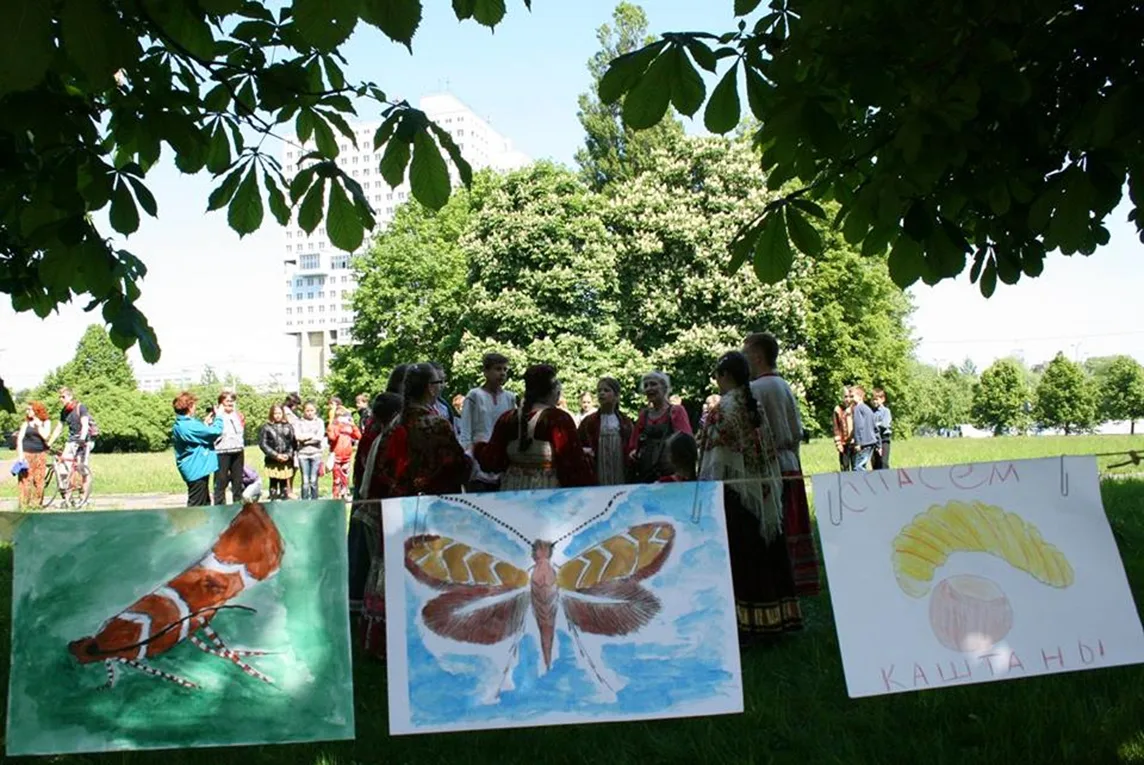
So, in autumn 2013 the activists chose a "model row" of trees – seventy not-yet-old chestnuts along the Pregolya in the public garden opposite the House of Soviets, across the river from the Cathedral. The chosen method has three stages: a long autumn stage, a second at the beginning of spring and a third at its end.
At the first stage, all the fallen leaves containing the pupae of the leaf miner have to be collected. Over the autumn we clear the leaves in several rounds, organising events attended by participants of all ages in the "days for saving Kaliningrad's chestnuts".
The work then continues in early spring. A special sticky tape belt is put around the tree trunks, with a pheromone lure on it. This attracts the male Cameraria moths: they fly towards the scent and get stuck to the belt.
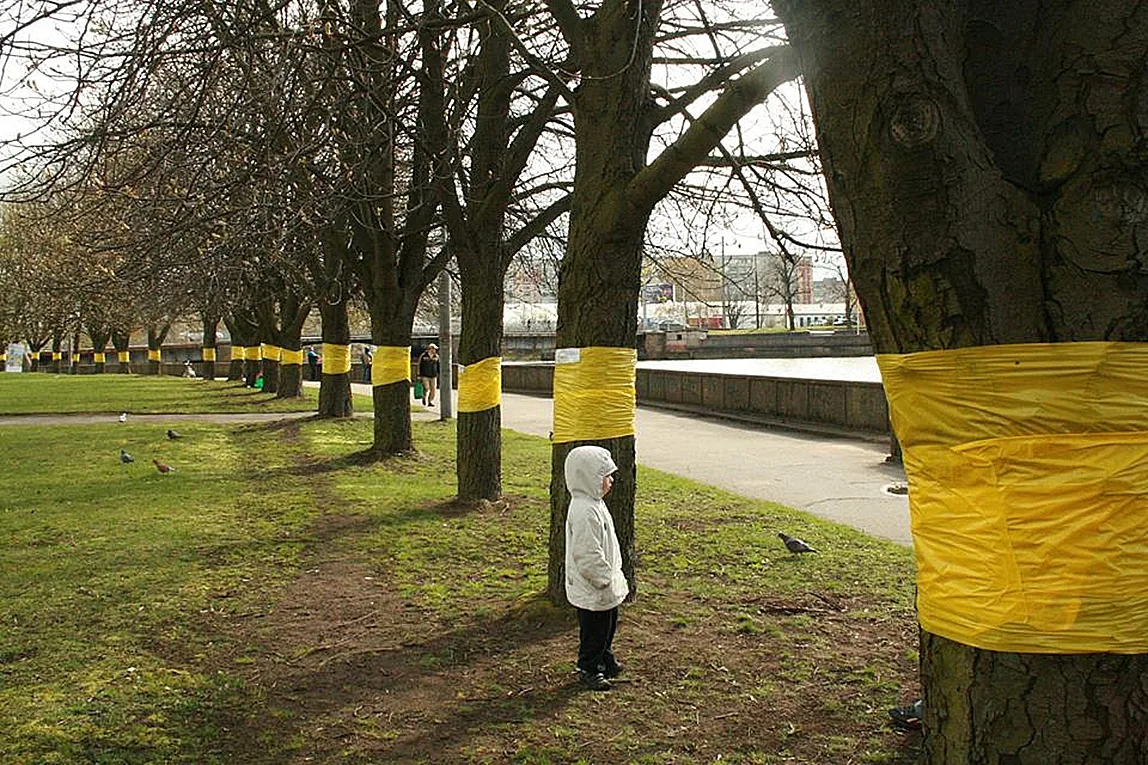
A row of trees wearing trap belts.
The next stage takes place in May, when the trees have already come into leaf. Other traps – "little houses" – are hung in the tree crowns. They also contain a pheromone lure and a sticky area on which some of the male moths will be caught. It is advisable to hang "fresh" traps after a few weeks, since the Ohrid leaf miner produces more than one generation over the summer.
This cycle of operations on the chestnuts on the Pregolya embankment has now been kept up for two years. Today it is clear that the foliage of the "model row" trees is healthier and stays on the branches longer.
How Do the City's Residents Feel About the Initiative to Save Kaliningrad's Chestnut Trees?
Some support it actively, coming to the events, sometimes as whole families. Others do so more as slacktivists, taking part in themed groups on social networks. Unfortunately, there are other responses too – outright opposition. Two weeks after bright yellow trap belts were put on the chestnut trunks (with leaflets explaining the essence and aims of the campaign attached to them), half of them had been cut off and stolen.
I still wonder who could have needed them. Cutting off a very sticky belt with a layer of non-drying glue is not easy. Dashing gardeners? Urban vandals? Who could have been bothered by our initiative to preserve these few dozen most Kaliningrad of trees?!
Happily, the positive responses to the idea far outnumber the negative ones. Organisations have appeared that have taken up the preservation of the chestnuts on their own grounds (some schools, for example); there are individuals who look after young chestnut saplings in their own courtyards. Kaliningraders have raised money to buy pheromone traps. The fight against the horse-chestnut leaf miner on the banks of the Pregolya goes on, and it is waged not only with rakes and stepladders but also with folk songs, ecological games, home-made pies and hot tea.
It is believed that 85% of success in fighting the Ohrid leaf miner comes precisely from clearing away the leaves, the mechanical method of combating the moth. And this is exactly what is within our power; ordinary residents, caring and strong people who want to preserve the face of their city – Kaliningrad, famous for its chestnuts – can help here. Take your familiar chestnut tree by your house or in a public garden under your care – join in!
Photos by Ismail Nigmatullin, Wikipedia, bildarchiv—ostpreußen.de.
Translated from Russian with the help of AI (Claude, Anthropic), October 2026.