Initially, it was assumed that Lithuania would be conquered in much the same way as Prussia. The tactic was this: devastating raids, which wiped out those actively resisting and broke the will of the remaining population to fight, would be followed by the seizure of territory, the construction of strongholds (castles), the baptism of the inhabitants, the recruitment of colonists from Germany, and then a fresh advance into the land being conquered. The brethren of the Order were, of course, well aware of the difference in territory and manpower between Prussia and Lithuania. It is therefore unlikely that a complete conquest of Lithuania was ever envisaged, even in the most distant future. The Order concentrated on two directions: the northern, which was of strategic importance, and the eastern, which was secondary.
It should be noted here that in the late 13th and the 14th centuries the Lithuanian lands were far more extensive than the territory of today's Republic of Lithuania. By the time the Teutonic-Lithuanian wars began, Lithuania already held almost all of western Belarus and part of the northwestern Russian territories, and at the height of Teutonic pressure on Lithuania, practically all of present-day Belarus and Ukraine.
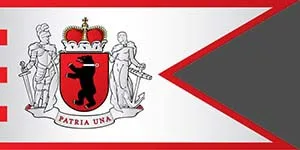
Samogitia (Žemaitija, Zhmud)
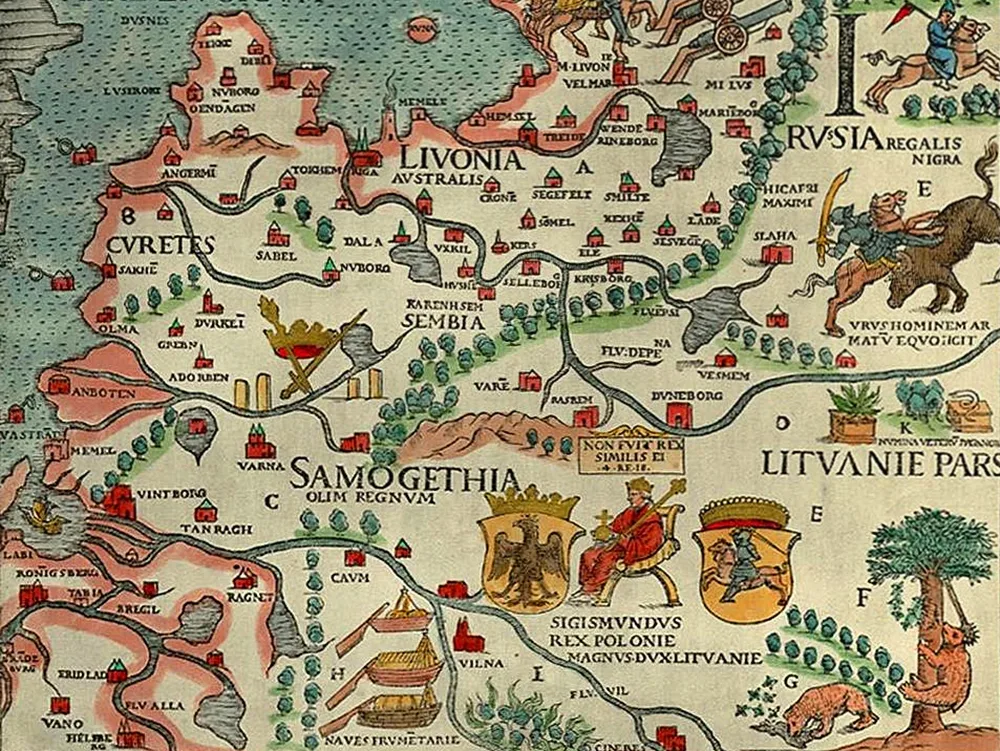
A historical region of Lithuania in the west of the present-day Republic of Lithuania. Samogitia was inhabited by the Samogitians and was a vassal territory of the Grand Duchy of Lithuania. It had its own capital, the town of Raseiniai. After fruitless attempts at conquest, the Teutonic Order obtained Samogitia under a peace treaty with Prince Jogaila. However, following the war of 1409–11, Samogitia once again became Lithuanian territory.
The Teutonic Order1 therefore set itself a simple goal: to drive a broad corridor from the conquered Prussian lands to the possessions of the Livonian Order2, located in what is now Latvia and partly Estonia. By that time the Livonian Order had become a “branch” of the Teutonic Order, one of its Landmeister provinces. Between the two lay the lands of Samogitia, whose capture would have made the Order's state master of the entire eastern Baltic. Interest in Samogitia was heightened by the fact that the Order had every right to it: in 1254 this territory had been granted to the Livonian Order by Mindaugas (1195–1263), the first Lithuanian king recognised by Catholic Europe. But the Samogitians themselves, over whom Mindaugas's authority was more than nominal at best, opposed the transfer. The Samogitian army routed the Order's forces at the Battle of Durbe, on the shores of Lake Durbe, in 1260, and finally drove the knights out of Samogitia in 1265.
From all the history preceding the events described below, it can be stated that by 1280 the future adversaries in the struggle for the lands of Lower Lithuania (Samogitia) and, in part, Upper Lithuania (Aukštaitija) each had both their strengths and their weaknesses:
– The Teutonic and Livonian Orders were able to attack simultaneously from two sides. Their forces were small in number but were, as we would say today, professional armies under strict unified command and with a rigid hierarchy;
– The Lithuanian side had manpower that was inexhaustible by the standards of the time and could afford to cede large territories temporarily, but its armed bands lacked serious military and tactical training and often acted not only without coordination but even against one another.
By the end of the 13th century the Teutonic Order had undertaken several campaigns into Samogitia and against Grodno. Despite victories in battle, none of these campaigns brought any territorial gains. The Order's army laid waste to the countryside, burned villages, killed Lithuanian militiamen, took men, women and children captive and drove off livestock, but was forced to withdraw before large Lithuanian forces arrived.
It became apparent that the army was not only too small to hold territory but also lacked bases in the border areas. Construction therefore soon began on the large border castle of Ragnit (today the town of Neman) and on a whole series of smaller fortresses along the banks of the Neman.
The Prussian Journeys
At the very beginning of the 14th century a social phenomenon known as the “Prussian journeys” (Preußenreisen) emerged in Europe. Knights from various countries, often from noble aristocratic families, came to Prussia to take part in campaigns against pagan Lithuania. There was nothing new about crusades to the Baltic lands, but whereas in the 12th and 13th centuries such campaigns had customarily been proclaimed by the Pope, the Teutonic Order itself now took on the role of organiser of the “Prussian journeys”. There were several reasons why these “journeys” became popular in Europe. Fighting for the Christian faith had always been the foremost knightly virtue, and anyone who had taken part in campaigns to liberate the Holy Sepulchre, or against heretics, pagans and infidels, was held in high esteem in secular circles.
Crusades for the faith absolved participants of all their sins, and given the deep religiosity of Europeans at the time, this too was a compelling reason. Finally, the journey to the Baltic was far less dangerous than the journey to Palestine, while the merit and honours were the same. In the “real” crusades to the Middle East, most crusaders perished not in battle but on the way, from hardship and disease. At sea they faced storms and pirates; on land, sandstorms and brigands... Prussia, by contrast, could be reached in relative comfort, and on arrival a crusader could always count on lodging, food and a warm welcome from his hosts.
The unwritten rules for “guests” (as the Order called the visiting knights) required them to acquire their own weapons at their own expense, maintain their squires and men-at-arms, and pay for their journey to Prussia and back home. In addition, they had to obey the commander of the campaign and, if booty was taken, share the spoils with the Order's treasury. There were, however, cases when “guests” voluntarily handed over to the Order everything they had won in a campaign, demonstrating that they had acted solely in the interests of spreading the faith of Christ. The “guests” often arrived well in advance and spent a considerable time in the Order's domains until a campaign was announced. As a result, there was always a certain number (sometimes a very large one) of knights and their soldiers staying in the Prussian lands, who reinforced the Order's army in repelling Lithuanian incursions.
For a while, the new Grand Master of the Teutonic Order, Karl von Trier (1265-1324), upset everyone's plans. Elected in 1311, he immediately began to pursue a peaceful policy towards the Poles and a restrained one towards the Lithuanian pagans. Within the Order itself and among the “Prussian travellers” this met with incomprehension; a circle of conspirators formed, and in 1317 its members convened an extraordinary session of the Order's chapter. Karl von Trier was blamed for all the Order's failures in Lithuania in recent years, for political and religious short-sightedness and for indecisiveness in the struggle against the enemies of Christendom, and he was removed from office, which was an extraordinary event in the Order's history. And although a year later the Pope interceded on behalf of the former Grand Master and demanded his reinstatement, he was in fact still excluded from the leadership of the Order and never again set foot in the Order's capital, Marienburg (today the Polish town of Malbork). This episode shows that as early as the first quarter of the 14th century the campaigns against Lithuania had become a veritable industry, involving influential forces that drew material and political benefits from their continuation.
Before long, the “Prussian journeys” became so popular among European knights that for some campaigns against Lithuania the Order merely supplied guides, while the main strength of the army consisted of visiting knights. Thus, having entered Samogitia in 1329, King John of Bohemia, John of Luxembourg (1296–1346), with his army and the support of the Teutonic Knights, “subjugated the whole Samogitian land together with all the Lithuanians, who were baptised on the day of the Purification of Mary” (i.e. 2 February). The culmination of the events of the first half of the 14th century may be considered the grand campaign against Kovno (Kaunas), in the course of which the Teutonic army, reinforced by a large number of “guests”, ravaged the entire Lithuanian Neman region, burned Kovno and inflicted a crushing defeat on the large army of Prince Algirdas, which had hurried to the aid of the territories under attack.
A Mirror Response from Lithuania
Leaving aside minor border skirmishes, in the first quarter of the 14th century the Teutonic Knights and their “guests” carried out seven major campaigns into Lithuania, and in 1311 they defeated the army of the Lithuanian prince Vytenis, which had invaded Prussia. The Order’s eighth campaign into Samogitia, in 1320, brought it its first serious defeat. At the Battle of Medininkai the Order’s army was utterly routed: of 40 brethren and a considerable number of knechts, 29 brethren, including the Marshal of the Order Heinrich von Plotzke, were killed on the battlefield, and one more was taken prisoner and sacrificed to the pagan gods by being burned together with his horse. In addition, two hundred soldiers of the Memel garrison and the Sambian levy perished. After this the Lithuanians carried out three raids on the Order’s lands, each time plundering villages, killing Christians and getting away before an Order detachment could arrive. From then on, raids by Lithuanian war bands became a constant headache for the Teutonic Order and a mortal danger for Christian settlers.
Then, for a short time, the conflict between the Order and the Lithuanians was put on hold: Grand Duke Gediminas of Lithuania informed the Pope of his intention to embrace Catholicism, and the Pope, not wishing to frighten off his good fortune, imposed a four-year ban on campaigns into Lithuania in 1324. During the truce Gediminas accomplished two important things: he considerably enlarged the Lithuanian principality at the expense of the lands of western Rus’, and he concluded an alliance with Poland, convincing the Polish king that the Teutonic Order posed the greatest danger to Poland and that Poland itself might one day take on the role of Lithuania’s baptizer. The result was the Polish–Teutonic War of 1326–1332 over disputed territories, which undermined the Order’s capacity to advance into Lithuanian lands.
Once the truce had ended, Teutonic and Lithuanian campaigns into each other’s lands resumed with greater intensity. The initiative lay with the Order, even though its geopolitical position had now sharply deteriorated as a result of Lithuania’s alliance with Poland. Nevertheless, in the very first year after the truce alone, the Order mounted three major campaigns into Lithuanian territory, and in Samogitia it succeeded in taking all the key Lithuanian strongholds. Later the Teutonic Knights captured Vilna (Vilnius) and Kovno (Kaunas), but the Order’s army lacked the strength to hold the conquered territories for even a short time. Several outpost castles were built beyond the Neman, but that was all the Order managed to achieve in terms of seizing and holding territory.
The Lithuanian counter-attacks were less impressive, but they caused a good deal of trouble and hardship. Because the Order possessed a far more developed economic infrastructure, Lithuanian raids also inflicted considerably greater damage. By the second half of the 14th century the Order had established on its territories an economic model that was advanced for its time, based on patents, rents, taxes and excise duties. So when an entire district was laid waste, with several thousand tenant farmers killed and as many again driven off into captivity, the Order’s economy suffered tangible losses. There was also the danger of a deep Lithuanian thrust towards Königsberg, and so in the first half of the 14th century the northern line of defence was strengthened. It consisted of the castles of Pobethen (Romanovo), Rudau (Melnikovo), Laptau (Muromskoye) and Powunden (Khrabrovo), plus Schaaken (Nekrasovo) and Waldau (Nizovye), which covered the shortest route to Königsberg across the Curonian Spit and the ice of the Curonian Lagoon. These castles also served as places of refuge for the civilian population in the event of an enemy invasion. A permanent watch was maintained in all of them, which was then a novelty in military affairs. Sentries in the towers kept the surrounding country under observation and signalled any sign of an enemy advance: smoke by day and the glow of fires by night. These sentinel tactics sometimes bore fruit, but they were by no means a cure-all against Lithuanian raids.
Looking at these events through modern eyes, it becomes clear that the campaigns against Lithuania could bring no strategic benefit whatsoever, unless one counts as such the proceeds from plundering villages and castles. Each time, the crusaders returned to their starting positions, while the Lithuanians they had baptized reverted to paganism as soon as the Order’s detachments had left, growing ever more hostile towards Christians and ever more eager to avenge the killing of their kinsmen. Death, hostages, burned villages and devastated lands were the only “result” the crusaders achieved, and it had, of course, nothing in common with their proclaimed mission of spreading Christianity on the fringes of Europe. What had been accomplished in Prussia at the cost of thousands of lives simply could not be repeated in Lithuania. Since the Pope had the power to abolish the Teutonic Order once and for all with a single bull, as no longer needed, the crusaders’ presence in the Baltic lost its higher purpose without the support of their mission and overriding goal. That is why the Knights of the Order strove at any cost to prove to the entire Catholic world that the existence of the Order’s state on the frontier between the Christian and pagan worlds was an absolute necessity.
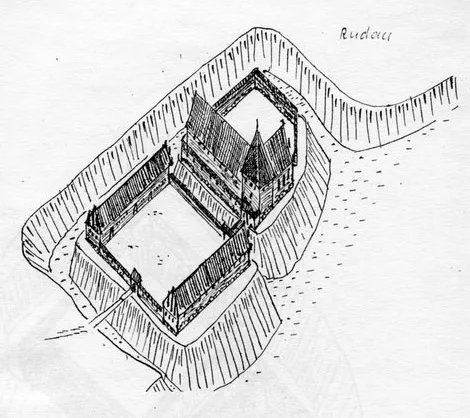
Rudau
A Teutonic castle in the north of Samland, now the village of Melnikovo in the Zelenogradsk District. Built in 1270 and rebuilt in stone in the early 14th century. In 1370 a great battle between the Teutonic Order and the Lithuanian army took place north of Rudau. The castle was later converted into a church, the ruins of which survive.
(Drawing by Anatoly Bakhtin)
The Decade Before the Battle
When speaking of the decade before the Battle of Rudau, one must certainly mention the 22nd Grand Master of the Teutonic Order, Winrich von Kniprode (1310–1382). The Order largely owes to this man the golden age that began during his rule and ended with the defeat at the Battle of Grunwald. Kniprode stood out sharply from the line of his predecessors. Above all, he firmly held to the principle that the strength of any state lies in the strength of its economy. Through Winrich von Kniprode’s efforts, the backwardness of the Order’s eastern territories began to be remedied: incentives were introduced for colonists settling there, the development of crafts was encouraged, and a strict but not burdensome system of taxes, licences and excise duties was established. Kniprode carried out what were perhaps the first large-scale anti-corruption measures in Europe within the Order. He also created a system of rotation for the Order’s officials and encouraged secular specialists in various fields from the German principalities to come to the state. Finally, mention should be made of such innovations as the development of urban and rural schools, the instruction of the Order’s brethren themselves in reading and writing, economics and diplomacy, and the holding of military exercises, which made the Order’s army the best in the region. Meanwhile, Lithuania was also gaining strength during these years. From 1345 a consensual dual rule was established there.
Gediminas’s son Algirdas (1296–1377) was recognized as Grand Duke of Lithuania. His brother Kęstutis (1297–1382) ruled alongside him as co-regent. This was a rare example in world history of two brothers reigning in one state without either trying to usurp power.
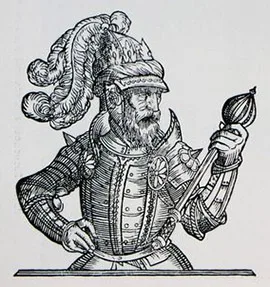
Algirdas (1296–1377)
Grand Duke of Lithuania (from 1345), son of Gediminas. During his reign he devoted his main efforts to expanding the Lithuanian state by annexing principalities in the lands of Rus’. Took part in the Battle of Rudau. Father of 23 children, among them King Jogaila of Poland. All his sons were installed as princes in various domains, and his daughters were married to Russian princes. He was baptized into the Orthodox faith but in practice remained a pagan. He was buried according to pagan rites.
By 1360 the Grand Duchy of Lithuania under Algirdas had annexed vast territories to the east and south-east, reaching as far as Kursk and the Principality of Kiev. In the south-east, Lithuanian lands now bordered the Crimean Khanate and the Golden Horde. For a time, all of Algirdas’s main efforts were concentrated in precisely this direction. The north-western lands of the Grand Duchy of Lithuania, meanwhile, were under the charge of Kęstutis.
He was placed in Marienburg Castle and held there as a hostage. Later he was exchanged for a large number of Christian prisoners. It is worth noting that some time afterwards Kęstutis contrived to fall into Teutonic captivity once again. And this time only the help of fellow tribesmen who had converted to Christianity enabled Kęstutis to escape from his confinement. From 1360 the situation in Baltic Lithuania grew tense once more. The Order undertook yet another devastating campaign against Kovno, in the course of which it took the castle and destroyed the town. The Order’s army advanced as far as Troki (Trakai) and Vilna (Vilnius). This time the Knights of the Order were blessed with incredible luck: Prince Kęstutis himself was taken prisoner.
This is how the Livonian chronicler Hermann von Wartberg describes the events of a single year of Teutonic–Lithuanian relations: "In 1362 Master Arnold undertook four campaigns against the pagans: the first, on the day of the Conversion of Paul (25 January), as far as the so-called holy village of Seten; the second campaign he undertook immediately after the first (in February), with certain «guests» from Germany; the third, by ship, at the request of the Grand Master, on Palm Sunday (after 16 April), to destroy the castle of Kauwe (Kaunas). The Grand Master, for his part, came to the said castle with an army on ships on the Tuesday before Judica Sunday (29 March) and laid siege to it, believing that the fugitive king Kęstutis was inside. But the castle, built of stone and fortified with high walls besides, was hard to take, especially as both kings appeared at that very time with all their might. At last, after prolonged toil and numerous battles, the castle was taken on the eve of Easter (16 April). Captured in it were a son of King Kęstutis, the commander of the castle with his son, and 37 others; the rest, some 2,000 picked and strong men, perished by fire and sword. Of the brethren 7 fell, and of the others 20. The fourth campaign the Master undertook in the autumn."
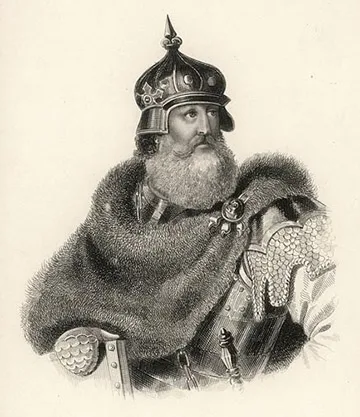
Kęstutis (1297–1382)
Duke of Trakai (from 1337), co-ruler with Algirdas (from 1345), Grand Duke of Lithuania (from 1381). Known as co-ruler alongside Algirdas during the latter's reign in Lithuania. His chief efforts were directed at resisting the Teutonic Order's incursions into Lithuania. A participant in the Battle of Rudau. Father of Grand Duke Vytautas of Lithuania.
And the Lithuanian response followed immediately. The Thorn Chronicle reports: "In the year 1365, before Shrovetide3, the Lithuanians burned three castles, namely Splittern (Spliteren), Kaustritten (Carisiten) and a castle near Ragnit (Ragniten); all the people of these castles were led away into captivity, and all of this through treachery."
With matters in the east still unresolved, Algirdas twice concluded a truce with the knights. When the last truce expired in 1369, another campaign against Kaunas followed, and once again the castle was taken and burned. It is quite likely that this very campaign provoked the Lithuanians into retaliating, with a plan to strike at the extensive territory of the Order, plunder the wealthy towns on the Pregel — Altstadt, Löbenicht and Kneiphof — and, if fortune favoured them, take Königsberg Castle itself.
The Events at Rudau
The armies of Algirdas and Kęstutis set out from Lithuania by two routes, intending to join forces in Samland, north of Königsberg. By then both princes were over 70 years old. On the campaign they were accompanied by their sons Jogaila, the future King of Poland, and Vytautas, the future Grand Duke of Lithuania. Kęstutis reached Rudau across the ice of the Curonian Lagoon. The main force, commanded by Algirdas, advanced overland, burning and laying waste to everything in its path. At last the two armies met north of Rudau.
The presence in the army of both co-rulers together with their heirs spoke to the grand scale of the campaign's ambitions. And indeed, this was the most powerful advance of a Lithuanian army into the Order's lands.
From this point on, accounts of what happened next begin to diverge. According to the Order's chroniclers, the Lithuanian army numbered 70,000 men, of whom 20,000 were Ruthenians — East Slavs who had become subjects of the Grand Duchy of Lithuania after the Lithuanian conquests. Another 10,000 were Tatar warriors. Both the Ruthenians and the Tatars joined the Lithuanian army entirely of their own free will: in those days plundering neighbouring lands was considered a worthy and, above all, profitable occupation. Seventy thousand warriors is only one and a half times fewer than the army of Batu Khan that ravaged central and northern Rus', so let us leave such exaggerations on the chronicler's conscience. According to the most balanced modern estimate, the Lithuanian army numbered no more than 17,000 men, including five thousand Ruthenians and two thousand Tatars.
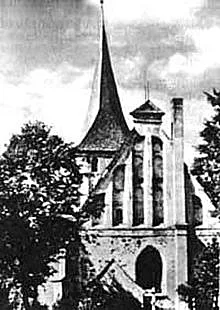
Quednau
A Teutonic castle that stood on what is now the northern outskirts of Kaliningrad, where Fort No. 3 is located today. When the Order's lands were divided, the castle passed into the possession of the Bishop of Samland. It is last mentioned in 1427, after which it was probably dismantled as no longer needed. The stone church in Quednau was built in the 14th century. The building survived the air raids of August 1944 and the storming of the city in April 1945. It was demolished in the 1970s.
Yet while historians long ago reached a consensus on the size of the Lithuanian army, the further course of events is presented differently by different authors (from the contemporaries of Kęstutis and Algirdas to our own), who openly contradict one another. According to one version, Marshal Schindekopf, seeing the glow of fires from Quednau Castle (today the area where Aleksandra Nevskogo Street leads out of Kaliningrad), could not bear the pain of knowing that his brothers in Christ were dying at the hands of pagans, and did not wait for the main Teutonic army under Grand Master Winrich von Kniprode. With a small force he made his way to Rudau, gave battle, defeated the Lithuanians, but was himself killed. Only later, when the time came to gather the wounded and mourn the dead, did the Grand Master's army arrive on the battlefield. Others claim the opposite: a combined army marched under the command of both the Grand Master and the Marshal (some add that it advanced in two columns). Meeting the enemy in battle at Rudau, the crusaders routed them. The Marshal fell, and the Grand Master erected a monument to him. There are also minor variations of both versions with differing details.
Let us try, then, relying on the chronicles and established facts, to reconstruct the true course of events. Historians have determined the approximate size of the Order's army: about 10,000 mounted and foot soldiers and militiamen. Yet 10,000 horsemen and infantrymen amounted to the Order's entire army at the time. At the same time, the chronicles of the period note:
– the presence in Prussia of a large number of European «guests» ready for a new campaign against Lithuania,
– the arrival of an "expeditionary corps" from Estonia, which then belonged to Denmark,
– the presence of a number of Livonian knights,
– the calling up of the militias of Altstadt, Kneiphof and Löbenicht.
It can therefore be assumed that the Teutonic army proper numbered five thousand men. In effect, every available force was committed to battle, except for the border garrisons (facing Lithuania and Poland), the garrisons of the major castles (Königsberg, Marienburg, Balga), which could not be left undefended, and the distant garrisons, whose arrival would have taken too long. It would be naive to think that such a mobilisation was undertaken without certainty that the Order faced not an ordinary Lithuanian raid of a few hundred, or at most a thousand, men ready to retreat across the border at the first sign of serious danger.
Grand Master Winrich von Kniprode knew full well that this time the Lithuanian army was strong, and so he prepared thoroughly. Moreover, the chronicles, albeit with exaggeration, report the ethnic composition of the enemy army even before it entered battle. Such information could only have been obtained by capturing prisoners, who revealed both the size of the army and the plans of Algirdas and Kęstutis. The Grand Master knew where the two Lithuanian armies would meet and where they would head once they had joined forces.
And indeed, in some sources we find that two weeks before the battle (namely on 2 February 1370) Marshal Schindekopf had carried out a brilliant reconnaissance in force. Taking the Lithuanians by surprise with a small detachment (some 20 knights and 500 other warriors), he attacked one of their units, routed it and captured 220 Lithuanian prisoners, while the rest of that Lithuanian force retreated. The chronicler goes on to relate that the Marshal and his detachment spent the following day (3 February) at the site of the skirmish, and on the day after informed the Grand Master that the captured Lithuanians had told of a great campaign by the Lithuanians, in league with the Tatars and Ruthenians, into northern Samland and on towards Königsberg. So it turns out that within a short February day Schindekopf, with his detachment and the prisoners, managed to return to Königsberg. This suggests that the site of the fight lay about 20 km away. The surroundings of Laptau Castle (Muromskoye), which stood on the Memel road of the time and on the way to Rudau, fit the description perfectly. Let us recall that only Lithuanians were captured — not a single Ruthenian or Tatar. And the Lithuanians reported that the Ruthenians and Tatars were yet to join the army.
Now everything falls into place. The version that Marshal Schindekopf marched on Rudau on his own initiative did not come out of nowhere. The marshal really did make a sortie from Quednau Castle to meet the enemy, but it was a reconnaissance raid, not a decisive battle. By that time only the part of the army that had taken the short route across the lagoon had reached Samland, and it consisted solely of Lithuanians. Its task was to blockade the castles of Rudau, Laptau (see the map; today Melnikovo and Muromskoye respectively) and Pobethen (Romanovo). It was probably the detachment sent to blockade Laptau that Schindekopf attacked.
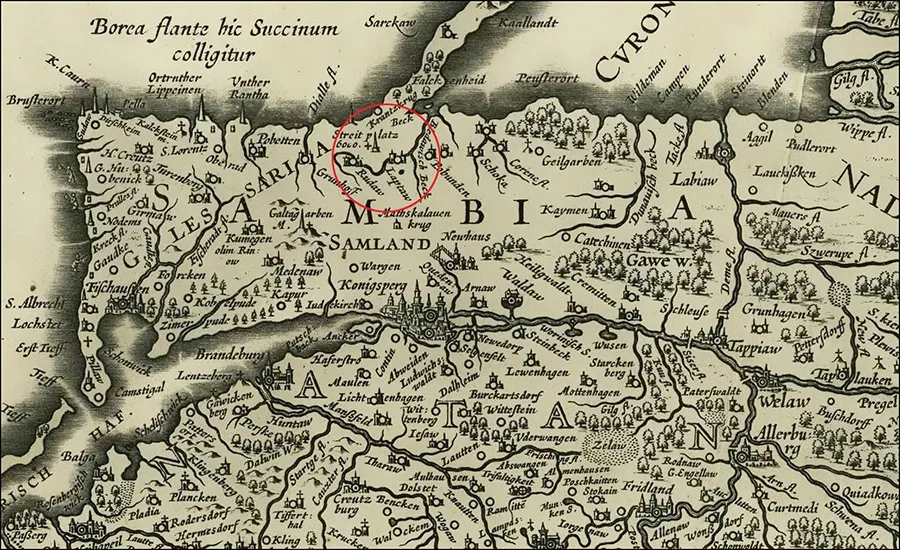 The castles of Rudau and Laptau (marked) on a 1649 map of Prussia.
On 4 February the Grand Master was warned of the danger. Some ten days went into assembling the army and the levies, and the Order's army presumably set out from Quednau towards Rudau on 15 February. The short daylight hours allowed such a huge host to cover no more than 15 km a day, so it took two days to reach Rudau and pitch camp there. Images of knights riding along the road by torchlight or under a full moon are best left to fans of films about princesses, dragons and unicorns: in those days an army stretched out along a road for at least 10–12 kilometres could only move in daylight.
The Battle of Rudau began towards midday on 17 February 1370.
Unfortunately, the course of the battle itself can only be reconstructed with a great many assumptions and conjectures, building on the few details mentioned in the chronicles.
On the left flank of the Order's army, facing the Tatar horsemen, stood the Danish-Estonian cavalry, medium in arms and armour and best suited to this kind of fighting. In the centre, presumably, stood the Order's own troops – knights, knechts and levies – led by Marshal Schindekopf. The right flank (again, presumably) was made up of a composite force of the Order's knights, Prussian secular knights and European knights with their squires and foot soldiers, under the command of Grand Master Winrich von Kniprode.
The battle opened with an attack by the Tatar cavalry, who showered the Estonians with arrows, inflicting almost no losses. Then the entire army of the Order went on the attack. Almost at the very start of the fighting the Tatars wavered under the onslaught of the Danish “Estonians”, and their retreat soon turned into flight. Tatar losses were slight. Rather than give pointless chase, the Estonian corps struck the flank of the central group of the Lithuanian army. Marshal Schindekopf fought bravely in the attack on this, the enemy's strongest position. According to a Livonian chronicler, the Rus' warriors did not waver; they fought steadfastly and almost all of them were killed. It was in this clash that Marshal Schindekopf himself was mortally wounded. An enemy warrior's spear pierced the visor of his helmet and struck him full in the face. According to another version, the marshal had raised his visor himself so that he could command his troops more easily. The marshal's standard-bearer was also struck down. Seeing the banner fall, the Lithuanians and Rus' went over to the offensive, but the banner was raised by Hans Sagan, a shoemaker serving in the levy. The Order's army took heart and attacked the enemy once more.
On the right flank the fighting was no less dramatic. The Lithuanians successfully repulsed the attacks of the composite knightly force. But then Algirdas made an absurd mistake: fearing for the life of his heir Jogaila, he ordered him and his squires to withdraw to the rear. Seeing this, the Lithuanian warriors assumed that the order to retreat had been given; some of them began to fall back, throwing the ranks into utter confusion, which soon became an uncontrolled retreat. Algirdas tried to turn the situation around and led the best-ordered part of his army into the forest, where the Order's main strength – its heavily armoured knights – would find it harder to deploy. But the odds were no longer even: in the forest the remnants of Algirdas's army suffered their final defeat and fled the battlefield.
It should be noted that this brief account of the battle (brief because so little reliable information exists) does not reflect how long it actually lasted. It is known for certain that nothing had yet been decided by midday, that the fighting reached its height somewhere around two or three in the afternoon, and that the battle ended at sunset. The Lithuanian army fled; some of its warriors were scattered across the snow-covered fields of Prussia and died of exposure. Yet during the flight another part of the Lithuanian army even managed to plunder the Order's baggage train. The victors had no strength left for pursuit, and in any case an army made up of heavy and medium cavalry was not suited to a long and effective pursuit of the enemy.
The victory of the Teutonic Order and its allies was indisputable. The Order's army fully accomplished its objective, held the field and suffered lighter losses.
Speaking of losses: estimating the number of those killed on the Order's and the Lithuanian side at Rudau is perhaps the hardest task of all. On the one hand, the chronicles themselves offer us figures for the casualties – in verse, no less:
Up rose the kings Algirdas and Kęstutis, two brothers;
And when they came among the Sambians and plundered them,
Straightway Master Winrich, Marshal Schindekopf
And their preceptors joined together all at once,
And routed them, and, taking many captive, slew
Of those villains fully eleven thousand.
But — oh, horror! — the marshal fell then, like a living lion.
And another poem:
The year one thousand three hundred and seventy
Is famed for the battle at Rudau on the Sunday Exurge quare!
Then fell Schindekopf, the fearless marshal,
Along with many servants, and 200 brethren perished.
But there is no exact count of the Lithuanians and Rus'
Who fled and perished of hunger and cold.
Glory be to the Father and the Son, one with the Holy Spirit!”.
A ratio of 11,000 dead to 200 leaves no doubt that the authors of these lines did not count the Prussian foot soldiers and levies who were killed. The figure of 200 knights, however, is quite realistic, since at the time these lines were written it was confirmed by a list of the fallen brethren by name. It is also known that of the 200 brethren of the Order who died, 26 were officials of various ranks and unit commanders. Besides Marshal Schindekopf, those who laid down their lives at Rudau included the Komtur of Ragnit (now the town of Neman), Burchard von Mansfeld; the Komtur of Rehden, Petzold von Korwitz; and the Komtur of Brandenburg (now the village of Ushakovo), von Hatzigetstein. Among the noble “guests”, according to the chronicler Hermann von Wartberge, three were killed: Arnold of Larett and two other knights whose names are not given. German historians put the total losses at 3,000 warriors, which on the whole fits the statistical ratio of knights to foot soldiers killed quite well.
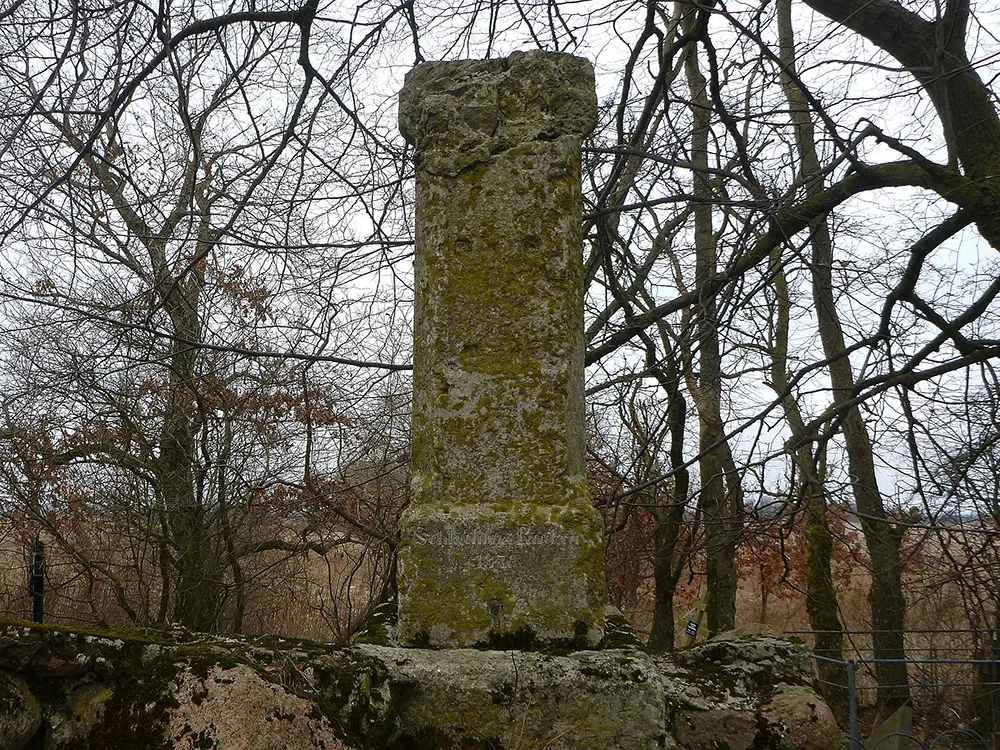 Monument to the Battle of Rudau on the outskirts of Ozerovo (Kaliningrad Region, Zelenogradsk District)
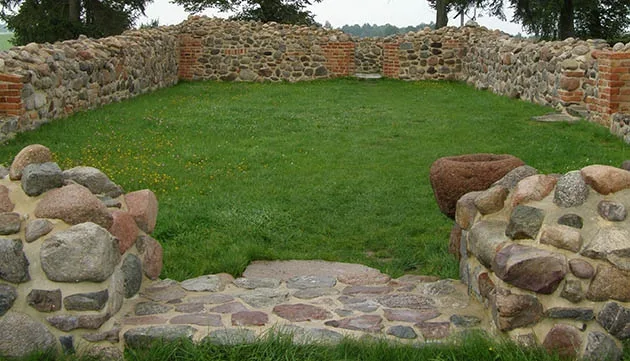
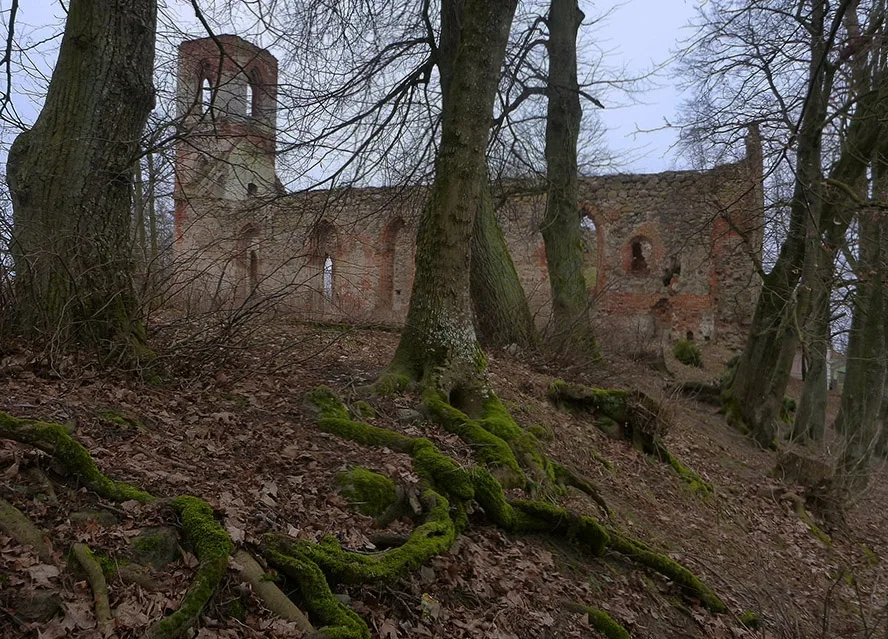 Ruins of the Rudau church (Melnikovo, Zelenogradsk District).
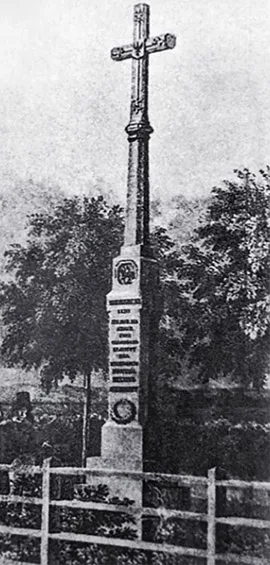
Column with a Cross
The monument to the Battle of Rudau shortly after it was erected.
The Tatar and Rus' dead are the easiest to count. Given that one and the same medieval author says that of the Tatars “almost none perished”, while of the Rus' “almost none survived”, he was surely applying the same yardstick when he used the word “almost”. A combined figure of 4,500 Rus' and Tatar dead therefore looks very close to reality. German historians add the same number of Lithuanian dead, putting the total losses at 9,000. Russian, Lithuanian and Polish historians have traditionally argued for a lower death toll for the Lithuanian army as a whole – about 5,500 warriors. Then again, they also reduce the Order's losses to 1,500, or even to 900 men. In any case, the Lithuanian losses were far greater than those of the Teutonic Order's army, but they were not critical for Lithuania as a whole. As early as the autumn of that same year, 1370, Algirdas raised a new army and launched a series of campaigns against the Principality of Moscow.
Two Heroes
In conclusion, I would like to say a little about two of those who took part in the battle and were undoubtedly its heroes.
Henning Schindekopf was born in Westphalia in 1330. At 17 or 18 he took monastic vows in the Order and became a member of the Königsberg convent4. From 1350 he was Komtur5 of Ragnit. Within the Order he was noted for his courage, his devotion to the cause of spreading Christianity and his knowledge of warfare. That is precisely why, at the age of 22, he was sent to the most dangerous sector of the Teutonic-Lithuanian confrontation. The next step in his career was the post of Komtur of Balga, which Henning took up in 1354. By 1360 he had become Marshal of the Order, which made him one of the six (or, to be entirely precise, one of the three) most influential figures in the Teutonic Order. It was he who was charged with organising the military campaigns against Lithuania discussed above, and it was under his command that the most successful campaigns, and the most devastating for the enemy, were carried out. There is every reason to believe that Henning Schindekopf was the leading candidate for the office of the next Grand Master, since his career followed the typical path of a leader of the Order in the 14th and early 15th centuries. A marshal had died on the battlefield before in the history of the Teutonic State: in 1320 Marshal Heinrich von Plötzke was killed during a campaign against Samogitia. But in 1370 a vast number of people witnessed Marshal Schindekopf receive his mortal wound, which helped make accounts of the marshal's death popular in the documents of the time.
It is fair to assume that the image of the selfless defender of Christians largely took shape after his death. He appears as a hero ready to lay down his life for the common people in a number of medieval texts, after which he was forgotten for a long time. The image of the marshal as a national hero was revived only in the years before the war by the Königsberg poet Agnes Miegel in her ballad “Henning Schindekopf”, although this literary work does contain a couple of historical errors.
Incidentally, the claim that the famous monument in Transsau (today the settlement of Ozerovo) stands on the spot where Marshal Schindekopf was killed is incorrect, as is the commonly published date of his death, 17 February 1370. Henning Schindekopf died the following day, already on the way back to Königsberg, when the Order's army halted at the Matzkallen inn, which later became the Matzkallen estate and is today the southern outskirts of the settlement of Mitino in the Guryevsk urban district. All that remains of the estate today is a former outbuilding, converted into a dwelling and left to fall into a derelict state.
In Königsberg, the street that is now General-Lieutenant Ozerov Street bore Schindekopf's name. For a long time the church in Quednau kept the so-called "armour of Marshal Schindekopf": his helmet, gauntlets and marshal's baton. Their subsequent fate is unknown.
Hans Sagan is the other hero of this battle. All that is known of his life before 1370 is that he was a shoemaker, or perhaps only a shoemaker's apprentice, from Kneiphof. Hans fought among the militiamen in Marshal Schindekopf's corps, and when the Lithuanian counterattack left the commander wounded and the Order's banner fallen, he raised the banner and advanced on the enemy, inspiring the Order's warriors, who in the end won the victory.
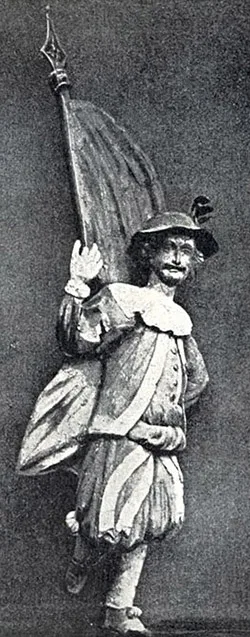
A Folk Hero
The statue of Hans Sagan that adorned a building on Unter-Haberberg in Königsberg (now Bagration Street in Kaliningrad).
This deed brought the hero extraordinary honours. Hans Sagan was knighted by the Grand Master (or even by Emperor Charles IV himself), received the noble particle "von" before his name and became known as Hans von Sagan. Hans declined a cash reward from the Kneiphof municipality, proposing instead that the town authorities hold an annual beer festival for the town's poor at the municipality's expense. The festival was named Schmeckbier, which might be rendered as "Tasty Beer". The festival is mentioned as late as the 16th century, so deep-rooted did the tradition prove to be. Hans Sagan appears in paintings depicting the events at Rudau. In the 17th century a statue of Hans Sagan was erected in Kneiphof. A considerable part of Agnes Miegel's poem “The Battle of Rudau” is also devoted to him. When the Nazis came to power, the statue of Hans Sagan in Königsberg came under harsh criticism, and there was even a saying, "as ugly as Hans Sagan". And although Nazi ideologues generally always exploited the images of German folk heroes, this time, for some reason, they were firmly set against the depiction of Sagan, and the statue was soon destroyed.
Many historians maintain that there never really was a hero-shoemaker, and that the whole story is the product of a popular dream of a shoemaker miraculously turned knight. Of course, this point of view has every right to exist, but we much prefer to picture the finest hour of a simple yet brave man raising the banner of victory in battle against foreign invaders.
_______________________
1. The Teutonic (German) Order is a religious military order founded in 1190 in Palestine during the Crusades. From the 1220s it was based in the Baltic region. It conquered the Prussian lands and established the State of the Teutonic Order on their territory. In 1525 the State of the Teutonic Order was transformed into the secular Duchy of Prussia. The Teutonic Order still exists today as a social and religious organisation.
2. The Livonian Order was a branch of the Teutonic Order, formed in 1237 on the territory of present-day Latvia and Estonia from the knights of the dissolved Order of the Sword Brothers. The Order's capital was Wenden Castle (now in the town of Cēsis, Latvia). It was finally destroyed in 1561 during the Livonian War.
3. Shrovetide Sunday (Myasopust): the Sunday 56 days before Easter.
4. Convent: the knights (brethren) of the Order living in a single castle, and also the collegial body through which they governed the castle. Traditionally a convent consisted of 12 knights headed by a Komtur. Small castles had no convent.
5. Komtur: the head of a Komturei (commandery), the smallest administrative unit of the Order's State. As a rule, a commandery consisted of a castle (sometimes several) and the surrounding territory. The Grand Komtur was an official of the Order who served as the Grand Master's deputy for general affairs.
Translated from Russian with the help of AI (Claude, Anthropic), October 2026.