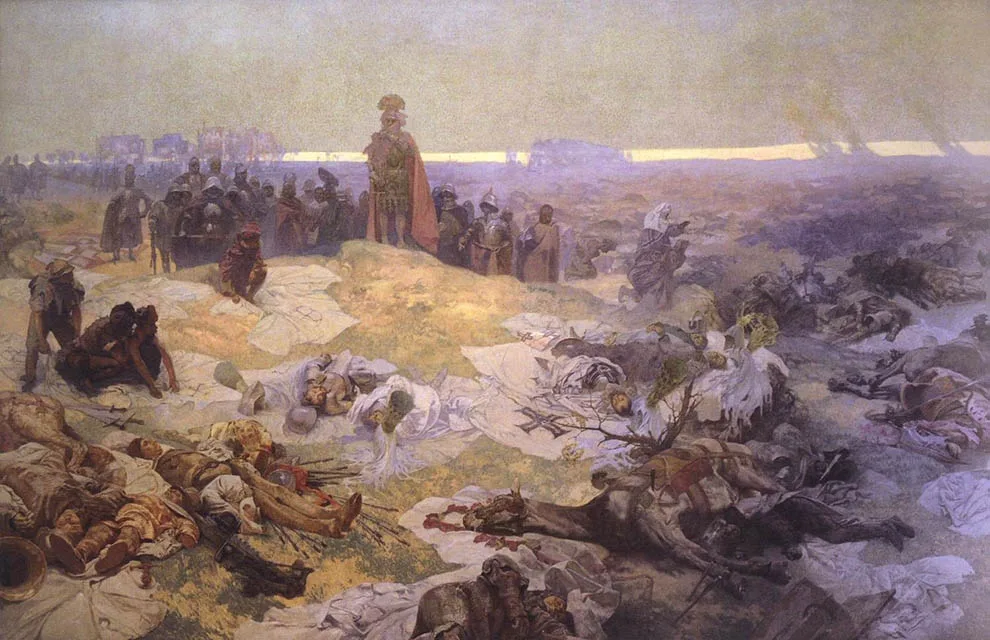
“… in the very first clash the Master, the Marshal and the Komturs of the entire Teutonic Order were slain”
Chronicle of the Conflict of Władysław, King of Poland, with the Crusaders in the Year of Christ 1410.
The battle took place on the territory of the State of the Teutonic Order, in an area lying between the villages of Grünfelde (Grunwald) to the west, Tannenberg to the north-east and Ludwigsdorf to the south, all of which are now in Poland.
The total number of troops who took part in the events of that day is difficult to determine. There are no precise figures, and historians, owing to their national allegiances and political motives, are often far from objective. The Polish-Lithuanian army is believed to have numbered between 20,000 and 27,000 men, the Teutonic army 12,000–19,000.
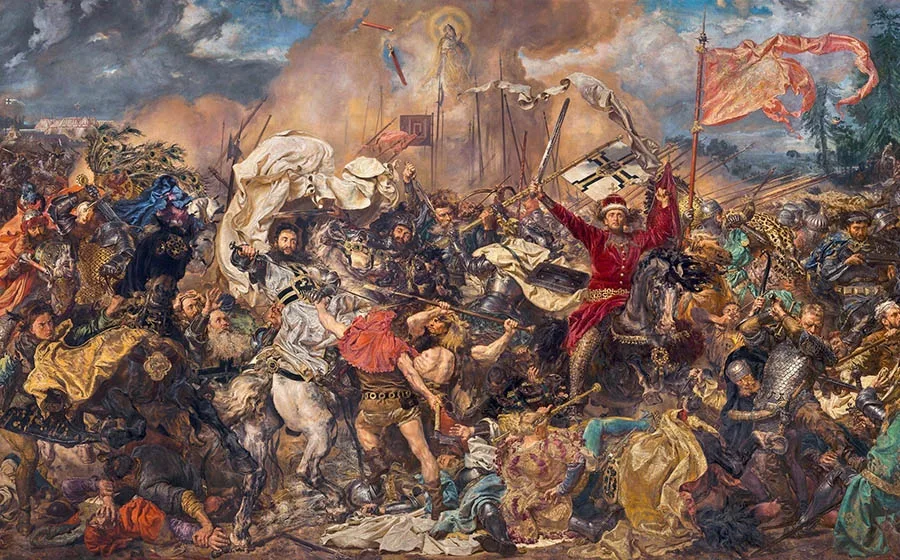
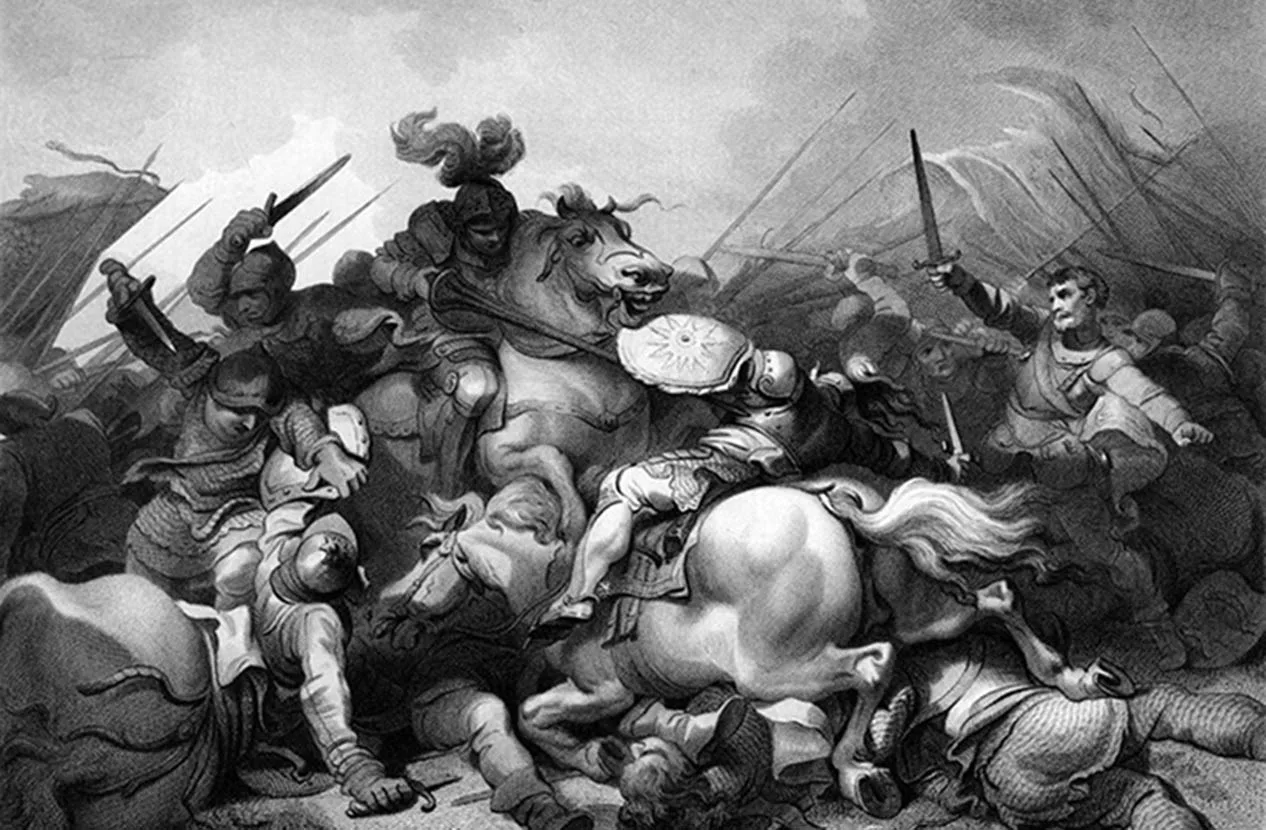
“The Battle of Grunwald”.
The central section of Jan Matejko’s famous painting (1878).
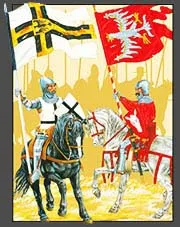
The Great Officers
The Grand Master’s inner council, which carried out administrative and representative functions, consisted of the Grand Commander, the Marshal, the Treasurer, the Trappier and the Hospitaller.
As a result of the battle, most of the Order’s knights were killed or taken prisoner. The Order’s losses were enormous: about a third of the Teutonic army fell on the battlefield, and a considerable number of knights were captured. It is hard to calculate the total number of the fallen, but it is known that more than 200 knights met their death on the field of Grunwald. Among them was virtually the entire leadership of the Order — the Grand Master and almost all of the “Great Officers”, as well as most of the Komturs. The Order had been decapitated.
“... and the Master’s men, and the great dignitaries, and a great many brethren of the Order — all perished.”
Chronicle of Johann von Posilge
A little more about the fallen knights of the Teutonic Order and the circumstances of their deaths.
Grand Master Ulrich von Jungingen fell in the final stage of the battle, after he had committed his reserve cavalry. There is no reliable account of his death: according to some sources, he was killed by a Polish knight, according to others by a Tatar. If the medieval chronicler Jan Długosz is to be believed, the Master received two wounds — one to the face and one to the chest.
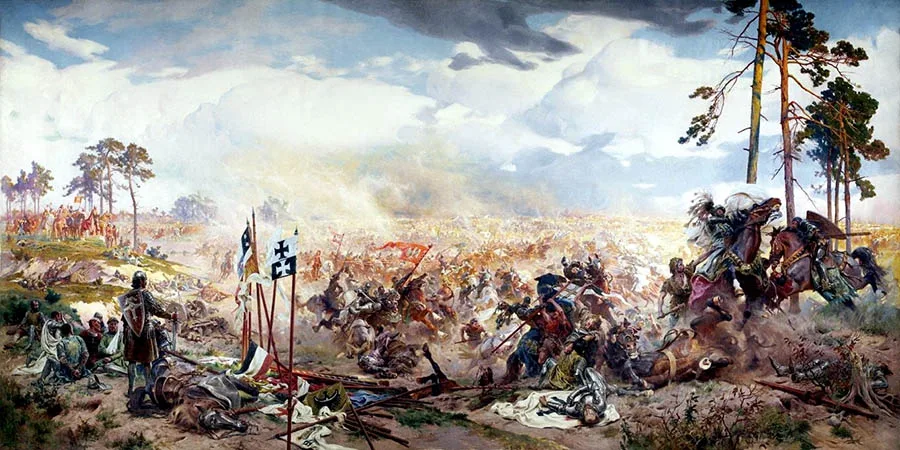
“The Battle of Grunwald”. A painting by the Polish artists Tadeusz Popiel and Zygmunt Rozwadowski (1910), in which they immortalised the moment of the death of the Grand Master of the Teutonic Order (on the right).
After the death of the Grand Master, Grand Commander Kuno von Lichtenstein took command and tried to turn the tide of the battle. He was killed when his troops were encircled by the Polish-Lithuanian forces. In Jan Długosz’s opinion, he was one of the finest swordsmen of the Order.
Komtur
An official who headed an administrative and territorial unit of the Order — a Komturei, or commandery.
Friedrich von Wallenrode, Marshal and Komtur of Königsberg, is believed to have been killed early in the battle, while pursuing the Lithuanians and in the encirclement that followed.
The details of the deaths of the Order’s other officials are, unfortunately, unknown. We can only list them by name.
Treasurer Thomas von Merheim
Trappier and Komtur of Christburg, Count Albrecht von Schwarzburg, cousin of Heinrich von Plauen, who became Master after Jungingen’s death.
Komtur of Althaus Eberhard von Ippenburg
Komtur of Gollub Nikolaus von Röder
Komtur of Graudenz Wilhelm von Helfenstein
Komtur of Mewe Sigmund von Ramungen
Komtur of Nessau Gottfried von Hatzfeld
Komtur of Osterode Gamrat von Pinzenau
Komtur of Papau Wilhelm von Rosenberg
Komtur of Rehden Nikolaus von Melin
Komtur of Strasburg Balduin Stal von Holstein
Komtur of Thorn Count Johann von Sayn
Komtur of Tuchel Heinrich von Schwelborn — killed during the retreat; according to Długosz, the Poles who caught up with him cut off his head.
Komtur of Schönsee Nikolaus von Wiltz
Komtur of Schlochau Arnold von Baden was identified among the corpses on the battlefield and taken, together with the other bodies, to Marienburg (today Malbork in Poland): “The said Arnold of Baden, Komtur of Schlochau, was slain together with a great many knights of his banner and, having been found amid a heap of corpses, was carried to Marienburg for burial.”

A page from Jan Długosz's manuscript Banderia Prutenorum
showing the banner of the Komturei of Schlochau and describing the identification of the Komtur's body.
Vogt
An official who governed on the Order's behalf in its territories, vested with judicial, administrative and fiscal powers.
Komtur of Engelsburg Burkhard von Wobeke
Hauskomtur of Königsberg Hannus von Heydeck
Hauskomtur of Thorn Johann von Merse
Hauskomtur of Elbing Ulrich von Stoffeln
Vogt of Brattian Johann Redern
Vogt of Dirschau Matthias von Bebern
Vogt of Leske Konrad von Kunseck
Vogt of Roggenhausen Friedrich von Wenden
The names of the other knights, sergeants, servants, burghers and mercenaries of the Order who fell in this battle are unknown.
Three of the Order's officials were executed in captivity for their insulting conduct towards Grand Duke Vytautas of Lithuania and his mother. Długosz describes in detail in his work how this came about, though he mentions only Salzbach and Schönburg.
Komtur of Brandenburg Markward von Salzbach
Vogt of Samland Heinrich Schönburg
The Master's Kumpan Jürge Marschalk
Apart from those taken prisoner during the battle, only three of the Order's officials managed to escape: the Komturs of Danzig, Elbing and Balga.
Kumpan
A companion or assistant to the Grand Master. Early in his career in the Order, Ulrich von Jungingen served as Kumpan to Konrad von Wallenrode, first when the latter was Marshal in 1387 and then when he was Master in 1391–1392.
The only one of the "great officers" to survive the battle was the Grand Hospitaller and Komtur of Elbing, Werner von Tettingen. According to the same Długosz, he managed to break out of the encirclement and then rode without stopping all the way to Elbing (today Elbląg in Poland). He retained his office until his death in 1412.
The Komtur of Balga, Count Friedrich von Zollern, directed the defence of the Order's baggage train and camp and succeeded in returning to Marienburg. He later became Grand Komtur. At the same time, some have suggested that von Zollern did not take part in the Battle of Grunwald at all.
The Komtur of Danzig, Johann von Schönfeld, saved himself by flight, but lost all his servants and men in the process. Under Master Heinrich von Plauen he was given the post of Fischmeister (the official in charge of fisheries).
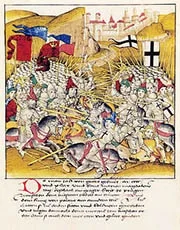
On the day after the battle, Jagiełło ordered the captured Teutonic Knights to search among the fallen for the body of the Grand Master and of any other officials they could identify. As a result, the remains of Ulrich von Jungingen, the Grand Komtur, the Marshal, the Komturs of Thorn and Schlochau and the Vogt of Roggenhausen were identified. Their bodies were taken to Osterode Castle (today Ostróda), and from there, on the fourth day after the battle, they were carried to Marienburg (now Malbork). The Master was buried in St. Anne's Chapel at the castle.
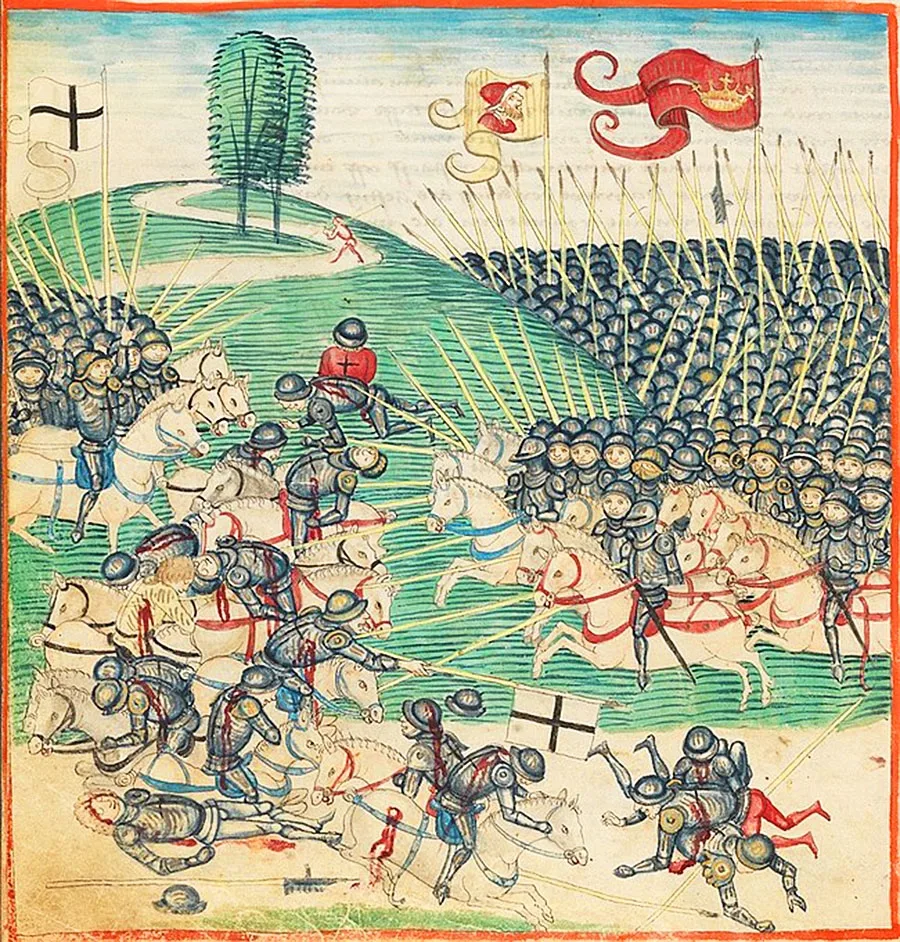
“The Battle of Grunwald”.
Diebold Schilling the Younger, miniature, c. 1515.
That same day Jagiełło wrote to his wife Anna about the battle he had won and the rout of the Teutonic Knights, mentioning those who had fallen:
"The aforesaid Grand Master and Marshal, Schwarzburg, and the Komtur of Elbląg and many other Komturs of the Crusaders were cut down, while the rest were put to flight, and we ourselves set off in pursuit. For two miles they were pursued, and as they fled, great numbers of them drowned in the lakes and rivers that lay along their path, and others were slain, so that very few got away."
And to Bishop Albert of Poznań:
"We destroyed all the enemy's forces and put to the sword the Grand Master himself with the Marshal, the Komturs of Schwarzburg and Elbing, and many other Komturs, those bearded Crusaders."
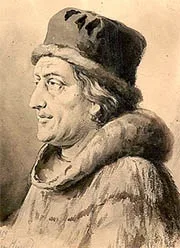
Chronicler
Jan Długosz (Polish: Jan Długosz; 1 December 1415 – 19 May 1480) was a Polish historian and diplomat, a prominent Catholic churchman and the author of the twelve-volume "History of Poland".
The rest of the fallen on both sides were buried on the battlefield itself. By Jagiełło's order, the Komturs and other persons of noble rank were buried in the wooden church at Tannenberg. All the fallen warriors of the Teutonic and Polish-Lithuanian armies were laid to rest in several mass graves beside the church and on the battlefield.
Ten days after the battle, the allied armies reached the Order's capital, Marienburg Castle. The siege came to nothing, and two months later first Vytautas's troops and then Jagiełło's lifted it without ever venturing an assault. On the whole, the outcome of the siege and the salvation of the capital were the achievement of the future Grand Master Heinrich von Plauen, who led the defence of the castle.
In February 1411 a peace treaty was concluded in the town of Thorn (today Toruń, Poland), under which the Order returned all the territories it had previously seized from Poland and Lithuania and paid an indemnity, while Samogitia was confirmed as part of the Grand Duchy of Lithuania. Poland, for its part, undertook to return the Prussian lands to the Order and to release the captured knights.
A papal bull of 1412 concerning the construction of a chapel on the battle site by Master von Plauen states that 18,000 of the fallen (from both sides) had been buried on the field. This chapel, built and consecrated in time for the first anniversary of the battle as the Chapel of the Virgin Mary, stood directly over one of the burial sites of the fallen warriors.
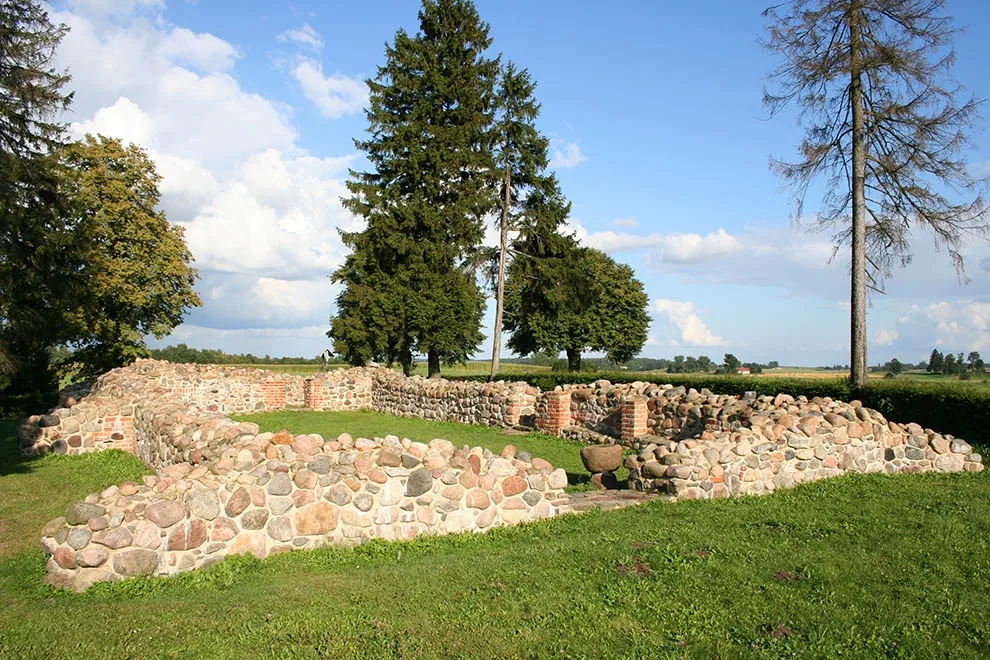
Ruins of the chapel on the Grunwald battlefield.
In 1414 the chapel was burned by the Poles, but it was rebuilt the following year and long remained a place of pilgrimage. The chapel was finally destroyed in the first half of the 18th century.
Today only the foundations of the chapel remain (see photo above); they have been listed as an architectural monument.
In 1901 a memorial stone (see below) was placed next to the chapel at the presumed spot where Master von Jungingen died. The stone still lies in its place today, but turned over with its inscription facing down. It reads: "In the struggle for German existence and German right, Grand Master Ulrich von Jungingen died a hero's death here on 15 July 1410."
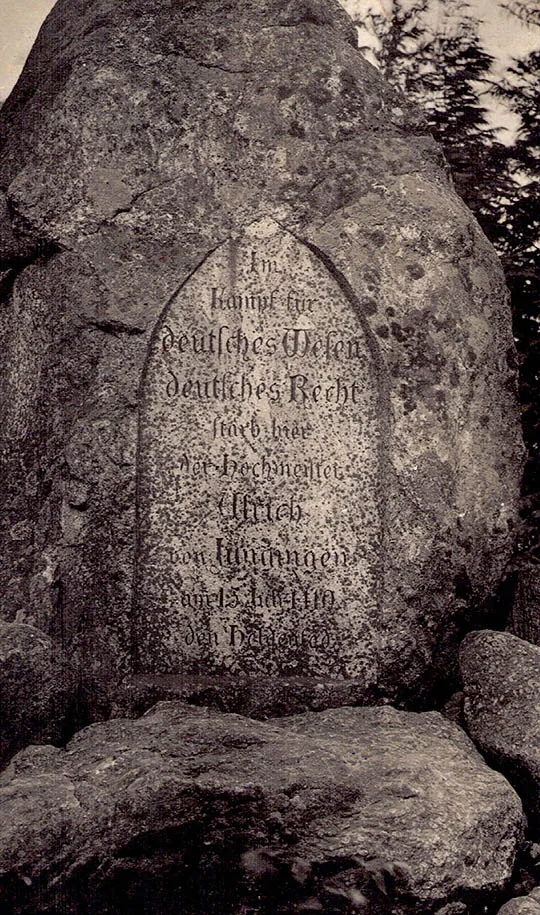
Memorial stone at the presumed spot where Master Ulrich von Jungingen fell.
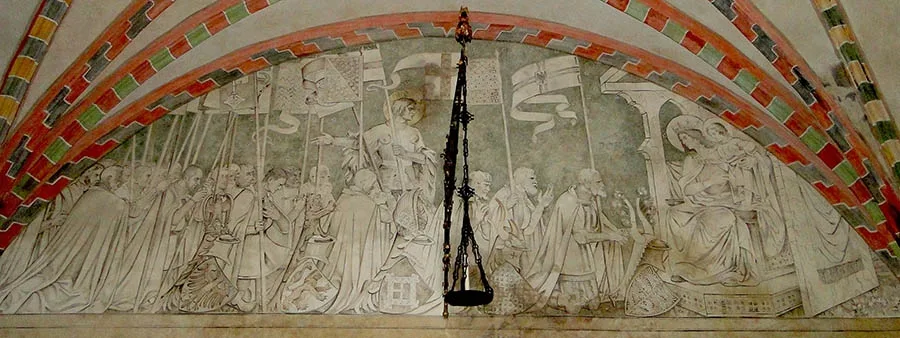
Another artistic depiction of the battle may be seen in the fresco on the west wall of St. Anne's Chapel at Marienburg (see below). In it, Saint George presents to the Virgin Mary the knights of the Order who fell in the battle, led by the Grand Master. The painting is currently being restored.
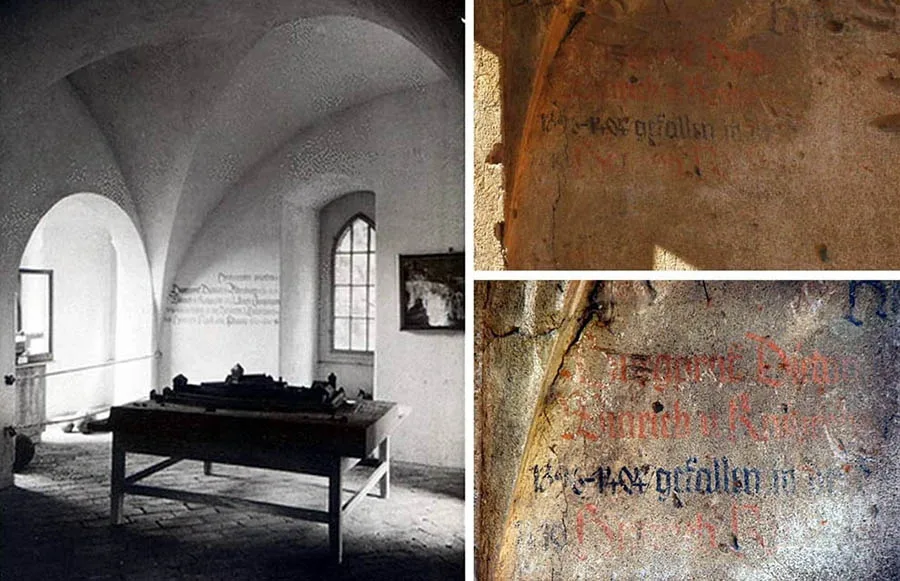
Yet another reminder of the fallen Master, which survived almost to the present day, was to be found at Balga Castle. The walls of one room in the Vorburg were covered (see below) with the names of the castle's Komturs. Ulrich von Jungingen had been one of them (from May 1396 to September 1404). All the Komturs' names were written in red paint, and only von Jungingen's in black, with a note that he had fallen in the Battle of Grunwald.
Episodes from the Battle of Grunwald, notably the deaths and capture of certain knights, are depicted in Jan Matejko's painting "Battle of Grunwald": among them the Grand Master's last fight, the fallen Grand Commander, the capture of the Commander of Brandenburg and the Grand Hospitaller who survived. Other artists, no less renowned, also created works devoted to this epoch-making battle, among them Alphonse Mucha and Wojciech Kossak.
The Battle of Grunwald is regarded as one of the largest battles of medieval Europe, and it marked the beginning of the Teutonic Order's decline.
Translated from Russian with the help of AI (Claude, Anthropic), October 2026.