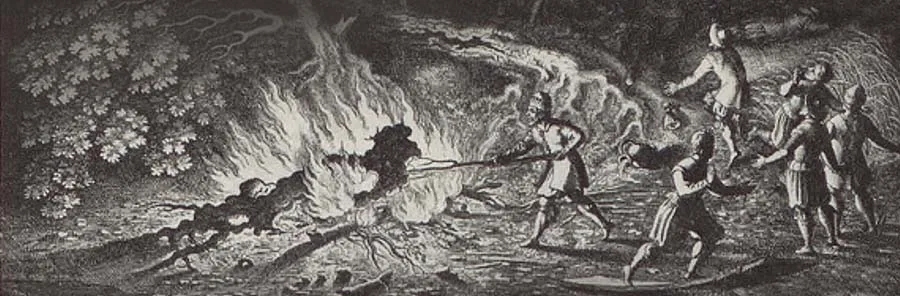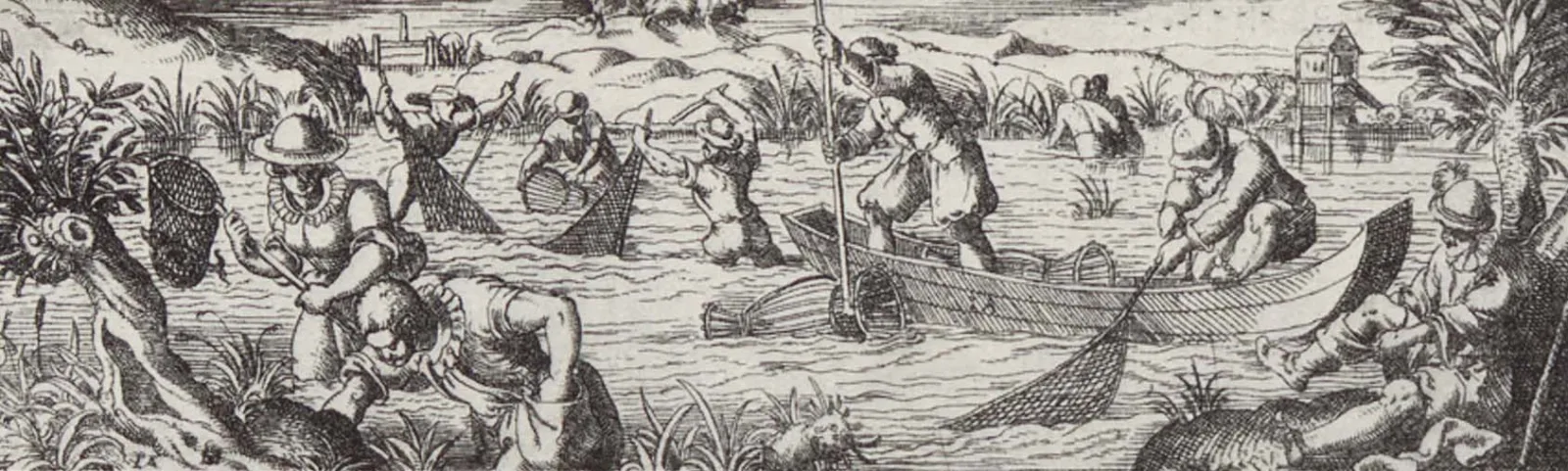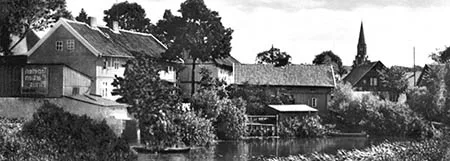
In time, however, the local people grew tired of Schlompetters' wet jokes, and so everyone tried to take another road, giving the pond where he lived a wide berth. The owner of the inn that stood nearby realised that things were going badly: there were fewer customers, and so less income, with every passing day. Having drunk some schnapps for courage, he set off to the pond to have a serious talk with the water sprite. He had nothing to lose: business was going from bad to worse, and it could not get any worse. As soon as the innkeeper reached the bank of the pond, he was doused with mud.
The poor fellow bore it stoically and peered closely into the reeds, where he did indeed see a lad caked in silt with an empty bucket in his hand. "Hey, you," he called to him, "what kind of tomfoolery is this?! I'm your neighbour the innkeeper, and I'll soon be utterly ruined if you keep up these silly pranks."
A melodious voice answered in a friendly way: "Oh, I'm so sorry. I just want to play with people, for I'm still very young... But everyone runs away as if I were wicked and frightening."
"Well, your jokes are a bit rough, Schlompetters. Girls would rather be given presents than be showered with fish guts mixed with mud. And the lads don't want to be drying their clothes every time you take it into your head to play a prank on them, either. They have more interesting things to do."
"Well I never!" exclaimed Schlompetters. "And I thought that you people also liked getting a little wet now and then, since it's so pleasant."
"And why do you pester people at all?" — "Spend just one week here and you'll start playing tricks worse than mine — it's that boring here! Invite me to your festivities so that I can have some fun at least now and then!" — "Agreed, but then you, for your part, won't pester passers-by." — "It's a deal. I'll keep my word, and you keep yours!"
Word of this agreement soon spread throughout the district, and everyone wanted to make the water sprite's acquaintance. Soon afterwards a villager was to have his child christened and was holding a feast with dancing for the occasion. The day before the christening he went to the pond. "Schlompetters!" he shouted. — "Yes!" — "Tomorrow is my child's christening. Come and be my guest!" — "All right, I'll come!"
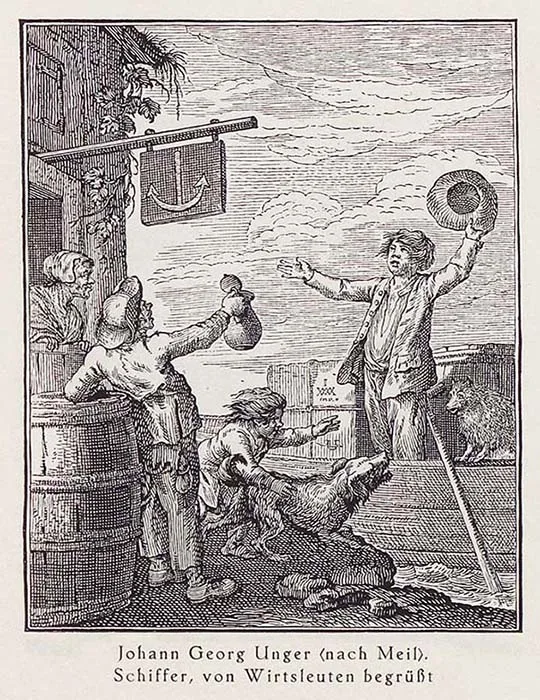
The next day, in the evening, after the church christening, everyone gathered in the house of the child's father. Suddenly the front door opened, and in walked a dashing sailor. He wore wide blue trousers, a dark blue jacket and a sailor's cap jauntily tilted over one ear. Under his arm he carried a big basket of excellent fish of the kind that rarely takes the hook. "Petri Heil!"1 the sailor loudly greeted everyone present, but then he spat discreetly into his handkerchief, since the name of Saint Peter had left a bitter taste on his tongue.
"Here is my present for my godson," he said. Then he turned to the baby, kissed him tenderly on the forehead and said: "Boy, you shall be a fisherman, and none luckier. Your nets will always be full of fish!"
The fiddles struck up, and Schlompetters asked one of the girls to dance. But the village lass dug in her heels: "You splashed me with mud the other day, I won't dance with you."
At this the water sprite would hear no objections, put his arm around the stubborn girl's waist and whirled her into the dance. And he whispered a little rhyme into her ear:
The pond at Algawischken
Is fair as a fairy tale's skies,
And the girl I am kissing
Has just the same eyes.
And then he kissed her, and the girl found the kiss rather too wet, but she liked it, and they began to dance with gusto in the middle of the room. Then other couples followed their example, and between dances Schlompetters would sit down with the men and reel off such infectious jokes that everyone simply doubled up with laughter. His humour was a little coarse, but that was no problem for village men. And anyone who did not know that he was the water sprite from the village pond took him for a jolly sailor just back from a voyage. Never before had there been such a merry christening in all the district.
For many years Schlompetters was a constant guest at every party in the district; not a single celebration took place without him. But one day, when he was invited once again, no one answered, nor did he appear at the appointed hour, and from that day on all calls to the water sprite were in vain. And although ripples still run across the water of the Algawischken pond, no one has heard of Schlompetters or seen him ever again.
TRANSLATOR'S NOTES
1. Petri Heil! (Glory to Peter!) — a traditional old greeting among fishermen, with which they wished their fellows the same luck that attended St Peter when he went fishing with Jesus Christ. The usual reply is the same: Petri Heil! If the catch was good, the answer is Petri Dank! — Thanks be to Peter!
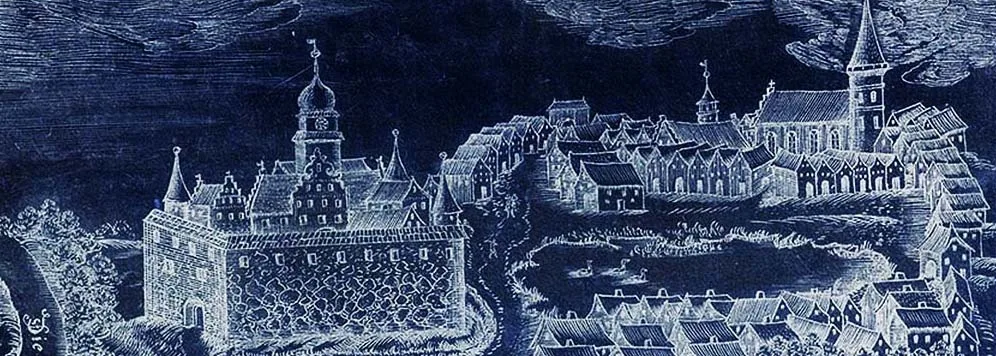
The village of Gross Algawischken (Groß Algawischken, "Great Algawischken") was most probably called simply Algawischken, as in the text of the legend, before Klein Algawischken (Klein Algawischken, "Little Algawischken") arose nearby. In 1946 Gross Algawischken was renamed Gribki. Klein Algawischken was renamed Allgau (Allgau) by the Germans themselves back in 1938, and from 1946 it was Ozerki. Both settlements lay to the west of Kaukehmen (Yasnoye) and have long since sunk into oblivion.
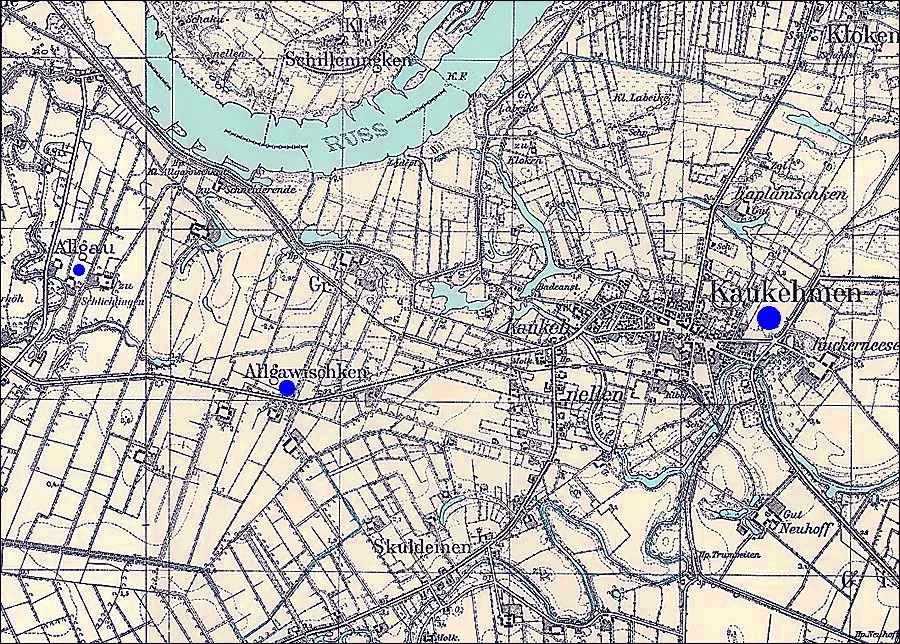
The Niederung district (Niederung, "Lowland") — polder lands in the delta of the Memel (Memel, now the Neman River). In 1938 the name of the district was changed to Elchniederung (Elchniederung, literally "Elk Lowland"). In the local-history vocabulary of Kaliningrad these places are known as the Elk Valley.
SOURCE
"Legends from Mecklenburg-Vorpommern" (Sagen aus Mecklenburg-Vorpommern).
● Editor's note: Read on VisitPrussia.com an interview with the translator of German, and in particular Prussian, fairy tales, our regular contributor Tatyana Kolivay, who runs her own blog, where countless other parables, legends and fairy tales in her translation have been published.
Translated from Russian with the help of AI (Claude, Anthropic), October 2026.