Schultitten has been known since 1405. From 1409 it appears as Scolotiten. After 1771 the name changed to Scholotiten, and then by 1831 to Scholtitten.
At the end of the 1460s the village of Schultitten, with eight Hufen of land, was granted by Grand Master Ludwig von Erlichshausen (1410 or 1415–1467) to the mercenary commander Daniel von Kunheim (1430–1507) as payment for his military services. From 1643 Schultitten belonged to the von Kalckstein family.
In 1785 Schultitten was classified as a noble estate (Adelich Gut) with six households and a Waldhaus (forest house) belonging to it. By 1818 the status of the estate had not changed, and the number of households had risen to nine.
In the second half of the 19th century Schultitten was an estate village (Gutsdorf), which from 1867 formed a Gutsbezirk in the Kreis of Preußisch Eylau (Bagrationovsk). The estate belonged to the parish of Mühlhausen (Gvardeyskoye). The Gutsbezirk also included the Vorwerke of Karlshof (Tambovskoye, part) and Schwellienen (Soldatskoye, part).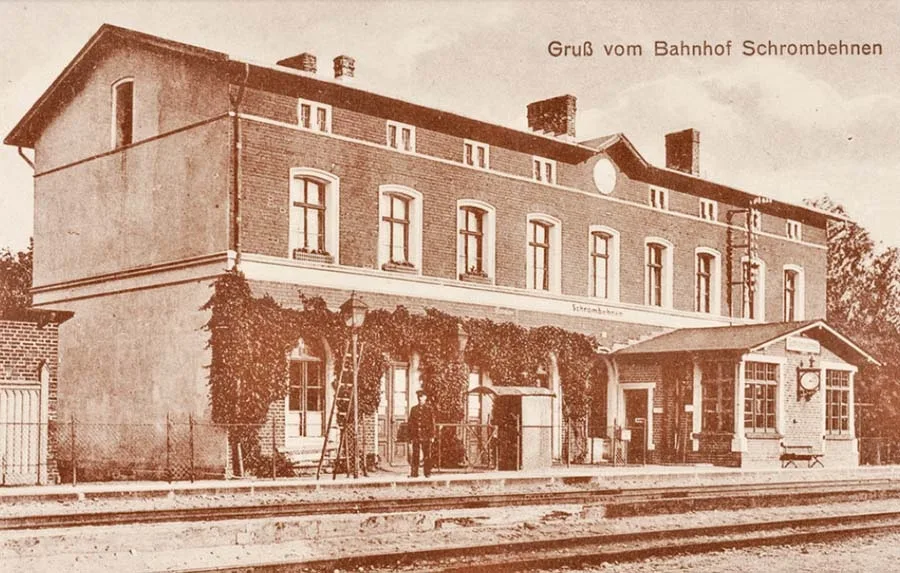 Schrombehnen station.
On 24.09.1866 traffic opened on the East Prussian Southern Railway, on which Schrombehnen station (Moskovskoye) was opened near Schultitten. In 1871 the Gutsbezirk of Schultitten had 16 residential houses, occupied by 50 families.
Of these, the Schultitten estate itself had 10 residential houses, and the Vorwerke of Karlshof (Tambovskoye, part) and Schwellienen (Soldatskoye, part) three houses each. On 07.05.1874 the Gutsbezirk of Schultitten was included in the newly established Amtsbezirk of Groß Lauth (Nevskoye; from 1930 the Amtsbezirk of Schrombehnen, Moskovskoye). The owner of the Schultitten estate, Kalckstein, held the post of head of the Amtsbezirk of Groß Lauth in 1903–30. In 1879 the Gutsbezirk of Schultitten owned 532 ha of land (37th place among the 166 Gutsbezirke of the Kreis), and the estate's annual net profit amounted to 4,968 marks (33rd place in the Kreis).
On 30.09.1928 the Gutsbezirk of Schultitten (without the Karlshof Vorwerk) was converted into a rural community of the same name. The Karlshof Vorwerk became part of the community of Vierzighuben (Tambovskoye). On 01.04.1936 the community of Schultitten lost its independence and was incorporated into the rural community of Schrombehnen (Moskovskoye).
Schrombehnen is first mentioned in 1426 and until 1785 was called Scrumbayn.
In 1785 Schrombehnen was classified as a noble estate and village (Adelich Gut und Dorf) with 19 households. By 1818 the number of households had fallen to 18.
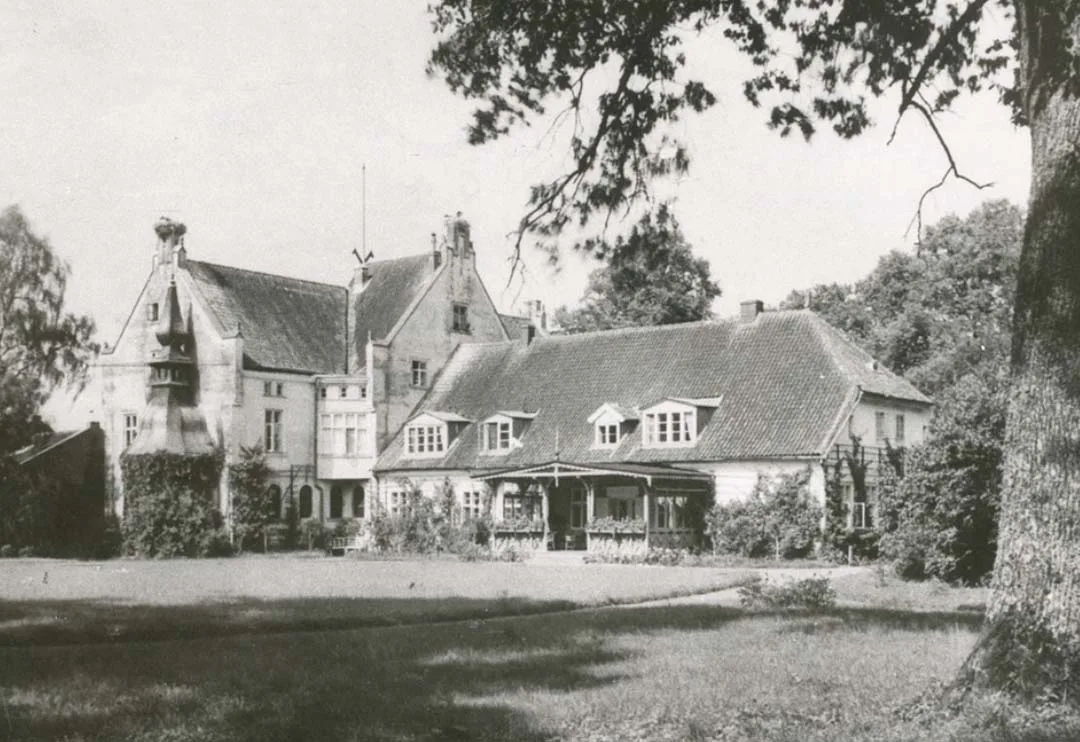
In the second half of the 19th century Schrombehnen was a knightly estate (Rittergut), which from 1867 formed a Gutsbezirk in the Kreis of Preußisch Eylau (Bagrationovsk). The Schrombehnen estate belonged to the parish of Dollstädt (Krasnoznamenskoye). On 24.09.1866 traffic opened on the East Prussian Southern Railway, on which a station was opened near Schrombehnen.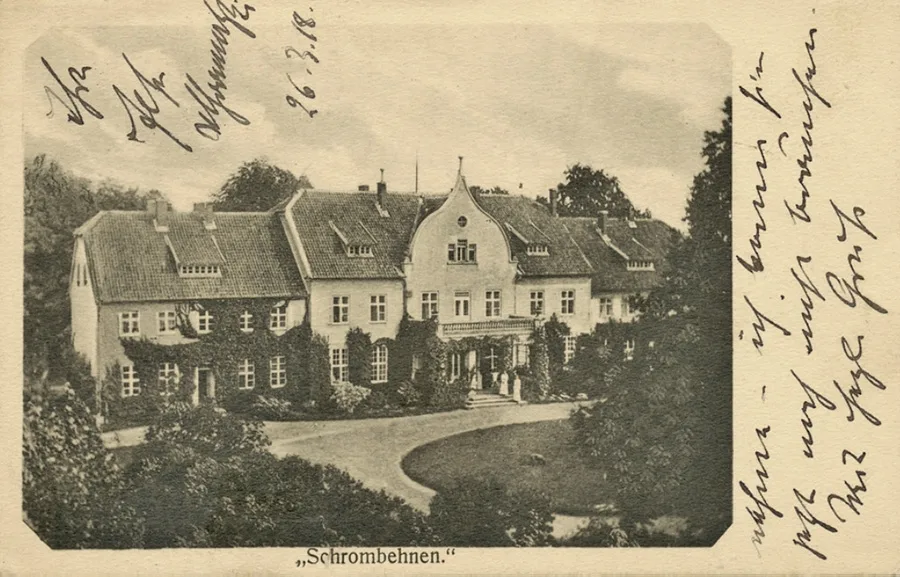 The manor house of the Schrombehnen estate.
As of 1871 the Gutsbezirk of Schrombehnen also included: the village of Schrombehnen (Moskovskoye), the Vorwerke of Bögen (Lineynoye), Ponitt (Turgenevskoye), Panzhof (Muratovo) and Klein Lauth (Sergeyevo), as well as the station and trackmen's houses.
The Gutsbezirk had 28 residential houses, occupied by 81 families and two bachelors. Of these, the Schrombehnen estate itself had nine residential houses, five houses belonged to the village of Schrombehnen, the Vorwerke of Klein Lauth (Sergeyevo) and Bögen (Lineynoye) had three houses each, the Vorwerke of Ponitt (Turgenevskoye) and Panzhof (Muratovo) two houses each, one house belonged to the station, and three houses were trackmen's houses.
In the course of the administrative reform of 1874 the village of Schrombehnen was separated from the Gutsbezirk of Schrombehnen and formed an independent rural community. On 07.05.1874 the rural community of Schrombehnen and the Gutsbezirk of Schrombehnen were included in the newly established Amtsbezirk of Schrombehnen. In 1879 the Gutsbezirk of Schrombehnen owned 1,489 ha of land (7th place among the 116 Gutsbezirke of the Kreis), and the estate's annual net profit amounted to 11,152 marks (6th place in the Kreis).
On 30.09.1928 the Gutsbezirk of Schrombehnen was abolished and incorporated into the rural community of Schrombehnen. The Bögen estate (Lineynoye) did not become part of the community of Schrombehnen; it joined the rural community of Jesau (Yuzhny). Having become part of the rural community, the Schrombehnen estate retained its place name (Gut Schrombehnen). On 14.05.1930 the rural community of Schrombehnen passed to the Amtsbezirk of Groß Lauth (Nevskoye), the Amtsbezirk of Schrombehnen being abolished, and on 28.05.1930 the Amtsbezirk of Groß Lauth was renamed Schrombehnen.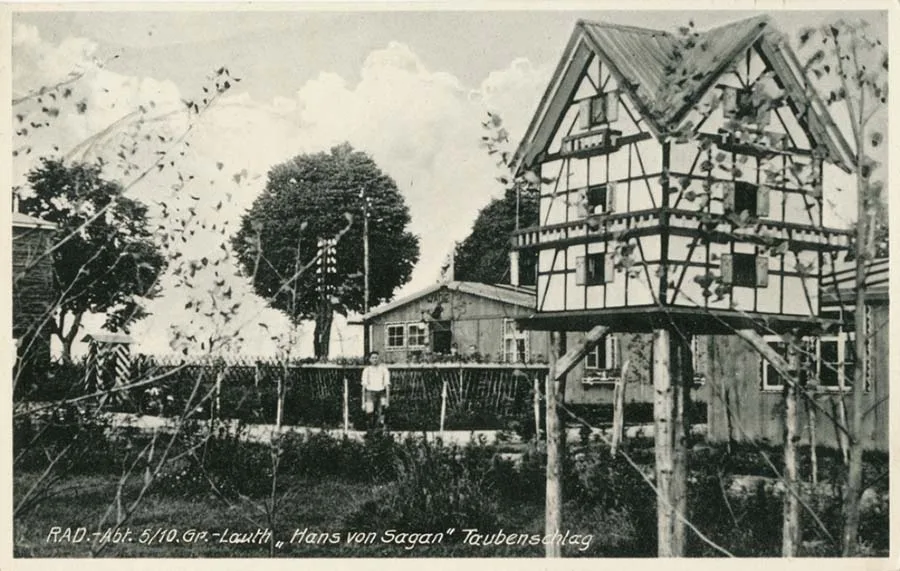 The "Hans von Sagan" dovecote in Groß Lauth.
In 1932 the Schrombehnen estate owned the Vorwerke of Bögen (Lineynoye), Klein Lauth (Sergeyevo) and Panzhof (Muratovo). The farm was a member of the East Prussian Breeding Association. The estate had a sawmill with steam and water engines.
Schrombehnen owned 1,829 ha of land, including 860 ha of arable land, 40 ha of meadows, 200 ha of pasture, 180 ha of forest, 20 ha of wasteland and 25 ha of water. The farm had 140 horses, 300 head of cattle (including 140 cows), 200 sheep and 800 pigs. The estate was owned by Alfred von Gramatzki.
On 01.04.1936 the village of Schultitten (Strelnya, Staroselye), previously an independent rural community, was incorporated into the community of Schrombehnen. In the pre-war years a sawmill and a brickworks operated near Schrombehnen station.
Amtsbezirk Schrombehnen
On 07.05.1874 Amtsbezirk No. 37 Schrombehnen was established in the Kreis of Preußisch Eylau, comprising the rural community of Schrombehnen and the Gutsbezirk of Schrombehnen. On 30.09.1928 the Gutsbezirk of Schrombehnen was abolished and incorporated into the rural community of Schrombehnen (without the Bögen estate (Lineynoye), which became part of the community of Jesau (Yuzhny). On 14.05.1930 the rural community of Schrombehnen passed to the Amtsbezirk of Groß Lauth (Nevskoye), the Amtsbezirk of Schrombehnen being abolished, and on 28.05.1930 the Amtsbezirk of Groß Lauth was renamed Schrombehnen. At the time of the renaming it comprised four rural communities: Lawdt (Nevskoye), Schrombehnen (Strelnya, later Moskovskoye), Schultitten (Strelnya, Staroselye) and Wöterkeim (Nekrasovo). On 06.01.1934 the community of Lawdt was renamed Groß Lauth. On 01.04.1936 the community of Schultitten (Strelnya, Staroselye) lost its independence and was incorporated into the community of Schrombehnen. Thus the Amtsbezirk of Schrombehnen came to consist of three rural communities: Schrombehnen (Strelnya, later Moskovskoye), Groß Lauth (Nevskoye) and Wöterkeim (Nekrasovo); its composition did not change thereafter.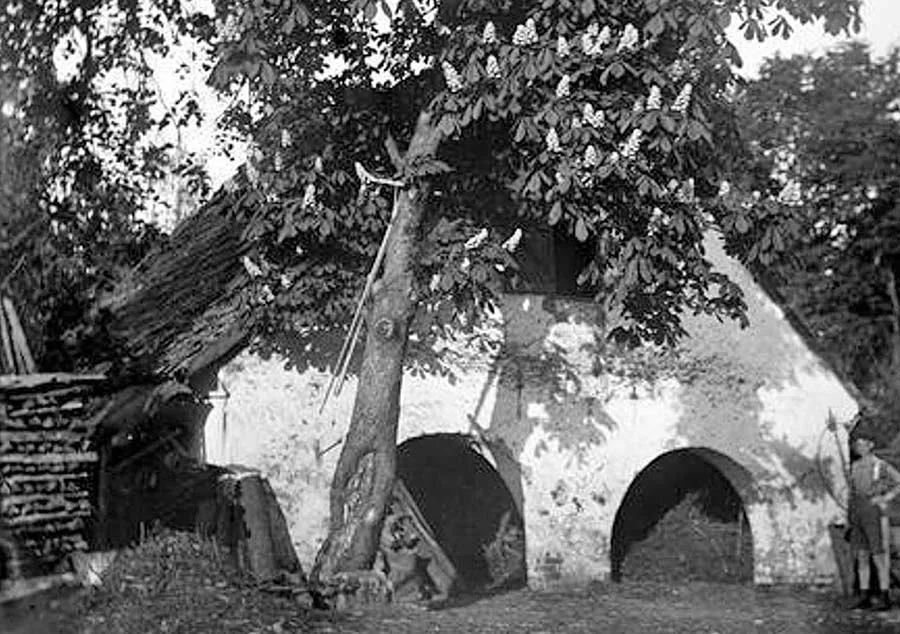 The old smithy in Lawdt.
On 29.01.1945 Schrombehnen was taken by soldiers of the 184th Rifle Division (Major General R.S. Maksutov, 1899–1949) of the 5th Army.
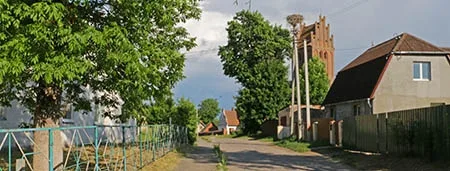
On 17.11.1947 Schultitten, Gut Schrombehnen and Schrombehnen were merged and renamed the settlement of Strelnya. The Schultitten forester's lodge was not officially renamed and became part of the settlement of Strelnya de facto. In 1955 Strelnya had 24 houses and a school. By 1963, 22 houses remained. From the 1970s dacha construction began in the Strelnya area. No later than 1975 the part of Strelnya on the site of former Schrombehnen and Gut Schrombehnen formed the separate settlement of Moskovskoye. At the end of the 1990s the settlement of Staroselye (the central part of the former Schultitten estate) was separated from Strelnya, as opposed to the rest of Strelnya, which became in effect a group of dacha and garden associations. In the 1990s the school in Strelnya was closed. As of 2021 the settlement of Strelnya has about 30 residential houses and public buildings.
Population: 1988 – 60, 2002 – 132, 2010 – 185, 2012 – 190 inhabitants.
Population of the Gutsbezirk of Schultitten: 1818 – 96, 1867 – 262, 1871 – 2601, 1885 – 312, 1905 – 300, 1910 – 295, 1925 – 174 inhabitants.
Population of the village (from 1874 community) of Schrombehnen: 1818 – 175, 1871 – 54, 1885 – 96, 1905 – 1032, 1910 – 84, 1925 – 424, 1933 – 601, 1939 – 635 inhabitants.
Population of the Gutsbezirk of Schrombehnen: 1867 – 442, 1871 – 4643, 1885 – 410, 1905 – 4234, 1910 – 418 inhabitants.
Population of the Schultitten forester's lodge: 1905 – 4 inhabitants.
Population of Waldhaus Schultitten: 1905 – 2 inhabitants.
Population of Schrombehnen station: 1905 – 44 inhabitants.
Composition of the population of the Gutsbezirk of Schultitten in 1871: all 260 Protestant Christians, children under 10 – 62, literate – 146 (of 182 surveyed, 80%), blind – 1.
1 — including 149 in the Schultitten estate, 64 in Karlshof and 37 in Schwellienen.
2 — including 53 in the village of Schrombehnen itself.
3 — including 152 in the Schrombehnen estate itself, 54 in the village of Schrombehnen, 59 in Klein Lauth, 75 in Bögen, 59 in Ponitt, 39 in Panzhof, 15 at the station and 11 in the trackmen's houses.
4 — including 236 in the Schrombehnen estate itself.
Photo: bildarchiv-ostpreussen.de
Translated from Russian with the help of AI (Claude, Anthropic), October 2026.