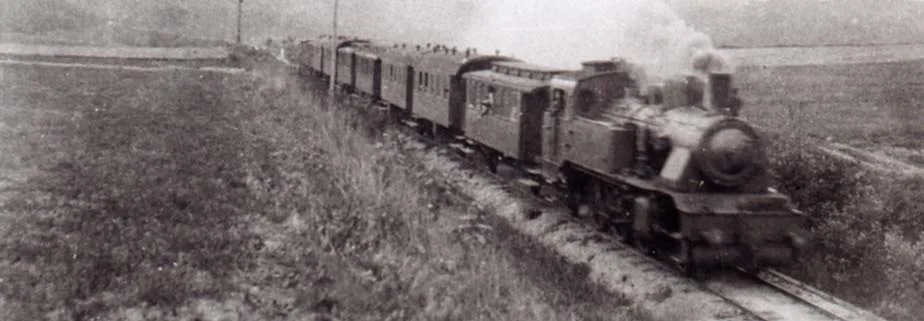
In the shade of the chestnut trees by the station, several old horse-drawn carriages waited for holidaymakers to take them to the summer cottage settlement of Cranz-Westend. There were, however, also those who got off at the station with a large suitcase, to spend a long holiday in Cranz or to take a course of treatment.
Those suffering from anaemia, exhaustion of every kind, scrofula, rheumatism, gout and gynaecological complaints could find healing here in cold and warm sea baths. Cranz had a Kurhaus as well as a sanatorium where patients took baths in potent medicinal mud.
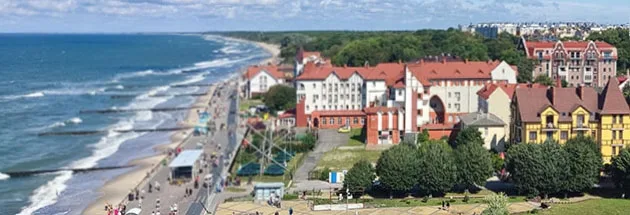
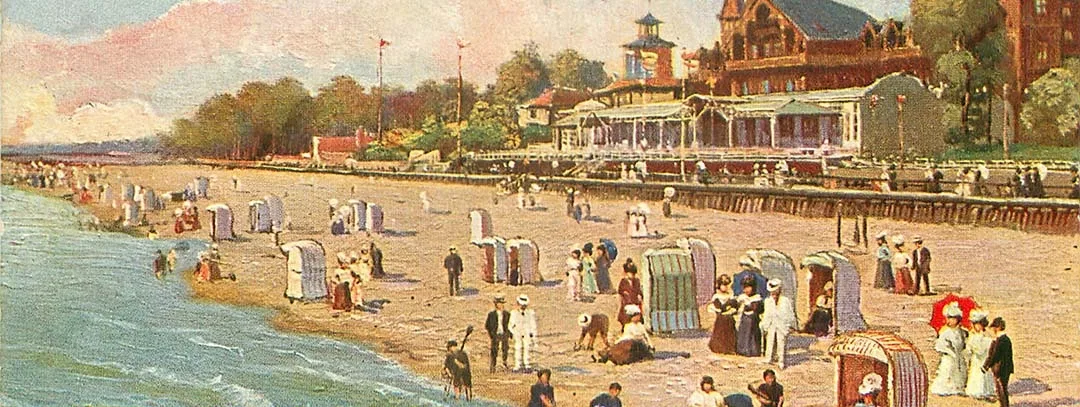
Crowds of young people who came for the day to swim and sunbathe on the white sand walked from the railway station straight to the nearby promenade in search of a good spot on the beach.
Older bathers, who dipped into the sea waves with caution, went to one of the bathing establishments located at the beginning and at the end of the long promenade.
In the middle of the promenade stood the Café Monopol with a wide wooden terrace facing the sea, crowded with tables and chairs that were quickly taken at Kaffeezeit — the afternoon hour when it was customary to have coffee and cakes — wonderful hours of rest in the company of the sea, the wind and the sun!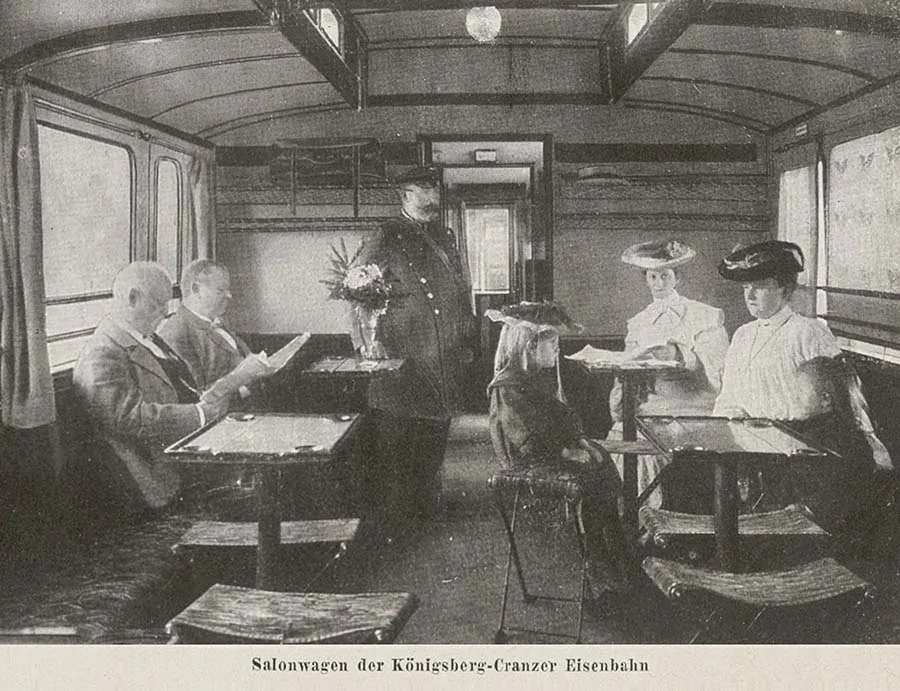 Inside a carriage of the train running between Königsberg and Cranz.
The café windows looked out over the sea and the shore with its countless beach chairs, their sides decorated with colourful pennants. Narrow wooden stairs led from the promenade down to the beach.
 The Cranz promenade. View towards the Curonian Spit.
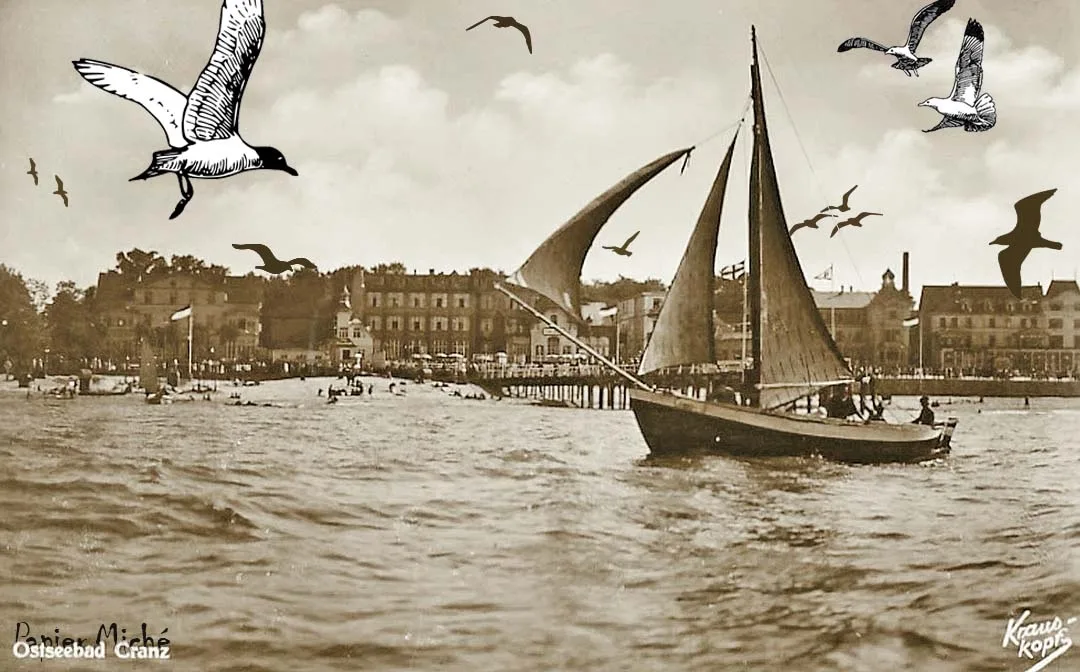
The fishermen of Cranz, leaning on the railings, invited people for a boat trip:
“Well, who else wants to come out with us?! There's a lovely ladies' breeze on the sea today...”
They were men with strong bodies and weather-beaten faces. Having gathered enough passengers, the local fisherman would roll his blue linen trousers above his knees and wade into the gentle surf. Then he took the ladies by the hand one after another and led them along the wooden jetty onto his sailing boat, softly rocking on the waves.
Evening came, the heat gave way to coolness, and the promenade filled with people again, old, young and very young, who strolled up and down admiring the sunset until the red ball of the sun dipped into the sea.
The lively resort life promised everyone afternoon and evening concerts, fireworks, children's festivals, all kinds of open-air performances, dance evenings, and East Prussian folk festivals and celebrations.
For sports enthusiasts there was a large sports ground that met the most modern standards. Six tennis courts not far from the pond and the rowing centre of the German Canoe Association (DKV) were open to all comers. Tennis tournaments, gymnastics classes and sailing regattas were held.
On the way back to the railway station one could always meet fishermen's wives offering fresh, golden-brown smoked flounder. The people of Königsberg would later eat this fish for supper with the hearty appetite they had worked up during a day by the sea.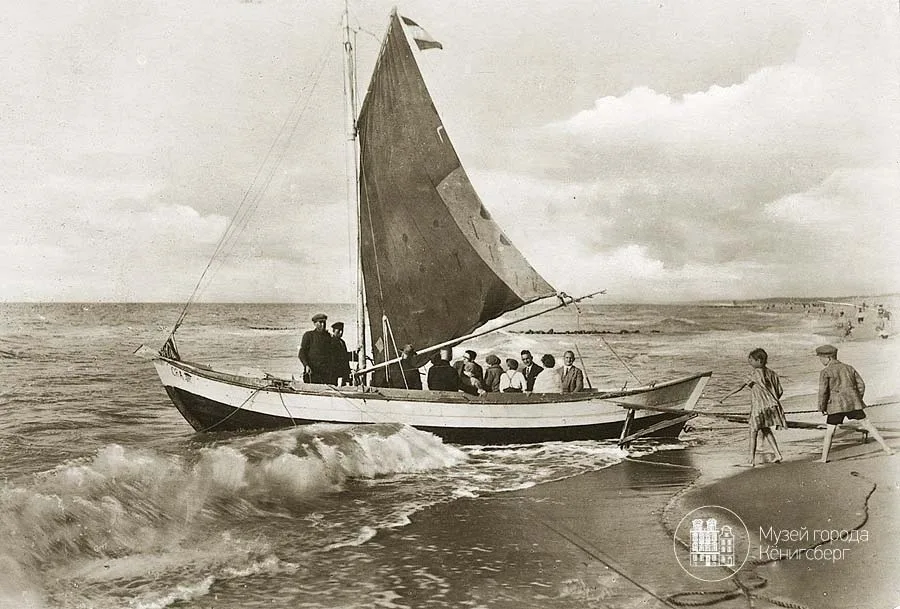 A fishing boat pushes off from the beach, taking holidaymakers out to sea.
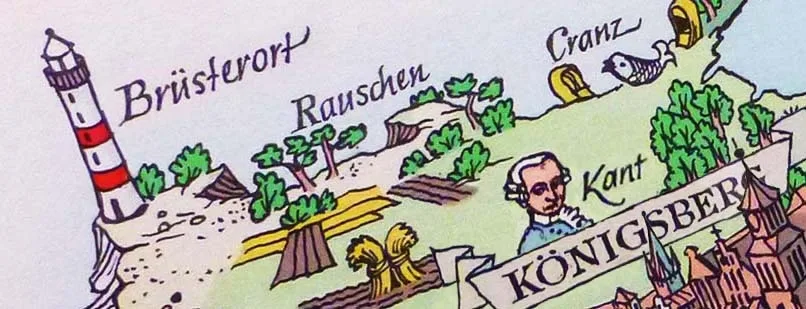
The thought of Rauschen brings to mind images of the beach and the cliffs, the Mill Pond, the spruce forest, the Karlsberg and the Gausup gorge — secluded places full of romantic charm and natural beauty for those who can appreciate it.
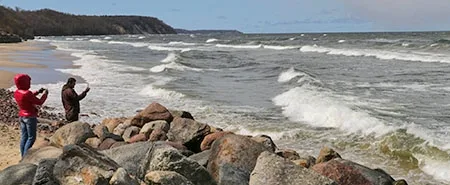
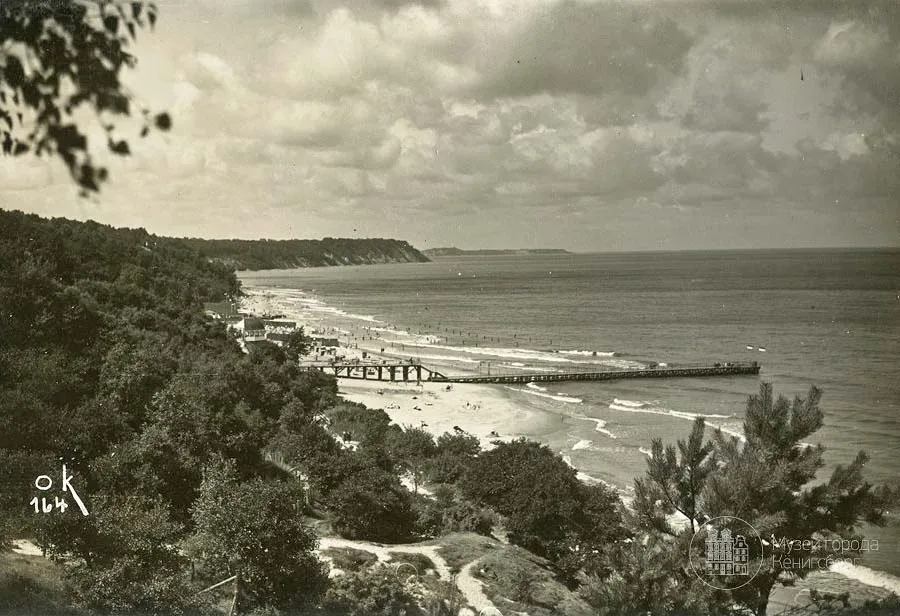 View of the Rauschen beach towards Cape Brüsterort.
Fireworks with illuminated coastal cliffs drew numerous resort guests from Königsberg. The Samland Railway brought holidaymakers in the morning on special trains. Little by little the car parks around the tennis courts filled with cars and motorcycles. People walked down the winding path to the beach or rode up on the funicular and, of course, never missed the chance to look out from the steep cliffs at the sea quietly lapping under the blue sky.
Far to the west, on a thin strip of coast, the Brüsterort lighthouse greeted them in friendly fashion. A military band played on the promenade.
Carefree holidaymakers dressed in summer resort fashion strolled along the promenade. Guests sat in the ever-crowded Seehallen restaurant (“Sea Halls”) — some waiting for the waiter, others already at their meal.
People stood on the pier. Chatting, they leaned over the railings to admire the play of the waves. Elderly ladies and gentlemen, in no hurry at all, rested on the benches of the promenade named after Count Keyserling.
When the sun disappeared below the horizon, the cliff illumination was switched on. Then cries of approval, oohs and aahs rang out from all sides. People stopped to admire the man-made beauty of the landscape. Bright coloured lights swayed in the trees in a wide circle between the Venusspitze and the Fischerweg. One had to give credit to the lighting men who hung these wires with multicoloured bulbs high in the treetops, making dizzying climbs up the steep slopes to do so.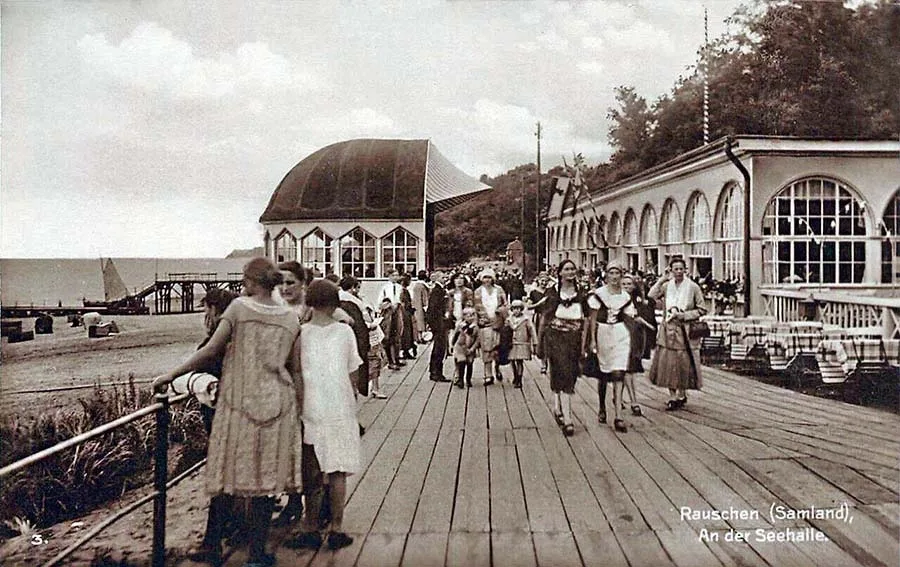 The promenade in Rauschen by the Seehallen restaurant (“Sea Halls”).
A long garland of lights also hung along the whole promenade, and out at sea sailing boats decked with lanterns rocked on the waves, patiently awaiting the climax of the evening — the fireworks.
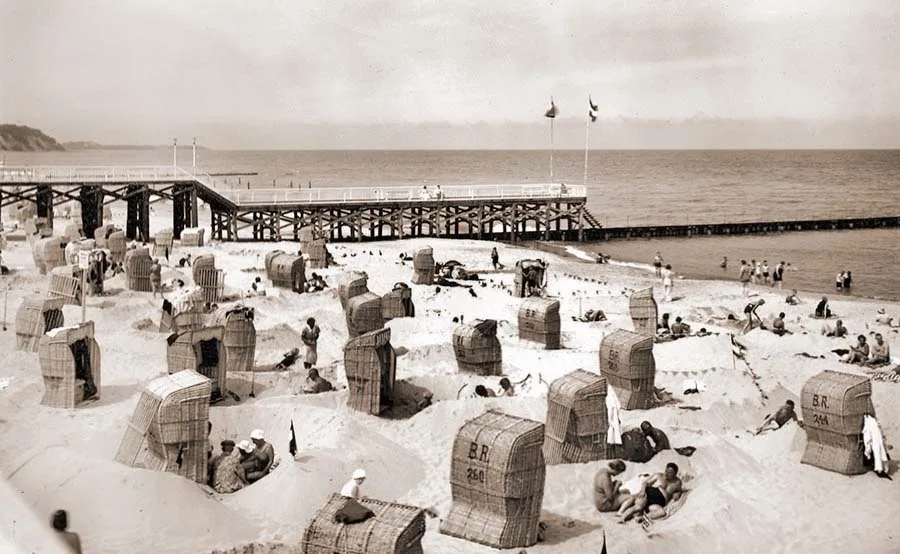 The Rauschen beach is somehow, elusively, different from the Svetlogorsk one...
Gradually people came to a halt, turning towards the top of the Venusspitze, from where the fireworks were to be launched. The lights went out, and soon one could see the lanterns of the pyrotechnicians dancing in the dark on the coastal heights. The first rocket soared into the air, showering the spectators with a huge, colourful rain of stars. Sun wheels, spinning comet tails rushing upwards, waterfalls, golden rain — everything came together to create an unforgettable spectacle.
The finale was the obligatory cannonade, explosions and flashes of fire accompanied by thick smoke. Long applause rewarded the work of the pyrotechnicians.
Unforgettable, too, were the concert evenings in the cosy Larch Park (Lärchenpark). People strolled among the tall, slender larches, gathering at the bandstand and the illuminated fountain to listen to the music and watch the colourful play of the water jets.
During the concert the streams of water danced several metres high, changing colour and shape with a gentle splash, and then, during a pause in the music, shot hissing upwards in a mighty column to the very tops of the trees. In the four corners of the area in front of the pavilion, among the trees and bushes, miniature fountains splashed playfully, just as colourfully lit.
And on the Mill Pond the wonderful “Oriental Nights” were very popular. The lights of the garlands were reflected in long luminous lines on the still surface of the pond. An orchestra played under the lime trees between the sluice and the mill. From time to time the musicians stepped onto a raft and played above the water.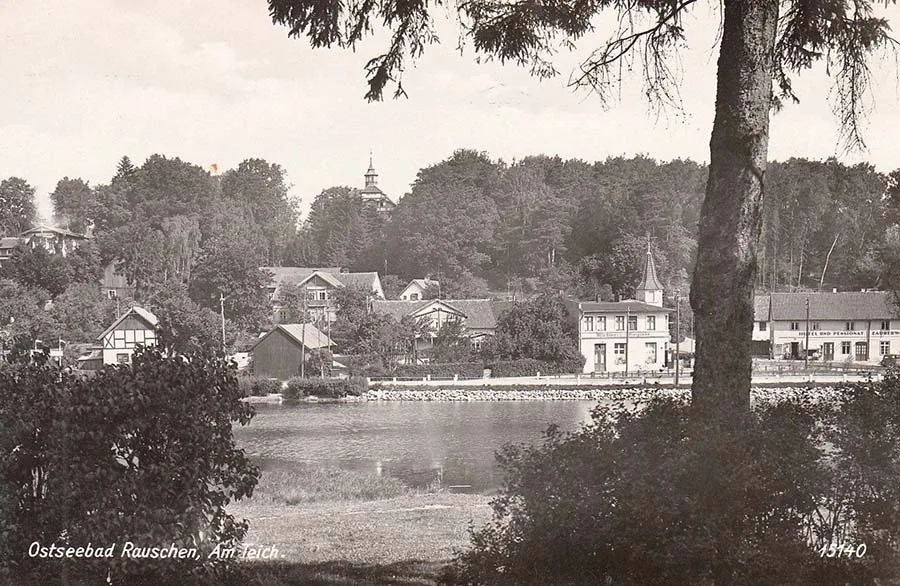 The Mill Pond, renamed Tikhy (Quiet) Pond.
The schoolchildren of Rauschen moved in single file with lanterns and torches through the black spruce forest. Like a swarm of fireflies, they walked along the winding paths past the gloomy-looking “Art Corner” (Kunstwinkel).
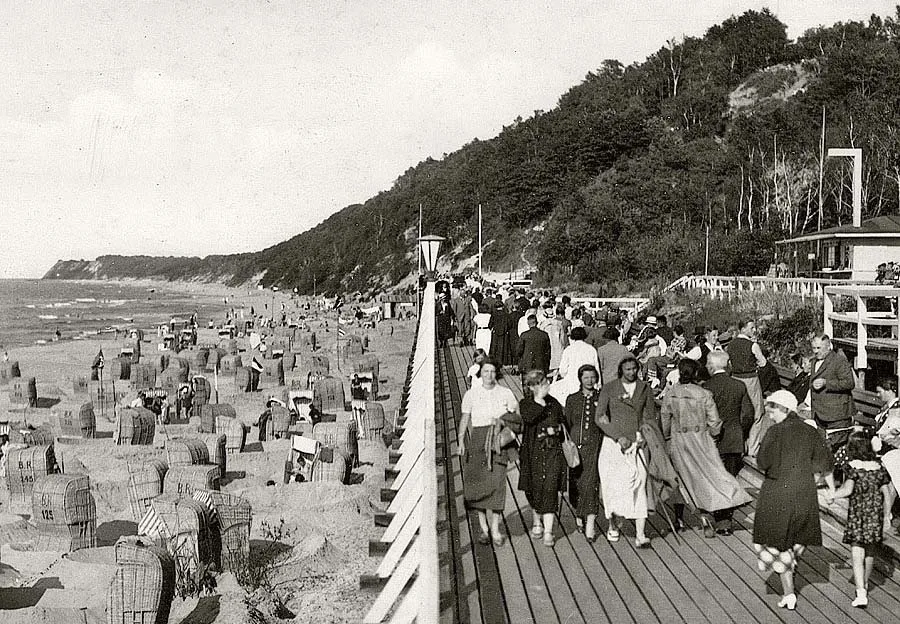 The Rauschen promenade. View towards Neukuhren (Pionersky).
Bengal lights flared red as they burned on the pond — a picture worthy of the tales of the “Thousand and One Nights”.
Fireworks were set off on the open meadow between the toboggan run and the sluice, though not as noisy as those on the beach. The bursting rockets could be seen twice: in the air and as a reflection in the water.
At one point the pyrotechnicians created a realistic copy of a huge stag. The bright yellow glowing outline of this noble animal with its proud branching antlers made a most impressive sight in the illuminated spruce forest. And in 1929, when the round-the-world flight of the “Graf Zeppelin” was on everyone's lips, a luminous image of the airship floated majestically over the same meadow.
All in all, it was not for nothing that the seaside resort of Rauschen was called the “Pearl of Samland”.
The mass departure of holidaymakers after their days by the sea caused general turmoil. Day-trippers hurried to their cars, which then crawled slowly through the streets of the little town, getting stuck in traffic jams. It was no less hectic at the Ort and Düne railway stations, where overcrowded trains departed one after another. People packed into the carriages like sardines, and those of them who had recently got sunburnt were not to be envied.
But every holidaymaker took home the memory of the fragrant summer evenings of Rauschen with their gentle breath of breeze that so refreshed heart and soul.
LEGENDS OF PRUSSIA in the blog of Tatyana Kolivay.
Sources:
Lucie Müller „Mit den Möwen an die See". Preußische Allgemeine Zeitung, Folge 32, 07.08.1976.
Ostpreußen-Warte, Folge 08 vom August 1958.
Collage: Mikhail Ogorodnikov.
Photos: Museum of the City of Königsberg.
Translated from Russian with the help of AI (Claude, Anthropic), October 2026.